PSA: Don’t Kill the Bees

You think people would know better by now.

I’ll keep it short, but it’s not sweet. In fact, it breaks my heart to write this.

I’ll also keep it simple for people who might have trouble understanding the facts of life. Yes, I’m talking about the birds and the bees — mostly the bees.

Why Bees are Important to Protect

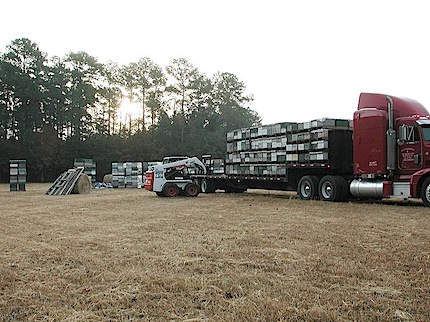
Bees being Moved
This Wikipedia photo by Pollinator shows bees being moved from South Carolina to Maine for blueberry pollination.

The production of food throughout the world relies heavily on pollination, much (if not most) of which is accomplished by bees as they gather pollen and nectar from flowers. Bees are so important for agriculture that it’s common for farmers and orchardists to have bees shipped hundreds of miles to their farms — often at a huge expense — to pollenate crops.

Colony Collapse Disorder

is a phenomenon in which worker bees from a beehive or European honey bee colony abruptly disappear. While such disappearances have occurred throughout the history of apiculture, … the syndrome was renamed colony collapse disorder in late 2006 in conjunction with a drastic rise in the number of disappearances of Western honeybee colonies in North America. European beekeepers observed similar phenomena in Belgium, France, the Netherlands, Greece, Italy, Portugal, and Spain, and initial reports have also come in from Switzerland and Germany, albeit to a lesser degree while the Northern Ireland Assembly received reports of a decline greater than 50%.

In other words, the world’s bees are dying.

I can’t stress how screwed the world would be if we lost the bees. I can’t even imagine it.

What Stupid People Do

Last night, when I returned home from a great day out with my dog and friends, I had an email message from someone responding to a Craig’s List ad I posted about wanting bees. He was reporting a swarm in Malaga. He’d sent the message at about 5:30 PM. It was now 8 PM, but still light.

I called him about it. He said the swarm was on a piece of scrap lumber only 2 feet off the ground on a lot with a home under construction. It had been there more than 24 hours. It was easy to reach and probably easy to catch.

Although I sorely wanted to capture the swarm myself, I didn’t want to drive the 40 miles (each way) to Malaga. So I called my friend, Jim, and told him about it. I gave him the address and even looked up directions on Google Maps. It would only take him about 15 minutes to get there. He was psyched. He said he’d throw on his shoes and try to get them.

I heard back from his wife about an hour later.

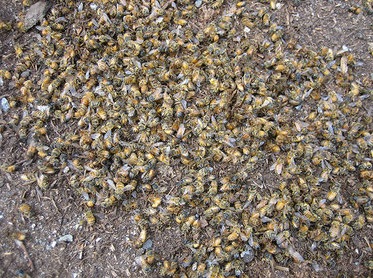
Dead Bees
Dead honey bees.

Jim had found the bees, dead, along with a few cans of Raid.

The bees are dying well enough on their own, but some moron has to go at them with a can of pesticide?

Dozens of beekeepers who live in the area are willing — and eager — to remove a swarm of bees for free, but some idiot has to kill them?

The stupidity of people amazes me.

Don’t Kill the Bees

Please, people, don’t kill the bees.

If you see a swarm, remain calm. Swarming bees are generally not dangerous. They’re just relocating. They’re like you in that big U-Haul truck, parked at a rest stop on the freeway, taking a break.

Call for help.

Your best bet is a beekeeper, if you can find one listed in a local phone book or online for your area. Try Craig’s List; search for “bees” or “swarm.”

The next best bet is the local Humane Society or Animal Control Department of the town or city where you live. They often have contact information for beekeepers.

Next choice: the police, but not 9-1-1. (A bee swarm is not a police emergency.)

Last choice: a pest control company, but with the request that they send someone to remove the bees without killing them. If they won’t do it for free, ask them to find a beekeeper who will. They should have this information handy.

I will concede that if the bees get into the walls of a building or some other place where they can’t be reached, extermination might be necessary. But if you call for help as soon as you see a swarm, you can usually prevent it from getting into that unreachable place and save it.

As the person who contacted me, and my friend Jim tried to do.

Adventures in Beekeeping: Tracking Down Swarms

I accompany friends while they track down three swarms of bees.

James
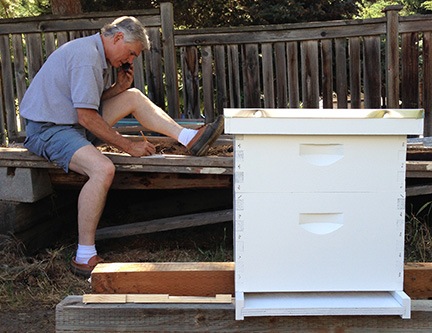
While I was admiring my new beehive, my friend James was on the phone, taking down information about two swarms he might be able to capture.

On the day I set up my hive in a friend’s yard, he got a call from a fellow beekeeper with two leads on swarms that needed capturing. Within 15 minutes, the two of us were heading north on highway 97 to chase them down.

About Bee Swarms

First, you need to understand that a bee swarm is not a dangerous thing. In fact, bees are least likely to bother people when they’re swarming because they don’t have a hive to protect. They’re on the go, looking for a new home. They’re protecting the queen. When they’re hanging out somewhere, they’re resting and waiting for scout bees to return with news about possible hive sites.

Beekeepers love swarms. Why? Well, because they’re free bees.

All a beekeeper needs to do is go to the swarm with a box and some protective gear, sweep the bees and their queen into the box, cover it up, and go. Back at the apiary, dump the bees into a hive body with frames and voila! A new colony, all set to grow and produce honey.

Or, if the beekeeper doesn’t need another colony, he can let the swarm develop into a colony in a nuc box and sell it to someone who needs bees.

Either way, it’s a win.

The Weeping Cherry Swarm

The first swarm sounded like the good one. It had landed in a weeping cherry tree at a home right off the main road. The tree was reportedly only 7 feet tall. That made it a potentially easy capture.

The only problem is, the call had come in earlier in the day. Much earlier.

We arrived at a nice home at the end of a dirt road. The Columbia River drifted past in the form of the Entiat Reservoir. There were lots of trees but no people. My friend, James, went to find the homeowners while I looked for a buzzing weeping cherry tree, not really knowing what such a tree looked like.

He called out to me a while later. He’d found the homeowner. The swarm had moved on a while before. We’d missed it.

The Chimney Swarm

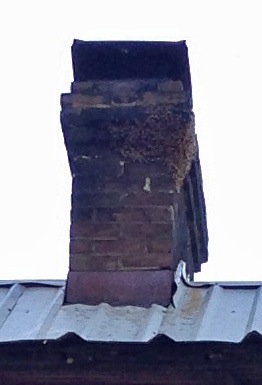
Bees on a Chimney
I know this is a pretty crappy photo, but take my word for it: there’s a partial swarm of bees on this chimney.

The second swarm was reported up by 25-mile creek on Lake Chelan. A quick check of my map app told me it would take 40 minutes to get there. I called the homeowner while James drove.

The swarm had been inside their chimney. When they discovered the bees, the homeowners had lit a fire in the fireplace to get them out. They’d come out of the chimney and were now on the outside of it in a big mass.

It was a two-story log home.

We arrived after a nice drive through the mountains at a home high above Lake Chelan with magnificent views of the lake and the mountains beyond. We met the homeowners and they pointed out the bees. Sure enough, they were gathered on the side of the chimney, high above us.

Throwing a Rope
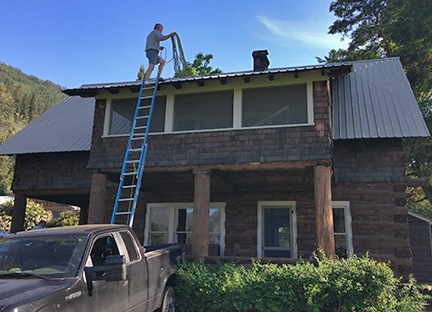
Here’s James at the edge of the roof at the front of the house, trying to throw a rope over the peak.

The roof was steep and metal. James and the homeowner put an extension ladder in the back of the truck. James climbed up. He tried to throw a rope over the peak of the house so it could be held or tied on the opposite side to prevent him from falling off the roof when he climbed. There was no way he could climb to the bees without such protection.

Multiple tries from both sides of the house proved unsuccessful. By this time, James had gotten a good look at the bees and was quite certain that it was only part of the swarm and was likely queenless. Not very valuable and not likely to survive much longer.

James tried walking on the slick metal roof. He couldn’t get any traction. He told the homeowners that he was giving up. I thought it was a good idea. Climbing up that steep roof without a rope to support him would be a great way to get himself hurt or killed.

We left empty-handed again.

The Pump House Swarm

Fast-forward two days. The beekeeping group James and I belong to was meeting for their monthly “bee chat” in Leavenworth. One of the members, Steve, lived in Plain, about 16 miles away. He put out an open invitation for members to visit his apiary. James and I went — he on his motorcycle and me in my Jeep.

Steve’s got six hives and is having some trouble with them — mostly, a queen that has stopped laying. He paints his hive bodies in pretty pastel covers and they look nice in his yard, protected from deer and bears by an electric fence. We visited and he showed us some of his feeders and his solution for winter protection. I learned a lot.

He told us he was going to try to pick up a swarm on his way to Leavenworth and invited us to come along. We did. I was even ready to help if needed — I had my bee equipment in my Jeep after tending to my bees at James’s house earlier in the day.

Inside the Pump House
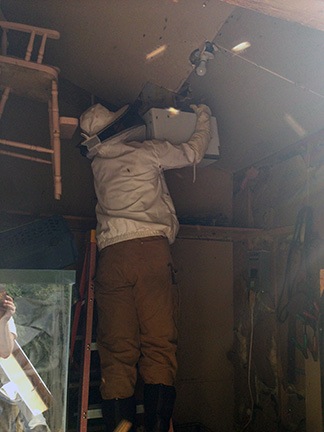
Steve had to scoop bees out of a hole in the building’s ceiling.

The swarm was almost all the way back to Leavenworth. The homeowner met us as we pulled up in our three separate vehicles. The bees, he said, had been hanging around on the outside of the pump house. He pointed to a building near a creek on his property that had bees coming out of the eaves. They’d since moved inside.

Steve went in for a look. James and I peeked, too. There were bees all over the place, but mostly around a big hole in the building’s ceiling.

Steve suited up, grabbed a nuc box with a few frames in it, and went into the building with a ladder. A few minutes later, he was scooping bees out of the ceiling and into the box, hoping to get the queen among the handfuls of bees he moved.

We stayed outside the building. It seemed like the prudent thing to do.

When he was finished, he came outside for a break. He reported that there was something dead in the ceiling. The homeowner said it could be the squirrels who had lived in there and done all the damage.

Outside the Pump House
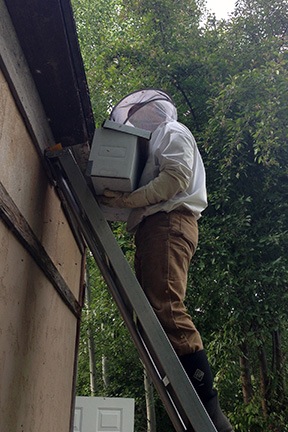
It was easier to gather bees on the outside of the building.

James got a picking ladder and leaned it on the side of the building. Steve climbed up and started scooping bees from the outside of the building into the box. His goal was to get as many bees as he could.

He also examined the bees in the box to see if they were “fanning.” He explained that when the queen was captured, the other bees would use their wings to spread her scent out where the other bees could smell her. The idea was for everyone to come together where the queen was. He saw some evidence of fanning in thx box and none on the side of the building. That was a good thing.

After a while, he’d done just about all he could. He closed up the box, taped the lid down, and put it in the trunk of his car. As he stripped off his bee suit, he told the homeowner to call him if the bees were still there the next day. He’d come back and try to get the rest of them.

One for Three

The score for the three attempts I’d witnessed this past week was one for three. I don’t think it had anything to do with skill, though. I think it was luck. James had bad luck, Steve had slightly better luck.

In watching two successful swarm captures (including the one last year), I’m pretty confident that I could catch a swarm if it was easily accessible — maybe on a 7-foot weeping cherry tree. I hope to get the opportunity to try soon. Wish me luck!

Bees: Filling My Hive

I get some bees and begin caring for them.

I started my beekeeping hobby in June 2013 and have been blogging about it periodically. If you’re interested in reading the other posts in this series, follow the Adventures in Beekeeping tag. Keep in mind that the most recent posts always appear first on this blog.

Hives don’t usually come with bees in them and my hive was no exception. It arrived in a series of big cardboard boxes. Each box contained a hive body and ten frames with foundation. Another box included the base, an inner cover, and an outer cover. All I had to do was stack these in the right order and put bees inside the resulting box and I was in business.

As I discussed in a previous post, I got a line on some bees locally from someone who answered a Craig’s List ad I’d placed. I knew very little about bees and felt weird going to pick them up by myself. Fortunately, my friend James, who kindly lent me some real estate to put my hive at his North Wenatchee home, agreed to come along.

Assembling the Hive

But first I had to assemble my hive.

Although I’d bought a traditional hive with two deep hive bodies and two medium hive bodies, I didn’t need the whole thing. When you establish a colony of bees, you give them enough space for the queen to lay eggs and the workers to tend to the brood and start storing honey and pollen. Then, when they’re almost out of room, you add another hive body with more frames.

It’s like waiting until you’ve almost run out of space in your bookshelf to buy and install another bookshelf.

My Hive
My initial hive setup.

I figured I’d set up a deep hive body for brood and a medium for honey. So that’s what I did. It looked very nice on the hive stand James had thoughtfully provided for me. (I guess he didn’t want me using the palette I’d found and rescued in his backyard. I can’t really blame him.)

I should mention here that I had been regretting my purchase of the two deep hive bodies for some time — since reading the book that came with my beekeeping kit, in fact. I read the book on the flight from Seattle to Phoenix and then from Phoenix to Seattle a few days later. I nearly finished it. In it, the author so strongly recommends that beekeepers buy only 8-frame medium hive bodies that she assumes every reader has done so. And although I have yet to meet a beekeeper who is using 8-frame hive bodies, I know quite a few who are using only medium depth hive bodies. I had decided that I ordered the wrong equipment even before I began using it. And I kept wondering how I was going to make the switch in the future.

That’s what I was thinking about as I assembled my hive and prepared to pick up my bees.

Then James got a phone call about two swarms. I went with him to track them down and (hopefully) capture them. More about that in another post.

Picking Up the Nuc

I was buying a nuc or nucleus colony. As I discussed in a previous post, a nuc is a box of bees with a queen already installed, mated, and laying eggs. It’s basically a very small hive. My Vermont beekeeping friend, Tom, says that this is the best way to get bees because all the bees already know the queen and there’s already brood and honey and pollen stored up.

The nuc was in Dreyden, which is about 15 miles from where my bees would live. After James and I finished chasing down swarms, we headed right to Dreyden. I called the seller, Randy, along the way. He’d meet us at the Shell station, which James knew. I told him what we were driving and he told me what he was driving. It was a typical Craig’s List meet.

We got there first and he pulled up next to us a few minutes later. He was a big guy — think horizontal — in blue denim overalls. He told us to follow him. We crossed the main road and got on a narrow drive. A minute or two later, we were pulling into a yard with lots of grass, a garden, a double-wide mobile home, and lots of parked cars and trucks, some of which looked as if they hadn’t moved in a long while.

A Nuc
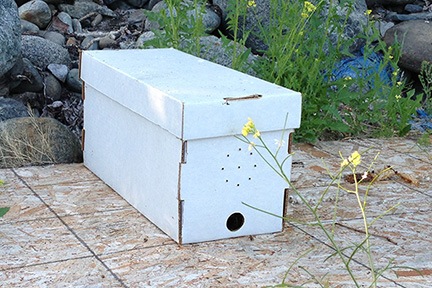
This is actually the nuc I didn’t take. We’d already loaded the other one into James’s truck when I realized I should have gotten a picture.

The nucs — he had two of them — were sitting on a board on the edge of the property. They were wax-coated cardboard, with a round hole in the front for the bees to come and go. Bees were flying in and out of each of them. Not too many, though — it was getting late.

And this is when I was suddenly glad I’d bought deep hive boxes. You see, the nucs use deep frames. If I only had medium frames in my hive, I wouldn’t be able to use the frames in the nuc. That was James’s situation. He wanted to buy the other nuc because he’d lost a queen in one of his hives but he couldn’t because the frames wouldn’t fit in any of his hive bodies.

Randy and James chatted quite a bit. It seemed they’d met before. James used to work for the cable company and had been to Randy’s house up by Blewett Pass. Randy was a nice guy. Very friendly.

Finally, it was time to do business. Randy asked me which one I wanted. I asked him which one was better. He and James agreed that whichever one was heavier probably had more bees. Randy checked them both. He put the round cap in one of them to close off the entrance and lifted it up. He handed it to James and James handed it to me.

I was holding a 15-20 pound cardboard box containing 5,000 to 10,000 live bees.

Cool.

We tucked the box in the back of James’s truck. I gave Randy a $100 bill. We shook hands. He told me to call him if I had any problems at all. Then we drove back down to Wenatchee.

Putting the Bees in the Hive

Back at James’s house, his neighbor’s son, Seth, came out to greet us. When he realized we had new bees, he asked if he could help.

“Suit up,” James told him.

Seems that Seth, who was maybe 10 or 12 years old, was really into bees. Even though his mom wouldn’t let him get any, she did let him get a bee suit and James let him help out. That was fine with me.

I unwrapped my brand new bee suit and pulled it on over my jeans and tee shirt. I put on the pith helmet and arranged the veil over it. Then I tried to zip the veil to the suit. I couldn’t do it. Neither could James. Neither could Seth — although he told me he had a lot of trouble with his, too. So I just let the veil hang over the neck of my suit and hope that the bees couldn’t find their way in. I put on the long gloves, grabbed my hive tool, and, feeling pretty silly, looked at James and our helper and asked, “Do we need smoke?”

Smoke calms the bees. I had a smoker, but I hadn’t used that either. James told me I wouldn’t need smoke. That was okay with me.

I carried the nuc box into the yard where my empty hive was waiting. James told me to take off the top box because I wouldn’t need it. Just the bottom box to get started. I pulled it off and set it aside. Then I pulled five empty frames out of the middle of the bottom box and set them aside. The five frames in the nuc would go into their places.

The moment of truth had arrived. I took the lid off the nuc box.

There were a lot of bees in there. They didn’t seem too interested in me. The tops of the frames were dirty and they were filled with thick comb. And dark brown goo.

James used my hive tool to scrape off a piece of burr comb on top that was filled with honey. “Your first harvest,” he said, handing me the comb.

I set it aside. I’d suck the honey out later.

Using my hive tool, I tried to pry one of the frames loose from the box. Bees create something called propolis — a dark brown goo — which is like a glue they use to seal up cracks. It’s the main reason a hive tool is necessary. I began prying up one side of a frame and tried to get the other.

The bees didn’t like that. A bunch of them came out and started swarming around my veiled head.

I tried again, but the bees were stressing me.

“Do you want some smoke?” James asked.

“If you think it would help,” I replied.

He and Seth left to get a smoker going. While they were gone, I just stood around, holding my hive tool in one hand, while bees swarmed all around me. I didn’t move my head much; I was afraid they’d find the gap between the veil and my suit and get inside. I was very happy to see them coming back about 5 minutes later. They puffed smoke into the nuc. It seemed to have some affect on the bees. Or maybe on me. I calmed down and got back to work.

One by one I removed the frames from the nuc. I didn’t really look at them, although I suppose I should have. I just wanted to get the job done. It was late and the light was fading.

I got all the frames from the nuc into the space in the hive body, making sure to put them in the same orientation and order so as not to confuse the queen.

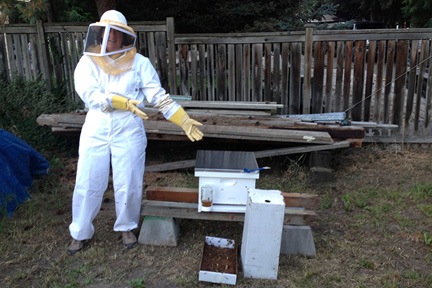
Me and my Beehive
Here I am with my beehive. The nuc box and its cover are nearby so the bees remaining in/on them can find their way into the hive. The sugar water looks brown because I use unbleached sugar.

There were lots of bees still in the otherwise empty nuc box and clinging to the box cover. James said to leave them; the bees would find their way into the hive overnight. That was fine with me. Finished, I put the inner and outer covers on my now occupied hive.

One thing left to do: fill the feeder. I’d prepared a 1:1 sugar:water mixture in advance in a jar. I fit the lid of the feeder on the jar, inverted it, and slipped it into one side of the entrance.

I was done.

I posed for a picture, then went back to the truck. I stripped out of my bee suit and my companions did the same. After a bunch of goodbyes, I left. It was just getting dark.

The tiny bit of honey in that burr comb was good.

Two More Visits

I visited the bees — mostly to feed them — on each of the following days.

On Wednesday, I arrived after my meeting with surveyors, lunch, and a lot of divorce bullshit that I wrote about in another blog post. My main reason to visit was to give the bees more sugar water. I got my veil zipped onto my bee suit. I also got my smoker going — although I really didn’t need it. I didn’t need to open the hive. All I needed to do was take the lid off the feeder jar, refill it, and then put it back in place. Bees were coming in and out of the entrance. All looked good.

The bees were mostly out of the nuc box. I shook the last few out and used my hive tool to scrape away the propolis and wax on it. Back at my RV, I’d put the five frames I’d removed into the nuc box for safekeeping. I now had a good place to put a swarm if I had the opportunity to catch one.

On Thursday, I arrived after spending too much time at Hooked On Toys, getting a fishing rod set up for salmon fishing. (Too bad salmon season doesn’t start until July 1!) I’d brought enough sugar water to keep them for two days. This time, I wore the suit — call me a coward — but skipped the smoke.

I didn’t visit them at all on Friday. North Wenatchee is 40 miles from where I’m living right now. Those bees are going to have to learn to fend for themselves. I can’t visit them every day.

I’ll likely visit again this weekend, though, to give them more sugar water. I’ll also use that opportunity to inspect the hive and hopefully add another deep hive body and frames. Later, I’ll add a queen excluder and honey super. I don’t expect to harvest any honey this year — the bees will need it all to get through the winter — but I’m eager to give them what they need to keep the colony growing.

More in another post. Stay tuned!

Bees: Finding Residents for My Hive

A beehive isn’t much good without bees inside it.

I started my beekeeping hobby in June 2013 and have been blogging about it periodically. If you’re interested in reading the other posts in this series, follow the Adventures in Beekeeping tag. Keep in mind that the most recent posts always appear first on this blog.

Now that I’d finally made the plunge into this new hobby, I couldn’t wait to get started. But the equipment was only part of what I needed. I’d also need bees.

I had a problem there. Most people who buy bees do so in the spring. I was planning to start in June, after the big pollen season had ended. Although the beekeepers I spoke to seemed to think that it wasn’t too late to start, most agreed that I probably wouldn’t be able to collect any honey the first year. The bees would need it for the winter.

That was okay with me. I just wanted to get started and get a feel for it. Honey could come later.

But where to get the bees? Most mail order sources simply did not ship bees anytime other than spring. I’d have to find another source.

How You Get Bees

Of course, before I could get bees, I had to learn about the options for getting them. There are different ways to get them.

  • A Package. The most common way to get bees is in a package. They arrive in a box with the queen inside a special container called a queen cage. You literally dump the bees from the box into the top of your hive. Then you place the queen cage where the other bees can eat away a “candy” stopper that’s holding her in. She moves into the hive with the others and they go right to work.
  • A Nucleus Colony or Nuc. This is a box of bees with a queen already installed, mated, and laying eggs. It’s basically a very small hive. Most nucs are 5 frames in a single box. You take five frames out of your lowest hive body and put the five frames from the nuc into their place. The bees then go about their business, building on the additional frames you provide in the hive bodies. My Vermont beekeeping friend says that this is the best way to get bees.
  • A Split. Some skilled and knowledgable beekeepers can split one colony into two by manipulating the frames so that the queen and a bunch of bees go into a new hive body. The remaining bees in the original hive body are suddenly queenless so they make a new queen. Of course, you need a beehive to split it. You can learn more about splitting hives in this video.
  • A Swarm. When bees get too cramped in their living space, they move out in a swarm. Swarms are relatively common in May and June. Beekeepers who can catch them basically get free bees. (Heck, some people are even willing to pay beekeepers to take the bees away!) I watched a swarm get caught last May. This is the cheapest way to get bees and it’s surprisingly easy if you have the right equipment and the swarm is within reach.

Although I would have loved to have gotten a swarm — and not because I’m cheap — I was hoping to get a nuc. The trick was to find one.

Craig’s List to the Rescue!

A fellow member of the North Central Washington Beekeepers Association (NCWBA) knew I was looking for bees and immediately began to help. He forwarded me some Craig’s List ads for nucs available in the Spokane area.

Spokane is about 140 miles from where I’m currently living and nearly 180 miles from where my bees would live. Needless to say, I wasn’t terribly excited about driving 360 miles in one day to get bees.

But if I had to, I would.

There was no real rush. At first, I was waiting for my equipment to arrive. It did — the day before I had to go back to Arizona for some personal business. I simply didn’t have time to set up a hive and get bees all in one day. It would have to wait until my return.

In the meantime, I placed my own Craig’s List ad:

New Beekeeper Wants Bees (Wenatchee area)

New beekeeper seeks bees for hive. Healthy nuc or swarm or split. Yes, I know it’s a little late in the season to start, but it isn’t TOO late. Can you help?

Also interested in coming along to observe/assist swarm removal in area, even if I can’t have the bees.

I was in Arizona when I got a response:

hi my name is randy I have 2 five frame nucs I want 100.00 each you can call me at 470 XXXX for info

Thus began an email exchange with questions and answers about the nuc. They were 5-frame nucs with queens that were laying eggs. The queen was a Carniolan — a breed known for gentleness. The frames were quickly filling with comb, brood, honey, and pollen. They needed to be put in a hive soon.

The best thing about it: it was in Dryden, less than 15 miles from where the bees would be living in my new hive.

I made an appointment to meet with him and pick up the bees late one afternoon when I returned to Washington. More on that in another blog post.

Bees: Choosing and Buying Equipment

I consider and order my first hive and related equipment.

I started my beekeeping hobby in June 2013 and have been blogging about it periodically. If you’re interested in reading the other posts in this series, follow the Adventures in Beekeeping tag. Keep in mind that the most recent posts always appear first on this blog.

Once I’d decided to move forward with beekeeping, it was time to buy equipment. Unfortunately, there were many options to choose from. Without going into an in-depth discussion of how bees live and thrive — I’ll let you read up in the books like I did — I’ll go through my equipment choices and explain why making decisions isn’t so straightforward.

Deep vs. Medium Hive Bodies

My Hive
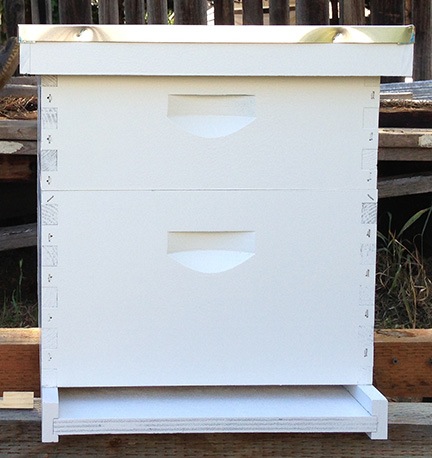
This simple beehive consists of five parts (top to bottom): telescoping cover (with aluminum roof), inner cover (not visible), medium hive body, deep hive body, hive base (with entrance for bees).

A hive body is the box that contains the bees. A bee hive consists of one or more hive bodies, each filled with vertically hung frames.

In general, beekeepers — and I hesitate to say “most beekeepers” because I really don’t know — use so-called deep hive bodies at the bottom of the hive and medium hive bodies at the top. A deep hive body holds frames that are 9-5/8 inches tall; a medium hive body holds frames that are 6-5/8 inches tall.

From my research, I learned that the benefit of medium hive body over deep hive body is weight; consult the table for details. It’s for this reason that medium hive bodies are usually used at the top of the hive for “honey supers.”

Hive Body Weights

This table, created with data from “Beehives, A Guide to Choosing the Right Size Boxes,” shows the difference in weight for a hive body full of honey at each standard size.

 10-frame8-frame
Deep80 lbs64 lbs
Medium50 lbs40 lbs

Seems like a no-brainer, right? Get all medium hive bodies so I can more easily lift them when necessary. The trouble is, the queen bee seems to prefer laying eggs in deep hive bodies. So there’s a possibility that a hive consisting of just medium hive bodies might not be as productive as one with deep hive bodies.

I consulted my friend in Vermont, who has been doing this for years. He recommended deep hive bodies at the bottom and medium hive bodies at the top. The “traditional” way.

10-Frame vs. 8-Frame Hive Bodies

Hive bodies can also hold either 10 frames (the traditional size) or 8 frames. Again, the main difference between these sizes is weight; consult the table.

Another no-brainer, right? Well, the way I saw it, the larger boxes would give the hive more room to grow so I’d have to add hive bodies less often to prevent swarming. Giving the bees more horizontal space would also eliminate the need to give them more vertical space — I wouldn’t be building bee towers. That’s the way I saw it, anyway.

Wood vs. Plastic

Hive boxes and frames are available in wood or plastic. The plastic boxes seemed to have more insulating properties for the winter, but all the beekeepers I talked to scoffed at the idea of using anything but wood.

Assembled vs. Unassembled

Hive bodies and frames come assembled or unassembled. They also come painted or unpainted. Frames come assembled or unassembled. Coated or uncoated. With foundation or without foundation. You can save money by buying hive components unassembled and putting them together yourself and then painting them or coating them with wax (as necessary). (You can also build your own bee hives from scratch, but I certainly didn’t want to go there.)

This was definitely a no-brainer for me. I’d buy them fully assembled and painted/coated.

Other Hive Parts

I’d also need some additional parts to each hive:

  • Frames. This is where the bees build their honeycombs, rear their brood, and store honey and pollen. They hang vertically in the hive bodies and usually include a wax-coated foundation on which the bees can build. There are a lot of frame foundation choices, but I think it’s best to start with whatever is standard.
  • Inner and outer covers. This protects the bees from the elements. Because each hive body is open on top and bottom, the top one must be covered.
  • Bottom board. This provides a base for the hive and an entrance for the bees. A reducer enables you to adjust the size of the opening.
  • Hive stand. This is a platform to keep the beehive off the ground. Most people build makeshift hive stands out of cinderblocks and scrap wood, although you can buy fancier ones.
  • Queen excluder. This keeps the queen from moving up into the part of the hive that’s reserved for honey storage.
  • Mite screen. This helps control varroa mites. (That’s a whole discussion in itself.)
  • Feeder. When you first get your bees, you have to feed them a 1:1 sugar water solution to keep them going until they can find their own source of food. You do this with a feeder. My vermont friend recommended an entrance feeder, although I’ll likely need to switch to a top feeder in the winter time.

The Importance of Sticking to Standards

Over and over, in every beekeeping information resource I consulted, the importance of standards was stressed. It’s pretty simple: you want your equipment to follow standards because you will be mixing and matching pieces down the road.

Some of the books also mentioned that standards aren’t always followed to the letter. They suggested finding one source of equipment and sticking to it. This would ensure uniformity so all the pieces fit together properly.

Sure, there are lots of pretty beehives out there, designed for gardens or patios or even inside an urban home. They’re more for show than for actual bee rearing. They usually don’t have standard parts so they’re not very practical if you’re serious about beekeeping.

Other Equipment

The hives are the homes for the bees. But other equipment is also necessary to keep bees. I had to get that, too.

  • Bee suit, gloves, hat, and veil. These items protect me from the bees themselves. I don’t think I’m allergic to bee stings, but who wants to take chances?
  • Smoker. Beekeepers use cool smoke to calm bees. I’d need a smoker for each time I opened the hive and manipulated the frames.
  • Hive tool. This is a specialized metal tool used to pry frames apart, scrape away accumulated propolis and wax, and work with the hive components.

Placing My Order

Although my Vermont friend had suggested Betterbee as an online source of beekeeping equipment, the local beekeeping group I joined suggested Mann Lake. They said Mann Lake had quick turnaround time and free shipping for orders over $100. I went with Mann Lake.

I had a choice of placing my order piecemeal (a la carte, so to speak) or ordering a kit. If I ordered a kit, I could order a complete beekeeping kit, which included everything I needed (other than the bees), or just a hive kit, which included a complete hive and still required me to order the other things I needed.

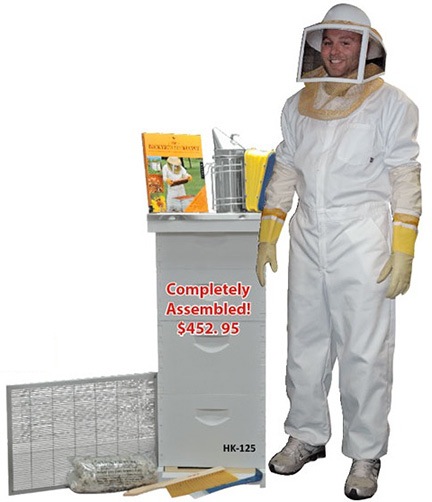
The Bee Kit
This is the bee kit I ordered. (No, it didn’t come with the guy.)

With so many choices to make, I decided to keep it super simple and order the Deluxe Traditional Starter Kit, which included four 10-frame hive bodies (two deep and two medium), 4 frames (in appropriate sizes, inner and outer cover, bottom board with reducer, bee suit with zip-on veil, hat, gloves, queen excluder, smoker, smoker fuel, hive tool, bee brush, and a book titled The Backyard Beekeeper. I also ordered an entrance feeder and a drawer-style varroa screen.

Now that I’d finally made the plunge into this new hobby, I couldn’t wait to get started. More on that in another post.