Bees: Choosing and Buying Equipment

I consider and order my first hive and related equipment.

I started my beekeeping hobby in June 2013 and have been blogging about it periodically. If you’re interested in reading the other posts in this series, follow the Adventures in Beekeeping tag. Keep in mind that the most recent posts always appear first on this blog.

Once I’d decided to move forward with beekeeping, it was time to buy equipment. Unfortunately, there were many options to choose from. Without going into an in-depth discussion of how bees live and thrive — I’ll let you read up in the books like I did — I’ll go through my equipment choices and explain why making decisions isn’t so straightforward.

Deep vs. Medium Hive Bodies
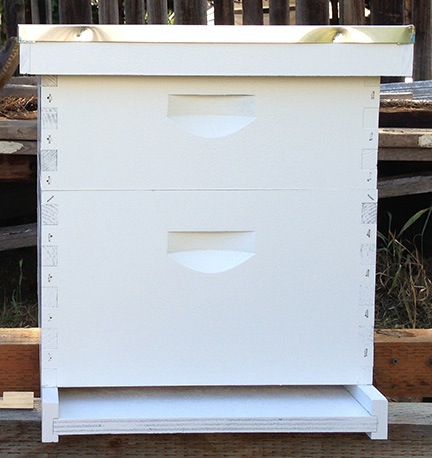
My Hive
This simple beehive consists of five parts (top to bottom): telescoping cover (with aluminum roof), inner cover (not visible), medium hive body, deep hive body, hive base (with entrance for bees).

A hive body is the box that contains the bees. A bee hive consists of one or more hive bodies, each filled with vertically hung frames.

In general, beekeepers — and I hesitate to say “most beekeepers” because I really don’t know — use so-called deep hive bodies at the bottom of the hive and medium hive bodies at the top. A deep hive body holds frames that are 9-5/8 inches tall; a medium hive body holds frames that are 6-5/8 inches tall.

From my research, I learned that the benefit of medium hive body over deep hive body is weight; consult the table for details. It’s for this reason that medium hive bodies are usually used at the top of the hive for “honey supers.”

Hive Body Weights

This table, created with data from “Beehives, A Guide to Choosing the Right Size Boxes,” shows the difference in weight for a hive body full of honey at each standard size.

 10-frame8-frame
Deep80 lbs64 lbs
Medium50 lbs40 lbs

Seems like a no-brainer, right? Get all medium hive bodies so I can more easily lift them when necessary. The trouble is, the queen bee seems to prefer laying eggs in deep hive bodies. So there’s a possibility that a hive consisting of just medium hive bodies might not be as productive as one with deep hive bodies.

I consulted my friend in Vermont, who has been doing this for years. He recommended deep hive bodies at the bottom and medium hive bodies at the top. The “traditional” way.

10-Frame vs. 8-Frame Hive Bodies

Hive bodies can also hold either 10 frames (the traditional size) or 8 frames. Again, the main difference between these sizes is weight; consult the table.

Another no-brainer, right? Well, the way I saw it, the larger boxes would give the hive more room to grow so I’d have to add hive bodies less often to prevent swarming. Giving the bees more horizontal space would also eliminate the need to give them more vertical space — I wouldn’t be building bee towers. That’s the way I saw it, anyway.

Wood vs. Plastic

Hive boxes and frames are available in wood or plastic. The plastic boxes seemed to have more insulating properties for the winter, but all the beekeepers I talked to scoffed at the idea of using anything but wood.

Assembled vs. Unassembled

Hive bodies and frames come assembled or unassembled. They also come painted or unpainted. Frames come assembled or unassembled. Coated or uncoated. With foundation or without foundation. You can save money by buying hive components unassembled and putting them together yourself and then painting them or coating them with wax (as necessary). (You can also build your own bee hives from scratch, but I certainly didn’t want to go there.)

This was definitely a no-brainer for me. I’d buy them fully assembled and painted/coated.

Other Hive Parts

I’d also need some additional parts to each hive:

  • Frames. This is where the bees build their honeycombs, rear their brood, and store honey and pollen. They hang vertically in the hive bodies and usually include a wax-coated foundation on which the bees can build. There are a lot of frame foundation choices, but I think it’s best to start with whatever is standard.
  • Inner and outer covers. This protects the bees from the elements. Because each hive body is open on top and bottom, the top one must be covered.
  • Bottom board. This provides a base for the hive and an entrance for the bees. A reducer enables you to adjust the size of the opening.
  • Hive stand. This is a platform to keep the beehive off the ground. Most people build makeshift hive stands out of cinderblocks and scrap wood, although you can buy fancier ones.
  • Queen excluder. This keeps the queen from moving up into the part of the hive that’s reserved for honey storage.
  • Mite screen. This helps control varroa mites. (That’s a whole discussion in itself.)
  • Feeder. When you first get your bees, you have to feed them a 1:1 sugar water solution to keep them going until they can find their own source of food. You do this with a feeder. My vermont friend recommended an entrance feeder, although I’ll likely need to switch to a top feeder in the winter time.

The Importance of Sticking to Standards

Over and over, in every beekeeping information resource I consulted, the importance of standards was stressed. It’s pretty simple: you want your equipment to follow standards because you will be mixing and matching pieces down the road.

Some of the books also mentioned that standards aren’t always followed to the letter. They suggested finding one source of equipment and sticking to it. This would ensure uniformity so all the pieces fit together properly.

Sure, there are lots of pretty beehives out there, designed for gardens or patios or even inside an urban home. They’re more for show than for actual bee rearing. They usually don’t have standard parts so they’re not very practical if you’re serious about beekeeping.

Other Equipment

The hives are the homes for the bees. But other equipment is also necessary to keep bees. I had to get that, too.

  • Bee suit, gloves, hat, and veil. These items protect me from the bees themselves. I don’t think I’m allergic to bee stings, but who wants to take chances?
  • Smoker. Beekeepers use cool smoke to calm bees. I’d need a smoker for each time I opened the hive and manipulated the frames.
  • Hive tool. This is a specialized metal tool used to pry frames apart, scrape away accumulated propolis and wax, and work with the hive components.

Placing My Order

Although my Vermont friend had suggested Betterbee as an online source of beekeeping equipment, the local beekeeping group I joined suggested Mann Lake. They said Mann Lake had quick turnaround time and free shipping for orders over $100. I went with Mann Lake.

I had a choice of placing my order piecemeal (a la carte, so to speak) or ordering a kit. If I ordered a kit, I could order a complete beekeeping kit, which included everything I needed (other than the bees), or just a hive kit, which included a complete hive and still required me to order the other things I needed.
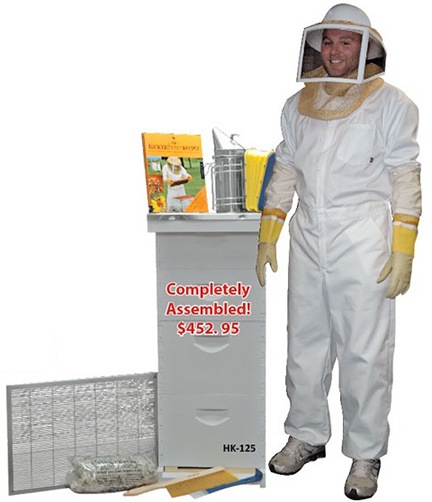
The Bee Kit
This is the bee kit I ordered. (No, it didn’t come with the guy.)

With so many choices to make, I decided to keep it super simple and order the Deluxe Traditional Starter Kit, which included four 10-frame hive bodies (two deep and two medium), 4 frames (in appropriate sizes, inner and outer cover, bottom board with reducer, bee suit with zip-on veil, hat, gloves, queen excluder, smoker, smoker fuel, hive tool, bee brush, and a book titled The Backyard Beekeeper. I also ordered an entrance feeder and a drawer-style varroa screen.

Now that I’d finally made the plunge into this new hobby, I couldn’t wait to get started. More on that in another post.

Bees, Please

I consider, reconsider, and prep for a new hobby.

I started my beekeeping hobby in June 2013 and have been blogging about it periodically. If you’re interested in reading the other posts in this series, follow the Adventures in Beekeeping tag. Keep in mind that the most recent posts always appear first on this blog.

I don’t know exactly when I started thinking seriously about keeping bees as a hobby. I know it was within the past few months, but if I had to give you an exact date, I’d come up empty.

I think it started as a tiny germ of an idea, like a speck of pollen clinging to a bee’s wing as it buzzes around, going about its business. Somewhere along the line it was noticed and moved to a place where it could be closely examined and considered. I immediately realized that I needed more information to make a decision one way or the other and I got to work gathering that information.

Doing My Homework

I started by querying my friend Tom, who has been keeping bees for some time now in Vermont. He has nothing but good things to say about beekeeping and I was very encouraged. He gave me a few details, but it all went over my head. I didn’t know enough. Yet.

Beekeeping BookI bought a book — as I usually do when I want to learn something. I chose The Complete Step-by-Step Book of Beekeeping by David Cramp. It’s a nicely illustrated, hardcover book that covers all the basics of beekeeping, written in a way that folks who know nothing about it can quickly grasp. It was published in the U.K., so it has more information about beekeeping in Europe than I’d find in a U.S. published book. It didn’t go into much depth on any topic, however. This might be because of constraints related to the spread-based presentation of the material — each topic had to be covered on one 2-page book spread. (This is something you notice when you’ve worked in publishing long enough.) But, in general, I highly recommend it to anyone who is clueless and curious about beekeeping — as I was.

Tales from the HiveI also rented NOVA: Bees – Tales from the Hive from Netflix. This video offers some amazing footage that clearly shows some of the more interesting aspects of bee life. I admit that I fell asleep halfway through it — I really can’t watch TV late in the evening anymore — but I fired it back up early the next day and watched the part I’d missed. I recommend this, even if just for the quality of the footage. NOVA documentaries are usually very good and this was no exception.

Natural BeekeepingIf that wasn’t enough, I bought and sat through (in two sessions again) Natural Beekeeping with Ross Conrad on DVD. This is an incredibly long video that isn’t particularly well-produced. It jumps from video footage of Mr. Conrad lecturing in a classroom about bees with very few visual aids to video footage of Mr. Conrad talking to the camera out in the field while showing off a few things. I wouldn’t recommend this video at all if it weren’t for the fact that it is jam-packed with detailed beginner, intermediate, and advanced information about keeping bees. If he could redo this video to show more than tell — and organize it into real chapters or segments on the DVD — he’d have a real winner.

Storey's Keeping BeesBecause I liked the Storey Guide series book about raising chickens, I figured I’d try Storey’s Guide to Keeping Honey Bees. I bought the Kindle edition so I could read it on my iPad and annotate it. I admit I was a bit disappointed. The book didn’t translate well to the Kindle format; illustrations and tables simply did not appear right. Sometimes paper really is better.

Beekeeper BibleBy this point, I’d pretty much decided that I wanted to move forward and give beekeeping a try. So I bought one more book, this one to use for general reference: The Beekeeper’s Bible: Bees, Honey, Recipes & Other Home Uses by Richard A Jones and Sharon Sweeney-Lynch. This 416-page hardcover book covers pretty much every aspect of bees and beekeeping. I’m certain I’ll turn to it again and again to learn as I work with my bees.

Join the Club

Of course, homework wasn’t limited to books and videos. I also wanted to meet with other local beekeepers — if I could find them.

So I asked all-knowing Google and, of course, Google gave me an answer: The North Central Washington Beekeepers Association (NCWBA) on Facebook. I “Liked” the page so I’d get updates.

I also posted a comment introducing myself and asking other members if I could see their beehives:

I am very interested in getting started with this as a hobby soon. Is anyone in the Quincy or Wenatchee area interested in showing a complete newbie their setup and giving her some pointers? I’ll buy lunch afterward. Let me know.

I almost immediately got a response that included an invitation to see a member’s apiary in North Wenatchee. The next day, I was pulling up to a complete stranger’s house on the edge of town and knocking on their door. I met Kriss and Jim, who escorted me out to their incredibly huge backyard to see Jim’s two hives. We chatted for a while about bees, took a walk in their yard, and checked out Jim’s honey extractor. They suggested I go to YouTube and watch videos by FatBeeMan. I left feeling glad that such nice people shared the same hobby so close to where I’d soon be living.

The NCWBA meets twice a month: once for an informal “chat” at an area restaurant and once for a formal association meeting in a hotel conference room. I was unable to attend the next chat, but I was able to go to the formal meeting. I met a bunch of great people and told them about my situation — that I wanted to get started with bees but didn’t have a place to put my hives yet. Soon, I told them, I’d close on a 10-acre parcel in Malaga. They talked about hive conditions now and what each beekeeper should be expecting. They talked about needing a webmaster for their website. (No, I didn’t volunteer. I have enough on my plate right now.) They talked about their involvement in the Chelan County Fair in September. (Can anyone lend them a mannequin with a head so they can dress it in a bee suit, hat, and veil?) And they talked about swarm season; I gave out my phone number and asked to be called if they went after a swarm so I could watch and/or help.

At the end of the meeting, Kriss and Jim offered to let me put my hive in their backyard so I could get started with my bees before the season is too far gone. We’d move the hive when I closed on my land. I accepted their very generous offer and started thinking about ordering my hive.

Another Friend with Bees

The following Tuesday, I was in Auburn, WA, picking up my sad little jet boat, which was in storage at my friend Don’s house. Don offered to take me to late breakfast at the Puyallap Airport. That meant flying over in his helicopter. He pulled it out of his hangar and preflighted it and we climbed aboard. While it was warming up, I told him I’d decided to keep bees. I then immediately suggested he and his wife might like to do the same — they’d make a good match for their goats and llama and chickens.

“We already have bees,” he replied.

I was dumbfounded. I didn’t know he had bees. We talked about them at breakfast. He told me that there was a woman nearby who did seminars and sold beekeeping equipment. Her place was closed just one day a week: Tuesday. Just my luck.

When we got back to his house, he showed me his two bee hives. He told me that they’d had one hive the previous year and that the bees had been killed by mites over the winter. He showed me the mite screen they’d just installed.

Two white molded plastic chairs were positioned in front of the hives, about five feet away, facing them. “Do you sit here?” I asked.

“Yes,” he replied. “It’s kind of fun to watch them come and go.”

I told him I was going to pick his brain about bees when I had questions. He didn’t seem to mind at all.

Prepped with Information

That was on May 21, less than a month after receiving that first bee book in the mail from Amazon.com.

At that point, I fully understood about 90% of what my beekeeping friends — both old and new — were talking about. Only a month before, I didn’t know much about bees other than that they lived in hives, had a queen, and made honey. Within a month, I’d learned the terminology and understood more than just the basics. I could communicate with others to ask questions and understand the answers. My homework — with books — had really jump-started my knowledge base.

It was time to make equipment purchase decisions. But I’ll save that for another post.

A Visit from the Bee Man

Removing a swarm of bees is easy — if you know what you’re doing and aren’t afraid to get stung.

BeesThe text message from my friend Pete arrived just as I was trying to think of another way to procrastinate:

Bees swarming on the shop. Bee man is going to come get them.

A cell phone image accompanied the text. It showed a roof eaves absolutely littered with bees.

A while later, I was at my friend’s farm, watching the bee man set up. He was an older man who’d likely been doing his job for quite some time. He was dressed in a loose-fitting, white coverall that was tight at his wrists and ankles. An attached hood with mesh mask hung at his back. He’d arrived in a flatbed truck towing a forklift on a trailer.

BeesWhen I arrived, he was placing a wooden door atop a fruit crate on a forklift, forming an elevated table. He placed a white box atop that and raised the apparatus about four feet off the ground, right beneath the bee swarm. The bees looked even more impressive live. Pete, three of his sons, and two of his older son’s friends stood a good fifty feet away, watching.

The bee man explained that the bees were swarmed around a queen and that they’d likely decided to settle there. It was pretty obvious that they needed to be removed.

While folks in cities might call an exterminator, here in farm country, bees have real value. The “bee man” was a beekeeper who not only made honey but rented his bees out to farmers for pollination. In fact, Pete had a few dozen of his hives out by his apple trees. The bee man would take the bees home and set them up with their own bee hive boxes. Pete might see them again next year in more controlled conditions.

The Bee ManWhen Pete made it clear that he wasn’t interested in sitting on the forklift to lift the bee man and his box up to the swarm, the bee man fetched his forklift off the trailer and parked it beside Pete’s. He then raised the two sets of forks and climbed up beside the box.

And then, as we watched, he used his bare hand to scrape the bees off the eaves and into the box.

“These bees are very calm,” he said.

Bee Man in Action

Bees CloseupHe wasn’t kidding. He continued to sweep them down toward the box with his hand and, later, a stick. Although everyone else kept their distance, I got closer and closer with my camera. Soon I was standing on a third forklift parked inside the shop, not eight feet from the swarm and box, snapping photos.

Bee Man with iPhoneI wasn’t the only one taking photos. The bee man climbed down, went to his truck, and came back with his iPhone. He then climbed back up the forklift and used the phone to take a closeup photo of the bees. I’m wondering if his shot ended up on Facebook.

Lighting the Smoker

Smoking the Bees

It took quite a while — at least 30 minutes. The bee man was very patient. One by one, most of his other spectators wandered off. He was sure he’d gotten the queen in the box, but the rest of the bees were taking their time joining her.

After a while, he got out his smoker, torched the burlap piece inside, and used smoke to coax the bees into the box. He explained that the smoke makes the bees think there’s a fire so they go into the hive to eat honey in case its lost. They then get sleepy from eating so much. Didn’t sound quite right to me, but what do I know?

Bees on a TruckWhen he had most of the bees in the box, he covered it up, carried it back to his truck, and strapped it down on the flat bed. He pulled his forklift back onto its trailer and got ready to leave — but not before he gave Pete a plastic gallon jug of honey in exchange for two of Pete’s bottles of wine.

I’d enjoyed the show and was glad I’d gotten that text message.