Real Life Flying: Researching Client Requests

Doing your homework is part of flying safely — and legally.

This afternoon, I got a call from a potential client. He’s the manager of a country club that does catering for weddings and other big events. He wanted to know if it were possible for me to land my helicopter on the country club property after dark, pick up a couple — say a new bride and groom — and fly them around Phoenix for about 45 minutes before dropping them off at a hotel with a helipad or an airport where a limousine would be waiting. He also wanted to know whether it was okay for them to have some wine while aboard the aircraft.

Off the top of my head, I said, yes, we should be able to do that. But then I listed the things I’d have to check out before giving a definitive answer.

I thought this might make a good topic for a blog post for commercial helicopter pilots interested in real life helicopter missions. You see, commercial helicopter flying is not always as easy as picking up two passengers at an airport, flying them around for a while, and returning them to the starting point. So, as an example, I’ll discuss the things that come into play for this particular kind flight.

Landing Zone

Mansion LZ

Off-airport landings are something I’m accustomed to. Photo by Jon Davison.

First and foremost is the safety of the landing zone. How big is it? Is it level? Are there obstacles such as trees, buildings, or wires? What are my approach and departure paths like? Can it be controlled to prevent onlookers from coming too close or walking behind the aircraft? How about neighbors? Are there homes in the area? Is it close to another airport where air traffic control might be an issue? Since landing and departing will be at night, can the landing zone be properly lit so I can find it and land safely on it?

I made an appointment to meet with the client to see the landing zones he had in mind. Hopefully, one will work. I also checked the location of the country club using the satellite view of Google Maps. Although its golf course is indeed surrounded by homes, there’s also a nearby freeway and shopping center that’s likely to be empty at night. I could see some possible approach and departure paths, but could not judge obstacles, such as light posts or wires.

As for a destination hotel — if one is found, I’ll have to go through the entire process there, too. It’s more likely, however, that I’ll just land them at Deer Valley Airport, which is my home base.

Local Ordinances

Of course, no off-airport landing would be possible without a lot of hoop-jumping if there were a local ordinance that prohibited off-airport landings. Scottsdale has such an ordinance, enacted, primarily, to prevent local helicopter pilots from doing asinine things like landing in residential subdivisions. (I guess it was done one too many times.) Wickenburg’s ordinance isn’t quite as restrictive; it states that landing is possible with the permission of the Police Chief. When I asked the Police Chief about this some years ago, he had no idea what I was talking about.

The client said that the mayor the country club’s city is a member, so if there was an issue, he might be able to get permission on an as-needed basis. But when I hung up the phone with him, I started making other calls. First, the local police, to see if they knew of any ordinance. They directed me to the city’s compliance office. They told me they had no ordinances, but that I should check with the FAA. I already know that the FAA is fine with landing a helicopter on private property, as long as it is done safely and in accordance with any related FARs.

So this would not be an issue for this particular location. No hoop-jumping necessary.

Passenger Loading

Night Flight Over Phoenix

The lights of Phoenix are beautiful at night. Photo by Jon Davison.

The client wants to use the helicopter as part of the event’s entertainment. At the predetermined time, the guests would be guided to “the patio” (wherever that is) where they could watch the helicopter come in for a landing. The bride and groom would climb aboard and the helicopter would take off, perhaps doing a quick circle of the area before departing.

This sounds great and its sure to make a memorable wedding party. But passenger loading could be an issue here.

Is the client willing to wait for the helicopter to cool down and shut down before the passengers are loaded? And then wait again while the helicopter starts up, warms up, and spins up before departure? If the wait is okay, the pilot (me) can do the passenger briefing and loading. While this might not make for good entertainment, it is the safest option.

The other option is “hot loading,” where the passengers board the helicopter while the engine is running and blades are spinning. Many people will simply not do hot loading, but I will — provided there’s a qualified ground crew to escort all passengers to their seats and ensure they’re buckled in. That means operating with someone on the ground — likely my husband — who would arrive before me and handle briefing and loading duties.

While you might think I prefer the first option, I actually prefer the second. It minimizes the amount of time I’m on the ground and ensures a qualified person is there to handle my next concern: crowd control.

Crowd Control

I firmly believe that a spinning helicopter is more dangerous on the ground than in the air. My tail rotor is literally invisible when it’s spinning — even at idle speed — and if someone walked into it, they’d be dead. That’s why I always set down in a landing zone with my tail pointed away from where people are most likely to be. Any helicopter pilot who doesn’t do this is looking for trouble.

Unfortunately, when landing in an uncontrolled area, there’s nothing to stop people from running up behind the helicopter. There’s a restaurant in Peoria, AZ that I used to land at for lunch quite often. It’s in a relatively remote area with lots of open desert around it. I always landed just outside the parking area with my tail rotor facing away from the building. The last time I landed there, however, a bunch of kids on off-road motorcycles saw me come in and began swarming around the helicopter as I was shutting down. Good thing my husband was with me to keep them clear. I haven’t gone back since.

When I inspect the landing zone, I’ll try to determine how well it can be controlled. And then I’ll put a plan in place to control it for my arrival. Having a reliable and experienced ground crew person will certainly help when the time comes for me to operate there.

Alcoholic Beverages

The final request that requires research is the glass of wine during the tour. FAR 135.121(a) states:

No person may drink any alcoholic beverage aboard an aircraft unless the certificate holder operating the aircraft has served that beverage.

This means they can’t bring their own alcohol aboard — it’s also why you can’t legally bring your own alcohol aboard an airliner!

If you’re wondering who the “certificate holder” is, well, so am I. It’s either me personally — since I have a single pilot Part 135 certificate and I’m the pilot — or it’s my company, Flying M Air. If it’s me, serving wine while I’m at the controls of a helicopter will be nearly impossible. If it’s my company, I can theoretically have an employee or agent of my company serve the alcohol for me, preferably right before we take off.

If there are any pilots out there who have real knowledge about this, please do use the Comments link or form to share what you know with me. Otherwise, I’ll just ask my FAA Primary Operations Inspector (POI). He’ll either tell me or help me figure it out for myself based on what I know.

One thing I do know: if I can’t legally serve alcohol on the flight, I won’t. No client request is more important than my certificate.

FAR 135.121(b) and (c) offer two other rules regarding alcohol:

(b) No certificate holder may serve any alcoholic beverage to any person aboard its aircraft if that person appears to be intoxicated.
(c) No certificate holder may allow any person to bard any of its aircraft if that person appears to be intoxicated.

That means I can’t serve them if they’re drunk and I can’t even allow them to board the aircraft if they’re drunk. This is something I need to make sure the client knows. It would be a shame if I brought my shiny red helicopter in for a landing at the big party and the bride or groom was too shitfaced from champagne to fly. (It would be a bigger shame if one of them puked on my leather seats.)

The Other Usual Stuff

Every flight has the usual collection of pilot tasks before it can be completed. I’m talking about things like calculating weight and balance, getting weather and NOTAM information, creating a flight plan, preflighting the aircraft. I might want to do a daytime landing at the landing zone in advance, just to make sure I was familiar with it. There’s lots of the usual responsibilities, none of which can be taken lightly for any flight.

This Is What It’s All About

This should give most folks an idea of what goes into planning what seems like a simple mission. Any pilot faced with a client request like this who doesn’t look into these things — at a minimum — is simply not doing his job.

I’ll know by Saturday, when I review the landing zone, whether we’ll be able to work for this client. I hope so. It would be great to have some regular gigs like this throughout the year.

Helicopter Sugar Cookies

Bake your own fleet. They’re good to eat.

Helicopter CookiesToday, I made sugar cookies in the shape of helicopters for my cherry drying clients. It was a lot of work, but worth it. The cookies came out great and I think my clients will get a chuckle when they see them.
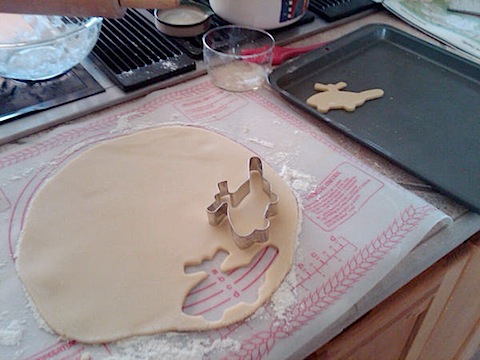
The recipe is my grandfather’s recipe for sugar cookies. He owned a bakery in New Jersey when I was growing up. My mother got the recipe from him and passed it on to me years ago. You can make the cookies in any shape you like.

Here’s the recipe. It may be doubled.

Ingredients:

  • 1/4 lb (1 stick) butter or margarine
  • 3/4 cup sugar
  • 1 egg
  • 1/2 tsp vanilla
  • 1 tbsp milk
  • 1-1/2 cups flour
  • 1/8 tsp salt
  • 1/4 tsp baking powder
  • white of 1 egg, beaten (optional)

Instructions:

  1. Preheat oven to 350°F.
  2. Cream butter and sugar in mixer.
  3. Add egg, vanilla, and milk. Beat well.
  4. Sift together dry ingredients and add gradually to butter mixture.
  5. Knead in extra flour if necessary to produce a firm batter.
  6. Roll out the DoughRoll batter out to 1/4 inch thickness on floured board.
  7. Cut with cookie cutters and place on cookie sheet.
  8. If desired, brush tops with egg white.
  9. Bake until golden brown (not more than 10 minutes).
  10. Cool on wire rack.

Yields 2 dozen cookies or fewer (depending on shape and size of cutter).

I added sprinkles before baking. My helicopter is red and I wanted to make the connection.

Helicopters 101: CG

The other half of the weight equation.

Articles in the Helicopters 101 series:
Flight Planning
CG
Weight
Hover Charts
Ground School

Last week, I wrote a blog post about helicopter weight. It was my response to a blog post by Tim McAdams on the AOPA helicopter blog titled “Gross weight.” The comments to that post indicated to me that some of the commenters were confusing weight with CG — center of gravity — issues. My blog post concentrated on weight, putting CG aside. But CG is the other part of the weight equation. And for most helicopters, CG is vitally important to calculate as part of preflight planning.

CG Defined

Center of gravity is pretty much what the phase indicates: a calculation of the center of gravity on an aircraft. It’s the aircraft’s balance and it’s calculated as part of the “weights and balance” computations.

For helicopters, CG is extremely easy to envision. After all, a helicopter with a single main rotor system (as most have) is supported at one point in flight: the main rotor system or mast. If you held up the helicopter by its rotor system, the distribution of its weight — not just what’s inside it but its engine, battery, tail rotor, etc. — would determine how level it hung.

Take, for example, my R44. Its full passenger load is in front of the mast. Its fuel, engine, and heavy components are slightly aft of the mast. For this reason, if I’m flying solo (just one person up front) with low fuel, the helicopter would be a bit tail heavy. As I set down from a hover to the ground, the back of the skids would touch the ground before the front. In fact, the right back would touch first. That’s the lowest point closest to the center of gravity for that load.

The same applies to R22 helicopters. In fact, it’s often terrifying for student pilots to pick up into a hover after their flight instructor steps out when its time for that first solo flight. (Sure scared the hell out of me.) The helicopter feels as if it’s going to flip over backwards!

But stick a pair of fatties up front in my R44 and the CG will shift forward. In fact, if you have enough of a load up front, the fronts of the skids will touch first on landing. (I remember the first time I flew with my brother-in-law on board. I thought I was landing on a slope!)

Watch any helicopter take off or touch down and you’ll probably be able to tell where its center of gravity is.

Why CG Is Important

CG limitations are important for aircraft operation. For example, if you’re loaded with too much weight up front, the helicopter will tilt forward more in flight. When slowing down, stopping, or hovering, you might not have enough aft cyclic to counteract this forward tilt. Ditto for lateral or aft CG.

Remember, every aircraft control has a “stop.” That’s the limit to the control’s movement. You pull the cyclic back to slow down in flight. If you’re heavy up front, you may have to pull it back to simply hover in place. If you’re so front heavy that you can’t pull the cyclic back enough to stop the helicopter from moving forward, you have a serious problem — a problem with your CG or balance.

Want to see how far your controls will move? You should be checking their movement before starting up by simply moving each of the controls as far as it will go. The idea is to make sure none of them are stuck on anything or binding in any way. You don’t want to learn about a control problem when the engine is running, rotors are spinning, and you’re picking up into a hover.

You Can Be Under Max Gross Weight and Still Out of CG

What was bothering me about the comments on that AOPA blog post was that a few of the early commenters kept referring to CG and “weight and balance.” But the blog post was about gross weight. CG wasn’t discussed at all.

I didn’t address CG in my post because that wasn’t being discussed. In fact, it’s quite possible to load an aircraft out of CG and still be within max gross weight.

CG Calculation

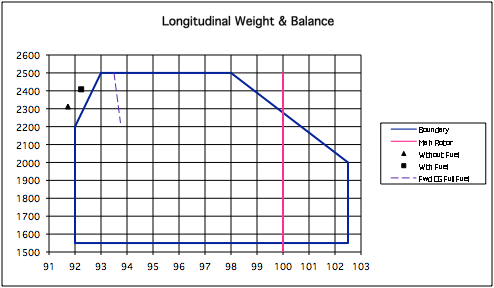
This aircraft is out of CG but still within gross weight limitations.

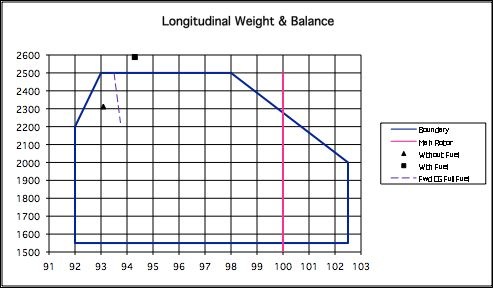
Want an example? Here are the plotted points for a W&B calculation for an R44 helicopter with 4 good-sized people on board (190 and 250 up front; 190 and 145 in back). It’s a short flight, so only 16 gallons or about an hour’s worth of fuel is loaded on board. The total weight of the aircraft is 2408 — that’s nearly 100 pounds below max gross weight. But as the graph points show, this aircraft is out of CG — too much weight up front.

If you’re having trouble reading this, envision the pink line as the mast. Everything to the left is the front of the helicopter. Everything to the right is the back end of the helicopter. The blue box is the CG envelope for the aircraft, as determined by the manufacturer. In this example, the aircraft with and without fuel is loaded forward of the CG envelope. That’s a no-no.

CG Example 2

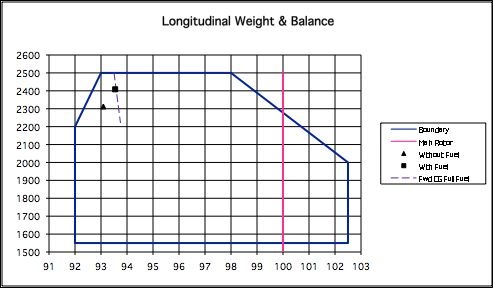
The same passengers as in the previous example, but with heaviest and lightest passengers switched. This load is within CG.

This situation is extremely easy to fix. Simply rearrange the passengers. While you can’t move the 190-lb pilot, you can move the fatty beside him. In this example, the 145-lb passenger in back has switched places with the 250-lb passenger up front.

Adding fuel might help, since fuel is loaded aft of the mast. But you couldn’t add much — you’re already pretty darn close to max gross weight.

Of course, both of these examples show only longitudinal CG — forward to aft. Lateral, or side to side, CG also needs to be calculated. As many of the commenters pointed out, they’ve created spreadsheets to perform these calculations for them. So have I — where do you think these two diagrams came from?

CG Example 3

Take the balanced load of the second example and top off the fuel tanks and you’ll get a situation like this.

Can you be over max gross weight and within CG? Technically, no. As these two diagrams indicate, if you’re loaded too heavy, the plot points will be outside the CG envelope. That means you’re out of CG.

But are you really out of balance to the point where you’ll run into control issues? I wouldn’t want to find out for myself.

Which is More Important: Weight or Balance?

I’ll always argue that you need to consider weight before you worry about balance. If you’re too heavy to fly within manufacturers max gross weight allowances, you’re too heavy to fly legally. Who cares about balance at that point?

So if you’re too heavy, it’s time to reduce weight. Leave behind some gear. Take less fuel. Leave behind the passenger who really doesn’t need to come along. Can the mission be flown with the load changes? If so, go the next step with the new load and do the complete CG calculations. Are you in CG? If so, you’re almost ready to go.

Almost? What else is there?

Performance, of course. I’ll discuss that in a future post.

The T3 Helistop at PHX

I show a fellow pilot my favorite LZ at Sky Harbor.

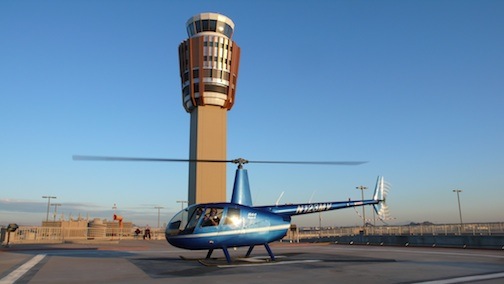
It’s a little-known fact that there’s a helistop atop the Terminal 3 parking structure at Phoenix Sky Harbor Airport. This is where I pick up passengers for Flying M Air‘s multi-day excursions. It’s extremely convenient, not only for my passengers, but for me.

PHX Helistop
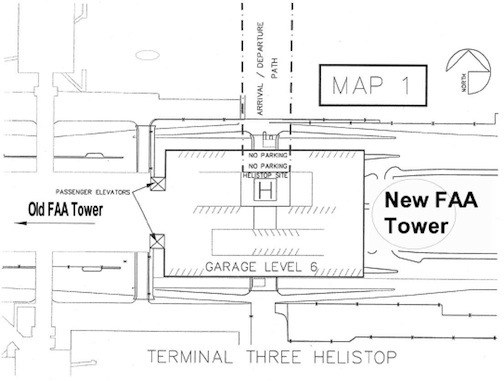
This diagram of the Terminal 3 Helistop refers to the old tower, but it no longer exists. This is part of the Sharp Echo letter of agreement for helicopter pilots operating at Sky Harbor.

I’ve been landing at the helistop since it reopened in 2007. It’s been there for a long time but was closed while they built the new FAA tower beside it. When the new tower opened and they took down the old one, they opened the helistop back up.

I blogged about landing there at night. I also put a video of a daytime landing there on this site and Viddler.

When I say few people know about the helistop, I’m not kidding. The last passengers I picked up there said they’d asked at least six people at Sky Harbor how to get to it and every one of them had told them it didn’t exist. Then they followed my instructions to go to the top of the Terminal 3 parking structure and there it was. Just as I’d told them.

I don’t think too may pilots know about it either — and that’s okay with me. There’s only room for one helicopter up there and if someone’s already there when I need to use it, I’m out of luck until it leaves. It’s not a parking spot — it’s a landing spot. That means that although I can land there, I can’t leave the helicopter there for any extended length of time. I also can’t just walk away. That’s why it’s up to my passengers to find it without my help. I simply can’t leave the helicopter to find them.

My friend, Don, who also flies an R44 Raven II, often needs to pick up his wife and other family members at Sky Harbor. When I mentioned the helistop to him, he wanted to know more. So I explained the intricacies of flying into Phoenix Class Bravo airspace in a helicopter, which is much easier than you might think. I also told him how I make my approach to and departure from the helistop. The conversation ended with me promising to fly with him for a landing there.

Don't Helicopter at PHX
Are we a bunch of tourists or what? Mike jumped out to take this shot of us when we landed on the helistop. Don’s flying; I’m in the front passenger seat.

We made the flight yesterday afternoon. My husband, Mike, came along for the ride, too. I recommended to Don that he not do the trip with a heavy load. The landing is a confined space pinnacle — yes, there are such things — so it needs to be approached with care. As shown in the diagram above, there’s only one way in and out. A heavy load on a hot day — or with a tailwind — could make for a dangerous situation.

Anyway, the flight was uneventful. The airspace was pretty quiet. Just one Southwest Airlines 737 landing as we came in; Don slipped in behind him. He came into the pad a bit lower than I would have, but the landing was smooth. Mike hopped out to take this photo. Then he climbed back in, Don called the tower again, and we took off right behind the next landing 737.

I just hope that Don’s helicopter isn’t sitting on that helistop the next time I need to land there.

Helicopters 101: Weight

Gross Weight ≠ Center of Gravity.

Articles in the Helicopters 101 series:
Flight Planning
CG
Weight
Hover Charts
Ground School

I was recently pointed to a blog post by Tim McAdams, AOPA’s helicopter blogger. [A side note here: It’s nice to see that AOPA has finally realized that the first “A” in its name, which stands for aircraft (not airplane), does indeed include helicopters. I’ve been waiting more than 10 years for this. But I digress.] The post, titled simply “Gross weight,” is a brief discussion of helicopter gross weight and an accident caused by a pilot attempting to fly over max gross weight.

Commenters Miss the Point

Many of the comments following this post mentioned Center of Gravity (CG) or Weight and Balance (W&B). At least two commenters offered links to their Excel worksheets to perform weight and balance calculations for the aircraft they fly. (I also have my own Excel solution for my R44.)

It seemed to me, however, that they were missing the point. The article wasn’t about CG or W&B. It was about weight. You can do the calculations in your head for that:

+ Helicopter Empty Weight (including oil and unusable fuel)
+ Weight of Fuel On Board
+ Weight of pilot and Passengers
—————————————————
= Gross Weight

Take my helicopter, for example. Using the above formula for a flight with half tanks of fuel, me, and two people weighing 150 and 200 pounds on board, the formula would be something like this:

+ 1500
+ 150 (that’s 6 lbs x 25 gallons)
+ 500
————————–
= 2150

Because the max gross weight of my aircraft is 2500 pounds and this total is less, I’d be flying within max gross weight limitations. This does not mean I’m within CG — that’s a different calculation.

This is not higher math. A pilot should be able to make this calculation in a matter of seconds without a piece of paper — and certainly without a computer.

In my opinion, this should be the first calculation a pilot makes when planning a flight. If you’re over max gross weight, don’t even bother doing a W&B calculation. You’ll need to offload some of that weight — fuel, a passenger, cargo — before you can even consider whether it’s loaded within CG limitations.

Max Gross Weight

Although the blog post was titled simply “Gross Weight,” what McAdams was really talking about was max gross weight — the maximum allowable aircraft total weight on takeoff. The two stories he related in his post dealt with aircraft that were likely over max gross weight on takeoff. One flight was uneventful; the other ended in a crash.

There are two aspects to a helicopter’s max gross weight:

  • IGE Hover

    IGE Hover Chart for a Robinson R44 Raven II. According to this, a helicopter may be able to hover in ground effect at max gross weight at 6,000 feet when it’s 95°F out.

    There’s the max gross weight for the aircraft, which is something you should never — in a perfect world, anyway — exceed. The manufacturer has created this limitation for a variety reasons and the ability to lift off or hover may not be one of them. For example, it could be structural. Would you want to fly a helicopter over max gross weight if you knew that every time you did, you could be putting additional stress on the airframe/blades/etc. that could lead to a failure in a future flight? I wouldn’t.

  • There’s a practical max gross weight as it applies to high density altitude. Look at the performance charts. Can you maintain an IGE hover at max gross weight when the LZ is at 6,000 feet and it’s 95°F out? I do a lot of high density altitude flying in Arizona and I’ve experienced a wide range of weight and density altitude situations. I can assure you, max gross weight might be a limiting factor at sea level, but it’s an optimistic number at high DA.

I flew at the Grand Canyon one season and got to know the operation very well. Some helicopters simply weren’t as powerful as others — even within the same make and model. For example, on a hot day, if I were flying a certain ship, I wouldn’t take a load that put me within 200 lbs of max gross weight. To the company’s credit, they knew which ships were the “dogs” and tended to load them lighter. I distinctly remember being asked over the radio while waiting on the pad if I could take 4000 pounds in the ship I was flying that day — one of the dogs. It was over 90°F and the ship had been flying sluggishly since noon. When I said no, they shuffled the passengers around to lighten my load.

It’s Up to the Pilot

McAdams’ first story explains how one pilot refused to take a heavy load while another stepped right up and took over. He quotes a non-pilot bystander as saying “Now there goes a real pilot.”

This is the attitude that’ll shorten a pilot’s career — and possibly his life. The attitude that says, “I’m a better pilot because I can handle the heavy load that this wimpy pilot won’t try.” The attitude that ignores aircraft limitations and flying conditions just to prove you can do something that a wiser pilot won’t attempt.

You know about old pilots and bold pilots, right?

[Another side note: When I flew at the Canyon, late in the season, the last fight of the day for one of the routes had the pilot facing right into the low-lying sun at a critical point in the flight: just as we were attempting to climb up the side of a canyon wall in a relatively confined area to fly over the North Rim. My eyes are extremely light sensitive — which is why I just about always wear sunglasses outside — and I simply could not see in front of me when I flew this part of the route at this time of day. So I asked the lead pilot to not put me on that route for the last flight of the day. Although he was obviously pissed off, he complied –probably because there were at least eight other pilots on duty who simply didn’t care and would do the flight without question. My point: don’t fly beyond your comfort level.]

Real Weights

McAdams’ second story, about the crashed heavy helicopter, relates how the pilot estimated weights: 150 lbs per passenger. Ah, if only our passengers were that light!

The FAA’s estimate is closer to 190 per person average.

In a perfect world, we’d be able to weigh every single passenger, fully dressed and holding their carry-on things, moments before the flight. Those weights would be used in our calculation. This is exactly what they did where I worked at the Grand Canyon, so they never loaded a ship over max gross weight and always had perfectly accurate numbers for CG calculations.

Nowadays, most of my flights are booked by phone and I have to trust passengers to give me accurate weights when they book. But I don’t. I add 10 pounds to each person. If the caller is estimating the weight of another passenger, I add 20 pounds. It’s better to overestimate the weight than underestimate it.

Center of Gravity

One more thing: being out of CG and being over max gross weight are two separate things. While you can be in both conditions, you can also be in either condition. This means that you can be within max gross weight limitations but still be out of CG.

But I’ll save a discussion of that for another post.