Flying Isn’t Always Fun

About flying in the afternoon in the Arizona desert.

If you’ve been reading these blog entries, you may recall that about a month ago, I was supposed to fly up to the Grand Canyon early one morning for work and was prevented from doing so by a nasty t-storm over Wickenburg. I was forced to drive that day and was an hour late for work because of it. I promised my boss that from that point on, I’d come up to the area the day before I was due to start work.

Flying in the summer in Arizona — especially central Arizona, where Wickenburg is located — is not much fun. It isn’t bad early in the morning, before the sun has a chance to heat the desert up to its daily high of 100°F+. (When I say early, I mean early: sometime between dawn and 7:00 AM.) During monsoon season, even the morning can be hot and rather sticky, though. But by 10:00 AM, things are starting to get pretty awful. The sun is beating down on everything, heating up the earth and the air. The thermals start, caused by all that hot air wanting to rise. And, with a little bit of moisture in the air, clouds start to form and climb. By afternoon, you have some nice towering cumulonimbus clouds, dropping virga, rain, hail, and lightning in isolated storms all over the place.

What does this have to do with promising to get to the Grand Canyon area the day before I start work? This: Instead of flying up the day I start work, in the cool, calm, predawn air, I fly up the afternoon before I start work, in the hot, turbulent, t-storm-infested air.

Two weeks ago, I had to pick up Three-Niner-Lima from its annual inspection in Prescott. Mike drove me up and we had lunch before I left Prescott. It was after 1 PM when I got out of there and I could clearly see all the t-storms that I had to fly around to reach Howard Mesa. The nastiest was right over Bill Williams mountain and I had to detour to the east to keep out of the virga on its fringes. I landed without incident, tied everything down, and drove the Toyota down to Williams for my groceries. There was some rain on the mesa that night and other rain during the week.

Three-Niner-Lima in SmokeI flew my helicopter to work four of the six days that week and enjoyed calm air in the morning. Unfortunately, a controlled burn in the forest east of the airport filled the airport area with smoke every morning; one morning I needed a special VFR clearance to land because the smoke was so thick. (Photo shows Three-Niner-Lima parked on a transient helipad for the day; the building in the background on the far right is Papillon’s tower. That’s not fog; it’s smoke.) The afternoon is another story. One afternoon was particularly nasty, with a t-storm east of Valle that I had to steer clear of. A sudden gust of wind slapped me sideways and shot my airspeed from 85 knots to 100 knots in a flash. (I hate when that happens.) But I did see my first circular rainbow that afternoon, so I really can’t complain.

Today was no fun at all. The temperature in Wickenburg at 11:30 AM was already about 100�F when I fueled up. I was so hot as I waited for the engine to warm up that I took my shirt off, content to fly in my shorts and sport bra. (Heck, it isn’t like anyone can see into the cockpit while I’m airborne.) I also took my Keds off, trying to get the sun on the tops of my feet. Every summer I get a Keds tan on my feet that I really hate. The best way to get rid of it is to fly with my shoes off. The thermal updrafts started on me before I even crossed route 93 (about 3 miles north of the airport) and Three-Niner-Lima felt sluggish with its full tanks of fuel. I climbed at a mere 70 knots and felt no relief from the heat until I was in the Prescott area. There was a t-storm southeast of Prescott, in the Bradshaw Mountains, and another one west of Chino Valley, out toward Bagdad. I flew between them. I got bounced around a bit, but not too badly. Unfortunately, with my temperature (30�C) / altitude (6500 ft) combination, the never exceed speed was only 82 knots. That speed wasn’t limited by power, either. I’m sure I could have gotten it up to a steady 90 knots if I wanted to. But Robinson claims that flying above never exceed speed, especially at high altitudes or when heavy, can cause damage to main rotor blades. And believe me, the last thing in the world I want to damage is my main rotor blades. So I flew slowly.

I also flew high. Well, higher than usual. You see, on my flights from Wickenburg to Howard Mesa, I basically have two mountain ranges to cross. The first is the Weavers. I leave the airport and immediately start to climb so by the time I reach the Weavers I’m at around 5500 feet so I can cross them. There’s a high desert valley beyond it (Peeples Valley, Kirkland Junction, Kirkland, Skull Valley, etc.) but I don’t usually descend because I’ll have to be at at least 6500 to go around the north end of the Bradshaws, just west of Granite Mountain. Then there’s Chino Valley and Paulden. But beyond them is another mountain range — so to speak. It’s the Mogollon Rim, just south of Billl Williams Mountain, I-40, and the town of Williams. I have to climb to 7500 or thereabouts to cross through that area. So almost the whole time I’m flying to Howard Mesa, I’m climbing.

Today I had a scare. I was about 1500 feet AGL (above ground level, for you non-pilots) when I caught sight of a small plane at my altitude. It crossed in front of me about two miles away and, as I watched, it banked to the right and headed straight for me.

I don’t know what radio frequency he was on. There is no frequency for that area. So talking to him was not an option. I put on my landing light in an effort to make myself more visible. He leveled out on a collision course, less than a mile away. I did what any other helicopter pilot would do: I dumped the collective and started a 1500 foot per minute descent.

I think it was this sudden movement that caught his attention. He suddenly veered to the left. But I wasn’t taking any chances. I kept descending until I was a comfortable 500 feet AGL. Right where I should be. And right where most planes won’t fly.

He passed behind me. I switched to Prescott’s frequency and, a moment later, heard a Cessna call from Chino Valley. Obviously the pilot who’d shaken me up.

A few minutes later, I saw a helicopter cross my path, west to east. It was pretty far off in the distance — a few miles, perhaps. It looked like it might be a LifeNet helicopter. But if it was, I didn’t know where he was going. He seemed to be headed toward Sedona.

The rest of the flight was pretty uneventful. There was a t-storm to the east of Howard Mesa, still pretty far off. And a forest fire on the south rim, far to the east of where we fly in the canyon. I landed, cooled it down a good long time (I never saw the oil temperature get that hot on a flight, but it was still in the green), and shut down.

Tomorrow morning, I’ll fly to the Grand Canyon airport and report for work. It’ll be a nice flight.
A Tale of Two Passengers

Two passengers on consecutive flights are as different as night and day.

Passenger one was a young boy, about twelve or thirteen years old. He was overweight, with pudgy freckled cheeks. He wore long, droopy shorts and a tee shirt. He sat down beside me and was buckled in by the loader. I handed him his headset as the loader closed the door and continued loading the rest of the family into the back.

When his headset was on, I gave him a cheerful hello. He responded with a very unenthusiastic hello.

“How are you doing today?” I asked him.

“Okay.” The word came out as if I’d forced it from him. It was flat. It told me he really wasn’t okay but he was telling me that he was just so I’d leave him alone.

Of course, I couldn’t do that. “Must be better than just okay,” I said. “After all, you’re going for a helicopter ride. That’s pretty cool, isn’t it?”

He nodded glumly.

I got the thumbs up from the loader and started my passenger briefing, glancing in the back. His mom and dad were facing forward. His little sister, about eight years old, sat behind me facing backwards. They were all overweight. They were American, of course, from Colorado.

I took off a while later. We were on an Imperial Tour. That’s the long one, 45-50 minutes long. I gave them a little bit of a narration. Once, I heard the little sister in back yell out, “Look Mommy!” and say something about seeing deer. The boy beside me was looking out through the bubble at his feet at the trees we flew over. Later, he looked out the windows. But he didn’t react to what he was seeing. It was as if he was watching a television show his parents were making him watch when another show he really wanted to watch was on another channel at the same time.

At one point, he rested his chin in his hand. I had to look at his eyes to make sure he was still awake. He had long, curly eyelashes. His eyes were open, but they revealed nothing but boredom.

For heaven’s sake! He was being flown in a helicopter over the Grand Canyon! His parents had coughed up $169 (each) for this life experience and he had absolutely no appreciation for what he was seeing.

(For the record, I do it ten or more times in a day and I still enjoy seeing it.)

When they got off, I gave him and his sister each an Aero-Prop. (It’s a helicopter-like toy I give out to the kids.) His has probably already been added to the collection of junk dropped by tourists at the rim.

The next group of passengers were from England. The woman who sat next to me was probably in her eighties. She was small and rather frail looking and had some trouble getting into the seat. Dennis, the loader, helped her. She thanked him very politely, looking like she really meant it. I helped her with her headset, then said hello to her. She said hello back, then started looking at my instrument panel and the flight controls. She was really studying them. I thought she was going to ask some questions, but she didn’t. Her eyes just kept moving all over them. I started wondering whether she was all there.

I did the preflight briefing. I had a full load of six passengers, all from the same bus tour. Most of them were middle aged. Two of the women had enormous breasts. (That really doesn’t have any bearing on this story, but it is a fact.) They were all crammed into the back seats, but they looked happy enough.

We took off on a North Canyon tour. That’s the short tour, about 25-30 minutes. The woman beside me was very interested in the collective as I pulled it up. More interested than anyone else who has ever sat beside me. I started to wonder whether she might try to grab it. I didn’t let go for quite a while.

We passed the Grand Canyon Railroad’s steam engine on its return trip to Williams. I pointed it out. The woman beside me looked. Then she untangled her sunglasses from her seat belt and camera strap and put them on. She gazed around like an average passenger and I realized that she was probably as harmless as she looked.

But as we made the turn toward Eremita Tank and she saw the canyon ahead of us, she changed. It was as if she’d been told that she was going to see something good and she suddenly realized that it was going to be better than she’d originally thought. Way better. She took off her sunglasses and, as we crossed the rim into the canyon, she began looking at everything. I’ve never seen anyone look so hard. It was as if she were trying to commit everything she saw to memory. Like she was a sponge trying to absorb everything in. And every time I pointed out something, she looked to make sure she saw it.

I thought about my Grandmother, who passed away about two years ago. For a moment, I imagined that this woman was my grandmother and that I was finally taking her for a helicopter ride. It made my eyes teary.

We were on our way back across the canyon when I saw her wipe her eyes. Her fingers were wet. She was crying. Here was a woman near the end of her life and she still saw wonder in the Grand Canyon.

And I thought about the fat kid who’d been in her seat for the last flight. He had his whole life before him but couldn’t see how incredible the Grand Canyon was — even when he was looking at it from the front seat of a helicopter.

(I’m glad I don’t have kids. I couldn’t bear to have a child like him. Or let my children associate with children like him. Small minded, spoiled, and never happy.)

I’ll think about the woman from England for a long time. The fat kid is someone I’d rather forget.

On Stuck Valves

How I recognize an engine problem — and resolve it — on top of a mesa.

I’d flown Three-Niner-Lima up to Howard Mesa on my birthday, June 30. I was due to work at the Grand Canyon the next day and was looking forward to commuting to and from work daily in my helicopter.

The next day, I climbed aboard, all dressed for work. I started the engine and immediately noticed that it sounded louder and vibrated more than usual. At first, I convinced myself that the louder sound was my imagination, due to spending the night in the absolute silence of Howard Mesa. (It’s amazing how your hearing gets more sensitive when there’s nothing for it to listen to.) The vibration was due to me parking on level but uneven ground.

The blades, however, took longer than usual to start turning. There was no logical explanation to that.

And when I got it up to warm-up RPM (75%), I realize that the manifold pressure gauge read 18 inches. 18 inches is what I need to hover when I fly solo. I didn’t know what it was at warm-up RPM, but I was pretty sure it wasn’t 18 inches.

I applied carb heat, thinking that perhaps there was some icing (not likely but possible). I immediately lost about 10% of my RPM. I normally lose about 2-4%.

The lightbulb over my head came on. I had an engine problem.

I disengaged the clutch and pulled the mixture. The engine cut out gratefully. I checked my watch. It was 6:15 AM. If I didn’t hop in the Jeep soon, I’d be late for work.

I stopped the blades, tied them down, and climbed into the Jeep. It started right up and I started on my way. Of course, I did get a flat tire about 1 mile from pavement that made me late for work anyway, but that’s another story, covered in another blog entry.

I called my R22 mechanic in Prescott, Cody, and talked to him about what I’d experienced. He suggested a few things: sticky valve, fouled plugs, bad magneto (I hadn’t even gotten to the mag check). We came up with a plan of action that included checking the plugs and possibly doing a mag check.

Mike joined me at Howard Mesa a few days later. He pulled the plugs and cleaned one of them. I assumed that was the problem and didn’t bother starting up again. Until it was time to go home. And guess what? The problem was still there, if not worse. I was now pulling 18 inches of manifold pressure at 55% RPM.

We tied down the blades, covered the cockpit, and went home.

I called Paul, my old mechanic in Chandler. Although I’m not allowed to bring my helicopter to him for repairs, he’s told me time and time again that I can call him any time I have a problem. He had the same opinion as Cody about the problem, but added that if it were a stuck valve, we could easily check for bent push rods by pulling off the valve covers. Easy for him.

Cody was leaving town for Montana and would be gone for a while. And I had a feeling his boss, John, wouldn’t be too receptive to a field trip. John had a trailer that we could use to bring the helicopter to Prescott. But I could only imagine what he’d charge for its use. I was pretty financially tapped out (heck, I just put a $25,000 deposit down on a new helicopter I wouldn’t see until January 2005) and didn’t want to spend $1,000 moving my helicopter off a mountain top, just so a mechanic could spend 10 hours repairing it (at $100 per hour).

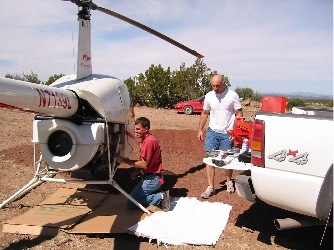
But Ed, our local mechanic, knew all about Lycoming engines, even though he wasn’t a helicopter guy. I called him and told him my problem. He agreed to make a field trip with us. We drove up yesterday with a bunch of Ed’s tools and lots of water and Gatorade.

Repairs at Howard MesaWe spread out some cardboard and throw rugs and Ed got right to work. He and Mike found another fouled plug. Then they did a compression check, with me cranking the engine. The results were pretty conclusive: Cylinder #4 was not producing any power. Zero.

The reason became apparent when Ed pulled off the valve cover. The exhaust valve was stuck. Really stuck.

He and Mike worked on it for 30 minutes and couldn’t get it to budge. It looked like they’d have to pull the cylinder and drop it off at a repair place in Prescott. Ed looked at the engine cover and all the other things attached to the engine. It looked like a lot of work. I called Paul again and told him the problem. I asked him if there were any shortcuts to getting the cylinder out. Then I turned the phone over to Ed. From Ed’s side of the conversation, I could tell it would not be a fun job.

Stuck ValveEd hung up and told us that it would be best to continue trying to free up the valve. So he and Mike went back to work. With a hammer. A big hammer.

I left to get us lunch. I was gone about 90 minutes. (It’s a half hour drive to Williams and the woman at Safeway was the slowest sandwich maker I’ve ever seen.) When I got back, they were putting things back together. They’d freed the value and had reamed it. It was now smoother than ever. I’d be able to fly.

We had lunch then cleaned up. I climbed on board while Mike and Ed stood outside, looking for leaks. When I started up, my idle manifold pressure was 8 inches. No leaks so Ed climbed on board. (It’s always reassuring to have your mechanic fly with you right after a repair he’s done.) Warm-up manifold pressure was only 12 inches. That’s more like it! Everything sounded good, the unusual vibrations were gone. (The usual vibrations, alas, were still there.) I pulled power and got into a hover at 21 inches of manifold pressure. Great. I pointed it toward the road and we took off.

I took Ed home a scenic route: over Prescott and down the Hassayampa River. He’d never been over the river in that area before and I think he really enjoyed it.

When we got back, he presented the bill. $312. And that included my oil change the previous month. I paid it with pleasure.

Oh, one more thing. Consultation of the engine log books revealed that this was the FIFTH time we’d had to ream the #4 exhaust valve. Hmmm….let’s hope it holds out until January.

On Accidents That Aren’t Accidents

How I’m spared from being the victim of the government’s bureaucracy.

If you read my jumper story (in an earlier entry of this blog) and you know anything about the FAA and NTSB and the rules and regulations they operate under, you might be wondering why they hadn’t classified the event as an “accident.”

Unfortunately, they did.

If you search the NTSB’s Web site for accident reports, using the word “suicide” as a search word, you’ll find one case very similar to mine. In that case, the jumper went up with a CFI and dove out during a steep turn that he’d requested. Although the CFI was not at fault — heck, the passenger committed suicide! — the case was classified as an accident.

And my case was going the same way.

Papillon fought back. Not just for me, but for them, too. They didn’t want an accident on their record any more than I did. Although the event met the definition of an accident (which really needs to be revised, in my opinion), common sense says that the word “accident” does not apply to a suicide. There was nothing accidental about it. (The guy purposely undid his seatbelt, pushed his door open against a 100-knot wind, and jumped.) The trick was to get the NTSB to disregard their definition and classify this as something less damaging to the pilot’s or operator’s flight records.

It went all the way to Washington, involving people from the FAA, NTSB, Department of the Interior, and HAI. I even tried to get AOPA involved, but they lamely claimed that you couldn’t fight NTSB on its accident definition. (Good thing I didn’t pay for their legal services plan.) Someone must have talked sense to the bureaucrats, because the other night I got a voicemail message with the good news: they’d changed the classification from accident to something else. What that something else is is still a question. I’ll find out tomorrow.

If there’s a lesson to be learned here, it’s this: don’t let a passenger jump out of your helicopter. Not only is it a traumatic experience, but it results in a ton of paperwork.

Six Rides in One Day?

Wickenburg residents come out of the woodwork to go for helicopter rides one Saturday.

The phone calls started on Tuesday, June 1. A woman had gotten a gift certificate for a helicopter ride from her husband. She wanted to take the ride and buy her husband the same ride. When could I do it?

I consulted my calendar and set her up for Saturday, June 5, at 10 AM.

Another call later in the day. This guy had a gift certificate for a Ghost Towns tour. He wanted to do it early in the morning. (So did I.) We set it up for Saturday at 7 AM.

The next day, another call. A woman with a gift certificate for a tour wanted to go this weekend. How about Saturday, I asked. I fit her in at 8:30 AM.

Thursday, Alta called. She’d wanted to send a co-worker on a brief ride so she could see her home from the air. When could I take her? I suggested Saturday at 9:30 AM.

In the span of three days, I’d booked five rides. In June!

Saturday rolled along with the usual beautiful weather. I pulled up to the airport at 6 AM and pulled Three-Niner-Lima out of the hangar. And for the next four hours, I flew. Not just the five rides I’d scheduled, but a friend of one of the passengers — I never did figure out which one — decided to take a ride, too.

One thing for sure: I’ll never set a gift certificate to expire on June 30 again!