Letting Go

There’s no use denying that it’s time.

Yesterday, I listed my motorcycle for sale on Craig’s list.

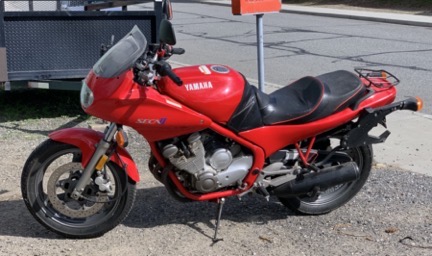
Yamaha Seca II
Here’s my bike, with the bags removed, parked in front of Bob’s house.

It’s a 1993 Yamaha Seca II that I bought brand new in 1992. I vividly recall the day I bought it in Paramus, NJ. I was still riding my first bike, a 1981 (I think) Honda CB 400 Hawk. I’d gone to Americade in Lake George, NY, with my future wasband and the sport touring motorcycle club we rode with and had test ridden the Seca II. It had more power and was sportier than the Hawk. I decided to upgrade and went to the Yamaha dealer in Paramus. I did the paperwork for the bike and then went next door to the BMW car dealer with my future wasband, who was a big BMW fan. They had a new 1991 (I think) K65 (I think) parked in the lobby area. He bought it. We showed up a week or two later at a club event, each riding brand new bikes.

Thanks for the Memories

Other Motorcycling Posts
I started this blog in 2003, which is after my primary motorcycling days. But I do have a few posts (with photos) here about motorcycling, if you’d like to read more:

I have a lot of really good memories tied up in that bike. I bought and rode it at a time in my life when I was in a good relationship with a man who still knew how to laugh and have fun. A man who knew how to say yes instead of making excuses to say no.

We took our bikes on a motorcycle camping trip down Skyline Drive and the Blue Ridge Parkway, all the way down to Georgia, then rode up the Outer Banks, right after a hurricane. It was an incredible trip — one of the best in my life.

We also took our bikes up to Lake George for Americade trips with the club and other long rides in New Jersey and New York. It was on a trip up to the Finger Lakes that I found the top end of the bike — 110 mph, if you’re curious — on a country road and began thinking about more power. I bought my 1996 Ducati 900 SSCR not long afterward.

But I kept this bike. It had the hard luggage and the comfortable seat. It would be my “touring” bike. Or so I thought.

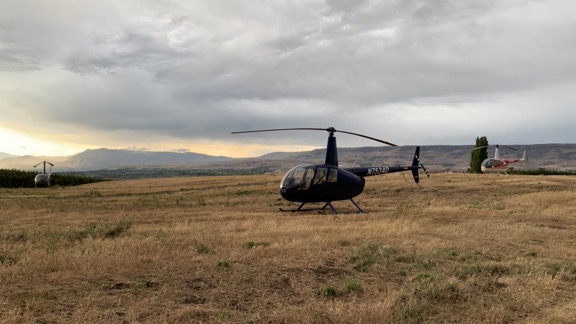
We moved to Arizona and did a lot less riding. I bought horses and rode out in the desert. I bought a Jeep (which I still have) and drove that out in the desert. I learned to fly and bought a helicopter. There just didn’t seem to be time — or a point, I guess — to ride to the same old places, over and over. The magic was gone.

When I packed up my Arizona life to move to Washington, the Ducati was the first thing to go. I rarely rode — I certainly didn’t need two bikes. Besides, the Yamaha was already up in Washington, where I’d had it shipped a year or two before. I was tired of driving a truck all summer during cherry season so I’d had the bike shipped someplace where I would want to ride it. And I did — I rode more in Washington than I did in Arizona.

Time went on. I did a trip to Friday Harbor with my friend Bob — me on that Yamaha and him on his big old Moto Guzzi. He rode like a Harley guy, slow and ponderously — not at all like the sport touring club members who had helped me find my bike’s top end all those years ago. I think I frightened him. Occasionally, I’d take it out on a ride to Leavenworth or Lake Wenatchee or Silver Falls up the Entiat River. But then I just stopped riding it.

I was busy with other things.

Too Much Stuff

As anyone who has glimpsed the interior of my 2880 square foot garage can tell you, I have a lot of stuff. Too much, probably.

Owning motor vehicles comes with a cost: maintenance. Even if you don’t use them, maintenance is required. In fact, I’d venture to say that more maintenance is required per hour of use if you seldom use them than if you use them often.

My motorcycle became a perfect example of this. Because I didn’t use it, the crap they put in gasoline these days would foul the carburetors and cause all kinds of problem. Tires and hoses get dry rot and crack. Dust accumulates. Lubed chains get clogged with dirt. Batteries die.

After not riding for a few years, I took the bike to the local Yamaha dealer to get it running again. I rode it a few times and parked it for another year. One day I charged up the battery and started it up, only to have fuel spew all over the ground. I covered it back up and left it for another two years. I stopped registering and insuring it. There seemed to be no point.

I had my hands full using and maintaining my other vehicles. The Yamaha was neglected and ignored.

Downsizing Means Letting Things Go

I had a kind of epiphany this winter when I was traveling. I think I have to thank my friend Bill for that. He lives a simple, mobile life and seems very happy. While I’m happy in my home and have no desire to give it up, he helped me realize that I’m probably at the point where I have too much crap in my life. I’d be happier if I could make things simpler.

And, for me, that means getting rid of the stuff I don’t need or want.

Let’s face it: I’m not getting any younger. I’m 59 now and starting to think seriously about retirement. I’m already semi-retired, with real work (my flying business) only a few months out of the year and busy work (my jewelry business) off and on for the rest of the year. I have big plans for my retirement years and they definitely do not include a bunch of stuff I have. Why not get rid of it now?

With that in mind, I decided that the motorcycle would be the first thing to go.

My friend Bob — the Moto Guzzi guy — came by and helped me load the bike onto a trailer so I could bring it to a repair shop in town. They put about $700 of work into the carburetor (again) and a new battery. That got it running pretty good.

Yesterday, I picked it up and rode it to Bob’s house. He’d very graciously offered to sell it for me at his house, which is a lot easier to get to than mine. He has a garage to store it in and won’t take crap from potential buyers.

That 5-mile ride — my first time on a motorcycle in at least 4 years — brought back a flood of memories. Accelerating away from traffic, gliding around curves. Feeling the power of the bike beneath me, feeing it respond to the throttle twist and pressure on the brakes. I seemed to flash back to Sunday rides in Harriman State Park or out to the Delaware Water Gap. To trips where I could feel the wind against me, sense the subtle changes in temperature, smell the aromas of things I passed.

God, how I loved riding!

But I need to be honest with myself: if I keep it I will not ride it regularly. As I age, my reflexes will deteriorate. If I don’t ride regularly, my skills will decline — as I’m sure they already have. Poorer reflexes and skills are likely to get me killed on one of the rare instances I do decide to ride it. And then there’s the maintenance of keeping it when I don’t ride it: battery tending and carburetor repairs. Ugh.

So it’s best to just let it go.

Let go of the object so many good memories are tied to. Let go of a piece of my past that I really wish I could cling to forever.

It’s hard not to cry while typing this.

In Bob’s Hands

Anyway, I brought it and its hard luggage and the big plastic box labeled “Motorcycle Stuff” to Bob’s house. I discovered that I had not one but three motorcycle covers — two of which Bob will keep for his bikes — and not one but two tank bags. I also had two helmets (and will keep one of them in case Bob ever wants to take me riding). It’ll all go in a package.

I’ll admit that I priced it high. The bike only has 22,000 miles on it and is in very good condition with all those extras. But the way I see it, if I can’t get a decent amount of money for it, why sell it? I’m not desperate for money. Besides, it’s spring in Washington, and riding weather is upon us. It would make a great bike for commuting to work or taking a trip. Even the fix-it place said there’s a high demand for used bikes right now.

It’s in Bob’s hands. I know he’ll do a great job finding a buyer for it.

Meanwhile, it’s both sad and nice to have the space the motorcycle and its box of accessories occupied available in my garage.

Letting Go

I realize now that letting go of the things you cling to for emotional reasons is part of getting older and winding down. I think I’ve been in denial for a long time about my stage in life, but letting go of my motorcycle has helped me come to terms with it.

For my whole life, I’ve been building up skills and knowledge and wealth and possessions. It’s part of a cycle that I suspect was ingrained in me from my childhood. But the cycle has another part that I wasn’t prepared for: the winding down. That’s what I’m facing now.

Back in 2013, my godfather, Jackie, died. He was single, in his 80s (I think), and, in his later years, had become a bit of a hoarder. My mother and her first cousin were his next of kin and were tasked with getting his affairs closed up. It was a mess and a lot of work for them.

I also recall when my wasband’s dad passed away suddenly and his family — wife and three adult offspring — were tasked with clearing out the stuff he’d stored in the basement. They used a dumpster.

The way I see it, we should all be tidying up our own affairs as we age to make things a bit easier for ourselves while we’re alive and our next of kin when we die. The older we get, the less stuff we should have.

Downsizing is, in a way, admission that we’re getting old. And while I’m not “old” yet, I’m undeniably getting there. It’s time for the downsizing to begin.

And that’s why I’m preparing to let things go.

Early August Check In

What I’ve been up to lately.

I know I haven’t been blogging much lately — other than to share my YouTube videos — and I apologize. I know a lot of folks come here to see what I’m up to and not necessarily to see big helicopters land in clouds of dust.

But regular readers should know why I’m not blogging: I’m keeping busy doing other things. Here’s a rundown of what I’ve been up to.

Cherry Drying

One thing I’m not doing lately is drying cherries with my helicopter. We haven’t had measurable rain here since June 28 and that’s the last day I flew.

This is both good and bad.

The good thing is that my helicopter is inching ever closer to the Hobbs meter number that will force me to bring it in for over haul. As I type this, I have 88 hours left until I must stop flying it.

If you watched my livestream video about helicopter operating costs, you’ll know that this required maintenance will cost about $250,000 (not a typo). I’ve been saving, but not that much. So I’ll have to go into debt to pay for that overhaul. (I hate being in debt.)

But because I’m hardly flying it at all, I realized that I can simply put the helicopter away for the winter and save those 80+ hours for next year’s cherry season, thus putting off the overhaul for a whole year. I should be able to save a bunch more money for it, thus reducing the loan I’ll need. It will also Eliminate the stress I’d feel trying to operate a helicopter tour/charter business when virus-related issues — social networking, the economy, etc. — might make it hard to bring in the extra cash I’ll need to keep up on the loan.

That’s the good side of this issue.

The bad side is that I like flying, especially when I can send someone an invoice when I’m done. Although I’ll get a few more flights in before I put the helicopter away — after all, I do have that YouTube channel to feed — it won’t be much.

Fortunately, all of my cherry drying contracts include a daily standby fee, so even if I don’t fly, I’m bringing in money to cover my personal and business costs.

Of course, the standby fee means I have to be on standby, available to fly 7 days a week during daylight hours. So since May 29, when my season started, I’ve been pretty much hanging around at home — or at least the Wenatchee area. (I guess a lot of folks are in the same boat with the virus running rampant throughout the country.)

During the busiest part of the season, when I had the most acreage to cover, I had four pilots helping me cover it. They left one-by-one as orchards were picked and there was less and less acreage to cover. The last one left about 2 weeks ago. Today I’m covering 34 acres by myself.

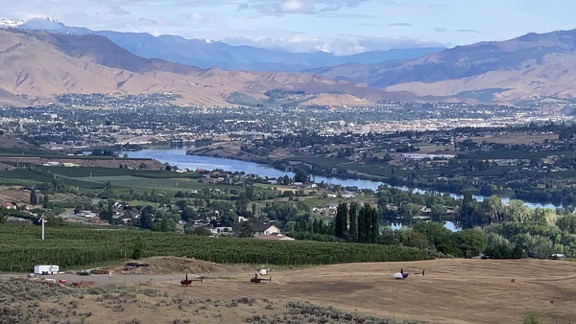
4 Helicopters
Here’s the view from my deck back on June 16; you can see four helicopters (including mine) parked in a cleared cherry orchard. The fifth helicopter was based in Quincy, covering one of my contracts there.

Starting tomorrow, I’ll have just one orchard of just 17 acres to cover until August 23. Even though the standby for just 17 acres is pretty low, I’ll stick around until all the cherries there are picked.

Cherry Driving

No, that’s not a typo. I spent a week driving cherries from an orchard to the packing house.

One of my clients was looking for someone to drive a pickup truck pulling a trailer full of cherry bins from their orchard to the packing house about 15 miles away. They knew I had experience pulling heavy trailers — after all, I lived near their orchard in my old 36-foot fifth wheel for several seasons in a row — so they offered me the job. I had nothing else that I had to do, I had to stay in the area, and I didn’t mind making a few bucks and learning about another part of the business. So I said yes.

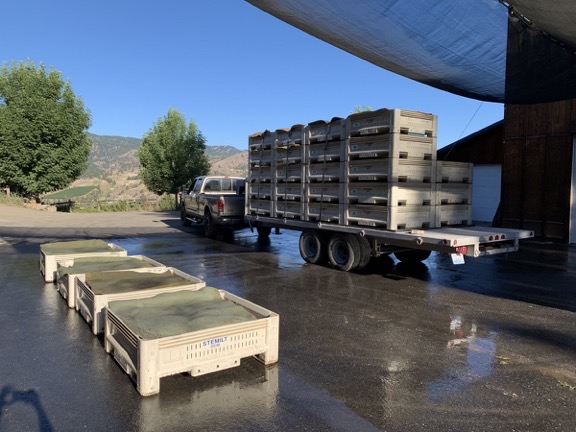
The truck was a 2004 Ford F350 4WD diesel pickup remarkably like my old green truck (RIP). The trailer was a dual axel with 4 wheels per axel flatbed with a gooseneck hitch that had been customized to hold eight stacks of plastic cherry bins.

Cherry Trailer
Here’s the rig I drove, nearly loaded, parked at the orchard’s loading area. Shade and mist help keep the area cool. Each bin of cherries is hosed down and then covered with a water-soaked foam pad to help keep them cool.

Cherry bins measure roughly 4’w x 4’d x 1’h and hold about 300-340 pounds of cherries. For the first bunch of runs, they stacked the bins 5 high so I was carrying 40 bins or 13,000+ pounds of cherries. This turned out to be the challenge: controlling speed for the first 8 miles of the drive to the packing plant, all of which was downhill.

Of course, before I left I also had to strap down those bins, which required tossing coils of ratchet tie-down straps over the tops of the bins and fastening them on the other side. It would not be good if I took a curve too quickly and the bins tumbled off.

One off my clients went with me for the first run so I’d know how to do it. I almost immediately got into trouble. The roads in the orchard are narrow and twisting and there was a hairpin curve I had to negotiate. I was so focused on the curve that I didn’t register the loose gravel in the middle of it. When I braked to slow (from about 10 mph), the wheels locked up and I came very close to sliding off the road into someone else’s orchard.

Oops.

Backing up uphill with 13,000+ pounds behind me on loose gravel wasn’t easy. I threw it into 4WD and had to use a foot on the brake while I pressed the accelerator to actually start backing up. I only needed to go back about 5 feet and managed to do it. Then we made the curve and were on our way.

I did not make that mistake again.

It took 45 minutes to get to the packing plant and they were stressful minutes. The setup had the braking distance of a freight train so I had to go very slowly any time there was a chance I might have to stop.

But then I was pulling into the delivery entrance and stopping at the entrance check point. I unfastened the tie downs while they took sample cherries and did a bunch of paperwork. Then on to the offloading area, where a team of forklifts took those 40 cherry bins off in less than three minutes. (And no, that’s not an exaggeration.)

On most trips, I came straight back, but on a few trips I needed to pick up (and strap down) empty bins or bins full of the foam pads they use to help keep the cherries cool in transit. Either way, the trailer was so light that I was able to get back in 30 minutes.

I made three runs the first day and two runs each of the next six days. I started at 8 AM — three hours after the pickers started because it took that long for them to fill 40 bins of cherries — and was usually done by noon — two hours after the pickers had finished and gone home. (They can’t pick cherries when it gets hot out and that week was very hot.) Although most loads had 40 bins early in the week, by the end of the week I was taking 44 bins (4 stacks of 5 and 4 stacks of 6). That’s nearly an extra ton. I got pretty good at controlling speed and handling the load and had no mishaps.

Along the way, I learned a lot about packing cherries. I think that was the best part of the experience; learning new things.

Cherry & Blueberry Picking

Like every year I’ve been up here during the summer — including years before I actually moved here — I always manage to get out for some cherry and blueberry picking.

I pick cherries after the growers have picked, “gleaning” what the pickers missed. I actually picked a lot more this year than I usually do, starting early with rainier cherries in an orchard near my home and, more recently, at the same orchard where I did my cherry driving. The key is to get to the orchard within a few days of picking; if you wait too long, the cherries are so far past prime they’re not worth picking.

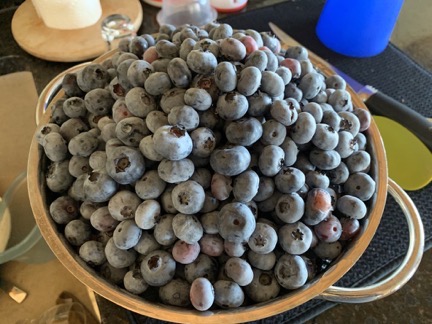
Blueberries
My first batch of blueberries.

I pick blueberries at the same orchard where I did my driving gig. The orchard owners have about 400 blueberry bushes that they don’t harvest commercially. Instead, they invite friends to come pick when they like. The season lasts well over a month — the blueberries on a bush don’t all ripen at the same time like cherries or other tree fruit do — so I can go weekly and bring home enough to freeze and still eat blueberries all week. I usually bring a friend and chat while we’re picking.

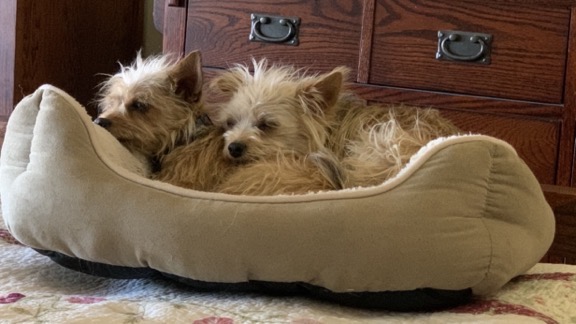
I bring my pups along on these outings. Like Penny, they enjoy running around the orchards, sniffing for mice and other rodents. It’s good to get them out someplace other than home where they don’t need to be on a leash.

Getting Out On the Water

Amazingly, I’ve only been out on the water three times so far this summer, but all three trips were real wins.

The first outing was in my own little boat with two friends. I blogged about that here, so I won’t repeat any details.

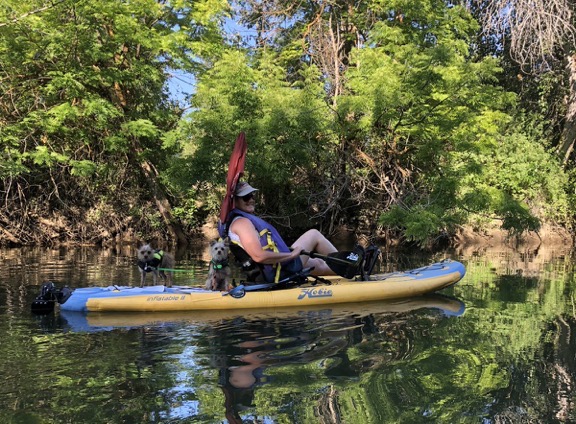
The second was paddling with my friend Cyndi and her dog. This was Lily and Rosie’s first time out on a kayak and, at first, they didn’t know what to make of it. I had life jackets on both of them and had them tethered to the kayak with expanding leashes and it’s a good thing I did! Lily took two dives into the water and Rosie took one. In both cases — their first times swimming! — their life jackets gave them plenty of floatation and I was able to reel them in with the leash as they swam back to me. We paddled around the estuary at the confluence of the Wenatchee and Columbia Rivers. The water was high so there were lots of channels to explore. We even got a chance to stop on a beach where Rosie surprised me by swimming out to my friend Cyndi who called her from the shallows.

Paddling
Here we are, paddling in the estuary. By this point, the girls knew the drill and stayed on board.

Fish
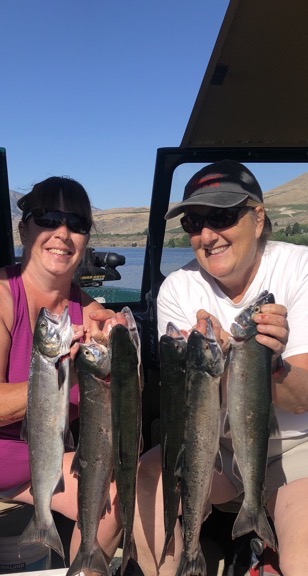
Here I am with Cyndi, holding up the six fish we caught.

The third trip was with Cyndi and her husband Matt on their fishing boat. I woke up at 2:45 AM so I could meet them at 3:30 for the hour+ drive to Pateros. We were on line at the boat ramp at 4:45 AM and joined the crowd of salmon fishers near the mouth of the Okanogan River upriver from Brewster by 5. I can’t believe how close the boats were to each other, trolling along on silent motors, pulling one sockeye salmon after another out of the river. We hit our limit of two sockeyes each by 8 AM and spent some time trying for chinook, which requires a different line setup and technique. After a half hour with no luck, we called it quits. I was happy! I took my two fish home and filleted them, freezing three large fillets and leaving a fourth for dinner. I also cooked up the bones for fish broth and made myself a nice salmon chowder with garden veggies and the trimmings from my filleting work.

Gardening

My garden is bigger and more productive than ever this year. This spring, I finally pulled out the last pallet planter I’d built, replacing it with one of the plastic cherry bins I’d bought as raised garden beds. That brings the total count to 11. (I have one more bin to install, but I need to do some deconstruction on a flower bed to fit it in; that’s an autumn project.)

Veggies from my Garden
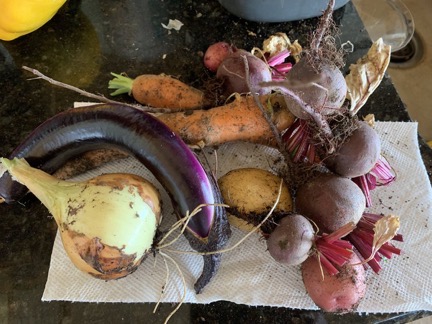
Here’s one evening’s side dish, brought in from the garden. I washed and chopped all of these, then roasted them with herbs in the oven. Delicious!

What did I plant? Let’s see. Broccoli, Brussels sprouts, onions (2 kinds), beets, radishes, scallions, tomatoes (3 kinds), asparagus, potatoes (3 kinds), sweet potatoes (2 kinds), peppers (4 kinds), eggplant (2 kinds), horseradish, spinach, carrots, strawberries, zucchini (2 kinds), yellow squash, pattypan squash, cucumbers, delicata squash, cantaloupe, watermelon, pumpkins, corn (2 kinds), green beans. Well, I didn’t plant the green beans — they planted themselves and have been doing so for the past four years.

Potatoes
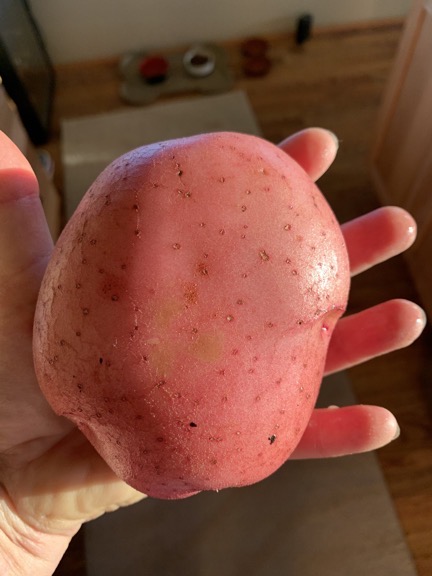
Have you ever seen a red potato this big? That’s my hand under it — and my hands aren’t small. I pulled it out of my garden last week.

I’ve been harvesting a little of almost everything and planting more beets, carrots, scallions, and radishes any time a bed empties and onions every time I pull a row. The only veggies I buy at the supermarket now is salad greens and broccoli (because it’s all done now). Everything else comes out of the garden and, frankly, I can’t keep up with production so I’m giving a ton away.

The 11 chicks I got in April are just getting ready to start laying. I just started an egg subscription service for neighbors: $10/month gets you a dozen eggs delivered to your doorstep once a week — if you give back the cartons. When I have all 16 chickens producing, I’ll be getting a dozen eggs a day and will need to do something with them. There’s only so much quiche a person can eat.

Cooking

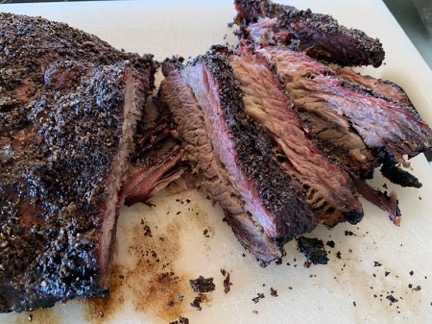
Brisket
I finally found a brisket recipe I felt able to follow — with some modifications — and made this. Not bad for a first try.

Like most of the folks stuck at home this summer, I’ve been doing a lot of cooking. Some of it is an attempt to use up some of the produce coming from my garden or the orchards and blueberry patch where I pick fruit. Others are attempts to make something I’ve always wanted to try making.

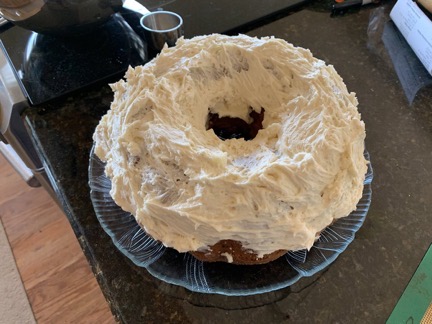
Cake
The cake tasted even better than it looks, but what was I thinking?

When I make something that freezes well, I portion it out, vacuum seal it, and put it in my garage freezer so I always have a quick meal available on those days I don’t feel like cooking. I made a blueberry zucchini cake recently and wound up giving nearly all of it away to neighbors and friends. What was I thinking when I made a cake that big?

Other Stuff

I’ve also been making and selling jewelry, although not as much as I’d like. I think I’ll save that for another blog post.

I’ve also been doing a lot of video editing for my YouTube channel, but I’ll whine about that in another post, too.

But these are the main things I’ve been up to this summer. When the weather is nice, I’d rather do stuff outside than sit in front of a computer typing up a blog post and that explains why I haven’t blogged so much.

I will try harder to blog more in the future. I find that my blog posts are the best way I can remember the things that went on in my life years after these things happen. My blog is my journal and I really do need to stick with it.

Stop for Five Minutes and Listen

Relax with me and see if you can hear what I hear.

I woke up this morning to another beautiful summer day. It was still cool outside and the sun’s first light turned the landscape around me that odd golden color I only get to see at first and last light. I took my coffee out onto the deck to enjoy a break before hustling down to the garage to load up my pups and kayak for a few hours of paddling around the Wenatchee and Columbia Rivers confluence with a friend.

The early morning quiet — which wasn’t exactly quiet — struck me. I wish I could bottle it up and share it with friends. Then I realized I could. My tripod was handy, along with the dead cat protected microphone I used with my iPhone for various video work. It took two minutes to set it all up. I recorded 5 minutes and 15 seconds of my morning bliss.

The news got you down? Worries about the economy, your job, the virus, politics? Feeling stressed and angry?

Slow down. Stop. Take a deep breath. Grab a cup of your favorite beverage and step out into a place away from the news, mobile devices, and other people. Look around. Listen. Become one with your surroundings.

Five minutes will make a real difference in your day.

And if you can’t find the right spot for your own five minutes, come on back here. You can borrow mine any time you like.

On Saying Yes When You Want to Say No

Never turn down an opportunity to hang out with new friends.


Here’s a time-lapse on YouTube of moving the helicopter. I didn’t realize at first that I had blogged about it.

The other day, I was invited to a steak dinner at what I call the Huey Camp: the area where three Huey helicopters are parked for cherry season. I met one of the pilots, Stan, late last season when I brought him and the other pilot a pizza after chatting with him on the radio while we were all drying cherries. Later, he let me fly his helicopter and I returned the favor by helping him load the helicopter onto its trailer while it was attached to my truck.

Huey Behind Truck
As I tweeted when I shared this photo on Twitter, I think that helicopter looks pretty good behind my truck.

I ran into him again in Arizona over the winter and was glad to hear he was coming back to Washington for cherry season, camping in his motorhome at the same place. He and another one of the Huey pilots came for my annual pilots’ BBQ a few weeks ago. So when he invited me for a steak dinner with all the Huey pilots and some others in attendance, I said yes.

Thinking of Excuses

Of course, when that afternoon rolled around, I wasn’t feeling like going out. The heat really knocks me out sometimes and I’d spent the afternoon napping after doing too much work in my garden. It was hot outside in the sun and I didn’t think there would be much shade up at his camp. I thought about all the excuses I could use to back out.

Falconer
It was dark out when I captured this image of a falconer with one of her birds last August.

But then I thought about the previous year’s steak dinner up there. (I apparently didn’t blog about it because a quick search came up empty.) In any case, it was one of those magic evenings when things are just a little bit weird and a little bit wonderful. One of those evenings you remember for a long time, mostly because they’re out of the ordinary. That one involved a frantic trip to a car parts shop with a woman I’d met just an hour before, arriving just before they closed to get a part she needed for her truck. Then repairs on the truck with steaks coming off the grill after 10 PM. It was after that that I learned the woman was a falconer and I got a really neat shot of her with one of her birds.

That night might be just as interesting, I told myself. Or more. You can’t experience new things when you stay home. Get the hell out.

At Huey Camp

So I showered and dressed and hopped in the truck for the 20 minute drive up to Huey Camp. I left my pups behind — I didn’t want to have to worry about them wandering off into the weeds where there might be snakes. The only reason I took the truck was because it was the only one of my three vehicles with a top — I keep the top down all the time on the Honda and the Jeep was in the process of getting a new roof — so it had the best air conditioning.

Huey camp is situated between two ponds that are linked by a waterway when the water levels are full. Two Hueys were parked on one side and the third was parked some distance away. Stan’s motorhome and dune buggy were parked between them, near one of the ponds. He’d positioned it so the side we’d sit on was in the shade of the big rig. The helicopter’s truck (with crane) and trailer were parked nearby, along with all kinds of orchard equipment. The spot is on a flat area on a hillside, surrounded by apple and cherry orchards, including one I’m contracted to dry. It had an excellent view of the sky, which came in handy later on.

Huey Camp
Huey Camp from across one pond.

Huey Camp
Two of the helicopters at Huey Camp.

We settled into chairs in the shade to chat while Stan prepped his portable BBQ grill. Stan, Brandon, and Dave were the Huey pilots. Brandon’s friend Emma, who is a new helicopter pilot, was also there. (I’d invited both of the pilots still working for me this season, but one had taken his paraglider to Spokane (!) again and the other was taking a motorcycle training course out at the airport.) Later, CJ (a JetRanger pilot) and Isaac (a falconer) joined us.

It turned out that we knew a lot of the same people and helicopters. Brandon had flown my helicopter when he was training at Quantum in Arizona, although he claims it was a different color. He’d also flown my friend Ed’s old S55 with the turbine conversion, which was now based up in Brewster on cherry work. One of the Hueys had actually been flown in Vietnam by a local guy who had come up to visit it all these years later.

Isaac had to do some work in two of the orchards and invited us to come watch. Some cherry growers use falconers to help chase birds away from their orchards. By repeatedly flying the falcons (or hawks, etc.) over the orchard blocks, birds like robins, which like to eat cherries, become convinced that a predator has moved in and they leave. That’s the idea, anyway.

Issac with Bird
Here’s Issac with one of his birds after the bird flew in the orchard. Hooding the bird is common and does not hurt the bird.

We all loaded into my truck and followed Isaac to his first worksite, which turned out to be very close. We watched him get a bird out and attach a GPS tracker to it (just in case the bird decided it wanted an extended break). Soon he’d removed the bird’s hood and it was flying over the cherry trees. Isaac had a long pole with a string and bait attached to it and swung the bait around. The goal was to get the bird to dive at the bait but not let him get it. He did this from a few locations alongside the orchard block before the bird “won” — it caught the bait. That cut that bird’s session a bit short, but Isaac had another bird with him and moved on to the next orchard. We went back to camp, mostly because Dave was hungry and I think Brandon and Emma were bored.

Stan started cooking right after that. He’d bought a rib roast and had carved it up into enormous bone-in steaks. I’d brought along my little grill and some uncooked marinated tri-tip that someone had left at my house at the BBQ and I’d frozen. I got that going and it was a good thing I did because Stan didn’t have enough room on his grill for all of the steaks so one ended up on mine. A while later, the sun was setting and we were eating steak — with horseradish, of course — potato salad, and salad off paper plates. Isaac was back by then and he joined us; I wound up giving him half the trip-tip for later in the week because there was enough regular steak for all of us.

Stargazing

After dinner, we moved over to a spot where we could see the sky to the northwest more clearly. Comet NEOWISE was a feature in the sky after sunset and I think we were all vying to be the first to spot it. One of the younger people saw it first — Brandon, I think — and over time we all saw it. The view from up there didn’t include the lights from the city, but it did include the glow from sunset.

We all started watching the sky, pointing out stars that flickered weirdly or seemed to change color. I saw a fast moving white light pass by and consulted the GoISSWatch app on my phone — sure enough, it was the space station. When I pointed it out, some of my companions were blown away. “You mean that’s the actual space station in orbit?” Dave asked. I told him it was and that there would be an even better pass just before 11 PM, right overhead.

That got us looking for satellites. Again, the younger folks with their sharper eyes spotted them quickly. Brandon got excited when he realized that he was seeing a bunch in a row. Believe it or not, I had an app for that, too: Find Starlink. Sure enough, we were seeing a Starlink satellite train that was passing overhead. I’d tried before to see one and failed miserably — now I know why: they really aren’t that bright at all.

We spent the next hour or so just watching the sky and talking. It was relaxing and kind of interesting. Our ages ranged from early 20s (Emma) through possibly 70s (Stan and Dave?). We talked about things we knew and told stories about experiences. No one had their head buried in a phone. No one argued. There was a lot of laughter. Politics stayed pretty much out of our discussions.

At 10:56, right on schedule, one of my companions spotted the space station again. We watched it travel across the sky, right overhead. I thought about the people on board and how tiny they were but how many people on earth watched them go by whenever they could. When it was gone, I decided it was time to leave. It had been a pretty good night for stargazing: a comet, two ISS passes, a Starlink train, and did I mention seeing Jupiter and Saturn in the southeastern sky?

Finishing Up the Night

It was a quick drive home. I left my truck on the driveway apron instead of putting it in the garage, mostly because I knew I’d need to drive it again the next morning on a garbage run. I let my pups out and my cats came over from wherever they were hunting to say hello. It was nearly midnight when I climbed the stairs.

But I wasn’t done. Outside, Comet NEOWISE was hanging in the sky near the lights of Wenatchee. I set up my Nikon and took a few shots with various settings, pausing now and then to study it through my binoculars and wonder what it would look like through my telescope.

NEOWISE
Comet NEOWISE with the Wenatchee night skyline.

I was asleep by 1 AM.

Postscript

I love living alone for the privacy and freedom that it gives me. I don’t get lonely because I stay busy. Sometimes, I’m so busy that I forget to get out and socialize when I should.

But one thing I’ve come to realize: any time I’m at a gathering with friends is time well spent, especially when the friends have unusual lifestyles that involve travel and unique jobs. The other day, I had dinner with five other helicopter pilots and a falconer. How can a gathering like that not be full of fun, interesting stories and experiences?

I have a friend I call “the man of a thousand excuses” because he’s far more likely to say NO when he’s invited to do something different than YES. I don’t think he has any idea of what he’s missing.

I have an idea of what I could be missing, so I try to say YES whenever I can.

Boating with Friends, 2020

Another day out in the boat reminds me how much I like being out on the water.

Way back in the autumn of 2011, I bought a 1995 Sea Ray Sea Rayder. This is a 16-foot jet boat with a 130 HP engine that can get it up to the whopping speed of 30 MPH on smooth water. It has five seats, a canopy that shades the three back seats, and the ability to pull a water toy but not a water skier. It’s the third boat I’ve owned — the first two were WaveRunners that I owned for a while in Arizona — and I actually bought it in Washington when I still lived in Arizona. I spent so much time just sitting around during cherry season that I thought it might be fun to have a boat in the area to take out on the Columbia River.

Boat in Garage
Here’s my little boat, tucked into its spot in my exceedingly large garage.

Fast-forward nine years. I kept the boat all this time (despite a bizarre episode at one of my two divorce trial dates in 2013). When I built my home, I made sure that my garage would have space for it. I used it a few times every season — some would say not often enough to own a boat, but I didn’t pay much for it and it’s cheap to keep. I took it to Arizona with me for the winter back in 2016/17 and had some fun with it out on Lake Pleasant and the Colorado River. And I continue to use it a few times every summer.

I would have taken it out a lot sooner this season if it weren’t for the battery. I was having a heck of a time getting it charged and I was starting to wonder whether it needed replacement. Pulling the battery out of the boat while it was on the trailer was not something I could do alone and I never seemed to find time to get the boat into town so it could be checked. Eventually, I realized that the problem wasn’t the battery — it was my battery charger. I bought a new one the other day, hooked it up, and voila! The battery charged up to 100% in just a few hours and I was ready to take it out.

Boat on Jeep
The boat is a lot easier to launch from the Jeep, which is currently topless while I wait for the new top to arrive.

I made plans with a two friends to take it out on Wednesday morning. The weather has been awesome here — unless you’re a cherry drying pilot — and although it tended to get a bit warm and windy in the afternoon, it was pleasant enough in the morning. One of my friends is a neighbor and I picked her up at 9 AM in my Jeep with the boat in tow. (It’s a lot easier to launch with the Jeep than my truck.) After stopping to top it off with fresh fuel, we drove to the boat ramp in Wenatchee behind Pybus Public Market.

I have to take a moment to rave about the free boat ramps and riverfront parks and trails we have in the Wenatchee area. The waterfront is managed by the local public utility district — the Chelan PUD — which manages the dams that give us most of our cheap, renewable power. As a public utility, they use our utility fees to maintain their systems and build/maintain a series of public parks along the river. There are two different boat ramps within 12 miles of my home and others farther away to access other dam-locked bodies of water on the Columbia River. The parks have paved biking/walking trails, softball fields, tennis courts, picnic shelters for group gatherings, volleyball courts, a swimming beach — the list goes on and on. The Apple Capital Loop Trail is an 11-mile paved walking/running/biking trail that loops on both sides of the Columbia River, with several access points on either side and extensions to other parks on the East Wenatchee side. All of this is free to use with plenty of free parking.

Anyway, I launched the boat while Teri watched over my pups. We tied up at the floating dock between the two lanes of the ramp and waited for Cyndi to arrive. Although there were a few cars with boat trailers in the parking lot, no one else was launching or coming in. While we were waiting, I cranked the engine until I got the boat started and let it idle for a while, which is something I don’t like to do, given that this jet boat doesn’t have a real idle. (When the engine is running, it is propelling the boat.) I shut down until Cyndi arrived, loaded everyone up, and after an iffy start due mostly to me not remembering if the button had to be IN or OUT for choke, putted out into the river.

My usual boat use in the area is to motor on up to the Rocky Reach Dam upriver from town, cut the engine, and drift back. I do this mostly because the boat can be loud under power and it’s no fun shouting back and forth to each other. It takes about 15 minutes to reach the dam and that day, we hit some mildly rough water in a windy spot along the way. As a jet boat with its weird rudderless steering, it operates best on glassy smooth water. This wasn’t a big deal and we motored right through it to more smooth water beyond. We didn’t get right up to the dam, but we did get close enough to see that they had multiple flood gates open. The water would really be churning at the base of the dam and we didn’t need any of that. So I cut the engine and welcomed the silence. We immediately started drifting back at a rate of about 3-4 miles per hour.

Motoring in my Boat
Cyndi took this photo of us just getting underway up the Columbia River. That’s Teri next to me, holding my pups. This was their first time in a boat and they didn’t know what the hell was going on.

The awning was up and Teri and I were under it. Cyndi sat in the bow, soaking up the sun. My pups, wearing their life jackets, walked around the boat for a while. Lily was a bit whiney and I held and comforted her for a while. When she realized that it was what it was, she finally settled down.

Pups on a Boat Pups on a Boat
Lily and Rosie were a little uneasy when we first stopped, but soon caught on that there was food to be had and begging to be done. Penny’s old yellow life jacket fit Lily perfectly; Rosie got the slightly larger one I bought for her in preparation for a kayak outing. (We still haven’t done that yet.)

We’d brought snacks and popped open the coolers. We chatted about all kinds of things: dogs, politics, the virus, fishing, camping, boating, traveling. Teri and Cyndi, who had never met before, seemed to hit it off well.

Repositioning the Boat
Cyndi took this shot of me holding both pups while gently guiding us away from shore and back into the main channel of the river.

All the time we drifted, we watched the scenery change around us. The air was cool in the shade. We saw bunches of buoys and, later, a police boat with a few guys on board tending to some others. We never figured out what that was all about. There were some other boats on the river — mostly the big aluminum fishing boats that are so popular around here. The salmon are running and although we weren’t there at the best time of day for salmon fishing, some folks were apparently trying anyway. A few times we drifted so close to the east shore that the boat got caught in a calm spot and stopped drifting. One time, it even headed back upriver. Each time, I’d push the button to start the engine, shift into forward gear, and move back toward the middle of the flow.

I know none of this sounds very exciting and it wasn’t. But it was restful and pleasant. It was nice to get out with friends someplace other than one of our patios or decks. It was nice to be on the water, which is something I’ve always enjoyed.

Columbia River
Cyndi took this shot looking back up the Columbia toward the Wenatchee River confluence. It was a perfect day for boating.

Cyndi had to be back by 12:30 for an appointment that afternoon, so at 12:15, I started up the engine again and pointed us back toward the launch. By that time, we were less than a mile away and I kept to a slower speed, which is not like me at all. I had a little bit of trouble getting the boat pointed into the launch area with the current pushing us so hard past it; jet boats don’t steer well at slow speeds, especially when fighting wind or a current. I have the boat rigged so I can bring it into a dock by myself and was pleased that neither passenger tried to “help” when I didn’t need help. I pulled up next to the dock, tied off from my seat, and killed the engine. Smooth. After a year, I still had it!

Cyndi left right away and Teri and I took care of the boat and pups. I did a great job backing the trailer in (if I do say so myself) — the Jeep is a lot easier to back up without a roof and rear window. Soon I had the boat on the trailer and, when I pulled out slowly, the boat positioned itself properly between the two fenders. I parked it in the shade of a tree in the parking area and pulled everything out, closed up the top, and put the cover on it. Teri tracked down my pups who had wandered off to find a place to pee. We all climbed into the Jeep and headed home.

Pushing the Boat
It’s a lot easier to push the boat into the garage than back it in. Why work harder than you have to?

I dropped off Teri and her cooler at her house, then went home. It was already getting hot and I wanted the boat put away before it got too hot. I unhitched the boat in my big driveway apron, turned the Jeep around, and re-hitched it using the front tow ball on the Jeep. With a little maneuvering, I pushed the boat into the end garage bay where it lives, unhitched it again, and backed my Jeep into the garage bay at the other end.

When I checked my watch, I was very pleased to see that I’d been able to get the boat out of the water, drive it 12 miles to get home, and put it away in less than an hour.

I need to take it out more often.