Things change.
There were a few things that drew us to our house in Wickenburg back in 1997 — beyond the obvious benefits of living in a recently built home. Situated in a hilly and rocky area on the edge of town, our 2-1/2 acres of horse property ensured plenty of privacy. Indeed, to this day we often sleep with the curtains wide open to the night sky. We had few neighbors and the ones nearby were generally very quiet. The dirt road we shared with two neighboring homes was in such bad shape that we didn’t have to worry about strangers bothering us. The Jehovah’s Witnesses have only found us twice in 11 years.
But one of the best things about our house was the view out the back. I’m not talking about the glimpse of nearby Vulture Peak. I’m talking about my neighbor’s home and its windmill.
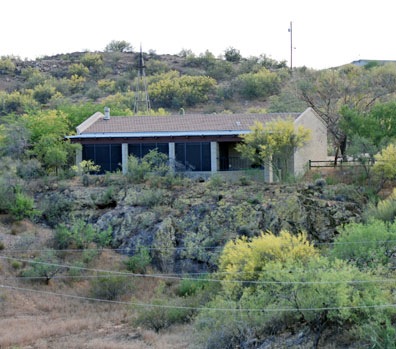
 The house was one of the very first built in our area. It’s a one-story structure with just two bedrooms and two baths, perched on a rocky, lichen-covered outcropping. At the base of the rocks was a densely vegetated flood zone, filled with local trees and bushes slightly higher than the level of Cemetery Wash, which also flows through our property. Up at house level were irrigated trees so mature that they blended in perfectly with the home. The house seemed to be part of the landscape. And in the morning, when the first light of day hit it from the east, it glowed red, as shown in this July 2007 photo.
But what I loved most was the windmill. This wasn’t a decorative lawn ornament — it was the real thing. It looked ancient and antique, but it caught the wind faithfully and pumped water from a well. Enough water for my neighbors to have a fish pond. A pond big enough to attract herons — yes herons! — in the desert.
Sometimes on a quiet evening, when the wind blew from the west, I could hear the mechanical clanking sound of the gears and pumps. The rhythm varied with the wind speed. And we could look outside during daylight hours and see just how windy it was.
When we first moved in, I came very close to choosing the back guest room for my office just so I could look out at that windmill while I worked. But late afternoon sun shining in that window convinced me that the front bedroom was a better choice if I wanted to leave my blinds open.
Time went on. And on. My neighbors decided to move. They put the house up on the market and about sixteen months ago, just before the real estate bubble burst, sold it for their asking price. I heard about the new owners through the local grapevine. Wealthy people who had another home. This would be their “guest house,” one person told us. They have horses and kids. They’re going to use it for a vacation home.
Before long, the workers arrived. They enlarged the horse enclosures on the property’s lower level and put in a welded pipe fence to create an arena. I worried when they put up tall poles for lighting and hoped they didn’t plan on keeping them on every night. More workers came with chainsaws and heavy equipment. Over a period of several days, the removed all the natural vegetation below the house, leaving the land barren. They’re putting in an irrigated pasture, one neighbor said. They used earth moving equipment to pile sand in berms that they evidently expected to protect the newly cleared land. They fenced in all of their flood plain property, putting an access gate in the deepest part of the wash.
Then they disappeared.
For a while, there was a red truck in the driveway. A caretaker, someone told me. Lights were on at night. The house looked a bit lived in. But then the red pickup stopped coming. A single light was on all the time, like a blind eye in a forgotten home. Then even that went out.
 Monsoon season came and the first heavy rain brought a massive flash flood. The sand berms were no match for the power of flowing water. The water coming down the wash was no longer held back by the dense vegetation that had grown below the house. The wash changed its course, flooding the undeveloped “pasture” and cutting across the bottom of our access road. The rushing water completely flooded the sandy area in our part of the flood plain and, for the first time ever, our entire fence was washed away.
When the water subsided, parts of our neighbor’s new fence were tangled across the access road to our neighbor’s house. Cinderblocks from their corral area littered our lower horse corral. Their “pasture” was filled with sand. Lucky they hadn’t set up the irrigation yet; it would have been destroyed.
No one came to fix their fence. My neighbor dragged its remains aside so he could drive through. After a while, tired of chasing trespassers in quads out of the wash, he spent a whole day repairing the damage.
Still no one came.
Throughout this time, the windmill kept turning. But the fish pond was empty and the riparian wildlife was gone. The irrigation must have been turned off because trees close to the house began to die. It made no sense; the water was free. Why not take care of the trees that depended on it?
This winter, I noticed that the windmill was making more noise than usual. It squealed to life in a heavy breeze, then clanked and screeched as it turned. I wondered why, after all these years, it was having these problems. Finally, after a few weeks of listening to it, I tracked down the former owners and asked them. Did the windmill require maintenance?
Oh, yes, I was told. “We had the pump people come in once a year for preventative maintenance.”
I asked if they could get in touch with the new owners and tell them about the problem. They said they had no way of getting in touch with them. We said goodbye and I hung up with a feeling of foreboding.
More time went by. The squealing and clanking got worse. It wasn’t a happy sound; it was the sound of neglect, the sound of the windmill’s pain. Neighbors who lived closer to the house must have taken action. Perhaps they called the owners. But the solution was not the one I wanted to see.
While I was out one day, workers took the head off the windmill and left it on the ground, at the base of one of the dead trees.
That was two months ago.
Today, the windmill’s tower stands topless, like so many deserted windmills throughout the desert. The trees closest to the house are dead. There are no flowers, no cars in the driveway. A single square of light looks out toward our house every night — the burned out lightbulb replaced by someone who checked in one day. The house seems dead and forgotten.
To me, the death of the windmill is a symbol of what’s happening to Wickenburg. With our 50% seasonal population, there are many homes that stand empty and neglected when summer comes. As developers take horse property and turn it into CC&R-controlled subdivisions, the people who moved to Wickenburg years ago for a taste of the old west are moving out. The new people don’t care about horses and natural desert vegetation and wildlife.
And apparently they just don’t understand the powerful emotions generated by watching an old windmill turn in the breeze.

 There was a big fire northwest of Quincy on Sunday. I first saw the smoke when I first drove into the Quincy Lakes area and didn’t think much of it. I figured someone was burning brush or trash. But when I next saw the smoke, it looked like a big, white mushroom cloud. Later in the day, the base of the smoke had spread. It was obviously a wildfire.
 With that load off my mind, I could goof off a little. I drove into downtown Wenatchee and parked right on Wenatchee Avenue. I immediately spotted a Mongolian BBQ restaurant. I hadn’t had Mongolian BBQ in 10-15 years and my stomach was grumbling for lunch — it was 12:15 PM, after all — so I went in. I had a great lunch. Then I came back out into the sunshine and walked a few blocks down and then up Wenatchee Avenue, looking into the shops. There’s a great sporting goods shop on the east side of the street and I’ll probably be going back next week to buy a new bicycle seat there. I treated myself to a vanilla ice cream with a shot of espresso on top before heading back to the truck.
 I’m writing this from the dining table in my 21-foot pull trailer. I pulled it to Quincy, WA on the back of my 1994 Ford pickup truck from Wickenburg, AZ last week. You can read about each day of that journey
  My trailer is comfortable. It’s 21 feet long, but none of that floor space is taken up with beds. Instead, the beds drop down in their own little tent-like structures on the front and back of the camper. Each bed is slightly smaller than queen sized. Their mattresses are 6-inch foam. Because I only need one bed, I stacked two mattresses on the back bed and put linens on that. The other bed is open, but I’m using it for storage and for Alex’s cage.
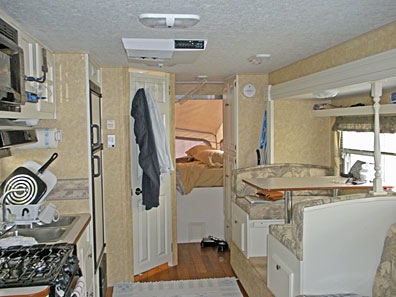 My bed has flannel sheets and three blankets on it. Since I added the third blanket, I’ve been sleeping remarkably well. In fact, when I wake at sunrise (around 5 AM) with Alex’s first words, I feel cosy and refreshed. I don’t want to get out of bed. This is extremely unusual for me — at home, I jump out of bed as soon as I wake.
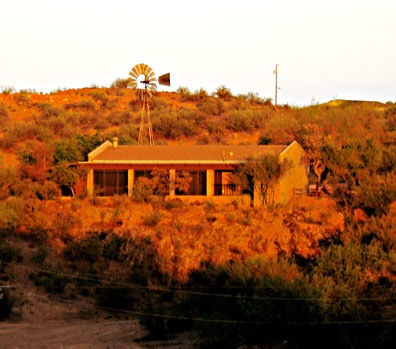 The house was one of the very first built in our area. It’s a one-story structure with just two bedrooms and two baths, perched on a rocky, lichen-covered outcropping. At the base of the rocks was a densely vegetated flood zone, filled with local trees and bushes slightly higher than the level of Cemetery Wash, which also flows through our property. Up at house level were irrigated trees so mature that they blended in perfectly with the home. The house seemed to be part of the landscape. And in the morning, when the first light of day hit it from the east, it glowed red, as shown in this July 2007 photo.
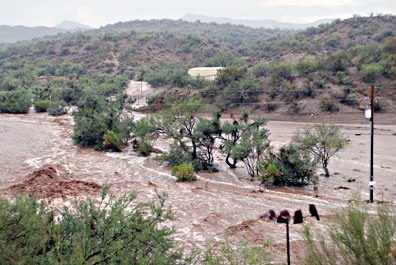 Monsoon season came and the first heavy rain brought a massive flash flood. The sand berms were no match for the power of flowing water. The water coming down the wash was no longer held back by the dense vegetation that had grown below the house. The wash changed its course, flooding the undeveloped “pasture” and cutting across the bottom of our access road. The rushing water completely flooded the sandy area in our part of the flood plain and, for the first time ever, our entire fence was washed away.
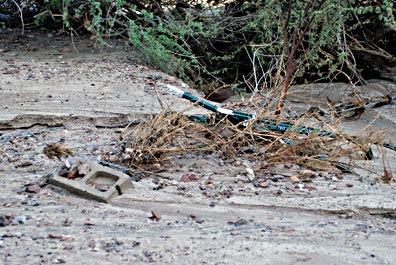 When the water subsided, parts of our neighbor’s new fence were tangled across the access road to our neighbor’s house. Cinderblocks from their corral area littered our lower horse corral. Their “pasture” was filled with sand. Lucky they hadn’t set up the irrigation yet; it would have been destroyed.
 While I was out one day, workers took the head off the windmill and left it on the ground, at the base of one of the dead trees.