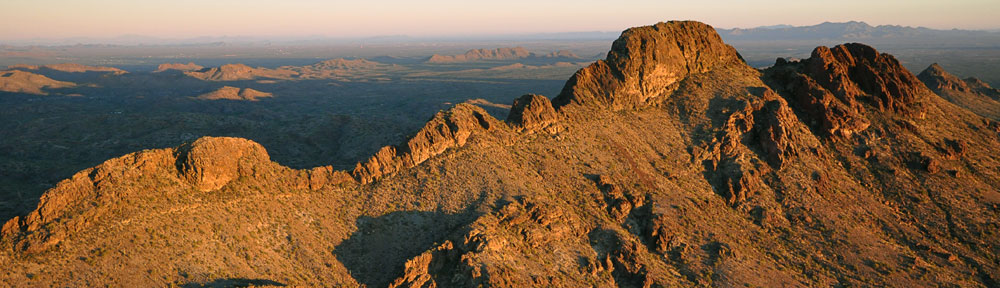
On Volunteering

Twenty hours this weekend.

This weekend, I spent a total of about 20 hours as a volunteer on the annual Land of the Sun Endurance Ride in Wickenburg, AZ. This was my fifth or sixth year as a volunteer — I’ve lost count — and it’s one of the feel-good things I do for my community.

The event, which is sponsored by the Wickenburg Horsemen’s Association, depends upon volunteers to be a success. There are countless jobs to be done, from marking and grooming the 50 miles of horse trails to marking numbers on the butts of horses. There are folks who handle registration paperwork for this AERC-sanctioned event, folks who order t-shirts and sweatshirts and prizes, folks who handle special requests and complaints. There are folks who buy or prepare the food for attendees, put it out on long tables, and clean up after every meal. There are folks who put out hay and bran and carrots for the horses, folks who fill the water troughs at vet checks, and folks who stand ready with clipboards while paid veterinarians call out horse vital signs. There are folks who check off the numbers of riders as they leave and as they return, and folks who track down riders who haven’t come in yet. There are folks who pick up injured — or just plain tired — riders and horses who are dropping out of the event, using trucks and horse trailers. And there are even folks just hanging around every 3 or 4 miles out on the desert trails, handing out water bottles to riders as they pass. These are just some of the jobs. There are doubtlessly many others I don’t even know about.

What I like about volunteering at the endurance ride is that I’m truly needed and appreciated as a volunteer. I come in and do my job(s). I’m not micromanaged or criticized. And I really get a charge out of the thanks I get from participants just for doing what I’m supposed to.

Each year I generally perform two or three tasks:

  • Make my famous (around here, anyway) vegetarian bean soup. A bunch of volunteers make soup, stew, or chili, but I seem to be the only one who makes a vegetarian dish. It’s actually gotten a few people to think I’m a vegetarian. I’m not. But I recognize that many of the riders are. And when the weather is less than perfect, it’s nice to be able to have a hot and hearty meal on the hour-long break between 25-mile ride segments or at the end of the 25-mile ride. This year, the weather was pretty good and I took home 1/3 crock pot of soup. I’ll freeze it and enjoy it the rest of the winter.
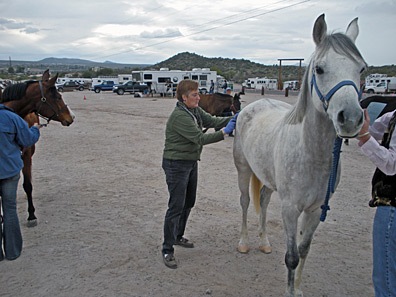
  • Marking Horse ButtsUse large crayon-like markers to write horse entry numbers on the butt ends of horses. It’s not usually a difficult task — most horses have been through this more times than I have and have no problem with strangers marking up their butts. But a few horses are real dancers that make the job difficult. And every once in a while, I’ll encounter a kicker. Their riders get the crayon to mark them. I usually do this from 2 to 6 PM the day before the race.
  • Record the numbers and times of 50-mile riders who return to the main base after their first 25-miles. I do this with another one or two volunteers. My job is usually to write the entry number and time on a blue ticket that I hand to each 50-miler as he or she crosses the 25-mile finish. The rider then takes care of his or her horse and visits a vet to be pulsed down. (There are lots of vets on this ride; no horse is allowed to leave a vet check if it can’t meet certain health requirements.) I usually work with someone who sits at a table and records this same information on a master sheet and another person a bit up the road who uses a radio to tell us who is on the way.

This year, I did all three tasks. I also stuck around to record the 25-milers finish and the 50-miler finish. When I left at 6:30 PM — which was well after sunset — all of the riders had returned except one. She’d refused a lift from a horse trailer and had insisted on finishing the race in the dark. She was riding with the “drag riders” — folks whose volunteer job was to ride portions of the trail, remove marking ribbons, pick up lost items, and make sure no one was left behind. A vet and three volunteers were left to wait for her; everyone else had gone to the award dinner in town.

Endurance RidersIt was a long day for me. I started at 6:30 AM, in the dark, to help put out breakfast and tidy up the departure area after the 50-milers left at 7 AM and the 25-milers left at 8 AM. I also set up a few feed stations with hay and carrots not far from the huge water trough there. I noticed a definite scarcity of volunteers — surely there were more at the rodeo grounds in previous years. The woman who was supposed to help me record the incoming riders never showed up, so a spare volunteer was put to the task. And although I’d told Nancy, who runs the whole shebang, that I’d record the in-times for all riders rather than just the first loop for the 50-milers, I stupidly didn’t realize that I’d have to record the 50-milers again after their second loop. That’s why my day was so long. It wasn’t a big deal — and it was certainly made quite pleasant by the few hours I spent chatting with one of the other volunteers as we called in arriving horses — but it was a very long day for me. I’m not accustomed to being on my feet that long.
One of the things the other volunteer and I discussed was the shortage of volunteers at the rodeo grounds. It seems that each year, there’s a group of core volunteers who show up to perform their tasks. Then there are a number of “volunteers” who show up to watch the goings-on at the rodeo grounds and help themselves to breakfast or lunch before disappearing. These same people often have their hand out for the dinner coupon that volunteers get so they can join in the evening’s festivities after the event. And many of them are sure to walk away with a volunteer t-shirt or sweatshirt.

While I certainly don’t expect association members to volunteer 12-hour days for the event, I don’t see why more of them couldn’t give 3 or 4 hours of their time. The timing in, which I do every year (except the one year I was sick), is usually done in shifts; this year, the same three people worked the finish line from the first arrival at 9:40 AM to nearly the last arrival at 5:30 PM. I really feel bad for the spare volunteer who had to fill in for the woman who didn’t show up — surely she got more than she bargained for. There were likely other volunteer stations that could have benefitted from multiple shifts of volunteers. Where were these people? The event is sponsored by the association. Any net proceeds from the event go to the organization. They all benefit from the hard work of a handful of people.

I’m sure this isn’t an uncommon thing in clubs and other groups. It’s just unfortunate that the weight of an entire organization has to be borne by a small portion of its members.

And, truth be told, some of us aren’t even members anymore.

Anyway, the event was a huge success, judging from the comments of riders I spoke to as they crossed the finish line. The trails were well marked and it was a beautiful day for riding. Of the 136 original entries, only about 12 were pulled due to horse or rider problems. It seemed as if the event went off without a hitch, which is great for Nancy.

I do want to take the opportunity here to complement and congratulate Nancy for another job well done. Nancy is a local business owner with her own responsibilities, yet she takes on the task of managing this ride every year. I can’t imagine the stress of it all. She does an amazing job and it’s a real honor and pleasure to do my part to help her out.

And yes, I’ll be back to make soup, mark butts, and time in riders next January.

Decorating with MY Art

Because everyone — even me — has some artistic ability.

One of the things that’s challenging me lately is the collection of blank walls at our Phoenix apartment (code-named “Rear Window”). It’s a challenge because I’m determined to decorate them with artwork — which I’ve never been very good at doing.

Why We Don’t Hang Art

I should explain. Our first house, in New Jersey, was made of reinforced poured concrete. Built in 1926, it was one of several in town that was formed with reinforcement mesh, concrete forms, and poured concrete. The walls, floors, and ceilings were all poured concrete. To say our house was solid is an understatement. It will survive earthquakes, floods, and nuclear explosions.

One of the problems of having a house like that is hanging pictures. A masonry nail (at the very least) was required to hang anything on the wall — whether it was a spice rack, framed poster, or paper calendar. As a result, we always thought twice or three times or more before hanging anything. We didn’t want to put unnecessary holes in the walls — holes we might later regret putting there.

So we hung very few items on the walls.

We lived there eleven years. The hesitancy of hanging anything on the walls became part of our mentality. To this day, after twelve years in our current home, we’re still hesitant to hang anything on the walls.

But there’s no excuse not to hang art on these plain, pale colored walls in Phoenix. So we’re going to do it.

My Art

I’ve been an amateur photographer since my college days, although I stopped taking photos for a bunch of years and only got involved again about three years ago. Like so many people, I’ve discovered that digital photography makes photography more affordable, more convenient, and more fun. I make a conscious effort these days to go to interesting places and take interesting photos. And since it costs the same to shoot one photo as it does to shoot 20, I experiment a lot. And although I’ll never quit my “day job” (whatever that is) to become a professional photographer, I’ve collected enough good shots to feel proud of my efforts and want to show them off.

So I’ve decided to draw upon my portfolio of photos to decorate the walls at Rear Window. Why buy someone else’s photos when I can show off some of my own?

(My apologies to the professional photographers out there trying to sell your work. There is a market for it. That market just isn’t with me.)

ribba.jpgI found some very basic frames that included bevel cut mats at Ikea. (Although Aaron Brothers is having their big 1¢ sale right now, getting a large mat cut would cost me about $95 and I’m not interested in spending more on a mat than the frame and enlarged photo combined.) The frame comes several colors, although I’ve chosen black. It’s also available in a wide variety of sizes, some of which have mat cutouts for multiple photos. So I have a lot of flexibility here to hang all kinds of photos in a number of sizes.
To get things started, I ordered enlargements of two of my favorite photos made last year:

  • North to the FutureNorth to the Future was taken in Alaska in March 2008 at Girdwood Airport, a small dirt strip (snowcovered that day) about 40 miles south of Anchorage. I’d been flying the day before as a passenger on three incredible helicopter flights but did not have my camera aboard. (Don’t ask.) The next day, I had my camera handy and snapped this photo on my way into Alpine Air’s office at the airport. The clouds were caught up in the snow-covered mountains all around the airport, the sky was an amazing blue beyond it, and the bright red and yellow of the airplane really called out to me. The title of this photo comes from Alaska’s state motto. The photo was entered into a photo contest but did not win.
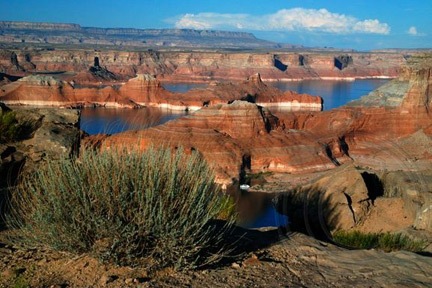
  • Lake Powell from Romana MesaLake Powell from Romana Mesa was shot in August 2008. I’d made the 2-hour drive from Page, AZ around the northwest end of the lake to the top of Romana Mesa in Mike’s pickup truck. Suffering with a bad back and concerned that I wouldn’t get back to Page before it got dark, I didn’t stay long or spend much time exploring. But the late afternoon light was great and there were just enough clouds in the sky to make it interesting. I took about 80 shots on that little excursion and this is one of my favorites.

I ordered 20 x 30 enlargements of each of these. They should be arriving by mail any day now. Later today, I’ll head down to Ikea to pick up the frames. This weekend, I’ll put them all together.

I’ll hang them at Rear Window the next time I’m in Phoenix. The airplane photo will be perfect centered over our new red sofa. The Lake Powell photo will go over the fireplace — until I can find the giant clock with Arabic numerals (not Roman numerals!) that I really want there. Then I’ll likely shift it to one of the walls in the dining room.

If I like the way they look, I’ll choose more photos and have them printed in other sizes. I’ll buy other frames. Little by little, I’ll cover the walls with souvenirs of our travels.

I’m really looking forward to this. It’ll be great to have these pictures reside somewhere other than on my hard drive.

Got photos you’re proud of? Don’t keep them cooped up on your computer’s hard disk. Make a place for them in your home. I guarantee you’ll be glad you did.

The Joys of Online Shopping

Why visit stores?

I have gotten to the point where I do about 75% of my non-grocery shopping online. I’m willing to bet that a good portion of the folks who read this are in the same situation. The rest of you might wonder why.

The Shipping Cost Argument

Most people use this as their argument against online shopping: if you shop in a store, you don’t pay shipping.

Okay, this is true. But I still have to get to the store. That takes time and costs money for fuel.

While I’m more concerned with the value of my time than the cost of fuel to drive to a store that has what I need, I won’t deny that I probably would have to drive at least 80 miles roundtrip from my Wickenburg home to find the item I’m looking for.

Let’s do the math here.

First, my time. Suppose I have to drive 80 miles round trip to get to a store that might have what I want to buy. Suppose I can get to the store in about an hour and that it takes me a half hour to find what I want to buy and pay for it. Then another hour to get home. That’s 2-1/2 hours. But what if the store that I thought had what I wanted didn’t have it? Then I have to go to another store, which may or may not be nearby. Let’s estimate 30 minutes for each store I visit. Now let’s estimate 2 stores per item I need to buy. So if I have to buy something as simple as a pair of jeans, I might be spending about 3 hours to get to the store, find them in my size and color, buy them, and get home. In 3 hours, I can write a how-to article for publication on a Web site that pays me several hundred dollars per article. So I’m potentially losing out on several hundred dollars of income.

Okay, so suppose I wasn’t planning on doing anything else that day. For the sake of argument, let’s assume my time is worthless.

But let’s look at the fuel costs. Suppose I drive that in my Honda, which gets about 20-25 miles per gallon highway. There’s some highway driving and some nasty “city” driving in terrible traffic where I usually shop. To make the math easier, let’s assume 20 miles per gallon. That’s 4 gallons for the 80 miles. Fuel prices for premium (which this little car takes) have ranged from $1.50 to $5.00 per gallon over the past year. We’ll use today’s price, which is about $2 per gallon. That’s $8 in fuel alone.

How much is the shipping cost for that pair of jeans?

It’s Not Secure

What? Get with the program. If you shop smart online, your transaction is secure.

In fact, it’s probably more secure than handing your credit card to a waiter in a restaurant where it’s all too easy to copy down credit card information before running a charge for your meal. Or reciting it over the phone, in a place where it could be overheard, or to a company that may or may not have honest employees or good intentions.

What’s risky is entering credit card information in unsecured forms online. Look for the lock icon on the edge of your browser window to ensure that a form is secure. You can also look at the URL; it should start with https (note the all-important “s”). Another thing that’s risky is putting your credit card information in an e-mail message. There’s no reason to do it, so don’t.

It Doesn’t Support the Local Economy

Well, that’s certainly true. But neither does shopping at the mall. Or at Wal-Mart.

And neither does hiring staff in India or China or Pakistan to provide telephone support or make products.

Let’s not go there, okay?

Today’s Purchase

Simply said, online shopping is fast, convenient, and affordable. Here’s an example.

Chef PantsI just bought 3 pairs of the “chef” style baggy pants I like to wear. (And no, I didn’t buy them with this crazy pattern — although you have to admit they look pretty funky.) As I was buying them online, my husband pointed out that he knows a place in Phoenix that sells “those kind of pants.” But do they sell the brand I’m wearing right now? The brand that seems to be cut perfectly for my middle-aged body and relatively long legs? And how much do they sell for there? These are all unknowns. There’s a chance that I could track down the store he knows and spend 30 minutes in there only to find out that they don’t have what I want. That my time wasted.

I found an online retailer that sold the pants I wanted by doing a Google search for a brand name. I immediately saw a store I’d bought from in the past, as well as a bunch of other online stores. Within about 10 minutes, I confirmed that the store I’d used before had the colors I was interested in at the best price. (You want to buy your own pair? The pants are from Five Star Fundamentals and the online store is AllHeartsChefs. These a great pants.) The entire shop-and-buy transaction took 15 minutes of my time as I sat at the kitchen table, enjoying my morning coffee.

Shipping on these three pairs of pants was a hefty $12.50. That’s a lot more than the $8 of fuel that I use up on a Wickenburg to Peoria shopping trip. But guess what? There was no sales tax added to my purchase. That saved me about $4.50. Oddly enough, when you add the cost of fuel to the sales tax I saved, it results in exactly $12.50 for this purchase. So the net savings was just my time.

And I’ll continue to argue that my time is of value to me.

The Death of Brick and Mortar Retailers

Online shopping is going to put a lot of brick and mortar retailers out of business. It’s sad, but is it such a bad thing? Don’t you think we have enough strip malls in this country? Aren’t you sick of seeing “big box” stores popping up all over the place, causing traffic jams during the day and blotting out the night sky with their parking lot lights?

Yes, there’s a loss of jobs. Or maybe it’s just a shift of jobs from malls to warehouses.

The benefits — as far as being green go — are real. People argue that when you buy online, the item has to be shipped to you and the shipper has a carbon footprint. That’s true, but don’t I have a carbon footprint when I drive my Honda down to Peoria and back to buy a single pair of jeans? The UPS guy, in contrast, is bringing goods for dozens — if not hundreds — of Wickenburg residents every time he comes to down. He’s doing the driving for all of us. And the more online shopping we do, the more driving we don’t have to do — while his driving remains almost the same.

This is the same argument the railroads have been using lately to say why shipping freight via rail is more green than shipping via truck. They’re already making the trip; adding more items doesn’t substantially increase the carbon footprint.

Personally, I’d like to see malls go away. I’d like to see downtowns revitalized. I’d love to be able to go to downtown Wickenburg and shop for things like clothes and shoes and books and music. I’d love to sit at an outdoor coffee shop with friends in my own town, with shopping bags at our feet while we discuss the bargains we’ve found. None of that kind of shopping is available in my town or anywhere near it.

Just as malls are killing downtown shopping, online retailers are killing malls.

And the way I see it, I’ve wasted enough time and money shopping. When I want to buy, I’ll buy it online.

What do you think? Use the Comments link or form to share your thoughts.

Country Dog in the City

Jack the Dog is bored and confused.

One of the things that’s new about my life this year is our place in Phoenix, nicknamed “Rear Window.” You can read more about it here.

When Mike and I go to Rear Window, we bring along Alex the Bird and Jack the Dog.

Alex is easy. We set up his old cage in the living room by the window, stocked it with toys and food, and let him do his thing. He’s not particularly happy to be here — he likes his cage at home better, even though it’s smaller — and he doesn’t seem to want to come out of his cage in the strange surroundings. But at least he does his bird thing and doesn’t seem distressed.

Jack and MikeJack is another story. At home in Wickenburg, he spends most of the day outside, loose. He hangs out on the back patio to watch the cars and trucks coming down the road so he knows when a strange vehicle needs barking at. (We’re at the end of the road and there are only three houses down here, so any strange vehicle qualifies.) He stretches out in the yard to soak up some sun while napping. He patrols the yard for mice or rabbits or, in warmer weather, lizards, and chases them accordingly. Once in a while, his friend, Charlotte, from the house across the wash, comes over and they chase each other for a while. When the weather is good, he often spends the whole day outside, on his own, to do whatever he likes. He never does anything that bothers us or our neighbors. He rarely leaves the property. And, of course, we take him with us for more off-leash fun on hikes all over Arizona.

It’s an idyllic life for a dog.

But in Phoenix, things are different. The apartment is in a complex where people come and go. He can’t see them, but he can hear their noises and he wants to bark. But we need to keep him quiet because we don’t want to annoy our neighbors, so we’re shushing him all the time. Rear Window has two patios, but they’re both too small for him to get any pleasure out of them — and certainly too small for him to do his business, even though they both have untiled dirt patches. Because he’s rarely on a leash at home, his leash skills are very limited. He also doesn’t like to do his business on a leash. In fact, the only way we can get him to do #2 is to let him loose.

Needless to say, this is quite a challenge for all of us. I feel bad for him because I can tell that he’s bored silly in the apartment, even with toys to play with. And I feel bad for all of us because this walking on a leash thing is a real pain in the ass.

And it makes me wonder why people in cities bother having dogs at all.

Anyway, I got a lead on a dog park about 2 miles from here. I figured I’d take him out and give it a try. It might be within walking distance — I have to drive it once to see. I’d hate to walk all the way out there to see a No Dogs sign.

No Dogs SignOne more thing I need to mention here…one reason there are so many No Dogs signs in parks is because so many people fail to clean up after their dogs. What’s the big deal here? Bring along a plastic grocery bag. When the dog does his business, use the bag to pick it up and seal it. Then drop it in the nearest garbage bin. If everyone did this, we wouldn’t have a need for so many No Dogs signs.

Waiting for the Cable Guy

No, not a movie review.

At this moment, I’m sitting cross-legged on a comfy new red leather sofa, listening to NPR and staring at a blank “parchment” (think pale pink) wall. The wall will soon house our first HDTV. And, with luck, it will also sprout a cable Internet connection.

I’m waiting for the cable guy.

He’s supposed to be here between 8 AM and 10 AM — a nice, narrow range. It’s 8:21 AM as I type this.

We spent a lot of time researching our Internet and television options for the Phoenix apartment. We discovered that we could get cable Internet that was 7 times faster than what we have in Wickenburg for half the price. (Chalk that down to another benefit of life in a city over life on the edge of nowhere.) We also discovered that if we went with DirectTV (rather than Dish Network or the cable company providing the Internet), we could get HD television service set up in up to four rooms, with DVR (think TiVo) for half of what we were paying Dish Network in Wickenburg for two rooms.

I should point out here that we’re not getting anything other than “basic cable” television channels. Why? Well, there are a few reasons. First and foremost, this is a part-time residence. It’s idiotic to buy premium cable channels for a home we’ll be occupying only part of each week. Second, we have a Netflix subscription. Why be at the mercy of television provider schedules — or pay extra for on-demand television programming — when you can get the movies you want to see on Netflix?

Netflix LogoBut that’s not all. Netflix also has the ability to play many movies on demand on your HDTV through your Internet connection if your connection is fast enough and you have a compatible device to handle the incoming Internet content. Our connection here will be fast enough. Devices to handle this start at $99; we just have to decide which one to buy.

Of course, all this television stuff is moot right now, since we don’t have any television down here right now. I don’t miss it too much, but I am looking forward to watching movies in high definition on a big screen.

AirPort ExtremeAirPort ExpressBut I’m hoping the cable guy can put the Internet connection on this big empty wall. I’ll use an AirPort Express that I brought from home to set up a wireless network and attach a printer, which I’ll also bring from home. If we wind up with a Netflix-compatible device that isn’t WiFi compatible, I’ll bring down a spare Airport Extreme base station from home and swap it with the Express, which doesn’t have an Ethernet out port. Otherwise, the AirPort Express should do the job.

So I’m waiting for the cable guy. It’s now 8:46 AM. He should be here any minute now.