The T2

I take delivery of a newer, smaller truck camper.

Regular readers might remember that I spent this past winter in Arizona and California, doing my best to avoid the dark and dreary winters of north central Washington state where I normally live. I had sold my big fifth wheel camper, the Mobile Mansion late in the summer of 2016 after purchasing my first truck camper, the Turtleback. I took the Turtleback south just before Thanksgiving and spent the winter living in a friend’s guest house, camping on mostly BLM land with friends, and traveling around Washington, Oregon, Nevada, Arizona, and California.

The Turtleback was pretty deluxe. It had basically every single feature you can cram into a truck camper, including a slide to give me lots of space. It was huge for what it was and although it was comfortable, it was also heavy. I decided, on my trip south, that I’d keep an eye out for a replacement and, if I found one, I’d trade it in. I wanted something slightly smaller — certainly without the slide, which I didn’t need — and perhaps a little newer. (The Turtleback, although in near new condition, was a 2005 model.)

Finding a Replacement for the Turtleback

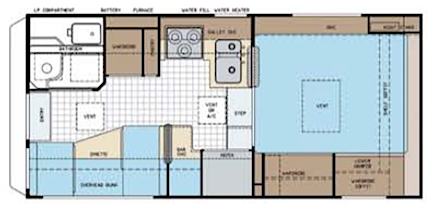
Floorplan
The standard 2007 Lance 950 floorpan.

I found the Turtleback’s replacement on the last day of my trip. I stopped by the Lance dealer in Yakima to see what they had among the used truck campers. They only had one — and it was one of the ones I’d seen there on my way south.

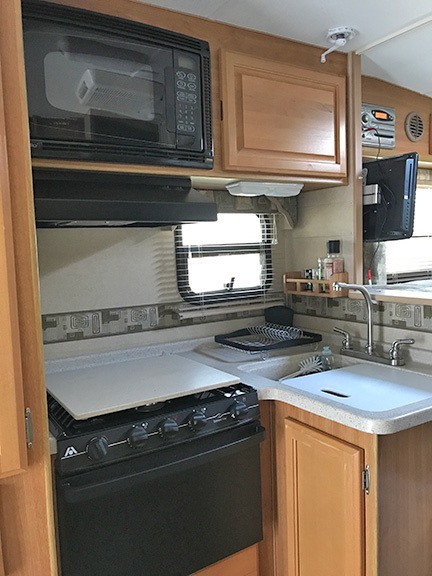
Camper Kitchen
The kitchen is compact but the sink is bigger and the propane stove includes an oven so I can bake without running a generator.

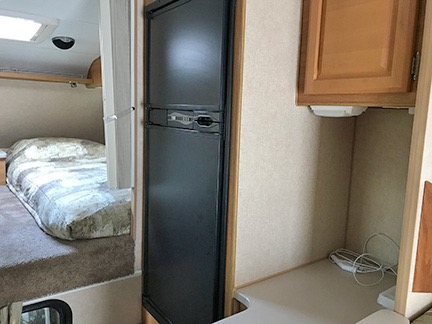
Food prep area
The “food prep” area is beside the 6 cubic foot refrigerator with separate freezer.

It was the same physical size as the Turtleback, but 400 pounds lighter, mostly because it didn’t have a slide. It had an oven and a microwave — the Turtleback had a convection microwave so I needed power to bake — and a lot more interior storage space, including cabinets over the dining area and a much larger pantry. And although the kitchen area was just as tiny as the Turtleback’s it did have a “food prep” area beside the refrigerator.

It had two 5-gallon propane tanks instead of two 7-gallon ones; that was actually good for me because the 7-gallon tanks are wicked heavy when full and tough for me to lift into place. It even had the sunroof over the sleeping area, which I’d grown to love.

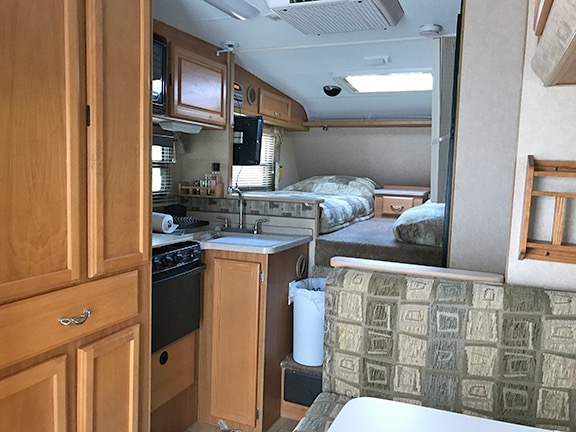
T2 Overview
The view from the dining area.

The only weird thing: it had two narrow twin beds instead of a standard queen bed. The mattresses could be zipped together to make a queen bed if I wanted one. But the setup actually added more functionality — I could travel with someone I didn’t want to sleep with without turning the dining area into a bed.

Beds
It has two twin beds with a moveable night table between them. The mattresses zip together to make a queen bed if I find the perfect travel companion. Until then, I’ll likely leave them like this.

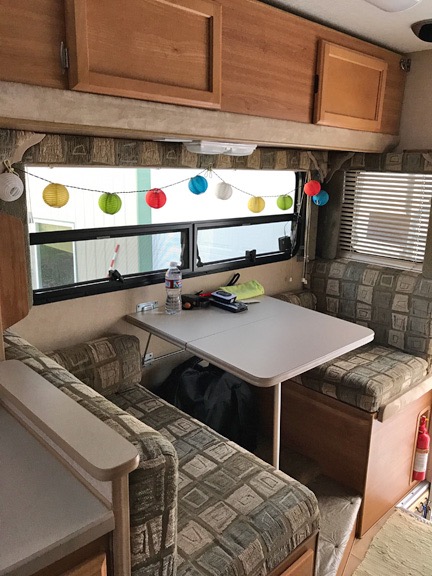
Dining AreaBecause the dining area isn’t on a slide, there’s storage overhead. That cabinet actually folds down to be used as a bunk for kids or a huge storage shelf. (And yes, I already hung my solar Chinese lanterns.)

It didn’t have a generator or solar panel, but I have a 2KW Honda generator I bought years ago and the portable solar panel I’d bought in Quartzsite in January. And instead of a satellite dish, which was useless to me because I don’t subscribe to satellite or cable TV, it had a regular RV TV antenna.

The bathroom was about the same microscopic size. Maybe an inch bigger.

And although it was a 2007 model, it was in very good condition.

In all, it was pretty much exactly what I was looking for. Smaller, lighter, and better designed.

For some reason — probably the beds — it wasn’t selling. Since their lot was crammed with new units, they were eager to get rid of it. They offered me a deal I couldn’t refuse. The only drawback was that the trade-in deal they offered absolutely sucked. I knew I could get a lot more for the Turtleback if I sold it on my own. They kindly offered to hold it for two months with a $500 deposit. I gave them a check and went home.

Selling the Turtleback

It took a week or two to clean out the Turtleback and get it ready for sale. Since my garage was still full of boats, I parked it near my shed. I put an ad on Craig’s List. The calls started coming almost immediately. The only problem was, folks were calling from Montana, Idaho, and the Olympic Peninsula — 5 or more hours away. I honestly don’t know why they bothered if they didn’t intend to come take a look. I certainly wasn’t about to deliver.

One guy told me he’d take it sight unseen. He’d come on Monday. By Sunday, however, he’d changed his mind. His wife had talked him into looking for a pull trailer.

A few days went by I still had more than a month to sell it, but when the calls suddenly stopped coming, I started getting worried. But then another call came. I answered questions. He was definitely interested but would be coming from the west side near Seattle. A few more phone calls and he and his wife arrived.

I showed them everything. They asked lots of questions. They tried everything — including the air conditioner, which wasn’t easy to get going when the outside temperatures were around 50°F. They talked it over in private. They offered $2K less than I was asking. I told them I really needed more and countered for $1K higher. They handed me a stack of $100 bills that had already been counted. I recounted them and it was right.

A while later, they drove away with the Turtleback on the back of their pickup. They’d gotten a good deal. I’d gotten $1,000 more for the Turtleback than I needed for its replacement — and $5,000 more than the trade-in offer had been for.

Picking Up Turtleback 2

Although I still had a whole month to get the new camper, I was eager to take possession. Cherry season would start soon and I was hoping to take it on a shakedown trip before I was stuck here. (I can’t travel during cherry season because I’m on standby for work.)

I scheduled a date to pick it up and drove down to Yakima to get it. I wound up spending about three hours, mostly chatting with the two brothers that own the place while their guys put the camper on my truck, inflated the air bags on my truck’s back end to level it, and strapped it down. Then I got the unit tour, which included an overview of everything on the camper. When I voiced disappointment that the TV/DVD player was AC rather than DC, the younger brother, Mike, gave me a 375 watt inverter. (Since the TV only draws 38 watts, I’ve since replaced it with a fanless 100 watt inverter.) So yes, I can still watch movies when I’m off-the-grid.

It felt the same as the Turtleback on the way home, although the brochure says the center of gravity is three inches higher.

Of course, I needed a name for it. Since it was my second Turtleback camper, I called it Turtleback 2 or just T2.

Plans for T2

It was parked in my driveway for about a week. Some overnight guests camped out in there. It was nice to have a place to put them.

I finally put it away in the garage yesterday. I’d planned on going on a trip down to Palouse Falls, but other things popped up on my calendar and it made sense to put it away rather than leave it out in the sun.

I’ll be using it in about 10 days on a Puget Sound Mycological Society weekend-long field trip to Silver Falls. Then maybe again on Memorial Day weekend. And likely the first weekend in June for another mushroom hunting field trip before cherry season starts.

Last summer, the Turtleback was a home for three different pilots who worked for me in Quincy. Although I don’t think I’ll need it for that duty this summer, it will be available.

And there’s a slight chance I’ll get a contract job in the Yakima area in September; if I do, I’ll stay down there in the T2.

Of course, I’ll be taking it south with me again next winter. And this time, I’ll bring along my boat.

More about the Wind Machines

A few new videos.

Back in April 2015, I blogged about the wind machines commonly used for frost control in the Wenatchee Valley. Resembling tall fans, different versions of these machines can be found in agricultural areas throughout the west wherever frost — especially early spring frost — is an issue. Around here, they’re often in low areas subject to thermal inversions.

Wind Machine
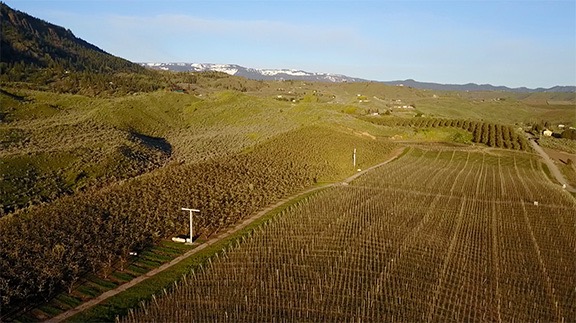
The wind machines that were running this morning. That’s the Mission Ridge Ski resort in the background. Photo shot with my Mavic Pro.

The machines are fans that generate wind. The blades spin fast — faster than you might think watching the video below — to circulate the air. The fan heads rotate to constantly change the direction of the wind. The net result is that the air is circulated, bringing warm air from above down into the crops.

In the almond orchards of California, they use helicopters to do this. I think it’s because the orchards are so big that they simply can’t install and maintain as many wind machines as they need. The helicopters are likely a lot cheaper in the long run, especially when you have a few years in a row when they’re not needed. I’ve been on frost control contracts for the past five winters now and have yet to turn a rotor blade over an almond tree. (Global climate change?)

This winter was particularly long, setting the tree fruit back two to four weeks. The cherry trees are still blooming around here; last year, the cherries were already beginning to redden in the orchards closest to my home. Nighttime temperatures at my home have been in the low 40s. But in the orchards below me, pockets of colder air form. And this morning, they got cold enough to trigger the temperature-set auto start feature on the wind machines in the closest orchards.

I don’t know exactly when they started. I was up at 4:30, reading before getting out of bed, and I didn’t hear them. But by the time I made my coffee at 5 AM, I could hear them faintly through the walls and windows of my my home. I stepped out on the deck for a better look in the predawn light. The sound was louder and I could see two of the machines to the west spinning. My ears told me that one to the northeast, which I can only see from a handful of spots on my deck, was also spinning.

Here’s the zoomed in video I shot with my phone. When I shut up, you can hear the wind machines.

I did a Periscope — that’s a live Twitter video — of the wind machines. A handful of people tuned in and I answered questions as they came up. I was frustrated that I couldn’t zoom in. I signed off, used the video feature on my phone to capture a short zoomed-in clip, and posted it on Twitter. Then the sun rose and the light got good and I did another Periscope that was mostly to show off how beautiful the area was. The wind machines droned in the background of my voice as I described various things and answered questions.

I went inside, washed some pots from cheesemaking, and listened to the radio. I could hear the wind machines faintly through the walls and windows. I was sort of bummed out that I couldn’t give people a better view.

Part 107 Explained
Want to become a commercial drone pilot? Start by learning all about the FAA’s Part 107. This book will help. Buy the ebook edition on Amazon or from Apple. Or buy the paperback edition on Amazon.

And then I remembered my Mavic Pro.

It took only two or three minutes to set it up. I launched it from my deck, got the video camera going, and sent it to the wind machines, stopping before it got so close that the wind could affect it. The light was beautiful and the image the Mavic sent back to me was clear. I hovered for a while to capture a good clip and then flew around a little, just taking in the view with the camera running. I stopped the video camera, took some stills, and then flew home for some more video of my home and the area around it.

Back inside, I made a fresh cup of coffee and spent a few minutes editing the video and setting it to music. It’s unfortunate that the Mavic doesn’t capture sound, but I understand why: it would be capturing its own buzzing sound, which isn’t pleasant. So music will have to do.

A side note here: I’ve been thinking a lot lately about how much I like living here. I realized — and I think I mentioned in one of those Periscope videos — that I like it here more than anywhere else I’ve lived. I’m not sure if it’s because of the place itself or the fact that I have a home with an amazing view built to exactly meet my needs or because after a stifling relationship that went on a lot longer than it should have I finally have the freedom to do what I want to do with my life and time.

Whatever the reason, I just want to remind readers that we all have just one life and it will eventually end. Don’t waste it stuck in a rut or in a place you’re not happy.

My Flying M Nightshirt

A bittersweet story.

It’s true: I have a nightshirt with a Flying M logo on it. But there’s a story behind it and I thought I’d take a moment to tell it.

It all started back when I made a visit to my family back in New Jersey. It had to be in the early 2000s, but certainly after I got my first helicopter, an R22. This was back in the days when my mother’s brother’s family was still on good terms with all of us. It may have been when my grandmother was still alive or not long after her death in 2001 or 2002. (I don’t remember death dates; I see no reason to.)

My Uncle Frankie and Aunt Julie lived in Bergenfield, NJ in a typical suburban home on a narrow street. My uncle, who had been in the army during the Korean War, based in Alaska, had worked in a print shop before getting certified as a 100% disabled vet due to a back injury he’d suffered while in the Army. His wife was a typical old-school Italian homemaker. In fact, their household was very Italian in the New York kind of way, despite the fact their families had been in America since at least the 1920s.

They had two kids, Ernest (named after my grandfather) and Madelyn (named after my mother), who were a little younger than me and my sister. Ernest had been in the Marines right out of high school, married someone he’d met when he was in boot camp, had two sons, got divorced, left in the middle of his second tour of duty, and promptly got into serious trouble with the law. Madelyn married and had two daughters.

My Aunt Julie and her daughter Madelyn never really liked me or my sister. Simply said, our grandmother favored us over my aunt’s kids and she did a pretty poor job hiding it. I’m sure everyone has family dynamics like this and they always cause jealousies. My aunt and cousin were jealous of us and there was nothing we could do to head it off. They manifested their jealousies by talking down to us, criticizing us, and ridiculing us whenever they could. We dealt with it. They were family and although we didn’t like it much, we let it slide like water off a duck’s back.

We — I think I can speak for my sister, too — really loved our uncle, who was loud and outrageous and a lot of fun. I remember him staging a mock fight with my cousin Ernest on a visit I made with my first boyfriend back when I was about 18. Ernest had gone down into the basement and my uncle was yelling at him from the door in the kitchen at the top of the stairs. Then he pulled out a gun and fired a round down the stairs. It really freaked out my boyfriend, but the rest of us just laughed and laughed. The gun was filled with blanks.

But because of the friction from my aunt — which got worse and worse as time went on — I didn’t visit often.

We did visit one day in 2001 or 2002 and sat around the kitchen table for a nice Italian meal. My aunt was a good cook, although in later years she was a bit heavy on the spices. (The Italian word agita comes to mind.) She made a great eggplant parmesan, which might be one of the reasons it’s my favorite Italian dish. Making a good Italian eggplant parmesan is a lot of work, but if you want to taste one that’s just like my aunt’s (or mine), try Michael Angelo’s in the supermarket freezer section. I’ve tried a lot of eggplant and this is, by far, the best.)

Flying M LogoThe Flying M logo includes both of my initials. Cool, no?
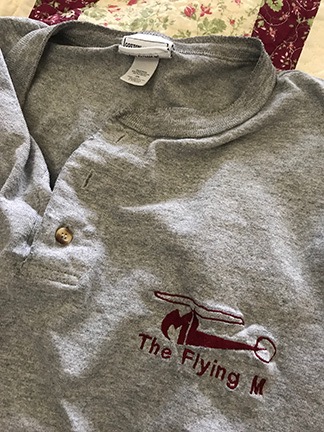
I was likely wearing one of the Flying M logo shirts I’d had made. The logo was designed by Gary-Paul Prince, based on a idea my wasband had come up with that incorporated my first initial in the design of a helicopter. Gary-Paul had managed to get both initials in. Back in those days, I was near the height of my writing career and had a lot of money to burn so I’d had the logo embroidered on a bunch of henley t-shirts, which I really liked to wear. My uncle liked the shirt and asked me for one.

Now at the time, my uncle probably weighed in at 350 pounds — at least. I obviously didn’t have a shirt at home that would fit him. So I told him I’d have one made and send it to him.

I got back to Arizona (where I lived at the time) and had another batch of shirts made. I made sure the embroidery people included one sized 3XL, which I was pretty sure would fit my uncle. After a week or two, I picked up the shirts, which came in a plastic shopping bag. I likely set it down near the door to my home and it likely sat there for a few weeks — I’m terrible about putting things away.

And then I forgot about them. For years.

You see, back then I had a cleaning lady who came every two weeks. She had apparently seen the bag near the door and decided it was better off about six feet north, on the other side of the door to the garage. She’d moved the bag into the garage where it was quickly hidden under other things that wound up in the garage. Out of sight, out of mind. I completely forgot about the shirts.

Time went on. My uncle died. I went to his funeral. It was the last time I saw my aunt and cousins. My aunt died a year or two later but I didn’t go to her funeral. I don’t think she would have wanted to see me anyway. I think my sister has been in touch with Ernest, but I haven’t communicated with either of my cousins since my aunt died.

Flying M Nightshirt
My Flying M nightshirt, now starting to show its age.

One day I was looking through a pile of stuff in the garage and came across a grocery bag with its handles tied tightly around something soft. I opened it up and found the shirts — including the gigantic heather gray one I’d had made for my uncle. I knew immediately what had happened.

I don’t throw away anything that has a use. Since I didn’t know any 3XL sized people, I decided to put the shirt into use as a nightshirt. It was comfortable and soft and very loose fitting.

And it’s still in my nightshirt rotation to this day.

The fabric is thinning and it isn’t quite as soft after so many trips through the laundry. The embroidered logo is puckered and there are tiny holes starting to form here and there in the cotton t-shirt fabric. I suspect that one of these days, I’ll have to throw it away.

But until then, it’s a reminder of my Uncle Frankie and some crazy good old days with family in New Jersey.

Hauling Water

When the water stopped running…and what I did about it.

I first heard about the problem when I got an email sent out to all members of the road maintenance association on February 8:

The water main has frozen at the S turn near Lot 7. Neighbors are experiencing very low or no water. Malaga Water district has reviewed the situation and believes it will stay frozen until thaw.

They have offered to get 5 gallon water jugs to the Malaga Water district HQ and make them available to us if needed.

I was in Arizona at the time, in transit between Wickenburg and Willow Beach on the Colorado River, where I’d camp for two nights and soak in a wonderful desert hot spring. It was t-shirt weather on a beautiful sunny day. It was the final month of my 2016/17 winter snowbirding trip south and I didn’t plan on getting back to my home in Washington for another month. The email message sent me a mixed message: “stay frozen until thaw” sounded like a long-term issue but “water jugs…available to us if needed” sounded like hauling in water might not be needed.

I should mention here that this isn’t the first time this has happened. It’s the third. The last time was eight years ago — years before I bought my lot — and the line stayed frozen until March 22. When it finally defrosted, the water company supposedly put a concrete “blanket” over the pipe and reburied it. They assumed the problem had been solved when it didn’t happen again.

Until this year.

Winter Weather
Mean temperature percentiles per the National Weather Service. Find more info here.

This has been an unusually cold winter here in the Pacific Northwest. While it was warmer than average nearly everywhere else in country, the northwestern United States, including all of Washington state, has been colder. There’s also been a ton of snow, some of which remains on my driveway in front of my car garage after having slid off the roof multiple times all winter. More than a few of my friends in the area made a point of telling me that I picked a good winter to go away. (Little do they realize that I plan on going away most winters.)

Cathedral Rock Road
A satellite view of my road with the cliff to the south. The originally suspected problem area is in yellow; the actual problem area is in orange. I live nearly a mile east of this spot.

Making the problem worse is that the water line runs under our privately maintained road, which gets zero direct sunlight for months at a time in the winter. Why? Because it’s on the north side of a nearly sheer 1000-foot cliff. Because of our northern latitude, the sun doesn’t rise high enough in the sky in the winter to clear the cliff, leaving the road in shadow. I’ve observed this phenomena at my own home and blogged about it here. My place, which is farther north of the cliff than the road and many of my neighbors, is in the shadows for just six weeks; the problem area of the road is in the shadows for more than two months.

Time went on. I continued my trip northwest through Death Valley and eventually to the Sacramento area. I flew back to Arizona to fetch my helicopter, which would be on a frost contract in that area for two months. I tried to have fun in “sunny California,” but it seemed to rain more often than not. I got a temporary job helping a friend with his spray operations. But the whole time I was in California, I was feeling homesick and wanted to go home.

I checked in with my next door neighbor regularly. The water still wasn’t flowing. She and her family of five were showering at the Y. They made weekly trips to the laundromat. At first, they melted show for toilet water; now they were hauling it.

But by March 12, I’d had enough of my extended road trip. I began the drive home, taking a leisurely route up the California coast with the idea of getting in on March 17. The trip was great — at least the first few days — but then the weather turned nasty. I pointed my rig inland on March 15 and rolled down my driveway the following day.

There was still no water.

Of course, my camper had water. I also had my four 6-1/2 gallon water jugs with me. I’d stopped at the water company office to top everything off. I figured I could always use the camper’s toilet and shower.

But I didn’t want to. I wanted to use a real toilet and shower.

I hauled water up the stairs in those 6-1/2 gallon jugs for a few days. During my travels, I’d rigged up a DC pump with hoses to transfer water from the jugs into my camper without having to lift the jugs; I now put that to work in my kitchen so I could wash silverware and pots with “running” water. (I was using paper plates.)

My neighbor, Elizabeth, had a well with a broken pump. She had the pump fixed and invited neighbors to shower at her place. I took her up on that offer. She has a nice shower in her guest bathroom. I also filled water jugs there.

But when March 22 came and went, I’d had enough. I needed a better solution.

Water Tank
Tanks like these are designed to fit in the back of a pickup truck for transporting water.

My neighbors, Al and Kathy, have a winery (and a well). The previous autumn, I’d noticed that they had a water hauling tank sitting neglected and unused in their yard near their burn pile. I’d asked if they were using it and was told they weren’t. I asked about buying it — with the crazy idea of gathering water for irrigation off my huge roof — and they said yes. But I hadn’t done anything about it then.

Fortunately, it was still sitting there in March, nestled in the snow. I asked again. The 425 gallon tank had never been used — in fact, it didn’t even have fittings or a valve at the bottom. Other than cobwebs and a bit of organic matter, it was pretty clean. I bought it for $100 — what a deal! I just found the same tank online for $332 — and Al and another neighbor, JR, loaded it onto my truck. I used a ratchet tie down to prevent it from sliding out the back.

I followed JR’s suggestion and brought it down to the car wash where I cleaned the inside as well as possible with a power washer.

I went to a local irrigation supply place and spent $25 on a valve and fittings to connect it to a standard garden hose.

I went on Amazon and spent $80 on a Shurflo pressure regulated pump that would automatically shut off when there was no demand for water. The trick was finding one with enough power to get the water up about 15 feet to my second floor living space. And I spent another $10 on fittings to attach that to a standard garden hose. And another $5 to turn the pump’s loose wires into a plug.

By Saturday, March 25 — nine days after returning home — I was ready.

Flashback: Howard Mesa 2005

My wasband and I used to own an off-the-grid camping cabin on 40 acres of land in northern Arizona. That area is notorious for its low water table and nearly everyone up there hauls their own water — including us.

Water could be purchased from a vending machine off the main road between Valle and Williams. You’d pull your tank up under it, set the hose in the top of the tank, and stick a $10 bill into the vending machine. 450 gallons of water would immediately gush out of the hose and into the tank.

Hauling Water in the Chevy

I remember hauling water once using a neighbor’s tank like the one I have now. The truck would be pretty stable until I hit about 50 miles per hour. At that point, the sloshing would make it difficult to control and I’d have to slow down. I only did it once or twice — it was a vacation home and we had 2,100 gallons of water storage up there — but can’t imagine what it must have been like to do it several times a week for a family.

I went to Elizabeth’s house with my new tank and wrenches and fittings and some plumbers tape and set the valve and fittings into the tank. I turned off the valve so the tank would hold water.

I ran Elizabeth’s garden hose to the top of the tank and turned on the water.

The tank holds more than 400 gallons. It takes a long time to pump 400 gallons from a garden hose. I sat in my truck and read the newspaper. Every once in a while, the truck would creak and shift as the weight of the water settled it lower and lower on its axles. Do the math: 400 gallons x 8 pounds per gallon = 3,200 pounds.

Tank on the Truck
Here’s the tank on my truck, parked on my driveway after yesterday’s refill.

At about 300 gallons, I got tired of waiting and turned off the water. I put the cap back on the tank and started the drive home. The water sloshed, making the truck feel somewhat unstable. But it was a short drive — only about a mile — and I didn’t go very fast. I backed the truck up on my concrete apron in front of my big garage door. I threw about a half cup of bleach into the tank to prevent algae from growing in it.

I noticed a slight leak from the fittings. Not much; maybe three drips per minute. I tried tightening up the fittings but didn’t see much improvement.

Pump
Here’s the pump after mounting it on a piece of scrap wood and propping it up so the water leaks away from it. I think that when this is all over, I’ll rework the fittings and permanently mount it near the hose bib.

I connected a garden hose from the tank and ran it into the garage. Then I connected it to the pump. That’s where I had some difficulty. You see, Shurflo pumps are designed to be used with Shurflo fittings. Although the manual said it should connect to a standard 1/2 inch pipe fitting, it didn’t thread exactly right. I had a bitch of a time getting it set up — on both sides of the pump. Eventually, however, I got it connected for inflow and outflow and connected the outflow end to a hose bib in my garage.

Water Source
I call this my Frankenstein monster. Water comes into my home through the black pipe on the right through a valve (off in this photo) and then into a number of PEX fittings that bring it down to 3/4 inch. From there, it goes up into my home as well as to the right through another valve (on in this photo) to my hose bib. My first plumbing job. Hey, it works.

This is where things are a little non-standard. Regular readers might recall that I lived in my RV inside the garage for the winter before my living space was done. When I set up the water system in my building, I included a hose fitting with its own valve that I was able to use to feed water to my camper. It can also be used to drain all the water out of my home’s plumbing system. So I was already set up for water input, although I hadn’t ever expected to use the valve this way. I just shut off the water from the street into my building and turned on the valve between my building and the hose attached to the pump. Then I plugged in the pump.

It ran. It ran for well over a minute. I was just beginning to wonder whether it would automatically shut off when the system was fully pressurized when it stuttered a few times and went quiet.

I went upstairs and flushed the toilet. (I have my priorities straight.) The tank had fill automatically and was filling again.

There was water at the sink faucet.

I came back downstairs to look at the pump. It was leaking at both fittings. I wasn’t surprised. Still, I knew I’d done the best that I could. (Later, I’d order Shurflo fittings and wind up not using them when they arrived. If it ain’t broke…)

I mounted the pump on a piece of scrap wood and angled it up so the water would drip away from the pump. There’s a drain in my garage so the water would eventually find its way out.

Then I turned on the water heater. (I’d had a friend turn it off while I was away when I heard there was no water. I was slightly concerned that the water would somehow drain out and burn up my heating element. None of that happened.) I’d have my first hot shower at home later in the day.

I figured that since I had come up with a solution, the water would come back the next day. But no, there’s still no water to the homes on our road.

Since then, it’s been pretty much business as usual at my house. I turn on the tap and water comes out. I do laundry and use the dishwasher. I shower and wash up. I am a bit more thoughtful about letting the water run and I admit that I haven’t filled up my 80-gallon bathtub yet.

The only difference is that I don’t drink the tap water. I have bottled water for making coffee, cooking, and drinking.

That first tank of water lasted me nearly a week. Yesterday, I drove out to Elizabeth’s again. While the tank filled with water, I helped her install chicken wire at the top of her chicken coop to prevent birds of prey from getting in or chickens from getting out. This time, I let it the water go almost to the top. It must have taken at least a half hour to fill. Back home, I connected the hose to the tank, turned on the pump again, and was good to go.

Is this a hardship? Not with this solution. Living a week without running water was driving me nuts — and I had to come up with a solution. It’s unfortunate, however, that my truck is tied up with water duty. I need to buy some lumber for a project and will have to drag my old cargo trailer behind my Jeep to get the lumber home.

It’s been nearly two months now since the water stopped running and some of my neighbors have been dealing with it — without a solution like mine — for that long. I don’t know how they’re doing it.

The problem was in the paper about a week ago. The water company says it can’t dig until the water starts flowing again. When they do dig, it’ll be quite a mess since there’s only one way in and out on this road and the pipe runs right down the middle.

In the meantime, my neighbors are confident that the problem will be fixed for good. I’m not that optimistic. But I am prepared for next time.

April 2, 2017 Update: I got a call from a neighbor at 6:30 AM. He jubilantly announced that the water was back on. Although I’m thrilled that our little ordeal is over, I’m left wondering what I’m going to do with the 350 gallons of water in the tank on the back of my truck…

April 3, 2017 Update: I found a home for all that water! One of my neighbors needed to do a water change in his fish pond and was thrilled to get 350 gallons that he didn’t have to run from his tap.

Congratulations! You’ve made it to the end of yet another lengthy blog post here on An Eclectic Mind. If you got this far, you must have gotten something out of what you read. And isn’t it nice to read Web content that isn’t full of annoying ads?

How about doing something to show your appreciation? I’d love it if you’d add a comment at the end of this post to share your feedback with me and others. But I’d really love it if you’d visit my Support page and chip in a few dollars to help cover the cost of hosting this blog and motivate me to keep writing new, interesting content. It’ll only take a moment and I really would appreciate it!


The Odd Thing about My Old Eyes

Can vision problems reverse themselves with age?

I’ve been nearsighted for most of my life. I began wearing glasses in the fifth grade and switched to contact lenses nearly full time when I was in college.

Over the years, my vision has gotten progressively worse. Each eye exam resulted in a slightly stronger prescription. I was lucky, though. Even though my natural far vision is bad, it’s very correctable. The contact lenses I’ve been wearing for at least 20 years — Acuvue disposable daily lenses — fit me like they were made for my eyes’ size and shape and bring my vision to 20/20 or better.

My near vision, on the other hand, is amazingly good. With glasses and contacts off, I can see nearly microscopic detail of things within 4-5 inches of my face. I can even read the micro text on $100 bills.

Of course, with contacts on, that close vision disappears. And as my far vision prescription got stronger and stronger, my close vision with contacts on got worse and worse.

At first, I combatted the close vision problem by letting my stronger eye do distance and my weaker eye do close vision. The ophthalmologist did this by prescribing a strong lens for my right eye and a much weaker lens for my left one. This worked pretty well, at least for a while. But then I realized that what it was really doing was making both my far vision and near vision less than satisfactory. So I went with contacts for good far vision in both eyes and began using reading glasses for close vision when my contacts were in. My back up eyeglasses were progressive lens bifocals.

Last year, my contact lens prescription was -6.50/-7.00 (right/left). My understanding is that that’s the equivalent to 20/650 and 20/700. Again, with the lenses in, my vision was about 20/20.

This year, however, I began having trouble with my vision. It started in the autumn when allergy (?) issues made it impossible to wear my contacts for more than a day or two. My eyes were itchy and teary. I wore my glasses quite often. I could see okay through them, but not great.

Then I started my drive south for the winter. I was wearing my contacts again and should have been seeing great. But I wasn’t. Everything in the distance was a bit blurry. I was having trouble reading signs. Objects in the distance on the side of the road that I thought were shrubs turned out to be cows. Oops.

What really confused me, though, is that when I wore my sunglasses and looked through the reading lenses at the bottom of the glasses, I could see distance better. That wasn’t right. I should see distance worse. Sure enough, when I put my readers on, I could see distance better than without them.

Eye Prescription
My current eye prescription shows a remarkable improvement in my vision.

So when I got to Arizona, I made an appointment at the same eye center I’d visited the year before, which is the same one I’d used when I lived in Arizona. After the usual eye health check up, I told the doctor what I’d noticed. He didn’t seem terribly surprised. We went through the usual exercise with the machine and eye chart to figure out what my prescription should be. The result: -5.50/-5.75.

My far vision had greatly improved over the past year.

He fetched some sample lenses and I popped in a pair. It was amazing. I could see perfectly again.

But what was even more amazing was that my close vision was also somewhat improved. Although I’d still need readers for small print, I could see good enough for most reading in good light. The doctor confirmed this: instead of +2.50 for readers, I could now use +2.00 readers.

I left the doctor’s office looking around me like a blind person who has just been given sight. I was drinking in everything I saw. The detail amazed me.

Needless to say, it really made my day.

The question both the doctor and I have is why my vision might have improved. He says that vision is often tied in with blood sugar levels and asked if I’d had any blood work done lately. I told him I had, about a month before, and that the doctor had given me a clean bill of health. He said that high sugar levels usually cause vision to get worse, not better. So now I’m wondering if I had high sugar levels last year when tested and they’d come back down gradually since then.

But I have to admit that I honestly don’t care. As long as I can see as clearly as I do now, I’m happy.

On Saturday, I treated myself to a new pair of good quality readers. On Sunday, I ordered two new pairs of bifocals, one of which includes snap-on sunglass lenses. For those interested in saving money on glasses, do check out Zenni Optical; I ordered two pairs of glasses for 1/4 of the price of one pair at Walmart Vision Center. You can’t beat that.

Glasses Order
My eyeglasses order. I decided to treat myself to two pairs: one just for indoors and the other for outdoors/flying. The pair with the snap-on sunglasses is a reorder with my new prescription. For some reason, they automatically applied a 10% discount so even with priority shipping, my order was less than $130.