The Guns in My Life

Not all gun owners are nuts.

I read something on Twitter this morning that really struck a nerve:

Monitoring? What did he mean by monitoring?

I read some of the comments and found this one:

I don’t think she meant “special” in a positive way. And that really got under my skin.

You see, I’m a gun owner. And although I like to think I’m special, I’m not special in the way Michelle seems to think all gun owners are.

And that’s why I decided to write this post. You see, I’m not the only person in my family who owns a gun and none of them are “special” in the sense that we need to be monitored.

My Father’s Guns

My father worked as a police officer in our small northern New Jersey town of Cresskill from around the time I was born in the early 1960s to his retirement. As you might expect, he owned a gun and I grew up with at least one gun in the house.

I say “at least” because I honestly don’t know how many guns he had. We were taught at a young age not to touch his gun and we didn’t. When he got home from work, he’d put it on the top shelf of a tall bookcase in the foyer or sometimes on top of the refrigerator when he came home for dinner. (He worked three different shifts: 8-4, 4-12, and “midnights” (12-8).) I knew the gun was dangerous and I knew I wasn’t supposed to touch it. I never did.

Well, that isn’t exactly true.

Every autumn, the town held what was called a “Turkey Shoot.” It was held at the local shooting range. They’d put up targets and participants would shoot. The targets were scored and the high score would win frozen turkeys. I think it was a fund raiser, but how would I know? I was a kid.

At least twice when we attended this event, my father let us shoot his gun at the target. He never handed us the gun. Instead, he held the gun with us to point and shoot. I remember it being heavy and the trigger being hard to pull. I don’t remember if I won a turkey. Again, I was a kid.

Girl Scouts

When I was in Girl Scouts, we learned to shoot rifles. This was at an indoor range in the nearby town of Tenafly (I think). The rifles were probably World War II surplus. They could hold one shot and had a bolt action. Again, I was a kid and don’t remember much about it.

I also don’t know why learning to shoot rifles was a Girl Scout activity in my area around 1970, but today I think it’s kind of cool.

I do remember that they taught us to shoot from multiple positions including prone and sitting cross-legged. I was a pretty decent shot.

My Uncle’s Guns

My uncle was a flag-waving veteran of the Korean War, although the closest he got to Korea was the Aleutian Islands in Alaska. He became quite a gun collector and kept most of them in a big gun safe down in his basement, right at the foot of the basement stairs. I vaguely remember him showing some of them to me. Most of them were collector’s items.

In his younger days, he was also a hunter. For years, he had a bearskin rug on the floor in his living room. He’d got the bear on the same trip my dad had shot a deer. (That’s when I first ate venison.)

He was a little crazy with the guns sometimes, but I don’t think he was unsafe. One day when I was just out of college, I visited his family with my boyfriend, who had a very “plain vanilla” family life. My uncle’s family was anything but “plain vanilla.” My uncle staged a fight with his son, my cousin, with my cousin yelling at him from down in the basement stairs. My uncle pulled out a gun and shot it down the stairs from the kitchen. Yes, in his house. The gunshot was loud! But the bullet was a blank. He’d apparently set the whole thing up to give my boyfriend something to talk about when he got home.

I don’t know how many guns he had, but I suspect it was more than 20. I don’t know what happened to them when he passed away.

My First Gun

I got my first gun in the early 2000s, not long after moving from the New Jersey suburbs to Arizona. My future wasband telecommuted to work back in New Jersey, which required him to be away from home 7 to 10 days every month. While he was gone, I was alone with a deaf dog in a house that creaked a lot more than I was used to. I used to lay awake at night, convinced that the creaking I was hearing was someone creeping up the stairs. Keep in mind that the house was at the end of a gravel road, pretty far from the neighbors so it wasn’t as if help could arrive quickly if there was an intruder.

At my request, my future wasband bought us a gun to keep in the bedroom. It was a 38 special revolver.

Of course, being responsible (not “special”) gun owners, we immediately sought training to make sure we could use it safely. The only training we found in the area was a Concealed Weapons Permit class. It was a weekend long and included lots of information about guns, including safety and legality. The guy who taught it with his wife — both of whom wore camouflage outfits to class — was very pro-carry. Remember, Arizona is an open carry state, meaning you can wear or carry a visible gun in most places. The concealed weapons permit enabled holders to carry a gun concealed by clothing or in a purse or backpack. Some people think this is important. I was the only woman in the class and they kept trying to convince me that I’d be safer if I carried a gun with me at all times. I said I wasn’t interested. They said, “Well, what about if you’re in a mall parking lot late at night, parked way out on the edge, and a gang of guys comes toward you.” I replied, “I’d never put myself in a situation like that. I’m not an idiot.”

The class was informative, opening my eyes to a different gun mentality than mine. It also included range time where we had to qualify before passing. Since I was the only woman in the class, I got a bit of attention. I was told that with a little practice, I could be a good shooter. Great.

A side benefit of having a concealed weapons permit was that I could worry a lot less about rules when I took my gun to the range or elsewhere. For example, suppose I’ve got the gun out of sight in my car’s glove box when I get pulled over for speeding. The gun would be considered “concealed” and without a permit to carry it that way, I could get in deep trouble. The course explained how to handle such a situation and the permit made it legal to have the gun in the glove box to begin with.

Beretta 21A Bobcat
My Beretta isn’t very practical, but it holds a place in my heart as my first gun. And yes, that’s my hand holding it.

Of course the 38 Special wasn’t really my gun. It was my future wasband’s. I wound up buying something quite a bit smaller, easier to handle, and less practical: a Beretta 21A Bobcat. It’s a semi-automatic handgun with a magazine that holds 7 22 caliber rounds. I bought it brand new in a gun shop and, yes, I did go through a background check process before it was sold to me. It’s less practical for three main reasons:

  • If I ever did have to use it to stop a serious attacker, I’d basically have to empty it into his body to stop him/her. 22 rounds aren’t very big.
  • It’s extremely picky about ammunition and will jam if I don’t buy the right stuff. A recent trip to the range for some additional training confirmed what I remembered about it: there’s a popular (and not cheap) brand of ammo it simply chokes on. No one wants a gun that will jam when it’s needed.
  • I’m not nearly as accurate firing it as I am with a bigger gun. I think that could be resolved with more practice, though.

But since I really don’t need a gun, I never saw a reason to replace it.

And it does have a nice feature that I thought was handy for horseback riding out in the desert: it’s rather unique flip up barrel makes it easy to load a single 22 long “snake shot” round. That turns the little gun into a small shotgun suitable for killing rattlesnakes or deterring coyotes out on the trail.

My wasband eventually replaced the 38 special with a Glock. I don’t know which one, but I do know that I was more accurate with the Glock than the Beretta.

The Big Sandy Shoot

As I’ve blogged about here and here, there’s a twice-yearly event called the Big Sandy Shoot, which his held on some private property in the middle of the Arizona desert. It’s a gathering of gun enthusiasts who get to fire a wide range of weapons at reactive targets. There are strict safety rules with range officers to enforce them. No one gets hurt, although the tracer rounds they use at night have been known to start fires.

Oh, and in case you’re wondering, a “reactive target” is one that literally explodes when hit.

These are hobbyists, mostly, although I suspect more than a few of them are “special.” (Ever see a cannon made out of a fire extinguisher that fires bowling balls? I have.) They’re really into their guns and showing off. It’s interesting, but a bit too hard core for my taste. Since I’ve already blogged about it, I’ll let you read those blog posts to learn how crazy it is.

My Brother’s Guns

My brother shoots for a hobby. He owns fifteen guns — as he just informed me in answer to my texted question — and he’s quite proficient using them. He regularly competes using an STI Edge handgun. According to him:

It’s specifically for competition. I have different barrels for it so I can shoot 9mm, .40 Cal and .22 with it.

My shotgun is a Benelli M2 and my rifle was built by a company called JP

Back in 2013, when I was visiting my brother and his wife, I went with them to one of their competitions. (They both shoot.) It was professionally managed and extremely safety oriented. Rules were followed with no exception — range officers made sure of it. I could see why he enjoyed it. It was challenging stuff, with a variety of target types and scenarios. It got him outdoors year-round, with other people who enjoyed the same hobby. Beats parking his ass on a sofa watching TV, no?

Keep in mind that my brother lives in New Jersey where gun laws are pretty strict. (My uncle lived in New Jersey, too.) I don’t know the details on how he’s required to register, store, transport, or shoot them. But I do know that he competes all along the eastern seaboard.

He and his wife divorced a few years ago. They still see each other occasionally at the range and at competitions.

I tried to find a YouTube video of him shooting but came up empty. He sent me a 30-second video of himself at a competition shooting a rifle but I don’t think it’s up to me to share it online. If he sends me a YouTube link, I’ll add it to this post.

My Shotgun

Concealed Carry Permit
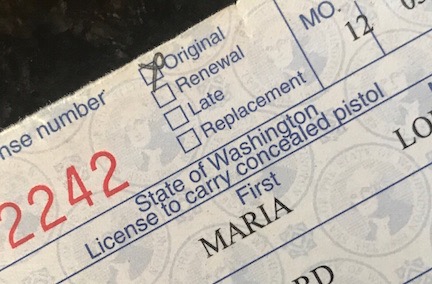
I got a concealed carry permit good for Washington State when I moved here.

When I moved to Washington state, which I believe is also an open carry state, I brought my little Beretta with me. Then I did the paperwork to get a concealed carry permit here. It’s actually easier here than in Arizona; no class is required. (I think that’s wrong.) I carry it in my wallet, even though I don’t carry the gun.

Reminton 870
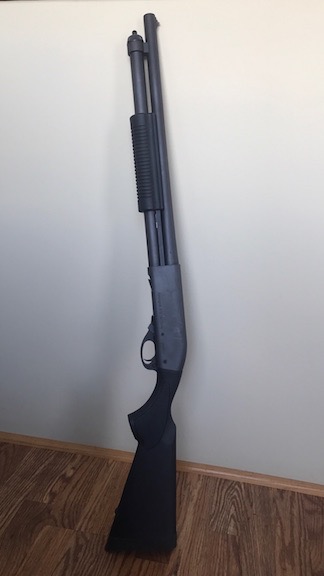
My Remington 870 Tactical shotgun. I had it sitting by the front deck door with a box of ammo for weeks after the second dog attack.

But when I started having serious worries about coyotes coming into my property to steal chickens or possibly my dog, I started thinking that maybe I needed a more practical weapon. And when my neighbor’s dog got into my chicken yard and slaughtered a total of 18 laying hens and two roosters (over two visits), I made my decision. I bought a shotgun.

The shotgun I bought was a Remington 870 Tactical. It’s a pump action 12-gauge shotgun that can hold 7 rounds. (I don’t keep it loaded.) And no kidding here: I bought it at a local store called Hooked on Toys and yes, they did do a background check on me before completing the sale.

Once again, I took it (and my Beretta) to the range to work with an instructor. A friend and I actually took a course together. The course was created by the NRA and had NRA materials, but the instructor was not an NRA employee and he assured us that the educational and political arms of the NRA are completely separate. (Although I thought that was okay at the time, I now want absolutely nothing to do with the NRA and will never pay for anything if there’s any possibility that part of my money might go to the NRA.) The course was informative and I got a chance to learn how to shoot the shotgun. I discovered that the kickback with the butt against my shoulder hurts like hell and I can be pretty accurate shooting from the hip. Hell, if you can’t hit a target with a shotgun, you probably shouldn’t be shooting a gun at all.

Fortunately, the neighbor’s dog has not returned. Could I shoot it? I don’t know. But the Animal Control folks say it’s legal for me to do so, as long as I kill it.

Not All Gun Owners are Dangerous Nuts

You might be able to see why I was bugged by Michelle’s tweet above. As you might imagine, I didn’t let it go uncommented:

But she’s not the only one making uninformed comments about gun owners. There’s a lot of it going around right now. It happens after every mass shooting.

And although I am a gun owner and have insight why other people own guns, I agree that we need to have some common-sense gun control laws. At a minimum, we need:

  • A ban on all guns and accessories that make it possible to fire more than 10 rounds without reloading. These devices should be absolutely illegal to own, let alone sell or use. There is absolutely no reason anyone needs this kind of equipment.
  • Registration for all guns, including those sold in secondary markets such as gun shows or private sales. If you own a gun, it should be registered. Period.
  • Background checks for all gun owners. The check should be done before each gun is purchased and should include criminal activity, domestic violence complaints, and mental health checks.
  • Training requirement for all gun owners. Before you purchase a gun, you should be required to take a qualified class in its use and operation and have a certificate to prove that you’ve taken the class. Additional refresher course training should be required periodically, perhaps every five years.

I don’t believe guns are bad. I believe people are bad. I also believe that we should not make it easy for bad people to do bad things with guns.

The situation we have in this country is absurd, with different laws in every state, many of which make it all too easy for people who are crazy to obtain weapons of mass killing capabilities — like the bump stock the Las Vegas shooter used to fire over 500 rounds without reloading. How can anyone think that’s okay?

The Second Amendment was written in a time when a high-tech gun fired one shot at a time. The Founding Fathers likely never imagined the kind of carnage that could be done with today’s weapons, so it’s pretty silly to keep referring to our “right” to have these kinds of weapons.

And no, a good guy with a gun isn’t the only way to stop a bad guy with a gun. It’s a good way for others to be injured in a crossfire or for the “good guy” to get mistaken for a bad guy and gunned down by police.

And yes, I’m a gun owner. But if the only solution to the gun violence epidemic in this country was to take away everyone’s gun — as they have done in other civilized countries — I’d hand mine over in a heartbeat.

Comments?

Please feel free to share your comments. But if this is your first time commenting here, you might want to read the Comment Policy first to avoid wasting your time. All comments are moderated and I have no qualms about deleting queued comments that violate the policy. Wouldn’t it be a shame if you composed a lengthy, hate-filled manifesto was never published?


On Chickens and Eggs

A brief progress report.

After two flocks of chickens — the original flock and my replacement flock — being killed last year by a neighborhood dog (who will get shot if he steps foot in my yard again), I dove back into chicken rearing this summer by buying 18 pullet (female chicken) chicks with the attention of raising them for eggs and sale as laying hens.

Because I like colored eggs, I bought 12 Ameraucanas, which lay green, blue, or brown eggs. I also bought 3 Rhode Island Reds and 3 Golden Sex Links. This was in mid-March; they were just a few days old.

I built them a brand new chicken coop from scratch and moved them into it in May when they’d gotten too big for the stock tank I’d been raising them in in my garage.

I fed them chicken feed, chicken scratch, and kitchen scraps. They grew.

One of the Ameraucanas died. It happens sometimes. That left me with 17 chickens.

Chicken Yard
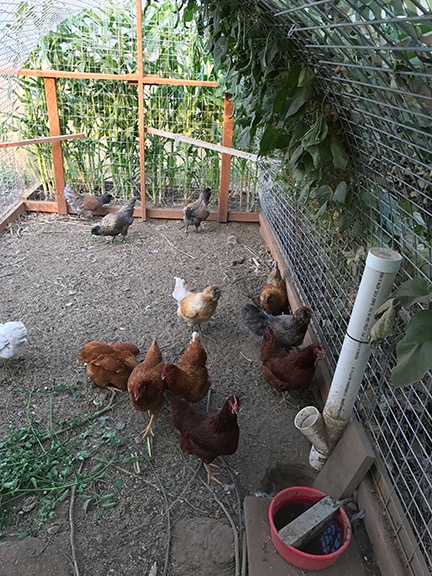
My main chicken yard is 15 x 8. Made of hog panels hooped over the yard, it protects the chickens from predatory birds, such as eagles. I planted string beans against one side and they grew right into the yard. This photo also shows their old PVC feeder and automatic waterer.

They seemed to eat a lot of food, but I began suspect that they had help. Rodent help. Voles and mice are pretty common out here and there’s no way to keep them away from spilled food. Chickens are notoriously messy eaters and were spilling a ton of food from the PVC pipe feeders I’d made for them. At first, I didn’t think it was a big deal. But when it got to the point where they were going through a 50-pound bag every 10 days or so — at $15 per bag — I realized I needed to try to fix the problem. So I bought them a galvanized feeder that hung on the side of the coop building. They didn’t want to use it — probably because they couldn’t easily get the food out on the ground — but when I pulled the other feeders out, they had no choice. What a difference! A 50-pound bag lasted at least twice as long. What’s even better is that the feeder holds more food so I have to fill it far less often.

In late July and early August, they started laying eggs. At first, they were laying only a few eggs a day. But as each hen matured, she added her eggs to the daily count. Soon I was getting about a dozen eggs a day. It was time to move into the revenue portion of my plan.

I bought really nice Farm Fresh Eggs for Sale signs. I put one at the end of my road, one (with an arrow) at the exit to the winery 1/2 mile away, and one at the end of my driveway. On weekends, I prepped egg cartons for sale. I’d have 3 dozen available, as well as some garden veggies.

Of course, this was a dumb idea. I live 2 miles from pavement on a dead-end road and although I was hoping winery customers would drive that extra 1/2 mile, they didn’t. So every Monday I was giving my eggs away to whatever friends didn’t have chickens.

The other part of the plan was to sell the laying hens. That part worked like a charm. I knew from experience how tough it was to get laying hens — I’d struggled to replace the first flock my neighbor’s dog had killed the year before. Surely there were other folks out there who wanted to skip the 4- to 5-month process of raising chicks to laying age. So I put an ad on Craig’s List.

I had decided to sell the Ameraucanas. Yes, I liked their colored eggs. But I had discovered that, for some reason, this batch of chickens were laying medium and small eggs. I wanted large ones. The Rhode Island Reds and Golden Sex Links were laying much larger brown eggs. I’d keep them and let most of the Ameraucanas go.

The first four went very quickly to a man who drove a hard bargain: 4 for $75. The trick was catching them. I’d never tamed them so I had to chase them around the chicken yard to get them.

Time passed. I was still getting too many eggs. No one was buying them. I brought the signs in.

But I wasn’t giving up on hen sales.

I realized that there were two benefits for starting chicks in the summer:

  • I wouldn’t have to deal with a heat lamp to keep them warm. It was in the 90s nearly every day, which was warm enough for them. At night, they could huddle together for warmth.
  • They would be laying eggs by winter time. (More about that in a moment.)

So I bought 8 more Ameraucana chicks, this time from the same place I used to buy my chicks when I lived in Arizona. Maybe they’d lay bigger eggs. They came in the mail and I was ready for them. I’d built a brooding area inside the chicken coop, over the nests. I set them up in there and they seemed happy enough.

I figured a good goal would be to keep my laying flock at 8 hens. I had 13 left. I renewed my ad on Craig’s list. A family came by to buy four of them and decided to take a fifth. I figured out that if I trapped them inside the coop building, they’d be a lot easier to catch. (Duh.) I got $20 each for them. I was down to my ideal flock size: 8 laying hens with 8 pullets that would begin laying by winter. I was still getting more eggs than I needed, but it’s always better to have too many than not enough. I really don’t like store-bought eggs anymore. Besides, with my glamping setup in full swing — more on that in another blog post soon — I’ve been giving a dozen eggs to each of my guests and they seem to really love it.

As the pullets grew, they began outgrowing the small brooding area. I made some changes to the coop to give them an indoor area under the hens’ nighttime roosting area, along with a separate outdoor pen for them to run around in. (I had designed the coop with two exits and merely opened up the one that had been closed.) If the the chickens in the two different age groups are put together when there’s a big difference in size, the bigger chickens will pick on and possibly kill the smaller ones so they had to be kept separate for a while. Over time, I moved their food and water outside. I eventually bought them a galvanized feeder, too.

I suspect that I’ll be able to put them all together before I start my winter travels. There’s a slight chance they might even be laying by then.

Of course, chickens don’t lay as many eggs in the winter here. It has to do with the number of daylight hours. Apparently, the more light they have, the more eggs they’ll lay. So if I put a light in their coop — maybe on a timer to simulate longer day times — they might lay more eggs. But since I’m not going to be around much, I really don’t care how many eggs they lay. So I’ll skip the light.

People have asked me what I do about the chickens in the winter months. The last time I had chickens over the winter, I had a neighborhood kid come by once or twice a week to check them, give them water, top off their food (if necessary), and take their eggs. Right now they have an automated water system that fills from my garden irrigation system — this makes it possible for me to leave them for extended periods of time. But when winter comes, that would freeze up. So I have a heated water dish — like you might have for a dog — and I set that up for them. The chicken watcher brings a gallon of water with her when she comes and just tops off that bowl each visit. The water doesn’t freeze and everything works out fine.

The coop is not insulated, but the last time I had chickens over the winter they had an uninsulated coop and managed okay. I did buy a chicken coop heater for them and will install it before I leave. That should keep the temperature above freezing for most of the winter.

In the meantime, my neighbor’s kids are incubating some fertilized eggs for me. (I got the eggs from a friend who has chickens and roosters.) If they manage to hatch more than 4 (out of 16 eggs), I’ll likely sell all or most of the layers I have now so I start next season with some very young layers. (I’ll know how well they succeeded by next week; they’re due to begin hatching September 20.) My goal is to sell all layers before they’re a year old so I always have a young flock and the person who buys my layers gets a young chicken who will likely lay reliably for at least two years.

Eggs
Yesterday was the first time I got an egg from each of my eight laying hens. (The tiny egg might be that hen’s first.)

I forgot to take my ad off Craigslist when I got down to the desired flock size of eight layers and someone called. I sold the last two Ameraucanas for $25 each around midday today.

The net result of all this chicken work? Well, I get delicious fresh eggs — that’s pretty obvious. But I also get a stronger connection to my food, which I blogged about back in May. If you do gardening or raise chickens or livestock for your own consumption, I’m sure you know what I mean. If you don’t, well, you’re missing out on something special.

For those of you who like the idea of raising your own chickens for eggs but don’t know much about it, here are a few tips:

  • You can order chicks online. They come in the mail. Really. Learn more at Ideal Poultry’s website, which is where I order my chickens online.
  • Chickens are easy to raise and a lot of fun to watch, especially if you raise them to be tame.
  • Raising chickens is a great project for families.
  • Chickens are a great way to rid your yard of pesky insects.
  • You don’t need a noisy rooster to get eggs.
  • Fresh eggs from your own chickens are amazing, with big, deep orange yolks you can’t find in most store-bought eggs.
  • The average laying hen lays about 5-6 eggs a week. 3-4 hens is enough to supply a couple with all the eggs they need, with some left over for gifting.
  • Chickens don’t need a lot of room. They can fit in virtually any back yard.
  • Most municipalities do allow a limited number of chickens, although roosters might be forbidden. Check with your town hall.

You can also learn a lot about raising chickens, as well as getting plans for building your own coop and feeders online. Remember: Google is your friend.

If you have questions or comments, please don’t hesitate to post them as comments to this blog post. I’ll answer them as well as I can.

Solar “Sleep In” Time at the Aerie

When my sunrise happens later than the people in the valley.

I’ve been home from my vacation for two days now — just in time to notice the start of what I think of as the sun’s “sleep in” period. Let me explain.

My home sits on a shelf overlooking the Wenatchee Valley. The valley is to the north. To the south is a 1000+ foot basalt cliff carved out by ice age floods. My home, in fact, sits on silt and rock deposits left behind from those floods. (The geology is fascinating here.)

As anyone who paid attention to basic astronomy in science class knows, the sun rises and sets at a slightly different part of the horizon every day. From the winter solstice in mid December to the summer solstice in mid June, the sun rises and sets a little farther north every day. From the summer solstice to the winter solstice it sets a little farther south every day. The equinoxes — in March and September — are when the sun rises and sets due east and west respectively. Ancient people knew all this stuff — probably better than today’s Americans — and created structures to track it, like Stonehenge and various Mayan observatories such as El Caracol in Chichen Itza.

Throughout August, the sun has been rising a bit more to the south (right) on my horizon every day. A slope up to the cliffs lies due east of my home. On a specific day in August, the sun starts rising behind that slope. Because it has to clear the slope (and eventually the cliffs) before I can see it, sunrise to me happens later than people who aren’t quite as close to the slope or the cliff.

For lack of a better way to describe this, I say that the sun is “sleeping in” or just rising later than it should be.

Since I moved here full time back in 2013, I’ve been trying to make observations about the sun’s movement as it relates to my home. Every once in a while, I witness a key event. For example, around the first of December is when the sun rises so far south that it never quite clears the cliffs to the south of my home. Starting on that date and ending about six weeks later is what I’ve come to call the “shadow time“; I get no sunrise at all and live in the shadow of the cliff. (If you think that’s bad, it’s a lot worse for my neighbors on the south side of the road — they don’t get any direct sun for months.) Since I spend much of my winter traveling, it doesn’t really affect me.

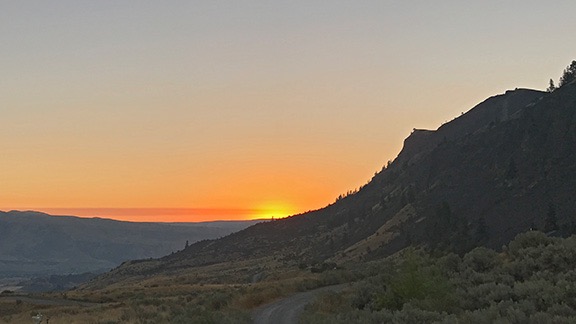
Yesterday, August 26, is when I noticed that the sun rose right where the flat horizon met the hills at the base of the cliff. I put it on my calendar as a recurring event called “Sunrise Corner” — when the sun rises in this “corner” of the horizon. This morning, I snapped a picture right before sunrise to illustrate it.

My Sunrise Corner
The sun now rises where the flat horizon meets the base of the cliffs behind my home. From now through December, the sun will have to clear the cliffs before it “rises” for me — hence, it’s “sleeping in.”

I should mention here that even though I’m not seeing the sun at the reported moment of sunrise, people down in the valley might be. I’ll look down and see the valley bathed in sunlight, with deep shadows cast by the cliffs and other hillsides delay sunrise for others. Even during my six weeks of “shadow time,” the valley gets sunshine and it’s bright outside. It’s all relative.

There is a benefit to the delayed sunrise and the steady movement of the sun to the south. My desk currently sits at an east-northeast-facing window. When the sun rises farther to the north, on the flat horizon, it shines right into the side of my face when I’m trying to work. I’m going to permanently solve that problem by moving my desk up to my loft. (I’ll have a lot fewer distractions up there, too.) But until then, I have to rely on sun shades if I can’t wait until later in the day to get desk work done.

I think that’s one of the things I like most about where I live now: nature is more a part of my life. I can see it and notice it. It’s impossible not to. And then I can reflect on how it affects me and the things I do.

For example, the front of my house faces mostly east. That means you’ll never see me mow my lawn during the hot summer months between sunrise and about 4 PM when my lawn is in the shade of my home. Likewise, you won’t find me lounging on the sofa in my bedroom beside that west-facing window on a summer afternoon — although it’s quite pleasant on a winter afternoon.

As the sun rises later and later in the morning — especially here at the Aerie — I’ll enjoy the extra cool morning time to get things done on the east side of my home.

When will the sun be at the corner again? That’s actually pretty easy to calculate. Figure the number of days between yesterday and the winter solstice: about 117. Now add that to the winter solstice date and you get April 17, 2018. It should be within a day or two of that. I’ll see if I can remember to check in April.

Where There’s Smoke…

…well, there are no fires here.

When you live out west, the weather forecast can include information related to smoke. And that’s the situation this week, for good reason:

Forecast
This is not the kind of forecast I like to see.

The smoke drifted in yesterday morning, looking like a low thin cloud layer. Throughout the day, it thickened and settled into the valley I can see from my house.

Normal View
Smokey View
My normal view (top) includes glimpses of the North Cascades, at least 50 miles away. Add wildfire smoke and you get my view this morning (bottom), which is barely four miles.

As the northwest’s weather guru, Cliff Mass, blogged yesterday, the smoke is mostly from fires in British Columbia, which isn’t too far from here. There are two fires in northwestern Washington and I heard a rumor that there was one much closer at Blewett Pass, but have not been able to confirm that. Fortunately, they’re not here — although there’s plenty ready to burn if a spark or ember touched down.

Sunrises and sunsets have been minor events lately, with the sun looking like a Sunkist navel orange as it hovers on the horizon. It reminds me of the sunsets back in New York that I admired so much. I remember the one on July 10, 1983 that I drove down to the West End 2 parking lot at Jones Beach to photograph. An orange ball like the one in the sky here today sunk into the western horizon, silhouetting Manhattan skyscrapers in the distance. I got more than photos that day, but that’s a story not worth telling anymore.

Smokey Sunrise, Untouched
Here’s what the sun looked like about 1/2 hour after sunrise. This is an unedited (except for cropping) cell phone photo.

Oddly, back in those days I never realized that that orange ball sunset was caused by air pollution. Ick.

I was supposed to make a day trip by helicopter to visit a friend of mine out on Lopez Island today. It’s an 80-minute flight and I can land in my friend’s yard. I haven’t seen him in months and was really looking forward to it. But when I checked the weather this morning and discovered that the smoke was moving out his way, too, I had second thoughts. My email to him at 6 AM asking whether there was smoke and his response confirming there was was enough for me to change my plans and stay home. If it’s smokey here and smokey there then it’s likely to be smokey en route. And the last thing I wanted to do today was spend nearly 3 hours in a helicopter flying through smoke. (The journey is usually almost as good as what awaited at the destination.)

So I’m home for the day. I went out this morning to pick blueberries and glean rainier cherries with a friend. But we were back by 11. It’s hot and sticky out in the filtered sunlight, with a level of humidity I like to avoid. I’ll do some work in my garage with my new jumbo fan pointed at me. When I get tired of that, I’ll come back upstairs, take a shower, have a snack, and do things in air conditioned comfort.

Or take a nap.

But you can bet I won’t be outside, breathing the dirty air sent down from Canada.

A Personal Tune-Up

Two new routines in my life.

I turned 56 at the end of June. (Unlike other women, I don’t lie about my age.) And although I’m a lot more active than my mother (for example) was at my age, I’m not quite as active and fit as I’d like to be. To make matters worse, I’ve discovered that Mother Nature plays nasty little tricks on a person’s body as he or she ages.

While most people would take the attitude that it’s all part of aging and there’s nothing they can do about it, I’d rather not. So I’ve set August as the beginning of a personal tune-up period and have added two new routines to my life.

Feeling Better through Weight Loss

If you’ve been reading this blog for a while, you’ll know that back in 2012 I lost 45 pounds or approximately 23% of my body weight. (I’ll let you do the math; and you never thought you’d use high school algebra, huh?) This huge weight loss coincided with the beginning of my crazy divorce and lots of folks assumed that stress from the divorce caused the weight loss. It didn’t — although I suspect it did help. I lost all that weight by getting on and sticking to Medifast, a diet plan that two friends had used to lose 80 and 70 pounds respectively. A friend who started at the same weight as me lost just as much as I did in about the same amount of time. Truth is, by the time I got home from my summer job to face the crazy that awaited me, I’d already dropped most that weight and I managed to keep most of it off for two years.

But as you might expect from going off a strict, unsustainable diet plan — I had no desire to eat that “food” for the rest of my life — the weight crept back on. Not all of it, thank heaven. But enough to make me feel the sluggishness and lack of motivation that I felt back in the final days of my ill-advised marriage. So I decided to do something about it.

The question was what to do? Sure — I could get back on Medifast and drop all that weight in another four months. But then I’d secure my seat on a dieting seesaw I never wanted to be on. I needed a more sustainable plan, something that would allow me to eat the food I wanted without counting calories or getting overly concerned about portions.

Enter Whole30

Long story short: six different friends raved to me about Whole30. It’s apparently been around for a while. It’s a version of a Paleo diet. Food is broken down into broad yes/no categories:

YesNo
Meats, fish, and eggsDairy, including cheese (!)
FruitAdded sugar or sugar substitute
Vegetables (with some exceptions)Legumes
Nuts (with some exceptions)Grains, including whole grains and pasta
Natural fatsAlcohol, including wine (!)

This isn’t everything you need to know, of course. But it is about 90% of what the plan entails.

It’s about your health, stupid.

I have no patience for overweight people who claim that they don’t care what other people think of them or that fat can be beautiful or that society places too strong an emphasis on perfect bodies and they don’t care. These people are missing the point.

I’m not saying we should all look like runway models. I’m saying that we should maintain healthy body weight. So many ailments can be avoided or even cured by weight loss. This isn’t bullshit hearsay — it’s the truth. Not only will you look better and feel better when you get down to a healthy weight, but you’ll be healthier and have a much better feeling of self-esteem. Take it from me: I’ve been there. Stop making excuses and start taking care of your health.

The idea is to stick to this plan exactly as written for 30 days (yes, it’s the 30 Day Challenge). The authors of the plan and the book that goes with it make all kinds of claims about how good you’ll feel at the end of that month. Some of them are admittedly outrageous — like claims to “cure” literally dozens of ailments related to “silent inflammation.” I don’t believe all that crap, although I do believe that symptoms of some ailments can be greatly reduced with a good diet and healthy weight. For example, I have had high blood pressure for years; it runs in my family. When I was very heavy, it took three meds to control it. When I lost all that weight, I got it under control with just one med — and that’s where I am today.

(I might also mention here that one of the reasons I was determined to lose all that weight back in 2012 is because my doctor told me I needed to start watching my sugar numbers. Type 2 diabetes also runs in my family and I didn’t want any part of that. My weight loss took the possibility of that off the table — no pun intended.)

Whole30 BookThe Whole30 book itself is pretty funny if you read it with a mind as cynical as mine. It’s all “rah-rah” and “you’ll hate us for this but” and other such nonsense meant to encourage weak people. The way I see it, if you want to see results, you have to stick to a plan that’ll work. No amount of coaxing is going to work on someone with no willpower.

The gimmick with the Whole30 Challenge is that for the 30 days you’re following the plan, you can’t cheat. Not even a tiny bit. If you have anything to eat that isn’t allowed, you have to start over. So yes, the 1/3 teaspoon (I measured it) of sugar and half ounce (estimated) of milk that I put into my 18 ounce cup of coffee (allowed) this morning is cheating and I’d have to start over tomorrow. That ain’t gonna happen. I was warned by my Medifast diet coach that coffee, milk, and sugar weren’t allowed on Medifast and I wouldn’t get results if I had them every morning. But I did and I still lost a shit-ton of weight.

And sure, you can throw my words about willpower above back in my face, but my morning coffee is something I’m not willing to give up for a week, let alone a month. I want to find a plan I can live with, not suffer through.

Not a Weight Loss Plan?

I should point out here that the Whole30 book claims it isn’t a weight loss diet plan. I honestly think they say that so you’re not disappointed when you don’t lose weight. But in the book, they say that you will lose weight as a side effect of getting all the bad food out of your system. And although they don’t have you counting calories, they do talk about portion sizes and having just three meals a day — or at least keeping three hours between smaller meals. And that sounds a lot like Medifast.

I guess it’s all the same no matter how different it is.

You Have to Like to Cook

One of the interesting aspects of Whole30 is that because you have no idea what they put in restaurant food, you can’t really eat in a restaurant. And because you’ll likely die of boredom eating plain salad and grilled meat all the time, they have lots of recipes in the book. (There are also a ton online. Want to make a pork dish? Google Whole30 pork recipe.) So you’ll theoretically do a lot of cooking at home. I like to cook so that’s okay with me.

The other day I made their Classic Chili recipe using some of the ground beef I already had in my freezer (from the 1/4 cow I bought last year) and vegetables right out of my garden. It was surprisingly delicious. It also made enough for me to freeze two portions so the next time I don’t feel like cooking, I can grab one out of the freezer, pop it in the microwave, and enjoy.

The book also has a ton of recipes for various sauces to spice up plainly prepared foods. I made an almond- and tomato-based “romesco sauce” yesterday to top garlic shrimp with zucchini noodles. The recipe made enough for several meals, so I used some this morning on an omelet I made with eggs from my chickens and onions, tomatoes, and peppers from my garden. It really did make breakfast more interesting.

Home Made Lara Bars
With no added sugar and simple, wholesome ingredients, you don’t need to be on a special diet plan to like these energy bars.

I also found a recipe online the other day for Whole30-compliant energy bars similar to the Larabars you might find in your supermarket or health food store. I made two versions: one with dates, coconut, dried cherries, almonds, and pepitas and the other with dates, coconut, dried apricots, almonds, and flax seeds. I put half in the fridge and used my vacuum sealer to seal and freeze the other half in individual bars. I’ve been eating them for dessert and will likely take them on hiking or day trips. They’re actually quite tasty.

So I guess that as long as I can continue to make interesting foods, I’ll have no trouble sticking with it. My 30 days started yesterday and I’ll go until month-end. I’ll likely blog some interesting things I discover along the way.

But I don’t actually expect Whole30 to be the reason I lose weight over the next few months. I’ll leave that to Invisalign.

Stopping Shifting Teeth

Here’s something I never knew about aging: your teeth shift.

I’ve always had very healthy teeth — only three cavities in my life so far. They were not, however, perfectly straight. When I was a kid, my parents actually debated me getting braces for an overbite and eventually decided that it wasn’t severe enough. (They were right about that.) My bottom teeth, however, have always been a bit crooked, with one of the front ones sitting at a 30° angle to the others. Fortunately, no one sees that when I smile since my front teeth steal the show. So although I was never happy about those bottom teeth, I never saw a need to fix them.

One of the happy side effects of my divorce is that I smile a lot more now. (It’s true! I’m a much happier person!) And about a year or two ago, I started to notice that in photos of me smiling, one of my front teeth seemed to be in the shadows. I realized, with a bit of horror, that it was starting to shift backwards in my mouth and it was affecting my smile.

Now I’m not raving beauty and I came to terms with that years and years ago. But I do look best when I’m smiling so I do it a lot. I found the thought of my smile getting ugly very hard to swallow.

Enter Invisalign

Invisalign is a program with dental “appliances” to straighten teeth. It’s extremely effective in cases where not much straightening is required — like in my mouth — and it’s popular with adults because it’s basically invisible to others. The patient starts with a set of clear plastic appliances that fit over his or her teeth and gently tug them toward the desired end position. Every 7 to 10 days, the appliance is replaced with a new one that continues the positioning. At the end of the program, the teeth should be in the desired end position.

My dentist showed me an animation of my teeth moving into the proper position over time. It was very cool. I’ll see if I can track down a sharable copy.

In my case, I’ll be using 20 sets of appliances. They started me yesterday with my first one. The worst part is the placement by the dentist of small upraised points on several teeth to hold the plastic braces in place. Then they snap in snugly and go to work. I can feel them pulling, but although I thought they’d keep me up, I slept like a log last night — nine full hours!

And yes, I do have to wear them night and day. You must wear them 20 to 22 hours a day for them to work.

I’ll wear these for 10 days, then switch. Then 10 days of that and a switch. Then I visit my dentist so he can see how things are going and get the next batch. I’m hoping that they’re going well enough to do a switch every 7 days instead of 10 to speed up the program.

The net results: I should have all my teeth — even the bottom ones I’d already decided I could live with crooked — straightened within about six months.

Of course, since my teeth will want to continue to shift as I continue to age, I’ll have to wear a retainer at night, likely for the rest of my life. Let’s hope I can live with that.

Invisalign and Weight Loss

Of course, I talked to a bunch of people about their Invisalign experience before plunking down a bunch of money to give it a try. (It ain’t cheap.) And one of the things that came up is the fact that you lose weight when you’re on Invisalign.

What?

Well, it actually makes perfect sense. You have to wear these things at least 20 hours a day and you can’t eat or drink anything other than water while you’re wearing them. Sure, they’re easy enough to take out, but if you take them out to eat, you need to brush your teeth and clean the plastic appliances before putting them back in. This is a huge pain in the ass. So, as a result, people wearing Invisalign appliances don’t do much snacking between meals. That means they lose weight.

So combine Whole30 with Invisalign and it would be a miracle if I didn’t lose weight.

Invisalign and White Teeth

I also expect that my teeth will be cleaner and whiter than they’ve ever been before.

Let’s face it: I hate brushing my teeth. I hate the flavor of toothpaste. (Peppermint has been known to make me nauseous.) When I eat a meal, I want the flavor of the meal to linger on my palate 20 or 30 minutes later, not the minty flavor of toothpaste. So I normally brush my teeth just once a day, and that’s usually right after showering. I do everything in my power to avoid brushing right before or after my morning coffee, which really is sacred to me.

But now I have to brush after every meal or snack. I brushed my teeth four times yesterday. I expect to brush at least five times today as I begin considering my mid-morning snack.

I use a whitening toothpaste. Brushing 4-5 times a day would have to result in whiter teeth, no?

So in six months, I can expect to have the straightest, whitest teeth I’ve ever had.

Is It Time for Your Tune Up?

Getting old sucks. (And don’t give me the tired old saw about it beating the alternative; there will come a point for many of us when the alternative is better.) But you don’t have to take things lying down. You can do what’s within your power or budget to make your life better as you age.

That’s what I’m doing. If you’re not, why not?