My 1987 Toyota MR-2 returns to Wickenburg for an oil change.
“The oil pan is damaged,” the oil change guy in Prescott said. “I can’t change the oil.”
“Can I see?” I replied.
He escorted me to the secret underground chamber where the oil change guys who do the under-the-car stuff perform their magic. Everything was covered with a thin coat of oil that slicked up the bottoms of my Keds. I looked up at the underside of my 1987 Toyota MR-2 and marveled at how old, rusty, and dirty it looked.
“There,” the oil change guy said, pointing.
Pointing was not necessary. The oil pan was clearly bashed in. The bash was at least six inches across and four inches wide and probably reduced my total oil capacity by a pint. I was lucky it hadn’t bashed about two inches farther back, where it would have bashed off the drain bolt. Or that the rock that had done the damage hadn’t bashed right through the metal.
I pulled out my digital camera and tried to take a picture, but the battery was dead. Figures. How often do I get a chance to photograph the underside of one of my cars?
“I’m afraid I won’t be able to get the plug back in,” the oil change guy explained. “Sorry.”
We climbed up into the garage and he pulled the car back out into the Prescott sunshine. He took out the paper floor mat and plastic seat cover and left the car there for me to take away.
I went for a second opinion, pretending I didn’t know anything about the bashed in oil pan. A few minutes after they pulled the car into the garage, the shop manager came out looking upset. “I hate to break this to you,” he started.
“My oil pan is bashed in,” I told him.
“You know?”
“Sure.”
“Well, we can’t change the oil.”
“Because you’re afraid you won’t be able to get the plug back in,” I finished for him.
He looked stunned. I was a mind reader.
I drove off, now just about out of time. I’d gone up to Prescott to drop off my helicopter for service and had spent the day shopping, filling the Toyota’s passenger seat with all kinds of things. The oil change was my last task of the day. It had been over a year and 1,000 miles since I last had the oil changed and I didn’t want the car to feel as if I was totally neglecting it. (I got it washed last time I drove it, two months ago.) But no one would change the oil and now it was time to go back to get Zero-Mike-Lima.
I’d have to get the oil pan fixed. I wasn’t about to do that in Prescott. I’d bring it back to Wickenburg to the only mechanic the MR-2 loves: Dan.
But not that day.
I offloaded my purchases at the airport and stuffed them into Zero-Mike-Lima, then flew home.
This past weekend, Mike and I drove up to Howard Mesa to drop off our camper. We were supposed to have our shed delivered (again) but the holiday weekend made that impossible, so it was postponed (again). But on the way home, we had to drive right past Prescott Airport, where the MR-2 lives. Mike dropped me off and I hopped into the MR-2.
“Surprise!” I told it, as I removed the sunshades.
As usual, it started right up. I love that car.
We had dinner at a new Asian fusion restaurant in Prescott that I can’t recommend. The scores, based on a scale of 1 to 10, are as follows: Atmosphere/Decor: 8; Service: 3; Food Quality: 4; Value for Dollar: 5. We can cross that one off our list.
Then we drove home.
Now there are two ways to get from Prescott to Wickenburg. We call them the curvy way (White Spar Road – route 89) and the straighter way (Iron Springs Road). Mike wanted to go the straighter way, but we were in town, closer to get to the curvy way. It would have taken 15-20 minutes just to get to the other side of town. So I voted for the curvy way, presented my logic, and won. I led the way.
Now the Toyota may be 18-1/2 years old and it may have 132,000 miles on it and it may also have its original clutch, but it was born a sports car and it hasn’t forgotten how sports cars are supposed to perform on curvy roads. And I certainly haven’t forgotten how to make that baby perform. We took off on White Spar Road, settled into second gear, and screamed around every one of the curves. Fortunately, there was no one in front of me — I hate passing on double yellows (just kidding, officer!) — so there was no real reason to use the brakes. Just keep those RPMs up and let the engine do all the work. I had a blast. And I beat Mike to Wilhoit — fifteen miles down that curvy road — by about three minutes.
God, I love that car.
I waited at the side of the road in Wilhoit for him, then let him pull out in front of me to set the pace for the straight part of the drive. He set a quick pace: about 75 mph. The MR-2 handled it nicely. I’m glad he kept it below 80, because I’ve noticed a serious increase in fuel consumption when the speedometer needle moves past that 12:00 position on the dial. (Yes, 80 mph is straight up on that car’s dash.) The stereo, which had been tuned into a classic rock station based in Prescott, stopped picking up a signal, but the Scan feature locked in on a Dewey/Humbolt-based station that was playing late 1970s disco. I’m talking about We Are Family, Kung-Fu Fighting, Copacabana, and other big AM-radio hits from my early college days, when my tastes in music were somewhat confused by the Top-40 thing and my job at a retail clothing store. Although the stereo’s two back speakers are dead and I have them turned off, I still cranked up the volume so I could reminisce while driving 75 mph into a high desert sunset.
For the record: I don’t like disco. But listening to it for short lengths of time does bring me back to a simpler time of life, when I only had one car to worry about (a 1970 Volkswagen Beetle that would never be reliable) and having $20 in my pocket made me feel rich.
I started smelling something weird at Kirkland Junction. Engine smell. Now the MR-2’s engine is behind the passenger cabin — it’s a mid-engine car — so I don’t usually smell the car’s engine problems. I figured it was the car in front of me, which was Mike’s truck. I got a little worried about it, but there didn’t seem to be a problem because he was keeping up his pace, probably listening to some blues music as loudly as I was listening to disco on crummy speakers.
On one of my glances in the rearview mirror, I noticed some brown splashed on my back window. Shit. My MR-2 was bleeding.
I checked my gauges. Everything was fine. But the smell was still there and there was definitely some kind of fluid splashing up from the engine compartment’s vent onto my back window.
I flashed my lights at Mike’s tail end. He was grooving with the blues band and didn’t see me. I slowed down. I wondered if my cell phone would work up there. Then I came around a bend and saw that Mike had also slowed down. He started to speed up, but I flashed him again and pulled over. I came to a stop behind him on the shoulder and turned on my 4-ways.
“My car is bleeding,” I told him, stepping out. “I’m afraid that if I shut off the engine it won’t start.”
“Pop the engine lid.”
I did as he instructed.
“Oh, shit,” he said. “Turn it off.”
I turned it off. “What is it?”
“It looks like those guys who were going to do the oil change didn’t screw the cap on tight,” he told me.
The engine had been spitting oil out the filler cap, probably for the past five or ten miles. There was oil all over the top of the engine.
Fortunately, the cap had wedged itself on top of the engine. He got a paper towel from his truck and came back to the car, then pulled out the cap and screwed it on tight. Then he closed the lid.
“Start it up.”
I started it.
“How’s your oil pressure?”
“Low, I told him. “But it wasn’t low when I was driving.”
“Rev it up.”
I revved. The pressure needle climbed.
“It should be okay,” he said. “Keep an eye on it. And keep your RPMs down.”
We continued on our way. He kept his speed down to just around the speed limit. My oil pressure looked good. The radio station switched from disco to 50s rock. Ick.
I left the Toyota in the parking lot next to Dan’s place. Dan has a gate at his place that he locks at night.
Let me tell you about Dan.
Dan used to run a car fix-it place in Wickenburg called Dan’s Automotive. Mike and I took all our cars to him. He’s always been able to fix them and he doesn’t charge an arm and a leg. More than once I went to him with a stupid little problem when Mike was away — the kind of thing where someone knowledgeable about cars will just look at or listen to, adjust one thing, and the problem goes away — and he worked his magic on it without charging me a dime. He’s a laid back kind of guy, the kind of guy that Mike and I can deal with.
Then Dan sold the place to someone else.
I won’t mention names because I don’t have anything nice to say about the buyer. I continued to bring my cars to him. The Toyota was first. I had a nasty vibration at around 55 miles per hour that couldn’t be fixed with a tire balancing. He did something to it, and it seemed to be better. Then he asked if I’d ever had the timing belt replaced. The car had over 120,000 miles on it and I had to say no. He told me that the belt could go at any time and then it would be a costly repair. Changing it now could save money down the road. I bit and told him to change it. I also asked him to fix my air conditioner, which hadn’t worked right in about eight years. Four hundred plus dollars later, I got the car back. The air conditioning worked. But the car didn’t drive right. It had no power at all until I got to about 4800 RPM. Then the power kicked in. It was very noticeable in the lower gears. I brought the car back to him and told him about the problem. He had it for a few days and claimed to have fixed it. But he didn’t. The car now drove like shit and I was heartbroken.
I took it back up to Prescott. Every time I flew up to Prescott and drove the car, my heart ached. It had always been a sporty thing, one that was such a pleasure to drive. Now it drove worse than the VW Bug I’d had in college. And when I had a passenger on board, the added weight made things even worse.
To further add insult to injury, the air conditioner didn’t work very well, either.
Then we discovered that Dan had taken over the car fix-it place across the street from his old place. The guy he’d sold Dan’s to was not only a poor mechanic, but he was a poor businessman. He didn’t include a Covenant Not to Compete in the purchase agreement for Dan’s. Now Dan was back in business.
I brought the Toyota back down from Prescott to Dan at his new place and told him my sad story. “It’s breaking my heart every time I drive it,” I told him. “Please, please look at it and see what you can do.”
He did better than that. He fixed it. It appears that the timing belt was off by two notches. He set it the way it should be and the car was back to its fun-loving, tire-screeching, curve-blasting self. Woo-hoo!
So it was to this wrench-wielding hero that I brought the Toyota. I stopped in this morning to tell him why it was there.
“You know my Toyota loves you, don’t you?” I began.
He just smiled at me, probably wondering how such a wacko could be left roaming the streets.
“I tried to get the oil changed,” I said, “But they told me the oil pan was bashed in.”
“It’s been bashed in for a few years,” he told me. “You just have to work a little with the plug to get it back in.”
“Well, then can you just change the oil? And give it a look-over to make sure there’s nothing else wrong with it?”
“Sure.”
We talked a little about “restoring” it. It’s a kind of dream I have. Fixing it up so it looks like new. After all, it’ll be a classic car in just another six years. He was very non-commital, probably because he was wondering how such a wacko could be left roaming the streets.
“No rush,” I told him. “I’d like to have it back by Friday. It’s spending the summer in Williams.”
He promised to have it finished by then.
Now I’m thinking about the family photo I want to take: all my red cars and my red helicopter, together on the ramp at Wickenburg.
I’d better call the detailers. The Toyota and Jeep can really use a good cleaning.
As for the Toyota’s air conditioning, it doesn’t work at all anymore and probably never will.
June 3 Update: Apparently, the oil pan’s condition is worse than Dan thought. (I guess I bashed it a few more times since Dan last saw it.) He had to order a new oil pan from Toyota. Special order — can you imagine? So the Toyota will have at least one shiny part this summer. And this will be a costly oil change. Guess I won’t be driving it to my place on Howard Mesa anymore.
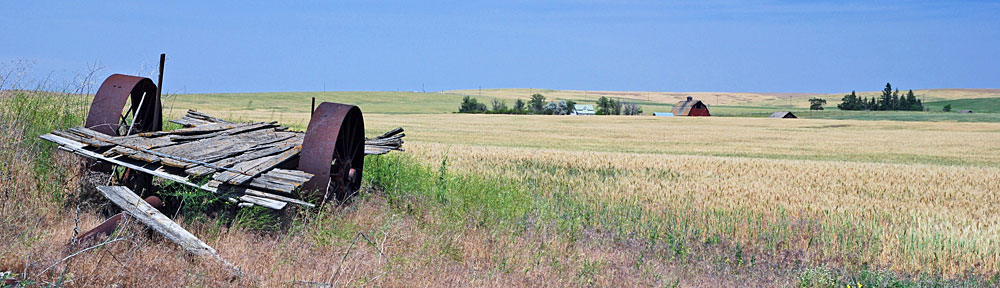
 I didn’t see or smell smoke all day yesterday. But in the evening, as the sun was setting, I saw the smoke on the northwestern horizon. Probably the fire out in the St. George area about 120 miles away. This morning, the smoke from Arizona’s big fire — the second biggest in its history — had drifted north, past the San Francisco Peaks, shrouding the eastern horizon. I almost missed the sunrise. The sun fought to be seen through the thick smoke, appearing as an orange globe poking out through the top of the thickest of it. There was little light from the sun at first. Then, when it broke clear of the cloud layer, I could feel its bright warmth. The smoke cloud faded back to a blue-gray blanket on the horizon.
 Horses are herd animals. That means they like to be together. When the lead horse moves, the rest of the herd follows. My horses follow that rule. I only have two of them: Jake, a sorrel Quarter Horse, and Cherokee, a Paint Quarter Horse. Jake is generally the boss, but they’re good buddies and they’re always within sight of each other, if not right next to each other.
 It took some doing, but I finally found Jake about a third of the way down the hill, at least a quarter mile away. I called him, but even if he heard me (which I doubt), I knew he wouldn’t come. (Jake is not like a dog. He’s more like a cat.) So I called Cherokee. At least he indicated that he heard me. But he was too panicky to even think of why I might be calling him. Long story not as long: I went back to the round pen, put the lead rope on Cherokee, and led him down toward Jake. When I had a good view of him, I pointed him out. But horses don’t understand pointing fingers. He looked everywhere except where I was pointing. Then Jake saw us. He let out a loud whinny that seemed to say, “What the hell are you doing up there?” Cherokee whinnied back. I took off the lead rope and he trotted down to his buddy.
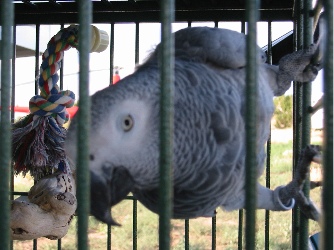 I landed on my gravel helipad near the trailer and shut down. Then I proceeded to do chores. Unlocking the camper, turning on the power and refrigerator, tuning in the stereo (presets get lost when you shut power), hooking up the water, setting up the pump, opening the gate, putting out the carpet. I was just staking down the awning when I heard Mike’s truck pull in. He unloaded the horses and other critters and I made him lunch. Then we put away all the things he’d brought: Alex’s big cage from the coffee shop, the cabinets I’d bought for the shed, and the tools I’d need to work over the summer.
 Mike spent the afternoon hooking up the camper to our septic system. It was a good thing he did, because the camper had been used for three short trips without being dumped and it was beginning to get stinky. I took care of things inside — putting away groceries, making the bed, cleaning things up. Two hot showers later, we had dinner at the picnic table outside the camper, with our horses and the San Francisco Peaks to admire while we ate. Cherokee decided to stand on the other side of the bird cage while we ate dinner. His head was about 2 feet from Alex. Alex was very quiet while Cherokee was there. Then Cherokee decided to sample the corn cob litter I’m using at the bottom of Alex’s cage. I think he likes it. We had to scold him and chase him off. Jake came over and watched us eat our corn. I think he was begging. It was very weird having the horses so close to us — less than five feet away — while we ate. I’m not sure how much I like it. Meanwhile, Alex has already learned to imitate the squeaky screen door. He makes the sound every time we open the door. I’m waiting for him to learn how to call Cherokee.
 Back on the mesa, we relaxed for a while before doing our final chore for the day: surrounding the helicopter’s landing area with a “fence.” We had some plastic fence posts designed to hold electric tape. We’d bought the whole system — complete with solar fence charger — as an option for when we went camping with the boys. But we’d since used the fence charger and some of the tape to surround the chicken coop and keep our neighbors dogs and coyotes out. We had these posts and plenty of tape left, so we used them to make a perimeter around the helicopter. The idea is to keep the horses out of the landing zone when the engine is running. Our horses respect fences, so we knew it would keep them out. We just weren’t sure how well the posts and tape would hold up to rotor wash.