On Stuck Valves

How I recognize an engine problem — and resolve it — on top of a mesa.

I’d flown Three-Niner-Lima up to Howard Mesa on my birthday, June 30. I was due to work at the Grand Canyon the next day and was looking forward to commuting to and from work daily in my helicopter.

The next day, I climbed aboard, all dressed for work. I started the engine and immediately noticed that it sounded louder and vibrated more than usual. At first, I convinced myself that the louder sound was my imagination, due to spending the night in the absolute silence of Howard Mesa. (It’s amazing how your hearing gets more sensitive when there’s nothing for it to listen to.) The vibration was due to me parking on level but uneven ground.

The blades, however, took longer than usual to start turning. There was no logical explanation to that.

And when I got it up to warm-up RPM (75%), I realize that the manifold pressure gauge read 18 inches. 18 inches is what I need to hover when I fly solo. I didn’t know what it was at warm-up RPM, but I was pretty sure it wasn’t 18 inches.

I applied carb heat, thinking that perhaps there was some icing (not likely but possible). I immediately lost about 10% of my RPM. I normally lose about 2-4%.

The lightbulb over my head came on. I had an engine problem.

I disengaged the clutch and pulled the mixture. The engine cut out gratefully. I checked my watch. It was 6:15 AM. If I didn’t hop in the Jeep soon, I’d be late for work.

I stopped the blades, tied them down, and climbed into the Jeep. It started right up and I started on my way. Of course, I did get a flat tire about 1 mile from pavement that made me late for work anyway, but that’s another story, covered in another blog entry.

I called my R22 mechanic in Prescott, Cody, and talked to him about what I’d experienced. He suggested a few things: sticky valve, fouled plugs, bad magneto (I hadn’t even gotten to the mag check). We came up with a plan of action that included checking the plugs and possibly doing a mag check.

Mike joined me at Howard Mesa a few days later. He pulled the plugs and cleaned one of them. I assumed that was the problem and didn’t bother starting up again. Until it was time to go home. And guess what? The problem was still there, if not worse. I was now pulling 18 inches of manifold pressure at 55% RPM.

We tied down the blades, covered the cockpit, and went home.

I called Paul, my old mechanic in Chandler. Although I’m not allowed to bring my helicopter to him for repairs, he’s told me time and time again that I can call him any time I have a problem. He had the same opinion as Cody about the problem, but added that if it were a stuck valve, we could easily check for bent push rods by pulling off the valve covers. Easy for him.

Cody was leaving town for Montana and would be gone for a while. And I had a feeling his boss, John, wouldn’t be too receptive to a field trip. John had a trailer that we could use to bring the helicopter to Prescott. But I could only imagine what he’d charge for its use. I was pretty financially tapped out (heck, I just put a $25,000 deposit down on a new helicopter I wouldn’t see until January 2005) and didn’t want to spend $1,000 moving my helicopter off a mountain top, just so a mechanic could spend 10 hours repairing it (at $100 per hour).

But Ed, our local mechanic, knew all about Lycoming engines, even though he wasn’t a helicopter guy. I called him and told him my problem. He agreed to make a field trip with us. We drove up yesterday with a bunch of Ed’s tools and lots of water and Gatorade.

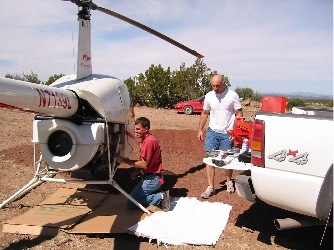
Repairs at Howard MesaWe spread out some cardboard and throw rugs and Ed got right to work. He and Mike found another fouled plug. Then they did a compression check, with me cranking the engine. The results were pretty conclusive: Cylinder #4 was not producing any power. Zero.

The reason became apparent when Ed pulled off the valve cover. The exhaust valve was stuck. Really stuck.

He and Mike worked on it for 30 minutes and couldn’t get it to budge. It looked like they’d have to pull the cylinder and drop it off at a repair place in Prescott. Ed looked at the engine cover and all the other things attached to the engine. It looked like a lot of work. I called Paul again and told him the problem. I asked him if there were any shortcuts to getting the cylinder out. Then I turned the phone over to Ed. From Ed’s side of the conversation, I could tell it would not be a fun job.

Stuck ValveEd hung up and told us that it would be best to continue trying to free up the valve. So he and Mike went back to work. With a hammer. A big hammer.

I left to get us lunch. I was gone about 90 minutes. (It’s a half hour drive to Williams and the woman at Safeway was the slowest sandwich maker I’ve ever seen.) When I got back, they were putting things back together. They’d freed the value and had reamed it. It was now smoother than ever. I’d be able to fly.

We had lunch then cleaned up. I climbed on board while Mike and Ed stood outside, looking for leaks. When I started up, my idle manifold pressure was 8 inches. No leaks so Ed climbed on board. (It’s always reassuring to have your mechanic fly with you right after a repair he’s done.) Warm-up manifold pressure was only 12 inches. That’s more like it! Everything sounded good, the unusual vibrations were gone. (The usual vibrations, alas, were still there.) I pulled power and got into a hover at 21 inches of manifold pressure. Great. I pointed it toward the road and we took off.

I took Ed home a scenic route: over Prescott and down the Hassayampa River. He’d never been over the river in that area before and I think he really enjoyed it.

When we got back, he presented the bill. $312. And that included my oil change the previous month. I paid it with pleasure.

Oh, one more thing. Consultation of the engine log books revealed that this was the FIFTH time we’d had to ream the #4 exhaust valve. Hmmm….let’s hope it holds out until January.

The Declaration of Independence

I listen to a reading of our country’s founding document and think about what brought about our independence from Great Britain 228 years ago.

When I’m at Howard Mesa, I listen to the radio every morning. I listen to NPR, National Public Radio. There are actually three NPR frequencies I can get here: on from Phoenix that is repeated by Prescott, one from Flagstaff, and another from somewhere else.

This morning, during Morning Edition, I heard some familiar words: “When in the course of human events…” I soon realized that the radio staff was reading the Declaration of Independence.

It was a moving reading — if such a reading could ever be considered moving. The radio staff took turns reading paragraphs from the document. They each put emotion into what they read, as if they were the people making these claims, the people injured. I’ve read the Declaration several times, but I believe this is the first time I really understood it.

Imagine the east coast of the United States as thirteen colonies under the power of a King far away. Communication between the colonies and the King took weeks (if not months) in those days. The people of the colonies feel that they are being mistreated by the King. They write a document that clearly argues their point, listing dozens of offenses committed by the King against them. That’s the Declaration of Independence.

I can only imagine how that document must have pissed off King George III when he finally read it.

Reading the Declaration gives you a unique view of life in the American Colonies in the early 1770s. It was a time when people truly cared about freedom — because their freedom was limited. It was a time when people considered taxation without representation — because it simply wasn’t fair. It was a time when people who cared about what was right and wrong actually stood up and did something about the injustices they saw.

A bit different from today, when people care more about what celebrities are wearing than what’s being voted on in Congress.

Anyway, this morning, when I spoke to Mike, I mentioned that I’d heard the Declaration on NPR. Do you know what he said? “I heard it, too. It was great, wasn’t it?”

Looks like I picked the right guy after all.

Now THIS is a Bad Day

A good entry in the “worst start for a day” contest.

Okay, so imagine this.

I’m up at my camper at Howard Mesa (read about it elsewhere in these blogs). I have a terrible night sleep, mostly because my allergies are so bad, I’m wheezing. When the alarm goes off at 5 AM, it actually wakes me. (I’m usually up before the alarm.)

Although I set the mouse trap the night before, no mouse.

I spend my usual hour getting ready with no major problems. In fact, everything is normal.

I go outside, take the tie-downs off my helicopter, check the oil, look under “the hood,” and hop in. When I turn the key, bzzzzzt. I get out and tap on the starter. I try again. Bzzzzt. I get out and spray contact cleaner on the electrical do-dads. I try again. Bzzzzt. Okay, I sit there with the master switch on and wait about a minute. I turn the key. The engine cranks. And cranks. And finally catches. But is it my imagination or is it louder than usual? And vibrating more than usual? The clutch light goes off and I wind it up to 75% RPM. That’s when I notice my manifold pressure is 18 inches. That’s the kind of power I need to hover when I’m flying solo, not warm up the engine. And when I apply a little carb heat, the RPM drops about 10%. That’s not right, either. Shit. I throttle down and pull the mixture. I stop the blades, tie them down, and get into the Jeep.

The Jeep starts right away. (That’s a good thing.) I zip out the front gate, stopping just long enough to open and close it, then head down the old state road. It’s 6:15 and I can still make it to work on time if I put the pedal to the metal. Two miles short of pavement, I hear a thump followed by a rhythmic hissing noise coming from the back right. I stop and get out for a look. The tire looks low. And lower. Shit. I hop in the Jeep and race toward pavement. I don’t want to change a flat tire in dust with my uniform on. But soon the tire is very flat and I know I have to either stop or destroy it. So I stop.

I try to use my cell phone to call work. There’s only one bar of battery power and a very weak signal. I don’t have work’s phone number programmed in. I call Mike in analog mode and leave a message for him to call work for me. The battery goes dead. The car charger is back in the camper (four miles up the dirt road) because I didn’t expect to take the Jeep.

I spread a rug I had in the back of the Jeep over the dust beside the tire. (The rug in the Jeep is part of a Girl Scout “be prepared” thing.) I have trouble finding pieces of the jack. A man and his wife, just leaving their house, stop to help me. (Thank heaven I made it past the last house.) The poor guy messes around in the dirt. His jack isn’t tall enough. I can’t find the missing pieces for mine. The high lift jack bolted to the back of the Jeep is obviously for show, because even after we get it off the bumper, it won’t work. I find the pieces for my jack. We change the tire. I thank them and go on my way.

I arrive at work 45 minutes late. I look at the Priority Schedule and discover that I’m the top priority pilot. Shit. I track down the lead pilot to see if that’s right. He tells me he switched me with Scott so I’m the last priority. I breathe a sigh of relief. I recheck the schedule and discover I have only a half hour to get my act together for my first flight.

After my first flight (which was fine, thank heaven), I’m called out to do some TOPS training. (TOPS stands for Tour Operators Program of Safety.) This is inadvertent IFR training and it requires me to put on a pair of doctored up “foggles,” which prevent me from seeing anything except the instruments — and those only if I hold my head at a terribly uncomfortable angle. I endure a half hour of flight time, chasing the instruments, being reminded that JFK, Jr. died because he couldn’t do what the instructor beside me wanted me to do. Of course, motion sickness started to set in. By the time I was allowed to see the world again, I felt pretty crappy.

The rest of the day wasn’t so bad. I flew a total of 3.5 hours in my ship and someone else’s. Someone at work had a car cell phone charger that fit my phone and volunteered to charge it for me. I dropped off the tire at the public garage in Grand Canyon Village and later discovered that they couldn’t fix it. I called Mike and asked him to bring a new tire with him. I bought lunch at Wendy’s and, while I was there, picked up a salad to bring home for dinner. I left the salad in the fridge at work. I picked up a pair of tickets for the IMAX movie for the people who helped me that morning and didn’t I have to pay for the tickets. (The uniform again.) Then I spent 45 minutes trying and finally succeeding in getting a gift certificate for those nice folks to have dinner after their movie. When I went to drop it off at their house, they weren’t home and I had to leave the envelope on their doorstep under a big dusty rock so it wouldn’t blow away.

I had to eat canned ravioli for dinner. (That chicken spinach salad would have been much better.)

Now I’m summarizing my day in this blog. I still don’t know what’s wrong with my helicopter; we’ll clean the plugs and try it again tomorrow. I just hope it doesn’t need a new engine. I just sent my last big bucks out to Oregon for its replacement.

Ah. That’s probably it. It knows it’s being replaced and is getting back at me.

[Note: It turns out that Three-Niner-Lima had a very stuck valve. My report of our road trip to rescue it can be found in my Pilot bLog .]

Another Birthday Comes and Goes

How I spent my birthday this year.

Nothing terribly exciting to report.

I started the day at the airport, where I gave a helicopter ride to one of the SEAT pilots. The morning (at 7AM) was cool and the air was smooth. Door off, of course. I was low on fuel so we kept it short — only about 20 minutes. I flew him around Vulture Peak and town, then flew over Jim’s house. When we landed at the pumps, both needles were below E.

I took on 20 gallons and Mike and I flew up route 93, just south of the Burro Creek Bridge. Jim and Ray had been exploring up there and they’d found an old sheep ranch tucked away in a canyon, deserted. Jim described where it was and what it looked like to me, but did not give me GPS coordinates. (Jim is GPS challenged.) His descriptions of possible landing zones were completely useless. Trouble is, we found two places that could have been the place he described. And neither one had acceptable LZs nearby. I almost landed on top of a hill at one of them, but I didn’t like the look of the big rocks that would be beneath and around my skids. At the other one, I nearly landed in a corral, but with a lot of fuel and Mike on board and heat on its way, I was afraid I wouldn’t be able to clear the fence to take off. And we weren’t sure if either place was the right one. Next time, I’ll let Jim fly and show me the place.

Our plans foiled, we decided to go to Skull Valley for breakfast. There’s a little cafe there that we’ve never tried. Jerry Kristoferson owns some land with a dirt strip nearby. It looked like the best place to land. A man and his son came out to make sure everything was alright. I guess they didn’t expect a helicopter to land on a dirt strip. It took us a while to figure out how to get to the cafe from the strip and we were a bit dismayed when we had to get through a locked gate. But we managed. Breakfast was good; we had chicken fried steak and eggs. The gravy was really stick-to-your-ribs. I didn’t need to eat for the rest of the day.

It was windy by the time we flew back to Wickenburg. I topped off the tanks, then wheeled the helicopter in to Ed for an oil change. He showed me the Champ, which JD had pretty much totaled at Eagle Roost a few weeks before. With all the work they’ll need to do on that thing, it’ll probably qualify as a homebuilt.

At the office, I took care of some e-mail and packed up my laptop to go up to the Grand Canyon. I also wrote the big check. That’s right. I finally placed an order for a Robinson R44 Raven II helicopter. I did a little wheeling and dealing on the phone and managed to swap the high skids and metallic paint for a pair of hardwired Bose Generation X headsets for the front seats. I haven’t lost my touch. Hillsboro Aviation gave me a smoking deal on the ship. I sent them a check for $25K (which took about a month to scrape together). If I’m lucky, I’ll see the ship in December. I have six months to come up with the down payment and arrange financing. Let’s hope interest rates don’t go up again and that I don’t have any trouble selling my apartment complex.

Bank, post office, supermarket. The usual errands. I bought some milk and other dairy products to bring to the camper with me. Then I went home and threw together my things for the trip to Howard Mesa. Mike took me to the airport where we pulled the helicopter out of Ed’s hangar and loaded it up. Mike watched when I started the engine (to make sure oil wouldn’t come spurting out). I sweated my brains out in the sun with the doors on, waiting for two other aircraft to get the heck out of my way. Then I took off, heading north.

It was still windy. Very windy. Fortunately, the wind was out of the south, blowing at about 25 to 30 knots. It was gusty, though, so I got bumped around a lot. When I climbed over the Weavers near Antelope Peak, turbulence hit very hard, reminding me just how tiny my helicopter is. But I kept a ground speed of at least 100 knots all the way up to Howard Mesa. The wind wasn’t quite as bad here. I landed, unloaded, made some dinner, and settled down to read and write.

Right now, I’m sitting on the sofa, listening to classic rock, sipping a glass of Australian Shiraz, writing this blog. It’s about 7 PM — that’s 12 hours after the start of my day. The sun’s still up. To the east, I can see the stream of smoke from the fire near Payson — I got a good look at the smoke plume most of the way up. The wind is carrying it far to the north; I bet I see it on the east side of the canyon when I fly tomorrow. To the west, there’s a small fire near the Grand Canyon. I wonder whether it’s close to my route and I hope they put it out soon.

Another quiet evening alone. Not a bad way to end a busy day.

On Accidents That Aren’t Accidents

How I’m spared from being the victim of the government’s bureaucracy.

If you read my jumper story (in an earlier entry of this blog) and you know anything about the FAA and NTSB and the rules and regulations they operate under, you might be wondering why they hadn’t classified the event as an “accident.”

Unfortunately, they did.

If you search the NTSB’s Web site for accident reports, using the word “suicide” as a search word, you’ll find one case very similar to mine. In that case, the jumper went up with a CFI and dove out during a steep turn that he’d requested. Although the CFI was not at fault — heck, the passenger committed suicide! — the case was classified as an accident.

And my case was going the same way.

Papillon fought back. Not just for me, but for them, too. They didn’t want an accident on their record any more than I did. Although the event met the definition of an accident (which really needs to be revised, in my opinion), common sense says that the word “accident” does not apply to a suicide. There was nothing accidental about it. (The guy purposely undid his seatbelt, pushed his door open against a 100-knot wind, and jumped.) The trick was to get the NTSB to disregard their definition and classify this as something less damaging to the pilot’s or operator’s flight records.

It went all the way to Washington, involving people from the FAA, NTSB, Department of the Interior, and HAI. I even tried to get AOPA involved, but they lamely claimed that you couldn’t fight NTSB on its accident definition. (Good thing I didn’t pay for their legal services plan.) Someone must have talked sense to the bureaucrats, because the other night I got a voicemail message with the good news: they’d changed the classification from accident to something else. What that something else is is still a question. I’ll find out tomorrow.

If there’s a lesson to be learned here, it’s this: don’t let a passenger jump out of your helicopter. Not only is it a traumatic experience, but it results in a ton of paperwork.