A few photos of a few classic helicopters.
I took these photos a few weeks ago. Mike and I were taking a drive and passed by the Brewster, WA airport. I couldn’t believe how many helicopters were parked on the ramp. We pulled in, parked the truck, and got out for a closer look. I had my junky little Nikon CoolPix with me, but it did a fine job, as you can see.
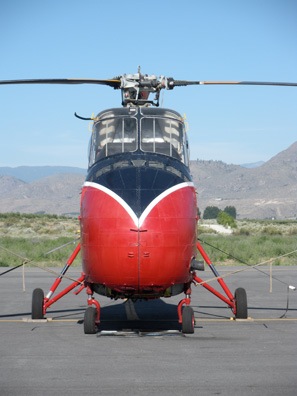 This is the ship I’d most like to fly. It’s a Sikorsky and I think it’s an S55. It has a radial engine and, a few days later, I had the pleasure of watching it start up and fly away while I was waiting on the ramp in my helicopter for my dispatcher to send me to an orchard.
This ship is in pristine condition, with seating for 7 on the lower level. What an excellent air-taxi ship this would make. Imagine flying into Scottsdale with this one? It would sure turn a few heads.
 This is another Sikorsky. Not quite as pretty, but also used for agricultural work. They dry cherries with these. I saw this one in flight, hovering about 50 feet over an orchard. I think there’s so much downwash that they can just hover in one place and dry the whole orchard. (Which is a good thing, because they cost a fortune to fly.)
 Were you looking for a Huey? How about this one?
This pretty blue Huey is also being used for agricultural work, although I didn’t see it in flight.
 Here’s another helicopter you don’t see every day: a Hiller. This is one of two Hillers that supposedly came down from Canada to dry cherries.
 Here’s the other Hiller in an artsy head-on shot. I love the old helicopters with the big glass bubbles — but I sure wouldn’t want to fly one in the Arizona sun. A buddy of mine in Arizona has one and I think he’s nuts.
 And here’s the pair of them, parked side by side.
There was a JetRanger there, too, but I didn’t take pictures of it. After all, you can see a JetRanger anywhere.
As cherry drying season is winding down to an end, most of these helicopters might be gone. I know the Sikorskys are based there. If you’re in the area, why not see for yourself? You can find them at Brewster Airport in Brewster, WA.
Now Read This: If do you stop by for a visit, remember to keep your hands and other body parts off the helicopters. They’re not toys and they’re not for you or your kids to climb on. It’s a Federal offense to mess with any aircraft — really! Remember that airport property is for authorized personnel; if you’re asked to leave, please do.
And if you like looking at aviation-related photos, I hope you’ll check out my Aviation photo gallery.
 This, in turn, triggered an idea for a meme — something that other pilots who blog could write about, too. What are the airports that you’ve landed at? Pick one and write about it. You can write about why you went there, what you were flying, or what it was like. You can write about the perfect weather or nasty crosswind or unreasonably hot temperatures. You can write about the coffee in the FBO, the courtesy car, or the line guy — or lack thereof. You can write about the people you were with and what they thought when you made that perfect landing — or two, or three. (Just teasing my airplane friends.)
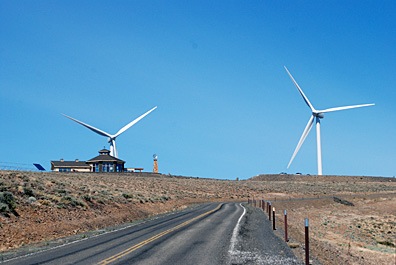 Follow the entrance road about three miles as it winds up a hill. You’ll pass a bunch of windmills along the way — the road actually passes quite close to a few of them. Eventually, you’ll see the Visitor Center at the top of the site. Behind it are a few windmills that, when seen with the building in front, look absolutely enormous.
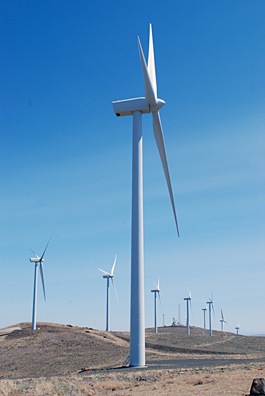 Want some stats? The facility is on a 9,000 acre site overlooking the Columbia River Basin. It was started up in December 2006 with 127 wind turbines. Each turbine is capable of producing up to 1.8 megawatts of power in 31 mph winds, for a total of 229 megawatts. The turbines start generating power at 9 mph of wind and are programmed to feather their blades and basically shut down when winds exceed 56 mph to avoid damage. Since the site is usually pretty windy, the facility does a pretty good job generating power.
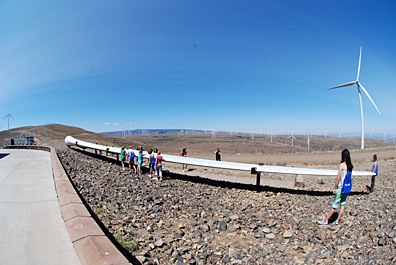 The blades are also huge. There was one on display outside the visitor center and I snapped a photo with my fisheye lens (which explains the distortion) of the girls gathered around it. Each of a windmill’s three blades is 129 feet long, 11.6 wide near the hub, and 1.6 feed wide at the tip. They’re made of composite materials, are hollow, and weigh 7 tons each. When you figure the length of the rotor blade into the total maximum height of the windmill, you get 351 feet.