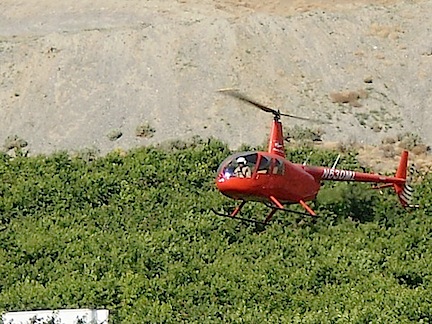
No, It Doesn’t Work That Way

I don’t provide services for free.

Today, a potential cherry drying client stopped by my trailer. I think he heard about me from the ag strip where my helicopter is parked; those guys do his spraying.

I stepped outside to chat with him. He introduced himself as a cherry grower with 22 acres of trees in town. Turns out, his three orchard blocks are right by another orchard I’m signed up to start drying in a few weeks, right at the peak of the season in this area.

“I figured that if you were in the area, you might cover my trees, too,” he said. “If I need you,” he added quickly.

Drying CherriesHis exact thoughts became pretty clear as the conversation progressed. He wanted to be able to call me to dry his cherry trees, but he wasn’t willing to pay a daily standby fee. He figured that the other growers were already paying me for that. He’d just get my services when he needed them. In other words, he’d get the same service and hourly dry rate they were getting, without paying for a contract.

I should make something clear here: without standby pay, there’s no way in hell I’d be here, sitting in an RV in Quincy, WA (of all places), watching the weather every waking hour. It’s not fun to be stuck in a farm town 24/7, on call during daylight hours on days that last 16 hours. It costs money to come up here and stay, it costs money to bring the helicopter here, it costs money to have the helicopter sit out on a concrete pad, idle when it could be doing tour/charter work someplace far more interesting. While it’s true that I make more per hour when I dry cherries than when I fly tourists, if it doesn’t rain, I don’t fly. I flew less than 5 hours over a nine week period last year; if it wasn’t for the standby pay, I would have lost a shitload of money. As it is, I barely broke even. So, needless to say, I won’t work for any grower who won’t pay standby. It’s fair to me and its fair to the other growers who do pay. I also wouldn’t expect any other pilot to do it. In fact, if I met another pilot who dried without standby, I’d chew his ear off. He’d not only be screwing himself, but he’d be screwing the rest of us, too.

I’m already stretched very thin for the period this guy “might” need me. In fact, I wouldn’t mind having a second helicopter around to help me with the contracts I do have — especially for about 5 days when I’m swamped. But I don’t have enough standby pay to pay a second pilot. I explained that to him. I suggested that he find a few other growers that wanted coverage and pool the standby money. I gave him a dollar amount to shoot for and told him the contract would be a minimum of two weeks.

He changed his tune a bit, making it sound as if he really didn’t need a helicopter. “Not much fruit this year,” he said. “Some guys won’t even pick. They’ll let the rain ruin the cherries and collect insurance.”

I countered that statement with what I’d heard. “They lost 60% of the crop in Mattawa. This isn’t like last year. Everyone has fewer cherries and every time a crop is lost those cherries become more valuable.”

I think he was a bit surprised that I knew what was going on. I wasn’t blowing smoke, either. I was speaking the truth and he knew it.

He told me a little about a local pilot who offered to dry his cherries last year with a big helicopter. He didn’t want standby pay. He’d never done it before and he just wanted practice, to learn how to do it.

“You want someone practicing over your trees?” I asked with the proper tone of disbelief.

“No,” he replied. “That’s why I turned him down.” He queried me about the kinds of helicopters and what was best for the job. I told him what I knew. Then he said, “I was thinking of buying a helicopter and just hiring someone to fly it for me.”

The absurdity of that statement made it difficult to reply with a straight face. “You might have trouble finding a pilot willing to come work for you only two or three weeks out of the year.” I also wondered whether that pilot would be satisfied to just sit around and wait, without pay, until it might be time to fly.

There wasn’t much of a conversation after that. He didn’t get what he wanted; I wouldn’t back down. I repeated my suggestion. “If a few of you get together and put in the money, I can get another pilot and can easily cover another 50 or 60 acres.”

“I don’t know if there’s anyone else.”

I knew there were plenty of other growers in town. Last year, they’d taken the cheap route and had lucked out. Maybe they’d even done it the year before that. But this summer was different. This summer, it was raining and unprotected crops were being ruined.

“I’ll get you my card,” I said, going back into the trailer. I came out and handed him the card. “Call me if you think you want coverage. But don’t wait until the last minute. I’ll need at least two weeks notice to find a pilot.”

I watched him drive off and went back inside. Will I hear from him? It depends how much it rains over the next two weeks.

I’ll be doing a rain dance later tonight.

The Pilot’s Alphabet

Words representing letters.

The other day, a new Twitter friend (@mpowerdesign) tweeted:

WTF? Whiskey-tango-foxtrot! I didn’t know there was an actual “military alphabet.” Dad never told me! http://bit.ly/biyLQT

I replied:

It’s used in aviation, too.

This was news to her, which kind of surprised me. I idiotically assumed that everyone knew that pilots used these special code words. But I’m obviously wrong. And, at this point, you might be wondering what the hell I’m talking about.

Meet the “Pilot’s Alphabet”

I’m referring to the ICAO Spelling Alphabet. Wikipedia offers a good basic description:

The ICAO spelling alphabet, also called the NATO phonetic alphabet or the international radiotelephony spelling alphabet, is the most widely used spelling alphabet. […] The International Civil Aviation Organization (ICAO) alphabet assigns code words to the letters of the English alphabet acrophonically (Alfa for A, Bravo for B, etc.) so that critical combinations of letters (and numbers) can be pronounced and understood by those who transmit and receive voice messages by radio or telephone regardless of their native language, especially when the safety of navigation or persons is essential. The paramount reason is to ensure intelligibility of voice signals over radio links.

ICAO AlphabetIn other words, pilots say words to represent letters so there’s no chance of being misunderstood. These words are universally used so all pilots know them. The table here lists them all, along with their all-important pronunciations. Note that not all are properly pronounced the way you might think — Quebec is a good example.

Although this is officially known as the ICAO Spelling Alphabet, it has been adopted by a number of other organizations, including NATO, the FAA, and ANSI. @mpowerdesign’s link to militaryspot.com identified it as the “Official U.S. Military Alphabet,” which is accurate only because the U.S. military adopted the ICAO Spelling Alphabet. The same goes for me referring to it as the “pilot’s alphabet.”

How It’s Used in Aviation

If you read this blog regularly, you might recall me referring to my helicopter as Zero-Mike-Lima. That’s because the last three characters of its N-number (like an aircraft license plate, painted on in big numbers and letters) are 0ML or zero, mike, and lima. When I identify myself to air traffic control, I call myself “Helicopter Six-Three-Zero-Mike-Lima.” The controller can, at his option, shorten this to the last three digits (Zero-Mike-Lima) and, if he does, the subsequent exchange between us will include just those digits. I use those digits as a sort of name for my helicopter.

In aviation, letters are also used to identify airports. So Phoenix Sky Harbor would by PHX or Papa-Hotel-XRay and Wenatchee Pangborn would be EAT or Echo-Alpha-Tango. Charted intersections and VORs also use letters and, thus, these codes. A pilot might use this extensively when filing a flight plan or receiving a departure clearance.

Towered airports use letters to identify the automated traffic advisory system (ATIS), which is generally revised and re-recorded hourly. At the beginning and end of the recording, the recording identifier will be stated — for example, “Deer Valley Tower, Information Juliet” or “Advise on initial contact you have Golf.” When a pilot makes his first call to the tower, he needs to include the ATIS identifier, so a call might sound like this:

Deer Valley Tower, Helicopter Six-Three-Zero-Mike-Lima, 10 miles north, landing west helipad with Juliet.

An airport’s ground control will also provide runway exit and taxi information to airplanes using these code words for letters. For example, they might tell an airplane to exit at “alpha-four” or use “taxiway charlie.” I don’t hear much of that because I don’t generally talk to ground control.

@mpowerdesign asked if I had to memorize it. I guess I did. It didn’t take much doing, though. The words are used so often in aviation that you kind of absorb them when you communicate. I make a special effort to keep them in my mind by using the same letters when I need to spell something out to someone — for example, “A as in alpha, B as in bravo” instead of using whatever words come to mind like most people do.

Expand Your World

At the end of our short exchange, @mpowerdesign tweeted:

Geez…you learn something new every day! See, this is why I tweet… :-)

And I think that sums up one of the reason I participate in Twitter. By following a variety of people with a variety of interests from a variety of places all over the world, you can’t help but learn new things, just by participating in Twitter conversations. It’s one way to expand your world.

Congratulations! You’ve made it to the end of yet another lengthy blog post here on An Eclectic Mind. If you got this far, you must have gotten something out of what you read. And isn’t it nice to read Web content that isn’t full of annoying ads?

How about doing something to show your appreciation? I’d love it if you’d add a comment at the end of this post to share your feedback with me and others. But I’d really love it if you’d visit my Support page and chip in a few dollars to help cover the cost of hosting this blog and motivate me to keep writing new, interesting content. It’ll only take a moment and I really would appreciate it!


Hovering Over Cherry Trees before Dawn

What some people will do to make a buck.

The weather forecast last night was clear: there was a 78% change of rain starting at 11 PM. At 8:30 AM, the approaching storm was nearby. It was already raining in Mattawa, where my buddy Jim is working. It looked like the rain in our area would start within an hour.

I called my cherry drying client, who owns a 32-acre orchard 6 NM from where I’m camped. “Looks like it’s going to rain tonight,” I said.

My client was not surprised. This was our third conversation about the weather in 8 hours.

“It’s too late to dry tonight,” I told him. The sun would set in less than 30 minutes and I didn’t dry cherries in the dark. “Sunrise tomorrow is around five. I can be airborne as soon as it gets light.”

“I’ll spend the night down there,” he told me. “I’ll call you at 4:15.”

“I’ll go to bed now then,” I replied.

I hung up, feeling bad for him. He had an old, beat-up RV down in the orchard. I knew he wouldn’t be comfortable. He probably wouldn’t get much sleep. But someone had to be down there to monitor rainfall to know whether I was needed in the morning. Spending the night in an orchard is not part of my job description.

I set an alarm on my iPad for 4:30 and went to bed.

The rain started before 11. Steady but light. I had no trouble sleeping through it.

Wake Up Call

I woke to the sound of birds chirping. It was still dark, but the birds around here don’t seem to care. I grabbed my phone and touched it to bring it to life. It was 4:10 AM. I grabbed my iPad, fired it up, and took a look at the radar on WeatherBug. The storm system was mostly past, but a small blob of rainfall was headed toward the orchard. It could rain itself out before it arrived. Other similar blobs had done so, disappearing off the radar when I put it in motion.

I was studying this when my phone rang. It was my client.

“Is this my wake up call?” I asked cheerfully. I wanted him to know I was already wide awake, on the job — even if I was still in bed.

“Yeah,” he replied. He sounded tired.

“Did it stop raining down there?”

“Yes. Come on out and dry. I won’t be there; I have to get back to town.”

We hung up and I got out of bed. I’d already laid out my clothes, but had neglected to set up the coffee maker. I took care of that, letting it drip into a travel mug while I dressed and washed up. By 4:30, I was slipping out the door with coffee in hand.

Predawn Flight

It was getting light. I could clearly see thick clouds out to the west, in the direction of the orchard. I kept thinking about that little blob of rain.

The helicopter was already fueled and preflighted, so all I needed to do was take off the blade tie-downs and do a walk-around. By 4:45 AM, I was in my seat with the engine running. It took a long time to warm up. My breath quickly fogged the inside of the cockpit bubble. The outside was covered with raindrops.

I spent a bunch of time trying hard to catch a moth that was hitching its second ride in my helicopter. I failed. Again.

By 4:50 AM, I was ready to go. The cockpit bubble was barely clear enough to see through, but I knew how to clear it. I pulled the knobs that turned on the air vent and heat to full. Then I hovered out over the ag strip and took off along it, toward the well-defined horizon to the east. Within 30 seconds, the windscreen was clear, inside and out. I turned to the west and headed toward my client’s orchard.

Out in the distance, a thick blanket of clouds covered the foothills on the other side of the Columbia River. A similar but smaller blanket hovered around 200 feet over the farmland just west of the town of Quincy. Another one poked up from beyond the drop-off I’d have to descend to get to the orchard on the river. I started wondering whether there would be fog on the river itself.

But when I got to the end of the plateau, I could see that the river far below was clear. I pushed the collective down slowly and smoothly, stopping only when I had a descent rate of at least 1,000 feet per minute. I approached the orchard from slightly downriver, as I usually did, but instead of descending to orchard level over Crescent Bar, I made a descending circle over the river. I was hoping to reduce the amount of sound I might project over sleeping people.

I settled into my usual five-foot hover in my usual place beside the water tank and got to work, flying up and down the rows at about 5 knots. Below me, the big, old tree branches went wild, throwing rainwater off the cherries. I varied my pattern only to avoid flying close to the bedroom window on the other side of the house there. I figured that if people were sleeping inside, I’d rather wake them from the other side of the house instead of 20 feet from their window.

The Rain

I was about 1/4 finished with the orchard when it started to rain. I looked up at the clouds floating over me and didn’t really see the rain coming down. But I could see it hitting the river, which wasn’t as smooth and glass-like as it had been when I first arrived. And it was certainly all over my cockpit bubble.

Now my goal is to dry the orchard and it’s pretty hard to ensure that everything I’ve flown over is dry if it’s getting rained on again right after I pass over. Without my client there to tell me what he wanted me to do, I had to do what I thought was right. I had two choices: land somewhere and wait it out and then start again or keep drying and just go over the areas that got rained on after they were dried. Landing wouldn’t have been a big deal — there was a sizable empty boat trailer parking lot nearby where I don’t think anyone would have bothered me at 5:15 in the morning. Still, I had a feeling the rain wouldn’t last and didn’t want to waste time landing and shutting down if I didn’t have to.

My decision to keep drying was based on the amount of rain falling. It seemed like a heavy drizzle. The trouble is, I couldn’t really see when it stopped. Because I was only moving at 5 to 10 knots, there wasn’t enough wind to blow the water off. So it just sat there. When it started dripping off, I figured the rain had stopped. In all, it lasted about ten minutes. I didn’t think the trees I’d already dried had gotten very wet. They certainly couldn’t have gotten soaked. A quick hover over every other row should shake off whatever moisture had settled on them.

But first I needed to finish the rest of the orchard.

This particular orchard is not easy to dry. The trees are a variety of sizes and thicknesses, ranging from very small young trees to very large old ones. There are obstacles. The rows don’t always go the same way and they’re not easy to see. I’m sure I must have whined about this elsewhere, so I’ll spare you any more whining.

The point is, despite the fact that the orchard is only 32 acres, it takes me at least 1.1 hours to dry it. This year, it’s been a lot wetter so it’s taken me 1.2 hours. Today, with the redo of part of it, it took me 1.5 hours. I’m doing it as fast as I can, but I need to be thorough, too. If the grower loses his crop because I did a shitty job drying, he’ll cancel the contract and never use me again. I don’t want that to happen.

Besides, his cherries are the best. I can’t wait until he starts picking.

Return Flight

I It was nearly 6:30 AM when I finished. I took one more low pass over the treetops and headed out over the river. I made my usual spiraling climb at 1200 feet per minute. The plateau was 500 feet above the river level; I needed at least 200 feet more to clear the edge comfortably.

Crescent Bar

I went back to a viewpoint near Crescent Bar and shot this photo about an hour after I landed. It really was a beautiful day.

As I climbed, I couldn’t help but admire the big, white puffy clouds that were scattered all around me. There was one just to the south of me that seemed to grow out of the top of the Babcock Bench, climbing like stretched cotton toward the sky. The low cloud that had been just west of the town of Quincy was still there, but seemed to have grown. I leveled off at 400 feet above the farmland south of Quincy and the cloud remained below me, as if unsure whether it wanted to be fog or the cloud it really was. I looked out over my shoulder and saw the windmills of the wild horse wind farm, basking in sunlight.

I was angry with myself for not bringing a camera.

I landed at the ag strip and did all the things I usually do: tie down the blades, refuel, do a post-flight inspection. It was about 7 AM when I returned to the RV. I made a second cup of coffee and had the pleasure of drinking all of it. Later, I went out with my camera and tried to capture some of the beauty I’d spotted on my way back.

Why My Mind is [Always] on the Weather

I’m a walking, talking, texting weather resource.

Yesterday was a beautiful, clear day in central Washington, with the occasional little puffy cloud floating across the bright blue sky. It was warm in the sun, cool in the shade, and a gentle breeze kept any insects from becoming a nuisance.

A perfect day to visit with a friend down in Mattawa, a 40-minute drive south.

I was about halfway there when my phone rang. It was one of my cherry drying clients. I pulled over to make sure I didn’t lose the connection on the winding river-side road. After exchanging greetings, she asked, “So what’s the weather forecast?”

“Twenty percent chance of rain tonight and twenty percent tomorrow.”

We finished the conversation, both promising to keep an eye on the weather. I hung up and continued on my way.

You might be wondering why I knew, off the top of my head, the weather forecast for the next 24 hours. Simple: It’s part of my summer job.

My job depends on the weather. If it’s a nice day, I get the day to myself and can wander away from my base. The nicer the day, the farther I can wander. If it’s a rainy day, though, I have to hang around, waiting for a call to fly.

This means I need to know the upcoming weather all the time.

How I Track the Weather

I use five different resources to track the weather.

  • Seven-Day WeatherThe National Weather Service at weather.gov offers a 7-day forecast with “at-a-glance” graphics and a detailed textual summary. I can also click a link to get an hourly weather graph that charts percent chance of rain, percent of sky cover, temperature, humidity, wind, etc. hour-by-hour several days into the future. This is my primary source of weather forecasting information.
  • Current RadarWhen rain is in the area or on the way, I use the radar graphic at the Weather Channel to see where the rain is and which way it’s going. What I like about this particular radar graphic is that you can drag and resize the map to change the view. I can see the big picture to get an idea of how much rain is on its way and zoom in to see exactly where it’s falling. This is my primary source of current weather information when I’m in front of my computer.
  • WeatherBug on iPadWhen I’m out and about and have access to the Internet, I use WeatherBug on my iPad to see weather information, including a radar graphic, forecast summary, and hour-by-hour forecast. I can also use its Webcam images to help judge visibility in the event that I need to cross the Cascades to get to Seattle. (Which I don’t usually do during the season.) WeatherBug is also available for mobile phones; I really do need to get it back on my BlackBerry.
  • In the RV, I use my radio scanner to listen to weather summary and forecast information from the National Weather Service for my area. It’s basically local weather radio. It isn’t nearly as helpful as the other sources, but it does offer a good overview for my area and playing it tends to keep Alex the Bird quiet.
  • I also look out the window a lot. Knowing which direction the weather usually comes from and watching the sky out that way can give me an early heads-up. This is especially useful when I’m out running errands and don’t have access to any of my other sources.

What’s amazing about the weather forecast is that it’s only accurate for a short while. Yesterday, the chance of rain this morning was 20%. When I got back from my day out, it was 30%. This morning, it was 50%. And then it started raining. It’s been raining for at least an hour and radar shows me that we could get at least an hour more of the stuff.

Knowing this can keep me out of trouble. 20% didn’t seem like much of a chance — and it isn’t. But 50% is a pretty good chance of rain. It went from 20% to 50% in less than 12 hours. So I have to constantly be checking my sources.

Today’s Weather Story

This morning, my client’s son, who manages the orchard, called. It was 7:46 AM. “What’s the weather?” he asked.

I told him what I saw on radar: a long line of rain showers stretching all the way from southwest of Portland to us, moving our way. “It’s raining here,” I added.

His orchard is 6 miles northwest of my position. He lives another 20 miles north.

“I’m on my way to the orchard,” he told me. “I’ll call you when it stops.”

He means that he’d call me to fly when it stops.

So I’m sitting here, dressed in my flight suit and ready to go. The rain is still pattering against the roof and windows of my RV. The radar shows some heavier rain inbound from the Ellensburg area. And more rain beyond it that, if we’re lucky, will pass to the south of us. (That’ll make my buddy Jim happy. He’s down in Mattawa, doing the same thing I am. In fact, we spend far too much time texting each other about the weather.)

Waiting to FlyThe helicopter is a quarter mile away and already fueled and preflighted. All I have to do is pull off the blade covers. I can be airborne within 10 minutes of my client’s call. The orchard is a 4-minute flight from here. So I’d much rather sit in my nice warm RV, watching the weather on radar, than sitting out in my truck by the helicopter, blind without most of my weather sources.

But I guess this explains why my mind is always on the weather — at least this time of year.

Greetings from Washington’s Cherry Country

Cherry drying season is off to a busy start.

Cherries

Cherries, at the source.

I’m in central Washington state for my third season as a cherry drying pilot. The short explanation of that is that cherry growers often rely on helicopter pilots to hover over cherry trees after a rain to shake/blow water off so the cherries don’t split or rot.

I’m based in Quincy, WA, living in my RV with my helicopter parked across the street at an ag strip. I arrived two weeks earlier than I had to. I didn’t know I was that early — I try to arrive about 5 days early. But my first contract was supposed to start early. It was only after I arrived that the start date was finalized to a much later date. It was supposed to start today.

Rain, Rain, Rain

Meanwhile, it’s been raining like crazy here. In the two weeks I’ve been in Washington, I’ve seen more rain that the past two seasons combined. My buddy, Jim, started a contract down in the Mattawa area about 10 days ago and has already flown more than 10 hours.

How important are helicopter pilots to the success of the crop? Well, this story should give you an idea:

Jim originally had two orchards under contract and was drying both when called to do so. One day, there was a light rain and only one grower called. He dried that orchard, then called the other grower to see if he needed his dried, too. He told Jim that the cherries didn’t seem that wet, that he thought he could dry them himself with the blower equipment he had on hand. Three days later, he cancelled the contract because he’d lost 60% of his crop to water damage after that light rain. He wasn’t even going to bother picking the rest.

The loss of so many cherries in this season’s crop makes the remaining cherries even more valuable. Last season, the problem was that there were too many cherries and the growers weren’t getting a good price. Some of them would have had a loss on their crop, so they didn’t even bother to pick.

But this year, with all the rain we’ve been having, cherries are going to be difficult to protect. Any grower who doesn’t have cherry drying hover service lined up for his orchards will likely lose his crop.

Expect to pay more for cherries this year, folks.

My First Dry

As for me, that first contract started a day early. It rained overnight from Thursday to Friday and was still raining when I got up in the morning. At about 9 AM, my grower called and said he’d likely have me start a day earlier. He launched me at 10 AM, right after the rain had stopped.

The clouds were still low when I made the 6-mile trip to his 32-acre orchard block on the Columbia River. I ducked beneath them and made the steep descent to the river. Remembering the pattern I’d flown the year before, I circled the orchard, descending. I settled into a hover five feet over the tops of the trees in the southeast corner of the block, being careful to avoid the water tower beside the trees there. And then I got to work.

Crescent Bar Orchard

My client’s orchard is the big patch of dark trees in this photo.

This particular orchard is one of the most difficult I’ll have to dry this year. There are trees at various ages and sizes. Some rows go east/west while others go north/south. There’s a gully deep in the west side with trees going right down into it and a house tucked into the south side. And a processing shed in the middle.

The grower arrived about 10 minutes after I’d started. I think he took some video of me flying around. And there were onlookers along the road from the nearby trailer park and condos.

It took me 1.2 hours to get there, hover over all the trees, and get back. The grower waved and stepped into his truck as I left the last tree and started my climb out.

More to Come

There’s a 20% chance of rain tonight and a 30% chance of rain tomorrow morning. So I’d say I have a 30% chance of flying again tomorrow.

While I hate to see the growers spending a lot of money to protect their crop, I have to admit that it’ll be a nice change for me to have a profitable year.