It’s a camera.
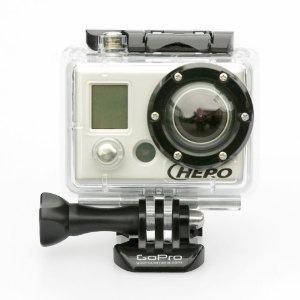 About two weeks ago, I bought a GoPro Hero camera. This is a tiny, durable video camera designed for extreme sports. Real extreme sports. (The darn thing comes in a waterproof housing.) For the past two days, I’ve been testing it out.
I’ve been really dissatisfied lately with the quality of video coming out of my POV.1 camera, which I’ve had for about two and a half years. I wanted something smaller, easier to set up and use, and with better picture quality. The GoPro Hero has the POV.1 beat hands down.
I started playing around with the camera on Tuesday, in the car on the way to Phoenix. I wanted to get an idea of image quality. The Hero offers several resolutions, including true 1080p HD. I shot in a lower quality and was very impressed with the results.
But movies isn’t the only thing the Hero does. It can also be used to shoot individual snapshots, three consecutive snapshots, and snapshots a set number of seconds apart. Anyone who knows me, knows how much I enjoy time-lapse photography — this little camera has the timing built right in.
Yesterday, while stuck in Pendleton, OR waiting for weather to clear, I played around with it a bit more. I decided to try creating a time-lapse. So I set it up before departing the airport on my second attempt to get across the Blue Mountains. In this 38-second video, I travel nine miles from the airport, realize that I’m not going to get over the mountains, turn back, and land on the ramp again.
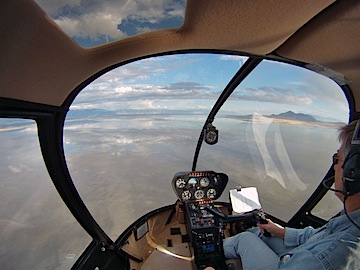
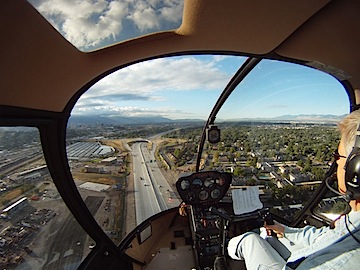
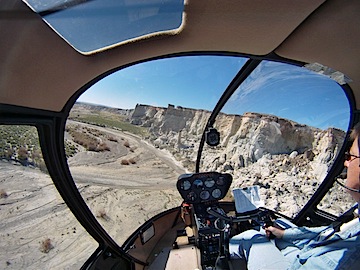
Three shots from my Hero. (1) The last shot it took yesterday, as I was flying over the Great Salt Lake; the reflections of the clouds on the glassy lake surface were amazing. (2) Early this morning as I flew down I-15 near downtown Salt Lake City. (3) A shot from my E-ticket ride past the Wahweap Hoodoos.
Later in the day, I finally got out of there. I’d cleared the camera’s contents and set it up to take a shot every 5 seconds (instead of 2 seconds in the video here). It did this for nearly five hours — the time it took for me to fly from Pendleton to the Salt Lake City area. The battery died about 15 minutes from landing. I compiled the video and liked what I saw. It compresses a 5-hour flight through Oregon, Idaho, and Utah into only four minutes. This morning, I set up the camera again and captured shots for my 2-1/2 hour flight from Salt Lake City to Lake Powell, including a wild, low-level flight down Wahweap Creek past the Wahweap Hoodoos (see photo here). I’ll likely put the two long videos together and get the resulting video online once I’ve had a chance to add notations.
As you can see in these images, the quality of the photos is excellent. There’s great depth of field, making it possible not only to see perfectly out the helicopter’s cockpit windows but to read the instruments. It has no trouble dealing with exposure; it seems to get it right every single time. If I had the time to go through the 5000+ images shot over the past two days, I would find all kinds of neat views. The original images are 2592 × 1944 resolution — that’s better than HD — I just downsized them for this blog post. And with one shot every 5 seconds, the camera battery died before it filled the 16 GB SD card I bought for the camera.
What’s kind of unusual is the way I mounted the camera for these shots. I hung it upside down using a suction cup mount on the passenger side ceiling window. (You can see the front of the window in each shot; I hung the camera from the back side.) Because the camera has a very wide angle lens, there’s some distortion to the view. I think that just adds to the funkiness of the photo. The camera is smart enough to turn the image right side up when processing, so there’s no need to worry about upside down video if you’re shooting video.
As for video…if I can figure out a way to mount it in a good spot, I should be able to get some really fine video while flying. That’s the challenge. Believe me — if I succeed, you’ll see the results here.
 I left Wenatchee Heights with my 5th wheel RV hooked up behind my husband’s Chevy pickup. The first day’s drive was relatively short: from Wenatchee Heights to Walla Walla, a distance of only 190 miles. Only a small portion of the drive was on a freeway (I-90); the rest was on back roads through farmland.
 In Walla Walla, I stayed at the
  On Friday night, I got the trailer hooked up again and mostly ready to go. I needed to be on the road early for the next leg of my trip: from Walla Walla, WA to Draper, UT (south of Salt Lake City), a distance of 606 miles. I was on the road not long after dawn. The route took me south almost to Pendleton, OR, then onto I-84 through Oregon and Idaho and down into Utah, where I picked up I-15. The landscape started with farmland, then mountains, then more flat farmland, then more mountains, and then finally into the Salt Lake basin. I’d driven the route before with my underpowered Ford F150 pickup towing my old 22-foot Starcraft. It wasn’t fun then; Saturday’s drive was much more tolerable. I stopped three times for fuel and twice for food. It was very unlike me to make so many stops; I usually try to get food and fuel on the same stop, but the situation made that tough. I rolled into Draper, UT’s Camping World parking lot at 6:15 PM local time, just 15 minutes after the store closed. I’d called the week before and knew I could park out back, so I did. I even got to hook up 50 amp power.
 On Sunday, @AnnTorrence picked me up for a drive to Ft. Bridger, WY. There was a
 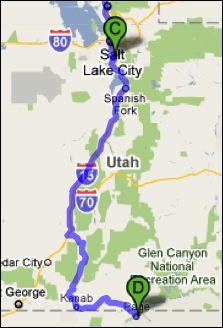 Monday — Labor Day — was my last drive day. I drove from Draper, UT to Page, AZ, a distance of 370 miles. I got a very early start, pulling out of the parking lot at 6:30 AM local time. By the time I stopped for fuel two hours later, I’d already gone more than 100 miles. (I parked with the big rig trucks and discovered that my rig was about as long as theirs.) This part of the drive was mostly on I-15, but started east on route 20 to Highway 89, which took us all the way to Page. The roads were mountainous and there was a lot of climbing and descending. There were also a lot more vehicles on the road, making driving a bit more of a chore.
 The only food stop I made along the way was at the Thunderbird Restaurant at Mount Carmel Junction. The place is a bit of a tourist trap, but it does have good “ho-made” pies (whatever that means). Odd thing happened when I tried to leave. They couldn’t give me a bill because the computer was down. Apparently no one knows how to do basic math. All I had was a piece of pie with ice cream and an iced tea. They apparently expected me to wait until the computers came back online. With Alex the Bird in the front seat of the car, that was not an option. Finally, my waitress disappeared into the kitchen where she may have used her “lifeline” to get help with this difficult math problem. The verdict was $7.79. I was afraid to count my change.
 My husband, who’d flown up in his plane and spent a few hours swimming in the lake, met me at the lodge restaurant for lunch. Afterwards, we put fuel in the truck and parked it (temporarily) at Page Municipal Airport. I gathered my belongings — forgetting only two things, one of which was vital — and we loaded into Mike’s plane. Then we started the long (90 minutes), hot (90°F+), and bumpy (I almost got sick) flight to Wickenburg. The only sights of interest along the way — keeping in mind that I make that flight about 1000 feet lower at least a dozen times a year — were a handful of forest fires east of our Howard Mesa place and a heavy rain shower coming out of a remarkably small cloud near Granite Mountain.

