The Goat Cherries

Because who can turn down fresh-picked organic cherries?

I went into Quincy today to pick up some mail that had been delivered to my last address. I figured that while I was there, I’d have an early lunch with Ron, the other pilot who works with me on cherry drying contracts, and pick up a few things in storage.

I knew that one of my clients was picking cherries and decided to swing by and see how the picking was going. Last week’s rain had absolutely ruined many crops and although none of my clients had complained, I wanted to see what the situation was without actually asking.

At the orchard, my father and son clients were busy working machinery to move around cherry bins. The dad was using a forklift to stack bins and move them into the shade before loading them into a waiting truck. They run a small operation with just 12 acres of organic bing, lapin, and rainier cherries. The pickers were deep inside the orchard, hard at work while the temperature rose steadily.

The dad took a quick break to let me know that he was happy with the way the crop had turned out. Yes, they’d lost some cherries to splits, but not as many as they could have. A bigger problem was soft cherries. He explained that when they plumped up and then shrank — due to temperature changes, I guess — the cherries sometimes get soft. This had impacted their bings. The packing house didn’t like what they sent the day before so today they told the pickers not to pick any cherries that were soft.

He then offered me some cherries. “Some of the pickers started early this morning before we could tell them not to pick the ones that were soft,” he said. “They’re in a bin over there.” He pointed to a bin of cherries sitting in the shade at the edge of the orchard. “We’re not sending them to the packing house. I was going to give them to my goats, but you can have as many as you want.”

Goat cherries. He was offering me cherries he planned to feed to his goats. I wasn’t sure how I felt about that, but it was worth a look. How bad could they be? After all, pickers had thought they were worth picking.

I fetched a plastic ammo can I’d gotten as a freebie from Hooked on Toys out of my truck and went to check out the cherries. I agreed that some of them were a tiny bit soft — but none of them were what I would call mushy. Otherwise, they looked very good, with few splits and nice color. I half-filled the container while they got back to work.

Goat Cherries
Goat cherries. Better than anything you can get in a supermarket.

I admit that I worried a little about the cherries sitting in a black container in a hot truck for the three hours it took me to do my errands in Quincy and get back to Wenatchee. Sure enough, the inside of the container was a bit warm when I opened it back up at home. But I filled the sink with the coldest water I could get out of the tap, dumped the cherries in, and topped them off with a lot of ice. I swirled them around and around, washing them in the (literally) ice cold water while they chilled. I picked out the very bad ones and a bunch of leaves. Then I strained them and put them in a big bowl. They looked — and tasted — delicious.

Yes, I Fly Helicopters

But come on, get real.

Yes, I fly helicopters for a living. Yes, the red R44 parked out in the dirt is mine. Yes, I bought it new and paid every penny of the $346K it cost, plus interest on the 8-year loan I needed to finance it. Yes, I am aware that’s more than your house probably cost. It’s definitely more than what my house cost.

I’m sorry, but no, just because a friend of yours introduced you to me in a bar tonight doesn’t mean I’m going to take you for a free ride. So don’t waste any more time telling me that you want me to fly crazy and swearing that you’ll sit still while I do so — as if that somehow matters. I have no intention of taking your creepy ass for a ride and would likely find an excuse not to do it even if you did offer to pay me. Which is unlikely. How much do I have to rudely text one of my friends while you jabber about the movie set you worked on 20 years ago in a failed attempt to impress me? How long before you realize I want nothing to do with you? How long before you just go away?

Thank you, yes, it is a beautiful helicopter. You should see it when it’s clean! But no, flying it is not a hobby. As a matter of fact, I have found a way to get paid for hovering. Imagine that! How else do you think I could afford to fly it? Do you think I’m independently wealthy? Or that I’ve got a sugar daddy paying my bills? Amazing that a woman can build a career flying helicopters, no? That someone is actually willing to pay me to do it. Amazing.

What’s that you want? The pay for a commercial helicopter pilot? The “lowest to highest salary and the average”? I’m sorry, but no, I don’t have detailed information about the pay scale for helicopter pilots. I’m an owner/pilot, not a career counselor or headhunter. I know what I make but that’s none of your business. I can tell you this: people who fly helicopters for the money are usually disappointed.

Four moronic men in four days. Just a sample of the kind of idiotic assumptions and questions I put up with from complete strangers. Don’t they think before they communicate? Don’t they realize how rude they’re being by making their assumptions about me and my life? By asking their questions in such a demeaning way?

Yeah, I know I get cranky about things like this. But seriously: four in four days?

What Matters Most

A life lesson in a video.

Yesterday was my birthday. It was a bittersweet day for me — a year ago on my birthday was the day my husband called and told me he wanted a divorce.

What kind of sick bastard asks his wife for a divorce on her birthday? After living with her for 29 years? The kind of bastard I was stupid enough to marry.

Anyway, my bank — yes, my bank — emailed me a birthday message with a link to a video. The message said:

Just a friendly little birthday wish from us to you. We can’t send you a double-tiered chocolate cake (it won’t fit through the mail slot — we tried), but hopefully this little video will help brighten your big day.

Have an awesome b-day filled with fun, happiness and, of course, saving.

Enjoy many more, Saver.

Normally, I’d trash it as spam, thinking it was some kind of marketing ploy. If so, it would be pretty tacky. But INGDirect (now CapitalOne 360) is not your average bank. So I clicked the link.

Here’s the video:

I cried when I watched it, of course. I already understood the message — what happiness is really all about. In fact, I blogged about it earlier this month. What made me cry is that it clearly showed the difference in philosophy between me and my ex-husband.

You see, I understand that happiness is making life what you want it to be so you can look around yourself and be happy about what you see. I do work I like to do in a place I like to do it. I have what I need and not much more. I’m not interested in impressing anyone with showy possessions. I’d rather spend time and money and energy seeing and learning new things to make me a more rounded person than to piss it away on crap. I save for my future and avoid unnecessary debt. This enables me to keep my time flexible and to really enjoy life. That’s what it’s all about.

My ex-husband, however, apparently believes that happiness is about keeping up with the Joneses, working at an unfulfilling job to pay for an empty lifestyle that revolves around eating out with the same four or five people, watching television, and buying showy things like a costly second home, airplane he never flies, and Mercedes to show off to friends. He made his obsession with financial wealth pretty clear to me when he went after my business assets and money in the divorce, refusing to settle unless I gave him my half of our our paid-for house plus $50,000 in cash and paid off his debt in the home equity line of credit. His greed would have left me nothing to reboot my life and keep my business afloat — but he didn’t seem to give a damn about that. He forced me to spend tens of thousands of dollars on legal fees to defend what was rightfully mine. (We’ll see how that worked out for him soon.)

I cried mostly because he wasn’t always that way — at least I didn’t think he was — and I pitied him, as I so often do these days, for wasting his life away. For missing the point.

My friends have been telling me lately how glad they are to see me so happy after such a difficult time. I’m glad, too. I’m happy and will stay happy — because I know what matters most: spending your time doing things you like to do with the people you like to be with.

Bees: Capturing My First Swarm

I lucked out. It was very easy.

I started my beekeeping hobby in June 2013 and have been blogging about it periodically. If you’re interested in reading the other posts in this series, follow the Adventures in Beekeeping tag. Keep in mind that the most recent posts always appear first on this blog.

The call came while I was hovering over 35 acres of cherry trees in Monitor, WA. It was my friend Katie, who lives in Quincy. The bees that live in the wall inside the shop at their home had swarmed again. They were gathered in a bunch on the maple tree, about 8 feet off the ground. Did I want to catch them?

Of course I did!

My only problem was that I was working — with no end in sight. I spend my summers as a cherry drying pilot and I was into what would become a hellish week of rain and lots of hard work. I was hovering over one orchard when she called and another was already waiting for my attention. I told her I’d get there as soon as I could, thanked her for her patience, and hung up.

About Bee Swarms

Before I go into the story of this capture, let me take a moment to educate readers about bee swarms.

Honey bees live in hives. They could be manmade hives like the one I (and countless other beekeepers) have. Or they could be hives built inside of structures not intended to house bees, like hollow trees, rock overhangs, or building walls.

Most hives have a finite amount of space in which to build. Bees exist to reproduce and increase their numbers. Everything they do is to meet that end. (The honey they make is really for their consumption, not ours. They just make a heck of a lot more than they need.) So they’re constantly building inside their hive, making wax cells for brood (eggs laid by the queen and the larvae they turn into) and the storage of food like nectar (which turns to honey) and pollen.

As the hive population grows, the bees eventually start running out of space. They realize this and instinctively plan to split the colony. First, they create queen cells, which are special large brood cells for raising queens. The existing queen lays an egg in each of these cells, as she does for all the other brood cells. The workers, however, raise the larvae in these cells to be queens by feeding them royal jelly. (All larvae are started on a diet of royal jelly, but only future queens get it throughout their development.) Workers raise queens when they sense that the current queen is ready to die or already dead or when they know they need to swarm. The positioning of the queen cells helps beekeepers determine what’s going on; swarm cells normally appear at the bottom of the hive while supersedure cells appear near the top.

Bee Swarm
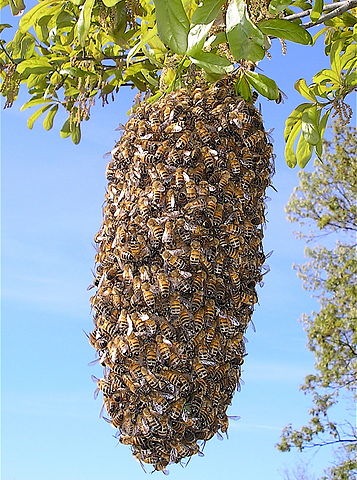
The swarm I caught looked a lot like this one. Wikipedia image by Mark Osgatharp.

Before the new queens emerge from their cells, the existing queen leaves the hive with at least half of the bees. They’ve already stuffed themselves with food so they’ve got enough energy to make a journey. This is the swarm. The bees stay close together, surrounding the queen to protect her. They leave the hive and often fly to a nearby location where they alight as tight mass on a branch or building eave or some other surface. They’ll remain there to rest and organize and get their bearings. Scout bees might fly off in different directions, looking for a new home. Eventually, the swarm will take off and fly in a bunch to a possible future homesite or another rest stop.

In general, when honey bees are swarming, they are least likely to sting. Why? Well, they don’t have a hive and food stores to protect. They’re on the go. Their only concern is protecting the queen and moving her into a new home so she can continue laying eggs and building their population.

Capturing a swarm is a win-win-win-win situation:

  • The property owner wins because she gets the bees removed for free.
  • Society wins because the bees are kept alive rather than killed — as an exterminator might do. Bees are vital to agriculture and the food chain.
  • The bees win because they’re not only kept alive, but they’re given a great new home all ready for them to move in — a manufactured hive, designed with their needs in mind.
  • The beekeeper wins because she gets a whole colony of bees, including a queen, for free.

Wikipedia, by the way, has an excellent article about honey bee swarming.

My Swarm Capture

I finally finished flying for the day at around 6 PM. I wasted no time loading up my beekeeping gear, which I keep in a rolling storage box, and the empty nuc box I’d gotten my first been colony in. My friend Cheryl climbed aboard the truck with me and we drove the 10 or so miles to Katie’s house.

Katie, by this time, was gone. She had to take her son to a swimming meet (or ball game or something like that). Her other son was home. He came out when we pulled up with the truck. The swarm hung from a branch on a maple tree beside their driveway. It was about 10 feet off the ground. But because it was overhanging the driveway, I could back my pickup’s bed under it. Standing on the pickup bed didn’t get me close enough to reach it, but standing on that big plastic bee equipment box in the back of the pickup did. (I really don’t like climbing ladders.)

I suited up and took a closer look, climbing up until my face was less than a foot from the swarm. They clung to a pair of small branches. I knew from conversations with other beekeepers that capturing a swarm like this was often as simple as clipping the branch off the tree and putting the bees in the box. So that’s what I did.

Capturing a Swarm
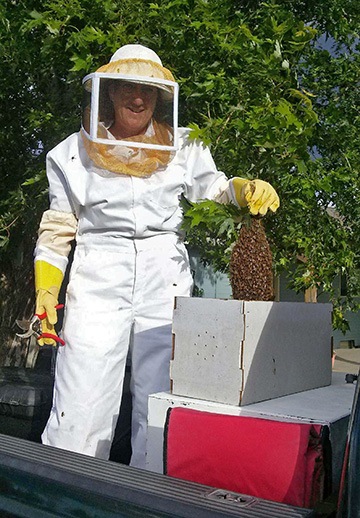
Cheryl took this photo of me lowering the bulk of the swarm into the nuc box.

I removed three frames from the 5-frame nuc box. Katie’s son got me a pair of clippers (note to self: buy clippers and put in bee box) and I climbed back up atop my equipment box. I grasped the branches right above the top of the swarm and clipped them right above my fingers. I then lowered the branch into the box. That took care of about 80% of the bees. I repeated this process for another small branch. Unfortunately, a clump of bees fell off and landed in the bed of my pickup. I had to scoop them up manually with some cardboard to get them in the box. When I was done, I had about 98% of the bees. A few dozen were flying around.

Captured Swarm
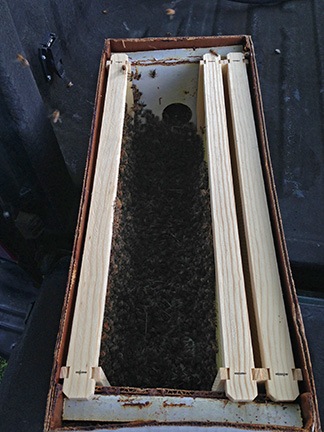
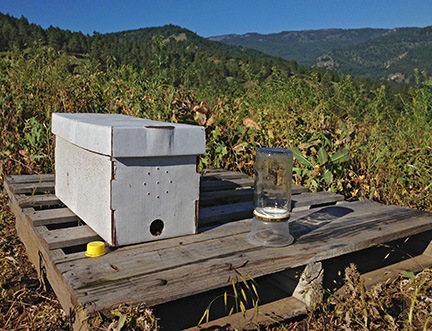
The captured bees wasted no time crawling up onto the frames in the nuc box I put them in.

I looked into the box. There was plenty of space in there to add a frame, so I gently lowered one in.

By that time, Katie’s husband had come out. He, his son, Cheryl, and I took a close look inside the box. We could clearly see “fanning” activity by a handful of bees on the top edge of the box. I’d seen this behavior before when watching another area beekeeper catch a swarm. The bees were trying to spread the queen’s scent outside the box to attract other colony members who hadn’t come into the box yet. That’s a great indication that the all-important queen was inside the box.

I took off my suit and stowed it in my equipment box, along with my smoker (which I hadn’t needed) and gloves. I waited as long as I could to cover the nuc box.Most of the bees were inside the box; the ones left behind might find their way back to the original hive in the shop wall less than 100 feet away. The plug for the hive entrance had already been put in place so the bees inside the box were trapped there. I wedged the box into a safe spot in the back of the truck, said goodbye to Katie’s family, and left.

Settling in the Swarm

Back at my RV, I offloaded the truck, leaving the nuc box on top of the bee equipment box under my fifth wheel hitch overhang. Then I took a quick shower, dressed, and went out with Cheryl to meet some friends in town.

The plan was to take the bees with me the next day when I moved my RV to Wenatchee Heights. Unfortunately, the weather didn’t cooperate. I had to fly most of the morning. If I left the bees closed up in the box, they could die from heat or lack of water. So I took the door plug off. Bees started coming and going like a regular hive. This meant that I would not be able to move the bees until that evening, when they returned for the night.

Although I did manage to move my RV that evening, I also had to fly. By the time I was done, it was too late to retrieve the bees. I asked Mike and Cheryl to close up the door, planning to retrieve them in the morning. But when morning came, I had to fly again. So they opened the door to let the bees out another day.

This turned out to be a tiny problem. Although I’d paid for my RV space through the next day, the campground people put a motorhome in that spot. The bees were coming and going from their box under the picnic table. The motorhome people were terrified of them and stayed locked up in their luxury box. The campground people called to ask when I’d get the bees. I was flying when they called. I assured them I’d be there later that evening and hoped (again) that the rain would stop.

Temporary Home
My new bees in their temporary home. I hope to have them moved into a real hive later this week.

Fortunately, the rain did stop and I did get back to Quincy to retrieve my bees and other possessions left behind. I brought everything back to Wenatchee Heights, where I’m currently camped out between two of the orchards I’m contracted to dry. In the morning, I opened the door to the hive. The bees began coming and going as usual, probably wondering what the heck was going on.

Several days have gone by. The bees seem happy enough. I’ve ordered a new hive to put them in; it should arrive sometime this week. I’ll set that up here, remove the frames from the nuc box and put them in the new hive, and get the nuc box ready for my next swarm capture. Details to come (of course).

A Hellish Week

Be careful what you wish for.

I’ll admit it: when I’m on contract to dry cherries, I hope for rain.

Yes, I’m in Washington state. But no, it doesn’t usually rain much here. I’m on the east side of the Cascade Mountains. That’s the dry, desert side.

In past years, rain has been light. I could count the number of days I had to fly on the fingers of one hand. Last year, I think I went to the second hand. We had one brutal day when I flew more than 6 hours last year, flying over one orchard after another until every single one under contract had been dried. But there isn’t usually much rain.

And although I do get paid to sit around and wait for the rain — which sometimes requires me to sit around my base all day watching radar — I also get paid to fly. It’s the combination of the two forms of revenue that make the season worthwhile.

So I hope for rain.

This week, however, I got more than I wanted. A lot more.

Day One

It started on Monday. I was still based in Quincy, so when the call came at 4:15 AM, it seemed to make sense for me to get started on the 50-acre orchard north of town. But radar showed activity in the Wenatchee area where I had other orchards under contract. I decided to call my other pilot, Mike, who was two spots down from me in the RV park. If I got called to Wenatchee, he’d have to do all the drying in Quincy.

Of course, I woke him up. But that’s part of the job. Our daily standby pay guarantees that we’ll be ready to fly from first light to last light. In Washington, in the summer, that’s a 17-hour day.

It was a good thing I called Mike because I’d been flying only 20 minutes when the call came to dry my first orchard in Malaga. Mike was enroute to the Quincy orchard when I left, telling him to start where I’d left off: at the first wind machine on the west end moving east.

I dried 26 acres in two orchards in Malaga and Wenatchee Heights. Then I returned to Quincy to dry 32 acres in two orchards there with a refueling in between. Then back to Malaga, Monitor, and Wenatchee Heights — multiple times — to dry a total of 177 acres in five orchards, one of which I dried four times.

It rained all day long, barely stopping long enough for us to get in and fly before the rain started up again.

I say “us” because I wasn’t the only helicopter flying. There was at least a dozen of us — R44s, JetRangers, Hughes/MD 500s, Hillers, and even a big, fat Huey. We were darting all over the place, making position calls on the informal air-to-air frequency, 123.45.

For the most part, pilots were polite and informative to avoid traffic conflicts, but there were exceptions. When one jackass flew 50 feet over the top of me while I was hovering at treetop level in an orchard in Malaga, I slammed him over the radio to make it clear that such behavior simply wouldn’t be tolerated. I don’t know whether he was being dumb or inconsiderate or simply trying to piss off the only female pilot drying cherries this year. But as anyone who knows me well can tell you, I don’t take bullshit from anyone. If I’d met him later in the day at the FBO, I probably would have attempted to break his nose — I was that pissed off.

I finished up long after sunset, when there was barely enough light to get back to my Quincy base. I’d spent 8.5 hours in the air, including all repositioning time. I’d dried a total of 245 acres of cherry trees.

What a day!

Back at my base, Mike’s wife had dinner on the table for me. Mike had spent a lot of the day flying, too, but not nearly as much as me. He’d already eaten but kept me company — and joined me to eat some of the ribs leftover from the day before — while I ate. I was exhausted when I went to bed.

But the forecast hinted that there would be more the next day.

Day 2

Although I really expected to be called out very early in the morning, I didn’t do my first dry until after 7 AM. The calls came in one after the other, evenly spaced apart. 7 acres in Malaga, 19 acres on Wenatchee Heights, 35 acres up Squilchuck Canyon, 35 acres in Monitor, 23 acres in Malaga, 7 acres in Malaga (again), and 35 acres in Monitor (again). Along the way, I refueled twice at Wenatchee Airport. I even had enough time to order, take delivery of, and eat a pizza.

In the meantime, a friend of mine in Quincy called to say that there was a bee swarm in a tree in her yard. She knew I wanted to catch it — that’s why she called me. But I was stuck in the Wenatchee area until there was no chance of rain there. I told her I’d come as soon as I could.

Storms over Wenatchee
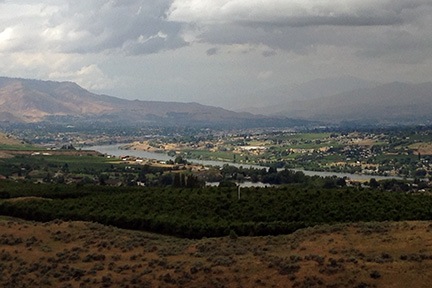
For a while, I just sat up at my future home and watched the storms move through Wenatchee.

I got called out to do that 35 acres in Monitor again after lunch. When that was done, it wasn’t clear whether I’d have to do any more drying. I had plenty of fuel on board and I was sick of hanging out at the airport, so I flew up to that lot in Malaga that I plan to buy, landed, shut down, and spent about an hour sitting on the best view spot just watching the world around me. It was very restful.

After about 45 minutes, I figured I was done for the day so I started up again and headed back toward Quincy. I’d gotten as far as the Rock Island dam when my phone rang. It was a client. I made a big, sweeping turn at 110 knots and headed back to dry that 35 acres in Monitor (again).

By the time I was done, it was after 5 PM. Mike had called to let me know that we’d been invited to go out for dinner (and possibly drinks) with another pilot and his grower clients in Quincy. And I still had that bee swarm to catch. And I needed a shower. Desperately.

I headed back to Quincy.

By 7 PM, I’d caught the bee swarm, showered, and was sitting down with new friends in the Moose Lodge (really!) in Quincy WA.

It was 8:30 when a grower in East Wenatchee called me. He was not one of my clients, although I’d tried at least twice to sign him up. He preferred to hang around at the airport and make friends with the pilots so he could convince them to dry his trees off contract. That made it possible for him to avoid paying standby fees. He had apparently been successful doing this for several years.

But that evening, he was in dire straits. It had rained again in Wenatchee and his orchard was soaked. And he couldn’t find any pilot to come — they were all busy drying orchards under contract. (That’s why growers contract with us. Duh.) He seemed to think I might be flying in the area and could squeeze him in. I told him I was in Quincy and done for the night. He hinted that he might want to get on contract with me. I told him I was already at capacity for both of my ships. I told him that if he’d contacted me earlier, I might have been able to add another ship and pilot and cover him under contract. I told him it was too late to launch from Quincy anyway. (For the record, I would have launched right up until 8:45 for a client under contract; sunset was about 9 PM that night.)

When I hung up, I felt bad for him, but also kind of glad that he was being taught a valuable lesson. But I discovered that he found another pilot to dry for him after all — probably first thing in the morning. (Some of the pilots need to be taught a lesson, too.)

Total for the day: 196 acres, 5.7 hours of flight time.

Day 3

I was awake the next morning at 3:51 AM when I got a text from one of my clients telling me to dry all four of his orchards in the Wenatchee area. It had rained overnight and he needed them dry before the sun hit them.

Morning Dry
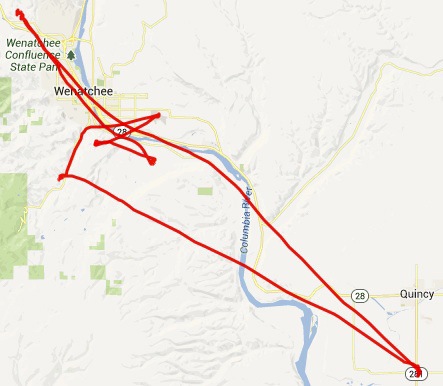
I used GPS track on my phone to show exactly where I flew on Wednesday morning. I started in Quincy, went to Monitor, then Malaga, then Wenatchee Height. Then I refueled at the airport, dried an orchard up Squilchuck Canyon, and returned direct to Quincy. 112 total miles.

I texted him back and told him I’d be at the first orchard at 4:45 AM. Of course, I was still in bed when I texted this. And the orchard was 30 nautical miles away — the farthest one. And it was still dark out.

I got up, made coffee in a travel mug, and pulled on my flight suit while Penny was out doing her business. Then I lifted Penny back into her bed, pulled the cover off Alex the Bird, grabbed my coffee, and headed out.

I preflighted with a flashlight and had the engine running by the time the horizon became clear. I took off and flew a semi-direct course. I was hovering over the first row of rainier cherry trees on the east side of the orchard at exactly 4:45. That simply amazed me.

Nice sunrise, too. A thin layer of stratus clouds kept the area shaded but glowed pink as the sun rose.

I was over the second orchard when I called Mike to let him know I was flying already. He flew later that morning in Quincy.

Maria and Penny
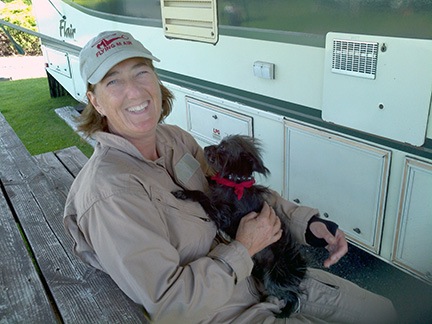
Cheryl snapped this photo of me in my flight suit with Penny shortly after my return from flying.

It was a quiet day — just the four orchards totaling 96 acres. I was done before 9 AM and after refueling, went back to Quincy. I spent the rest of the day packing my my RV in preparation for moving it to Wenatchee Heights for the rest of the season. Unfortunately, my next door neighbor had parked in such a way that I couldn’t hook up my pickup truck to the trailer. So I had to wait until 5:30 to leave. It was mostly sunny most of the day in Quincy and kind of hot and humid. I ran the air conditioning for a while.

At 6 PM, Mike, his wife Cheryl, and I headed to Wenatchee Heights. Mike was driving my truck and trailer. Cheryl was driving my Jeep towing my boat. (Mike and his replacement guy Ron are using the Jeep while they’re working for me.) And I flew up in the helicopter. I beat them there (of course) and was visited by neighbors I hadn’t seen since the previous season. Then they arrived and we parked the trailers. They drove off in the Jeep and I started settling in.

I left in the truck at 8 PM to go back to Quincy and pick up the things I’d left behind: my kayak, my Traeger grill, some nice wood palettes I’d been collecting, and my captured bee swarm, which had been flying around its temporary home all day. I’d gotten as far as Rock Island by 8:20 when my phone rang. Could I dry that orchard up on Wenatchee Heights?

If I’d been at my base — where technically, I should have been while on standby — the answer was yes. So even though I had to drive 20 minutes to get back to the helicopter and that would make it very late indeed, the answer was still yes. I turned around and drove, calling Mike along the way to let him know I wouldn’t make it there that night.

At 9 PM, right around sunset, I was hovering over the last 19 acres I’d dry that day. I was on the ground at my new base, only 2-1/2 miles away, by 9:30 PM.

Total for the day: only 115 acres in 3.6 hours, at least 1 hour of which was (non-billable) repositioning time.

Day 4

By Wednesday night, I thought the drying flights were over. There was a very slight chance of rain the next day — only 20% — when I went to bed. After years of watching weather here, I can tell you that 20% is barely worth thinking about.

So imagine my surprise when I got a call at 4:54 AM from a grower telling me that it was raining in Monitor and he’d likely need me when it stopped.

I got out of bed, made my coffee, took care of my critters, and suited up. The call to dry came at 5:45 AM from a different grower in Malaga. And that’s when the fun began.

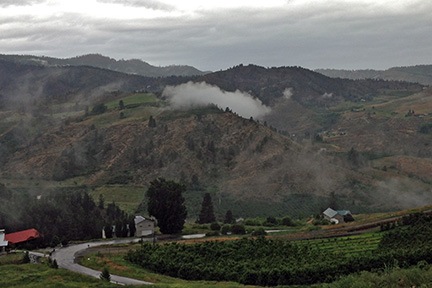
Orchard in the Clouds
For a while, the orchard I was waiting to dry had a cloud sitting right on it.

For the next few hours, I dried six different orchards — two of them twice — stopping only to wait out another rain storm and to refuel. It got intense for a while: while I was drying the third orchard, I had my next two orchards lined up and waiting for me. But everyone stayed calm, including me, and it got done timely. Indeed, after finishing all my orchards at around 11:30 AM, I saw other pilots heading out to start drying other ones near mine.


I waited at my base in Wenatchee Heights for rainstorm to pass through the area. This nosecam video clip shows my minute-long “commute” from my base to the orchard I dried across Squilchuck Canyon. There were lots of low clouds that morning.

Total 162 acres in 4 hours of flight time.

I was finally able to retrieve my possessions (including bees) in Quincy that evening.

Enough Already!

You know what they say: be careful what you wish for. This past week was a real lesson in that.

All cherry drying pilots want it to rain. Rain = money. But how many of us want it to rain this much?

I certainly don’t.

There comes a point where there’s so much rain that helicopters simply can’t keep the cherries dry enough to prevent splitting. I’ve heard loss numbers ranging from 10% to 50% in orchards that do have helicopters on contract. (This is better than another grower I’m in touch with who doesn’t use helicopters and had 60% splits; he’s not picking at all.) I’d also heard that loss rates were so bad in Mattawa (south of me) that growers gave up and stopped calling helicopters to dry. That doesn’t do us any good at all.

And while it’s nice to be able to send out invoices, I admit that I felt bad for my clients when I sent out the ones for this week. When you have a 35 acre orchard that needs to be dried multiple times in a day multiple times in a week, the costs climb quickly. Yes, that’s revenue for me. But it’s also a huge cost for the grower. While my services will make the difference between a crop that can be picked and sold and one that’ll rot on the trees, it must be painful for them to face such large bills.

But most of all was the sheer exhaustion I felt after hours of hovering at treetop level over fruit trees — especially the ones in orchards planted in steep terrain with numerous obstacles to avoid. It’s tedious, dangerous work. Three helicopters were lost so far this season: a JetRanger went down in bird netting near Royal City, a 500 had a wire strike that took it down, and an R44 had a wire strike that I’m still waiting to learn more about.

I can’t argue the profitability of a rain-filled week. I dried a total of 718 acres of cherry trees with 21.8 hours of flight time. I billed accordingly.

And I still have 6 weeks left in my cherry drying season.

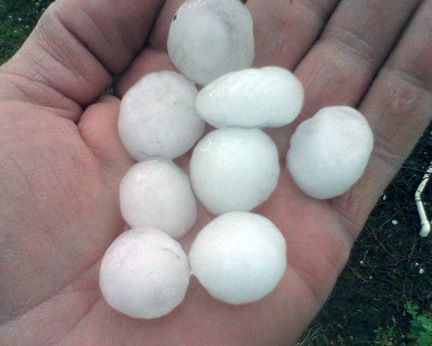
Hail
This hail fell in Prosser, WA this morning. So glad it didn’t fall anywhere near my helicopter.

Right now, it’s cloudy outside, with thunderstorms rolling through the area. Ron dried an orchard in Quincy 1-1/2 times. (It started raining when he was half finished so he waited it out and restarted.) I’ve been watching severe storms moving northeast through the area mostly east of me. A severe storm passed over Lake Chelan at Manson near where my friend Jim is based with his helicopter. One of my growers sent me a photo of hail the size of…well, the size of cherries… that fell in the Prosser area. Hail like this can destroy a helicopter, so I’ll be covering mine up in case any storms like that pass through here.

Will I fly today? Who knows? In all honesty, I hope I don’t.

I’d like a rest — and I’m sure my clients would, too.

Postscript, 30-June-2013

Two things I’d like to mention.


Nick Henderson put this video of his cherry drying work on YouTube. Check it out.

First, I wound up flying another 5 hours on Saturday, drying a total of 208 acres. The rain came down fast and furious, with thunderstorms rolling through and flash flood warnings for Wenatchee. More than an inch of rain fell near where I’m based.

Second, fellow cherry drying pilot Nick Henderson put together this little video of his cherry drying work this week if you want to see what it looks like from the pilot’s point of view.

Today (Sunday) is a beautiful clear day — perfect for a well-deserved day off!