A New Sign

With a tiny garden.

Here's My Sign
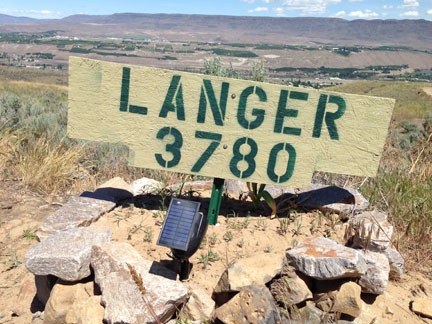
My first stab at a house sign.

Way back in August 2013, I blogged about my first week as a single landowner. In that blog post, I showed off a picture of a temporary sign I’d made to mark my driveway for contractors and visitors.

I was proud of that silly, ugly sign — it was a mark of achievement. It was evidence that I was on the road to a new life. A better life without a sad old man holding me back. Maria, rebooted, version 3.0.

Old Sign
By May 2014, my once-proud sign was looking very sad.

Time went on. I put a little ring of rocks around the sign and added a solar-powered light for nighttime. In the autumn, I planted bulbs.

Then winter came. I moved away for about five months, first on a local house-sitting “job” and then on a frost contract in California. When I returned, the ground was dry and the few bulbs that had emerged were struggling. The sign looked forlorn and sad.

The sign wasn’t meant to be permanent. I was hoping that a friend of mine in Arizona who works with metal would make me a new sign, but the death of her husband and the aftermath kept her busy with other things. I’d need to find another solution.

I should mention that I had a neat sign back in Arizona. It was made out of sandstone with symbols and numbers carved into it. I’d bought it from an artist at a show in Cave Creek (I think) and it was custom made. (Wish I had a photo of it to share!) I was hoping to get something like that, but I simply couldn’t find anything.

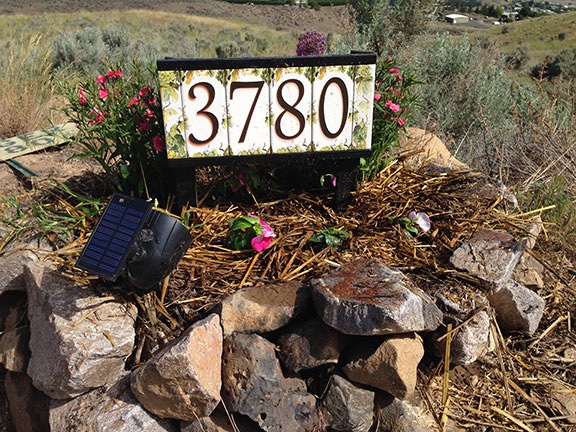
Then, last week when I was in California again for work, I happened upon an art tile shop. They made house numbers and frames. I chose a style with a black frame, picked out my numbers, and had them assembled. I bought it home and mounted it on a pair of stakes I painted black to match and then I pulled the other sign — with some difficulty! — and replaced it with the new one.

Yesterday, I went to Fred Meyer for groceries and stopped at their excellent garden shop. I bought a bunch of flowering plants that should bloom all summer. I loosened up the soil, removed rocks, added compost and top soil. Then I planted the flowers around the sign. I covered the soil with a dressing of straw (which I have no shortage of), watered it good, and took this photo.

A New Sign
Freshly planted: my new sign and some flowering plants.

Not bad, eh?

Of course, the big challenge will be to keep it watered…wish me luck!

Construction, Day 3: Gravel Spread, One Roof Framed

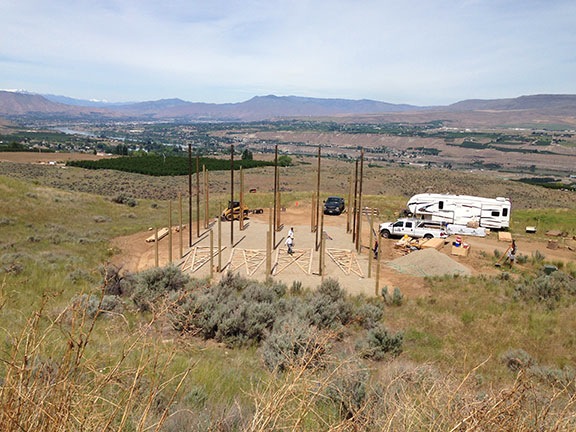
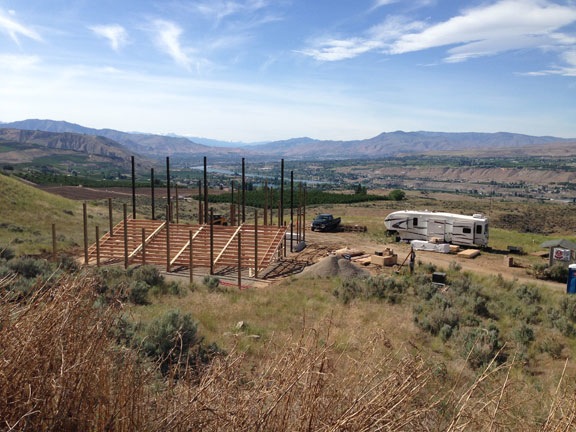
More than just a bunch of poles now.

On May 20, 2014, I began blogging about the construction of my new home in Malaga, WA. You can read all of these posts — and see the time-lapse movies that go with them — by clicking the new home construction tag.

I was away from home yesterday for most of the day — I had an interesting charter to a mountaintop in the morning and dozens of errands to run in the afternoon — and missed the action here. Fortunately, my time-lapse camera caught it all. Of course, I could see what was done when I stopped in around lunchtime for an hour and then when I got home at around 6 PM that evening and I did manage to take a few photos from different angles than the time-lapse offers.

My building site is nestled between hills on the south and west sides. The road to my home winds down the hill on the south side, so when I drive down the hill, I get a perfect bird’s eye view of my site. I often stop there on my way in or out to get a photo of the site in progress. When I drove down at lunchtime, I had to do a double-take. It looked like they’d poured a concrete pad. But then I realized that one of the three loads of gravel Jeff, the earth-moving guy, had delivered was gone; the crew had spread the gravel inside the building’s footprint.

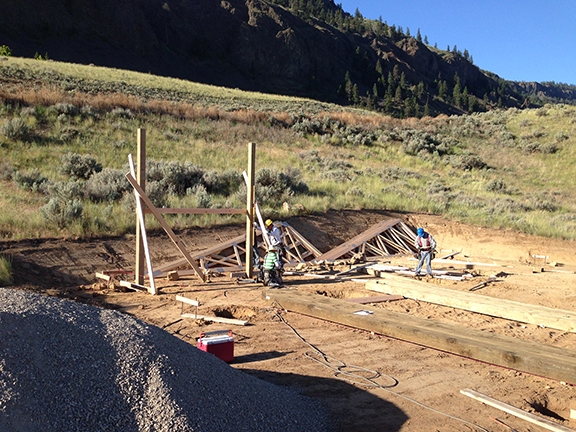
Trusses Laid Out
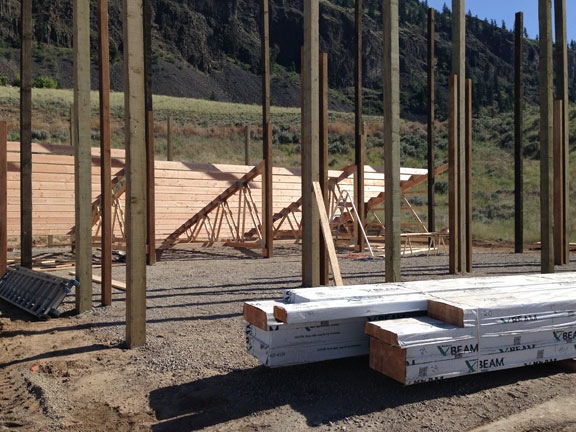
By lunchtime, the horizontal supports for the posts had been removed, gravel had been spread, and the roof trusses had been laid out.

I stopped to talk to the crew before going inside. I wanted to tell them that it was okay to spread some more gravel in the area to the north of the building which would eventually be the apron for my four-car garage. Dust was a real issue. The constant driving over the area had ground the soil into a very fine powder. I knew that kind of dirt. I knew that watering it down would turn it into a snotty muck. I had two more loads of gravel in a pile and they had a bobcat. We’d use some of that gravel to keep the dust down.

Angel, as usual, was cheerful and helpful. After agreeing to do that, he complemented me on the pad. Both he and Corey, the boss, had checked it for levelness. He said it was very good. From the way he spoke, I got the feeling that they didn’t often get to work with building pads so well prepared. But Jeff had done a great job. I sent him an email this morning to let him know.

I was out all afternoon and, when I got home, the crew was gone for the day. But they had kept busy. One of my building’s two roofs were fully framed and ready to be lifted.

Roof Framed
One roof had been framed by the end of the day.

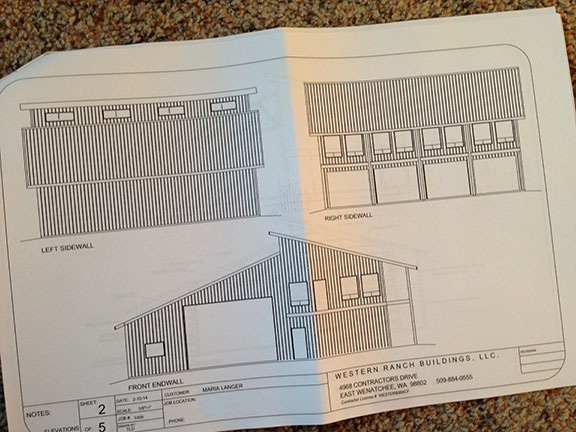
To give you a better idea of what’s going on, check out the elevation sketches below. The building will have two roofs. The low roof, which is the one they framed out that day, was built with trusses — at least I think that’s what they’re called; someone will likely correct me if I’m wrong — and will go over the RV garage on the south side of the building. I don’t care about the wood beams showing in that area since it’s all storage and shop.

Elevation Sketches
Elevation sketches for my building show the two rooflines.

The other side of the building will have my living space on the second floor. I don’t want to look at trusses with naked wood beams and hanging hardware there. Instead, I want a vaulted ceiling that will be finished with sheetrock like any other ceiling. That means they need to build the roof completely onsite. I suspect that’s what yesterday’s lumber delivery was — the third lumber delivery so far.

Roof and Wood Delivery
I noticed the new stack of wood when I got home that evening. Judging from its size, it must be for my living space roof.

After being interviewed by Chuck Joiner for an upcoming MacVoices video podcast (link to come), I wandered around “inside” my home under construction with a bottle of hard cider made by a friend. I wish I could explain the way my emotions welled up inside me. After only three days, there was an amazing amount of progress on what would be my future home.

My. Future. Home.

I was finally moving forward again.

Those who know me think that my life has been stalled for only the two years that I’ve been dealing with my extremely ugly divorce. But that’s not true. I’ve come to realize that my life has been stalled for about ten years.

But now I’m moving forward again. Working hard to achieve my goals, no longer held back by a “partner” who makes excuses instead of plans.

As I walked through the site, between posts that would soon be connected by framing and walls, I realized something else: everything around me was mine. Like like other things I’d worked hard to get — my helicopter and my vehicles and my RV — I’d earned all of the money to make this dream a reality. I was walking through the beginning of my new home designed to my specifications to meet my personal needs.

And that’s what I was thinking about as I wandered around the site, imagining how I’d use the shop space and where I’d park my vehicles and where I’d place my furniture in the rooms upstairs.

And thinking again about sipping wine on the deck overlooking the Wenatchee Valley.

Here’s the Day 3 Time-lapse:

How’s This for a Landing Zone?

We don’t need no stinkin’ runways.

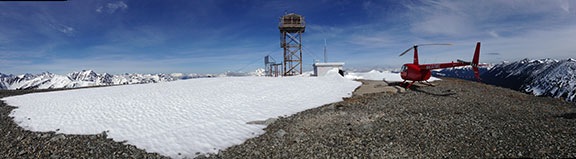
This is why I really love my job as a pilot. Because sometimes I get to fly places like this:

Landing Zone Panorama
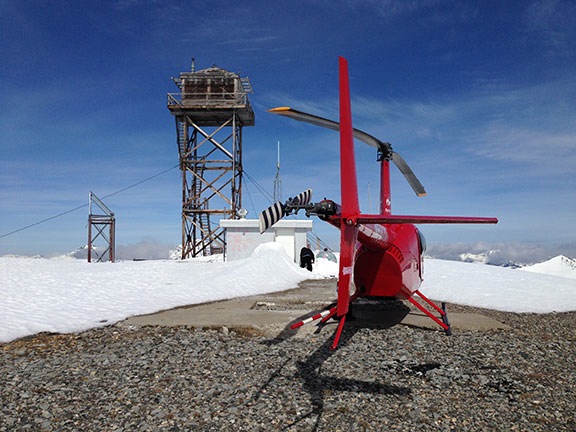
The landing zone was on top of Slate Peak, 7400 feet, which had a nice flat area that had (fortunately) been blown clear of snow.

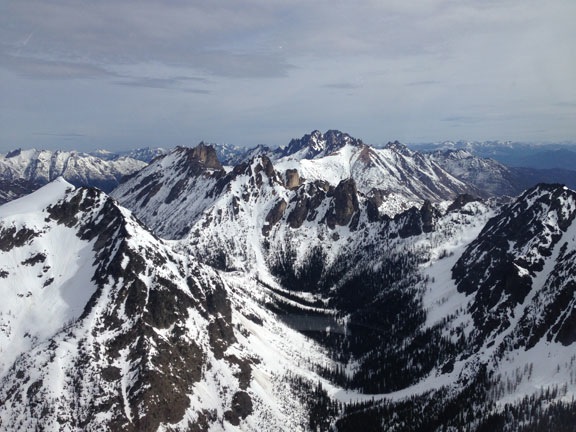
Slate Peak has a communication repeater that needed servicing by my clients. I had to take two men and about 60 pounds of equipment up there this morning. Perfect flying weather — breezy, but without any gusts. No turbulence at all — which is a good thing because we were flying in the North Cascades.

North Cascades
The terrain in this area is unforgiving. If you have an engine failure, there’s no place to land without bending up a lot of metal.

The landing zone was a flat-topped mountain. There was a road running up there, but it was still snow-covered. The ground was pretty snow-covered, too, except where the wind had blown it off the mountain. That’s where I landed. My clients had to shovel a path to the door of the building.

Landing Zone Closeup
Not exactly level, but level enough. The fire tower is in disrepair and no longer used.

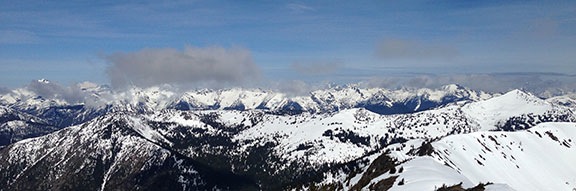
Clouds
There was a SigMet for mountain obscuration in our area, but we were right on the edge of it. I took this photo out to the west while waiting for my clients.

My clients finished quickly — less than 30 minutes — and we were soon heading back down the way we’d come. The flight up there had taken over an hour, but it was only about 45 minutes back because of the tailwind and the simple fact that it was “downhill” almost all the way.

Not a bad way to make an honest living, eh?

Construction, Day 2: The Poles Go In

I cannot believe how quickly this happened.

The workers arrived at 7 AM sharp yesterday morning and got right to work. Within 30 minutes, two poles had been placed.

First Posts Planted
These guys didn’t waste any time. Within 30 minutes, the first two posts had been planted.

On May 20, 2014, I began blogging about the construction of my new home in Malaga, WA. You can read all of these posts — and see the time-lapse movies that go with them — by clicking the new home construction tag.

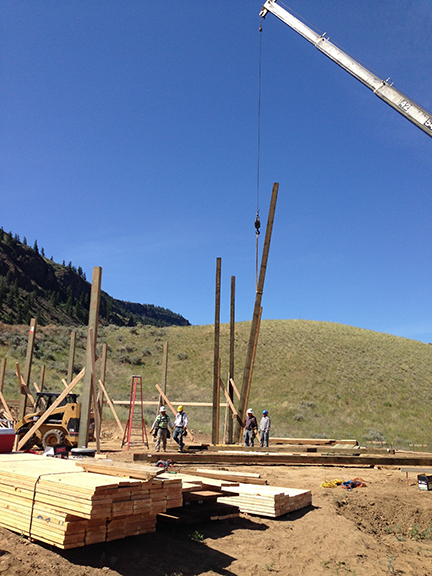
I was writing yesterday’s blog post in my RV and happened to glance out my office window. What I saw blew me away. I couldn’t believe how quickly the poles went in. At one point, I think they were averaging 10-15 minutes per pole.

My building will be one story tall on one side and two stories on the other side. The two-story side has some seriously long poles — 32 feet, according to Angel (the worker foreman). Apparently, that’s among the tallest the company usually does.

Hoisting with a Crane
The long posts were hoisted with a crane.

Of course, the chances of four workers being able to hoist a 32-foot long 8×8 post are slim. I was just wondering how they’d lift the long poles when the boss, Corey, showed up. With a crane.

The pace slowed down a bit, but still moved along at a good clip. By 2 PM, they were almost done placing poles. That’s when the Chelan County building inspector showed up. (Yes, I had my first inspection on the second day of construction.) He chatted with me and Corey and went through the plans, asking a few questions. Then he looked into all the holes and at all the poles suspended over the hole bottoms. In the end, he signed off on something Corey gave him.

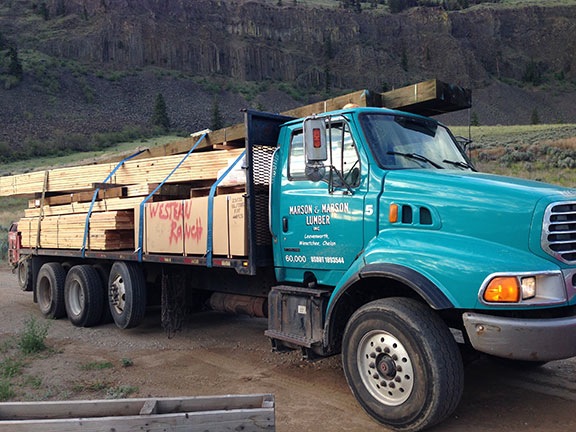
He was still in the driveway when another truckload of lumber arrived. I scooted him out and then rearranged my vehicles to make room for the lumber on the RV side of the driveway. The other side was getting very crowded.

More Lumber Delivered
More lumber arrived in early afternoon.

Pouring Concrete

They used a concrete caddy to shuttle loads of concrete to the post bases.

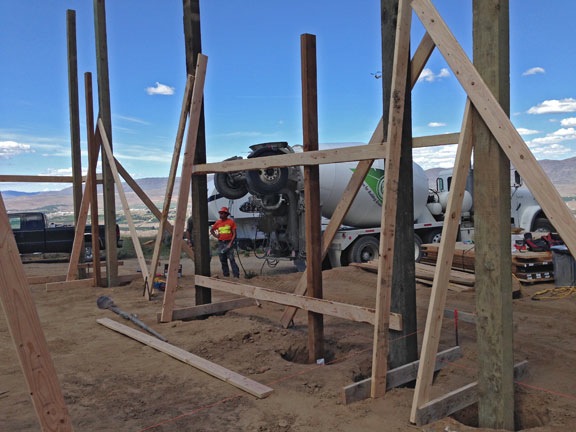
When he was finished, the first cement mixer arrived. Corey wasn’t too happy. He was done with the crane and had been hoping to get it out before they poured concrete around the pole bases. (My driveway is rather long and very narrow; just one vehicle at a time.) They used a concrete caddy on the bobcat to shuttle loads of concrete out to the poles on the south end.

Cement Mixer at Jobsite
The first cement mixer at the job site.

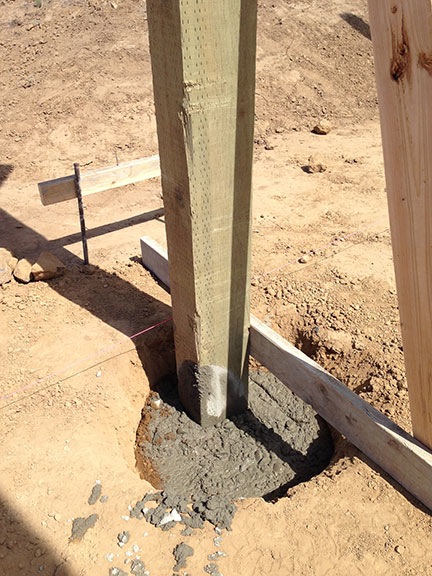
Concrete around Posts
A post with concrete at its base.

The second truckload was already waiting when the first finished. Corey chased the first truck out with the crane and the second truck came in. They filled in the rest of the holes and topped off the first ones.

By 4 PM, they’d erected all 40 posts and poured concrete around the post bases. I’m not sure whether they can start framing today or if they have to wait for the concrete to cure. I guess I’ll find out soon enough.

Want to see it for yourself? Here’s yesterday’s time-lapse. I slowed it down to 15 frames per second; each second of video corresponds to 15 minutes of time.

Next up: framing begins.

Construction, Day 1: Lumber Delivery, Post Hole Digging

Off to a good start.

On May 20, 2014, I began blogging about the construction of my new home in Malaga, WA. You can read all of these posts — and see the time-lapse movies that go with them — by clicking the new home construction tag.

The lumber delivery truck pulled into my driveway at 6:15 AM sharp. I was already up. In fact, I was setting up my time-lapse camera on the roof of my RV.

The truck was neatly stacked with lumber. A forklift clung to the back. It didn’t look like enough lumber for a 48 x 60 foot building, but the driver assured me it was. In fact, he told me it was a lot of lumber.

My Lumber
The lumber truck arrived at 6:15 AM. I was awake (of course).

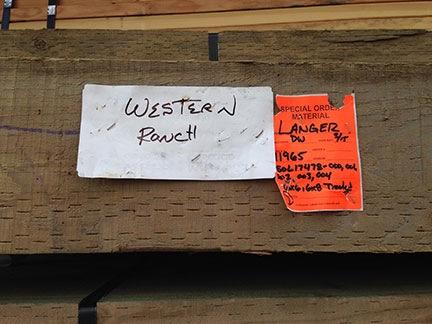
Special Order for Langer
It must be mine. It has my name on it.

He didn’t waste any time offloading it and leaving it spread out on the building site. Then, without taking up my offer of coffee, he backed down the driveway the way he came and was gone.

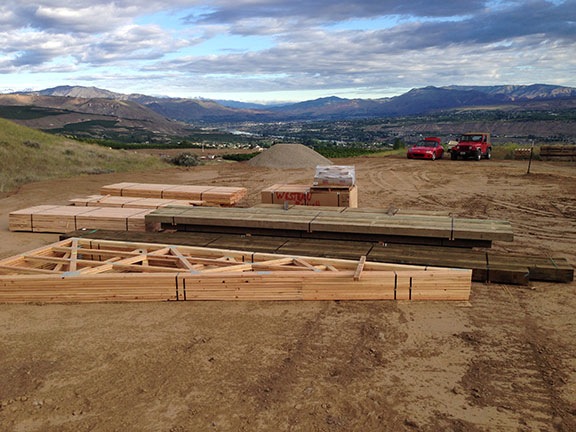
I looked over the lumber he’d left behind — my lumber. The skeleton of my future home in a sort of kit.

Assembly Required
As one of my Twitter friends said about this photo, “Some assembly required.”

The builders showed up less than 20 minutes later. There were 3 hispanic guys who introduced themselves and shook my hand, the owner of the company, and a bobcat with two augers. They spent about an hour moving around the lumber. Then the boss left and the workers got down to work with the auger.

A pole building utilizes post-frame construction. From Wikipedia:

Pole framing or post-frame construction (pole building framing, pole building, pole barn), is a simplified building technique adapted from the labor-intensive traditional timber framing technique. It uses large poles or posts buried in the ground or on a foundation to provide the vertical structural support and girts to provide horizontal support. The method was developed and matured during the 1930s as changes in agricultural practices, including the shift toward engine-powered farm equipment and the demand for cheaper, larger barns and storage areas. Unlike competing building methods, once the poles, girts, and rafters are put in place, much of the construction work on a pole-built structure can be handled by a single individual over the course of a month or season.

My building required 40 holes roughly 3-4 feet in diameter and 4 feet deep. The builder estimated that construction could be completed in 6 to 8 weeks. Of course, that’s just the exterior of the building; I still needed to finish my living space.

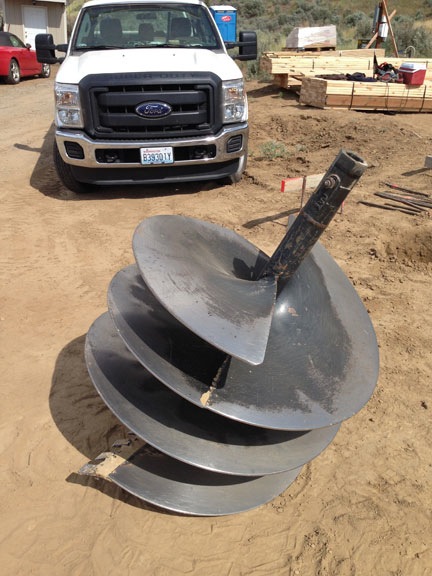
Auger
Close-up view of one of the augers they used to dig holes for my building.

So that first day was all about digging holes. I was worried about rocks on the south side of the site. I’d been warned that although the pricing included some work with rocks, if there was a lot of rocks and they couldn’t do the digging, I’d have to pay extra for earth moving equipment to come back in and dig the holes. Extra could get into the thousands of dollars. Every extra dollar I spent on the building’s frame was a dollar that wouldn’t be available to finish the living space. Needless to say, I wanted those holes to be easy to dig.

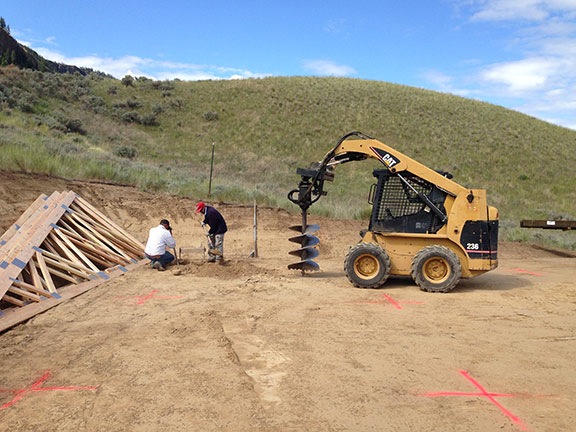
They encountered a rock about three feet down on the first hole. The workers stopped and got tools out of their truck. I came over to watch. Angel, who seemed to be in charge of the workers, told me it didn’t seem to be a big rock. They banged away on it with a digging stick and then dug it out with shovels. And then they got the auger back in place and dug.

They had the same problem with the other south corner. Angel said it wasn’t bad, though.

Digging Holes
The workers deal with a rock on the second hole.

And when they moved north, they didn’t hit any rocks. At all.

In fact, of the 40 holes they dug, they only hit rocks on four of them — the four south side holes.

The digging went amazingly fast. I’d estimate about 10 minutes per hole. The auger went in and filled its grooves with earth. Angel moved aside and then rotate the auger in the opposite direction to dump the earth in a pile. He made two of these piles and later used the bobcat to move the earth into my future driveway apron. They took a break for lunch at 11:30 AM. By about 2 PM, they were done with the holes.

Sometime around the middle of the day I emailed Tanya, the woman I’d been working with at the builder, to let her know how it was going. I think she was just as happy as I was that the work was going smoothly.

I had to leave at 3 PM, so I didn’t get a chance to see them finish up. I did watch on the time-lapse, though. After finishing the holes and moving that dirt, they spent the rest of the day moving the posts around. By 4:15 PM, they were gone.

The project is definitely off to a good start. Even today, as I type this, I can’t believe how much they’ve gotten done in less than 90 minutes. A crane is pulling down my driveway right now. You can read about that tomorrow.

In the meantime, here’s yesterday’s time-lapse.