First Cherry Drying Flights of the Season

Two flights, two hours.

I’ve been on contract for cherry drying services since May 26. It’s the earliest contract start I’ve ever had.

Although the first orchard I was on contract for dodged a few storms right at the beginning of the contract, the weather settled down and was very nice for two full weeks. Too nice, if you ask me. The east side of the Cascade Mountains is almost as dry a desert as the one I left in Arizona.

During that time, two other small orchards came on contract, giving me responsibility for three orchards totaling 60 acres. The only drawback is that 30 acres are in Quincy, about 10 miles from my home in Malaga, where the other 30 acres is. So there’s a bit of uncompensated flight time between orchards.

I’m Ready for the Calls

With a 20% chance of rain in the forecast for Thursday, a few growers — including one who isn’t on contract yet — called to check in. Normally, I don’t bug my growers unless they owe me paperwork or money; when there’s a chance of rain, they sometimes call just to make sure I’m really around.

What they don’t realize is that from the first day of my first contract to the last day of my last contract, I’m walking weather advisory service. I know the chance of rain for the next 3 days (50% today, 20% tonight, 0% Saturday and Sunday, 20% Monday) and what’s on radar now (dissipating storm system headed for Quincy orchard and building storm system heading for Malaga, both from north in counter-clockwise rotating weather pattern). I have weather on my phone, iPad, and computer and always have at least one of them within arm’s reach.
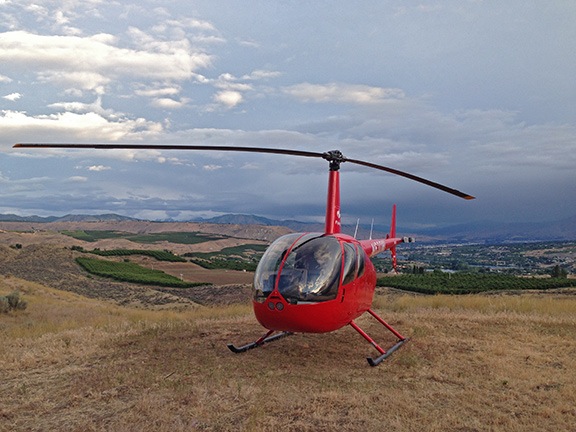
Helicopter Ready to Go
Rain in the area? I know about it and am ready to fly.

While under contract, I’m never more than an hour away from my helicopter, even on nice days with no chance of rain. If there’s rain in the forecast, I’m never more than 30 minutes away. If there’s any chance at all of rain within the next 30 minutes, I’m hanging out with the helicopter. If it’s raining on any of my orchards, I’m suited up and the helicopter is preflighted, untied, and ready to go. No matter what the weather is, I don’t drink — not even a glass of wine with dinner — during daylight hours. Of course, by the time the sun goes down, I don’t feel like that glass of wine anyway.

As for the helicopter, it’s completely up-to-date on all maintenance that would have it down for more than a few hours. Both fuel tanks are topped off — I refuel after every flight — giving me an endurance of at least 3 hours over the trees. I have the hinge pins off the pilot door so I can pull the door quickly — I’ve discovered that it’s better to fly with the door off, especially if it might get sunny during a flight; I’d rather be a little wet than roasting in the sun.

Thursday’s Flights
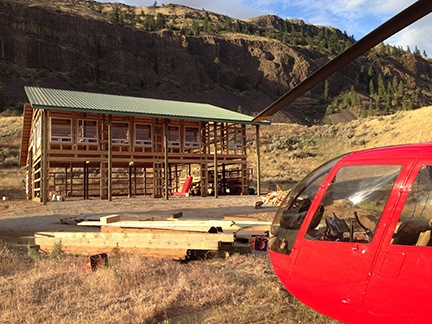
Under Constuction
There’s always something to do with a home under construction.

With a 30% chance of rain forecasted for Thursday, I hung out at home, which is where my helicopter is now based. The builders were still working on on my building and I had plenty to do to keep busy.

By around 1 PM, it started clouding up. I watched various storms on the radar, including a nasty cell near Peshastin and another near Cashmere. But all the storms were moving south to north and both of those points were west of me and my orchards. No threat. Still, I spent some time getting scrap lumber I planned to use for projects stowed away under my RV and closing up the windows in my Jeep and truck.

When I saw a storm come out of nowhere and apparently drop a ton of rain right on top of one of my orchards — which I could see from my home — I suited up and went out to prep the helicopter.

When the call came, I was actually sitting in the helicopter with the key in the ignition. I told the grower I’d be over as soon as I could. I was hovering over his orchard less than 10 minutes later.

I don’t particularly care for this orchard. In 23 acres, they’ve managed to throw in a cornucopia of obstacles: 4 buildings, 2 sets of wires (plus a nearly invisible one running from a pole to a house right at treetop level), 3 wind machines, a bird house, tall border trees, and a pipe that, for some reason rises about 5 feet over the tops of the cherry trees beneath it. It was just after negotiating around this pipe that my main rotor blades trimmed some narrow branches on one of the border trees.

And then there was the wind. Dead calm one minute and gusting like crazy the next. I made a 180° turn at the end of a row of trees and got a headwind gust that lifted me 30 feet. Sheesh.

It takes about 45 minutes to dry this orchard and I was glad when I was done. I sped over to the airport, parked at the fuel island, and topped off both tanks. My client called while I was at the airport to thank me for my speedy response. I told him I hoped I could respond that quickly every time he called and reminded him that I lived less than two minutes away by air.

After refueling, assuming I was done for the day, I headed home.
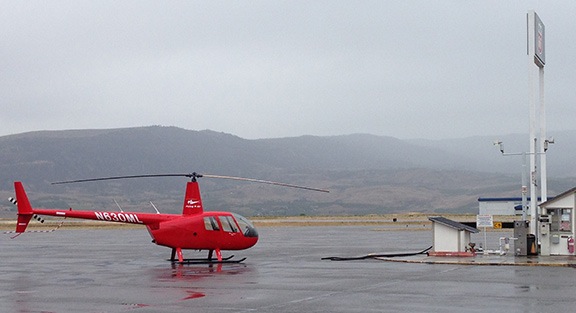
Refueling
The fuel island at Wenatchee Pangborn on a rainy day. My home is at the base of the cliffs behind the helicopter’s tail rotor in this photo.
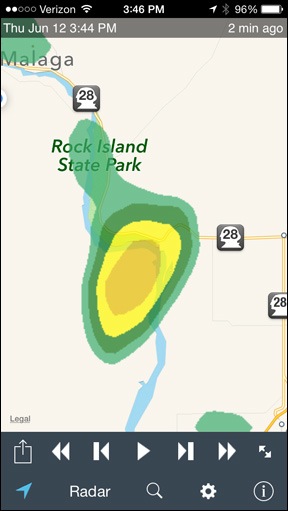
Radar Storm
It should not have been a surprise to get a call from my Quincy client, considering this storm cell passed right over his orchard.

I was home less than a hour when a call came from the owner of my Quincy orchard. I felt sorry for the guy — he was going to start picking the next day. He’d almost made it through the whole contract without having to call — something he’d done only once in the seven years I’d been flying for him. Now he needed his cherries dried and they were especially vulnerable this close to picking time. Even though it hadn’t finished raining there yet, I hopped in the helicopter and flew over.

I landed in a parking lot nearby. The orchard is on Crescent Bar, which is a resort area. Unfortunately, a crack in the Wanapum Dam forced the Grant County Public Utility District (PUD) to drastically reduce water levels to the point where the boat ramp and dock are nowhere near water. This is destroying the summer season for businesses down there, including the condos, shops, restaurants, and rental companies. But it also means that no one will raise an eyebrow if someone lands a helicopter in a parking lot on a Thursday evening in June. In fact, it’s likely to be the most interesting thing anyone down there has seen this season.

I didn’t even have time to shut down. My client saw me and called to get me started.

This is an old orchard with some trees even older than me — can you believe that? The land is somewhat hilly and there’s a house and a shop building inside its boundaries. Also some wires on one end in an odd place. Other than that, no obstacles to speak of. What’s weird, however, is that some rows run east/west while others run north/south. This is a bit of a pain since I follow the aisles between rows. But after drying this orchard at least 10 times over the years, I’d learned a good, efficient pattern.

Unfortunately, my client wanted be to dry in a different order. He called with instructions. I did my best to follow them. The idea was to dry the trees with the most fruit first. Since it takes just over an hour to dry the entire orchard, that made sense, especially with the fruit so vulnerable.
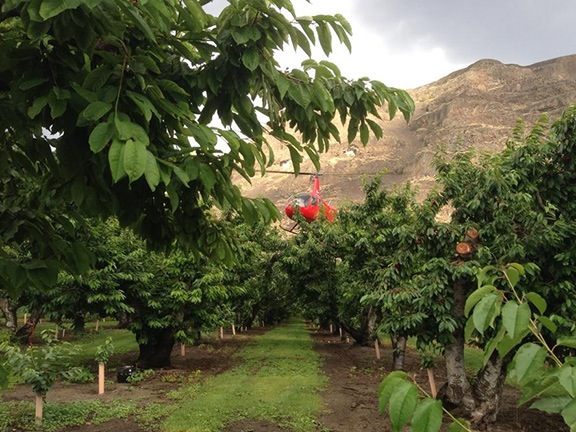
Drying an Orchard
My client took about a dozen photos of me in action over his orchard. Of course, he was on the ground looking up.

While I was flying, my phone reminded me that I was due to have dinner at a friend’s house in an hour. I’d already called to postpone the date; I just hadn’t told Siri.

Down below me in various places, they were preparing for the next day’s pick. Outhouses lined the entrance road. A refrigerated truck trailer was parked at the loading dock. Cherry lugs and picking ladders were placed strategically in the area to be picked first. Cherry bins were laid out on trailers. A handful of swampers were moving around, doing odd jobs.

If you want to learn more about the picking process at this orchard, be sure to check out this video I made a few years ago.

The wind was a real factor in this orchard, too. Although it had been calm when I arrived, when I was about 2/3 done it really kicked up. I could easily see the windy spots — it was where the tops of the trees were moving nowhere near me. The trees in that area were young and I suspected that the wind alone might be enough to shake the water off. But I wasn’t taking chances. I kept flying.

I was very glad when I finished the orchard. I did my usual “victory lap” past the shop to say goodbye. Then it was back to the airport for fuel before making the 3-minute flight home.

More to Come?

The weather looked iffy for the rest of the day and I thought there might be a chance of more rain. So after a snack, I settled down in my La-Z-Boy, still in my flight suit, to relax. It was probably around 8 PM when I fell asleep.

I woke up, shut the door, and went to bed around 11 PM. I’d only flown 1.9 hours; I was clearly out of shape.

Little did I know, but there would be much more to come the next day.

Construction, Day 15: Roofs Finished

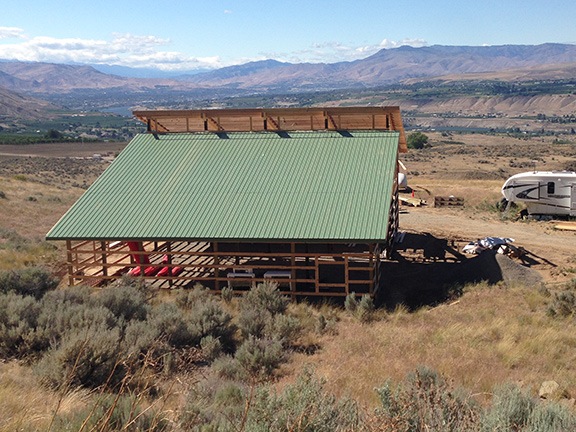
The roof is done.

On May 20, 2014, I began blogging about the construction of my new home in Malaga, WA. You can read all of these posts — and see the time-lapse movies that go with them — by clicking the new home construction tag.

The crew arrived early on Wednesday — only minutes after I popped a fresh SD card into my time-lapse camera and started it up. Now that the days are very long — we get almost 16 hours of sunlight, and even more light if you include twilight hours — and starting to get very warm, the builders want to work early. They asked if they could come as early as 5 AM and I told them they could — heck, I’m awake at that time. They rolled into my driveway at about 5:40 AM. The earlier they start, the earlier they can leave.

The day was perfect for construction on a rooftop — very little wind and relatively cool. As usual, the crew got right to work. I was home all day, doing odd jobs around the yard and working on a writing project on my computer. I came out a few times for a peek at where they were, amazed, as usual, at how quickly this “well-oiled machine” worked.

Roof from the Roof
At one point, I climbed up onto the roof of the RV for a better look at what they’d done — and a photo, of course.

They finished the metal on top of the roof before lunch. Afterwards, they went back outside and worked on the trim, which I’m sure has a special construction name I’m not aware of.

And then they left.

Afterwards, I repositioned the man-lift and used it to go up to the second floor. I was meeting with a builder to start getting bids on the framing job and wanted another look around before he arrived. With the roof on, the building was beginning to really feel like the big shelter it would soon be.

Second Floor, Covered
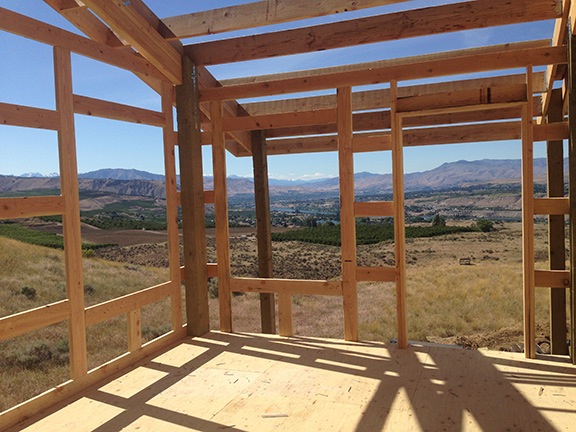
Another look from the second floor, this time with the roof on. There’s no insulation under this roof yet; it’ll be done with the framing and drywall. The framers will put a wall between the second floor and the shop. I’ve decided to leave the roof beams (but not the purlins, of course) exposed.

Once again, the time-lapse camera isn’t in the best position to see exactly what they did. But you can watch them progress from left to right across the rooftop and then see them put up the trim.

Construction, Day 14: One Roof Finished

Despite moderate to heavy winds, the workers manage to finish one of the building’s two roofs.

On May 20, 2014, I began blogging about the construction of my new home in Malaga, WA. You can read all of these posts — and see the time-lapse movies that go with them — by clicking the new home construction tag.

Monday’s high wind postponed roof work. The wind was also supposed to be a factor on Tuesday, but when the workers arrived around 7 AM, the wind wasn’t much more than a breeze. They decided to go for it.

Starting on the Roof
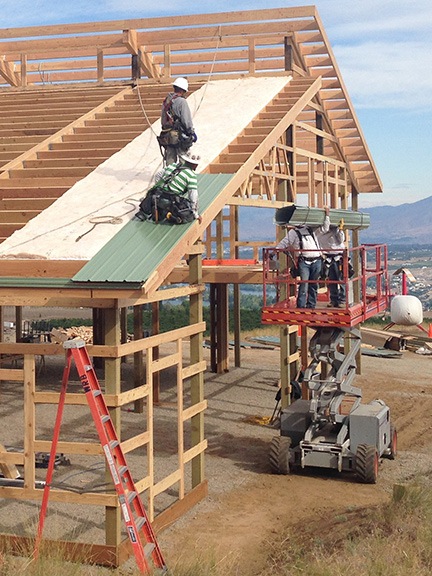
In this shot, you can see the first roll of insulation and first roof metal panel placed. Two workers are delivering a rolled up sheet of roof metal to the guys waiting on the roof.

There were four workers in the crew that day and you could tell that they’d obviously done this many times before. They started by using the man-lift to get two of the workers and a roll of insulation up on the roof beams. The workers unrolled and placed the insulation. Then the two men on the ground rolled up one of the many long sheets of roofing metal and tied it securely. They used the man lift to get it up to the workers on the roof. They unrolled it and fastened it into place.

The very edge of the roof, where it overhangs the outside of the building by about two feet, did not get any insulation. As Angel and I discussed later on, there’s no reason for it and it’s basically all taken away by birds, over time, for nesting material. (Note to self: keep garage doors closed during bird nesting season.)

I busied myself with work around the yard for most of the morning. I needed to construct a latticework for my peas and beans to climb as they grow. I needed to haul off some sage I thought I’d burn but realized was an eyesore. I needed to retrieve a 20-in by 14-ft culvert pipe someone had left on my property years ago and put it on Craig’s List to earn a quick buck. My 1999 Yamaha Grizzly ATV, which I bought new in 1999 for “yard work” in Arizona, was a huge help. I’m so glad I brought it with me, along with the “farm trailer,” I’d bought in Arizona all those years ago to use with it.

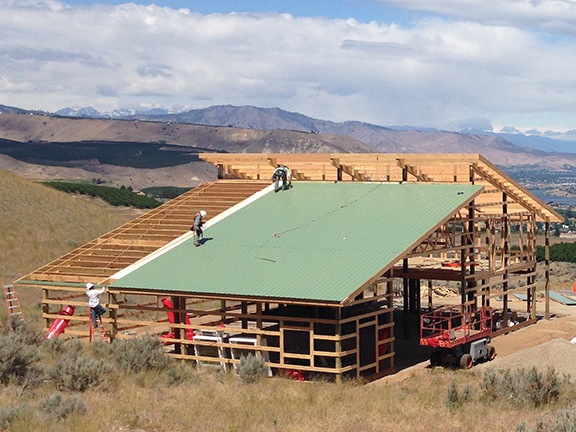
At one point, I drove the Grizzly up the road for a look at their progress from above. In only a few hours, they’d done more than half the roof.

Roof progress
I can’t believe how quickly the roof metal went up.

Meanwhile, the wind was picking up. I really expected them to call it quits, but if there’s one thing I noticed about this crew, it’s that they like to finish a whole job in a day. You can clearly see this if you go back through the day-by-day posts I’ve written about the project. So even after breaking for lunch at about noon, they went back to the roof to finish up.

I had a meeting at the airport to attend at 2 PM. Although I toyed with the idea of flying over, I had some errands to run in town so I drove. I passed the workers on their way home when I drove back around 4:15. When I reached the overlook for my building, I saw that the roof was done.

Finished Roof
The larger of my two roofs is done.

I have a time-lapse for the day (of course). It doesn’t clearly show what they did because of the camera angle. Although I toyed with the idea of moving the camera, I didn’t want to deal with the problem of getting power out to it. So I left it where it was. The other roof work, which should be done today, will be more visible.

Construction, Day 13: Framing the Living Space Windows

Ten of the last 11 windows get framed.

On May 20, 2014, I began blogging about the construction of my new home in Malaga, WA. You can read all of these posts — and see the time-lapse movies that go with them — by clicking the new home construction tag.

The builders were supposed to put on the metal roof today. In fact, on Thursday they even warned me that they might come as early as 6 AM to get started.

But the weather didn’t cooperate. The usual work crew arrived without the roofing guys. It was just too damn windy. No one wants to be standing 30 feet above the ground holding a sheet metal sail.

So Angel and his crew went to work on framing the windows and doors to the deck for the second floor living area. With the floor in place, it was easy.

I was out most of the day. With the construction of the building shell nearing completion, it was time for me to get to work on the interior. The first step was the HVAC. I met with four contractors to talk about options and got promises for bids by Wednesday. I made some other stops, too, including a very nice lunch at a farm stand up the road from East Wenatchee.

When I got back, most of the windows had been framed. I watched them work on a few while doing some odd jobs around my property. They would have finished them all, but they ran out of lumber.

Later, after the builders had gone, I used the man-lift to go upstairs. (My friend Bob, who had come for dinner the night before, had shown me how to get the darn thing started and that was all I needed to make it my personal elevator.) I wandered around my future home, checking out the views from my future windows. I liked what I saw.

Bedroom View
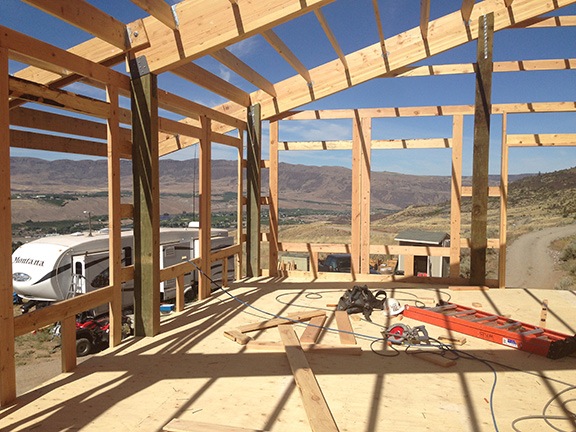
Here’s the view from the doorway of my future bedroom. There will be two 4×5 windows and a glass door leading out to a long deck.

Great Room View
In this shot, I’m standing right about where my stove/breakfast bar island will be in my future kitchen looking out across my future great room. This room will have eight 4×5 windows and a glass door leading out to the front deck.

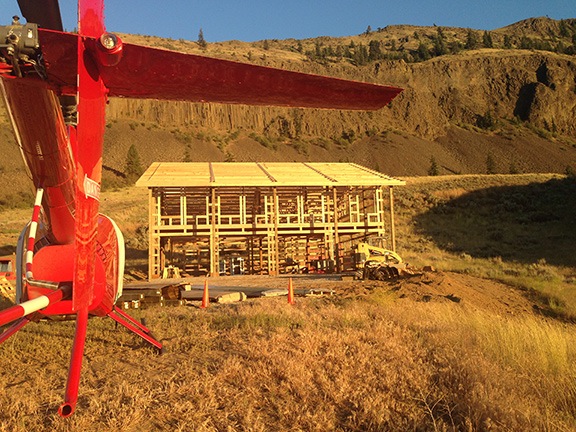
Still later, as the sun was getting ready to set, I wandered out by where my helicopter was parked to take a photo from a different point of view. I realized that my home was really starting to look like a home.

Sunset Helicopter
Home is where the helicopter is.

Here’s the time-lapse video for the day:

Paddling with Friends

The river is high, the estuary is flooded, and the irises are blooming.

My friend Brian bought a kayak from a friend’s estate a few weeks ago. Knowing that I had some experience paddling in the Wenatchee River and — possibly more importantly — I had a truck to haul the kayaks, he suggested that we go for a paddle. When I heard his daughter was in town for the weekend, I offered her my second kayak (yes, I have two; long story) so she could come with us.

Estuary
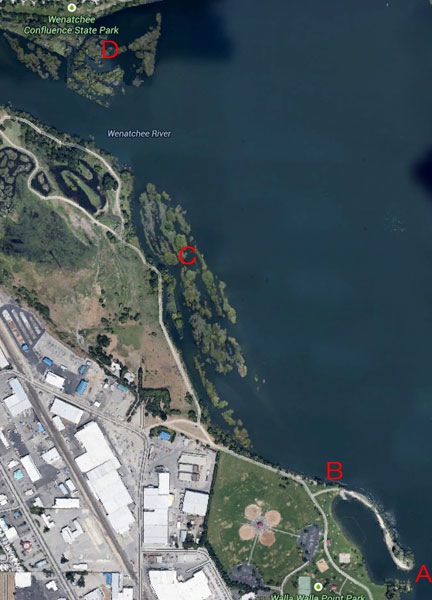
My favorite paddling destination on the Columbia River, labeled.

We put in at Walla Walla Point Park, near the swimming lagoon. I knew from experience that the river’s swift current — it’s currently at a low flood stage — would make it nearly impossible to paddle out the lagoon entrance (A on the satellite image) and upriver past the sheltering arm of land. So I recommended that we launch from just upriver from the park’s little bridge (B). It was a bit of hike from the parking lot, but we each handled our own kayaks and did fine.

I let them launch first. They stayed near the launch point, holding onto tree branches until I was in the water with Penny. Then we began paddling up the shoreline toward the estuary (C) at the mouth of the Wenatchee River.

It was difficult at first. I clocked the river’s current at about 5-1/2 miles per hour the other day. But once we got moving, it became easier. And some place near the shoreline had less current, making it an easy paddle.

Bryan's Kayak
Brian bought his kayak from the estate of a friend. It’s really designed for white water.

Brian had trouble, though. His kayak is designed for white water. It’s short and has a completely smooth bottom. Each paddling stroke pushed the kayak’s nose hard in one direction. As a result, he wiggled his way along, having a heck of a time moving in anything resembling a straight line.

Brian’s daughter, Kathleen, did much better. In fact, she kind of surprised me — she’s a quiet girl and I wasn’t sure how outdoorsy she was. Maybe it’s the kayak, though. My two Costco specials are pretty easy to use.

We entered the mouth of the estuary at the southmost point. The satellite image is a pretty good representation of the area, although it might show the water level even higher than what we experienced on Saturday. The last time I’d been in there for a paddle, late last summer, the water level had been much lower and there were fewer channels that I could paddle through. This time there were multiple channels and a pretty decent current.

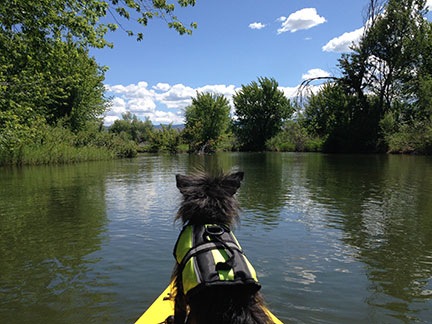
Penny in the Kayak
After Penny took an unexpected swim, I put her life jacket on and she returned to her favorite position on the boat’s bow.

At one point, Brian’s kayak rammed into mine and poor Penny, who’d been sitting on the bow, fell into the water. She wasn’t wearing her life jacket yet, but she was secured with her leash and I reeled her in. I put her life jacket on more to warm her up than to keep her safe.

More than once, we found side channels to get us out of the main current. Once, the channel met back up with the one we’d been in after a nice, leisurely paddle through a shady area. Another time, the channel dead-ended in tall grasses that were difficult to turn around in. No worries, though. It was a beautiful day — perfect for exploring.

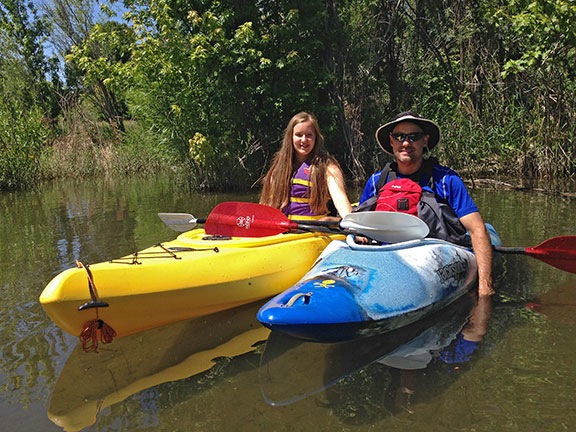
Brian and his Daughter
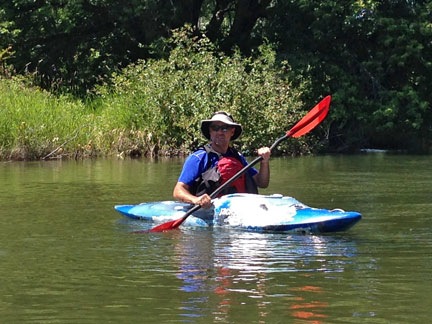
Brian and his daughter posed for a photo in one of the calmer side channels.

We eventually reached the Wenatchee River confluence. The Wenatchee was running hard. I wanted to cross it to continue padding in the estuary on the other side (D on the satellite image above) and even got a start, but the current was sweeping me out into the Columbia and it looked like it would be a tough crossing. So before the others started off behind me, I returned. We took a different one of the estuary’s channels back downriver, exploring more side channels on the way.

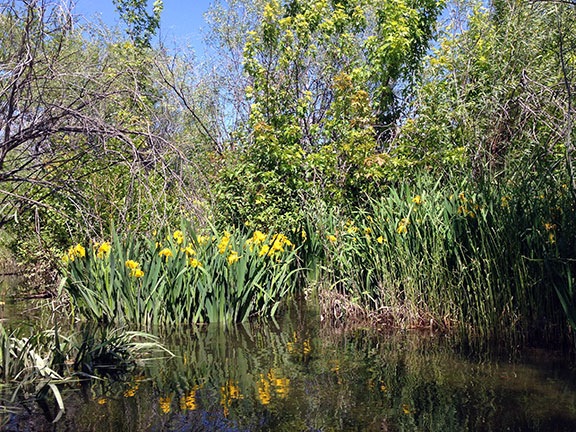
We were nearly back to the south end of the estuary when I began to see irises — thousands of them — coming up through the floodwaters and blooming along the shoreline. The calm water reflected the bright yellow blooms. For a while, everywhere we turned were irises among the trees. I must have taken a dozen photos, trying hard to capture that reflection in the water. I want to return a little later in the year and see if I can snag a few of the bulbs for my garden. I just hope they don’t need to be flooded to grow.

Irises in the Columbia River
There were irises blooming all over the place in the south end of the estuary.

We left the estuary and began paddling back. It was easy, moving along with the current. Instead of pulling out where we’d started, we went around to the mouth of the lagoon (A on the satellite image above). There was some fast water along the way. We passed a man in a beautiful, long sea kayak headed upriver. He told me he was surprised that Penny didn’t jump out to chase the geese.

Once in the lagoon, we paddled to shore, close to the swimming area. I climbed out onto land, feeling pleasantly tired.

It had been a nice day out. I’m hoping to paddle on Friday with another friend; maybe there will be something new to report.