Another Reason Why I Love It Here

Wildlife watching from the door to my front deck.

I’d been told that there were bighorn sheep in the cliffs up behind my home. And more than once I’ve heard them knocking rocks around up there as they move along the cliff face. And occasionally Penny will bark like a crazy dog at the cliffs, obviously hearing or seeing something I can’t. But despite purchasing and using a set of binoculars last autumn, I haven’t been able to see the animals up on the cliffs.

Until last week. That’s when Penny’s urgent barking caught my attention and I spotted three bighorn sheep — two adults and a yearling — in my neighbor’s front yard. I rushed Penny into the RV to shut her up and grabbed my binoculars.

Unfortunately, I got more of an eyeful than I expected. Not only did I get a close look at one of the animals, but I also got a too close look at my neighbor, who’d come out stark naked to photograph them.

Life’s different out here.

Today, more barking got my attention. And this time, when I rushed Penny into the RV, I grabbed my Nikon, 300mm lens, and monopod. Then I went into my unfinished building, climbed the stairs, and opened the door to my future front deck. I zoomed in on one of the animals grazing in the yard. Her head was down but I waited. No sense taking a picture of her back. After about a minute, I was rewarded. She popped her head up and looked right at me.

Bighorn Sheep
Captured in pixels from the door to my future front deck.

This isn’t the only interesting animal we have around here. There are also golden and bald eagles and other birds of prey that I see daily. There are quail — which have youngsters right now — as well as robins, magpies, and hummingbirds. I hear owls but have never seen one here. There are coyotes, which I occasionally see but more often hear at night. There’s elk and deer in the area, but I’m not sure if they ever make appearances near my home. And, of course, there are bull snakes and rattlesnakes.

It’s nice to live in a place that’s remote enough for wildlife viewing out my window without being too remove to take advantage of the conveniences a small city like Wenatchee has to offer. I really like it here — I only wish I’d moved here sooner.

Construction: The Oil/Water Separator

Another do-it-yourself project for my home.

On May 20, 2014, I began blogging about the construction of my new home in Malaga, WA. You can read all of these posts — and see the time-lapse movies that go with them — by clicking the new home construction tag.

I had a lot of time to design my new home. A lot of time. And not only did I have time to think about the building and how I would use it, but I also thought a lot about the land.

The Plan — or at least the relevant part of it

I decided that I’d try to plant a small vineyard. The rolling hills on the east end of my property are well-suited for wine grapes and, after all, there is a winery less than a half mile down the road. If I did everything right and could produce some good grapes, I could sell them for supplemental income. I don’t expect to get rich and I certainly don’t want to become a winemaker, but it would be a nice way to join the agricultural community beyond my short season cherry drying work. Of course, all this is a bit in the future — 2 to 3 years, I think — but it got me thinking about features I could incorporate into my building to make it more attractive for someone who might want to buy a vineyard and start making wine.

And that’s what got me thinking about the floor drain. If there’s one thing you need when you’re making wine, it’s a place to rack the wine. Wine racking involves pumping wine out of the barrels where they’re aging, cleaning the lees (dregs) out of the barrels, sterilizing the barrels, and pumping the wine back in. The process is time consuming and labor intensive and since you’re dumping the lees and rinsing the barrels, the runoff has to go somewhere. Being able to do this indoors, in the shade, in a possibly temperature-controlled space would be a big plus for a future winemaker, making my property a bit more attractive than it otherwise might be.

As if the view and the privacy and the giant garage and the wrap-around deck weren’t enough.

Besides, I reasoned, I’d like a drain in the floor, too. It would make it possible for me to wash a car or my RV indoors or simply hose off the floor.

The Drain

I talked to the builder and we decided on a 24-foot long drain with a grate on top and pipe leading the water out the back of the building. I already had a drainage channel dug back there to take rainwater off the roof away from the building. We’d tap into that.

I went to Home Depot and bought the parts: 2 10-foot lengths and 1 4-foot length of drain channel, 12 2-foot lengths of snap-in grating, 2 10-foot lengths of plastic pipe, 3 drain channel fittings, and 1 drain channel end cap. I spent just over $500.

When the workers prepped the floor for the concrete pour at June month-end, they installed the channel and the cap. It sat above the gravel grade; the concrete would be poured around it. They covered the grate with duct tape to prevent concrete from getting in. And then they poured.

Pouring Concrete around the Drain
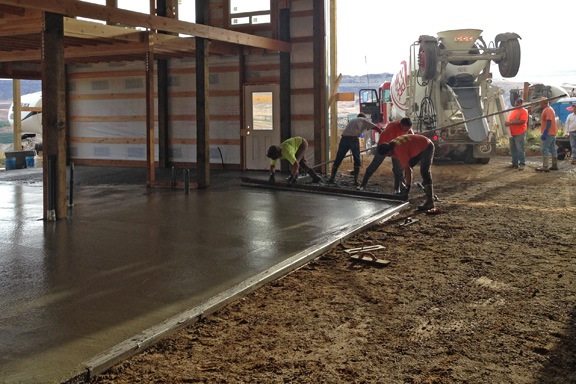
In this shot, the drain channel divides the poured concrete from the unpoured gravel floor. The concrete is basically as thick as the drain channel is high.

Finishing around the Drain
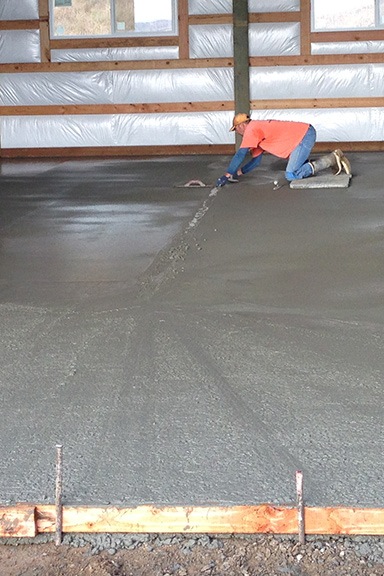
You can barely see the drain in this shot; they used silver duct tape that really blends in with the concrete color.

Finishing took effort. The drain runs down the center of a 24 x 48 foot space. The front, back, and sides needed to slope down gently to the drain so if water got into that space, it would eventually end up in the drain. I was told that the slope would not be steep and that was fine with me. I didn’t expect to use it very often anyway.

The Drain in my Floor
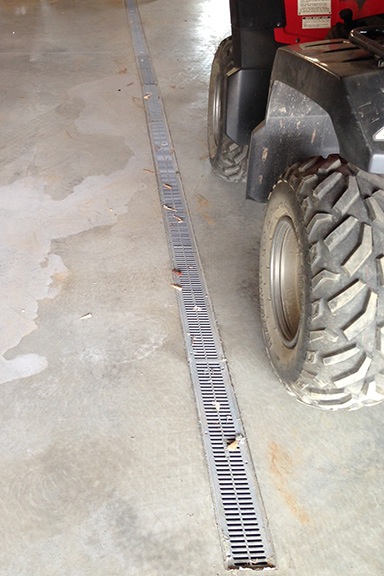
Here’s the drain looks like today, although it’s actually longer than what you see here. The white “stain” is from me hosing off my tile saw; some of the water came back into the building and went where it’s supposed to go: into the drain. That’ll wash away the next time I use the hose.

Later, when the concrete was dry, I peeled off the duct tape. I even took out a hose and hosed down the floor to watch the water flow into the drain. I walked around the back of the building and watched the water move away. Cool.

The Oil/Water Separator

There was a bit more to the drain than just the drain itself. Because the drain was in the floor of a garage space, it needed an oil/water separator. That’s a contraption (for lack of a better word) that prevents oil that might wash away from vehicles from getting into the ground. Instead, it’s trapped and, when enough has accumulated, can be cleaned out.

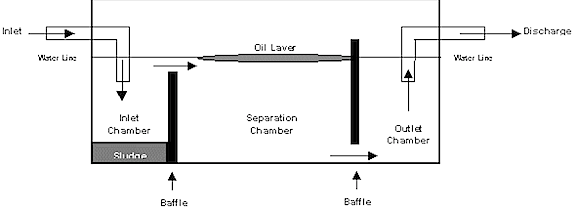
Before buying the drain parts, I did some research. I found a very simple oil/water separator that I thought I could make myself. It was basically a container with a water inlet from the drain and outlet to the drainage ditch. Inside the container were two baffles or dividers. One was short but went to the bottom of the container; sludge would gather between the inlet and that first baffle. The other was short but went nearly to the top of the container with space beneath it. The water would move through there but the oil, which floats, would stay at the top. The water would then go through the discharge outlet, clean.

Oil/Water Separator
Here’s the design I found on the Web.

Box Diagram
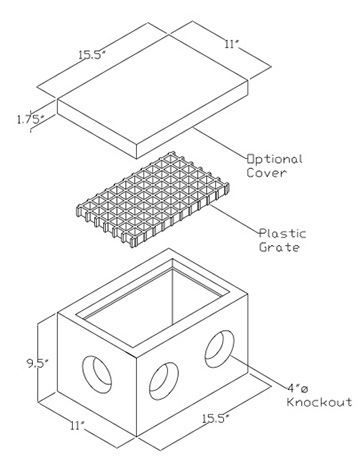
Here’s a diagram of the box. I didn’t buy the grate, mostly because I wanted it completely covered; I don’t want to be fishing dead rodents out of oily sludge.

I sent this image to the plans inspector to see what he thought. He agreed that it would do the job. I suggested making it out of a heavy-duty plastic toolbox. He said that wasn’t heavy-duty enough.

It took a while to figure out what I could use as the container. It was Tanya who suggested that I go to H2 Pre-Cast near Wenatchee Airport. I sat down with the sales guy and showed him my drawing. He showed me concrete boxes on his computer screen. I spent $70 for a small one with a concrete lid.

The Concrete Box
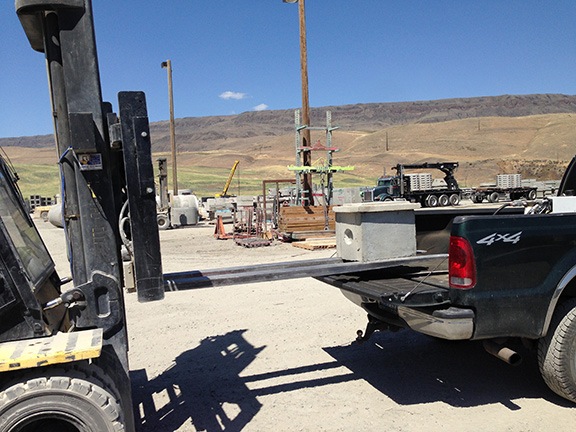
They used a forklift to load the box onto my truck for a reason — it’s very heavy.

When I realized I how heavy it was, I rushed home to get there before the crew working on my building went home for the day. I let them use their forklift to get it off my truck. They stowed it in the building. Later, when they’d gone for the day, I used the forklift to move it to the back of the building so it would be out of the way.

When the concrete was poured, the box was waiting for the rest of the installation: digging a hole for the box, moving it in, and putting in the baffles. That was my job — and I had no idea how I was going to do it.

The Concrete Solution

I thought about how I would do this for almost a month. I talked to friends. My friend Bob suggested using the concrete pavers I already had to build the dividers. He had a masonry saw he thought could do the job. Because the interior of the box was smaller on the bottom than the top, if we cut the pavers just the right size they should slip into place. We could then use a cement paste to sort of “glue” them in.

It sounded good to me.

In the meantime, I had to get the box into the ground. That meant digging a hole in compacted earth. Fortunately the earth there has very few rocks and I have a very heavy digging stick. I made short work of the job one morning before it got hot and the spot was still in the shade.

Of course, I still needed to get the box in the hole. And I couldn’t budge the box.

The solution came on a motorcycle: my friend Mike. Looking for an early morning destination with his dirt bike, he showed up at 6 AM on Tuesday. After giving him hot coffee and a bacon and egg breakfast, I led him around to the back of the building to the little moving problem I’d discussed with him on the phone. Together, we knocked out the holes on either side of the box — guess who I was thinking of as I banged away with a heavy hammer on one of the punch outs? — and lowered it into the hole. Then we connected a cut length of pipe to the pipe coming out of the building to make the inlet and used the rest of the pipe as an outlet.

Now I was ready for Bob and his masonry saw.

But it was Tuesday and Bob works 10-hour days during the week. The soonest he’d be able to come would be Friday — if he didn’t have something else on his plate for his only weekday off. And I’d been thinking about other solutions.

Like concrete.

I figured I could make 2 concrete forms for the inside of the box, mix up some concrete — I already had portland cement and sand — and pour the concrete into the forms.

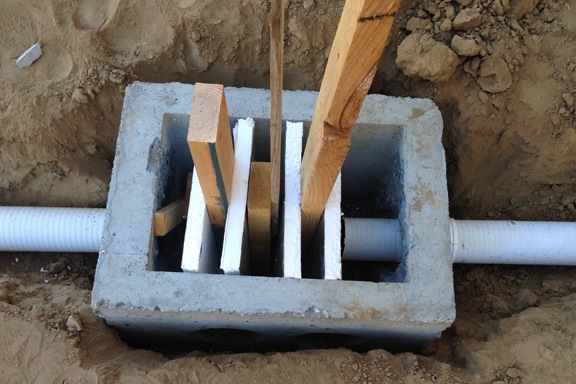
And that’s exactly what I did on Wednesday. I cut some 1-1/2 inch foam insulation sheets I had lying around into 4 dividers. I positioned the dividers for the pour, being sure to place more foam under the dividers on the outlet side to leave a space under the baffle. I used scrap lumber to hold everything in place. It looked extremely makeshift.

Dividers
Foam dividers are held in place by pieces of scrap lumber.

Then I mixed up some concrete in a big paint bucket. I tried 4 parts portland cement + 4 parts sand + 4 parts water but the mixture — once I got it mixed up enough — seemed too thin. So I added 2 more parts of cement. The resulting blend looked like it might be thick enough to stay within the forms.

So I poured it.

Concrete immediately began leaking from the first form. But only for a moment; it seemed to sort of clot itself, like blood on a wound. So I kept pouring. I poured both forms, stopping the inset side form about 2/3 of the way up and bringing the outlet side form (with the foam beneath it) within a few inches of the top of the box. Then I got down on my hands and knees, scooped up the leaked concrete and slapped it against the walls where the pipes came in and out. I did the best I could to use all the concrete in the baffle forms and around the pipes. It looked awful when I was done. So did my hands.

After the Pour
Here’s the big picture after the pour. You can see the box lid standing up against the side of the building as well as one of the pavers Bob wanted to cut for baffles.

I cleaned up and resisted the temptation, for the rest of the day, to pull off the forms. Instead, I used a level and a shovel to make sure the outlet pipe sloped down. I put the paver on top of it and closed up its mouth with some hardware cloth to keep the rodents out. (Around here, you don’t wonder if the mice will get in. You assume they will and take preventative measures to keep them out.) Then I buried both pipes and brought the dirt around the outside of the box.

On Thursday, I could resist no longer. In all honesty, I didn’t think it would work. I couldn’t imagine why freshly poured concrete would adhere to the concrete walls of the box. But it did. As I pulled the forms out, cracking and cutting them as I worked, I revealed the smooth walls of my new concrete baffles. With a little cleaning up, it would be all ready for inspection.

Finished Separator
Here’s my finished oil/water separator after cleaning it up a bit. The inlet from the drain in the building is on the right; the outlet is n the left. Although you can’t see it, there’s space beneath the left side baffle.

Inspection and Test

I was hoping I’d be around when the inspector stopped by so we could test it together, but I was on a charter flight at an orchard near Othello. He called me to get access to the building, which is secured by a keyless lock. He asked me to remind him what he was supposed to inspect.

“The oil/water separator and the framing,” I told him. “If you want to run the hose over to the drain in the building to test the oil/water separator, you can. Just don’t add oil unless you have to.”

“Oh, I already looked at that,” he told me. “It’s fine.”

And that’s that.

Of course, I wanted to test it. I wanted to make sure the water drained out properly.

Besides, who doesn’t like playing with flowing water?

So I ran a hose into my RV garage and laid it down by the drain. Then I turned on the water and ran around to the back of the building. I’d just managed to turn on my phone’s video camera when the water arrived.


Here’s the test. The water was only turned on partway — I have excellent water pressure. But the outlet drain kept up with the inflow of water and none of the water went over the top of the outlet side baffle.

Success!

What I like best about my solution for the oil/water separator is that other than the concrete box, I already had everything I needed to get the job done: foam for forms, scrap wood for supports, cement, sand, hardware cloth. So rather than spend over $1,000 for one of the many of the pre-made solutions out there, I got the job done for about $70. You gotta like that.

One More Thing

Of course, not everything could go perfectly smoothly.

Wrong Lid
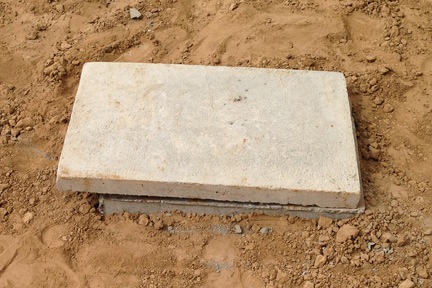
Duh-oh! These two pieces were sitting around here for two months and I never noticed I had the wrong size lid.

When I was cleaning up the area after the test, I put the lid on the box. That’s when I discovered that I had the wrong size lid.

Well, at least I can lift it to return it for the right one.

Angry, Hateful People and Wasted Lives

Why waste energy on negativity when it’s so much better to spread happiness?

Over the past two years, I’ve been exposed to more angry, hateful people than I had been over the rest of my life.

You likely know the kind of people I’m talking about — people who are so overwhelmed by their own insecurity, paranoia, hatred, and/or jealousy that they spend far too much of their time and energy trying to make others miserable. After all, why should anyone else be happy when they can’t be?

Mommy Dearest

My first exposure to this kind of person was my wasband’s mommy/girlfriend, the desperate old woman who hooked him on a dating site with 30-year-old lingerie photos of herself and the incessant babying he obviously craved.

But luring a weak and confused man away from another woman and into her bed wasn’t enough for her. She found it necessary to lead him on a campaign of harassment against me, fueled by paranoia and false accusations. His money wasn’t enough — she wanted mine, too — so she guided him and his lawyers in a never-ending battle to separate me from the money and business assets I worked hard for my entire life. To this day — yes, two years after starting the divorce process! — they continue trying to hold me back from moving forward with my life.

Anger, hatred, and jealousy govern her life and actions. It’s apparently more important to her to hurt a woman she’s never even met than to make her own life better. Or to let the man she won with her lies let go of his past and move forward into his future.

It must be hard to live in a world so full of hate.

The joke’s on her, though. Unlike the man she hooked, I make a good living and know how to live within my means. Court actions and legal fees can’t stop me from moving forward and enjoying my life.

In fact, she made my great new life possible by freeing me from the rut my wasband had dragged me into with him.

Thanks!

Power Trips, Jealousy-Driven Feuds

Sadly she was just the first of several sorry human beings — people more focused on spreading their hatred and anger than making their own lives better. Whether driven by a desire for petty power over others or jealousy over things they don’t have, these people need to whine and complain and make waves any way they can to hurt others.

They choose their targets carefully — people who are happy, people who are making something of their lives, people who have charted a future and are on course to make it happen.

In most cases, their targets haven’t done a thing to hurt them. They probably like it better that way — choose an unsuspecting victim for the maximum effect.

Once their victim is selected, they focus on one or more things they can do to screw up the works for that person and they spend all their energy on it. But they don’t do it out in the open. Instead, they do it quietly, behind their victim’s back, waiting for others to swing the hammer for them once the wheels are in motion.

Why do they do this?

A man I loved used to scold me when I used the phrase I hate…

“Don’t hate,” he’d tell me. “It’s not good to hate anything.”

But that’s one of the things he forgot when he got old and died inside.

I think it’s because the only way they can make themselves happy is to make the people around them miserable. But it never works because it simply isn’t possible to be happy when you have so much anger, hatred, and negativity inside you.

It’s sick and it’s sad.

And I feel so very sorry for the people who live every day with so much hatred for their fellow man that they’re just not able to let others be happy. What a dark and gloomy world they must live in.

What a waste of life.

Clap Along

Happy Fish
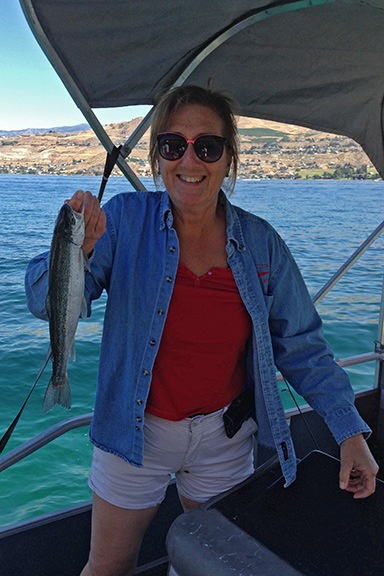
Do I look happy here? I should! I was boating and fishing with friends on Lake Chelan and caught this trout!

Can you imagine how much better these people’s lives would be if they spent all that effort making themselves and others happy?

I can. That’s my world.

I spend my time working hard and playing harder. I extend a helping hand to my friends and they’re only too pleased to return the favor. We spend lots of time together doing the kinds of great things that make life worth living. The things that make us all happy.

And it’s not just friends I spread the joy to — it’s strangers I meet every day. Share a joke, hold a door, pick up a dropped item, smile. Happiness is contagious. Spread it around!

I don’t let angry, hateful people get me down. Pharrell Williams obviously wrote these words for me:

Here come bad news talking this and that, yeah,
Well, give me all you got, and don’t hold it back, yeah,
Well, I should probably warn you I’ll be just fine, yeah,
No offense to you, don’t waste your time

Because I’m happy…

Viddler Content Being Pulled

I guess I deserve that for putting so many eggs in one questionable basket.

Back in 2008, I discovered Viddler, a site for sharing videos. For some reason I’ve long since forgotten, I decided that it was a better way to host my blog’s video content. I embraced it and uploaded dozens of videos to Viddler, embedding them in blog posts. I even went a step farther and wrote articles explaining to other WordPress uses how they could embed their Viddler videos in their blog posts.

Silly me.

Earlier this year, Viddler pulled the plug on all of its free accounts. Because I hadn’t used the service for so long, they did not have an up-to-date email address for me and I did not get notification of the change. As a result, I was unable to retrieve copies of my videos from their service. Now, if I want them, I have to pay a fee.

Yes, I have to pay a fee to get copies of my own videos from their service.

Needless to say, I’m not paying.

Understand that I don’t make a penny on this blog. I removed all the advertising years ago and don’t even ask for donations anymore. My hosting fees are low enough that I don’t mind footing the bill for that, but I simply can’t pay for additional services — like those offered for a fee now by Viddler. I need to stick to low-cost or free alternatives for anything related to my blog.

No More ViddlerA total of 65 of my blog posts contain references to Viddler and/or embedded Viddler content — including “video blog posts” I was creating back in 2009. I’ll be spending some time today editing these posts to remove the bad embedding code. I suspect I’ll wind up simply deleting a lot of these posts in their entirety.

There are two valuable lessons to be learned here:

  • Keep copies of all of your content. I know I have copies of the “lost videos” somewhere, but they’re likely packed with the rest of my office stuff. Or maybe they aren’t. Who knows? The point is, uploading them to a service isn’t necessarily any way to assure that they’ll always be available.
  • Stick to services that aren’t likely to change payment policies. YouTube has become the go-to service for sharing video for a reason: it’s free and it will remain free forever. In addition, being a part of a big company like Google makes it unlikely that it’ll shut down or be sold anytime soon. New services spring up all the time and they often seem like good alternatives for one reason or another. But will they stick around forever? And maintain their current cost policies?

At this point, anyone who has been involved in technology for at least 10 years can likely list several online services that have disappeared or changed policies. Viddler is one of the latest. It’s unfortunate that I relied on them the way I did.

A(nother) Full Day

Sometimes I can really pack it in.

Yesterday was one of those days when there’s simply no rest. Here’s a quick rundown.

A Natural Alarm Clock

I woke at 3:50 AM. It was the sound of three drops of rain hitting my RV roof that woke me. This was an unusual sound that I hadn’t heard in weeks and it took a moment for my sleeping mind to register why it was important.

Rain.

I’m on contract to dry cherries.

I was wide awake in a flash, reaching for my iPad, summoning the radar. Yes, it was drizzling on me, but was it raining on my orchards 5 miles to the west?

Not yet, the radar told me. But there was rain in the area.

I lounged in bed for a while, reading, catching up on Facebook crap (which I’m convinced has become a sick addiction for me, since I get very little pleasure out of it), and checking my calendar for the day. I had three things scheduled: a meeting with my earth-moving guy about the ground work for my utility connections at 7:30 AM, a charter flight at 8:30 AM, and an invitation to help a friend pack Rainier cherries at 10:00 AM.

But the rain made things a lot less solid. Getting called to dry cherries took precedence over anything else I might have to do.

Earth-Moving Plans

Jeff Parks, the guy who had installed my septic system last year and did all the earth work in preparation for my building, arrived at 7:30 sharp. By then, it was drizzling again.

I outlined what I needed and he suggested ways to get the job done. That’s one of the things I like about Jeff — if you want to do something one way and he has a better way, not only will he suggest it, but he’ll explain why it’s better. He’ll also take the time to go over the pros and cons of the different materials that can be used.

In my situation, I need to run a water line from the city water source to my building and my shed, an electric conduit from my transformer box to my building and my shed, and a septic system line from the takeout near the building to the building. I also wanted to install a second takeout near the shed so I could create a complete RV hookup there for guests. I wasn’t in a hurry to get this done, but I did hope to have it finished by August month-end, which was fine for Jeff.

We decided that I’d buy the materials with a shopping list he provided. I already had much of the conduit and pipe I needed. He’d get back to me with a solid estimate.

The Charter

My charter client knew I was a cherry drying pilot and called while Jeff was there to make sure we were still on for the flight. I told her we were, then told her that I’d call her cell phone if I needed to cancel.

But I didn’t have to cancel. At 8:20, I said goodbye to Jeff, locked Penny in the RV, and hopped into the helicopter. Ten minutes later, I was shutting down at Pangborn Airport across the river, ready to greet my passengers.

My passengers were two fruit buyers from the midwest that my client was entertaining during a visit to the orchards. I’d done short tours for a handful of the client’s guests last year. This year there were only two of them and the client didn’t mind my one-hour minimum. I’d pick them up at Wenatchee Airport, take them on a scenic flight around the area, and drop them off at Quincy Airport where my client would be waiting.

My passengers were pleasant men who really seemed to enjoy the flight. They asked me to show them a new orchard being planted north of the airport on some old wheat fields — I didn’t even know it was up there! Then we headed down river, past the Rock Island dam. I pointed out the features now visible due to the low water levels. (The Wanapum Dam is still being repaired so the lake level is extremely low and closed to the public.) We saw Crescent Bar, the Gorge Amphitheater, Cave B Inn and Winery, and Sunland before turning and heading back over Frenchman’s Coulee, Quincy Lakes, and Quincy. One of the passengers obviously knew the area very well because he kept pointing out various orchards and packing/storage facilities around us. After 45 minutes, I landed at Quincy where their ride was waiting. The last 15 minutes of their hour would get me back to Wenatchee.

Packing Cherries

Of course, I didn’t go back to Wenatchee Airport — or home. Instead, I flew to the orchard where my friends Donn and Kathryn were using their cherry packing line for the very first time. The reason I flew instead of driving there was because there was still rain possible and it would have taken 30-40 minutes for me to drive home (or to the airport for that matter) if I were called out to fly. By flying there, the helicopter was only 5 minutes away so I’d be able to respond quickly if called.

The Cherry Packing Line
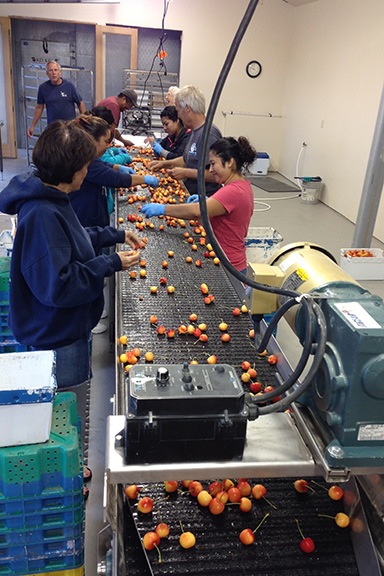
Packing cherries can be labor-intensive, too.

The packing line was set up in a new building near their house on the orchard. There was a huge walk-in refrigerator where cherries picked the previous day and that morning had been stored. Then a conveyor belt that would take cherries from an ice water bath past quality control people who’d pick out the bad ones. Finally, the cherries came out on the far end where they fell into plastic-lined boxes.

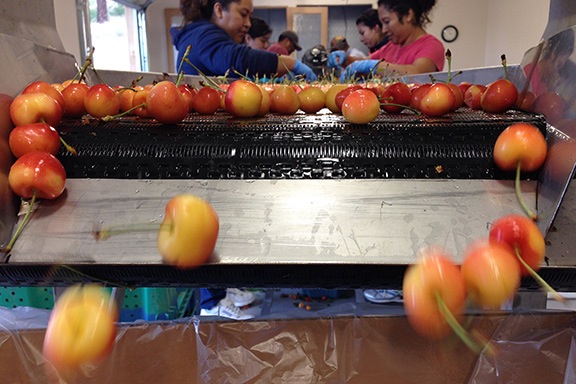
Cherries Dropping into Box
At the end of the line, the cherries dropped into a box.


I shot this little video to show how the cherries moved down the line.

The quality control people worked at a feverish pace, picking out cherries that weren’t “perfect.” They checked for things like size, color, splits, bird pecks, and mold/fungus. Even stems — if a cherry didn’t have a stem attached, it was rejected. (I ate a lot of those.) The line moved quickly; we probably packed at least 10 pounds per minute.

My job was to work with Kathryn to fill the boxes, make sure they weighed 16 pounds (15 pounds of cherries plus the weight of the box and excess water), close them up, and put them on a pallet. The trickiest part was pulling one box away while putting an empty one in its place. It required the two of us to work in harmony to prevent cherries coming off the line from falling on the floor. It took us a few tries, but we finally got it working perfectly. We joked that she was Lucy and I was Ethel.

Drying Cherries

It started to rain while I was there. Then the inevitable phone call from one of my two clients still on contract. Could I dry, please? Fortunately, my helicopter was parked right across the street from the orchard. I excused myself from Kathryn and Donn and walked down the hill to where I was parked. On the way, I ran into the orchard owner. I told him I’d been helping with the cherry packing in the new shed and expected rain so I’d flown over.

I was airborne when the second client called. I was now responsible for flying over about 90 acres of cherries — about my limit for the 2-1/2 hours allotted.

I called Mike, my backup pilot. Although he was off-contract, he was in the Quincy area and could, theoretically, fly up to help out. But he was having engine trouble with his motorhome and needed to sort that out. So I tackled it on my own.

I flew until I was low on fuel — remember, I’d burned an hour’s worth that morning — then refueled at the airport 5 minutes away and flew until I was done. I explain what cherry drying is all about in other blog posts; click the cherry drying tag to learn more.

Back to Packing

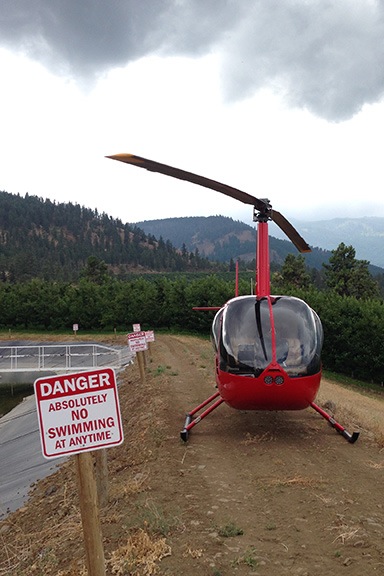
No Swimming
I don’t know…do you think swimming is allowed here? Sky looks nasty, huh?

Afterwards, I landed back near Donn and Kathryn’s house, but this time on a dam around a reservoir in the orchard. I walked down to the packing shed where they were all still working. Kathryn took one look at me and asked, “Are you hungry?”

“I was hoping you’d ask,” I replied.

She brought me into the house and let me loose on salad fixings everyone else had had a while earlier. I made myself lunch and ate it alone while she went back down to work. Then, after a quick trip to the loo, I went back out to help.

Other helpers had taken my previous job so I filled in where needed, giving people breaks as they needed them. In the end, I wound up right where I’d started with Kathryn beside me. That’s where we were when the last few cherries came down the line. We all cheered. They’d packed 420 15-pound boxes — over 3 tons of cherries.

We cleaned up immediately. Extra cherries were handed out. The packing line ladies left. I passed on the cherries, preferring to come back later in the week to pick my own from the same trees — pickers aren’t always thorough. I’d get some blueberries that day, too. Kathryn invited me to join them for dinner in town later on. She’d text me. I looked forward to it, but not nearly as much as I looked forward to taking it easy at home.

When I flew off, the refrigerated truck that would take the cherries to Seattle had just arrived.

A Short Rest

At home, Penny the Tiny Dog was happy to see me. She always is.

I took it easy for a while. I made some soup and watched a documentary about abandoned cities on Netflix.

Kathryn called to tell me they’d decided on Pybus Bystro at 6:30. I told her I’d come if the weather held.

A friend called and I spent a half hour chatting with him. Then I noticed the weather was changing again. One look at the radar and I cut the call short.

I went outside and topped off the helicopter’s fuel tanks with 100LL from the tank on my truck.

I texted Kathryn and told her I wouldn’t be joining them after all.

More Cherry Drying

My other client called first this time. It was about 6 PM when I launched. The second call came while I was enroute.

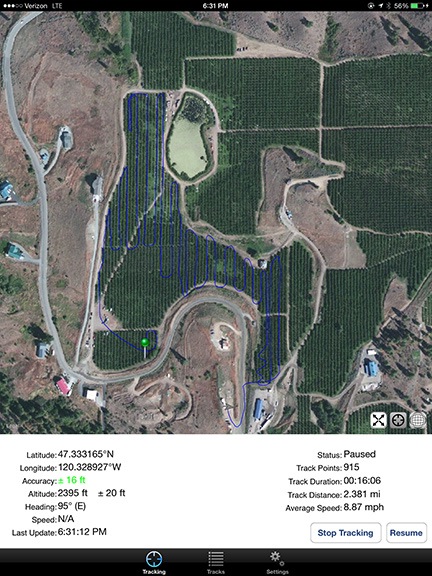
Track
I hadn’t gotten very far when it started raining. Again.

The orchards are only 5 minutes away by air. I settled in over the trees of the big orchard and was at work for less than 15 minutes when I decided to track the flight with GPSTrack.

I was only 16 minutes into the logged part of the flight when it started to rain. Hard.

I flew over to a friend’s house and landed in his driveway, knowing he was out of town. I called my two clients and told them that I’d wait until it stopped or 7 PM, whichever came sooner. If I re-started after 7, I’d never finish before it got dark. Even then, it was iffy.

It was still raining at 6:55 PM when I started back up.

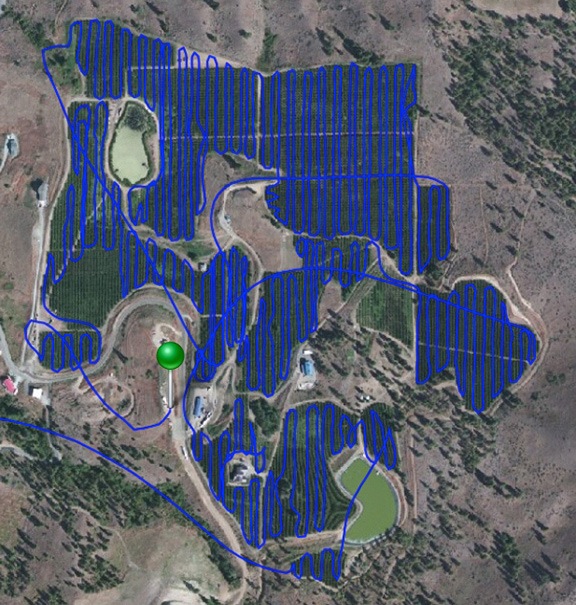
I speed-dried. I knew I’d never get it all done thoroughly, but I figured I could get most (or all) of it done if I was a bit less thorough. The result wasn’t as good, but was better than leaving 20 or 30 acres completely uncovered. Partial coverage was better than no coverage. Besides, rain was expected overnight and I was likely to be called out first thing in the morning.

Speed Drying
In speed drying, I go down every third aisle instead of every second. Sometimes I do every third one way and every second the other. Less coverage is better than no coverage. Keep in mind that this satellite image is three years old; the orchard configuration is a bit different these days.

I got through all of the big orchard and one of the two smaller orchard’s blocks. By then, it was getting dark. The sun had set around 8:45 PM and clouds on the western horizon made it darker than it would normally be. My landing zone at home wasn’t lighted and I really didn’t want to land in the dark. I also didn’t want to hover five feet over cherry trees in hilly terrain in semi-darkness with a windscreen full of raindrops. So I let the last orchard block go.

It was drizzling when I headed home.

Home

The helicopter was lit up like a Christmas light parade float on the flight home. Strobe light (required during flight), navigation lights (required after sunset), landing light, pulsing lights on my skid shoes. I wouldn’t be surprised if neighbors called me in as a UFO. But it felt good to get on the ground, especially since I knew I was done for the night.

I shut down, let Penny out for a run, and then went in. My friend Bob called while I was pouring a glass of wine. We chatted for a while and I invited him to join me Thursday evening to pick cherries and blueberries. It was after 10 PM when he reminded me that I’d probably be up early.

I finished my wine and went to bed, exhausted.

It had been a very full day.