
When the water stopped running…and what I did about it.
I first heard about the problem when I got an email sent out to all members of the road maintenance association on February 8:
The water main has frozen at the S turn near Lot 7. Neighbors are experiencing very low or no water. Malaga Water district has reviewed the situation and believes it will stay frozen until thaw.
They have offered to get 5 gallon water jugs to the Malaga Water district HQ and make them available to us if needed.
I was in Arizona at the time, in transit between Wickenburg and Willow Beach on the Colorado River, where I’d camp for two nights and soak in a wonderful desert hot spring. It was t-shirt weather on a beautiful sunny day. It was the final month of my 2016/17 winter snowbirding trip south and I didn’t plan on getting back to my home in Washington for another month. The email message sent me a mixed message: “stay frozen until thaw” sounded like a long-term issue but “water jugs…available to us if needed” sounded like hauling in water might not be needed.
I should mention here that this isn’t the first time this has happened. It’s the third. The last time was eight years ago — years before I bought my lot — and the line stayed frozen until March 22. When it finally defrosted, the water company supposedly put a concrete “blanket” over the pipe and reburied it. They assumed the problem had been solved when it didn’t happen again.
Until this year.
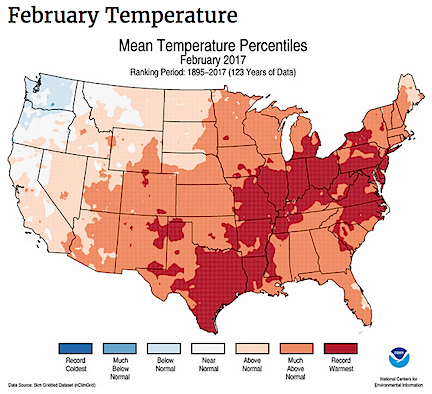
Mean temperature percentiles per the National Weather Service. Find more info here.
This has been an unusually cold winter here in the Pacific Northwest. While it was warmer than average nearly everywhere else in country, the northwestern United States, including all of Washington state, has been colder. There’s also been a ton of snow, some of which remains on my driveway in front of my car garage after having slid off the roof multiple times all winter. More than a few of my friends in the area made a point of telling me that I picked a good winter to go away. (Little do they realize that I plan on going away most winters.)
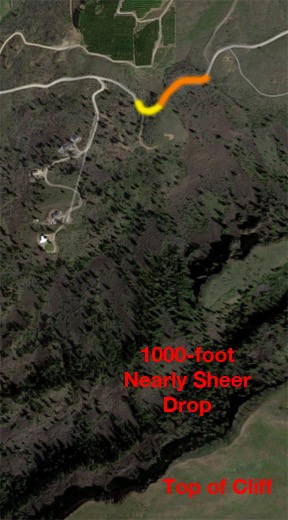
A satellite view of my road with the cliff to the south. The originally suspected problem area is in yellow; the actual problem area is in orange. I live nearly a mile east of this spot.
Making the problem worse is that the water line runs under our privately maintained road, which gets zero direct sunlight for months at a time in the winter. Why? Because it’s on the north side of a nearly sheer 1000-foot cliff. Because of our northern latitude, the sun doesn’t rise high enough in the sky in the winter to clear the cliff, leaving the road in shadow. I’ve observed this phenomena at my own home and blogged about it here. My place, which is farther north of the cliff than the road and many of my neighbors, is in the shadows for just six weeks; the problem area of the road is in the shadows for more than two months.
Time went on. I continued my trip northwest through Death Valley and eventually to the Sacramento area. I flew back to Arizona to fetch my helicopter, which would be on a frost contract in that area for two months. I tried to have fun in “sunny California,” but it seemed to rain more often than not. I got a temporary job helping a friend with his spray operations. But the whole time I was in California, I was feeling homesick and wanted to go home.
I checked in with my next door neighbor regularly. The water still wasn’t flowing. She and her family of five were showering at the Y. They made weekly trips to the laundromat. At first, they melted show for toilet water; now they were hauling it.
But by March 12, I’d had enough of my extended road trip. I began the drive home, taking a leisurely route up the California coast with the idea of getting in on March 17. The trip was great — at least the first few days — but then the weather turned nasty. I pointed my rig inland on March 15 and rolled down my driveway the following day.
There was still no water.
Of course, my camper had water. I also had my four 6-1/2 gallon water jugs with me. I’d stopped at the water company office to top everything off. I figured I could always use the camper’s toilet and shower.
But I didn’t want to. I wanted to use a real toilet and shower.
I hauled water up the stairs in those 6-1/2 gallon jugs for a few days. During my travels, I’d rigged up a DC pump with hoses to transfer water from the jugs into my camper without having to lift the jugs; I now put that to work in my kitchen so I could wash silverware and pots with “running” water. (I was using paper plates.)
My neighbor, Elizabeth, had a well with a broken pump. She had the pump fixed and invited neighbors to shower at her place. I took her up on that offer. She has a nice shower in her guest bathroom. I also filled water jugs there.
But when March 22 came and went, I’d had enough. I needed a better solution.
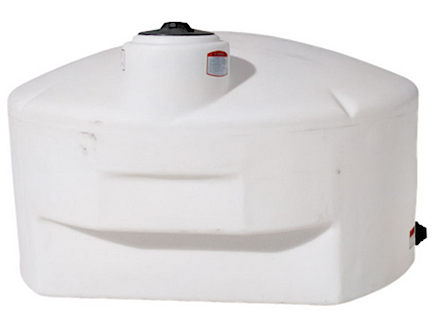
Tanks like these are designed to fit in the back of a pickup truck for transporting water.
My neighbors, Al and Kathy, have a winery (and a well). The previous autumn, I’d noticed that they had a water hauling tank sitting neglected and unused in their yard near their burn pile. I’d asked if they were using it and was told they weren’t. I asked about buying it — with the crazy idea of gathering water for irrigation off my huge roof — and they said yes. But I hadn’t done anything about it then.
Fortunately, it was still sitting there in March, nestled in the snow. I asked again. The 425 gallon tank had never been used — in fact, it didn’t even have fittings or a valve at the bottom. Other than cobwebs and a bit of organic matter, it was pretty clean. I bought it for $100 — what a deal! I just found the same tank online for $332 — and Al and another neighbor, JR, loaded it onto my truck. I used a ratchet tie down to prevent it from sliding out the back.
I followed JR’s suggestion and brought it down to the car wash where I cleaned the inside as well as possible with a power washer.
I went to a local irrigation supply place and spent $25 on a valve and fittings to connect it to a standard garden hose.
I went on Amazon and spent $80 on a Shurflo pressure regulated pump that would automatically shut off when there was no demand for water. The trick was finding one with enough power to get the water up about 15 feet to my second floor living space. And I spent another $10 on fittings to attach that to a standard garden hose. And another $5 to turn the pump’s loose wires into a plug.
By Saturday, March 25 — nine days after returning home — I was ready.
My wasband and I used to own an off-the-grid camping cabin on 40 acres of land in northern Arizona. That area is notorious for its low water table and nearly everyone up there hauls their own water — including us.
Water could be purchased from a vending machine off the main road between Valle and Williams. You’d pull your tank up under it, set the hose in the top of the tank, and stick a $10 bill into the vending machine. 450 gallons of water would immediately gush out of the hose and into the tank.

I remember hauling water once using a neighbor’s tank like the one I have now. The truck would be pretty stable until I hit about 50 miles per hour. At that point, the sloshing would make it difficult to control and I’d have to slow down. I only did it once or twice — it was a vacation home and we had 2,100 gallons of water storage up there — but can’t imagine what it must have been like to do it several times a week for a family.
I went to Elizabeth’s house with my new tank and wrenches and fittings and some plumbers tape and set the valve and fittings into the tank. I turned off the valve so the tank would hold water.
I ran Elizabeth’s garden hose to the top of the tank and turned on the water.
The tank holds more than 400 gallons. It takes a long time to pump 400 gallons from a garden hose. I sat in my truck and read the newspaper. Every once in a while, the truck would creak and shift as the weight of the water settled it lower and lower on its axles. Do the math: 400 gallons x 8 pounds per gallon = 3,200 pounds.
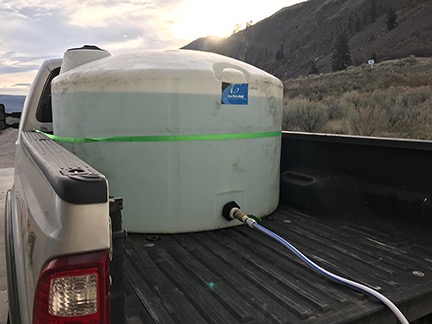
Here’s the tank on my truck, parked on my driveway after yesterday’s refill.
At about 300 gallons, I got tired of waiting and turned off the water. I put the cap back on the tank and started the drive home. The water sloshed, making the truck feel somewhat unstable. But it was a short drive — only about a mile — and I didn’t go very fast. I backed the truck up on my concrete apron in front of my big garage door. I threw about a half cup of bleach into the tank to prevent algae from growing in it.
I noticed a slight leak from the fittings. Not much; maybe three drips per minute. I tried tightening up the fittings but didn’t see much improvement.
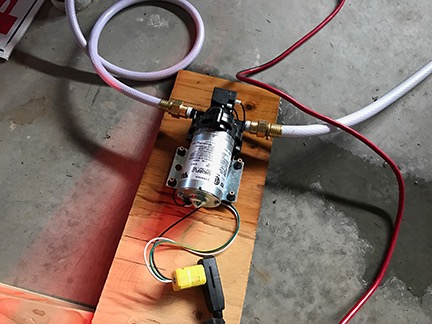
Here’s the pump after mounting it on a piece of scrap wood and propping it up so the water leaks away from it. I think that when this is all over, I’ll rework the fittings and permanently mount it near the hose bib.
I connected a garden hose from the tank and ran it into the garage. Then I connected it to the pump. That’s where I had some difficulty. You see, Shurflo pumps are designed to be used with Shurflo fittings. Although the manual said it should connect to a standard 1/2 inch pipe fitting, it didn’t thread exactly right. I had a bitch of a time getting it set up — on both sides of the pump. Eventually, however, I got it connected for inflow and outflow and connected the outflow end to a hose bib in my garage.
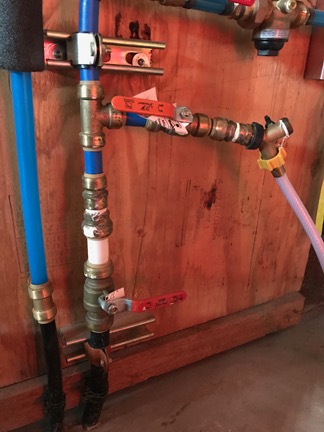
I call this my Frankenstein monster. Water comes into my home through the black pipe on the right through a valve (off in this photo) and then into a number of PEX fittings that bring it down to 3/4 inch. From there, it goes up into my home as well as to the right through another valve (on in this photo) to my hose bib. My first plumbing job. Hey, it works.
This is where things are a little non-standard. Regular readers might recall that I lived in my RV inside the garage for the winter before my living space was done. When I set up the water system in my building, I included a hose fitting with its own valve that I was able to use to feed water to my camper. It can also be used to drain all the water out of my home’s plumbing system. So I was already set up for water input, although I hadn’t ever expected to use the valve this way. I just shut off the water from the street into my building and turned on the valve between my building and the hose attached to the pump. Then I plugged in the pump.
It ran. It ran for well over a minute. I was just beginning to wonder whether it would automatically shut off when the system was fully pressurized when it stuttered a few times and went quiet.
I went upstairs and flushed the toilet. (I have my priorities straight.) The tank had fill automatically and was filling again.
There was water at the sink faucet.
I came back downstairs to look at the pump. It was leaking at both fittings. I wasn’t surprised. Still, I knew I’d done the best that I could. (Later, I’d order Shurflo fittings and wind up not using them when they arrived. If it ain’t broke…)
I mounted the pump on a piece of scrap wood and angled it up so the water would drip away from the pump. There’s a drain in my garage so the water would eventually find its way out.
Then I turned on the water heater. (I’d had a friend turn it off while I was away when I heard there was no water. I was slightly concerned that the water would somehow drain out and burn up my heating element. None of that happened.) I’d have my first hot shower at home later in the day.
I figured that since I had come up with a solution, the water would come back the next day. But no, there’s still no water to the homes on our road.
Since then, it’s been pretty much business as usual at my house. I turn on the tap and water comes out. I do laundry and use the dishwasher. I shower and wash up. I am a bit more thoughtful about letting the water run and I admit that I haven’t filled up my 80-gallon bathtub yet.
The only difference is that I don’t drink the tap water. I have bottled water for making coffee, cooking, and drinking.
That first tank of water lasted me nearly a week. Yesterday, I drove out to Elizabeth’s again. While the tank filled with water, I helped her install chicken wire at the top of her chicken coop to prevent birds of prey from getting in or chickens from getting out. This time, I let it the water go almost to the top. It must have taken at least a half hour to fill. Back home, I connected the hose to the tank, turned on the pump again, and was good to go.
Is this a hardship? Not with this solution. Living a week without running water was driving me nuts — and I had to come up with a solution. It’s unfortunate, however, that my truck is tied up with water duty. I need to buy some lumber for a project and will have to drag my old cargo trailer behind my Jeep to get the lumber home.
It’s been nearly two months now since the water stopped running and some of my neighbors have been dealing with it — without a solution like mine — for that long. I don’t know how they’re doing it.
The problem was in the paper about a week ago. The water company says it can’t dig until the water starts flowing again. When they do dig, it’ll be quite a mess since there’s only one way in and out on this road and the pipe runs right down the middle.
In the meantime, my neighbors are confident that the problem will be fixed for good. I’m not that optimistic. But I am prepared for next time.
—
April 2, 2017 Update: I got a call from a neighbor at 6:30 AM. He jubilantly announced that the water was back on. Although I’m thrilled that our little ordeal is over, I’m left wondering what I’m going to do with the 350 gallons of water in the tank on the back of my truck…
April 3, 2017 Update: I found a home for all that water! One of my neighbors needed to do a water change in his fish pond and was thrilled to get 350 gallons that he didn’t have to run from his tap.
How about doing something to show your appreciation? I’d love it if you’d add a comment at the end of this post to share your feedback with me and others. But I’d really love it if you’d visit my Support page and chip in a few dollars to help cover the cost of hosting this blog and motivate me to keep writing new, interesting content. It’ll only take a moment and I really would appreciate it!
 “Advice from a Raven” was different, though. Each of its seven points rang true with me:

 The same goes for my friend. If he didn’t have that big garage, could he rent out space to boat owners? No. What did it cost him to build that garage? Maintain it? Insure it? All that costs money.
 The ACA made it easier to shop for insurance by setting up a marketplace. It prevented insurers from denying coverage or setting unreasonable rates for people with pre-existing conditions. It required insurers to provide a list of basic coverages that a person might need. It covered, at no additional cost to insured people, annual well-care visits to help prevent illnesses or to catch them before they became serious problems. It required more employers to offer health care benefits to employees. It encouraged everyone to get health insurance coverage to increase the pool of insured individuals, thus reducing the overall cost of coverage for each of us. It prevented insurers from taking obscene profits on healthcare coverage by setting maximum profit levels that actually refunded premiums to customers. These are all benefits that help those of us who don’t work for big companies that offer health insurance in a benefits package.