The Last Chicken Coop

The last one I’ll build here, anyway.

I just built my third (and final) chicken coop.

The first coop was really more of a chicken lean-to. It was mostly open on one side, had two nice nests and two very rickety perches. I made it mostly out of pallets and scrap wood — and it showed.
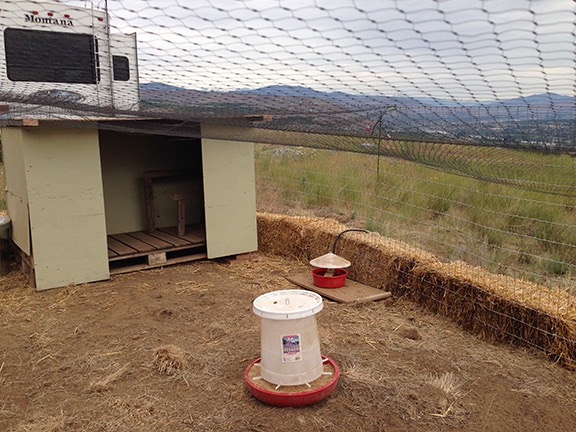
Chicken Coop 1
My original chicken coop and chicken yard. The coop lasted from mid 2014 through October 2015; the yard was rebuilt with better fencing early 2015. This photo was shot in early 2014, when I was still living in my “mobile mansion” fifth wheel.

The second coop was way more ambitious. Also built with pallets as its base, it was designed to match the appearance of my home with an exterior finish using the same exact metal. It had three nests under a hinged lid and three sturdier perches. It was also insulated and had a covered porch so I could keep the chicken food out of the rain. It weighed a ton, though, and I had to drag it into place with my ATV. You can learn more about this project and my other efforts in this blog post from 2015.
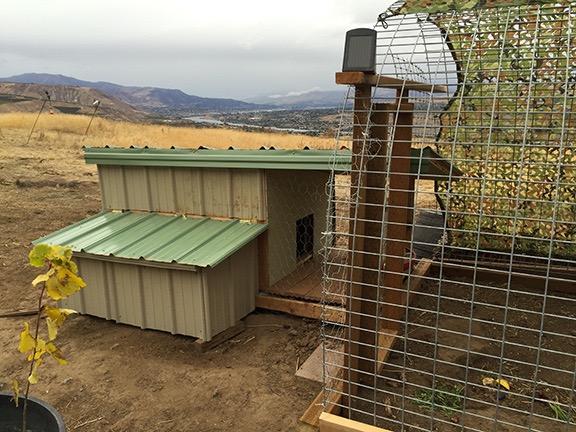
Coop 2
The second coop scored high on durability and insulation values, but low on practicality. I don’t think there was enough room inside for more than the 8 chickens I had at the time. This photo also shows part of my third chicken yard, a hoop affair made of 5×16 foot “hog wire” panels. I like the design and still use it.

What I wanted was a coop that was big enough to hold a lot of birds laying a lot of eggs. But I wanted one I could actually walk into, one that was easy to clean and had plenty of light and ventilation. Although I’d bought a small coop the year before, it was unsuitable for more than two or three adult birds. I wanted to raise chicks into laying hens and sell them when they started laying. To get started, I bought 18 chicks when I got home from my winter travel in March and set them up in a brooder in my garage. That gave me a time limit — I needed the new coop done before they outgrew the brooder.

I almost converted my existing shed into a coop. With a little interior modification, it would have done the job. But then I would have lost my garden storage area. And what about the controls for the irrigation? Did I really want my chickens crapping on it?

I looked into shed kits at Home Depot. They were not cheap and they were a lot of work to build. I could build a custom solution for a fraction of the price.

But no more pallets! I was going to build from scratch.

I sketched out a design. The footprint would be 4 x 8 feet. The roof would be 7 feet sloping down to 6 feet. I began disassembling the old coop. I think that was harder than assembling it. I managed to salvage the framed plywood roof and one of the trim panels. I wanted more overhang on the metal, so I scrapped what I had. I burned pretty much everything else, although I did have to throw away the Trex decking I’d used inside. (I did say it was heavy.)

I started at the bottom, building the floor on 4x4s with 2×4 studs 16 inches on center. I used a heavy OBS sheet as the base and gave it two coats of oil based porch paint.
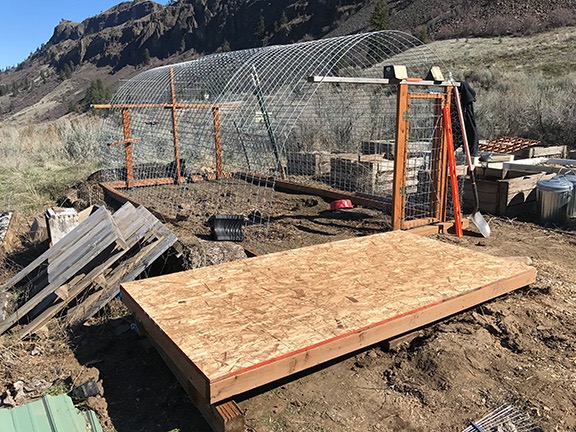
Chicken Coop Floor
I started with a floor on 4x4s, leveled in place.

Next, I framed out the four walls. But instead of framing them on the floor, I built the frames on my concrete driveway apron. It was easier for me to work on level ground. I framed them with 2x4s 16 inches on center. Every time I finished a wall, I stood it up against a deck post. I knew that it would be impossible for me to carry the two long walls over to the coop and fasten them into place by myself, so I did as much as I could before prepping the building area with two ladders and a bunch of wood screws and my impact driver. Then I called my neighbor Elizabeth and made an appointment for her to come help me get the walls in place. I promised it would take less than an hour and it did. And not only did we get the walls in place, but we even lifted the roof into position and fastened that down.
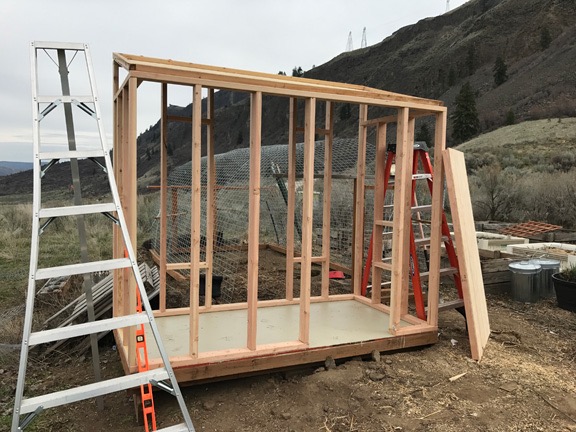
Framed Chicken Coop
I shot this photo right after Elizabeth left. The ladders were still in place; the one on the left is an orchard ladder, which are pretty common here. The wood thing leaning against the building is the door, which I’d made while I was waiting to put the walls in place.

The coop design had a 32-inch wide door, three ventilation windows, and two chicken doors. I framed them as needed. The trick then was to cut the T1-11 wood — it’s like plywood paneling — so the openings would match up right. Measure twice, cut once. I think I must have told myself that a dozen times a day during construction. But it sunk in. I fitted the north side short wall and half the west side wall without any problems.

Weather came. We had an unusually rainy spring this year. I had some large tarps and fastened one over the coop’s roof and two wall panels. I hadn’t painted anything yet and I didn’t want the wood to get soaked or ruined. My camper, the Turtleback, was parked on the driveway near the coop, blocking it from view from my home. So I was very surprised to find the coop lying on its side when the weather cleared and I was ready to get back to work. Apparently, strong winds had come though and knocked it over as if it were a sail.
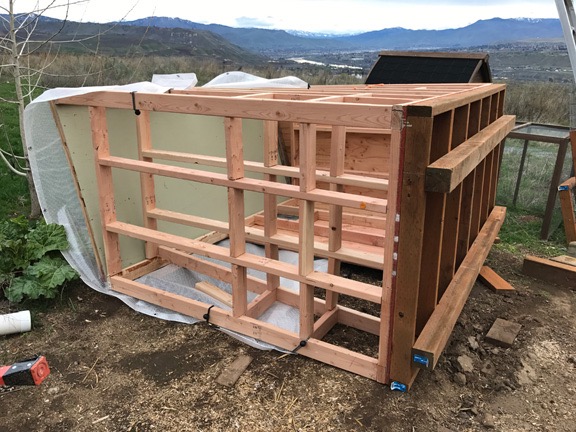
Coop on its side
Oops. Did I mention that it gets windy here? The tarp acted as a sail on the top-heavy coop and it went right over.

Neighbors to the rescue. I had three of them meet me the next morning to right the coop. Damage was minimal. When they left, I got right to work.

I used 1/4 inch wire that I already had between the frame and the T1-11 for the windows. Later, I’d put sliding panels to close them off. I had two doors to the outside but planned on using only one for now; the other one was for expanding the chicken yard with another hoop enclosure. (It’s important to cover the chickens here to protect them from birds of prey.)

The original designed called for nests just inside the door that were accessible through hinged panels from the outside. I decided to do away with the outside access, mostly because I figured a single T1-11 panel would add to the structural integrity of the building. And after all, the building was big enough for me to walk into.
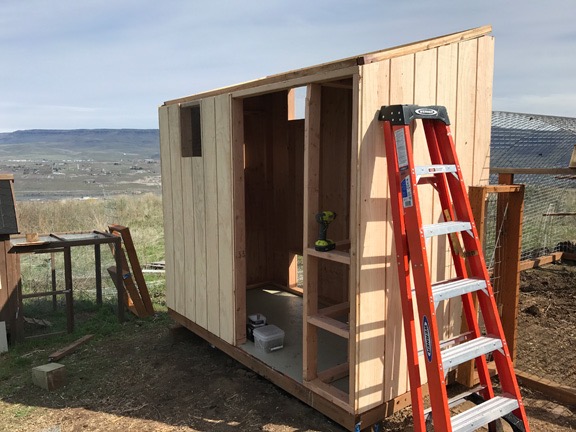
Coop Under Construction
In this shot, only one wall and the door are left to install. The nests are just inside the door to the right.

Once the walls were in place and the door was hung, it was time to paint it all. I used the rest of that oil-based porch paint and even bought a second can. The paint guy had warned me that it would absorb into the wood and he wasn’t kidding. I’m going to need a second coat. But for now, the wood is sealed tough against the elements. A second coat before winter and it’ll be ready for any weather.
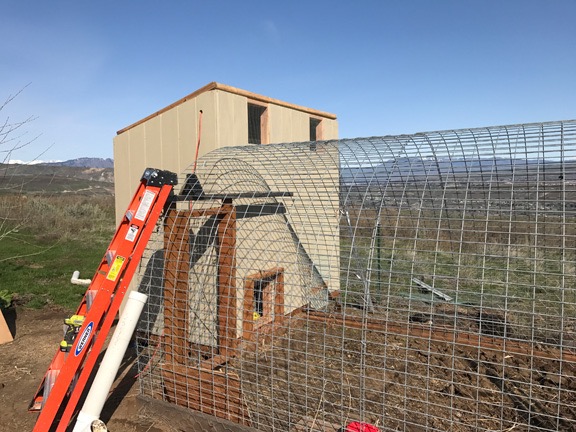
Painted Coop
Here’s the coop right after painting it. By this point, the chicks were living inside. I drilled a hole in the wall and ran an extension cord so I could hang their heat lamp. I blocked off the exit to the chicken yard with a framed bit of fencing I already had. The two upper windows have 1/4 inch screen that doesn’t show in the photo.

I still had to finish the roof. I wanted so badly to get metal panels that match my home — after all, the walls of the coop match the walls of my home — but Home Depot had a limited selection of colors. So I chose the dark green. I dreaded cutting the metal — it’s no picnic, believe me — but it went a lot more smoothly than I expected it to. I had insulation leftover from the old coop and I put it into place. Then I painstakingly lifted the metal panels into place and screwed them down. Not perfect by any means, but functional.
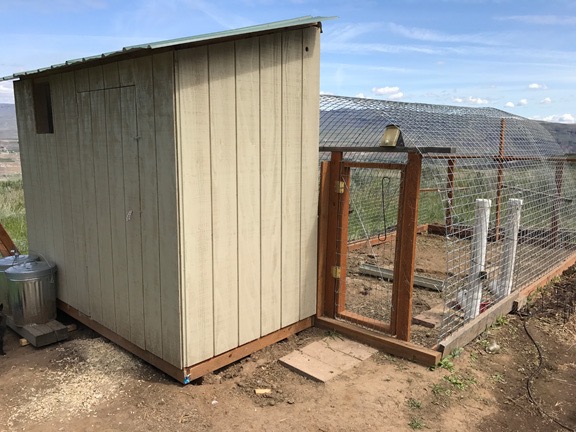
Outside Finished
Here’s a photo of the outside of the coop and yard that I took just the other day. The door really blends in; I use a piece of rope as a “doorknob” and a hook to keep the door closed. The long white pipes are chicken feeders I made last year; they each hold about 10 pounds of chicken food.
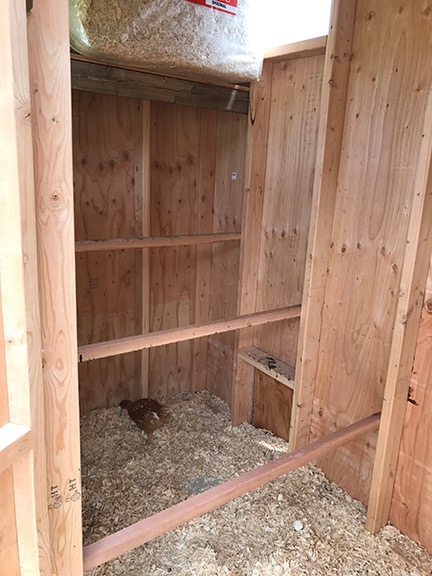
Coop Perches
I used 2x2s with rounded edges for the perches. I also added a shelf on the north side, far above the highest perch, to store odds and ends like the pine shavings I use on the floor and in the nests.

By this time, the chickens were installed and able to come and go freely between the coop and their yard. I had put in some perches for them, but as they grew, I knew I could raise them and add more. So I did; they have a total of three perches now, each about 4 feet long. With 8 inches per bird, my 18 chickens (now 17 since one died) have plenty of space to roost. I could easily add 2-3 more if I had to since they’re spaced 16 inches apart.
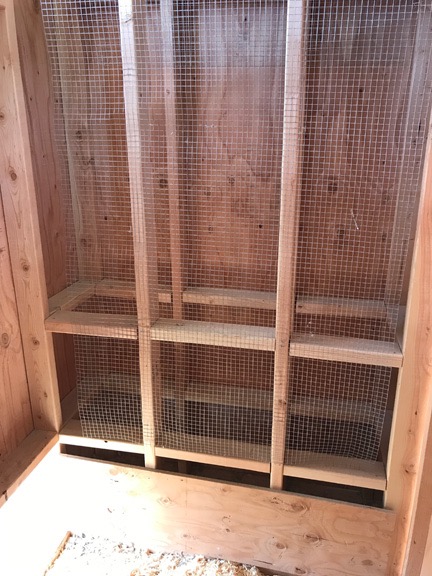
Coop Nest Area
I had to block off the nest area with wood and wire mesh to keep the chickens out.

I still needed to do the nest boxes. The first thing I did was close off the nest area; the chicks were sleeping on the floor in there when they were still very young and I wanted to break them of that habit. They wouldn’t need the nests until they started laying, which probably won’t be until August.
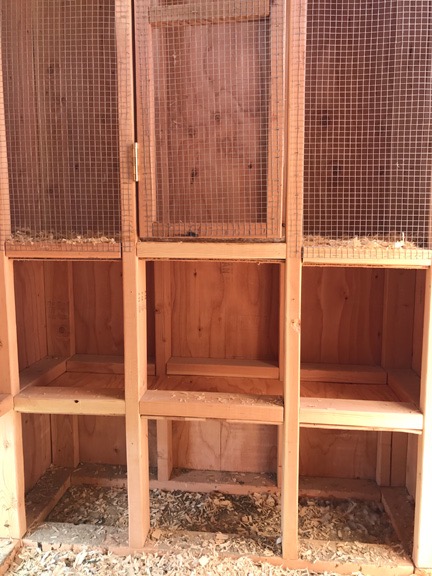
Coop Nest and Brooding
Here are the finished nests on the bottom with the bottom half of the brooding area on top.

Still, I wanted to get them done and create a brooding area above them. My design called for six nests — three on each level — so I had to build a floor for one level and then the brooding area level above it. This required me to take careful measurements of the 2×4 framing because I’d have to cut plywood around it. Then I’d have to lift it into place from below and screw it into the 2x4s I’d put in to hold them. It’s hard to describe and was hard to do, although my little jig saw did make the job easier than I expected. In the end, I had to cut each floor into two pieces to get them into the tight-fitting space.

Once that was done, I used a staple gun to securely fasten 1/4 inch screen to either side of the top brooding area. I framed a door with 2x2s and stapled more screen onto that. Then I put the door on hinges and added a hook to hold it closed. I’d be able to hang a heat lamp over the area if I needed to to keep chicks warm. I figure I can brood up to 6 chicks for up to a month in the space. Keeping them with the other chickens should allow them to get to know each other while they grow, hopefully preventing fights when they’re released into the flock.

When it was all done, I had to block off the nests again. The chickens really like snuggling up in corners when they’re indoors. I wouldn’t mind so much, but they crap where they hang out and it’s a pain in the butt to clean out the nests.

At this point, the chicken coop is mostly done. In July, I’ll pull the covers off the nests and put a fake egg — I usually use an egg-shaped rock — into one or two of the nests. With luck, they’ll get the idea and start laying in there when the time comes.

Although I’d originally wanted to add sliding panels over each of the windows, I think I’ll skip it. The ventilation is good. In the winter, I’ll fasten some heavy plastic over each window to prevent drafts. I’ll leave the door to the yard open for them.

Because this coop is not insulated — neither was the original one — I might buy a chicken coop heater for it. I already have a Thermo Cube that will turn power on when the temperature gets down to 35 and turn it off when it gets up to 45. Attaching that to the heater will run it only when needed during the winter. It’ll never get warm in there, but it’ll stay warm enough to prevent frostbite. You might think that’s nuts, but power is cheap here and from renewable energy (hydro and wind) so I have no qualms about using it to keep my chickens from freezing in the winter.

In the meantime, I’m just happy to have this project done. And even happier that I can’t find anything wrong with this design so I won’t have to build yet another one.

One Way to Do Twitter Wrong

Some people don’t get it.

Last night, before going to bed, I took a moment to check Twitter notifications. I found two tweets from someone I didn’t know who had mentioned me without actually tweeting to me.

I’m not going to embed them here because I don’t see any reason to give this idiot any additional attention. But he’s a perfect example of someone trying to use Twitter to move markets — when he only has 49 followers.

Here’s the first one:

Idiot Tweet

He was referring to a blog post I wrote years ago about Groupon. I think he’s trying to say, in his semi-literate way, that if I advertised on Groupon, I could fill otherwise empty seats on my aircraft with Groupon customers. Apparently, he thinks these people will appear just when I need them and be willing to sit around and wait until I do.

Of course, his theory doesn’t apply to my business because I only fly by appointment and I don’t have seats that are not paid for. So why would I be willing to discount flights by 75% — which is basically what Groupon requires* — thus taking a deep loss on every Groupon deal flight? That was the point of my blog post.

He then replied to that post to add this:

Idiot tweet 2

Not very bright? Well, at least I can string a sentence together, buddy.

My response was simple: “Fuck off.” I then responded to the first tweet by thanking him for the link and following it up with a simple “LOL.”

And that’s when I discovered just how dim this guy is.

He responded:

Idiot Tweet 4

Not personal? He said I wasn’t very bright. That isn’t personal? And does he honestly think being a Twitter user with 49 followers gives him any clout? Enough clout to get me to delete a 6-year old blog post with dozens of comments?

I responded “Is there something about “fuck off” that you don’t understand?” (Yes, I know. I can be a real bitch. But if you had any idea of the kind of trolling I’ve dealt with over the past few months on Twitter, you’d understand why I now have zero patience for idiots on Twitter.)

But it was his response to my tweet thanking him for the link that proved how really dim he is:

Idiot Tweet 3

He didn’t realize that by including a link to my blog post, he was actually sharing it in his Twitter stream. Giving it more exposure. Best of all, he’d done it with a #GRPN tag, increasing the exposure beyond his 49 followers. Anyone looking for the #GRPN tag — people actually interested in Groupon — could potentially see it.

And bash him? Why would I want to do that? If I wanted to bash him, I could do it here by simply embedding his tweets without redacting his identity. But I’m not. Instead, I’m ridiculing him while keeping his identity anonymous. Truth is, I feel sorry for him. He’s so amazingly clueless.

So, to sum up, this clown unwittingly shares my blog post about Groupon with a #GRPN stock tag, says I’m not very bright, and then offers to delete his tweet if I delete the post.

I went to his profile to take a look. It was full of Groupon company and stock related tweets. They guy is an investor — that’s clear. For some reason, he thinks he can use Twitter to influence the price of Groupon stock or get more people to sign on for their “deals.” He’s big on tags like #ecommerce, #investing, #socialmediamarketing, #stocktips, and, of course, #groupon. He could be a bot, but even bots aren’t that dumb.

So I blocked him. He’s still probably trying to figure that out.


* Do the math: Groupon wants a 50% discount “deal” and then keeps 50% of the discounted price. That leaves me with a total of 25% of the original price.

The T2

I take delivery of a newer, smaller truck camper.

Regular readers might remember that I spent this past winter in Arizona and California, doing my best to avoid the dark and dreary winters of north central Washington state where I normally live. I had sold my big fifth wheel camper, the Mobile Mansion late in the summer of 2016 after purchasing my first truck camper, the Turtleback. I took the Turtleback south just before Thanksgiving and spent the winter living in a friend’s guest house, camping on mostly BLM land with friends, and traveling around Washington, Oregon, Nevada, Arizona, and California.

The Turtleback was pretty deluxe. It had basically every single feature you can cram into a truck camper, including a slide to give me lots of space. It was huge for what it was and although it was comfortable, it was also heavy. I decided, on my trip south, that I’d keep an eye out for a replacement and, if I found one, I’d trade it in. I wanted something slightly smaller — certainly without the slide, which I didn’t need — and perhaps a little newer. (The Turtleback, although in near new condition, was a 2005 model.)

Finding a Replacement for the Turtleback

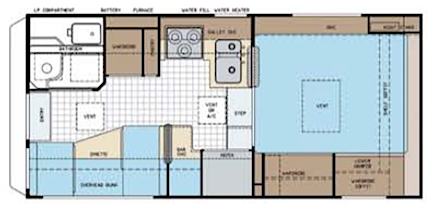
Floorplan
The standard 2007 Lance 950 floorpan.

I found the Turtleback’s replacement on the last day of my trip. I stopped by the Lance dealer in Yakima to see what they had among the used truck campers. They only had one — and it was one of the ones I’d seen there on my way south.

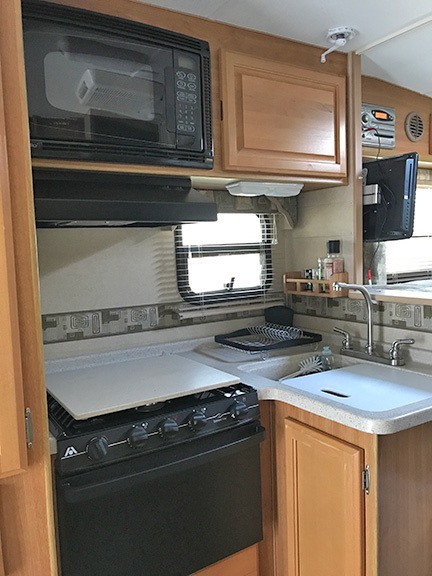
Camper Kitchen
The kitchen is compact but the sink is bigger and the propane stove includes an oven so I can bake without running a generator.

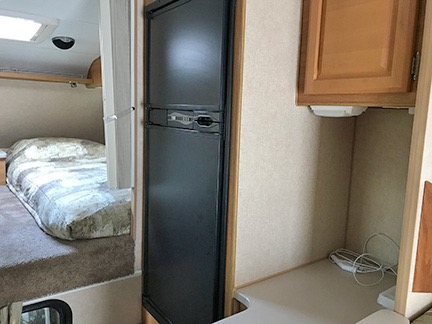
Food prep area
The “food prep” area is beside the 6 cubic foot refrigerator with separate freezer.

It was the same physical size as the Turtleback, but 400 pounds lighter, mostly because it didn’t have a slide. It had an oven and a microwave — the Turtleback had a convection microwave so I needed power to bake — and a lot more interior storage space, including cabinets over the dining area and a much larger pantry. And although the kitchen area was just as tiny as the Turtleback’s it did have a “food prep” area beside the refrigerator.

It had two 5-gallon propane tanks instead of two 7-gallon ones; that was actually good for me because the 7-gallon tanks are wicked heavy when full and tough for me to lift into place. It even had the sunroof over the sleeping area, which I’d grown to love.

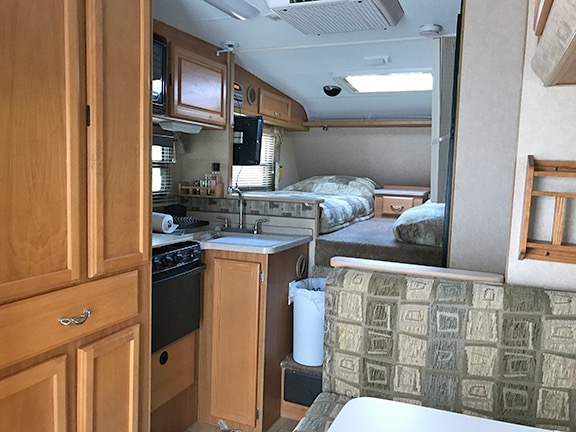
T2 Overview
The view from the dining area.

The only weird thing: it had two narrow twin beds instead of a standard queen bed. The mattresses could be zipped together to make a queen bed if I wanted one. But the setup actually added more functionality — I could travel with someone I didn’t want to sleep with without turning the dining area into a bed.

Beds
It has two twin beds with a moveable night table between them. The mattresses zip together to make a queen bed if I find the perfect travel companion. Until then, I’ll likely leave them like this.

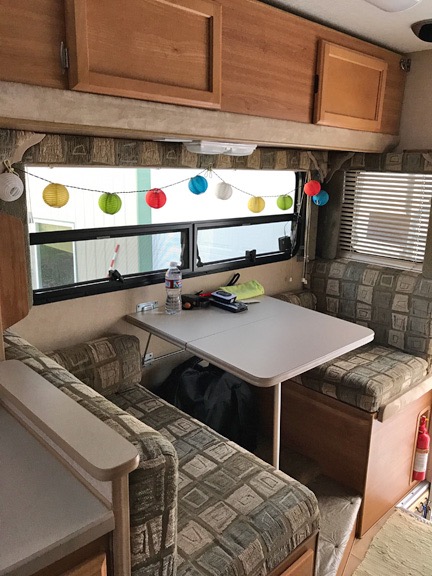
Dining AreaBecause the dining area isn’t on a slide, there’s storage overhead. That cabinet actually folds down to be used as a bunk for kids or a huge storage shelf. (And yes, I already hung my solar Chinese lanterns.)
It didn’t have a generator or solar panel, but I have a 2KW Honda generator I bought years ago and the portable solar panel I’d bought in Quartzsite in January. And instead of a satellite dish, which was useless to me because I don’t subscribe to satellite or cable TV, it had a regular RV TV antenna.

The bathroom was about the same microscopic size. Maybe an inch bigger.

And although it was a 2007 model, it was in very good condition.

In all, it was pretty much exactly what I was looking for. Smaller, lighter, and better designed.

For some reason — probably the beds — it wasn’t selling. Since their lot was crammed with new units, they were eager to get rid of it. They offered me a deal I couldn’t refuse. The only drawback was that the trade-in deal they offered absolutely sucked. I knew I could get a lot more for the Turtleback if I sold it on my own. They kindly offered to hold it for two months with a $500 deposit. I gave them a check and went home.

Selling the Turtleback

It took a week or two to clean out the Turtleback and get it ready for sale. Since my garage was still full of boats, I parked it near my shed. I put an ad on Craig’s List. The calls started coming almost immediately. The only problem was, folks were calling from Montana, Idaho, and the Olympic Peninsula — 5 or more hours away. I honestly don’t know why they bothered if they didn’t intend to come take a look. I certainly wasn’t about to deliver.

One guy told me he’d take it sight unseen. He’d come on Monday. By Sunday, however, he’d changed his mind. His wife had talked him into looking for a pull trailer.

A few days went by I still had more than a month to sell it, but when the calls suddenly stopped coming, I started getting worried. But then another call came. I answered questions. He was definitely interested but would be coming from the west side near Seattle. A few more phone calls and he and his wife arrived.

I showed them everything. They asked lots of questions. They tried everything — including the air conditioner, which wasn’t easy to get going when the outside temperatures were around 50°F. They talked it over in private. They offered $2K less than I was asking. I told them I really needed more and countered for $1K higher. They handed me a stack of $100 bills that had already been counted. I recounted them and it was right.

A while later, they drove away with the Turtleback on the back of their pickup. They’d gotten a good deal. I’d gotten $1,000 more for the Turtleback than I needed for its replacement — and $5,000 more than the trade-in offer had been for.

Picking Up Turtleback 2

Although I still had a whole month to get the new camper, I was eager to take possession. Cherry season would start soon and I was hoping to take it on a shakedown trip before I was stuck here. (I can’t travel during cherry season because I’m on standby for work.)

I scheduled a date to pick it up and drove down to Yakima to get it. I wound up spending about three hours, mostly chatting with the two brothers that own the place while their guys put the camper on my truck, inflated the air bags on my truck’s back end to level it, and strapped it down. Then I got the unit tour, which included an overview of everything on the camper. When I voiced disappointment that the TV/DVD player was AC rather than DC, the younger brother, Mike, gave me a 375 watt inverter. (Since the TV only draws 38 watts, I’ve since replaced it with a fanless 100 watt inverter.) So yes, I can still watch movies when I’m off-the-grid.

It felt the same as the Turtleback on the way home, although the brochure says the center of gravity is three inches higher.

Of course, I needed a name for it. Since it was my second Turtleback camper, I called it Turtleback 2 or just T2.

Plans for T2

It was parked in my driveway for about a week. Some overnight guests camped out in there. It was nice to have a place to put them.

I finally put it away in the garage yesterday. I’d planned on going on a trip down to Palouse Falls, but other things popped up on my calendar and it made sense to put it away rather than leave it out in the sun.

I’ll be using it in about 10 days on a Puget Sound Mycological Society weekend-long field trip to Silver Falls. Then maybe again on Memorial Day weekend. And likely the first weekend in June for another mushroom hunting field trip before cherry season starts.

Last summer, the Turtleback was a home for three different pilots who worked for me in Quincy. Although I don’t think I’ll need it for that duty this summer, it will be available.

And there’s a slight chance I’ll get a contract job in the Yakima area in September; if I do, I’ll stay down there in the T2.

Of course, I’ll be taking it south with me again next winter. And this time, I’ll bring along my boat.

More about the Wind Machines

A few new videos.

Back in April 2015, I blogged about the wind machines commonly used for frost control in the Wenatchee Valley. Resembling tall fans, different versions of these machines can be found in agricultural areas throughout the west wherever frost — especially early spring frost — is an issue. Around here, they’re often in low areas subject to thermal inversions.

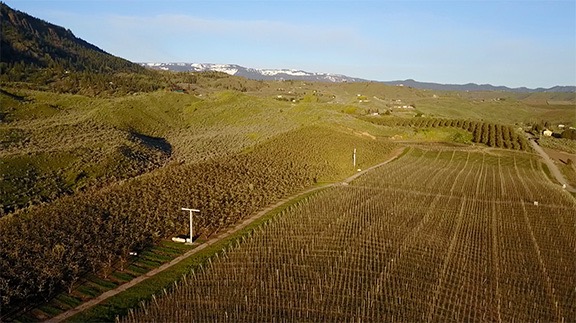
Wind Machine
The wind machines that were running this morning. That’s the Mission Ridge Ski resort in the background. Photo shot with my Mavic Pro.

The machines are fans that generate wind. The blades spin fast — faster than you might think watching the video below — to circulate the air. The fan heads rotate to constantly change the direction of the wind. The net result is that the air is circulated, bringing warm air from above down into the crops.

In the almond orchards of California, they use helicopters to do this. I think it’s because the orchards are so big that they simply can’t install and maintain as many wind machines as they need. The helicopters are likely a lot cheaper in the long run, especially when you have a few years in a row when they’re not needed. I’ve been on frost control contracts for the past five winters now and have yet to turn a rotor blade over an almond tree. (Global climate change?)

This winter was particularly long, setting the tree fruit back two to four weeks. The cherry trees are still blooming around here; last year, the cherries were already beginning to redden in the orchards closest to my home. Nighttime temperatures at my home have been in the low 40s. But in the orchards below me, pockets of colder air form. And this morning, they got cold enough to trigger the temperature-set auto start feature on the wind machines in the closest orchards.

I don’t know exactly when they started. I was up at 4:30, reading before getting out of bed, and I didn’t hear them. But by the time I made my coffee at 5 AM, I could hear them faintly through the walls and windows of my my home. I stepped out on the deck for a better look in the predawn light. The sound was louder and I could see two of the machines to the west spinning. My ears told me that one to the northeast, which I can only see from a handful of spots on my deck, was also spinning.

Here’s the zoomed in video I shot with my phone. When I shut up, you can hear the wind machines.

I did a Periscope — that’s a live Twitter video — of the wind machines. A handful of people tuned in and I answered questions as they came up. I was frustrated that I couldn’t zoom in. I signed off, used the video feature on my phone to capture a short zoomed-in clip, and posted it on Twitter. Then the sun rose and the light got good and I did another Periscope that was mostly to show off how beautiful the area was. The wind machines droned in the background of my voice as I described various things and answered questions.

I went inside, washed some pots from cheesemaking, and listened to the radio. I could hear the wind machines faintly through the walls and windows. I was sort of bummed out that I couldn’t give people a better view.

Part 107 Explained
Want to become a commercial drone pilot? Start by learning all about the FAA’s Part 107. This book will help. Buy the ebook edition on Amazon or from Apple. Or buy the paperback edition on Amazon.

And then I remembered my Mavic Pro.

It took only two or three minutes to set it up. I launched it from my deck, got the video camera going, and sent it to the wind machines, stopping before it got so close that the wind could affect it. The light was beautiful and the image the Mavic sent back to me was clear. I hovered for a while to capture a good clip and then flew around a little, just taking in the view with the camera running. I stopped the video camera, took some stills, and then flew home for some more video of my home and the area around it.

Back inside, I made a fresh cup of coffee and spent a few minutes editing the video and setting it to music. It’s unfortunate that the Mavic doesn’t capture sound, but I understand why: it would be capturing its own buzzing sound, which isn’t pleasant. So music will have to do.

A side note here: I’ve been thinking a lot lately about how much I like living here. I realized — and I think I mentioned in one of those Periscope videos — that I like it here more than anywhere else I’ve lived. I’m not sure if it’s because of the place itself or the fact that I have a home with an amazing view built to exactly meet my needs or because after a stifling relationship that went on a lot longer than it should have I finally have the freedom to do what I want to do with my life and time.

Whatever the reason, I just want to remind readers that we all have just one life and it will eventually end. Don’t waste it stuck in a rut or in a place you’re not happy.

Flying with Miss Veedol

My first photo flight of the year.

Early Tuesday morning, I lifted off from the ramp at Wenatchee Pangborn Memorial Airport in East Wenatchee, WA on an air-to-air photo flight with Miss Veedol for Voortex Productions and the Wenatchee Chamber of Commerce.

The Miss Veedol was the first airplane to fly non-stop across the Pacific ocean. A 1931 Bellanca J-300 Long Distance Special piloted by Clyde Pangborn and Hugh Herndon Jr., it took off in Japan with 915 gallons of fuel, jettisoned the landing gear to improve aerodynamics, and crash landed 41 hours later at Fancher Field in East Wenatchee, making history. You can learn more about it and its eventual demise on Wikipedia and the Spirit of Wenatchee website.

I recommend you watch this in full-screen mode.

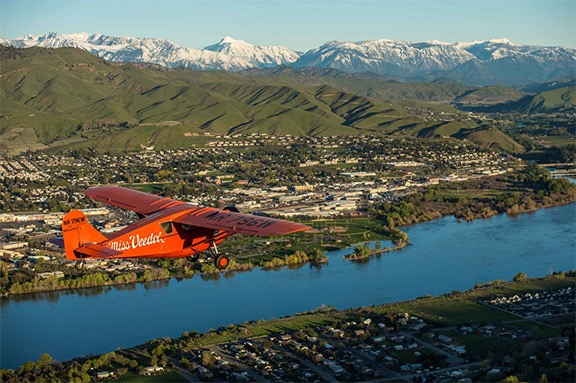
The Miss Veedol I flew with on Tuesday is a replica of the original aircraft that is based at Wenatchee Airport. This isn’t the first time I flew with it — we did a video flight way back in January 2014. Footage from that flight (and a few others) was incorporated into the amazing We Are Wenatchee Part I video. (This video still brings tears to my eyes; I’m so glad I live here and so proud to be part of the team that made the video. I hope you’ll check out Part II and Part III, too.) It was a difficult flight, mostly because it was bitter cold and I was having trouble keeping up with the plane.

But Tuesday was a completely different story. It was a gorgeous morning when we gathered just before dawn. I parked near Miss Veedol’s hangar and discussed the flight plan with my clients from Voortex Productions and Miss Veedol’s pilots. Then we split up. I got the helicopter going while they started up Miss Veedol’s big radial engine. The two photographers climbed on board — I had already taken their doors off — I backed the helicopter away from where Miss Veedol would be taxiing, and then I followed her down the taxiway while the photographers shot photos. By that time the sun was up, illuminating the plane’s orange wings and fuselage and casting long shadows. We circled the plane in the run up area, then moved beside it as it taxied to the runway. We took off in formation, with the helicopter slightly above and behind the plane.

The conditions were nearly perfect for the flight. Light wind, blue sky, gorgeous early morning light. It was just after 6 AM when we reached the river and headed up on the East Wenatchee side. The plane would go up one side of the river and down the other while a photographer and videographer captured images and footage.

Miss Veedol Over Columbia River
Miss Veedol with the city of Wenatchee in the background. The snow-covered mountains are the Enchantments, west of Wenatchee in the foothills of the Cascades. Most of the snow will be gone by late June. (I can see the tops of these mountains from my home.) Photo by Charley Voohris.

One of the most frustrating things to me when I do photo flights is that I can’t take photos. I see the shot but I don’t have a camera handy and, even if I did, it would be impossible to work it properly with just one hand. I have to wonder if the photographers see the same shots I do. I like flying with Charley because he usually does see the same thing I do — or something even better — and gets the shot.

Miss Veedol Over Shadows
I distinctly recall when we were in position for this shot because the shadows beneath the plane made its orange color really pop in the early morning light. Photo by Charley Voorhis.

One of our target areas was a rock formation called Saddle Rock at the top of a hill overlooking Wenatchee. Every time we do an aerial photo flight, we spend time up and around Saddle Rock. (You can see it in the closing shot of We Are Wenatchee Part I above — seriously, you must watch that video.) Part of our mission was to get photos of Miss Veedol around Saddle Rock. Charley succeeded in getting several really good shots as we circled Saddle Rock twice.

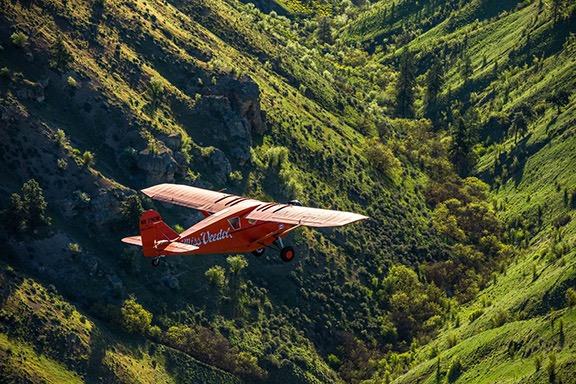
Miss Veedol Flies up a Canyon
Spring time is always green here, but this year it’s especially green with all the rain we’ve had. I followed Miss Veedol up this canyon on our second pass for Saddle Rock. I love the textures and contrasts in this shot. Photo by Charley Voorhis.

Another target area was the Senator George Sellar Bridge — which I usually refer to as the South End Bridge. We circled twice at the end of the shoot.

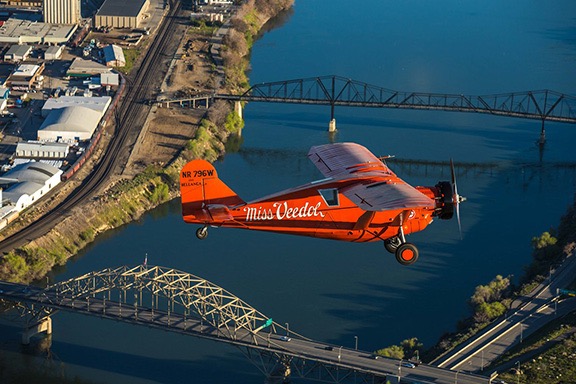
Miss Veedol at the Columbia River Bridge
Charley managed to perfectly frame Miss Veedol between the Senator George Sellar Bridge and the historic Columbia River Bridge. Photo by Charley Voorhis.

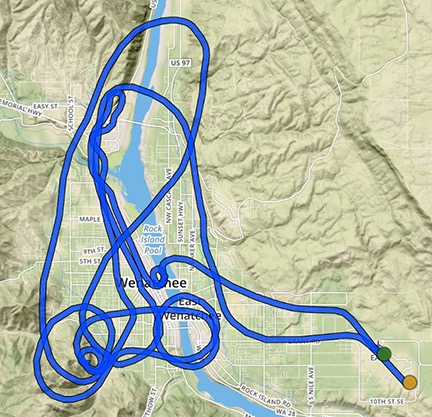
Our Flight Path
Our flight path, captured by Foreflight.

After circling the bridges, Miss Veedol headed back to the airport for a few touch and goes before taxiing back to her hangar. We went back for a few more shots at Saddle Rock. By that time there was just enough tailwind to make hovering flight a tad difficult pointing in the direction we needed to point but I think they got the shots they needed. We did a quick run to the north end of Wenatchee and then back to the south, circling Pybus Public Market once. Then it was back to the airport.

Total flight time was 1.3 hours.

I want to thank Charley Voorhis at Voortex Productions and the Wenatchee Chamber of Commerce for allowing me to show these photos on social media and in my blog. It was a great flight and I look forward to our next one!