Lamb, Eggplant, and Tomatoes Ras el Hanout

A made up recipe that came out better than I expected.

Another evening, another dinner guest. This time of year, I have to invite people I can send home with zucchini.

Of course, I’m also growing eggplant, which I really like, and have a bunch of that to eat. After browsing Whole30 recipes for eggplant, I decided to try something completely different, something that used up garden vegetables and some of the ground lamb I had in my freezer from the half lamb I bought last year.

I also had a seasoning I’d whipped up for goat (which I also have in my freezer) that I knew would be great with the lamb. Called ras el hanout, I found the recipe on the Amazing Ribs website when I was looking for something interesting to season goat ribs. I made it exactly as written, including the culeb berries, which I tracked down online at Spice Jungle. The result is mind-bogglingly aromatic, reminding me of the middle eastern food I used to eat at my wasband’s Aunt Rose’s house or the Persian Room in Scottsdale.

So I made up this recipe. It’s Whole30 compliant, but what’s more important is that it’s delicious. And that’s what really matters, right?

Ingredients:

  • 2 medium to large eggplants or 4 medium Japanese eggplants.
  • olive oil
  • 1 pound ground lamb or goat. (I used lamb.)
  • 2 cloves of garlic, minced
  • 2 tablespoons ras el hanout
  • 1 medium onion, chopped.
  • 1 large or 2 medium tomatoes, chopped
  • 1/2 can tomato paste
  • salt and pepper to taste

Since this recipe is made up, the measurements aren’t precise and don’t need to be. Use more or less of any ingredient to suit your taste. I think it’s the combination of ingredients that make it good.

Instructions:

  1. Prep the eggplant:
    • Cut half the eggplants lengthwise and, using a paring knife, carve away about half the flesh, leaving the skin and a layer of flesh. Brush the flesh with olive oil, place on a baking sheet, and bake in a 350°F oven until flesh is cooked. Remove and set aside.
    • For the other half of the eggplants, pare away the skin and chop the flesh, as well as the flesh carved out of the other eggplant, into small pieces.
  2. Cook the lamb (or goat), onions, garlic, and ras el hanout together in a large skillet. You shouldn’t need to add any oil; the meat will be fatty enough. In fact, you can probably drain away some of the fat once the lamb is brown and the onions are just starting to get translucent.
  3. Add the chopped eggplant and tomatoes.
  4. Simmer until the eggplant is cooked.
  5. Stir in the tomato paste.
  6. Simmer another 10 minutes or so, stirring occasionally.
  7. Spoon the lamb, eggplant, and tomato mixture into the prepared eggplant skins. (You may have some leftover.)
  8. Return the stuffed eggplant skins to the oven and bake for another 10-15 minutes, until well heated.
  9. Remove from oven, season with salt and pepper, and serve.

I don’t have a picture. I’ll take one the next time I make this, which actually might be soon. I was thinking of trying it again with goat meat. I sure have enough eggplant and tomatoes in my garden.

You can skip the stuffed eggplant part — in other words, serve the dish on its own, with a salad, or with rice. The other day, I made scrambled eggs and topped them with reheated leftovers. Delicious!

If you make this, please come back and let me know how you liked it.

One-Pan Pork Tenderloin with Tequila

An easy recipe with Whole30 in mind.

With the summer dragging on and lots of work to do around my house and property in preparation for my first glamping guests, I’m still making time to entertain, inviting friends up for dinner a few times a week. But rather than chain myself to the kitchen for hours preparing a complex meal, I’m keeping it simple. Yesterday, I looked up one of my favorite recipes, a one-pan dinner combining meat and vegetables that can be prepared and cooked in less than an hour: pork tenderloin with tequila.

Jose CuervoNow I know what you’re saying. Tequila is alcohol and alcohol is verboten in Whole30, which I started last week. And you’re right. But I can make a two-part argument for why I could include it in this recipe:

Still, if you feel strongly that alcohol should not be included in any Whole30 recipe despite these two points, just exclude it when you prepare this. Then let us know how it came out. I bet it’s still good.

Now here’s the recipe:

Ingredients:

  • 1/4 cup mustard. If you’re going Whole30 on this, check the label and make sure it doesn’t include sugar. Many do. I recommend Guldens, which does not.
  • 2 pounds pork tenderloin. Don’t get hung up on weight. Just buy a package of pork tenderloin. There are usually two in a pack. Use both of them.
  • 1/4 cup oil. The original recipe called for vegetable oil. I used light olive oil.
  • 2 cloves garlic, peeled and halved.

  • 1/4 cup chopped carrot. I’m not big on measuring so I just peeled and cut one carrot. Done.
  • 1/4 cup celery. Read what I said about the carrot above. One stalk.
  • 1/4 cup lime juice. Again, I’m not interested in measuring or putting away half a lime. I used the juice of one lime.
  • 1/4 cup tequila. I used Jose Cuervo. I still have a ton of it from Arizona. (People here don’t drink tequila like they do in Arizona.)
  • 1 tablespoon ground red chiles. I used chile powder and because I don’t like very spicy food, I used less than a full tablespoon.
  • 1 teaspoon salt.
  • 1/4 teaspoon pepper.
  • 1 teaspoon dried oregano leaves.
  • 1 teaspoon dried thyme leaves.
  • 4 medium tomatoes, chopped. This should equal about four cups. In the past, I’ve made this with canned chopped tomatoes. If you decide to go this route, drain off some of that tomato juice. Otherwise, this will wind up as a soupy (although still tasty) mess.
  • 1 small onion, chopped. I used a medium one. I like onions.
  • 1 bay leaf. I just realized that I forgot this yesterday. Oops.
  • 1/4 cup snipped parsley. I didn’t have any so I didn’t use any.

Yesterday, I also added some chopped up banana peppers from my garden, mostly because I’m trying very hard to use them up. I would have added some chopped zucchini, too, if I’d remembered to.

Instructions:

It can’t get any easier than this:

  1. Spread the mustard over the pork tenderloin.
  2. Heat oil and garlic in a large skillet until hot.
  3. Cook the tenderloin over medium heat in the oil until browned.
  4. Stir in the remaining ingredients except the parsley. (I mixed them all together in a bowl in advance and just poured them in.)
  5. Heat to boiling, then reduce heat to simmer and cover.
  6. Cook until pork is done, about 30 minutes.
  7. Remove bay leaf.
  8. Cut meat into 1-inch slices against the grain and arrange with vegetables on a serving plate with a generous lip. (I used a glass pie plate.)
  9. Sprinkle with parsley, and serve.

Tequila Pork
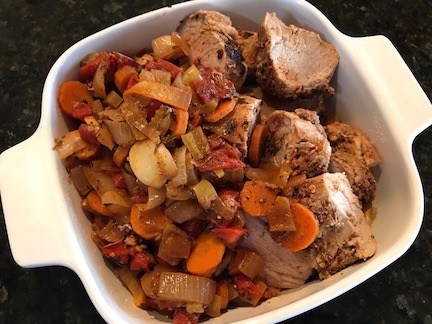
Of course, I forgot to take a photo before dinner yesterday. But don’t the leftovers look pretty good?

I prepared all this right in front of my dinner guest. We’d been working on one of my garage projects and came upstairs when we were done. My stove sits on a kitchen island with food prep counter space, a breakfast bar, and seating. While my guest chatted with me, I cooked. It was all very easy and social. (I should mention that I planned my kitchen with the stove in the island instead of the sink just so I could stay social while preparing food. There’s nothing ruder than turning your back on a guest for extended periods of time.)

The result was delicious.

I had a bunch left over and will likely have it for dinner tonight. But I’m also going to heat up some of those vegetables and enjoy them with my scrambled eggs this morning. Yum.

About Helicopter Fuel Consumption

It’s only part of the cost of operations.

Among the stats recorded for this blog are the search phrases people use to find content here. I can’t tell you how many times I’ve found search phrases related to “helicopter mileage” or “helicopter miles per gallon” or “helicopter fuel burn.” It seems that a lot of people are really interested in learning how much fuel a helicopter burns.

It’s not just the blog, either. I get related questions every time I do a rides gig. I’d say that 1 out of every 10 adult passengers wants to know how many miles per gallon my helicopter gets or gallons per hour my helicopter burns.

Of course, a helicopter’s fuel burn varies based on its make and model — just like an SUV will burn more fuel than a compact car. Bigger engines burn more fuel.

Fuel burn also varies based on conditions, again just like a car. If I cruise alone on a cool day near sea level, the helicopter will be operating efficiently with a light weight to carry and burn less fuel than if I operate near maximum gross weight on a hot day. This is similar to a car’s “highway” and “city” MPG ratings.

Ready for my answer to the question?

My helicopter burns roughly 15 to 17 gallons per hour, depending on conditions.

Helicopters generally take one of two different kinds of fuel. Some helicopters with piston engines, including mine, burn AvGas, which is also known as 100LL, a high-octane, leaded fuel similar to what you might put in a car. (I actually “dispose of” spoiled AvGas in my lawnmower and ATV once in a while. My understanding is that the lead will damage a car’s catalytic converter so I’d never put AvGas in my Jeep or Honda.) Other helicopters with turbine engines, like a JetRanger, burn JetA, which is the same stuff they put in jet airplanes. (It’s also remarkably similar to diesel, although I’ve never put JetA in my truck.)

Aviation fuel prices vary the same way auto fuel prices vary. AvGas and JetA seldom cost the same. These days, my local airport sells AvGas for $5.14/gallon and JetA for $4.04/gallon. The least I’ve ever paid for AvGas was $2.43/gallon way back when I first started flying. The most was around $9/gallon when I needed to refuel at an airport with a fancy FBO that normally caters to business jets. Ouch.

R44 Gauges
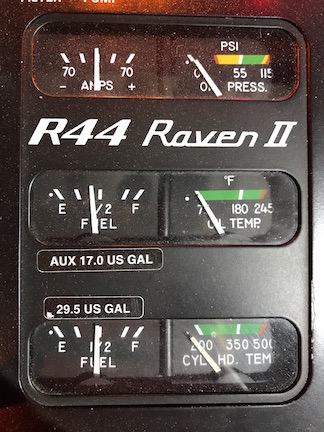
I have two tanks that supply the engine with fuel from a single feed (so there’s no need to switch tanks in flight) for a total of 46.5 gallons of usable fuel. (The Master switch is on but the engine is not running in this photo.)

My helicopter can hold about 46 gallons of fuel. I can fly for 2-1/2 to 3 hours on that, depending on conditions. If you figure I average about 100 knots when cruising — that’s 115 miles per hour or 185 kilometers per hour — I can cover about 300 miles on a full tank. Of course, that also depends on wind conditions; I’ll fly fewer miles with a headwind than with a tailwind or no wind.

One more thing. The reason most people seem interested in learning about fuel consumption is because they’re trying to figure out what it costs to fly a helicopter. (At rides gigs, they’re usually trying to figure out my profit.) What they fail to understand is that fuel is only a small part of what it costs to fly. I’ve blogged about this extensively here. Fuel currently accounts for less than a third of my operating costs.

So you can imagine how annoyed I get when people offer to just “pay for fuel” if I fly them somewhere. As if I’m interested in picking up two thirds of the cost of giving them a ride and throwing in my time for free, while forgoing any possibility of a “profit” to help cover the cost of operating my business.

(And what about the $14,000 I need to spend later this year to install a radio altimeter that I’ll never need?)

Anyway, I’m hoping that this post comes up in those searches now. It answers the question succinctly in a way that most people can’t fail to understand.

Freedom Day Comes and Goes without Notice

If I didn’t have it on my calendar, I’d likely forget its significance entirely.

Freedom Day
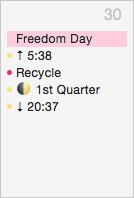
You can see how I missed it; it’s just a tiny note on the calendar.

It was Tuesday, July 30, 2013 that my very favorable divorce decision came through. Although I thought at the time that it would be the end of the bullshit my wasband was sending my way during our crazy divorce, it was just the beginning of a new chapter. Some people are seriously delusional and make all kinds of bad decisions based on their delusions. My wasband is a textbook case of this for the period starting around January 1, 2012 through (likely) today.

I called it Freedom Day because I was finally free of sad sack old man who was holding me back from moving forward with life. I didn’t realize how much I’d been held back until I was free to make my own decisions without having to compromise or, worse yet, wait for a risk-adverse “partner” to provide input. In the four years since, I not only bought the land for my new home — which I did the very next day — but built a custom home to my specifications on it, doing much of the interior work myself. I’ve tripled the amount of contract work I do each year, building my flying business far beyond I ever thought I could. I’ve met new people, made new friends, and traveled to new places.

In short: I’ve accomplished far more in the past four years than I had in the previous 10.

I’ve since settled into the kind of laid back and flexible lifestyle I always imagined having in my later years of life, free to do what I want with my time. I’m living life on my terms and if that isn’t freedom, what is?

Freedom Day is on my calendar as a recurring annual event. I put it there back in 2013 because I was so happy to finally have my poisonous relationship behind me. But unlike other people who hold significant dates close — often too close — to their hearts and minds, my Freedom Day is little more than that calendar reminder. This year it came and went without me even noticing it.

And I think that speaks volumes about where I am in my life today.

Another No Fly Decision

Smoke in the area forces me to cancel a scenic flight.

I’ll start this one with a story.

Flashback: Grand Canyon 2004

When I flew for Papillon at the Grand Canyon, Mother Nature threw all kinds of weather at us. In the spring, it was wind, sometimes blowing as hard as 50 miles per hour, causing all kinds of mechanical turbulence on our prescribed tour routes over the forest and Canyon. In the early summer, it was heat and high density altitude, which made the departure and arrival in our rather confined landing zone challenging. Then there were the fast-moving monsoon storms that sped across the terrain, sometimes blocking our path across the canyon and forcing us to shut down when lightning near the airport made it unsafe to refuel. (And yes, we did fly within 20 miles of thunderstorms.) That lightning would often start fires in the forest along the Grand Canyon’s rims, filling the air with thick smoke that made it nearly impossible to see.

Special VFR at GCN
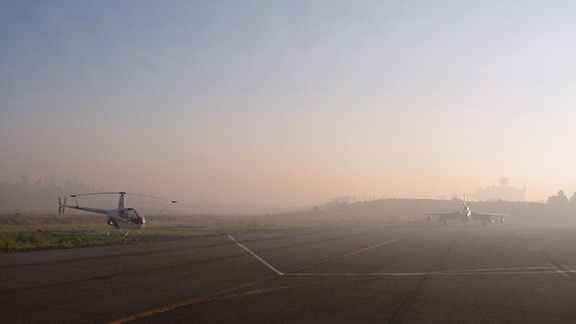
Here’s an early morning view on one of those smokey days at the Canyon. The R22 on the left is mine, parked at transient helicopter parking at Grand Canyon Airport. I used to commute to work by helicopter once in a while; I needed a special VFR clearance to get into the Class D airspace that day. The tall building in the haze is Papillon’s base with its tower.

Honestly: flying at the Grand Canyon is the best experience a helicopter pilot can get. There isn’t much that you don’t experience as far as flying conditions go.

On one late afternoon in August, the area was full of storms and smoke from numerous wildfires. I took off in trail behind at least six other helicopters with another four behind me for one of the short tours. The passengers had come off a bus and their tour had likely been booked years in advance. All 11 helicopters were flying with the same group.

When we reached the Dragon Corridor, where we were supposed to cross the Canyon, we found our way blocked by a thunderstorm that made it impossible to see the other side of the canyon. So one by one we made our radio calls, turned around, went back past the airport, and crossed over the Canyon in the Zuni Corridor. There was a short tour on that side that we’d been taught but Papillon didn’t sell. I’d never flown it, so I basically followed the helicopter in front of me, making the same calls he did when I reached vaguely recalled reporting points.

The air was thick with smoke. The visibility was definitely less than five miles, although it had to be more than three miles for flight to be legal. But maybe that’s what it was at the airport. It wasn’t that over the canyon. At one point, I lost sight of the strobe light of the helicopter in front of me and had to find my way back without him. (We did not have GPSs on board.) I only got a little lost and was very glad to finally see Grand Canyon Airport’s tower. I adjusted my course to put me where I was supposed to be, made my radio call, and landed.

They shut down flights for the day after that.

Afterwards, I went up to the Chief Pilot’s office. His name was Chuck and he’d always struck me as someone who was very reasonable. I complained about the visibility and asked him why we were taking people on scenic flights when we could barely see. His response stuck with me: “If they’re willing to pay and it’s safe to fly, we’ll fly them.”

I swore I’d never take that attitude with passengers in my tour business. Indeed, years later I turned down a flight I could have done because I was certain that wind and turbulence would have made my passengers miserable.

And I’ve turned down flight since. Today is one of those days.

Today: Smoke in the Wenatchee Valley

The hour-long tour for one of my client’s vice presidents and his out-of-town guests has been on my calendar for about two months. I have the passengers names and weights and have done my weight and balance calculations. I know where they want to go and what they want to see.

The smoke started blowing in last week, which is kind of weird because (1) there aren’t any fires nearby and (2) there isn’t much wind. Apparently the fires are mostly in British Columbia (Canada), which isn’t very far from here, was well as in northwestern Washington State, on the other side of the Cascades. There was a rumor going around that there’s a fire in Blewett Pass, which is actually quite close, but I can’t find any information anywhere about that, and I have good sources to check.

Smoke from the Airliner
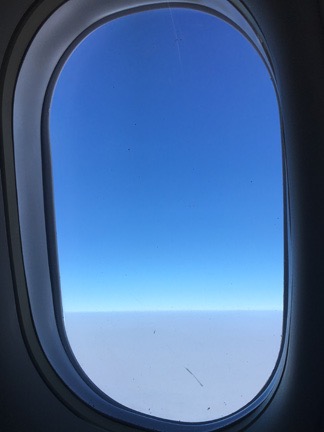
As this photo from my friend shows, the smoke was a thick blanket up to about 14,000-18,000 feet.

So the smoke is drifting down from Canada on a light breeze. It’s settling in the Columbia River Valley at Wenatchee. And elsewhere. A friend who who took a Horizon Airlines flight out on Thursday sent a picture from 20,000 feet and there was a blanket of smoke right beneath the plane. It was so bad I blogged about it.

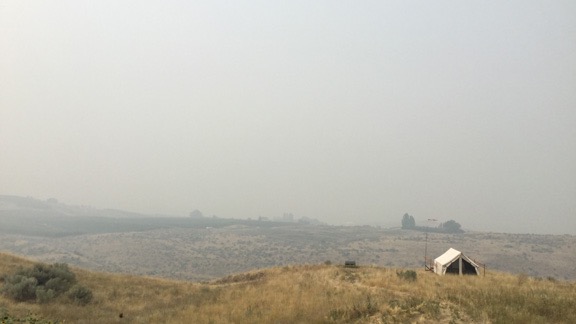
For the first few days, it was a light haze. But yesterday it settled in so thick that not only could I smell the smoke, but I couldn’t see the river from my house, let alone the airport on the shelf right above it. Sure enough, the airport was reporting 1-1/4 mile visibility. Instrument meteorological conditions (IMC), meaning that it wasn’t legal for me to fly without getting a special VFR clearance from Seattle.

Bad View
I shot this photo from my deck yesterday when the visibility was at its worse.

Foreflight Weather
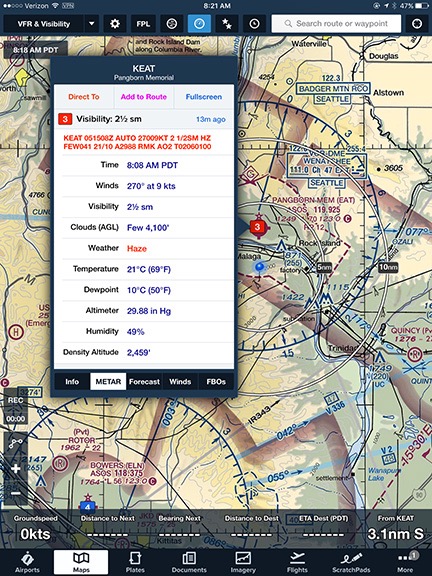
Turning on ForeFlight’s visibility layer displays visibility in miles at each airport that provides this data. Clicking the number displays details.

I emailed my client yesterday, asking him to check in with me an hour before the flight. But I wound up calling him this morning, two hours before the flight. I’d used ForeFlight, the basis of my electronic flight bag, to check conditions at Pangborn Memorial Airport, which I could barely see across the river. It was reporting visibility at 2-1/2 miles: IMC.

Could I fly in these conditions? Technically, yes. I could get a Special VFR clearance to leave my home (which is within Pangborn’s Class E airspace) and fly up to Baker Flats where my client would be waiting. That’s in Class G airspace where only 1/2 mile visibility is required for helicopters during the day. I could then do the whole tour, making sure I stayed out of class E airspace or get another clearance if I wanted to enter Class E. So yes, it’s legal.

But is it safe? Well, since I would always remain within sight of the ground and whatever’s at least a half mile in from of me and I can fly at virtually any speed to keep it safe, then yes, it’s safe.

So by Papillon’s standards — at least those back in 2004 when I flew there — I shouldn’t hesitate to do the flight. After all, it’s money in the bank, right?

I don’t think that way. It’s all about passenger experience. Other than me getting paid for a hour of flight time, what’s the benefit? The tour would be terrible — my passengers wouldn’t be able to see more than a mile or two during the entire flight. What’s “scenic” about that?

My client understood perfectly. He was happy to cancel. We agreed that we’d keep an eye on conditions and that if, by some miracle, a wind kicked up and blew some of the smoke out, we could try in the afternoon. Or maybe tomorrow. I’ve got nothing on my schedule. But it’s more likely that we won’t do it at all since his guests are leaving town on the 6 AM flight tomorrow morning. (Provided Horizon can get the last flight in tonight.)

In the meantime, I don’t mind staying home today. It’s better indoors with the windows shut than outside breathing that crap we’re importing from Canada.