Killer Floods

A review with a backstory.

Last summer, I did a flying gig that started in Spokane and had me flying over a good portion of the state. The client was a video production company based in the U.K. that was working on a NOVA documentary about the ice age floods, which are often referred to as the Missoula Floods.

If you don’t know anything about the Missoula Floods, here’s the short version. Millions of years ago, when the Cascades were a chain of active volcanos, they laid down layer after layer of lava that became (mostly) basalt rock. The Ice Ages came and a sheet of ice stretched from the North Pole down into the northern United States. In Montana, the ice sheet formed a dam across the mouth of a valley and huge volumes of water accumulated behind it. Over time, the ice dam was eroded and broke free, releasing all that water very quickly. It came downstream, across Idaho and Washington State, carving out some very interesting canyons and other formations. Then the ice dam was created again and broke again and created again and broke again. This cycle happened at least 15 times, depending on who you talk to, starting about 16,000 years ago. It explains the modern geology of Central Washington state’s coulees (those carved canyons), potholes, dry waterfalls, and so-called Scablands. You can read more about this in Wikipedia. Or you can just watch the documentary I’m reviewing here.

The best way to get an idea of the massive scale of the hydrologic action resulting from the Floods is from the air. Sure, you can take a hike into a coulee or to the top of Dry Falls and look around, but it isn’t until you get a few hundred feet up that you realize just how enormous these places are. So the film crew looked for a helicopter with a Cineflex camera mount. Of course, there aren’t any of those outside a big city and they did have a budget so bringing one in was not an option. They did, however, find my helicopter company, Flying M Air, which, at the time, owned a Moitek gyrostabilized camera mount (which I’ve since sold).

I should mention here that this is the one and only time that damn camera mount got me a flying gig. I bought it to increase my aerial photo business and very seldom used it. I charged a fee for its use and it probably finally paid for itself sometime in 2014; I’d owned it since 2009. It was a beautiful piece of equipment, exquisitely hand made right here in Washington State, but it weighed a ton and took 30 minutes to assemble and another 20 minutes to break down. I hated dealing with it, despite the $500 per use fee I charged. Packed in two huge Pelican cases — one for the mount itself and one for the three Kenyon KS-8 gyros that went with it — it took up space and gathered dust on my garage floor. I sold it to an LA-based pilot for just $5K this past summer. What a steal. The gyros alone were worth more than that — but I don’t miss it one damn bit. It was not one of my best asset acquisition decisions.

The Flights

Turns out that they needed a videographer who could use the mount and had appropriate equipment to mount on it. I turned to Charley Voorhis of Voortex Productions, one of the two local video companies I’ve worked with. Charley has some impressive equipment — I think he brought one of his RED cameras for this gig — and lots of experience with the mount. (I almost wish he’d bought it.) Then I stepped back and let him make his deal with the client. All I cared about was flying.

The day of the flight came and we left, bright and early, for Spokane. I’d already set up the mount as far as I could, tying it down with gaffer tape since it would be out of balance until a camera was on it. I’d put the door back on so we could maximize cruise speed to get to the client meeting site; the helicopter is limited to 100 knots with any door off. We got there on time and met at the FBO to come up with a plan. I had them top off the tanks with fuel and removed the door where the camera mount was. Charley set up his camera.

We wound up doing several flights. The first was a long one that started in Spokane, flew directly out to Dry Falls — which is about 2/3 of the way back to Wenatchee — circled that more times than I can count, and then headed down the smaller lakes to Ephrata, past Moses Lake, and over the Potholes Reservoir. On board were me (of course), Charley, and the video director (or producer?) who told Charley what shots to get. The mount took up a whole seat but I wouldn’t have taken a third passenger if I could; I have a strict policy regarding the number of people on board for photo flights and always limit it to three.
Dry Falls Photo Shoot
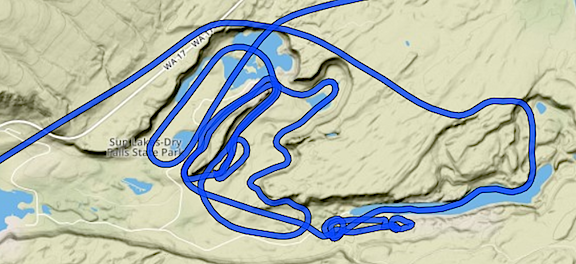
Here’s a closeup of my track, recorded automatically by ForeFlight, for the time we were in the Dry Falls area. What’s ironic here is that we flew around in a noisy helicopter for a good 15 minutes and likely bugged the hell out of people on the ground. A drone probably could have gotten the same footage without disturbing so many people. (Of course, it would have taken most of the day.) But because Dry Falls is a Washington State Park, drones are prohibited. Go figure, huh?
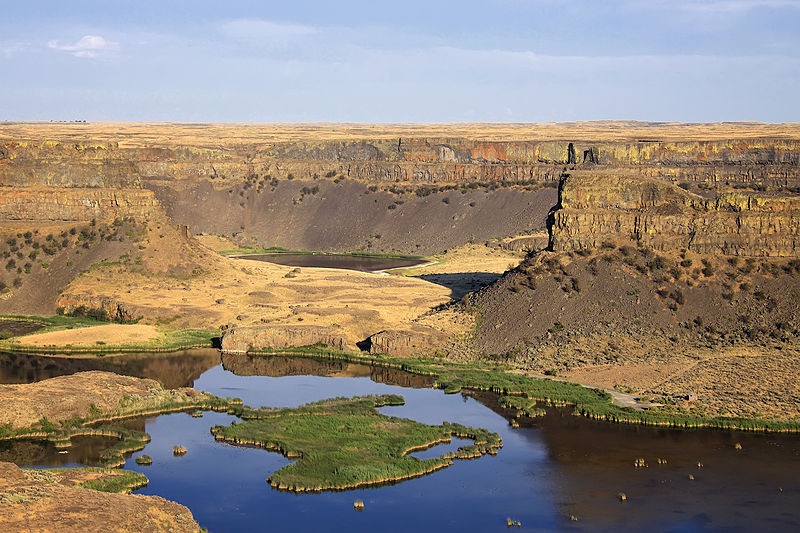
Dry Falls
Photo of Dry Falls by © Steven Pavlov / http://commons.wikimedia.org/wiki/User:Senapa, CC BY-SA 3.0, https://commons.wikimedia.org/w/index.php?curid=16059590 I think that most of the footage shot from my helicopter and used in the documentary was shot in this area.

After refueling at Moses Lake — we’d flown about 2-1/2 hours since leaving Spokane — we pretty much high-tailed it back to Spokane. Then we did two flights south past Cheney and east of Ritzville. That’s where the Drumheller Channels are. I’d never even heard of the place, but apparently it’s one of the best examples of the Channeled Scablands. One flight was with the same group on board; the other was with the geologist you see in the documentary. When the geologist was on board, the client’s own videographer flew with me, sitting beside me to shoot the geologist in the seat behind me as he spoke about what we were flying over. That’s probably also when they got footage of my helicopter’s panel and even me. Those two flights each took about a 1-1/2 hours with refueling in Spokane between each one.

After that, we were done. I dropped everyone off in Spokane, retrieved the door, and put it back on. Charley and I sped back to Wenatchee where we went our separate ways.

I think the whole gig was supposed to be just 5 hours, including travel time, but I flew (and billed for) more than 9. It was a very lucrative gig. But what was [almost] better was how much I saw and learned about the geology of the state. That’s one of the reasons I like doing aerial photo work; I get to see and learn a lot.

The Documentary

I have to admit that once my invoice was paid — which took a little effort since the money was coming from the UK — I didn’t give the project much thought. I didn’t even blog about it. That’s probably because last summer was very busy for me and I did a lot of cherry drying work. I even dried cherries later that day. I’d stopped blogging about my interesting flights, although I really don’t know why.

So imagine my surprise when a lawyer friend asked me yesterday in an email if he’d just seen my helicopter in a NOVA episode.

I went online and found the NOVA episode titled Killer Floods immediately. And although I rarely watch television during the day, I’m recovering from a cold and figured it was a good way to kill an hour. So I sat down, fired up the Roku with PBS, and watched it.

Let me start by saying I generally like NOVA documentaries. At least I used to. They’re filled with facts and good videography and leave you feeling better educated about topics than you were before you watched them. But I don’t know if it’s a general trend in documentary filmmaking or just a new NOVA style, but it seems to me that they’re trying too hard to sensationalize the topic or apply it to today’s world.

Two things immediately struck me about this one.

First, the name: Killer Floods. This particular documentary covered three flood events, all three of them were prehistoric. So although it’s likely that they killed something — plants? animals? — they didn’t have an impact on man at the time. In addition, their significance was not the fact that things were killed but more that the flooding changed the shape of the landscape by suddenly and violently eroding and washing away rock.

Second, the attempt to suggest that the three floods documented in the video have anything whatsoever to do with today’s flooding due to climate change. They managed to include footage from the flooding in Houston from Hurricane Harvey — a mere two months before air time! — which has absolutely nothing to do with these three prehistoric floods. Yet the narrator suggested that they might be related. I think that’s stretching it beyond reasonability.

But hey — I get it. They want people to watch so they come up with sensationalized names (see also Killer Hurricanes and Killer Volcanoes), and try to get people interested by pointing to recent events that they’re familiar with. After all, is the average person going to be interested in a documentary about how three prehistoric flood events changed the landscape in relatively remote areas of Central Washington State and Iceland or under the English Channel? I doubt it. NOVA is competing with reality TV, sitcoms, and sports. While I’m interested in just about any topic NOVA covers, most people aren’t. Sad but true.

That said, I thought the documentary was well written and produced, with plenty of good videography, interview clips, and narration. It walked viewers through the logical process of figuring out how each of the three landscape formations they were researching were actually made. (I already explained the one in Washington State; I’ll let you watch the documentary to learn about the other two.) The Washington one was a bit slow for me because I already knew the answer but I found the other two fascinating. I’ve been planning a trip to Iceland for late next summer and may extend it a few days to take in some of the sights shown in the documentary. And now I have a fresh desire to see the White Cliffs of Dover.

But what really tickled me was seeing my helicopter near the very beginning of the documentary, with the Flying M Air logo prominently displayed. Later, a shot shows my door with my name on it. And somewhere else near the beginning, you can see the helicopter’s controls and even a quick shot of me looking like a bit of a bum in my gray sweatshirt.

Those glimpses were enough to get my brother, who never picks up the phone, to give me a call yesterday evening. “I’m watching NOVA. Is that your helicopter?”

And that set off an hour-long conversation about all kinds of things. Heck, I talked more with him yesterday evening than I had all of last year. (Seriously: he just doesn’t like to talk on the phone.)

This obviously isn’t the first time I’ve been involved in a video production. I’ve been flying this helicopter since 2005 and have done countless video/photo shoots over the past 13 years. But I’m pretty sure this is the first one that has appeared on PBS or a highly respected documentary series like NOVA.

It’s about as “big time” as my little company will get — and that’s okay with me.

If you’re going to watch it, watch it soon. The website says it “expires” on December 7. If you’re really interested in flood-related geology, why not get the video? You can buy it on iTunes.

Look for me in the credits.

Dealing with Two Colds in Three Months

It’s really all about rest.

It’s funny how when you pay attention to your body it tells you things about yourself and the way your body works.

The September Cold

Back in September, a few days before I was due to head out on a trip to Lopez Island, I got struck down by a cold. It came upon me suddenly with a lot of sneezing and a very runny — more like drippy — nose. (I call that leaky faucet nose.) I assumed it was an allergy attack. I’ve had “hay fever” my whole life and moving to the west — first Arizona and now Washington State — really reduced the number of attacks I get. But I was working outdoors that day in a dusty environment and I assumed that either pollen — the sagebrush was blooming — or dust had triggered the attack. I walked around with a tissue box, which I brought with me when I went out to dinner with friends. “Just allergies,” I assured them.

But it wasn’t allergies. The symptoms persisted throughout the night and I woke the next morning feeling like crap. Weak, achey, miserable. I realized then that I had a cold and began to panic. I was really looking forward to that Lopez trip and knew how horrible traveling with a cold could be. (It had ruined vacations in Hawai’i and the Bahamas.) I was determined to recover quickly.

Alka Seltzer Cold Medicine
Alka Seltzer Plus is what really helps control my cold symptoms. Keep in mind that no cold medicine “cures” a cold. The best you can hope for is to control symptoms so you can get some rest.

So I spent the whole day in bed, drugged up with whatever cold meds I could find in my medicine cabinet. That was mostly Alka Seltzer cold medicine, which happens to work great for me. Daytime formula during the day and nighttime formula for night. I slept most of that first day, getting up only to feed Penny and the cats, let Penny out a few times, and gather eggs from my chickens. I found some frozen chicken soup in the downstairs freezer and heated it up for lunch and dinner. I had orange juice in the fridge and drank all of it. The whole day went by in a sort of fog. It’s fortunate that my calendar was empty; I would have had to cancel everything on it, including any revenue flights.

The next day, I felt human again. Almost good. I got up and started my day as usual: coffee, catching up on news, etc. I’d planned to take it easy again and did — at least for the first half of the day. I read on the living room sofa. I wasn’t tired enough to nap, so I didn’t.

Later in the afternoon, I ventured outdoors to take care of a few chores. I did more than I expected to do, but I monitored my condition carefully and came inside at any sign of fatigue. My symptoms were controlled by cold medicine and I was okay.

I was very surprised to be feeling fully recovered just a few days later, in time for my trip to Lopez. I thought long and hard about how that quick recovery and I realized that for the first time in my life, I’d done something I’d never done before: surrendered an entire day of my life to a cold.

Could that be the answer to a quick recovery? Just spending a whole day in bed?

I’d read in numerous reliable places that the common cold took 5-7 days to pass. I’ve had colds in the past that have lasted weeks, with lots of suffering every day and even a few doctor visits. Yet the symptoms for mine had come and gone in about 4 days.

Lucky? Maybe.

The November Cold

Unfortunately, I have the opportunity to try to repeat my fast recovery this week.

I flew home from Arizona on Saturday morning and immediately got to work putting out fires (so to speak) at my house. My housesitter had done a good job taking care of things while I was gone and left the house immaculately clean (which I really appreciate) but since I wasn’t expecting the temperatures to dip below freezing while I was gone — hell, it was in the 60s every day right before I left — I didn’t give him instructions for the chickens water. It was frozen and the poor birds had apparently been trying to peck through the ice. So I had to get them set up with their heated water dish for winter. They’d also run out of food — I thought what I’d left them in their feeder would have been enough. They didn’t seem to be suffering at all, so I suspect the situation had been short term. No harm, no foul (no pun intended).

I also had to struggle to deal with a frozen hose (which I’ll need to wait until warmer temperatures to resolve), my mousers running out of dry cat food, and clearing space in my garage for a friend who was bringing his boat over to store for the winter.

So I was running around like a nut all afternoon and most of the next day.

It was on Monday afternoon — notably three days after my commercial airline flight — that those “allergy” symptoms started in. I had just cleaned the chicken’s roost area in the coop and put down some bedding pellets. The pullets were on the perches in there and did a lot of panicked flapping around as I worked. The sneezing and runny nose started within 10 minutes. Damn birds. The dander must have gotten me.

But the symptoms persisted through my dentist visit and the rest of the afternoon. And that evening. By night time, I knew it wasn’t an allergy attack.

Puffs w/Vicks
My #1 choice for tissues when I have a cold is Puffs with Vicks. My mother used to put Vicks VapoRub on our chests when we had colds as kids. I don’t know if it helped, but the smell of Vicks is forever associated in my mind with cold recovery. These tissues are very hard to find in stores.

I got on the nighttime cold medicine before bed. I still had a miserable night, tossing and turning, blowing my nose enough to build a mountain of dirty tissues beside me.

In the morning, I felt super crappy with a headache the size of the migraines I used to get years ago. (Honestly, if nausea had accompanied it, I would have called it a migraine.) After the sun rose, my bedroom, with the lights off, was too bright — even though it was overcast all day. I got up only to let out Penny, give her some food, and take some drugs. I had grapefruit juice in the fridge and drank a bunch of that. I felt too weak to go down and check the garage freezer for more chicken soup. I went back to bed. Penny, obviously sensing that something wasn’t quite right, snuggled up between me and my dirty tissue mountain.

I cancelled my dinner date with a friend and blew off the wine tasting I was supposed to attend afterwards.

I slept most of the day.

Around 3 PM, I got up and made myself something to eat. A salad with sardines. (Don’t knock it; I like sardines.) I cursed myself for packing the balsamic vinegar into my camper (which is waiting for me in Arizona) and not buying a fresh bottle for home. I tore down and discarded my tissue mountain. I let Penny out again and went back to bed. I slept more.

In the evening, woken by that damn headache, I got up to take some more ibuprofen. I let Penny out again. I went into the garage and gave the cats a can of food. I let Penny in. Then I settled in on the sofa with a throw blanket and glass of grapefruit juice to catch up with Stephen Colbert’s Late Show. I felt a little better, but not much. At least I could stay awake.

After about an hour of that, I was exhausted. It was only 7 PM. I surrendered, took some more nighttime cold medicine, and climbed back into bed. I read for about 10 minutes and then fell asleep.

I slept pretty well until about 3 AM. Then I woke up feeling pretty darn good. I hung around in bed, catching up on news via Twitter. (Lots of good news about yesterday’s election. Hooray!) Then, at about 4:30 AM, I decided that my internal clock would just have to stay screwed up for a while and got out of bed to start my day.

With coffee.

I’ll take it easy today, but will get stuff done, mostly indoors. I have a lot of paperwork to catch up on after my two-week trip south. Maybe I’ll finally finish unpacking my books. And I’m sure I’ll take a nap.

My goal is to rest up enough to be completely recovered by Friday. I think it’s possible if I don’t push myself.

Lesson Learned

And that’s the lesson I’ve learned in dealing with these two colds: when a cold strikes, give in to it. Just treat the symptoms with whatever cold meds can help you get rest. Sleep as much as possible. Stay warm and comfortable. Rest, rest, rest.

If it’s just a cold — not the flu — a quicker-than-average recovery might be possible. But not if you push yourself.

And if you’re feeling good right now, go out and get a flu shot. I haven’t gotten mine yet — shame on me — but will definitely get it as soon as I feel 100% recovered from this cold.

Bulk-Deleting Facebook Data

I’ve finally found a solution that works.

Years ago, I decided I wanted less personal data on Facebook. I figured I’d delete posts from past years, so only posts from the past year or so would remain. I’d do this regularly, at least once a year, to get rid of the old stuff. At least that was the plan.

Discovering that there was no built-in bulk delete feature really put a damper on my plans. You see, on Facebook, if you want to delete you posted or “unlike” something you “liked,” you had to make three clicks for each item. Click a menu, click an option, click a confirmation button. The folks at Facebook obviously did that to make removing old content as difficult and tedious as possible so the average person just wouldn’t do it.

Not being “average,” I’d periodically delete about a month’s worth of stuff. But then even I succumbed to the futility of it all. I figured that the best way to minimize stuff on Facebook was to post less there — which is what I do now. (I basically just share links to my blog posts.)

I tried other solutions I’d found via Google. None of them worked reliably.

Until yesterday. I found a Chrome extension called Social Post Book Manager. It looked so promising, I downloaded Chrome just so I could install and try it.

It isn’t sleek or fast, but it is functional. Here’s how it works.

Start by logging in and going to the Activity Log for your account. Use the filter options on the left side of the page to display just the type of thing you want to delete. For example, if you want to unlike everything you’ve liked, click Likes. Facebook displays only the items that meet the criteria you specified in the filter.

Now go up to the URL bar in the Chrome browser. You’ll see a tiny blue and red icon there. Click it to display Social Post Book Manager’s options.

Social Post Book Manager

Set the options as desired. This enables you to filter by year, month, and search word or phrase. If you’re brave, turn off the check box so you don’t review the changes before they’re made. (I’m a coward and left it turned on for the first few times I used it, but it really slows things down.) Then click the appropriate button at the bottom of the box and stand back.

The longer the period you’re working with, the longer it takes to do the job. I first deleted posts that included the word “twittering” from 2007; those were automatically posted by an app that took Twitter content and posted it to Facebook. The search took about 10 minutes. When I clicked the confirm button, it took another 10 minutes for those to be deleted. Deleting all Likes from 2012 took considerably longer. Like hours.

While the extension is running, you basically have to leave it alone. The screen will flash with a dialog box that disappears before you can click anything. Do something else — but not on Facebook. You must keep that page open without changes while the extension works.

When it’s done, the items it found are permanently gone.

Using it for the past few days has taught me that the extension works best when set to slower speeds. When left at the default speed, it often misses many items. So it’s necessary to redo a period over and over to get it all removed. But no matter how long it takes, it’s a lot quicker than manually deleting or unliking content. Best of all, you can set it up to do a long period of time and then leave it while you do other things. I think of it as a multitasking partner.

And the one thing I’ve learned from this experience: I’ve shared and liked way too much crap on Facebook. Seriously. What was I thinking?

Tired of having Facebook share your life and preferences with the world? Give this a try and get some of that data off Facebook.

My MATE Bike: The Wait is Finally Over

It’s a nice bike, but I honestly can’t recommend it. Here’s why.

Way back in September 2016, I blogged about ordering a MATE foldable electric assist bicycle. It was offered through an Indiegogo crowd funding project. The makers wanted to raise $60,000. They wound up raising over $6.1 million.

From Copenhagen my ass
The Overview of MATE’s Indiegogo campaign, which still appears on the Indiegogo site. From Copenhagen? Not exactly.

And that’s where everything went south.

The Delays

If you’ve come to read a review and don’t want to read my whining complaints about delays, damaged parts, and customer service issues, click here to skip ahead. But if you want the whole story from an actual funder, keep reading.

You see, they sold a lot of bikes — apparently enough to make them cheaper in China. So they sent the project there and spent months working with a Chinese manufacturer to get the bikes made. This added huge delays to the project. I was originally supposed to get my bike in September or October 2016, which would have been in time for my annual migration south. But instead of a bike, I got numerous progress report emails that apparently went out to everyone in my situation all over the world. Emails about new features available. Emails about working through design bugs. Emails about picking a color. Every few weeks, there would be another one, but none of them would specify a delivery date.

I went online when directed and set up an account on the Mate website. I picked a color (red). I changed my shipping address to where I’d be that winter. Later, when I left Arizona, I changed my address back to my home address. I reviewed my invoice to see if I had to pay any VAT tax (I didn’t) and tried to understand the confusing instructions about finalizing payment (I had paid in advance — over $1,000).

Months went by. When the emails came, I’d scan them to see if there was any delivery date. There wasn’t. These people wasted a lot of words on email messages that talked a lot about progress but delivered nothing.

I emailed them. I got canned responses about them being busy dealing with the amazing response to their incredible bike. I seldom got any response from a real person and, when I did, it didn’t answer my questions about when the bike would arrive.

After a while, I started to think the whole thing was a con. I contacted a friend of mine in New York who had bought one. He didn’t have any more information than I had.

More Problems with Shipping

Finally, in August 2017 — yes, eleven months later and at least nine months after the the original expected ship date — my bike was shipped. I got an email message about it and was hopeful. But if I’d read the message more closely, I would have anticipated the phone call I got from my friend in Arizona. The bike had been shipped to his house.

I went online. I looked at my record on their website. There was a billing address and a shipping address. My address in Washington appeared in both places. The Arizona address did not appear anywhere.

But now there was a 50+ pound box for me sitting in Arizona.

By some miracle I was able to get someone in MATE’s Customer Service who put me in touch with a woman in California who dealt with shipping. She had a Chinese accent. I suspect that she worked as a shipping agent for the Chinese manufacturer. She was very apologetic. After some back and forth by phone and email, she sent me a PDF for a UPS shipping label. I sent it to my friend. He printed it, stuck it on the box, and brought it to UPS for me.

“By the way,” he told me in a text, “the box is pretty beat up.”

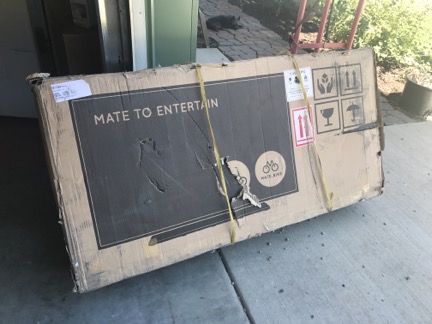
Mate Shipping Box
My MATE finally arrived at my home in August, eleven months after paying for it.

The box was still beat up when it arrived and I made sure the UPS driver noted the damage. I took a photo of it before I opened it. The brown outer box fit snugly around a MATE inner box — the same kind of packaging Apple uses to ship computers. That inner box had some dings but nothing had fallen out.

A Damaged Part

The next day, I set about assembling the bike. It was mostly assembled; just a few pieces had to be put on. Putting on the front tire was Step 1. For some reason, however, I couldn’t get it on.

That’s when I realized that the front fork was bent. Badly. As if it had been crushed.

In all fairness, the packing job looked good. There was lots of foam and everything was secured with plastic wire ties. Everything fit tightly in the box; nothing had rattled around during shipment.

The damage to my fork, however, had likely been caused by a crushing weight. Whether it happened before the bike was packed or when it was put into the container or while it was moving across the ocean or when it was removed from the container or when FedEx or UPS shipped to to my friend or me is something I’ll never know. And frankly, I don’t care. The bike arrived damaged and was useless.

Knowing how bad MATE’s customer service was, I took the bike to two bike shops in Wenatchee to see if they could fix the fork. Biking is a big sport here and we have two excellent bike shops right in town. They both said the same thing: the fork was too badly bent and I needed a new one.

Crap.

I contacted my friend in New York. His bike had arrived damaged, too, but not as badly as mine. They’d been able to get the wheel on, but he admitted that it had been wobbly. I don’t think he was impressed.

Of course, there was no customer service phone number. The woman I’d worked with on the shipping issue could not help. I emailed MATE. About a week later, I got a message telling me to fill out a form on their website. I did.

Then I waited.

And waited.

I went online and filled out another form. I included photos of the damaged fork, as instructed. And I waited.

And waited.

I started sending emails to the same address I’d been communicating with. I got no response. None.

Meanwhile, I’d begun following @Mate_Bike on Twitter. When someone tweeted a photo of their new headquarters with a bunch of MATE bikes parked out front, I went ballistic. I’d helped pay for those headquarters and I had nothing to show for it other than a bike I couldn’t assemble. I tweeted a nasty response.

Any time @Mate_Bike retweeted someone’s praise for the bike, I’d reply that they were lucky to get one that worked. I was going to be the squeaky wheel, making sure that other folks knew about the crappy customer service I’d been getting.

And it worked. After a few tweets, I got a direct message (private tweet) from MATE. They were looking into my problem.

More time went by. I kept tweeting. I began using direct messages to nag them. I still can’t believe it was necessary to be such a whiney bitch.

But it was apparently the only thing that worked. I finally got a message saying the part had been shipped. I asked several times for a tracking number and after a week or so they sent me one.

And then, two full months after the bike arrived damaged, the new fork arrived.

Yes, I waited two months for them to replace a damaged part.

Assembly

I took the bike, which was back in its box, and the new fork to one of the bike shops in town and told them to assemble it for me. I was tired of screwing around with it. If there were problems with other parts — which was possible since I hadn’t been able to get past step 1 of the assembly instructions — I hoped they could deal with it.

They did. The fork arrived partially crushed but they were able to repair it well enough to put it on the bike. They got the bike assembled and even took it for a test ride, although they didn’t seem able to figure out how to get the motor running. (They thought that something needed to be in the USB port on the computer to turn it on; in reality, the port is provided to provide battery power to a mobile phone or other device.) They did, however, charge it up for me. So when I returned the next day, in pouring rain, I had a working bike.

Not a moment too soon. It was Friday. I was due to leave on my two-week autumn vacation south on Sunday. One purpose of the trip was to reposition my truck and camper in Arizona for the winter. If I didn’t get the bike on board my truck before I left, I wouldn’t have it with me for my big winter vacation.

Of course, it was raining like hell all day Friday so the only place I could test ride it was inside my garage. My garage is big, but not really big enough to test out a bike. Because I was kinda sorta hoping to leave on Saturday, I folded the bike up and packed it in the truck that morning.

First Test Ride

It wasn’t until Monday, at an autumn leaf strewn campground along the Salmon River in Idaho that I got a chance to finally test it out. The campground roads were paved and there was only one other camper around. I pulled it out of the truck, unfolded it, inserted the key in the lock, and turned it on. I turned on the computer display. I got on and started to pedal.

The electric assist gave me a little push between pedals. I dialed it up to help more and it did. I dialed it down to help less and it did. I used the “throttle” lever and let the electric motor do all the work.

Yes, the bike worked as advertised. And from what I’d seen so far, I liked it.

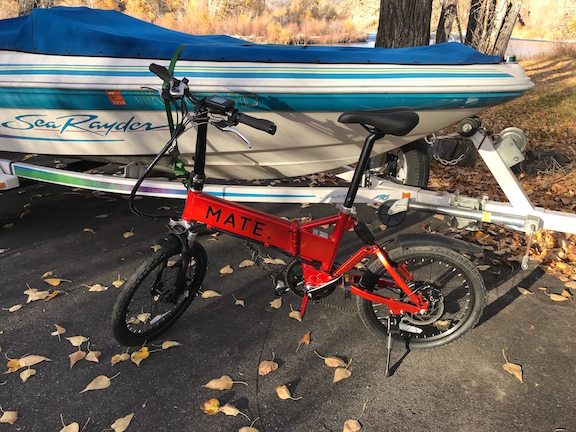
Mate Bike
Here’s my MATE bike, parked after my first real ride in an Idaho campground. Does that look red to you?

Of course, I couldn’t seem to set the on board computer to display distance in miles instead of kilometers. I tweeted to MATE about that and was shocked to get a fast response with an image laying down step-by-step instructions for getting the job done. When I finally got around to trying them a few days later, they worked. (Unfortunately, when I tried them again to change the bike’s maximum speed, I couldn’t get back into the settings. I shut the bike down with the key and tried again in the morning; it worked. Go figure.)

The Big Test Ride

I put the bike through its paces on Sunday. I was winding up the traveling portion of my vacation and my last night on the road was in Natural lBridges National Monument in Utah. I found a campsite in their very pleasant campground but the parking area was so small I had to unhitch the boat I’d been towing for the past week and leave it parked on a gravel area near one of the restrooms just so I could back the camper in. Once I was parked and semi leveled, I wasn’t interested in moving the camper. So I decided to take a bike ride through the park. I knew there was a paved loop road with overlooks and figured that the bike should be able to handle it.

When my campground neighbor saw me getting on the bike with Penny in my backpack, he asked if I was doing the loop road. I told him I was.

“It’s nine miles long,” he told me. “And it has some pretty steep hills.”

I told him the bike had electric assist and should be able to do it. I sure hoped it would. The return trip was uphill and I had no desire to walk several miles rolling a bike with a dog on my back.

It didn’t take long to fully understand the power assist feature. It has six levels of assistance: 0 (none) to 5 (the most). It seemed to work at certain speeds (depending on the setting) when I pedaled down on the left pedal. So it was like a pulsing timed with my pedaling. Kind of annoying, frankly.

The model I bought also has an independent throttle that I can use whether I pedal or not. That’s limited to the speed you can set in the computer. (Which is why I wanted to try to change it; it was too slow.) It seems to have plenty of pep on level ground and gentle uphill climbs. But when roads get steeper — as the loop road did — the motor can’t seem to keep up. I soon learned that if I kept the bike in top gear (7) and pedaled while using the throttle, I could keep the speed above 15 miles per hour and not get fatigued with pedaling.

The trip computer crapped out on me once during the ride. It registered zero speed and the odometer didn’t click. I had to turn it off (thus turning off the electric motor) and then turn it back on to get it to work again. I have a feeling that the computer is going to be a problem in the future.

Going down hill with pedal power only is pretty fast. At one point, I had it up to 30 miles per hour, which probably wasn’t a good idea. But the bike is very solid and stable. It felt good, even at that speed. The brakes work well, although they do squeak a bit.

Mate at Natural Bridges
My MATE bike parked near one of the bridge overlooks at Natural Bridges National Monument. I’m thinking it’s orange.

I answered a lot of tourist questions about the bike when I stopped at viewpoints. My speed was almost enough to keep up with the people driving the road (where the speed limit was 15 mph) and making the same stops as me so I saw a lot of the people a few times. The bike obviously looks different and that starts conversations.

The battery seems to last well. It was fully charged a little over a week ago and I put nine miles on it Sunday after about two miles of screwing around with other short rides last week. When I finished on Sunday, four of the five battery level indicator bars were still solid. I can’t remember offhand how long MATE says the battery should last, but I’m sure I’ll get at least 25-30 miles out of a charge, even using the motor as much as I did on the loop road.

On ease of folding, I give it a 6 out of 10. The handlebars fold down and then the bike folds in half. There doesn’t seem to be any way to hold the two halves together; I use a bungee cord. Once the bike is folded, it’s awkward to roll. And it’s heavy — more than 50 pounds — so it isn’t very easy to lift in and out of the back seat area of my pickup truck, which is where it’s riding on this trip. I have learned to fold and unfold it right next to the truck door.

And the manual? Very nice looking waste of paper. It has very little useful information in it. I shouldn’t have to figure out how the bike works. The manual should explain it. And I shouldn’t have to use Twitter to get instructions for setting the computer with miles instead of kilometers. That should be in the manual, too.

Do I like it? Well, it meets my needs: it provides portable transportation that I can take with me in my truck, boat, or helicopter. The electric motor, if fully charged, will give me a good range on steep uphill climbs that I likely would not be able to pedal on my own. That means I don’t have to worry much about how far I might have to ride from, say, a landing zone to a local restaurant or motel.

But do I like it? I really don’t know yet. I don’t think I regret buying it, and that says a lot. But after talking to other people about electric bikes they’ve used, I’m not convinced this one was worth the wait and aggravation.

Customer Service is a Real Concern

Despite any level of satisfaction I have with the bike itself, customer service remains a serious concern.

What I want to know is where the customer service person who finally helped me with the fork issue and was so prompt with computer instructions was last year when I was waiting for my bike to arrive and two months ago when I first reported the fork problem. It’s almost as if it took the company fourteen months to set up a decent customer service department and even then, it only works through Twitter.

So no, even though I like the bike I honestly can’t recommend it to anyone.

Why would I? Until recently, I’ve had almost zero customer service. I can imagine recommending the bike to a friend and that friend having the same frustrating experiences I have had. And that friend coming to me and saying, “I thought you said this was a good bike?”

And don’t even get me started on the fact that when I dished out $1,000 for a bike thirteen months ago, I thought I was getting a bike made in Denmark. There’s no way in hell I would have bought the bike if I knew that manufacturing was being farmed out to China and I’d be waiting a year to get it.

This has been a big lesson for me about crowd-funding purchases. I realized that funding a project doesn’t mean you’ll get what you paid for timely. Or get any kind of acceptable customer service related to it. Or, in the case of Lily, an amphibious drone a friend of mine funded, it doesn’t mean that you’ll get what you paid for at all.

So even though I’ve now participated in three crowd funding projects through either Kickstarter or Indiegogo, I will not fund another one. Nothing is so amazing that I can’t wait until it hits the market to buy it from a real store with real support.

I just hope I don’t have any other issues with my MATE bike in the future.

Autumn 2017 Roadtrip Postcards: The Night Sky Photos 

So far, I’ve attempted night sky photography in two places: Horsethief Campground Just outside of Canyonlands National Park and Lower Onion Creek Campground in Castle Valley about 25 miles from Moab. In both cases, I shot before dawn because a waxing crescent moon illuminated the night sky until after I’d gone to bed. I’m not really happy with any of the images, but I thought I’d share four.
At Horsethief, the problem was that the night sky didn’t really get dark enough and there were some light clouds.

The night sky to the southwest. You can clearly see Orion’s Belt.


My Truck and camper, parked under the night sky. The light in the camper is a candle.


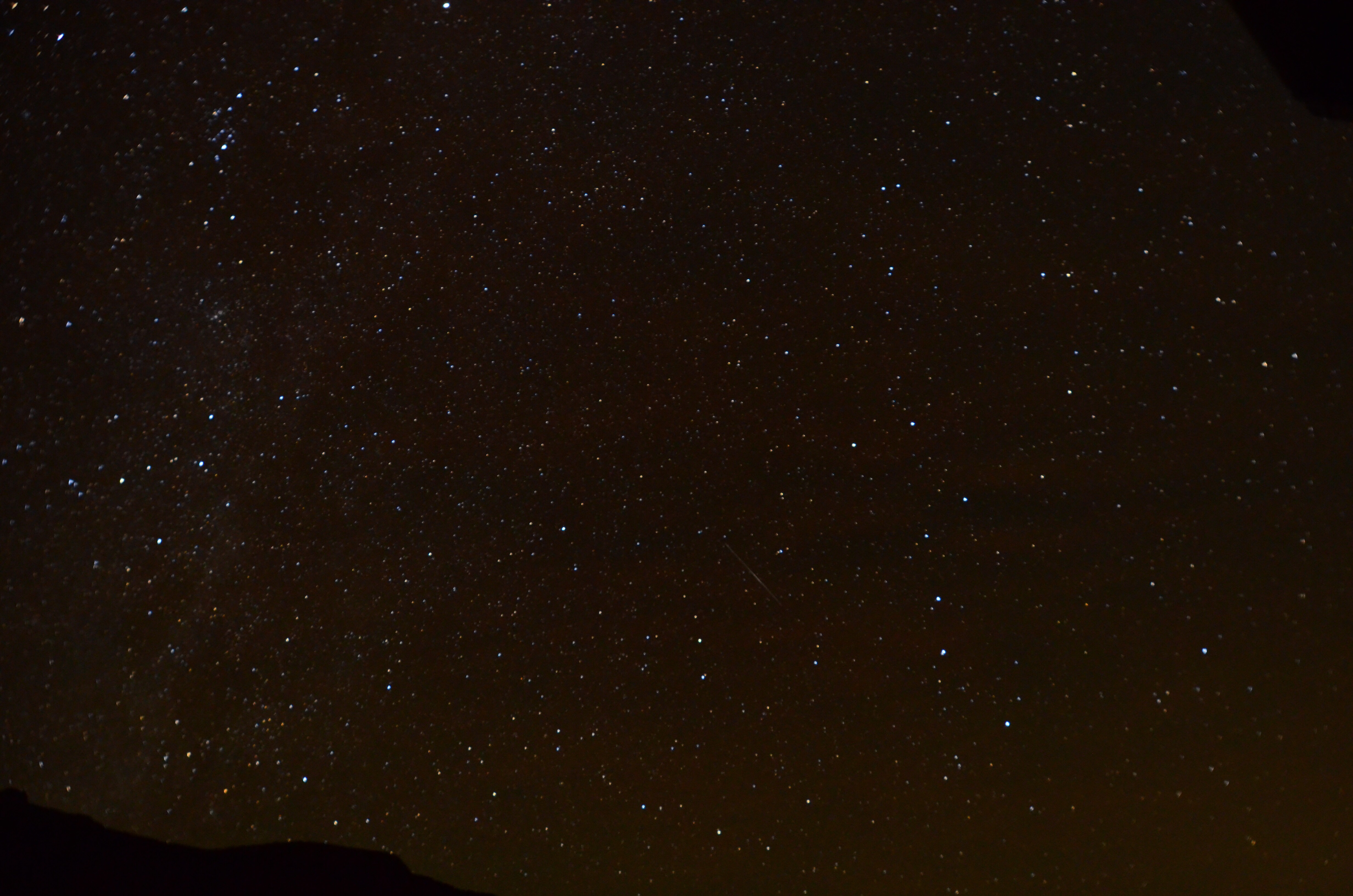
At Lower Onion Creek, the Sky was very dark. But the problem there was wind. Although I have my camera on a very sturdy tripod and stayed on the west side of the camper so it would shield me, there was enough movement to blur the stars. Very disappointing!

Milky Way on the left, Big Dipper on the right.

Another night sky shot with disappointing focus.