The Fuel Trailer

I get new life out of an old fuel transfer tank.

Way back in 2008, when I first starting doing cherry drying work in Washington State, the guy who got me started, Erik, told me that I needed to get a fuel transfer tank. He gave me the make and model of a tank and pump that he used: an 82-gallon Transfer Flow. This tank was DOT-approved in all states and made of steel. It was costly, but very good quality.

It didn’t come without problems. First of all, when they heard I wanted it for aviation fuel, they refused to sell it to me. I had to have my wasband call back and order it under his name. Second, the folks who put it together for me didn’t put the proper gasket in the pump so when I filled it the first time, it leaked like a sieve at the pump fitting. A $2 gasket fixed the problem.

A Mobile Tank

I originally had it installed in my first pickup, a miserable 1994 Ford F150. I’d bought the truck to leave on some property I owned in northern Arizona but it quickly became Flying M Air’s utility truck. Of course, it wasn’t up to the task of towing the 22-foot Starcraft RV I had in those days, so the following year it was mounted on my wasband’s 2001 3/4 ton Chevy Silverado, which I took north for a few months every summer. The tank’s DC pump was hardwired to the battery so I didn’t need to deal with cables. Somewhere along the line, I painted it white, mostly so it would stay cooler in the sun — who wants a black fuel tank? — but also so it would look better in my wasband’s white truck. When the divorce started happening in 2012 and my wasband’s mommy decided that he wasn’t going to let me keep the truck in the divorce after all, I had it moved out of his truck and eventually put into my new(er) truck, a 2003 Ford F350. When I killed that truck in December 2015, I had it moved into my much newer 2012 Ford F350.

So the tank has lived in four different pickup trucks in less than nine years.

I did use the tank every summer in Quincy, WA, during cherry drying season. I also occasionally used it for work in Arizona — I remember hiring my friend Janet one day as a fuel truck driver to bring it up to Seligman where I refueled twice during a wildlife survey job. (I honestly can’t remember which truck it was in back then.) By 2014, however, I was moved into my new home in Malaga, WA, and didn’t need a fuel source at the helicopter in Quincy. Instead, I fueled at the local airport when I went out on or came back from a flight. I didn’t really fly much in Quincy anymore — I hired guys to help me with my contracts and two of them were based there with their own fuel sources. So I didn’t need the tank and it was pretty much empty on the back of my truck.

When I decided to replace my fifth wheel “Mobile Mansion” with a truck camper, “the Turtleback,” I needed to get the tank off my truck. At the same time, I knew that if I just put it in my garage or beside my building, I’d likely never move or use it again. A better solution would be to put it on a trailer so I could continue to move it around and possibly use it again.

The Trailer

This spring, a Harbor Freight opened in Wenatchee, which is the “big city” near where I live. Harbor Freight sells tools and other related items. Most of what it sells is cheap junk made in China. (That’s okay, as long as you know what you’re getting and don’t set your expectations too high.) Harbor Freight also has a pretty large selection of you-bulld-it utility trailer kits. One was a 40-1/2 x 48 utility trailer with a 1090 pound capacity. At 6 pounds per gallon, the fuel would never weigh more than 500 pounds. Add maybe 100 pounds for the tank for a total of 600 pounds. Plenty of leftover capacity; better safe than sorry.
Trailer Kit
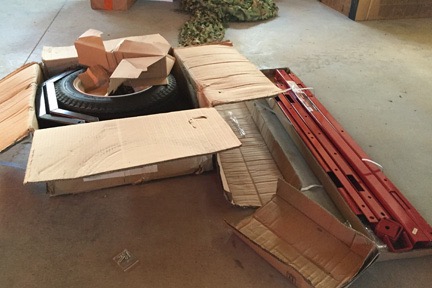
The trailer kit came in two boxes. Here are the pieces.

The trailer came in a kit. One day in April 2016, I set about putting it together in my garage. It wasn’t difficult, but it was time-consuming. The wheels had to be mounted on the axles, but they also had to have their bearings packed with grease. I’d never done that before but learned pretty quickly. And the wiring for the taillights was particularly tedious. But I did that, too, and apparently got it right because they work.
Finished Trailer
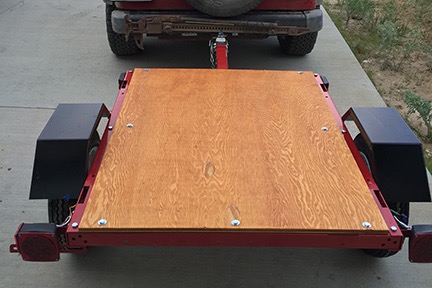
The newly completed trailer after dragging it out of my garage on the back of my Jeep.

Of course, the kit didn’t come with a deck. So I went to Home Depot with the measurements and had them cut a piece of heavy duty plywood the size I needed for the deck surface. I took it home, gave it two coats of waterproof stain, and used lag bolts to attach it at six points to the frame. When I was done, I was rather proud of my work.

The next thing I needed to do was get that very heavy fuel tank — which still had a bit of fuel in it — off my truck and onto the trailer. When it had been moved from my dead truck to my new used truck, the folks at the car dealer had used a forklift and I’d just strapped it in with tie-downs, knowing I’d eventually move it. I had no idea how much fuel was in it but I knew it wasn’t empty and I knew it would be heavy.
Tank on the trailer
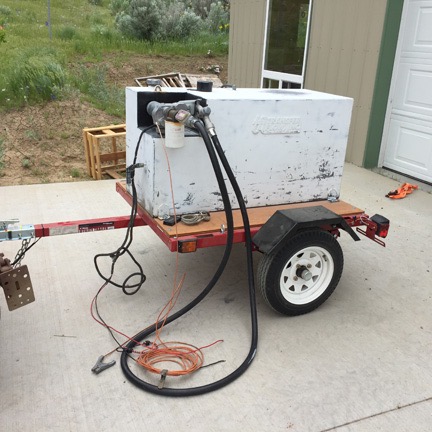
The tank just fit on the trailer.

Fortunately, my winemaker neighbor has a forklift. I drove the truck over there one day while he was working with wine barrels and he pulled the tank off my truck. Then I drove home, hopped in the Jeep, and drove it over with the trailer in tow. My neighbor placed the tank on the trailer bed. It just fit — honestly, I should have gone with the larger but less capacity trailer.

There were a few things I needed to do to finish up:

  • Bolt the tank down to the trailer. There were four bolt holes and I used lag bolts to do the job. But since I didn’t trust the bolts in the wood, I also put a pair of ratchet tie-downs across the top.
  • Paint the tank. I still had a can of white paint I’d bought years ago to touch up the tank while it was on my wasband’s truck. As the picture shows, it looks pretty shabby and I’d wanted it to look nicer on the truck. But I never got around to painting it. Now was the time. I gave it two coats.
  • Secure the hose and grounding wire. I was going to have custom metal hose rack made but the guy I was going to hire to do the job talked me into whipping something up out of wood. I later wound up tucking the hose into the tie-down straps and using a bungee cord to hold it in place in transit. That worked better than I expected.
  • Add alligator clips to the pump wires so it could be connected to a battery for power. The pump had always been hardwired to the trucks it lived on (with the exception of the last one). When I had it moved off the dead truck, they’d simply cut the wires at the battery. Clips would make it easier to use with any battery. I bought clips capable of handling the 18 amps the pump would draw and put them on.
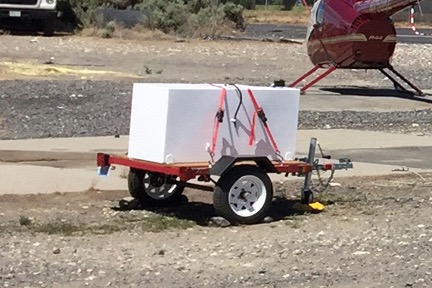
Tank on Site
This is the only photo I have of the tank sitting at the Quincy landing zone. In this photo, the helicopter it had been fueling had been moved. The hose and pump is on the other side.

I got all this done pretty quickly — and that was a good thing. I’d hired two guys to help me out in Quincy for cherry drying and only one of them had a fuel tank. I figured I’d let the other one borrow mine. So I towed it to the bulk fuel place, filled it up, and then moved it to his Quincy landing zone. He’d power the pump with the battery on his rental car.

Final Improvements

The tank sat in Quincy for over a month. The pilot towed it to the bulk fuel place and topped it off. Later, another pilot came and took his place, topped off another helicopter, and then refilled the tank again. Along the way, one of them allowed the pump fitting to get loose and 100LL — which is dyed blue — leaked all over the front of the tank and that nice wooden trailer deck, staining it all. It took me 3 minutes with a pair of pipe wrenches to fix the problem — apparently, that’s too much to ask some people to do.

I towed the tank — still full — home. Now I had 80 gallons of 100LL to offload. I had no desire to use the tank at home and no interest in storing it full over the winter. I topped off my motorcycle and my ATV, filled a 5 gallon fuel can, and managed to put some of it in the helicopter. It was a pain in the neck because I had to move my Jeep over to have something to hook the pump up to.

So I bought a battery to power it. We have a battery place in town that sells all kinds of batteries. I chose a small maintenance free model. I charged it up and it worked fine.
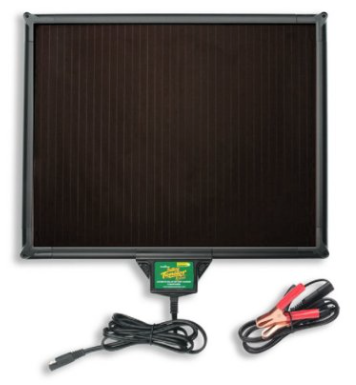
Battery Tender
This very small panel should keep the battery charged; we have plenty of sun here.

And I got to thinking that it would be nice if the battery just had a solar powered battery tender on it so it would stay charged. I did some homework and bought a small, 5 watt Battery Tender Solar Panel.

And then I thought that it would be nice if the battery was enclosed in a box with the solar panel mounted on it. So I built a box out of scrap lumber, painted it with some outdoor “Oops” paint I’d bought cheap to paint my beehives, put the battery inside, and mounted the solar panel on the side. (And yes, I did put a vent in the box; I even put some screen over it to prevent mice from getting in.) I screwed the whole thing down onto the deck of the trailer over one of the wheels. But before I did that, I repainted the tank, using up the rest of the white paint I had to hide the dye stains and make it look cleaner.
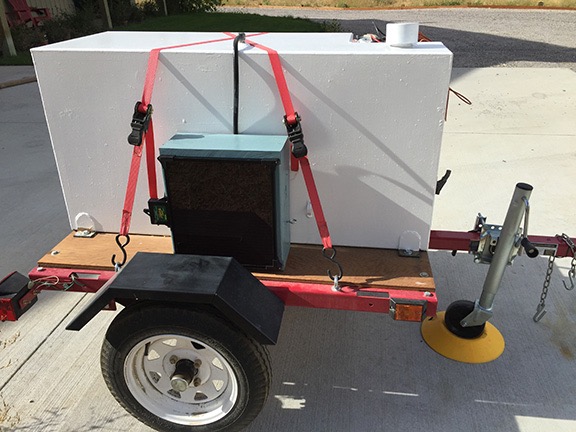
Finished Tank Trailer
The end result was very polished looking and very functional.

The only thing I still have to do is connect the wires for the pump to the battery. The tank is empty enough to store it for the winter so I probably won’t bother until spring.

I figure I have about $2K invested in this setup — the tank was the most expensive part of it. It’s DOT-approved and road legal. It’ll likely be used annually in Quincy by one of my pilots and may get some use at events that aren’t close to an airport. But I have no interest in fueling at home. All of my flights either start or end at the airport so it’s a lot easier to just get fuel there.
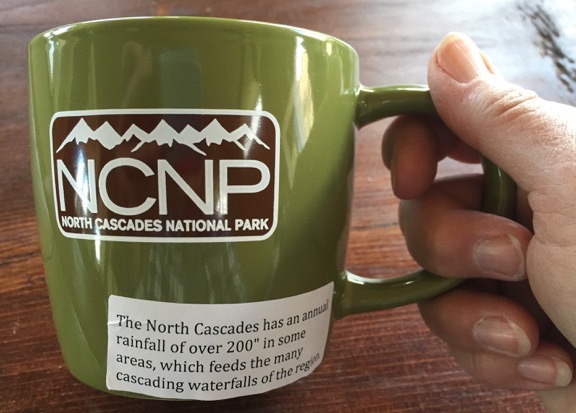
The Sticker on the Coffee Cup

Logic, U.S. government style.

Last week, I was in the North Cascades National Park. On a whim, I stopped by the Visitor Center at Newhalem. In addition to the usual interpretive displays, they have an excellent three-dimensional map of the area that identifies rivers and lakes and dams with lights; push a button and a red light appears on the map to show you where that thing is. They also had a ranger standing at a table with a bunch of reproduction animal skulls (wolverine, wolf, and bear) and corresponding paw castings and pelts. And a gift shop.

I went into the gift shop before leaving because … well, that’s what I do. I found some interesting kids’ stuff and picked out two gifts for my neighbor’s grandson, who has some learning disabilities. Then I saw a large coffee mug I liked — I like a big cup of coffee in the morning — and thought I’d buy it as a little gift for myself. But it had a paper sticker on it that had nothing to do with the mug. I reached for another, hoping to find one without a sticker and that’s when I realized that they all had stickers.

The sticker, which is shown below, says:

The North Cascades has an annual rainfall of over 200″ in some areas, which feeds the many cascading waterfalls of the region.

Sticker on Mug
This sticker was on every single coffee mug in the shop.

On a side note, I can definitely believe that rainfall figure because it rains every single time I go there. Although I like rain more than most people — probably because it rains so seldom where I live — I prefer getting rain at home instead of when I’m traveling. (Yeah, I know: whine, whine, whine.)

Of course, being the inquisitive person I am, I had to know why this sticker was on the mugs. So when I went to pay for my purchases, I asked the ranger at the check out counter.

He didn’t know. He said he’d never even noticed the stickers. He said he’d ask the guy who stocked the shop.

PFDs when flying across the Grand Canyon?

This brings to mind another side story that is related to this.

Years ago, the FAA changed its rules regarding personal flotation devices (PFDs or life jackets) on board flights conducted for tours. The new rule said that if any part of the flight crossed any body of water, a PDF was required for each passenger. This extended to Grand Canyon tours, which, of course, cross the Colorado River 5000 feet or more below the helicopter’s flight path. When I was a Grand Canyon tour pilot (which was before this rule came into play) the pilots often discussed that in the event of an engine failure, we should autorotate anywhere except to the water. The river was about 55°F, flowing at 10 mph or more, and full of rapids. When you’re doing an autorotation from 5000 feet, you have plenty of time to find and navigate to a more suitable landing zone; believe it or not, there are quite a few inside the canyon.

I spoke to the woman who created this rule — an aging FAA pencil pusher who had likely never flown across the Grand Canyon and reminded me of my sixth grade teacher, Miss Dumphy — and tried to tell her how silly (actually, idiotic, but I toned it down) her rule was. She didn’t care. Water was water; the way her rule was written, PFDs would be required when crossing a 3-foot-wide stream.

I didn’t have long to wait. That ranger walked by a moment later and the guy I’d asked called him over and asked him. He seemed almost embarrassed when he told me that they weren’t allowed to sell anything in the gift shop unless it provided some kind of interpretive or general information about the park.

Apparently, just having a logo on the mug wasn’t enough to satisfy some decision maker higher up on the food chain. The sticker was the solution.

I bought the mug as a practical memento of my visit to the park. I didn’t mind paying the price — which I honestly can’t remember — because I figured that it was another way to support the National Park Service. I didn’t need any additional information about the park to help me justify my purchase. And I definitely didn’t need a sticker that I had trouble scrubbing off once I got home.

But it makes me wonder … what other things are National Park Service employees being required to do to meet government guidelines established by someone in Washington who may have traveled to only a tiny fraction of the parks?

Mate: The Solution to a Problem

There is an ebike in my future.

I was minding my own business yesterday, checking in on Twitter, when I came across a tweet by my friend Mike in Brooklyn. He was linking to an Indigogo campaign about an electric bike. I’ve been looking at ebikes for some time now and clicked the link.

Indiegogo, in case you don’t know, is a website that entrepreneurs use to raise capital for new products. They create prototypes, produce slick videos, and put information on the site that includes support levels and perks. The perks are usually versions of the products or a chance to buy at a reduced rate when the product becomes available.

The video for Mate, the ebike Mike linked to, was slick in a way that only Europeans can make them. In it, the Mate designer described the bike while video clips played, showing off how fun and practical it was. I watched closely; I was interested in two features: motor control and foldability. When both features appeared, I was sold.

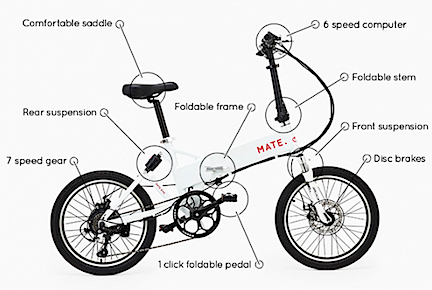
Mate
Nicely designed and feature-packed. This is the solution I’ve been looking for.

But Mate has more features that make it perfect for my needs. It has a good suspension with all-terrain tires — that means it’ll work on rough road surfaces. (The video shows it riding on cobblestones.) It weighs in at less than 50 pounds. It has an onboard trip computer that helps control the motor and keeps track of distances. The rechargeable battery is hidden in the frame so there’s no bulky box to deal with. There’s an ergonomic handle that makes it easy to lift if you need to carry it up a flight of stairs. And on the top-of-the-line S model, the battery can take you up to 50 miles and an independent throttle can get the bike up to 20 miles per hour. In other words, this bike can go the distance.

Although Mate isn’t cheap, it’s a heck of a lot cheaper than every other ebike or portable bike I’ve seen. Better yet, it’s a lot cheaper than the Honda Grom I’ve been looking at (about $4200) or the cost of getting my new used 100cc dirt bike street ready (about $1200). Yes, it won’t go as fast as either one of those, but I already have a road-ready motorcycle (and now a dirt bike) so I don’t need another fast bike. And with a Mate, I won’t have to worry about how I can take one of those motorcycles with me when I travel (the front hitch with bike carrier solution I was looking at would cost about $700). This will fold up and fit inside the Turtleback, my truck, or even — dare I say it? — my helicopter.

So I signed up for the Mate S. The way I see it, the money I saved by not going with any of the solutions I was already looking at paid for this ebike. And if it does fit onboard the helicopter, I’ll get a lot more use out of it. My only tiny concern is delivery; more than a few Indiegogo campaigns have failed to deliver in the past. This one looks pretty solid, though. I guess time will tell.

As for Mike, well his wife is getting one, too.

What’s Wrong with Being an Artist?

My reaction to a Wells Fargo ad that has my creative friends outraged.

One of my creative friends on Facebook posted the following ad image:

Wells Fargo Ad

His comment: “Oh, Wells Fargo, fuck off.”

His friends had similar comments voicing similar outrage.

Now if you were born and raised on the east coast — as I was — you might not understand the problem. I think east coasters are raised with a different set of values than the rest of the country. I suspect the person who created the ad and the one who approved it didn’t get it because if they did, it never would have appeared. While it plays to a certain group of people, it’s downright offensive to others.

I get both sides and want to explore them briefly here.

Career-Focused Parents

The ad creators were likely tapping into the hopes and dreams of parents who simply want their kids to achieve on a career path that they can be proud of. Back east, at least in the household I grew up in, that meant having a job title that could be equated with a good living. In other words, money.

I get this, possibly a lot more than women in my age group do. When I was in high school and was good in math and showed an interest in accounting, it was a given that I’d go to college and eventually be a CPA. My (lower) middle class family was all over that idea. They saw a CPA as someone who makes a lot of money. There was even talk of me eventually becoming an actuary — the folks with accounting degrees who made even more money.

For the record, none of that talk came from me. I didn’t want to be an actuary and, as my college time progressed, I didn’t want to be a CPA, either. I admitted to myself, in my junior year, that what I really wanted to be was a writer. (I’d been writing since I was 13 and still have those notebooks.) That’s when I got up the nerve to phone home and tell my mother I wanted to change my major to journalism. I’m sure seismologists are still talking about the minor quake caused by the fit she threw at me over the phone that day. Writers don’t make money, she told me. Do you want to be poor for the rest of your life?

Of course I didn’t — I’d had a good taste of that life when my father left us and we were trying to survive on my mother’s waitressing pay. So I stuck with accounting. Two years later, was working at the first of three jobs in auditing that made my first eight years out of college the nine-to-five grind I grew to despise.

I should point out that a lot of women my age were never pushed into careers the way I was. Although the ones with financial resources did go to college, it was understood that they were there for an “MRS degree.” (That was the big joke around campus.) So many of the ones I knew in the very expensive private university I went to — Hofstra on Long Island, if you must know; I got scholarships — hooked up with a male counterpart on a solid career track, got married, and put their BA or BBA or BS degree aside, never to be used. It was a given in the 70s and 80s that women got married, had children, and let their husbands take care of the finances. But my family never pushed me that way and when I was old enough to think for myself, I knew it wasn’t for me.

Neither was being a CPA.

My mother freaked out again when I left the last of those three jobs — where I was a financial analyst for a Fortune 100 company making more money at age 28 than my father ever made — to start a freelance writing career. But within a few years, I was making a good living and a few years after that, I was making an incredible (even to me) living. Doing what I wanted to do, building my own unique career path, making my own life outside corporate America.

But you see, the parents the Wells Fargo ad are appealing to don’t care what their kids want to do with their lives. Like my mother, they just want their kids to have potentially lucrative careers that they can brag to their friends about. After all, which sounds better:

  • Maria’s article about the new zika virus prevention measures being tested in Florida was just published in the New York Times.
  • Maria was just promoted to Director of Auditing at Wells Fargo Bank.

What I don’t think my mother counted on was my ability to succeed as a writer. I suspect “Maria just published her fiftieth book” satisfied her need to brag. And I don’t think “Maria just bought a helicopter” hurt either. Touché.

From the Creatives’ Point of View

To be fair, this Wells Fargo ad seems to take a slightly different tack. They’re pushing careers in science. It’s as if they’re saying to parents, “Sure, your kid might want to be a ballerina or actor now, but we can help you get him or her on the right track to a great career in the sciences.” It doesn’t take much to walk away with the message that a career in the sciences is much better than a career in the arts.

And that’s what’s offending my creative friends.

What’s wrong with wanting to be a ballerina or an actor? Or a writer? Or an artist?

In my opinion, if a kid has a real natural talent for dancing or acting or writing or painting or any other creative thing and loves to do it, he or she should be encouraged at every step. Nurture that love. Provide lessons and moral support. Help him or her succeed in doing something he or she loves.

Sure, a lot of kids will “grow out of” their love for a creative endeavor. But what about the kids who don’t?

Kids like me? I began writing stories when I was 13 and did it until I was deep into my 40s. Writing is in my blood, as it is with most writers. Blogging is an outshoot of this, a creative outlet for me — even though the stories I tell here are deeply rooted in fact and/or opinion. I never grew out of my love for writing. I was just smart enough to jump the tracks when I realized my career train was taking me in a direction I didn’t want to go. How many other people aren’t brave enough to do this? And get stuck with a career and possibly a life that they really don’t like?

Why would you pull a kid away from something he or she loved doing — and might actually be good at — and push him or her into a career they might not like? A career that would leave him or her feeling unfulfilled? Always wondering what life had been like if they’d stuck with the thing they really loved?

Imagine if the world’s great creatives had been pushed into “practical” careers and stayed there: Fred Astaire, Martha Graham, Tom Hanks, Meryl Streep, Pablo Picasso, Claude Monet, Ernest Hemingway, Mark Twain, Kurt Vonnegut? And countless others? Can you imagine how dull and empty our world would be without the creatives that make us think and wonder? Who entertain and enlighten us?

Are any of these people worth less than an engineer or botanist?

Success Trumps Happiness?

To me, the Wells Fargo ad represents a sad truth about today’s American society: It’s more important to be successful than to be happy. And sadly, success is measured by what you do, what you earn, and what you own.

Parents should want just two career-related things for their children’s futures:

  • The importance (to me) of financial security

    Because of my past, financial security is very important to me. I don’t want to be poor, I don’t want to move back to my mother’s home — even if it were possible. And I take great pride — which fuels my happiness — in my ability to make a decent living in my current career as a pilot. My financial security also helped me in my costly divorce battle, making it very easy to rebuild my life alone.

    I’m also very happy with the life I’ve made for myself, especially these past few years. I’m happy with my work and the amount of time I have to travel and play and spend with friends.

    None of this was handed to me; I worked hard to get where I am. The feeling of achievement I get almost every day also adds to my overall feelings of happiness and well-being, as I blogged in July.

    My parents should be satisfied, even though I never became the CPA they wanted me to become.

    Financial security. Can they support themselves, especially as they get older? No parent who cares about a child really wants that child living at home because they can’t support themselves. But under no circumstances should a child be pushed into a career because its earning potential is greater than the career that child wants.

  • Happiness. The way I see it, if you can wake up every morning — or nearly every morning — looking forward to that day, you’re happy. (I’m there now, but I certainly wasn’t there when the alarm went off at 7 AM and had to make a 30-mile commute to a job I hated. The memory of those mornings has scarred me for life.)

Note that is a bulleted list, not a numbered list. That means you can take those two points in any order. I guess the order you take them in determines, in part, the kind of parent you are.

Now where’s the Wells Fargo ad promoting careers as dancers or actors? You know, you can send a kid to a costly school for that, too.

My First Stab at Night Sky Photography

What I learned at a North Cascades Environmental Learning Center photography class.

I love the North Cascades Environmental Learning Center, which is not far from the Diablo Dam on Diablo Lake on the North Cascades Highway (Route 20). I got my first glimpse of it during a camping trip last summer and later that year returned to take a three-day course about mushrooms. This year, I returned for one night of Base Camp right before an overnight seminar titled “Wilderness Photography: Washington Pass at Night.” Here’s the course description, since I can assume the link to the course page will eventually break:

In the grandeur of the North Cascades, moonless nights with clear skies offer fantastic opportunities to capture vivid images of the galaxy.

Join photographer Andy Porter on this specially-scheduled evening expedition to capture images of the Milky Way on this moonless night. We’ll begin the adventure with a short evening workshop on night photography at the North Cascades Environmental Learning Center. Then we’ll head to Washington Pass where, under the towering peaks of Liberty Bell and the Early Winter Spires, Andy will guide us in capturing our own images of the night sky.

I could go into a lot of detail about my stay at the NCELC and the other things I did while I was there, but I’ll try to stay focused for this post. But I do need to talk briefly about the weather, since it did play a major part in how the course went.

The weather was not very good. It was overcast all day and rained more than a few times. Although the clouds were relatively high, there wasn’t a single clear patch in the sky. It was like this all day, which really didn’t surprise me — it rains every single time I come to this area. I like the rain, mostly because I don’t get much of it at home, but I really wish it wouldn’t rain in the mountains when I’m there.

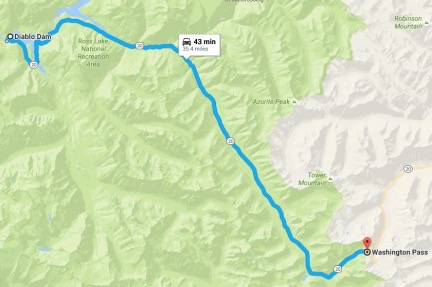
Diablo Dam to Washington Pass
Washington Pass is a 35-mile drive southeast from Diablo Dam on Route 20.

Of course, we weren’t supposed to take pictures in the Diablo Lake area. We were supposed to go to Washington Pass, about 35 miles east. I’d driven through the Pass the day before on my way to the NCELC and it had been partly cloudy, with smoke from a fire I later discovered was burning near Mazama. But the weather information we had showed that Washington Pass was likely just as bad as it was where we were. And there’s nothing worse than making a 70-mile round trip drive to take pictures and not being able to do so.

There was a short classroom session after dinner. Andy introduced himself and showed off a few slides of his work. Most featured an easily identifiable foreground object that was often lighted — like a tent with kids in it or the roots of a fallen log — and a magnificent night sky. He briefly explained how he accomplished the lighted part of the shot by illuminating it for only about a second during the long exposure required to get the night sky. He also admitted to doing a lot of post processing and even showed us before and after shots.

Then he gave us the details on how we needed to set up our cameras for nighttime shooting. Here’s a brief version of his instructions. I’m not giving away any secrets here — all this information is available in a wide variety of places online.

Required Equipment

Before I detail the settings, let me start with the basics. If you don’t have this equipment, you probably can’t do this kind of photography. Or at least I won’t be able to explain how.

  • Camera. At the very minimum, you need a camera capable of setting aperture, shutter speed, ISO, and focus manually. Most DSLRs can do this, although lower end models might have limitations. These days, I shoot with a Nikon D7000, but I’m pretty sure my old Nikon D80 could do the job. And yes, a film camera could work, but the ability to immediately see results and adjust settings make it really impractical.
  • Wide-angle lens. The wider the field of view, the better off you’ll be. In case you don’t know, the lower the focal length, the wider the field of view. I used a 10-24 mm lens for this shoot and set it to 10 mm. Because I don’t have a full-frame sensor in my Nikon camera, that’s equivalent to a 15 mm focal length. There were people shooting with everything from 10 mm to 28 mm in the class.
  • Tripod. You need a good, sturdy tripod. There’s no getting around it. I use a Manfrotto with a ball head and I love its flexibility. If you have options, use one that can be extended so it’s tall enough for you to look through the lens and check image results without having to bend over. Sturdy is especially important if there’s any wind — although this isn’t something you’d likely attempt with anything stronger than a light breeze.
  • Cable or remote shutter release. My camera won’t support a cable release, but it does support a remote shutter release, which I have. If you don’t have either, there is a workaround: use the camera’s self-timer to release the shutter. (This is what I wound up doing when my remote crapped out for some unknown reason during the shoot.) Under no circumstances should you be pressing the shutter release button by hand; it will definitely shake the camera, even on a tripod.

What’s interesting to me is that just about all of the people who took part in the class — and I think there were nearly 20 of us — had brought a bunch of camera equipment. I didn’t bring all of mine, but I did bring my camera body and three lenses. In reality, all we needed was what I listed above. So when it was time to get on the van to drive out to our shooting destination, I secured my camera on my tripod, rested the top of the tripod on my shoulder, and left the rest of my gear behind. I like traveling light.

Camera Settings

The tricky part of shooting the night sky is setting up the camera properly. Andy, our instructor, had us do this in the classroom so we wouldn’t be fiddling with settings in the dark. If you set the camera up right in advance, there’s only one thing you might have to change out in the field.

  • Widest field of view. If you’re using a zoom lens, zoom out to the widest field of view (smallest focal length number). Again, I used 10 mm.
  • Widest aperture. Set your lens so it’s wide open (smallest f-stop number). This enables the camera to take in as much light as possible during the exposure. For my lens, that was f3.5.

  • Manual focus. This can be a setting on your lens or camera or both. (It’s both on mine.) You definitely do not want the camera trying to automatically focus, especially if your camera won’t make an exposure unless focus is locked in.
  • Lock it in!

    This is where I really wish I had some gaffer’s tape with me. This is special tape used in film production; it makes it possible to secure things like you would with any tape, but when you pull the tape off, no sticky residue is left behind. This would have been very helpful for me to lock that focus ring down, preventing me from accidentally moving it during the shoot.

    Focus to infinity. This is actually a lot trickier than it sounds and it took a while for us to all get it right. Simply dialing the focus ring as far as it goes on the infinity side isn’t necessarily correct. You need to play with it a little at a variety of settings out near the infinity symbol (∞). After each setting, snap a photo of something at least 50 feet away and then check it in the review window. Zoom in to see how crisp it is. Then try another setting to see if it’s crisper. Repeat this process until it’s dialed in perfectly. On my lens, the tick mark was lined up with the center of the infinity symbol but it might be different for yours. If you don’t have focus distance symbols on your lens, you might have to use autofocus to get the right focus setting before setting manual focus. I’m pretty sure that’s what Andy helped a few people do.

  • Manual exposure mode. You must set the camera for manual exposure so you’re in charge of how it takes the photo.
  • Calculating shutter speed with the 500 Rule

    If you want to do the math, it’s pretty simple: 500 ÷ Focal Length ÷ Crop Value

    So if you have a high-end camera with a full frame sensor and you’re using a 12 mm lens, the math is:
    500 ÷ 12 ÷ 1 = 41.66, which you can round down to 40.

    With my camera’s 1.5 crop sensor and 10 mm lens, the math is:
    500 ÷ 10 ÷ 1.5 = 33.33, which I rounded down to 30.

    Maximum shutter speed per the 500 Rule. Okay, this is where it gets a little complicated. Andy gave us a handout with a table of settings for the 500 rule, but never explained what the rule was or why it’s important. I did a little research this morning to learn more. We all know that the earth rotates, which means that the stars appear to move across the night sky. They move slowly so we don’t actually see them moving, but if your camera’s exposure is too long, you’ll get star trails — lines made by the stars as their light moves across the camera’s focal plane. To avoid star trails — which is what we wanted to do — you need to set your maximum shutter speed in accordance with the camera sensor size and lens focal length. You can learn more about this on Petapixel, which is also where you can find a table of values. Keep in mind that the shutter speed is in seconds, not fractions of a second. So when I set my camera’s shutter speed, it appeared as 30" in the settings screen. Exposures longer than that require the “bulb” setting on my camera, which means I’d have to manually open and close the shutter based on time I keep with a stopwatch or something.

  • ISO to 2000. This is a good starting point. Of all the settings, this is the one you might be fiddling with in the dark, so make sure you know how to change it. On my camera, it can be done with a combination of buttons and dials but it’s actually a lot easier to just go into the settings menu. I found that my best shots were done at 5000; more on that in a while.

Shooting

Once we had set up our cameras, we all climbed onto the NCELC’s shuttle bus, filling every seat. Andy took a few people in his car. Although it was difficult to see the sky through the tall trees around the campus, it was still pretty cloudy and none of us had very high hopes of getting good photos. They’d decided to try a closer viewpoint: the Diablo Dam Overlook. This offered views of the main lake and dam, as well as up the Thunder Creek arm of the lake and Colonial Peak. With few trees, we’d have a clear view of the sky.

As we drove over the dam, I was looking out the window and saw a single point of light. “I see a star!” I called out. Other people looked but I’m not sure if they saw anything.

Get away from the lights!

Incredibly — to me, anyway — one of the class attendees had to ask the instructor where the Milky Way was. He could see it, but he didn’t know that that the bright band of stars he was looking at was what’s referred to as the Milky Way — the galaxy our tiny planet is part of. This made me sad. I remember my grandfather pointing out the Milky Way when I was five or six years old, sitting with him on the front lawn of his house in suburban New Jersey, long before light pollution hid it from view. Yet this man, in his seventies (!), had spent so much time in the city that he couldn’t even identify the Milky Way when he saw it in the night sky.

Less than ten minutes later, we were at the overlook, which was understandably deserted. It was well after 9 PM and quite dark. But once our eyes had adjusted after the lights from the bus we saw it above us: the Milky Way.

I beelined it to the corner of the overlook where I’d get a good shot up the Thunder Creek arm. My camera was already on my tripod; all I had to do was extend the legs and neck and get it in position. I might have been the first person to take a shot.

And this is where patience is important. Each of my shots was 30 seconds long. Once the shutter closed, the image did not immediately appear. The camera, which is nothing more than a computer with a camera attached to it, had to process all the information it had just collected. I think this took longer than the exposure time — perhaps as long as another 40 seconds. So from the time I started my shot to the time I was actually able to see it in the review screen at the back of the camera was more than a minute.

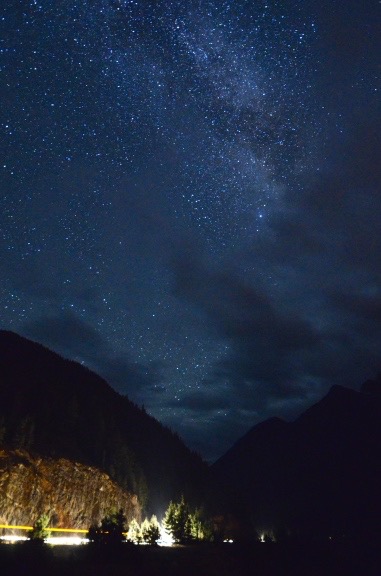
Thunder Arm at Night
A look up Thunder Arm at night. The cars driving by on the road often ruined shots by illuminating landscape features we wanted to be kept dark.

My first shot came out dark. Yes, I could see the stars, but no, I couldn’t see them well. I thought it might have something to do with my reading glasses, which seem to make things look darker than they are. But Andy took a look and recommended bumping up the ISO, which he’d originally advised me to start at 1600. So I tried 2000. It wasn’t much better.

Meanwhile, other photographers were snapping away, emitting occasional oohs and aahs and cursing at the cars that drove past the view point, illuminating foreground items we wanted to be kept dark. One woman near me had very good luck with her camera ISO set to 5000 so I gave it a try. (My camera goes up to over 24000.) That looked much better, so I stuck with if for the rest of the shoot.

Keep in mind that the higher the ISO setting, the more light is processed in the camera. There is a cost to this, however. High ISO settings lead to grainy images or “noise” (digital artifacts) in the images. Ideally, you want to keep the ISO as low as possible to get the shot you want. But since you can’t open the lens any wider (aperture setting) and can’t lengthen the exposure any longer (shutter speed setting), the ISO is the only thing you can change to vary the brightness of your shot.

I moved around to a variety of places. The Milky Way was mostly overhead, but it did dip down to the horizon in the south. A handful of light clouds drifted by, sometimes obscuring stars.

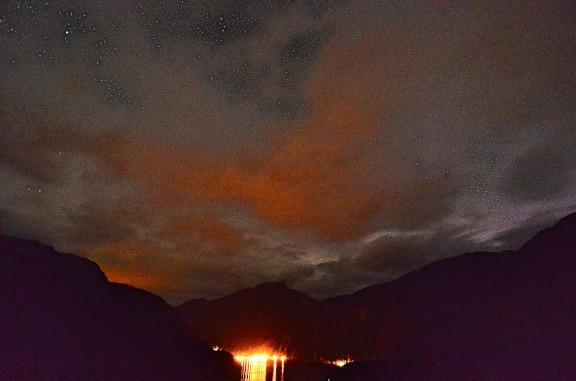
Diablo Dam at Night
I took a few shots of the dam. The lights reflected off the clouds, reddening them. I think this is the image where digital noise is most apparent, especially in the clouds. (A few people mistook the reddish clouds in their pictures for the aurora. Sorry, but no.)

We shot for well over an hour. I captured about 40 images. I haven’t looked at all of them on my big computer yet; these are pretty much decent random images I grabbed for this blog post. All of these are edited to make the stars “pop” more than they do in the original. If you have good image editing skills, you’ll definitely use them if you do night sky photography. I prefer to minimize editing.

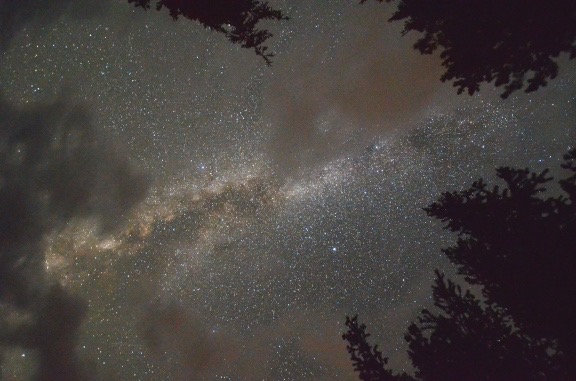
Sky Through Trees
This was shot almost straight up. I think the trees and clouds offer a sense of three dimensionality.

For the most part, the photographers were good to work with. The only real problem we had was with light — too many of them wore headlamps. The trouble with headlamps is that they point wherever you look. So if you look up, your light flashes up, possibly illuminating trees or other foreground object people want dark. This got a bit frustrating and, more than a few times, I called out, “Lights down, please!” One photographer seemed to think that no lights should be on at all and rudely yelled at anyone who used a light, even if it was pointed down at the ground. Sorry, but when walking on uneven terrain in the dark I’m going to use a light — in my case, my phone’s flashlight. If the light doesn’t shine on the subject, it should not affect the photo.

The End of the Shoot… and Beyond

We went back to campus in two groups. I was in the first one. I’d had enough. My remote shutter control had died about halfway through the shoot and I had to rely on the camera’s self-timer to activate the shutter, adding another 20 seconds to each shot. I was burned out and, unlike most of my companions, I live in a dark sky area and can try this again anytime, right at home.

There was no follow-up lesson — although I really think there should have been the following morning. A chance to review and critique what we’d done. I did spend some time at breakfast with other students and got signed up for a Washington State Astrophotography group on Facebook. I’ve already swapped photos and comments with a few classmates there.

Could my images be brighter? I think so. Next time I try this, I’ll do more experimentation with ISO settings. I might need to pop it up some more.

And yes, there will be a next time. I’m thinking of giving it a go on my deck tonight. And I’m definitely looking for companions on overnight outings, possibly with the Turtleback. Washington Pass would make an excellent subject area, especially with the fresh snow I saw on the peaks on my way home. Anyone game for an overnight road trip this coming week?