How to Calculate Nutritional Information for a Recipe

And why you might want to do it.

As the folks who know me well or follow my blog know, I’m dieting again.

Back in 2012, I lost 45 pounds in four months and regained both my health and my self-esteem. Although I’ve managed to keep most of the weight off since then, it’s been creeping up slowly. I want to nip that in the bud so I’ve gone back on the same diet that helped me lose so much weight so fast nearly three years ago. I expect that two months of serious dieting should be enough to get back down where I was in September 2012.
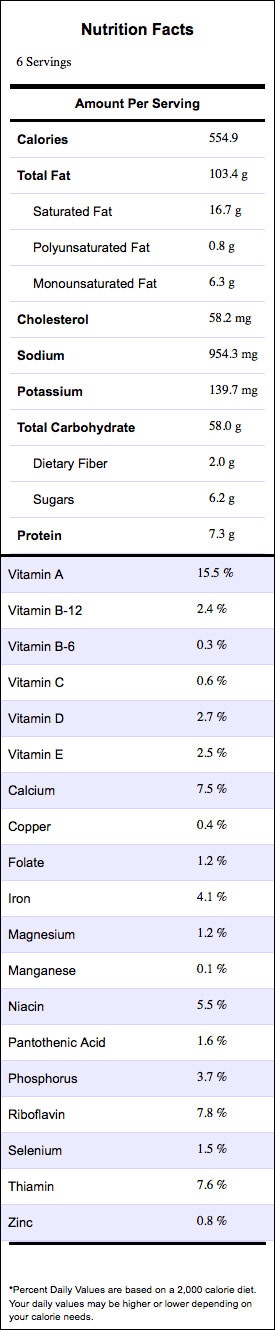
Nutritional Info Example
Calculating the nutritional info for an easy and yummy looking biscuit recipe a friend shared on Facebook makes it clear that this is something I need to avoid. (In case you’re wondering, this recipe’s ingredients are 4 cups Bisquick, 1 cup sour cream, 1 cup 7Up soda, and 1/2 cup butter.)

I know the reason I gained that weight back, which is important to prevent it from happening again:

  • Portion control. Although the diet I was on basically “shrunk my stomach” so I couldn’t eat those big portions, over time, I stretched it back out by eating more and more. What can I say? I like to eat. And when you put a big plate of food I really like in front of me, I want to eat as much as I can. This is something I need to control once I’m back down to my goal weight again.
  • Bad food choices. In general, I eat very well. Lots of fresh foods — not prepared foods — cooked simply. I grill or smoke most meats, I eat salads and fresh vegetables. But occasionally I make bad choices — usually at restaurants — that include fried or high-carb (or both!) foods. And every once in a while a friend will share a recipe online that looks too good to pass up and I’ll make it.

I believe that if you’re at a good, healthy weight and keep relatively active, short forays into the realm of bad food choices should be okay. Sure — enjoy a piece of pie or a flaky biscuit or a plate of pasta once in a while. But remember that portion control! And don’t do it every day.

That’s what I’ve learned over the past two years. Now if only I could remember that when you place my favorite food in front of me!

But how do you determine what’s a good food choice and what’s a bad food choice when it comes to preparing recipes? That’s where nutritional calculators come in handy. The one I use is on a site called SparkRecipes, but there are plenty of others. You enter the ingredients for the recipe along with the quantity of each item, indicate how many servings it creates, and click a Calculate Info button. The result is a display like you see here, which I calculated this morning for a four-ingredient biscuit recipe a friend shared. The numbers make it clear just how healthy — or unhealthy — a food choice the recipe can be.

I began doing these calculations for all the recipes I share on my blog. I recently learned that by omitting part of a recipe — for example, the dumplings in the chicken and dumplings recipe I recently shared — or substituting one healthier ingredient for another, you can make a recipe healthier without sacrificing flavor. This can help you cook healthier meals for yourself and your family — something that’s especially important when weight-related health problems such as high blood pressure, high cholesterol, or diabetes is an issue.

Is calculating nutritional information like this worth the effort? What do you think? Isn’t your health worth a few minutes of time in front of a computer so you can make an informed decision?
Difficult Decisions that Shouldn’t Be

Over-thinking slows me down.

I think my brain is turning to mush. I’ve been struggling to make little decisions in the wiring for my home. In most cases, the decisions are not important and they’re taking too long to make.

Yesterday was a perfect example. I had to put at least two 20-amp receptacles (AKA outlets) in my laundry room. One was for my washer. The other was for something else — perhaps an iron? The vacuum? Something that would be plugged in only once in a while.

Before I could finish the task, I struggled with several decisions that really aren’t earth shattering:

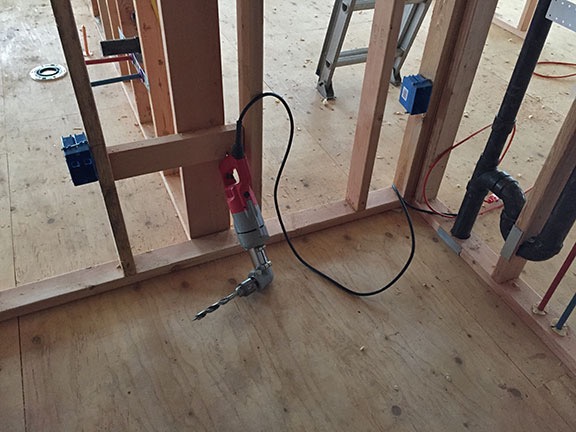
  1. Where do I put the outlets? The decision on approximately where to put the washing machine outlet was easy: in the corner where the washing machine would be. I couldn’t put it behind the washer because that’s where the plumbing was. So I’d put it on the adjacent wall. But which stud to nail it to? As for the other outlet, which side of the room should it go on? Should I have one on each side? What if I decided to put a cabinet or countertop on the other side of the room? Would an outlet fit there? And if I did put an outlet on the other side of the room, how would I run the wire to it? The final decision: Put them on the same wall.
  2. How high do I put the outlets? Near the floor? Or higher up? If I put the washing machine outlet near the floor, how would I be able to unplug it without moving the washing machine? But because my washer and dryer were going to be stacked, how could I access an outlet halfway up the wall anyway? And what if the cord didn’t reach? As for the second outlet, if I used it for an iron, it might be handy to have the outlet at waist high. But I’d used outlets down near the floor for an iron without any trouble. And how likely was it that I’d use an iron anyway? The final decision: Put them both near the floor.
  3. Do I run the wire between them into the top or bottom of the boxes? Although this really doesn’t matter — after all, the wires will be covered when the drywall goes in — I labored for at least 5 minutes over this decisions.The final decision: Run the wire from the top.
  4. Which outlet do I run the home run from? (The “home run” is the uninterrupted length of wire from the first device on the circuit back to the circuit board.) Again, this doesn’t matter at all. The final decision: undecided. I was interrupted and set the whole job aside.

outlets
Here’s how things stood after decision 1 above. I took this photo when I realized how long it had taken me just to decide where to put the two boxes and right before I drilled the holes in three studs to run the wire.

A real electrician would come into the room and bam! – knock two blue boxes into the wall, run the wire, and be done with it. But I spent a total of at least 30 minutes making these decisions. And I’m not even done! That’s ridiculous. The room is less than 5 x 6 feet in size. Hell, my old walk-in closet was bigger than that.

It wasn’t like this for every room — thank heaven. I think I’m just starting to get tired and am over-thinking things.

I’m really looking forward to being done. And I think I will be by Sunday.

Now what do you think? Another outlet on the other side of the room?

Construction: January 8 Walkthrough

Too busy to blog. Watch this video instead.

On May 20, 2014, I began blogging about the construction of my new home in Malaga, WA. You can read all of these posts — and see the time-lapse movies that go with many them — by clicking the new home construction tag.

I’m working hard to meet a deadline for inspections and really don’t have any time in the morning to blog. In the evening, when I have plenty of time, I’m too exhausted!

So here’s a walkthrough video I shot today with my iPhone and threw together with iMovie. It’ll show you the interior of my place as it was this morning, with an emphasis on layout and electrical setup. Enjoy!

What do you think?

Playing Like a Kid In the Snow

Makes you feel like a kid again.

Saturday, I went to a “winter fun” party at a friend’s house up in Peshastin. He lives up a canyon, on 15 acres of what used to be an orchard. In addition to his 1940s era home and open garage, he has a handful of apricot trees, a small pond for storing irrigation water from a creek that runs through his property, and a few hiking trails that wind up into the national forest that borders his land. It’s quite idyllic out there — very quiet with little road traffic and lots of trees.

And snow.

Even though Peshastin is only about 20 minutes by car from Wenatchee, they get more snow up there. It’s a higher elevation and it’s closer to the Cascades. Because of that, my friend Kirk planned a winter fun party at his home there. Activities would include sledding, cross-country skiing, snowshoeing, and skating. There would be a bonfire and a potluck dinner.

Since leaving Arizona, I’ve embraced the snowy winter days here in North Central Washington state. It started with my return to cross-country skiing and taking up snowshoeing last season and continued this year with a return to ice skating. While I still like to stay warm, I discovered — belatedly, apparently — that with the proper clothes you can keep quite warm in the typical 20-30°F winter weather we get. I got the clothes last year and have been giving them plenty of use.

And yes, I know 20-30°F isn’t that cold. In fact, I think it’s milder here than the winters we had back in the New York metro area. But after 15 years in Arizona, it’s a bit chillier than I’m used to.

Kirk wasted no time getting us organized for sledding and skating. He had some equipment; some of us brought our own. Although I would have liked to go skating, my knee was still sore from the nasty fall I’d had the last time I skated. I swore that I wouldn’t skate again without knee pads — and not until my knee was fully recovered. I just don’t heal as well as I used to when I was a kid. (Duh.)

Instead, I opted for sledding. Kirk and Pete had a few old runner sleds, including one that looked just like my old Flexible Flyer. I gave one of them a try on the relatively mellow hill that led from the road to the pond. I was disappointed. The sled was old, the runners were rough with rust, and the hill wasn’t slick enough. I was a long way from the quarter mile sled runs down the street from where I used to live in Cresskill, NJ, starting in the woods out behind the Merrifield’s house and ending on Brookside Avenue.

Kirk skates among the piles of snow on his pond. The wise-ass requesting the double axel is me.

Meanwhile, Kirk was skating and others were just walking around on the frozen pond surface. Kirk had shoveled the snow onto big piles and was gliding gracefully among them.

Pete, in the meantime, had a need for speed. He’d taken one of the metal saucer sleds he’d brought along and had climbed to the top of a much steeper hill that led down to the pond. As we watched, he launched himself down the hillside, crashing into the tall frozen reeds at the side of the pond. Not to be deterred, he did it again. And again. After a while, he wore out a good, fast track down to the ice.


My first run down the hill.


My second run down the hill was enough for me.

He kind of dared Megan to try it. She wasn’t interested, but I was. I climbed up the hill, sort of surprised by how steep it was — it didn’t look that steep from the pond. Then I grabbed one of the sleds and, after asking Pete for some advice, launched myself down the hill. It was wicked fast and wicked bumpy. No control at all. About halfway down, I closed my eyes. I finally skidded to a stop on the ice, laughing and groaning. Megan caught the whole thing on video.

And if that wasn’t enough, I did it again. The second time, I definitely got airborne at least twice. The banging sled beat the crap out of me. When I slid to a stop on the ice, I just lay there, laughing. That was enough for me.

Pete kept going, through. On one of his runs, both Megan and I had video cameras rolling. I was up top and actually gave him a push down, so my video is very bumpy. But it’s interesting to see the two camera angles side by side.

 
Two views of one of Pete’s better runs.

By that time, Kirk and Kathy had moved on to sledding on another hill. The rest of us joined them. It was getting dark and Kirk wanted to take us on a quick hike before it got too dark to see. So I loaded Penny up in my day pack — mostly because I didn’t want to worry about her running off after real or imagined wildlife — and we we all followed Kirk up one of the trails behind his house. I think we would have made an excellent commercial for Sorels boots, since I think we were all wearing them. The path was snowy but not slippery and the forest around us was quiet with snow on the evergreen branches. We stopped on the way back to admire Kirk’s tractor — that’s how things are around here — and swap stories about how useful they can be around the area. I might have convinced Kirk to use his tractor to dig some holes for trees for me this spring. Fingers crossed.

Megan and Pete
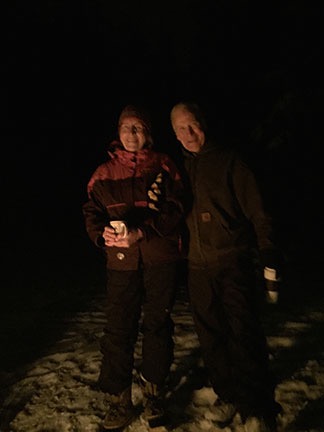
Megan and Pete stand beside the fire.

While we were gone, the fire Kirk had started earlier in the day and fed with scrap lumber I brought along had come to life. We sat around it in lawn chairs. A few other people showed up, including Kirk’s housemates. Kirk and Kathy poured out some warm Glühwein from Leavenworth. We chatted, told stories, took photos.

Afterwards, we went inside for dinner. Clam chowder, leek soup (my contribution), garlic bread, fresh fruit, pizza, lasagna, and more. We sat around the big table Kirk had set up in his living room. It was warm and toasty indoors — so warm that I stripped down to my bottom layer Under Armor.

Of course, there was more. After dinner, six of us drove about a half mile up the road to a National Forest trailhead. We strapped on our snowshoes and started a hike up an old, closed off forest road. It was full dark out by then and thin clouds filtered much of the light from the full moon. Most people had headlamps. We crunched up the trail with snow covered evergreens and hillsides or ravines on either side of us. It was magical out there, especially when, on the way back, it began snowing.

Back at the house, Kirk and Kathy went back out to the pond to skate in the moonlight. The rest of us enjoyed the warmth of the wood-burning stove, chatting about life, careers, and retirement. A while later, just as Kirk and Kathy were coming back we prepped to go home. It had been a great day out in the snow and, for me, a reminder of my younger days.

Although I’m sure I’ll have bruises on my back from the edges of that silly saucer sled, it was worth it to remember my young, fearless, and carefree days as a kid.

Monitoring Resolution Progress

Maintaining a checklist may seem a bit over-the-top, but it does help.

Yes, I’m a geek. And yes, I’m somewhat compulsive about some things. But I really think it helps to stay on track with goals and objectives. Here’s what I mean.

The Weight Tracking Table

Back in 2012, when I finally got serious about losing weight and lost 45 pounds in four months, one of the things I did that I believe helped me to succeed was to create a weight monitoring chart. It was a simple list of dates with spaces to record a daily weight reading and body measurements.

Weight Loss ChartHere’s the first three months of my chart. I stopped tracking my weight on paper when I moved home to Arizona, but got all the way down to 149 pounds (from 196) by the middle of October.
Although most diet plans tell you not to weigh yourself daily, I did. And as the weight ticked down day after day, with minor upticks along the way, my success — clearly indicated on the chart I kept on the back of my medicine cabinet door — positively reinforced my efforts. Not only that, but I when I fed those numbers into an Excel spreadsheet, I wound up with a cool chart that showed my progress. (I told you I was a geek.)

I didn’t take body measurements daily. It was a pain in the ass to do. But the few measurements I did record show my progress and also helped reinforce my efforts.

My point is this: when you set a measurable goal, it might be a good idea to track it on paper (or in some other recording tool). This gives you evidence that you’re on target. And as you get closer to achieving your goal, you can feel good about it, not just when you reach that goal but at various points along the way.

Note that my weight chart shows upticks. Whenever a weigh-in showed me to weigh more than the previous day, that made me think about what I’d done that might have given me this setback. It made me work harder to stay on track. After all, with a goal like losing weight, the longer it takes, the longer you have to make sacrifices to reach your goal. It’s in your best interest to stick with it so you can minimize the time you’re making that big change in your life.

(And please don’t think that once you’ve reached a weight goal you can go back to your old ways. You can’t. Those old ways got you where you were. Just keep in mind that it’s harder to lose weight than to maintain a healthy weight once you’ve taken off the extra pounds. The main sacrifices come in the losing weight stage. After that, the “sacrifices” are fewer and must become part of your lifestyle. With me, that meant portion control. It wasn’t until I went back to my huge portions that my weight began creeping up again. I’m nipping that in the bud now.)

This Year’s Chart

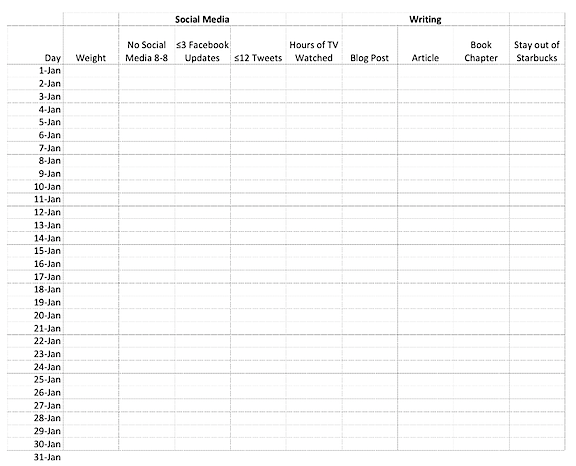
Because I have five New Year’s resolutions this year, my chart is a bit more complex. It has multiple columns since some of my resolutions have multiple parts. Some columns get simple check marks. Others get numbers.

I created the chart in Excel, since it’s a grid, but I don’t expect to record the data in an actual spreadsheet. (I’m not quite that much of a geek.) Instead, I printed it out and put it on my bulletin board. Each morning, after writing in my journal about the previous day, I record the previous day’s results. As I look at the chart I have a concrete, in print record of how I’m doing.

Resolution Progress Chart
My New Year’s Resolution Progress Chart. I suspect that this will keep me on track — at least as long as I keep printing new charts and recording my progress on them.

Over-the-Top?

Is this approach over-the-top? Super anal-retentive? Evidence of an obsessive compulsive personality disorder?

Maybe.

But I think the reason many people don’t succeed with New Year’s Resolution goals — or any other goals, for that matter — is because they don’t have a daily reminder of what that goal is. It’s not in their face. There’s no one looking over their shoulder to make sure they stay on track.

This is my solution. The chart is in my face and I’m looking over my own shoulder, making sure I stay on track.

And, as always, I’m the only one that can ensure my own success.