Hovering Over Cherry Trees before Dawn

What some people will do to make a buck.

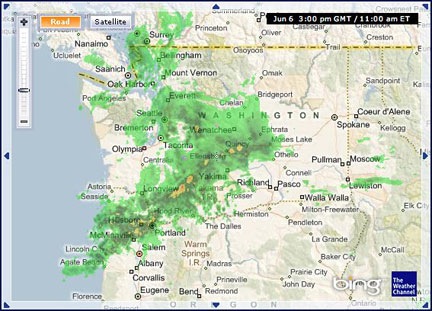
The weather forecast last night was clear: there was a 78% change of rain starting at 11 PM. At 8:30 AM, the approaching storm was nearby. It was already raining in Mattawa, where my buddy Jim is working. It looked like the rain in our area would start within an hour.

I called my cherry drying client, who owns a 32-acre orchard 6 NM from where I’m camped. “Looks like it’s going to rain tonight,” I said.

My client was not surprised. This was our third conversation about the weather in 8 hours.

“It’s too late to dry tonight,” I told him. The sun would set in less than 30 minutes and I didn’t dry cherries in the dark. “Sunrise tomorrow is around five. I can be airborne as soon as it gets light.”

“I’ll spend the night down there,” he told me. “I’ll call you at 4:15.”

“I’ll go to bed now then,” I replied.

I hung up, feeling bad for him. He had an old, beat-up RV down in the orchard. I knew he wouldn’t be comfortable. He probably wouldn’t get much sleep. But someone had to be down there to monitor rainfall to know whether I was needed in the morning. Spending the night in an orchard is not part of my job description.

I set an alarm on my iPad for 4:30 and went to bed.

The rain started before 11. Steady but light. I had no trouble sleeping through it.

Wake Up Call

I woke to the sound of birds chirping. It was still dark, but the birds around here don’t seem to care. I grabbed my phone and touched it to bring it to life. It was 4:10 AM. I grabbed my iPad, fired it up, and took a look at the radar on WeatherBug. The storm system was mostly past, but a small blob of rainfall was headed toward the orchard. It could rain itself out before it arrived. Other similar blobs had done so, disappearing off the radar when I put it in motion.

I was studying this when my phone rang. It was my client.

“Is this my wake up call?” I asked cheerfully. I wanted him to know I was already wide awake, on the job — even if I was still in bed.

“Yeah,” he replied. He sounded tired.

“Did it stop raining down there?”

“Yes. Come on out and dry. I won’t be there; I have to get back to town.”

We hung up and I got out of bed. I’d already laid out my clothes, but had neglected to set up the coffee maker. I took care of that, letting it drip into a travel mug while I dressed and washed up. By 4:30, I was slipping out the door with coffee in hand.

Predawn Flight

It was getting light. I could clearly see thick clouds out to the west, in the direction of the orchard. I kept thinking about that little blob of rain.

The helicopter was already fueled and preflighted, so all I needed to do was take off the blade tie-downs and do a walk-around. By 4:45 AM, I was in my seat with the engine running. It took a long time to warm up. My breath quickly fogged the inside of the cockpit bubble. The outside was covered with raindrops.

I spent a bunch of time trying hard to catch a moth that was hitching its second ride in my helicopter. I failed. Again.

By 4:50 AM, I was ready to go. The cockpit bubble was barely clear enough to see through, but I knew how to clear it. I pulled the knobs that turned on the air vent and heat to full. Then I hovered out over the ag strip and took off along it, toward the well-defined horizon to the east. Within 30 seconds, the windscreen was clear, inside and out. I turned to the west and headed toward my client’s orchard.

Out in the distance, a thick blanket of clouds covered the foothills on the other side of the Columbia River. A similar but smaller blanket hovered around 200 feet over the farmland just west of the town of Quincy. Another one poked up from beyond the drop-off I’d have to descend to get to the orchard on the river. I started wondering whether there would be fog on the river itself.

But when I got to the end of the plateau, I could see that the river far below was clear. I pushed the collective down slowly and smoothly, stopping only when I had a descent rate of at least 1,000 feet per minute. I approached the orchard from slightly downriver, as I usually did, but instead of descending to orchard level over Crescent Bar, I made a descending circle over the river. I was hoping to reduce the amount of sound I might project over sleeping people.

I settled into my usual five-foot hover in my usual place beside the water tank and got to work, flying up and down the rows at about 5 knots. Below me, the big, old tree branches went wild, throwing rainwater off the cherries. I varied my pattern only to avoid flying close to the bedroom window on the other side of the house there. I figured that if people were sleeping inside, I’d rather wake them from the other side of the house instead of 20 feet from their window.

The Rain

I was about 1/4 finished with the orchard when it started to rain. I looked up at the clouds floating over me and didn’t really see the rain coming down. But I could see it hitting the river, which wasn’t as smooth and glass-like as it had been when I first arrived. And it was certainly all over my cockpit bubble.

Now my goal is to dry the orchard and it’s pretty hard to ensure that everything I’ve flown over is dry if it’s getting rained on again right after I pass over. Without my client there to tell me what he wanted me to do, I had to do what I thought was right. I had two choices: land somewhere and wait it out and then start again or keep drying and just go over the areas that got rained on after they were dried. Landing wouldn’t have been a big deal — there was a sizable empty boat trailer parking lot nearby where I don’t think anyone would have bothered me at 5:15 in the morning. Still, I had a feeling the rain wouldn’t last and didn’t want to waste time landing and shutting down if I didn’t have to.

My decision to keep drying was based on the amount of rain falling. It seemed like a heavy drizzle. The trouble is, I couldn’t really see when it stopped. Because I was only moving at 5 to 10 knots, there wasn’t enough wind to blow the water off. So it just sat there. When it started dripping off, I figured the rain had stopped. In all, it lasted about ten minutes. I didn’t think the trees I’d already dried had gotten very wet. They certainly couldn’t have gotten soaked. A quick hover over every other row should shake off whatever moisture had settled on them.

But first I needed to finish the rest of the orchard.

This particular orchard is not easy to dry. The trees are a variety of sizes and thicknesses, ranging from very small young trees to very large old ones. There are obstacles. The rows don’t always go the same way and they’re not easy to see. I’m sure I must have whined about this elsewhere, so I’ll spare you any more whining.

The point is, despite the fact that the orchard is only 32 acres, it takes me at least 1.1 hours to dry it. This year, it’s been a lot wetter so it’s taken me 1.2 hours. Today, with the redo of part of it, it took me 1.5 hours. I’m doing it as fast as I can, but I need to be thorough, too. If the grower loses his crop because I did a shitty job drying, he’ll cancel the contract and never use me again. I don’t want that to happen.

Besides, his cherries are the best. I can’t wait until he starts picking.

Return Flight

I It was nearly 6:30 AM when I finished. I took one more low pass over the treetops and headed out over the river. I made my usual spiraling climb at 1200 feet per minute. The plateau was 500 feet above the river level; I needed at least 200 feet more to clear the edge comfortably.

Crescent Bar

I went back to a viewpoint near Crescent Bar and shot this photo about an hour after I landed. It really was a beautiful day.

As I climbed, I couldn’t help but admire the big, white puffy clouds that were scattered all around me. There was one just to the south of me that seemed to grow out of the top of the Babcock Bench, climbing like stretched cotton toward the sky. The low cloud that had been just west of the town of Quincy was still there, but seemed to have grown. I leveled off at 400 feet above the farmland south of Quincy and the cloud remained below me, as if unsure whether it wanted to be fog or the cloud it really was. I looked out over my shoulder and saw the windmills of the wild horse wind farm, basking in sunlight.

I was angry with myself for not bringing a camera.

I landed at the ag strip and did all the things I usually do: tie down the blades, refuel, do a post-flight inspection. It was about 7 AM when I returned to the RV. I made a second cup of coffee and had the pleasure of drinking all of it. Later, I went out with my camera and tried to capture some of the beauty I’d spotted on my way back.
Why My Mind is [Always] on the Weather

I’m a walking, talking, texting weather resource.

Yesterday was a beautiful, clear day in central Washington, with the occasional little puffy cloud floating across the bright blue sky. It was warm in the sun, cool in the shade, and a gentle breeze kept any insects from becoming a nuisance.

A perfect day to visit with a friend down in Mattawa, a 40-minute drive south.

I was about halfway there when my phone rang. It was one of my cherry drying clients. I pulled over to make sure I didn’t lose the connection on the winding river-side road. After exchanging greetings, she asked, “So what’s the weather forecast?”

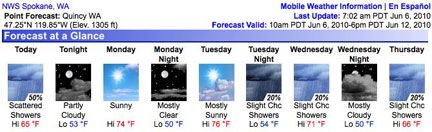
“Twenty percent chance of rain tonight and twenty percent tomorrow.”

We finished the conversation, both promising to keep an eye on the weather. I hung up and continued on my way.

You might be wondering why I knew, off the top of my head, the weather forecast for the next 24 hours. Simple: It’s part of my summer job.

My job depends on the weather. If it’s a nice day, I get the day to myself and can wander away from my base. The nicer the day, the farther I can wander. If it’s a rainy day, though, I have to hang around, waiting for a call to fly.

This means I need to know the upcoming weather all the time.

How I Track the Weather

I use five different resources to track the weather.

  • Seven-Day WeatherThe National Weather Service at weather.gov offers a 7-day forecast with “at-a-glance” graphics and a detailed textual summary. I can also click a link to get an hourly weather graph that charts percent chance of rain, percent of sky cover, temperature, humidity, wind, etc. hour-by-hour several days into the future. This is my primary source of weather forecasting information.
  • Current RadarWhen rain is in the area or on the way, I use the radar graphic at the Weather Channel to see where the rain is and which way it’s going. What I like about this particular radar graphic is that you can drag and resize the map to change the view. I can see the big picture to get an idea of how much rain is on its way and zoom in to see exactly where it’s falling. This is my primary source of current weather information when I’m in front of my computer.
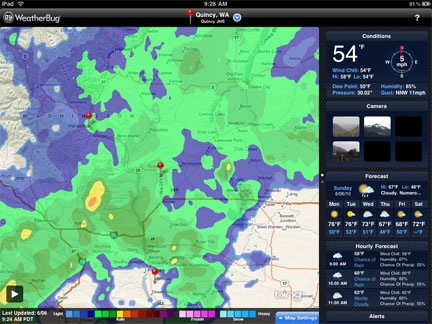
  • WeatherBug on iPadWhen I’m out and about and have access to the Internet, I use WeatherBug on my iPad to see weather information, including a radar graphic, forecast summary, and hour-by-hour forecast. I can also use its Webcam images to help judge visibility in the event that I need to cross the Cascades to get to Seattle. (Which I don’t usually do during the season.) WeatherBug is also available for mobile phones; I really do need to get it back on my BlackBerry.
  • In the RV, I use my radio scanner to listen to weather summary and forecast information from the National Weather Service for my area. It’s basically local weather radio. It isn’t nearly as helpful as the other sources, but it does offer a good overview for my area and playing it tends to keep Alex the Bird quiet.
  • I also look out the window a lot. Knowing which direction the weather usually comes from and watching the sky out that way can give me an early heads-up. This is especially useful when I’m out running errands and don’t have access to any of my other sources.

What’s amazing about the weather forecast is that it’s only accurate for a short while. Yesterday, the chance of rain this morning was 20%. When I got back from my day out, it was 30%. This morning, it was 50%. And then it started raining. It’s been raining for at least an hour and radar shows me that we could get at least an hour more of the stuff.

Knowing this can keep me out of trouble. 20% didn’t seem like much of a chance — and it isn’t. But 50% is a pretty good chance of rain. It went from 20% to 50% in less than 12 hours. So I have to constantly be checking my sources.

Today’s Weather Story

This morning, my client’s son, who manages the orchard, called. It was 7:46 AM. “What’s the weather?” he asked.

I told him what I saw on radar: a long line of rain showers stretching all the way from southwest of Portland to us, moving our way. “It’s raining here,” I added.

His orchard is 6 miles northwest of my position. He lives another 20 miles north.

“I’m on my way to the orchard,” he told me. “I’ll call you when it stops.”

He means that he’d call me to fly when it stops.

So I’m sitting here, dressed in my flight suit and ready to go. The rain is still pattering against the roof and windows of my RV. The radar shows some heavier rain inbound from the Ellensburg area. And more rain beyond it that, if we’re lucky, will pass to the south of us. (That’ll make my buddy Jim happy. He’s down in Mattawa, doing the same thing I am. In fact, we spend far too much time texting each other about the weather.)

Waiting to FlyThe helicopter is a quarter mile away and already fueled and preflighted. All I have to do is pull off the blade covers. I can be airborne within 10 minutes of my client’s call. The orchard is a 4-minute flight from here. So I’d much rather sit in my nice warm RV, watching the weather on radar, than sitting out in my truck by the helicopter, blind without most of my weather sources.

But I guess this explains why my mind is always on the weather — at least this time of year.

Greetings from Washington’s Cherry Country

Cherry drying season is off to a busy start.

Cherries

Cherries, at the source.

I’m in central Washington state for my third season as a cherry drying pilot. The short explanation of that is that cherry growers often rely on helicopter pilots to hover over cherry trees after a rain to shake/blow water off so the cherries don’t split or rot.

I’m based in Quincy, WA, living in my RV with my helicopter parked across the street at an ag strip. I arrived two weeks earlier than I had to. I didn’t know I was that early — I try to arrive about 5 days early. But my first contract was supposed to start early. It was only after I arrived that the start date was finalized to a much later date. It was supposed to start today.

Rain, Rain, Rain

Meanwhile, it’s been raining like crazy here. In the two weeks I’ve been in Washington, I’ve seen more rain that the past two seasons combined. My buddy, Jim, started a contract down in the Mattawa area about 10 days ago and has already flown more than 10 hours.

How important are helicopter pilots to the success of the crop? Well, this story should give you an idea:

Jim originally had two orchards under contract and was drying both when called to do so. One day, there was a light rain and only one grower called. He dried that orchard, then called the other grower to see if he needed his dried, too. He told Jim that the cherries didn’t seem that wet, that he thought he could dry them himself with the blower equipment he had on hand. Three days later, he cancelled the contract because he’d lost 60% of his crop to water damage after that light rain. He wasn’t even going to bother picking the rest.

The loss of so many cherries in this season’s crop makes the remaining cherries even more valuable. Last season, the problem was that there were too many cherries and the growers weren’t getting a good price. Some of them would have had a loss on their crop, so they didn’t even bother to pick.

But this year, with all the rain we’ve been having, cherries are going to be difficult to protect. Any grower who doesn’t have cherry drying hover service lined up for his orchards will likely lose his crop.

Expect to pay more for cherries this year, folks.

My First Dry

As for me, that first contract started a day early. It rained overnight from Thursday to Friday and was still raining when I got up in the morning. At about 9 AM, my grower called and said he’d likely have me start a day earlier. He launched me at 10 AM, right after the rain had stopped.

The clouds were still low when I made the 6-mile trip to his 32-acre orchard block on the Columbia River. I ducked beneath them and made the steep descent to the river. Remembering the pattern I’d flown the year before, I circled the orchard, descending. I settled into a hover five feet over the tops of the trees in the southeast corner of the block, being careful to avoid the water tower beside the trees there. And then I got to work.

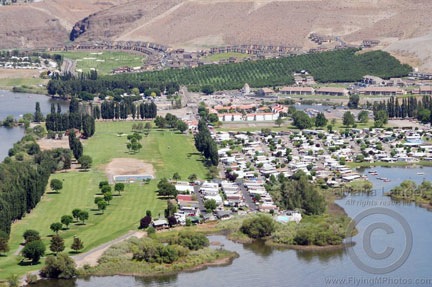
Crescent Bar Orchard

My client’s orchard is the big patch of dark trees in this photo.

This particular orchard is one of the most difficult I’ll have to dry this year. There are trees at various ages and sizes. Some rows go east/west while others go north/south. There’s a gully deep in the west side with trees going right down into it and a house tucked into the south side. And a processing shed in the middle.

The grower arrived about 10 minutes after I’d started. I think he took some video of me flying around. And there were onlookers along the road from the nearby trailer park and condos.

It took me 1.2 hours to get there, hover over all the trees, and get back. The grower waved and stepped into his truck as I left the last tree and started my climb out.

More to Come

There’s a 20% chance of rain tonight and a 30% chance of rain tomorrow morning. So I’d say I have a 30% chance of flying again tomorrow.

While I hate to see the growers spending a lot of money to protect their crop, I have to admit that it’ll be a nice change for me to have a profitable year.

RV Living

A quick look at my current RV living experience.

I’m back in Quincy, WA for the third consecutive year, gearing up for cherry drying season. On Saturday, when my first contract starts, I’ll be literally stuck here in town, waiting for it to rain so I can spring into action and fly for my clients. And if the weather stays the way it has been for the past week, I’ll be doing an awful lot of flying.

The previous two years, I lived in a 22-foot “hybrid” RV that included a hard-sided camper shell with a single slide out and two pop-up camper type beds. When I first bought this camper, I thought it would be perfect for this kind of mission. But I didn’t foresee the need to write three books in it or an excruciating back problem that would last a month. I realized that when you have to live in an RV for three to four months out of the year — with a parrot, no less — you’d better have a pretty damn comfortable RV.

So I bought what I considered to be “the perfect RV.” While I don’t really think it’s “perfect,” I still believe that it’s as close as I’m likely to get unless I have one built to my exact specifications — which is not an option. This RV has plenty of space, as well as comfortable places to sit. Best of all, I don’t have to work in the same space where I try to take my meals.

But I’m getting ahead of myself here. @Miraz wanted to know more about my setup here, so let me go into that a bit.

The Campground

I’m living at the Colockum Ridge Golf Course. A weird thing about golf courses out here is that they often include a limited number of RV parking spaces. Colockum Ridge (formerly Quincy Golf Course), which is now owned and operated by the Port of Quincy, is one of those places. It has five or six full hookup sites — that means sites with water, electricity, and sewer hookups. The sites are not far from the main office, between a wide driveway area and a narrow path out to the golf course. One of the greens is about 50 yards from the last spot. The golf course also has a handful of water and electric only spots. Those are on the other side of the wide driveway, near a well-trafficked road.

For the first two years I was here, the monthly rate for a full hookup spot was $300. I thought that was a pretty good deal. The first year, all the full hookup spots were occupied by me and construction workers for a pair of data centers being built in Quincy. Last year, I was the only long term occupant. This year, in an effort to attract more long term occupants, they dropped the monthly rate to only $200. This is a steal. (Oddly, I was worried the rate might go up; never expected it to go down.) The only drawback to the lower rate is that they’ve apparently attracted the owner of a junky old trailer who seems to be using his site as a weekend getaway. (Sometimes a higher rate is good to keep the riffraff out.)

My RVAlthough the spots are small, they do have well-kept lawns. Parking is on a gravel spot that you need to back into; that gravel area is surrounded by railroad ties on three sides to keep it separate from the grass. The spots aren’t exactly level — as I found out this year — but they’re not far off. I surprised myself with my ability to get the trailer into the spot; it was the first time I’d every done any serious backing up and it didn’t take more than a few tries to get it into place.
There are a few drawbacks of living here:

  • They start tending to the grass not long after dawn. That means there are lawn mowers running as early as 5:30 AM. This doesn’t bother me because I’m usually awake by then.
  • Because the RV spots are near the office and the office is at the intersection of two major roads, traffic noise — especially trucks slowing down to make one of the stop signs — can be a bother. In my old camper, it actually kept me up at night. In my new one, I don’t hear much unless the windows are open.
  • Golf carts and the odd piece of maintenance equipment drive right past the back window of my RV all day long every day. Before I moved the trailer 2 feet forward to get the left wheels on blocks (for leveling), they’d be within arm’s reach of my back window. Now they’re 2 feet farther away.
  • The sites really are tiny — although I suppose they’re about the same as the standard RV parking lots selling themselves as RV parks or “campgrounds” these days. My front slide-out actually hangs over into the parking spot next to mine, which is on a weird angle. There’s nothing I can do about it.

But there’s plenty good about living here:

  • They allow me to have my mail delivered to their address. So I can get mail and packages delivered to me here. I’m also the one who collects the mail daily; apparently no one else ever checks it. The first time I checked it, the box was absolutely stuffed. The mail carrier must like me.
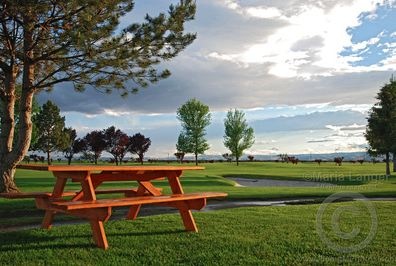
  • This year, I have a picnic table, which will come in handy (if it ever stops raining for more than a few hours) for using my new barbecue grill, eating out, and getting Alex the bird outside for a while.
  • After the RainI have some nice views. My “office” window looks out on an idyllic view of trees, a picnic table, and the golf course. There are also birds — primarily robins — digging in the grass for worms throughout the day. Soon they’ll bring their chicks.
  • My helicopter is parked at an ag strip right across the street. In fact, I can see it from my back window. That means I can hang out here until I’m called out to dry. Definitely beats sitting in the truck at an airport for hours, waiting for a call that might not come. An added bonus: watching the crop dusters fly by.
  • I can get wireless Internet that works just well enough to pay for it. (I’d be very happy if it worked reliably all the time.)
  • The golf course has a restaurant where I can get breakfast or lunch if I get too lazy to cook. It’s not a great restaurant, but I’m not complaining.
  • The golf course is only five miles from town, where there’s a supermarket, coin-op laundry, post office, and other conveniences.
  • The area, being a farming community, is relatively safe and secure, so I don’t have to worry about my personal safety or the security of my belongings. It’s unlikely, for example, that anyone will break into my truck or trailer or walk off with my barbecue grill.
  • The golf course is in the middle of a farmland grid, offering lots of easy bicycling for me to get exercise.
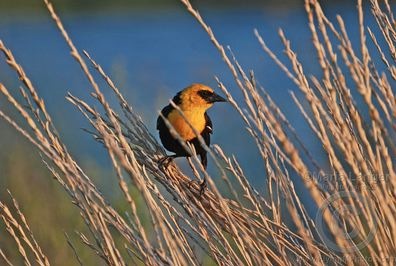
  • Yellow-Headed BlackbirdThe golf course is only a few miles away from the Quincy Lakes area, which offers hiking, fishing, camping, and wildlife photography opportunities. Over the past two years, I spent a lot of time with my camera at Quincy Lakes, photographing birds.

The more I stay here, the more I like it. I’m even thinking of blowing off an aerial photo gig in Nevada in August so I can spend another month here.

The RV

The RV is amazingly comfortable. Comparing it to my old RV is almost silly, but here are a few examples:

  • There is a ton of storage. Enough storage to put everything away and still have space for more. That includes inside storage for indoor things and underneath storage for outdoor things. I even have enough room to store the old muffler for my helicopter, which I need to get repaired so it’s available as a spare. (They cost $2K new.)
  • The kitchen area has counter space for my coffee maker and grinder and enough cabinet space to store all my food, pots and pans, and dishes. And it even has drawers for storing silverware, napkins, and utensils. The stove is self-lighting so I don’t need to have a lighter or matches handy all the time to use it. The sink is a decent size, too.
  • The table and chairs is a hell of a lot more comfortable than the booth I had in the old camper. And with lots of windows, its bright and airy.
  • The sofa may not be as comfortable as the one in front of our TV at home (which is the most comfortable sofa in the world), but it sure beats the sofa in our last trailer. And rather than covert into a short, narrow “bed” for guests, this one has a queen-sized air mattress that two can sleep on comfortably.
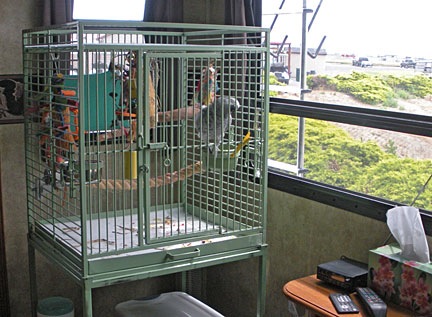
  • Alex's Cage in my RVThere’s a La-Z-Boy style rocker/recliner. (There were actually two, but we pulled one out to have room for Alex the Bird’s cage.) I never thought I’d like one, but I spend a lot of time in it. I sit here and blog or read in the morning with my coffee and sometimes do the same after I’ve covered Alex for the night. It’s right beside the big back window, so I can watch the world — or at least this part of it — go by.
  • The RV has not one, but two flat panel televisions. They’re kind of wasted on me — I don’t watch much TV so I don’t have a satellite receiver. But I can pick up about 6 channels, including Fox and PBS. The 32-inch TV in the main room has a DVD player, so I can watch my Netflix videos on something larger than my computer monitor.
  • My RV OfficeI have an “office.” It’s a slide out with a desk and room for a chair. I’ve got drawers and cabinets to store my office stuff, so there’s not a lot of junk lying around. I brought along my 24″ iMac so I have all the same computing capabilities I have at home. And I managed to bring my color laser printer (what was I thinking?) and store it out of sight in a cabinet. There’s even a spot for my scanner. The office area even has two windows that look out over the golf course.
  • The bedroom has a nice bed with a dresser and closet. So I can store all my clothes neatly and accessibly. There’s a window on either side of the bed. I can even walk around the bed. The only thing I wish it had was a night table or storage area for the kinds of things you like to keep beside you at night. (And yes, I will be buying a new mattress for it; the mattress it came with is a real piece of crap. Just not sure how I’m going to get it through the doorway by myself.)
  • The shower has enough hot water for me to take a shower without turning off the water during the wash cycle. Yes, I can bask under hot water for the entire time I’m in the shower. Like a normal person. In my old RV, it was typical to run out of hot water during a shower; in fact, when I camped at a campground with a shower facility, I used their shower. Those days are over.
  • The toilet has a food pedal for flushing. The old trailer had a hand lever. That meant I needed to bend over the toilet every time I wanted to flush. Gross. It’s simple things like this that really make a difference in your life.

So I’m not exactly suffering out here in Quincy, WA. Sure, it’s not as nice as the house my buddy Jim rented in Chelan last season when he had contracts up there, but it’s very pleasant. And unlike Jim, I don’t have to share my space with another pilot — or anyone else other than Alex the Bird.

In a way, it’s a bad thing that the RV is so comfortable and pleasant to live in. Combined with my relatively pleasant surroundings and cheap living costs, I feel that I’d rather stay here than go home. I never felt that way in the old RV — especially when the temperature started rising and the horrendously loud air conditioning couldn’t keep up. This is my home away from home and I’m really enjoying it.

Joy-Flying on a Saturday Afternoon

It’s days like this when I feel very privileged.

I spent most of yesterday morning at my desk, editing videos I recorded the previous afternoon. It was boring, tedious work, made even more unpleasant by a stupid little nagging headache I’d had for more than 24 hours. In general, I was feeling under the weather and I couldn’t understand why. It was a nice day and I had most of the windows in my RV open for fresh air. Even Alex the Bird was behaving.

I worked on a book for a while, then decided I needed a break. I’d head into town and pick up a few groceries, along with an ice cream sundae. That would make me feel better.

The supermarket parking lot was unusually crowded. That’s when I realized it was Memorial Day Weekend. (One of the oddities of being a freelancer is being completely oblivious to things like weekends and holidays.) The parking lot was crowded and so was the store. I realized that many of the people shopping for their holiday weekend groceries were young people who were likely camped out at Crescent Bar.


View Quincy, WA in a larger map

Crescent Bar is a mostly manmade island extending down along the Columbia River just before it enters a gorge. There’s a campground, a few trailer parks, some condos, a golf course, boat ramps, and a cherry orchard (belonging to one of my clients) down there. On weekends, it’s a popular destination for water lovers.

Seeing these people filling their shopping carts with chips and salsa and hamburger buns gave me a brainstorm. Why not take a little flight down to the river and around Quincy Lakes? And maybe even past the Gorge Amphitheater? Hell, I was a helicopter pilot. I had a helicopter parked at an ag strip within sight of my RV. Why the hell wasn’t I flying it?

(For the record, one reason I wasn’t flying it is because it costs a fortune to fly and I’m not made of money — although too many people think I am. Still, occasionally I do need to treat myself to a flight that doesn’t have a “mission” attached to it. Today would be that day.)

So I drove back the RV, stowed my groceries, and hopped back in the truck. A while later, I was standing on the truck’s bed, gently pulling off the blade covers. After a quick preflight, I climbed on board, and started the engine. I did some paperwork while everything was warming up. Then I donned my headset, waved to the ag pilots who were hanging out by the office door, and took off.

Where I live in Quincy is a good 700 feet higher in elevation than the Columbia River. The river flows in a gorge carved out by massive ice age flooding. Quincy sits on a sort of shelf full of irrigated farmland; there’s another, higher shelf to the north covered with wheat fields. The area is fascinating from a geologic perspective. You can really appreciate it when you fly over and through it in a helicopter — which I’d done numerous times in the past two years. I like flying along the towering basalt cliffs and over the various formations formed by those floods.

I hooked up with the road and descended with it through a valley that dropped in steps down to the river. I was cruising at 110 knots. I slipped over the final step and descended down to about 200 feet over the river. There were lots of boats and jet skis speeding around. The campground was full. I circled a small island where some people were camped out, then sped off downriver.

Crescent Bar

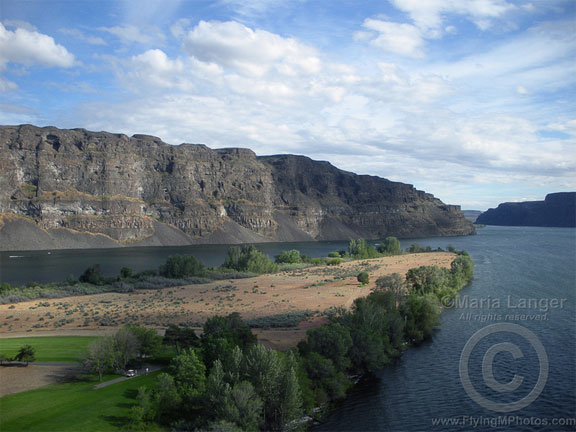
I snapped this photo of the south end of Crescent Bar as I left the area. Quincy’s farmland is spread out on the shelf above the cliffs on the left side of this photo. (View a larger version in my photo gallery.)

Farther downriver, I swung to the east and climbed over the edge of the gorge. I sped over Dusty Lake, where Mike and I had gone hiking with Mike’s cousin Rick and his friend last year. A few fishermen stood on the southwest side of the lake and looked up at me as I zipped past. Then, dodging wires, I climbed back up to Quincy’s level and headed southwest. The Gorge Amphitheater was packed with cars, tents, and people. A show was going on. I kept my distance as I swooped past, then dropped behind the stage and headed back upriver over a rock shelf covered with ancient potholes. Then I was abeam Quincy Lakes again and chose another of the two flood-carved canyons to fly up.

Quincy Lakes

This is Ancient Lake, fed by a waterfall that, in turn, is fed by runoff irrigation water. Quincy’s farmland is spread out on the shelf beyond these cliffs. (View a larger version in my photo gallery.)

I zipped back over the farmland south of Quincy. I noticed that my GPS wasn’t working quite right — a restart was required to fix it — but I knew my way back to the ag strip without it. The ag pilots were just leaving when I touched down. I’d been out for just a half hour. My mood was considerably brightened and my headache was just about gone.

Because of a gusty little wind coming out of the west, flying wasn’t smooth enough to make the flight perfect, but it was good to get out and about. What I really like is flying on those windless mornings or afternoons, when the river is glassy, reflecting the cliffs and clouds. When it’s like that, I can fly low over the water and around the canyons in effortless control of the aircraft. That’s magic.

As you can see, I got two reasonably good photos of the area while I was flying. I used a Nikon Coolpix camera for these shots. Although I really don’t like the camera in general — it doesn’t seem to work as well as the Canon Powershots I had before it — it’s easy enough to use with one hand (my left) as I fly. I can’t really frame a shot — I literally point and shoot and hope for the best. On these shots, the light was low and soft enough to prevent glare through the cockpit bubble. I lucked out.