VFR on Top

Fog in Wickenburg makes for an interesting departure…or two.

On Saturday, I was scheduled to appear at the Buckeye Air Fair in Buckeye, AZ to give helicopter rides. This would be my fourth appearance at this great family event.

The weather on the days leading up to the event was overcast with scattered rain. While rain isn’t too common in the desert, it’s not unheard of. The weather forecast for Saturday was clear with temperatures around 65°F. That’s unseasonably cool, but I’d take it. Winds in Buckeye were forecast at 7 knots from the east shifting to 5 knots from the southwest. Nice.

Fog in Wickenburg?

What the weather forecast didn’t mention was fog. Fog is only slightly more common here than snow. While we can get snow about once every 3 to 5 years, we can get fog once or twice a year. This year’s first encounter with fog was Saturday morning.

I saw it when I woke up at 4 AM. (I’m a naturally early riser; its a curse of middle age.) It was still dark out, but I could barely see the lights from my neighbors’ homes and I couldn’t see the tower normally visible out the back of our house. I’ll fly at night or in rain or in high winds. But I can’t fly in the fog.

I went about my morning routine. The sky brightened. We were in a thick fog. Visibility was about 1/2 mile.

Mike woke up, had breakfast, and fed the horses. By then, it was 7 AM, time to head to the airport. But I still couldn’t see beyond the hills immediately around our house. It was definitely not flying weather.

We packed up a cooler with bottled water, soda, some snacks, and ice. We took the Jeep to the gas station and filled it up — not because we needed it for the event, but because I, as usual, had run it until the Low Fuel light came on. Then we headed over to the airport to load and prepare the helicopter.

The visibility there was the same, if not worse.

I did a good preflight, taking my time. Mike loaded the cooler, paperwork, signs, and other paraphernalia into the back seat area. There was no reason to rush. Even though we were going to be late, I couldn’t take off in the fog.

We towed the helicopter out to the fuel pumps and took on 12 gallons. Fuel is cheaper in Buckeye, so we figured we’d fuel up there. It would also be a good way to support the airport that was hosting the event. (I wound up buying 88.8 gallons of 100LL at Buckeye that day, coming home with full tanks.)

Playing the Waiting Game

Ed, one of my mechanics, came by. He has a classic Taylorcraft Sport airplane and planned to fly it down to Buckeye and put it on display. But he didn’t like the look of the weather, either. He, Mike, and I spent about 30 minutes standing near his hangar, chatting, watching the fog thicken and thin out and thicken again.

A helicopter flew by overhead, completely out of sight above the fog layer. That told me that the fog wasn’t very thick.Helicopters don’t normally make a habit of flying in clouds less than 1,000 feet off the ground. No aircraft does.

I went into the terminal to use the facilities and chat with the FBO guy, Roark. By now, it was 8:15 AM. I was supposed to be in Buckeye at 9 AM. Buckeye was about 40 minutes away by air. I made a few calls to let the people who were waiting on us know that we’d be late. I also called the automated weather observation system for Phoenix Sky Harbor, which is reachable by telephone, and listened to the recording. Visibility 10 miles. Scattered clouds at 1200 feet AGL; overcast at 3000 AGL. In other words, the weather down in Phoenix wasn’t bad at all.

While Roark and I were chatting, an airplane called in, coming from the north. His transmission was difficult to read, but what we eventually understood was that it was clear where he was. He wanted to know what the cloud ceilings were at Wickenburg. The way I saw it, we were in a cloud — ceilings were zero.

When the plane landed at Moreton Field, a dirt strip at a residential airpark three miles north of Wickenburg Municipal, I began to wonder whether the weather might actually be better than it looked. And that’s when I realized that the fog was lifting — I could actually see at least a mile and the dim outlines of the mountains 15 miles to the north were coming through the haze.

Our First Departure

I went out and started up the helicopter. Mike joined me as I was warming it up. We could see the full length of the 6050-foot runway and what lay beyond it when we took off.

At the airport, Roark and Ed were listening for reports. I climbed to just below cloud level — perhaps 400 feet up. When we got to the river, the clouds around us melted away. It was a beautiful, clear, sunny day to the north. I reported all this on the radio.

Unfortunately, we needed to go south. I decided to follow the river and Grand Avenue until we broke out of the fog bank.

It was a tense few minutes. Visibility varied from more than a mile to about 1/4 mile. Every time visibility got low and I considered turning around, it would suddenly open up, giving me confidence about moving forward. I was flying at 2300 MSL — below airport elevation. We could never get more than 300 or 400 feet off the ground because the cloud level was right there. This was scud running, pure and simple.

Then, about 8 miles south of town over Grand Avenue, I suddenly realized that if I continued forward, I’d be in a cloud. I dropped the collective, pulled back on the cyclic, and started a slow, sharp turn. Clouds surrounded us, but I kept sight of the ground. The five seconds it took to make my 180° turn seemed like ten minutes. But then we were flying back the way we’d come.

It wasn’t until I was back in town that I could make another radio report to Wickenburg Airport. I was too low for my signal to reach them through the mountains south of town. We continued north along the river until the cloud bank opened up again. Then I climbed steeply to take a look at the situation from up above.

Low Clouds at WickenburgWe got above the cloud tops at 3000 feet. At 3200 feet MSL, the clouds looked like a fluffy blanket of cotton with Vulture Peak, Twin Peaks, and, far to the south, the bulk of the White Tank Mountains sticking out the top. It was absolutely beautiful.

Mike and I briefly discussed flying VFR on top. For those of you who aren’t pilots, this means flying using visual references, but above the clouds. The conditions for this were perfect — there were no other clouds above the ones we were already above, so there was no danger of flying into other clouds. There were ground references in the form of mountains poking through the clouds. But there were two problems with this:

  1. I’d never flown VFR on top and wasn’t very comfortable with the idea.
  2. If we had an engine failure, we’d have to drop through clouds that might reach all the way to the ground, making it impossible to find a suitable landing spot.

I descended back beneath the clouds. For a few minutes, I thought we might try heading west, but by the time we reached the airport again, I realized that visibility out that way wasn’t much better than at the airport. So we decided to land and wait it out.

Remember, there are old pilots and bold pilots but very few old, bold pilots.

More Waiting

On the ground, there was a man with a Piper Cub who was hoping to leave Wickenburg and fly to Tucson. He was in the same situation as us, since he needed to go south. I told him about the cloud tops and the nice day above them. He had an instrument rating, but his aircraft was not properly equipped for IFR (instrument flight rules) flight. So, like us, he decided to wait.

Time marched on.

I called Phoenix’s AWOS again. Still 10 miles visibility down there. Then I called Brad, who was working ground crew for us at Buckeye. He said it was overcast, but otherwise clear. The event was just starting to get under way, with lots of people coming in. I think he had a hard time believing that the conditions at Wickenburg could be bad enough to keep me on the ground.

At 9:15, I could wait no longer. The sky had brightened considerably and I was sure whatever clouds were left would burn off quickly. I was also sure that the VFR on top route we’d glimpsed would have plenty of holes with views to the ground. So I decided to give it another try.

Our Second Departure

While I warmed up the helicopter again, we heard radio calls from pilots coming into Wickenburg from the north. Some of them were on their way to Buckeye and, like us, were concerned about the cloud cover. They’d decided to stop in Wickenburg and wait it out.

The Cub guy had decided, like us, to go for it. He taxied down to the end of Runway 23 to depart. We took off, climbed out about 300 feet, and turned to the south. At first, I planned to follow Vulture Mine Road under the clouds. But when we saw how the clouds came down to the road level just south of Rancho de los Caballeros, I changed my plan. Instead, I made a 1300 FPM climb at about 60 knots right through the biggest hole I saw in the clouds. We popped out the top into the sunshine, will all the nearby mountain peaks clearly in view. Seeing the huge White Tank Mountains, which weren’t far from our destination, helped convince me that a VFR on top route would be okay.

I punched Buckeye into my GPS, adjusted our course, leveled off at 4000 feet MSL, and accelerated to 110 knots.

Mike took this excellent shot of Vulture Peak as we flew by it.

The cloud tops were about 500 feet below us as we moved south. There were plenty of big holes in the clouds offering clear views of the desert below us.

We reached the edge of the fog bank about 20 miles south of Wickenburg. I made a radio call to the Cub pilot to let him know the clouds stopped there. He was still on frequency and thanked me for the report. We descended to my usual altitude of 600 feet AGL and continued on our way with the low clouds behind us.

By the time we got to Buckeye, there were a few clouds scattered in a hazy sky. A cloud bank remained to the west and to the north through most of the day. But by the time we returned to Wickenburg much later that afternoon, the low clouds were gone.

Chasing Race Cars Isn’t for Every Pilot

Analysis of an accident report.

The other day, I got a call from an off-road racing team manager. He was interested in hiring me to chase his truck at an upcoming race. But rather than ask me the usual bunch of questions about rates and ferry times, he grilled me about my flight experience.

How long have you been flying? Do you own the helicopter? How many times have you done this?

I answered all of his questions honestly — I have nothing to hide. I’ve been actively flying for about 8 years, since I bought my first helicopter. I have about 1800 hours of flight time. I own the helicopter I fly and I’ve put all of its 610 hours on it. I’ve followed cars and trucks and boats during races about ten times now.

Then he asked, “Did you hear about the helicopter crash at Lucerne Valley last year?”

I told him I hadn’t.

“One of our guys was on board. The pilot didn’t have very much experience, so we’re careful about who we hire now.”

The Accident Report

Later, after discussing rates and finishing up the call, I looked up the info on the accident he referred to in the NTSB database. I found it under NTSB Accident number LAX05FA189. He’d been wrong about the accident date — nearly three years had passed since the May 28, 2005 accident in Lucerne Valley, CA. The helicopter had been a Robinson R44. Although no one had died, three people had been seriously injured in the crash.

I read accident reports to find out how accidents occur. This helps me stay aware of potential problems with my aircraft or flight situations. Here’s the short text of this particular accident’s description:

The helicopter impacted level terrain and rolled onto its left side while maneuvering during a low-level photo flight. The pilot was flying southbound along a racecourse on a photo flight when he made a hard 180-degree turn, and lost control of the helicopter. As the helicopter began a spin to the right, the pilot noted a loss of rpm and altitude. He asked the certified flight instructor (CFI)/safety pilot to take the flight controls. As the CFI took control of the helicopter, he realized that the rpm’s were decaying and that the helicopter was too low to recover the rpm. He attempted to cushion the impact with the collective. Both pilots reported that there were no preimpact mechanical anomalies with the airframe or engine. No evidence of any preimpact mechanical malfunction was found during the post accident investigation that would have precluded normal operation. During the accident flight, the helicopter was running approximately 131 pounds over the maximum gross weight for an Out of Ground Effect hover for the existing atmospheric conditions. The helicopter was being operated in a high density altitude environment, which was computed to be 7,350 feet mean sea level. The pilot received his rotorcraft helicopter rating 7 days prior to the accident. He had approximately 77 hours of total rotorcraft flight time at the time of the accident. The helicopter manufacturer indicated that photo flights were a high risk phase of flight and issued a safety notice SN-34. Safety Notice SN-34 recommended at least 500 hours and extensive training in both low rpm and settling-with-power recovery techniques prior to flying photo shoot type flights.

The National Transportation Safety Board determines the probable cause(s) of this accident as follows:
the pilot’s failure to maintain adequate main rotor rpm and directional control while maneuvering at low altitude. Contributing factors in the accident were the helicopter’s gross weight in excess of the maximum hover out of ground effect limit, a high density altitude, and the pilot’s lack of overall experience with regard to low rpm and settling-with-power recovery techniques.

Full narrative available

There’s a lot of information here. I’ll review it and explain the parts that might not make sense to folks who aren’t pilots, aren’t helicopter pilots, or are new helicopter pilots.

Out of Ground Effect Hover

Let me start out by explaining that helicopters need more power to hover than to perform just about any other maneuver. That might seem counter intuitive, since when you’re hovering, you’re really not going anywhere. But the reason for this is that when a helicopter is in motion, there’s an increase in lift from the relative wind against the rotor blades.

Effective Translational LiftFrom the FAA’s Rotorcraft Flying Handbook:

Translational lift is present with any horizontal flow of air across the rotor. This increased flow is most noticeable when the airspeed reaches approximately 16 to 24 knots. As the helicopter accelerates through this speed, the rotor moves out of its vortices and is in relatively undisturbed air. The airflow is also now more horizontal, which reduces induced flow and drag with a corresponding increase in angle of attack and lift. The additional lift available at this speed is referred to as “effective translational lift” (ETL).

So you use less power to fly than to hover. And any speed lower than ETL will require more power than speeds above ETL. Helicopter pilots often use 30 knots airspeed as a rule of thumb.

You can break down hovering into two types: in ground effect (IGE) and out of ground effect (OGE). From the Rotorcraft Flying Handbook:

When hovering near the ground, a phenomenon known as ground effect takes place. [Figure 3-7] This effect usually occurs less than one rotor diameter above the surface. As the induced airflow through the rotor disc is reduced by the surface friction, the lift vector increases. This allows a lower rotor blade angle for the same amount of lift, which reduces induced drag. Ground effect also restricts the generation of blade tip vortices due to the downward and outward airflow making a larger portion of the blade produce lift. When the helicopter gains altitude vertically, with no forward airspeed, induced airflow is no longer restricted, and the blade tip vortices increase with the decrease in outward airflow. As a result, drag increases which means a higher pitch angle, and more power is needed to move the air down through the rotor.

Here’s the diagram that goes with this information:

Hovering

Out of Ground Effect Hover R44Operating Handbooks for helicopters provide charts that help pilots determine the expected performance of the aircraft in a variety of conditions. The accident report indirectly refers to the OGE Hover Ceiling chart. This chart tells a pilot the maximum altitude you can expect to maintain an out-of-ground effect hover given the aircraft weight, altitude, and outside air temperature. The one shown here is for a Robinson Raven I helicopter (I can’t seem to find my office copy of my Raven II manual). Here’s how it works. Start by following the weight line up to where it hits the temperature line. Then follow that intersection across to the altitude.
For example, if the aircraft was 2300 pounds and the outside temperature was 20°C, the maximum OGE hover would be 3,000 feet pressure altitude. In this accident, the aircraft was roughly 2,220 pounds at the time of the accident and the temperature was about 31°C. Following those lines on the chart indicates that the maximum OGE hover would be 3,100 feet pressure altitude.

The accident location was at 4,266 feet MSL. So the pilot was operating in an area and at a weight that made out of ground effect hover impossible in his aircraft.

Now I don’t want people reading this to think that you can’t (or shouldn’t) fly a helicopter in a place where you can’t hover out of ground effect. That’s not true. But the OGE hover situation does weigh heavily into this accident because of the maneuvers required for the mission.

Lower Rotor RPM

Having just flown with a photographer for an off-road race, the kinds of maneuvers needed are very fresh in my mind. More than once, we were required to slow down to wait for a vehicle. We also hovered OGE several times, with and without slight tailwinds or crosswinds. And, of course, we often had to make sudden course changes that required sharp 180° turns. These are not simple maneuvers, especially when power is an issue.

I can also say from experience that when flying an R44, if you pull more power than what is available, the first indication of a problem will be a low rotor RPM horn. I’ve had this happen twice on takeoffs at high altitude locations (over 6500 feet) with four people on board. If you can increase airspeed to reduce the amount of power needed to fly, you can get out of the situation, but that normally means a descent. (In one case, I did a running take-off from an airport and was fine once airborne; in the other case, my takeoff was from the edge of a cliff, so a descent wasn’t a problem.)

Here’s how I see this accident setting up. The pilot is going very slowly, below ETL, almost in a hover, and makes a hard turn. The aircraft starts to settle, so he pulls more pitch. This increases the drag on the main rotor blades, but there isn’t enough power to overcome it. The blades slow down. The low rotor RPM warning system sounds its horn. He’s too close to the ground to push the cyclic forward and get the airspeed he needs to get out of the bad situation.

How could this have been prevented? One way is to lighten the load. The maximum gross weight for a Robinson Raven I is 2,400 pounds. The pilot and passengers weighed 230, 180, and 175 respectively. If the pilot had checked the OGE charts, he would have seen that the aircraft was too heavy to fly at speeds less than 30 or so knots. He could have taken on less fuel or, better yet, flown without the 180-pound man beside him.

Another way to prevent the problem is to keep the aircraft speed up, above a minimum of 30 knots. This will prevent the pilot from getting into a situation where OGE hover power is required.

I should note here that I considered buying a friend of mine’s R44 Raven I — until I looked at the OGE hover chart. The performance was simply not acceptable to me. I often fly to the Grand Canyon (6300 feet), our vacation property (6700 feet), and Sedona (5200 feet) on hot days. Based on the chart, it was uncertain whether I’d be able to land and take off from these destinations when the aircraft was near maximum gross weight. I needed the additional power and performance of the Raven II for flexibility and safe operation in these areas.

Pilot Experience

Like my potential client, I think a main contributing factor to this accident was the pilot’s inexperience. He had only 70 hours in helicopters, and this was the first time he’d flown this kind of helicopter at a race event. He simply was not prepared for the kind of maneuvers he’d have to perform to get the job done. Add that to the OGE hover problem and it’s easy to see how this could have happened.

Robinson Helicopter Company knows that inexperienced pilots should not be flying photo missions. It issued Safety Notice SN-34 in March 1999 which states:

There is a misconception that photo flights can be flown safely by low time pilots. Not true. There have been numerous fatal accidents during photo flights, including several involving R22 helicopters.

Often, to please the photographer, an inexperienced pilot will slow the helicopter to less than 30 KIAS [knots indicated airspeed] and then attempt to maneuver for the best picture angle. While maneuvering, the pilot may lose track of airspeed and wind conditions. The helicopter can rapidly lose translational lift and begin to settle. An inexperienced pilot may raise the collective to stop the descent. This can reduce RPM thereby reducing power available and causing an even greater descent rate and further loss of RPM….

The Safety Notice goes on to recommend that the pilot have at least 500 hours pilot-in-command time in helicopters and over 100 hours in the model flown before conducting photo flights.

Conclusion

I’m glad my potential client mentioned this accident and I’m very glad I looked it up. I learned a lot from reading it, analyzing it, and summarizing my thoughts here.

It’s also made me more aware of weight and performance at events like these.

When you do a lot of point-to-point flying, you become somewhat complacent about the aircraft and don’t consider the additional demands of multi-maneuver flying. Although I’m always concerned with the weight of my aircraft on takeoff, I tend to look at it more in terms of whether I’m too heavy to fly legally — over maximum gross weight. With only 3 people on board, unless we’re all fatties, that’s not usually a concern.

Parker was at less than 500 MSL and it was a cool day, so I admit I didn’t check the hover charts. (When you check them over and over, you get a “feel” for them and can “guesstimate” what they’ll say.) But after reading this and thinking about it, I’ll review the charts before each photo flight, even if I’m already pretty sure that OGE operations won’t be a problem.

Any thoughts, comments, experiences you want to share? Use the Comments link or form for this post.

Chasing Desert Racers

At the Best in the Desert/BlueWater Parker 425.

I spent this past Saturday doing one of the things I really love to do: chasing racecars with a helicopter.

The venue was the Best in the Desert Racing Association’s BlueWater Resort & Casino Parker 425, which featured highly modified trucks, cars, and buggies racing on a 140+ mile dirt track through the desert. My client was a television producer who videos these events from multiple cameras and turns them in TV shows. For this event, they had a total of 15 cameras, includibut thingsng one in my helicopter and several in the trucks out on the course.

I flew the helicopter with the cameraman and my husband, Mike, working as a spotter, on board. The cameraman sat behind me with his door off. Mike sat beside me.

We started before dawn at the Parker Airport. I started up at 7 sharp and was warmed up and ready to fly by 7:15. The police escort was leading the 300+ participant vehicles to the starting line on Route 95 in downtown Parker when we began circling about 500 feet overhead. The cameraman had a list of 15 targets he needed to video. The first one was the 15th truck in line at the start. Racers were released 30 seconds apart. When our first target was released, the fun began.

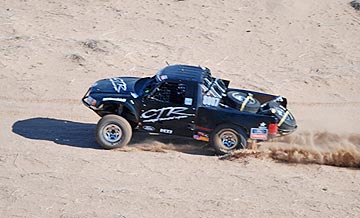
Desert Racing TruckI chased the car down the paved road and onto the dirt track, descending as I left the downtown area. Soon, we were racing beside it just 70 feet up on the long straightaway that heads due east. Mike kept an eye out for wires, calling them out as he saw them. My attention was split between the truck, the wires, and the track in front of me. I worked the cyclic and collective hard, climbing, descending, slowing, speeding up. Both arms and legs worked automatically to make the helicopter do what I needed it to do. Spectators below me went by in a blur. The track made a 90 degree turn to the left and I paused at the inside of the curve just long enough to pivot so the cameraman could keep the camera on the target. Then down the short straightaway to the edge of a steep drop with high wires on one side. The truck descended the hill while I climbed over the wires. I met the truck on the other side and we raced together through a tree-filled dry wash.

“Okay, peel off,” the cameraman instructed.

I turned away from the target and followed the road back. Now we had to find the next target. All we had were numbers — we didn’t know much about how the vehicle looked, other than what class it was in. I had to fly low enough to see them. The first one of us to see a number, called it out. We got the next target halfway back to town. I lowered the collective to slow down and made a sharp 180 degree turn. Then I was on that truck, following it to the wires and into the wash.

We repeated this process about seven or eight times, each time picking up our target a little farther away on the track and ending a little farther down the track. I got to know exactly where all the wires were. Sometimes, I’d look down in time to see a spectator wave up at us or snap a photo. I think there were more photos taken of us that day than of any one racer.

This went on for over an hour.

Then, suddenly we could no longer find any of the targets we needed to video. That started a search up and down the track, flying low enough to read the numbers. Every once in a while, the cameraman would pick out a “trophy truck” or a vehicle driven by someone well-known, and ask me to follow it. I’d follow as closely as I dared, putting the cameraman close to the action. Inside the helicopter, through our noise-reduced headsets, we could sometimes hear the engines of the racers below us or the sirens of the vehicles preparing to pass. We watched one driver slip off the track and race along beside it, scattering spectators who had been standing too close. We shot some video of a modified Hummer flying through the air after a particularly bad bump.

I suppose I should mention here that I wasn’t the only helicopter at the event. There were at least five others: 2 R44s, an Astar, a Eurocopter, and a Bell Jet Ranger. In most cases, they’d been hired to follow a specific race vehicle or team. Once they left the area, they didn’t come back for a while. So keeping an eye out for aircraft wasn’t a serious issue.

After two hours, we headed back to the airport. I shut down and placed a fuel order. Then we drove over to the BlueWater Casino for breakfast. The cameraman the cameraman met with some of the folks he works with to see how many vehicles on his list were still in the race. Each vehicle had a transponder and satellite communications device so it could be tracked from headquarters at the Casino. According to the cameraman, fewer than 50% of the vehicles finish the race. Most of them break. And if you saw the track, you’d understand why.

With an updated list, we headed out again just before noon. We were expecting one of the target vehicles in the pit area, so we stayed nearby. There was a “serpentine” area just east of the airport, with winding, bumpy tracks in a big field surrounded by spectators. I think there was about 5 miles of road there, and it was so twisty that even from the air, I had trouble figuring out the route. We spent about 15 minutes there, filming the action of vehicles skidding around the sandy curves, throwing dust high up into the air. At some point, I realized that I was probably putting on a better show for the spectators than the cars and trucks were.

We spotted a target vehicle as he was leaving the pits and took off after him. More chasing at low level, avoiding wires, slowing when the truck slowed, speeding up when it speeded up. We peeled off and continued down the track, looking for more targets. That’s when we started seeing the breakdowns. Trucks and cars and buggies on the side of the road with parts peeled off of them and drivers bent over their innards. One team was changing a tire. Another was taking the hood off the car. We saw a fender alongside the track. Later, we saw a prone driver with his companion performing CPR. (The rumor I heard was the driver suffered a heart attack or stroke while driving and died on the race course. I have not been able to confirm this yet.)

Desperate to find one last vehicle on the cameraman’s list and looking for exciting footage, we followed the entire 140-mile course. It stretched from Parker through the empty desert as far east as Cunningham Pass (north of Wenden) and around Planet Peak (near the Bill Williams River) to the northwest. This much-reduced map gives you an idea of the distance — I’ve highlighted the track in light red so it’s easier to see.

Parker 425 Map

Much of the course was pretty boring from my point of view — lots of long, straight stretches. In one area, the road ran alongside a set of high tension power lines, making it tough to get low enough to see car numbers. But things got interesting on the last 4 or so miles, when the track headed into the mountains south of the Bill Williams River. The cameraman got some excellent footage of a car winding its way down a narrow canyon. I had to stay high — there wasn’t enough room for me to fly alongside it. But when the canyon opened, I dropped down so he could get some close-up shots.

After trying a few more times to find the missing buggy — we were in touch by radio with the satellite tracking people — we headed back to the airport and I shut down.

We’d flown a total of 5.0 hours. The sky had clouded up and lighting wasn’t as good as it had been earlier in the day. Although we’d planned a third flight for the finishers, the cameraman. The cameraman decided to skip it.

It had been a great day. Not only did I do a lot of flying, but it was the kind of flying I really love to do — challenging, exciting, and with a goal other than going from point A to point B.

Why can’t all my gigs be like this one?

Note: If you were at the 2008 Parker 425 in February and have photos or video footage of a plain red helicopter (no stripe) flying with the cars, please let me know. I’d love to show them off with this post or elsewhere on this site.

February 7, 2008 Update: I added a photo Mike took during the flight to give a better idea of what was going on at Parker.

On Avatars

Why can’t they look at least a little like the person they represent?

Like so many techno-geeks these days, I’m involved in a bunch of social networking sites: Twitter, LinkedIn, FaceBook, RedBubble, Flickr, MyBlogLog, etc. And all of these sites give each member the ability to include an avatar — an image to represent that user.

Maria Langer AvatarMaybe I’m not very creative, but my avatar is a photo of me. It was taken by photographer Jon Davison during one of our flights last September. It shows me in one of my favorite places: at the controls of my helicopter, flying over the Arizona desert. (I think I’m over the Little Colorado River Gorge in this shot.)

The way I see it, my avatar is supposed to represent me. What could represent me better than a photo of me doing something I like to do?

Evidently, not everyone has the same idea. While many of the avatars I see in Twitterrific are photos or drawings of the people they represent, quite a few are not. And in other social networking sites — MyBlogLog comes to mind — the majority of avatars don’t bear any resemblance to the people they’re supposed to represent.

I find this bothersome, especially among my Twitter friends. Why? Well, in most cases, an avatar is the only visual representation I have for a person. If the avatar features purple hair or a goofy cartoon face — you know who you are, folks! — that’s the image I have of that person. And it’s a lot tougher for me to take these unrealistic avatars seriously.

Maybe I’m old fashioned, but I find it easier to communicate with people I can take seriously.

A few more notes on avatars:

  • Some people seem to like using their Second Life avatars as their social networking avatar. While I could write a dissertation covering my thoughts about Second Life — starting with, is your first life so bad that you need a second one? — I’ll just say that Second Life avatars are generally a highly stylized version of how people want to look. While few of us are supermodels, surely there’s a decent photo of these people somewhere that they can use online.
  • Some people use glamour photos for avatars. I have a colleague who does this. When I met her in real life, I didn’t recognize her. Let’s face it, we only look like our glamour photos in our glamour photos — after they’ve done the photo shoot and brought our faces into Photoshop for some digital plastic surgery. Every time I see this avatar, I have to remind myself that she doesn’t really look like the photo. (Of course, it’s also made me want to get a glamour photo.)
  • Some people use photos of their pets as avatars. Talk about going to the dogs! Do the dogs really look better? Or do they just identify with their dogs? Ditto for cats, birds, and miscellaneous wild animals.

Of course, none of this has to do with special-purpose avatars used to promote an idea or cause. An example is the Frozen Pea avatars that many of us wore on Twitter for a few Fridays to raise awareness and funds for Breast Cancer Research through the Frozen Pea Fund. I was a single pea for the day. My favorite avatar was one Twitter friend who created an image of his head sticking out of a pea car.

But I’d like to start a movement among serious social networkers. Be proud of your face and show it off as your avatar! It doesn’t have to be a full-face shot; it can be creative. (Some of the best avatars I’ve seen show only part of a person’s face.) But it should show you, as you really are.

I’d just like to see who I’m tweeting to.

Round Robin Photo Challenge: Landmarks

The Mittens.

This afternoon, I stumbled upon a blog devoted to sharing photos. The description on the Round Robin Photo Challenges page states:

Welcome to the official information and update journal for the Round Robin Photo Challenges. This is where you will find all the details for each photo challenge, such as the subject, the link to blog or journal where each challenge is being hosted, and all updates to the players participation lists.

The current challenge can be found at “Round Robin Challenge: Landmarks:”

Again, let’s take an opportunity to show off our hometowns. I live in the Bay Area, so I have no real shortage of recognizable landmarks, so what I would do is try to show those landmarks in an interesting lighting circumstance, such as a sunset, or under special lighting conditions. But I want to see other places, and the landmarks that make those places so special. A beautifully designed building, an incredible bridge, or a monument of some sort, or maybe even an unusual road sign. It’s all good!

Unfortunately, there’s no landmark in my current home town that I want to show off. As the Mayor and Council continue to make decisions that destroy what was special about Wickenburg — cutting down tall trees bordering a park, allowing new housing developments where there were once horse trails, approving road construction that will destroy the downtown riverfront — I prefer to look away, to the places that remain unspoiled.

I get around a lot — probably a lot more than most folks. And I visit a lot of landmark locations in the Southwest. And I usually have a camera with me. So there were a lot of “stock” photos in my iPhoto library to choose from. Many of them represent places I wish I could spend even more time.

I chose The Mittens — or the Mitten Buttes — in Monument Valley. Although the Tribal Park overlook where I took this photo is in Arizona, the buttes themselves are in Utah. This isn’t a terribly special photo — it was taken from the ground at a viewpoint every tourist stops at. But I like the lighting of this shot. It was an October morning, with light coming from the southeast. I like the way it illuminates the rock in the foreground, giving it texture and color far more interesting than the famous monuments that stand beyond it.

So, for what it’s worth, this is my entry. I hope to be a regular participant.