I finally figure out how to do it right.
I’ve been taking photos of the moon for years — since I first developed an interest in photography.
I remember one of my first experiments. I was in my late teens, away at college. My dorm room was on the top (14th) floor of one of the university’s six dorm towers. My room faced east. At moonrise one night, I set up my camera and tripod and took several long exposures of the rising disc. I developed the film — remember that stuff? — and was very disappointed with the results. The moon wasn’t round. It was oval. And there were no features. Why? Because my long exposure was too long and the moon moved during the shot.
Time passed. I stopped dating a photographer, graduated from college, and got on with my life. Photography wasn’t very important to me. Photographing the moon was, in my mind, something I simply couldn’t do.
More time passed. Enter digital cameras. They’ve done more for photo experimentation than any other development (pun intended). I could try all kinds of things and see results immediately (on a tiny screen) or almost immediately (on a 24-in high resolution computer monitor. How does a change in shutter speed, aperture, focal length, or lens filter affect my image? Try it and see! (The trick, of course, is to pay attention and remember what it is you’re trying. Remembering is not one of my strengths.)
So I tried shooting the moon again. I shot some photos of a lunar eclipse this past February. They weren’t bad. In fact, some of the folks who saw them liked them a lot. But I wasn’t satisfied. Not enough detail. Not clear enough.

 Last month I tried again. It was my first full moon in Quincy. I was camped out at the Quincy Golf Course, which has an “RV park” connected to it. (The quotes are because there are only 5 full hookup sites, a bunch of partial hookup sites, and no other RV parklike facilities.) I brought my tripod out to take some photos of various things in night lighting. I got a bunch of good photos — check my Photo Gallery to see a few of them — but my shots of the moon were not among them. I liked these two the best. In the first, I lined up the moon with the Quincy Golf sign. The moon looks like a big golf ball. In the second, I shot the moon when it was still quite low. My camera angle included the road (State Route 281), which is heavily trafficked. The lines are the lights of cars and trucks whizzing by during the relatively long exposure.
The other day, I tried again just after moonrise. I used my 70-300mm lens, dialed in to 300mm with image stabilization on. I put it on a tripod. And then a shot a bunch of photos, examining each one after I shot it. I realized that the moon was too bright. And then my brain kicked in. What makes a photo too bright? Too much light; overexposure. What do you do if a photo is overexposed? Reduce the amount of light coming in. How do you reduce the light coming in? Two ways: close down the lens or increase the shutter speed.
Or, on my camera, just set exposure compensation to underexpose the photo.
So I set the exposure compensation to the minus side of the meter. At first, I set it 1/3 stop. I took a shot. No appreciable difference. A full stop. Better. Two stops. Much better; I could now see some detail on the moon’s face. Three stops, now beyond what the meter can show. Great. With each change, the camera increased the shutter speed. So I was actually killing two birds with one stone: I was decreasing the amount of light that came into the camera to avoid washout of the moon’s surface and increasing the shutter speed to shorten up my exposure, thus preventing blur from the moon’s movement.
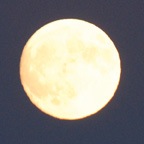
Want to see the differences over time? Here are six shots. The first was taken without exposure compensation at 9:03 PM. The others were taken with various amounts of exposure compensation from 9:10 PM through 9:11 PM, about 12 seconds apart.
 Aperture: f5.6
Shutter Speed: 1/40 second
Exposure Bias: 0
Aperture: f5.6
Shutter Speed: 1/60 second
Exposure Bias: -1
Aperture: f5.6
Shutter Speed: 1/80 second
Exposure Bias: -1
Aperture: f5.6
Shutter Speed: 1/120 second
Exposure Bias: -2
Aperture: f5.6
Shutter Speed: 1/200 second
Exposure Bias: -2.67
Aperture: f5.6
Shutter Speed: 1/250 second
Exposure Bias: -2.67
None of these images have been retouched. All I did was bring them into Photoshop, crop them to a 600 pixel square, and then reduce the resolution to 72 dpi.
But with a tiny bit of sharpening in Photoshop, at a higher resolution, the final photo doesn’t look bad at all:

What do you think? Have you used any special techniques to shoot the moon or other objects at night? Use the Comments link or form at the bottom of this post to share your secrets.

 But this sign, which is lighted at night, remains to remind us of the golf course’s past. It’s a great old-style sign that may not be in the best condition, but still calls out to passersby on busy state route 281 as they drive between Quincy, five miles north, and George, five miles south. My favorite part? The silhouetted golfer is wearing knickers. During the day, the sign is rather nondescript and not very interesting.
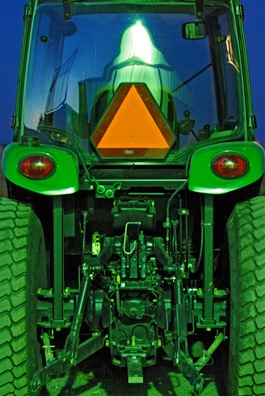 The golf course is in the middle of farmland. All around are fields growing wheat, feed corn, potatoes, alfalfa, and other crops. There are all kinds of farm vehicles all over the place.
 The golf course and its RV park are on the corner of a busy intersection. State route 281 runs north/south between Quincy and George. Road 5, also known as White Trail Road, is a sort of Quincy bypass, that runs east/west and then north/south, west of Quincy. Because it bypasses the traffic light (and minor traffic) in town, its popular with truckers traveling between I-90, five miles south, and Wenatchee, 35 miles northwest.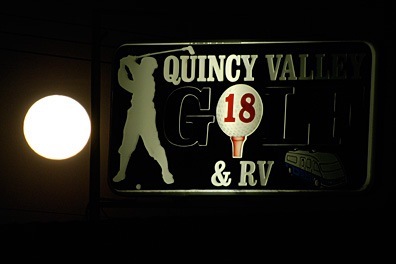
 Last month I tried again. It was my first full moon in Quincy. I was camped out at the Quincy Golf Course, which has an “RV park” connected to it. (The quotes are because there are only 5 full hookup sites, a bunch of partial hookup sites, and no other RV parklike facilities.) I brought my tripod out to take some photos of various things in night lighting. I got a bunch of good photos — check my
  Aperture: f5.6
 Aperture: f5.6
 Aperture: f5.6
 Aperture: f5.6
 Aperture: f5.6
 Aperture: f5.6
 I’m not sure if this is a Bell 212 or a Huey. I never could get my helicopter models straight. In this first shot, it’s coming down to the river to dip its bucket in the Columbia River. You can see the burned hills and smoke behind him.
  In this shot, the same helicopter is dropping on flames. (That would have been a great shot if the damn camera would have focused properly! Ugh!) The precision of these guys was incredible. They hit the flames 9 times out of 10 and the fire would turn to a huge cloud of steam. Note the power lines. They were all over the area. Not only did the pilots have to avoid the lines with the aircraft, but also with the bucket and line beneath them.
 Here’s a shot of a beautiful red K-Max heavy lift helicopter dipping in the Columbia River. The pilot completely submerges the bucket, then pulls up slowly so as not to overtorque the engine as it lifts. I don’t know the size of these buckets, but I know they make them 600 gallons and more. At 8 pounds per gallon, that’s a heavy weight. The K-Max is an unusual helicopter with two sets of main rotor blades mounted overhead at an angle to each other. The blades spin in opposite directions, making a tail rotor unnecessary, and intermesh with each other. The aircraft sounds very cool when it flies by.
 I spent the July 4 holiday weekend at Lake Pateros in Washington State. Most of the time I wasn’t flying — I spent 3.1 hours on Friday drying cherries — I was holed up at the extremely pleasant (and helicopter-friendly)
 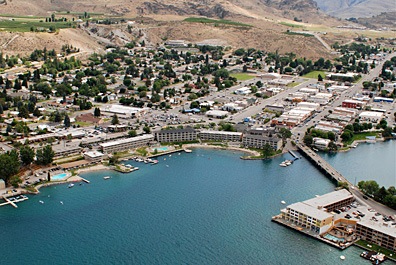 I continued snapping photos throughout the weekend. On Saturday, Mike and I took a helicopter flight around central Washington and we took turns snapping photos out of the helicopter. (He’s a pilot, too, and we had the dual controls in, so I had a rare opportunity to use both hands and decent equipment for aerial photography with doors off.) Some of those photos were pretty good, too, like Mike’s shot of downtown Chelan.