Yesterday, I tried my hand with another time-lapse, this one involving people. I set up my camera near the base of some trees on the edge of the putting green area of the Colockum Ridge Golf Course and zoomed in a tiny bit on the pro shop, golf cart, and RV park area. I got it all started at around 6:15 AM, with one shot every 15 seconds. I let it run until about 4:20 PM — just over 10 hours. I assembled the movie two ways: 15 frames per second and 30 frames per second. I liked the shorter movie (30 fps). I used Stomp to crop the frame to 16:9 ratio as I compressed the movie, thus cutting out a bunch of boring grass and a little bit of the sky.
Here’s the final product:
Tuesday is men’s league day at the course, so I knew there would be a considerable crowd in mid-morning. I think it’s interesting to watch how the scene changes throughout the day. You gotta love the people jumping around in the frames. You can see my new neighbors arrive in the RV park — they had a heck of a time parking those big rigs in the relatively narrow parking spaces here. (I did much better when I arrived.) Did you see the birds walking all over the putting green early in the morning? And what was that that seemed to fly into the camera?
My thanks to the folks at the Colockum Ridge Golf Course. Do you golf? Have an RV? Know where Quincy, WA is? If you answered all of those questions, you have no excuse not to visit one day soon!
The other afternoon, I drove down to Quincy Lakes with my Nikon D80 camera, 70-300 mm VR lens, and monopod. It was a scouting expedition for me. I’d spent a lot of time down at Quincy Lakes in the summer of 2008, photographing birds. This was my first visit in 2009. Although I brought my camera along, I wasn’t really expecting to take many photos. I was more interested in finding “good spots” to set up a tripod for some serious photography.
Of course, once I got down there and saw the incredible variety of colorful birds, I couldn’t stop myself from shooting away. I’d park the truck and hike a bit of a distance away from it, plant the foot of my monopod in the dirt, and target a bird. Most of the red-winged blackbirds and yellow-headed blackbirds I saw, however, were clinging to tall reeds, with other tall reeds blocking my view. I shot a lot of photos, but knew that only a small percentage of them would be any good. I wasn’t sure how I’d be able to do any better with a tripod.
After about 90 minutes and eight or so stops and short hikes, I was tired and ready to go back and review what I’d shot. But I detoured down a road to check out the camping area. If Mike comes up to Washington to join me later in the season, we might pull the trailer over there for a few days of camping on a lake.
I was just driving away from the parking area when I spotted a yellow-headed blackbird clinging to some reeds on the side of the road. The bird was less than 15 feet away from the roadside. I pulled up abeam him as quietly as I could in a diesel pickup truck and pressed the brake to stop. For a moment, I just looked at the bird and he looked at me. My camera was still attached to my monopod; its leg was almost fully extended. If I opened the door to step out or swung the leg around outside my window, the bird would surely fly off. In fact, I couldn’t understand why he hadn’t already flown off.
Yes, I shot this photo from the window of my truck.
With my foot still on the brake and the truck stopped squarely in the middle of the narrow dirt road, I reached over and began to unscrew the camera from the monopod’s very basic swivel head. Every once in a while, I’d glance back at the bird. He remained in place. I finally got the camera free, zoomed it to 300 mm, and focused. I squeezed off about a dozen shots before the bird flew off.
This is the best one. It is not cropped.
I don’t know about you, but I find this incredibly ironic. We gear up and go out with multiple lenses and filters and tripods. We hike away from roads and vehicles and people. We bushwhack off trails and wade into streams.
And yet it’s possible to take a photo as nice as this without leaving the vehicle.
Hell, I think I even had the stereo on.
It pays to cruise around with the windows rolled down, I guess.
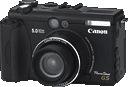
About two weeks ago, I got the bright idea that it was a complete waste of valuable camera resources to use my Nikon D80 for time-lapse photography when I had an older camera I could use. The other camera is my Canon PowerShot G5, which I bought back in 2003 for aerial photography work.
Buying the camera was a huge deal back then. Digital SLRs, if available back then, were too expensive to be an option. The G5 offered 5.0 megapixel (!) resolution — more than twice the resolution of any other digital camera we had. But it also included features we needed, including manual setting for focus and exposure.
Looking at the camera today, it’s amazingly big and clunky. But it takes a decent picture — certainly good enough for my time-lapse experiments. And frankly, I was having trouble getting my mind around leaving my Nikon outdoors, unattended, for hours at a time. It could be because the tripod got knocked over once and it was sheer luck that it fell toward a rail that caught it rather than toward the empty concrete behind it. I had no love for the G5; if it broke, well, that’s the way it goes. Ditto if it got stolen. In fact, I’d be more upset about losing my tripod or Pclix than the G5.
Oddly enough, the G5 has a built-in intervalometer — a fact I was unaware of. Unfortunately, the interval must be set in minutes (1 to 60) and it can only take 100 shots at a time. This simply wasn’t going to cut it for my needs. Besides, for some reason I still can’t understand, I can’t get the damn thing to work.
So I bought an optical cable for my Pclix. It arrived right before I left for Washington. I tried it for the first time on Friday.
For the optical cable to work, its end must be taped to the camera. The Pclix maker recommends electrical tape, so that’s what I used. Unfortunately, the heat of the day softened the tape. After about 2-1/2 hours, it shifted out of position. The camera stopped taking pictures. Here’s the result, with most of the beginning edited out (since there was really nothing going on):
Disappointing in so many ways. The sky was just getting interesting when the setup failed. And let’s face it — the view of the golf cart shed isn’t all that enticing.
So I tried again yesterday after recharging the camera’s battery overnight. I fixed up the camera differently and pointed it north instead of west. Same settings: one shot every minute, compiled into a movie at 10 frames per second. To prevent the camera battery from running out, I turned off the camera’s video screen. First shot at 9:13 AM; last shot at 7:33 PM. I left the camera outside all day long — even while I was out doing a helicopter ride. I never would have done that with my Nikon.
The result isn’t bad at all. I’m a little POed at myself for including the wires in the shot and it’s a little weird that some of the larger vehicles that drove by appeared in some shots — like the hay truck near the beginning! Again, I think I could have done better. But the clouds are so awesome in this movie. They build and move and swirl around. So cool. See for yourself:
I’ll keep working on this. Hopefully, I’ll get it right soon.
I’m living in my camper on a golf course south of Quincy, WA. The golf course is in the middle of farmland. In fact, the golf course used to be a farm field. The irrigation circle (or semi-circle) is still used to water the fairways. Because of this, all of the trees in the middle of the course are very short.
It’s a weird setup.
Last year when I was here, I took walks with my camera quite often. (You can find some of my better photos in my Photo Gallery; click here for a slide show of my Washington shots.) I’m trying to get into the habit of doing that again. I walk along the edge of the golf course property. There’s a canal on the south side with rushing water. On the other side of the canal, there was a wheat field.
This year, it’s alfalfa.
I was surprised to see the change. The alfalfa was freshly cut — no more than a day or two ago. They cut in the shape of the irrigation circle (or semi-circle). It was difficult to get a good shot at the curves.
The alfalfa will be left to dry in the field for a week or so. Then they’ll drive through with a baler and gather it up into bales that are dropped on the field. Later, another piece of equipment will come by and gather up the bales. They’ll be transported somewhere and covered with tarps until sold or used.
Last year, I didn’t start walking around the golf course until late June or July. I suspect that they’ll plant wheat in the field when the alfalfa has been taken away. I’m not sure if it’s too late to plant that — other fields already have wheat crops that are quite tall.
But I’ll observe and learn and maybe report back here.
I swear I’ll stop posting these. One day. Soon, maybe.
Nice colors and a bonus feature near the end.
The clouds were set up in the northeastern sky for an interesting sunrise when I woke up before dawn (again) this morning. So I set up my camera to record a time-lapse of the sunrise on the clouds. Settings: 1 shot every 10 seconds, made into a movie at 15 frames per second.


 Looking at the camera today, it’s amazingly big and clunky. But it takes a decent picture — certainly good enough for my time-lapse experiments. And frankly, I was having trouble getting my mind around leaving my Nikon outdoors, unattended, for hours at a time. It could be because the tripod got knocked over once and it was sheer luck that it fell toward a rail that caught it rather than toward the empty concrete behind it. I had no love for the G5; if it broke, well, that’s the way it goes. Ditto if it got stolen. In fact, I’d be more upset about losing my tripod or