
2009 Edition.
I did another flying gig out at Parker AZ again this year. It was wicked windy on the ground when we took off — so windy, in fact, that a Bell Jet Ranger pilot refused to fly. (I didn’t think it was that bad, but then again, I’m not flying a Bell.)
About 100-200 feet up, however, it was dead calm and I was able to do just about any maneuver the camera guy needed. I had an excellent observer on board who kept an eye out for wires and other helicopters without freaking out when I intentionally got close to either one.
For the first flight, we chased the truck featured in the video below, as well as a dune buggy like car. I don’t know the technical terms for any of these things — I’m a pilot, not a dirt racer.
For the second flight, it was windy. We were videoing the guys coming into their pits and a lot of hovering was required. I could only hover when pointing into the wind, which was gusting to 28 knots. When we flew around the trucks in the “Python” area of the course, I couldn’t fly slowly enough with a wind up my tail so I did a lot of circling, keeping the target where the camera guy could keep his camera on it.
In case you’re wondering, our usual setup is to have the camera guy behind me with his door off. (If it were warmer, I probably would have had my door off, too.) This makes it easy for me to see what he sees and keep the car in sight. The observer sits up front next to me. Although I keep a good eye on what’s around me, he’s a second pair to make sure I don’t miss something important.
After the second flight, I could see that bad weather was literally minutes away. After putting the doors back on and estimating that I had enough fuel to get home, I took off. I called the airport later to pay my fuel bill and was told that the downpour started 10 minutes after I left.
I flew a total of 3.9 hours, including ferry time. Judging from the video, I think the guys got just what they wanted.

 Turns out, the reason the mixture cable became fractured is because the mixture control arm (lavender in this image) on the fuel control was too stiff. When I pushed or pulled the mixture control in the cockpit it was buckling and fraying. Pushing it in may not have resulted in full rich fuel, which could result in the engine running hot and lead to even more problems.
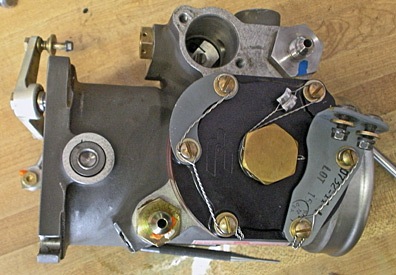 Ed, Wickenburg’s very best airplane mechanic, followed up by pulling the fuel control and fixing it, following instructions of the device’s manufacturer in Wichita, KS. Here’s what it looked like sitting on his workbench with the offending arm removed for repair. This is a lot more of my helicopter’s innards than I usually like to see. But it was interesting to see the piece I’d found an illustration of for this blog (see above) in a place where it was clearly recognizable.
 The other day,
  Well, things are never as easy as they should be. Ed got the cable and went to work installing it. He soon ran into problems. The cable wouldn’t move smoothly. It wouldn’t go in all the way. He’s pretty sure we’ll have to order the entire cable assembly today. (This image, taken from Robinson SB-55, shows where the mixture cable attaches to the fuel mixture control. I highlighted the cable and its sheath in red. We ordered just the cable and it is apparently having trouble moving in the original sheath.)