More GoPro Camera Tests, More Aerial Photos and Videos

Another chapter in my never ending saga: any excuse to fly.

Early this week, it rained.

That might not seem like a big deal to most folks, but it rains very seldom in Arizona. In fact, I hadn’t experienced a good rainstorm since my drive back from Washington state in October.

This week, it was cold and rainy for two days in a row. With rain comes three things:

  • Clouds, which make our normally plain blue sky more interesting and give it depth.
  • Cleansing, by which I mean that the dust is washed off the desert rocks and plants, making their colors more vibrant.
  • New growth in the desert, which makes everything look just a tiny bit greener than it otherwise would.

You need to be a desert dweller to really appreciate these things.

There’s nothing I like more than to go flying over the desert right after a good rainstorm. So on Wednesday, as the storm clouds moved north and blue sky started to appear again, I loaded up my GoPro cameras and mounts, hopped in the car, and drove up to Deer Valley Airport, where my helicopter is living part-time this season. When I arrived just before 9 AM, my helicopter was sitting out on the pavement, ready for me to preflight, set up my cameras, and go.

The Camera Setup

I took my time about setting up the three GoPros. I have three different models and I use each one for a different purpose.

  • GoPro HD Hero2 Professional – With its sound-in port and better lens and recording capabilities, I normally mount it on the helicopter’s nose as the “nosecam” and connect it to an audio-out port I had put into the helicopter a few years back. It captures not only intercom communications, but all radio communications. Basically, anything I hear in my headset is also sent out through that port to my GoPro. Here’s an example of an image from the video on this camera, shot at 720p:
    Bartlett Dam Nosecam
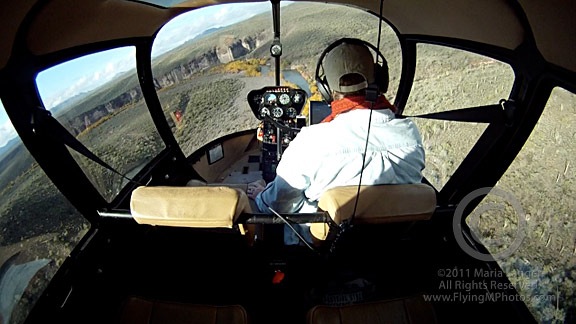
  • GoPro Hero HD Original – I mount this between the helicopter’s two back seats, inverted, to capture a wide-angle view of what’s going on inside the helicopter and beyond. This “cockpitcam” view works fine with passengers, but it doesn’t give a close-up view of the instrument panel. For that, I need to mount the camera forward, on the bar between the two front seats. Here’s a view from the camera as I had it mounted Wednesday, also shot at 720p video:
    Back Seat View
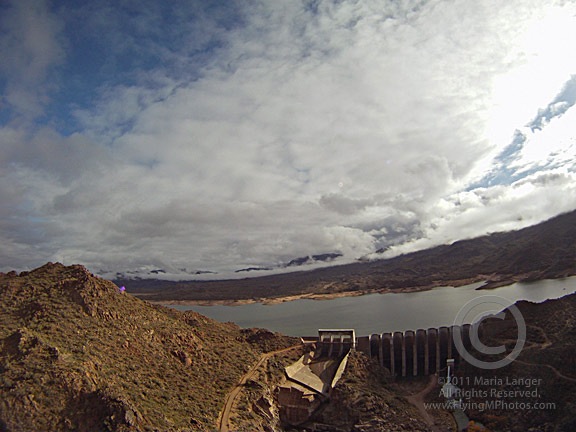
  • GoPro Hero 960 – Because I haven’t been exactly thrilled with the 1080p video coming out of my original GoPro HD Hero, when I decided to invest in a second one, I went with the cheaper model, which can’t shoot 1080p video. Instead, it shoots up to 1280×960. I like the widescreen format, so I shoot 1280×720. I saved about $100. On Wednesday, I used a new skid mount and set it up to snap a 2592 × 1944 still image every 10 seconds. (In the 20-20 vision of hindsight, I should have set it up for every 2 seconds; 6 shots per minute isn’t quite enough when you’re cruising at 100 miles per hour.) Here’s a sample image from that “skidcam”:
    Bartlett Dam

So to summarize: I set up the helicopter as a camera mount for three different cameras: 2 shooting video and 1 shooting stills.

The Flight and Some Photos

I turned on all the cameras, climbed into the cockpit, and started up. Five minutes later, I was overflying Deer Valley Airport at 500 feet AGL, northbound. Here’s a nice shot of the airport from the nosecam:

Deer Valley Airport, Northbound

The beauty of all this was that with this setup, I’m able to capture images from three cameras without having to even think about any of them. Absolutely no distraction for me, allowing me to keep my full attention on my primary duties as a pilot: aviate, navigate, and communicate.

The flight was not quite what I had in mind. I was hoping to overfly Lake Pleasant and get all the way to Wickenburg. But as I neared Lake Pleasant, I saw low clouds over the lake. There was mountain obscuration to the northwest — which means the clouds were pretty darn low, since those mountains aren’t exactly lofty peaks. Here’s a nose cam image of the marina at Lake Pleasant near the dam; you can see the low clouds at the north end of the lake:

Marina at Lake Pleasant

I wasn’t very interested in getting images and video shot in overcast conditions. So I decided to head east, where the sky was clearer and sunlight was filtering through to the desert floor.

There was a balloon flying southeast of Lake Pleasant and I tried to get some shots of it with the skidcam. Trouble is, the GoPro’s very wide angle lens exaggerates the distances. If I wanted a good shot of the balloon where it looked close, I’d have to get much closer to the balloon. While I think I could have gotten closer safely, I didn’t want to give the balloon operator or his passengers heart failure so I stayed clear. This is the best I could get; again, a shot every 2 seconds would have given me more to choose from.

Hot Air Balloon

As I flew east, the two front-facing cameras were pointing toward but not exactly into the sun. GoPro cameras get their best images when the sun is at an angle of at least 60 degrees from the lens. According to the LightTrac app on my iPhone, at about 9:45 AM the sun was at about 140 degrees. I was flying at about 90°, so the sun was at 50° angle to the front-facing cameras. At the same time, it was at a 40° angle to the skidcam, which was facing almost due south. (Obviously, I didn’t look up the angles while flying.) As a result, the images from this leg of my flight were pretty disappointing. Here’s an example from the cockpitcam as I flew over the intersection of I-17 and Carefree Highway:

I-17 and Carefree Highway

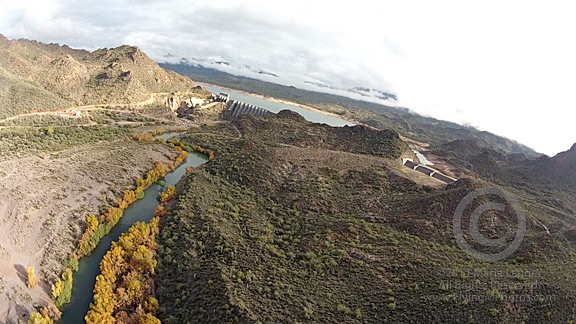
I flew all the way out to the Verde River and then headed up the river as far as Bartlett Dam. The two photos near the beginning of this post shot nosecam and skidcam views. Since more gray skies and low clouds covered Bartlett Lake, I turned around and headed south. The cockpitcam shot near the beginning of this post shows my view as I headed approximately southwest. After a tiny bit of shallow canyon flying (see nosecam photo below), I headed toward Scottsdale where sun, low clouds, and rocky outcroppings made for interesting views.

Canyon Near Verde River

I got a nice shot of Pinnacle Peak from the skidcam at several altitudes for use in a book project I’m working on.

Pinacle Peak

I also got nosecam and cockpitcam footage as I approached the peak. Interesting to see the difference between these two views, shot at about the same time.

Approaching Pinnacle Peak

Approaching Pinnacle Peak

By that point, I’d been in the air for about an hour and thought I had enough footage to test my setup thoroughly. I headed back to Deer Valley. The one mistake I made was that I flew along side a power line, with the power line on my right — right in the view for my skidcam. This was very unfortunate because the camera was facing north at this point and could have captured a lot of nice footage. Instead, all the footage features the damn wires.

Wires in my Photos

I guess that proves that I wasn’t really thinking much about the cameras.

And for those who are interested in such things, this is the track log of where I flew, as recorded on my iPad.

Track Log

The End Result

In all, I got just over 300 photographs and 2 hours of video — an hour from each camera. Quite a bit of it is useable and will likely appear in edited video content I produce in the future.

I plan to try shooting video from the skidcam. I could see it from my window and checked it a few times in flight to see how much it was vibrating — it didn’t seem to be vibrating much at all. Of course, you can never tell until you shoot the video and see the results. So that’ll be my next test, probably tomorrow.

A Final Note about the Camera Setup

I took photos of all my cameras as they were mounted before beginning the flight. I hesitate, however, to share them or provide detailed information. Although I know many pilots who regularly mount cameras on the outside of their aircraft, it’s one thing to talk about it and another to document it with photos for the world to see. I’m very confident in two things:

  • Any camera I mount on the outside of my aircraft will not fall off. I use several safeguarding measures to ensure this. I am positive I will not lose a camera.
  • None of the mounting locations affects the aerodynamics of my aircraft. In other words, it flies just as well with the cameras attached as it does without them.

These are the only things that should concern a pilot or anyone overseeing that pilot’s activities.

Comments? Questions?

I welcome your comments, questions, and suggestions. Post them here.

Move Over, Reindeer! Santa’s Got a New Sled

I take the honorable Mr. Claus by helicopter to meet his adoring fans.

Yesterday, I had an unusual gig: I had to fly Santa Claus for an appearance at the Deer Valley Airport Restaurant in north Phoenix.

Santa asked me to take the door off. He has a thing about waving to his fans as the helicopter approaches. It also makes it easier for him to get out.

Let’s face it: Santa is a big guy. I bet he eats like it’s Christmas all year ’round at his place. But surprisingly, those inches didn’t translate to pounds. He weighed in at 180; it was almost as if that big belly of his was as light as a feather pillow.

Anyway, here are two shots from the flight. My husband was on the restaurant’s rooftop patio and recorded our approach and landing.

Santa's New Sled

Santa's Departure

Required Reading for Helicopter Tour Pilots

Two accident reports that clearly demonstrate how “hot dogging” can get you — and your passengers — dead.

November 25, 2013 Update:

The NTSB’s probable cause report for this accident is now available. The pilot was not at fault in this particular accident — it was a maintenance issue. As a pilot, I’m glad that the pilot’s name was cleared of fault but, at the same time, I’m concerned that maintenance shortcomings caused five deaths. The pilot was flying a ticking time bomb and it went off. There was nothing he could do to prevent the crash. And that scares me.

While the points presented in this blog post clearly do not apply to the Boulder City crash mentioned here, they are still important reading material for all pilots. Learn from other people’s mistakes.

On Wednesday, a Sundance Helicopters AS350 with a pilot and four passengers on board, crashed in the mountains near Boulder City, NV. It was on a “twilight tour” of the Hoover Dam and Lake Mead.

At this point, there’s no speculation about how the accident occurred. But, as usual, the media is dragging all the dirt they can out into the limelight to sensationalize the event and give people potential places to point blaming fingers.

One of the things the media has brought up is another Sundance Helicopters crash that occurred back in September 2003. I was unfamiliar with this crash — it must have occurred before my regular reading of NTSB accident reports began. Unsure whether I was confusing it with another crash, I looked it up today. But no, this was yet another instance of stupid pilot tricks becoming deadly pilot tricks.

I thought it was worth reviewing this case and another I’ve covered in the past and urge pilots to read both of the final reports carefully to see how reckless flying can kill. What’s interesting to me is how similar these two cases are — heck, they even took place within 30 miles of each other.

LAX01MA272: AS350, August 10, 2001, Meadview, AZ

I covered this accident briefly in Part 5 of my “So You Want to Be a Helicopter Pilot” series. Here’s the NTSB summary:

On August 10, 2001, about 1428 mountain standard time, a Eurocopter AS350-B2 helicopter, N169PA, operating as Papillon 34, collided with terrain during an uncontrolled descent about 4 miles east of Meadview, Arizona. The helicopter was operated by Papillon Airways, Inc., as an air tour flight under Code of Federal Regulations 14 (CFR) Part 135. The helicopter was destroyed by impact forces and a postcrash fire. The pilot and five passengers were killed, and the remaining passenger sustained serious injuries. The flight originated from the company terminal at the McCarran International Airport (LAS), Las Vegas, Nevada, about 1245 as a tour of the west Grand Canyon area with a planned stop at a landing site in Quartermaster Canyon. The helicopter departed the landing site about 1400 and stopped at a company fueling facility at the Grand Canyon West Airport (GCW). The helicopter departed the fueling facility at 1420 and was en route to LAS when the accident occurred. Visual meteorological conditions prevailed, and a visual flight rules flight plan was filed.

The pilot had a reasonable amount of experience with nearly 3,000 hours of flight time, all of which was in helicopters. He had CFI and instrument ratings.

The pilot, however, also had a reputation for hot-dogging. From the NTSB report‘s interview with previous passengers:

According to the passengers, once the tour started, the pilot was talking all the time. He was very informative, and they felt he knew his history and geography very well. They went over the Hoover Dam and Lake Mead. About 20 minutes into the flight, the pilot turned his head toward the back and was talking to the passengers as the helicopter flew toward a cliff. The people in the back were trying to get the pilot’s attention and point out that he was flying toward a cliff, but he pretended he did not understand what they were saying, as if this was all being done on purpose. All this time, the pilot was turned around and talking to the passengers in the back seat, while the passengers were all pointing up trying to get him to climb. One witness said she finally picked up the microphone and said, “they are really scared…turn around and pull up the helicopter,” and he did. She could not estimate how far they were from the cliff when the pilot terminated the maneuver.

One of the passengers stated that there were particularly exciting episodes during the tour that were frightening to some of the others. As part of the tour, they flew over a site that was used in the commercial motion picture film Thelma and Louise, and the pilot pointed out the cliff. The pilot stopped for fuel before he landed in the canyon for the picnic lunch. After lunch, no more stops were made. During the return to LAS, the pilot asked if they wanted to know what it was like to drive a car off of a cliff. She stated that they all said “no” to this question; however, he proceeded to fly very fast toward the edge of the cliff and then dove the helicopter as it passed the edge. The passenger reported that it was “frightening and thrilling at the same time but it scared the others to death.”

Both of these incidents — heading directly for a cliff and then diving like Thema and Louise over a cliff — were confirmed in a video tape provided by the passenger.

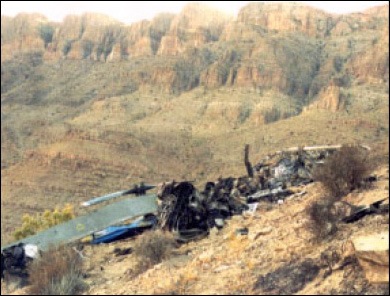
Crash Site
I don’t think the pilot expected to end up like Thema and Louise, too.

Evidence at the crash site indicated that not only was the helicopter’s engine producing power at the time of impact, but the collective was full up. The debris field was compact, indicating very little forward movement when the helicopter hit the ground. There was no evidence of any mechanical failure immediately before the crash. The NTSB ruled out many accident scenarios based on mechanical malfunctions before concluding:

In the absence of any evidence to indicate a preimpact mechanical malfunction, and given the density altitude, helicopter performance considerations, and virtually all of the signatures evident at the IPI and in the wreckage, the investigation revealed that a probable scenario involves the pilot’s decision to maneuver the helicopter in a flight regime, and in a high density altitude environment, which significantly decreased the helicopter’s performance capability, resulting in a high rate of descent from which the pilot was unable to recover prior to ground impact. Additionally, although no evidence was found to indicate that the pilot had intended on performing a hazardous maneuver, the high rate of descent occurred in proximity to precipitous terrain, which effectively limited remedial options available.

In other words, he most likely performed his Thelma and Louise maneuver, dove off the cliff, and because of high density altitude, was unable to arrest the decent rate before hitting the ground.

LAX03MA292: AS350, September 20, 2003, Grand Canyon West, AZ

This case is a lot worse. I’ll let the NTSB describe what happened briefly:

On September 20, 2003, about 1238 mountain standard time, an Aerospatiale AS350BA helicopter, N270SH, operated by Sundance Helicopters, Inc., crashed into a canyon wall while maneuvering through Descent Canyon, about 1.5 nautical miles east of Grand Canyon West Airport (1G4) in Arizona. The pilot and all six passengers on board were killed, and the helicopter was destroyed by impact forces and postcrash fire. The air tour sightseeing flight was operated under the provisions of 14 Code of Federal Regulations Part 135. Visual meteorological conditions prevailed for the flight, which was operated under visual flight rules on a company flight plan. The helicopter was transporting passengers from a helipad at 1G4 (helipad elevation 4,775 feet mean sea level [msl]) near the upper rim of the Grand Canyon to a helipad designated “the Beach” (elevation 1,300 msl) located next to the Colorado River at the floor of the Grand Canyon.

You need to read the NTSB’s full report to fully understand what happened here. You can download it as a PDF (recommended) or read it online.

The pilot was experienced. He was 44 years old with an ATP certificate for multiengine airplanes and for helicopters. He had CFI and instrument ratings for a variety of aircraft. He’d logged nearly 8,000 hours of flight time, nearly 7,000 of which was in helicopters. He had a clean record with the FAA.

But the pilot had also earned the nickname “Kamikaze” because of the way he flew. (And you can bet your ass that the media is having a field day with that in its coverage of Wednesday’s accident.)

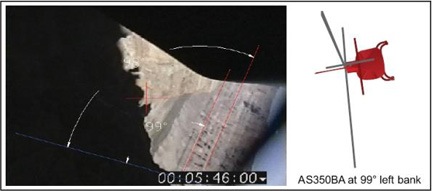
99° Bank Angle
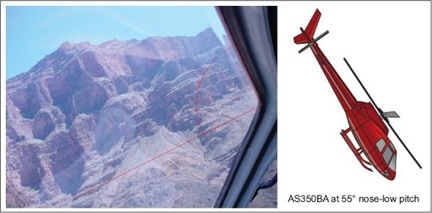
55° Pitch Angle
Two images from the NTSB report, calculating angles based on photographs and videos shot during other flights.

With a great deal of supporting evidence from the pilot’s previous passengers that same day and earlier, as well as photographs taken during flights with the pilot, the NTSB concluded that the pilot had a history of risk-taking behavior. Photographic evidence showed him flying at bank angles exceeding 90° with nose-down attitudes exceeding 50°. It’s estimated that he typically reached speeds up to 140 knots and rates of descent of 2,000 feet per minute.

With passengers on board.

For comparison’s sake, Sundance policy limited bank angles to 30° and pitch angles to 10° — both of which are very reasonable. Other pilots typically flew that portion of the flight at 110 to 120 knots, descending at 1,000 feet per minute.

Yet the report cites one passenger story after another of the pilot diving into the canyon and flying close to canyon walls. One former Sundance employee who had flown with him stated he “flew very close to the canyon wall” and “banked off one wall and then turned the other way, almost upside down.” One passenger claimed that his friend’s wife was screaming throughout the entire descent.

Sundance received at least two formal complaints about the pilot. There’s no evidence that anything was done about the first. The pilot was suspended for a week without pay after the second, but since Sundance was short of pilots, the penalty was never enforced and the pilot continued working with pay.

It should come as no real surprise that the pilot ran out of luck. According to the NTSB, on that September day:

The helicopter’s main rotor blade struck a near-vertical canyon wall in flight. The resulting damage to the main rotor system likely rendered the helicopter uncontrollable, and the helicopter subsequently impacted a canyon wall ledge.

There was a fireball when the helicopter exploded on impact. There wasn’t much wreckage. You can see for yourself; there are photos in the report. I wouldn’t even know it was a helicopter if it weren’t for the arrows pointing out parts.

Probable cause placed the blame on the pilot, as well as Sundance and the FAA:

The National Transportation Safety Board determines that the probable cause of this accident was the pilot’s disregard of safe flying procedures and misjudgment of the helicopter’s proximity to terrain, which resulted in an in-flight collision with a canyon wall. Contributing to the accident was the failure of Sundance Helicopters and the Federal Aviation Administration to provide adequate surveillance of Sundance’s air tour operations in Descent Canyon.

Disregard of safe flying procedures. That’s a bit of an understatement, no?

What We Can Take from This

If you don’t get the message I’m trying to convey here, you probably shouldn’t be flying anything — let alone passengers for hire in a helicopter.

It’s a fact: many of us fly a little nutty once in a while. Maybe low and fast over flat desert terrain. Or maybe threading our way though empty canyons at high speed. Or performing some other maneuver that takes all your attention and can easily turn into a disaster.

But when does “a little nutty” turn into pushing the aircraft beyond company or manufacturer limitations?

And who in their right mind would fly so dangerously with passengers on board?

You?

I hope not.

The point is that flying like a stunt pilot can get you killed. And if there are passengers on board, you’ll kill them, too.

Is that something you want to be remembered for? Do you want to be the subject of another pilot’s blog post about flying like an asshole with passengers on board? Do you want a derogatory nickname like “Kamikaze” brought up by the press eight years after your death when another pilot who works for your company is killed in a crash with his passengers?

How do you think the “Kamikaze” pilot’s family feels about his accident being brought up again? And again?

Think about why these pilots flew the way they did. Were they showing off? Or trying to get a rise out of their passengers?

In both instances, passengers made it clear — verbally, during the flight — that they didn’t want the pilot to fly the way he was. Think about the people pointing to a cliff face or the woman screaming throughout the descent. Why did these pilots treat their passengers with such disrespect? Scare them for no reason? Put their lives in danger? Was this fun for them? When is fun an excuse to risk other people’s lives?

Do you do this? If so, why? When will you stop? When your crash makes a big fireball like the ones in these stories?

Do you understand what I’m trying to say?

Read these accident reports. Two pilots are responsible for the deaths of eleven people with a twelfth person permanently disfigured.

Isn’t that enough to convince you not to fly like an asshole?

I only hope that Wednesday’s accident report isn’t another example for this blog post.

And my thoughts go out to the families of the victims of this stupidity.

Dealing with In-Flight Passenger Requests

Remember the primary job of every pilot-in-command: fly the aircraft.

Phoenix MapYesterday, I had a rather unusual charter for Flying M Air. I needed to take two men on an aerial survey of commercial properties throughout the Phoenix area.

A Full Workload

For two hours, we flew low (about 300 feet AGL) and slow (about 50 knots) over building rooftops. While this may have been too low to need to worry much about traffic, I did have to keep an eye out for obstacles, such as towers. And because some of these properties were within Class D and Class B airspace, I had a lot of radio work to do.

As you might imagine, I had a pretty serious workload.

Yet ten minutes into the flight, it appeared that my under-prepared clients expected me to know the street addresses of individual buildings that we flew over.

For those readers who are not pilots, I may need to point out that finding the street address of a building you’re flying over is not easy. The address is not painted on the roof. The street out front isn’t labeled on the pavement.

Yesterday, we covered an area 26 x 33 miles in size. That’s over 800 square miles. It would not be possible to know the names of every single street — and recognize them from the air! — in an area that size.

Foreflight Street MapYet, believe it or not, I tried to accommodate them. I had my iPad with me and Foreflight software running. I had the Street Map displayed and was zoomed in far enough to read street names. When they asked, I attempted to read off the street name beneath us. I left it for them to try to get a number of the building. I did this for about 10 minutes.

And then I realized that what they wanted me to do was far beyond my duties as a pilot.

A Pilot’s Duty

Aviate, navigate, communicate. Those are my responsibilities, in the order of importance.

Aviate = Fly the aircraft. That means not only keep it in the air safely, but avoid hazards like other traffic and obstacles.

Phoenix Terminal ChartNavigate = Go where you need to go. That means knowing where you are, where you need to go, and how to get there. It means following the instructions of air traffic control. In my situation, it also meant keeping track of the airspaces I needed to fly in: Deer Valley Class D, Scottsdale Class D, Phoenix Class B, Chandler Class D, Phoenix Class B (again), and Deer Valley Class D (again). Certain rules apply in these airspaces and I needed to abide by these rules so I needed to know when I was nearing or in these spaces.

Communicate = Talk to air traffic control or other aircraft. Communication is required in controlled airspaces. Not only did I have to talk to towers to legally enter their airspace, but I needed to tell them what I wanted to do while I was in there. I had to acknowledge and respond to their instructions and traffic advisories.

If any one or two of these duties had been light — for example, if we were cruising point to point at 100 knots 500 feet AGL instead of flying low and slow in an area with potential obstructions or if we were flying in the middle of nowhere where navigation and communication weren’t a factor — I may have been able to provide them with more of the information they wanted. But with the heavy workload I had to deal with, adding another complex task — one that clearly required me to remove a hand from the controls and eyes from outside the cockpit — was far more than I could handle safely.

Indeed, if I had continued to try to provide this additional information for them, I would have put our flight in danger.

I was smart enough to realize this and I simply stopped providing address information. Instead, I mentioned street names that I knew as we flew over them. I let them deal with figuring out where we were.

Pressure on the Pilot

You might wonder why I even tried to meet this client request. After all, it seems like a no brainer. I was pretty busy doing what had to be done. Why add more to my workload?

The answer is easy: pressure to please the client.

All pilots feel this pressure. The client is paying for a service. We feel a need to please that client by providing every bit of service he requests.

But this is wrong. So often, client requests are unreasonable or unsafe. The pilot-in-command is responsible for the safe operation of the flight. The pilot in command has the authority to say no to any request he or she thinks would jeopardize the safety of the flight — or, for that matter, get him or her in hot water with the FAA.

As the owner/operator of a charter business, I may feel more pressure than a pilot who has no real stake in the profitability of the business or the ability to get repeat customers. In other words, I may feel more pressure to make clients happy. But should I? Of course not! I need to be a pilot when I’m in the air. I can be a business owner when I’m on the ground.

Client Shortcomings

In all honesty, I was a bit peeved with the clients. These guys were almost completely unprepared. The only legible map they had of the survey areas was an image on an iPhone with limited scalability. They didn’t have a GPS. They didn’t even have a camera. Either tool would have helped them get the location information they needed on their own. I’ve taken plenty of survey clients out on flights in the past and they’ve always been very prepared to track their location and take notes along the way.

How could I have made the situation better? I could have told them point-blank that I would not be able to provide exact street addresses during the flight. I could have recommended that they get a street map that they could mark up while we flew. I could even have refused to depart unless they had the tools they needed to get locations on their own. But I didn’t do any of these things. I was on the ground, wearing my business owner hat after prepping the aircraft for a 2-hour charter that had already been paid for in full. I wanted to complete the flight.

To the clients’ credit, after I stopped providing street names, they didn’t press me for them. I think they realized that my hands were already full. They took some notes and spent a lot of time just looking. At the conclusion of the 2-hour flight, they seemed happy enough with the results.

But I know they could have gotten a lot more valuable information — and made the cost of the flight more worthwhile — if they’d been better prepared.

Two Points

There is a moral to this story. Two of them, in fact.

  • A pilot needs to prioritize his workload in flight. The first three items must be aviate, navigate, and communicate. If doing all that doesn’t take up all of the pilot’s attention, additional tasks to meet passenger requests may be added.
  • A client needs to be fully prepared for an aerial survey mission. That means coming with maps, GPSes, cameras, or any other equipment that will help him get his part of the mission done. In addition, he needs to communicate, in advance, with the pilot to learn about the limitations of the flight.

Sometimes, when I read accident reports, I wonder whether the accident was caused by a pilot doing something other than his primary duty of flying the aircraft. While it’s great to be able to meet all the needs of a paying passenger, conducting a safe flight and getting back to base in one piece is far more important.

I’d love to hear other stories about handling client requests beyond the call of duty. Use the comments link or form for this post.

Shop Smart for Services: Avoid Dealing with Middlemen

I cannot stress this enough.

As usual, I’ll use a story to illustrate my point. I’ll try to keep it brief.

The Flight

Today, Flying M Air did a 2-hour charter for two men from Texas. They’d come to Phoenix to do a rather unusual aerial survey. I don’t think it would be appropriate for me to go into details of what it was all about, but I can say that it required me to fly low and slow over a bunch of commercial properties all over the Phoenix area.

The flight was booked last minute in an odd way. I got a call from a local airplane charter company who told me that these two guys had shown up to charter a helicopter — which the airplane charter company did not have. Could I take these guys on a survey flight? I spoke to one of the clients, got a few quick questions answered — including their weights, which I needed to calculate a weight and balance for the flight — and told them my rates. Then I hung up and got ready to meet them at the airport in less than two hours.

I was just leaving when my phone rang. It was XYZ Company (not their real name), which I wrote about at some length here. The short version is that XYZ is a booking company that markets itself as a provider of aviation (and other) services but doesn’t own a single aircraft. Instead, it hires third party companies (like mine) to provide the services,

The XYZ person on the phone told me they were sending two clients to me. She then proceeded to describe the job I’d booked directly with the client.

I told her I’d already booked it with the client and that the client was going to pay me with a credit card at the conclusion of the flight. I was trying hard to keep XYZ out of it. It didn’t matter much to me — I’d get paid the same amount whether they were involved or not — but I simply don’t like the way XYZ does business. But the caller told me that the client already had credit with XYZ and that XYZ was willing to pay me for the 2 hours of flight time up front with a credit card.

I didn’t want the client to pay me and still be on the hook with XYZ, so I took the payment. I then called the client and told him what had transpired. He seemed happy enough.

I went to the airport and did the flight. It was far from an ideal setup. For some reason, the client expected me to know the addresses of the buildings we flew over. As if flying a helicopter 300 feet off the ground while watching for obstructions and other traffic and talking to an airport control tower wasn’t enough of a workload for me. They were completely unprepared to get the location information they needed — hell, a handheld GPS, which I could have provided with enough notice, would have been a real handy tool.

But the client seemed satisfied with the flight. It was a nice day to fly and I was paid up front. So how could I complain?

The Lesson to Be Learned

I do, however, want to use this story as a lesson to folks shopping around for services — perhaps for holiday gift-giving.

There are several points to be made about what transpired. Although these points deal specifically with XYZ, they also apply to similar organizations that act as booking agents for services:

  • XYZ Company makes money off every flight it books. It typically marks up my services by 30%. So yes, if you bought an hour of flight time from me, it would cost you $545. But if you bought the same hour of flight time with XYZ in the middle, it would cost you about $700. In today’s story, these guys spent $300 more than they could have for the same service.
  • XYZ Company does not give refunds. For any reason. If you need to cancel a flight, you get a credit for the amount you paid. You have one year to use it elsewhere. Since I don’t (usually) take payment in advance, when you book with me, you don’t need to worry about refunds or credits. So if XYZ had been unable to book the flight with me, these clients would probably be stuck with a credit.
  • XYZ Company charges a fixed price for the service you say you need. So if you want 2 hours of flight time, you’ll pay for it up front. If you fly only 1-1/2 hours, you’re out of luck since they don’t give refunds. But because I charge charter clients based on actual time flown, if they fly less than expected, they pay less than expected. In fact, I typically overestimate flight time so folks feel good when the final cost is less than they thought it would be.
  • XYZ Company can’t be relied upon to get a reservation handled correctly. This is a classic example: they booked an airplane when the client clearly needed a helicopter! These guys flew in from Texas for this survey — imagine if there weren’t any helicopter charter operators available to do the flight on such short notice. They would have made the trip for nothing. Another time, they booked a 5-hour survey flight for a client that required landing illegally in a wilderness area (which I was not going to do). And I can’t tell you how many phone calls it takes to arrange a flight for a client with XYZ in the middle. Right now, I’m waiting for a yes/no answer on a flight they’ve called me about four times already — and I still don’t know if it’s going to happen.

Yet time after time, people turn to companies like XYZ, relying on a middle man who knows nothing about the provider’s capabilities or operations. The chain of communication is never properly established, services are misrepresented, clients and providers get unpleasant surprises at job time.

And the buyer of the services is paying a 20% to 40% premium.

What are they getting for this extra cost? Well, they don’t have to call more than one company that appears in Google’s search results.

You see, that’s how these companies get the calls. They buy up domain names and Google AdWords. They set up generic websites for local helicopter tours or airplane tours or balloon rides or skydiving. You search and they come to the top. You look at their site and you think they’re some big adventure travel company with airplanes and helicopters and hot air balloons all over the country. You call and they assure you they can help you. So you stop looking and let them do the work.

Is that worth 30% more than you could pay?

If you think so, fine. Like I said: it doesn’t affect me. I get paid the same amount, whether you book through me or them.

But in a day and age when everyone is so hot for deep discount deals like the ones Groupon offers, it seems so very strange to me that people would be willing to give money away to a middleman just because he knows how to dial a phone.