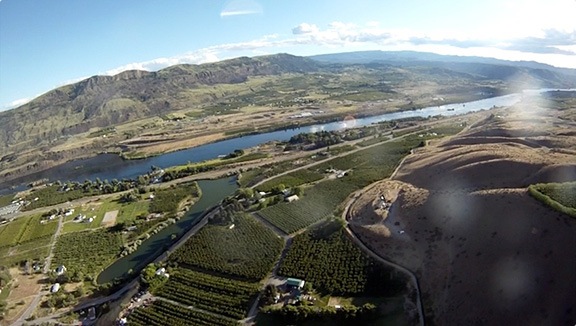
Watching the Weather

It’s that time of year again.

I’m deep into my sixth season in central Washington State, working as a cherry drying pilot.

It’s an interesting gig. I need to be available to fly at a moment’s notice on any day that it rains. But if it doesn’t rain, I don’t work. And if there’s no chance of rain, I can argue that I have the day off.

So my life revolves around the weather.
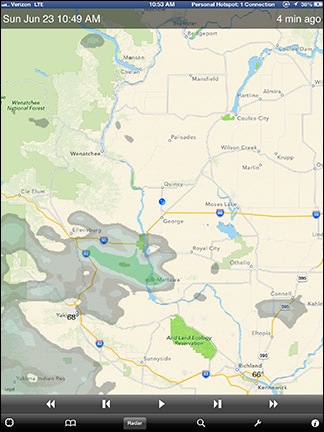
Radar
Current radar shows a storm system to the southwest heading my way. If it doesn’t dissipate, I expect it to arrive within 2 hours.
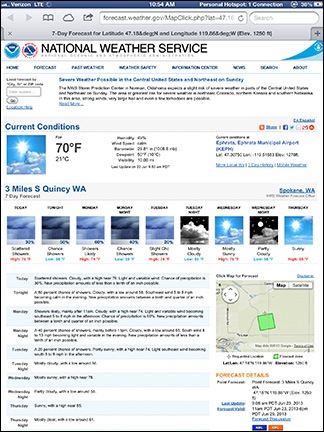
7-Day Forecast
There’s rain in the forecast for the next three days.
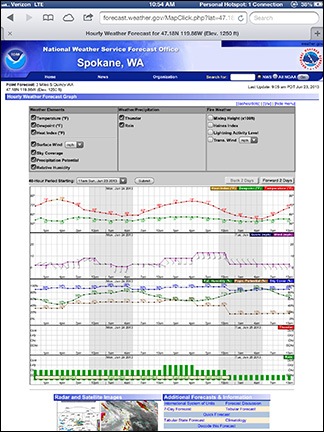
Hourly Forecast
The hourly forecast shows a 32% chance of rain now rising to a 47% chance at 5 PM.

I start every day with a look at the current radar on the Radar US app on my iPad or iPhone — and yes, both are nearby, even when I’m in bed. If there’s any rain in the area, I put the radar in motion to see which way it’s going. Then I look at the week’s forecast on the National Weather Service website. If there’s any chance of rain for the day there, I look at the hourly forecast to get an idea of when the rain is expected.

The screenshots here from my iPad gives you an idea of what all of these sources look like right now.

I tentatively plan my day based on this weather information. On a day like today, I won’t wander far from base. There’s a decent chance of rain and a look outside shows me the cloudy day that proves it. Although I won’t get called until it starts raining (or finishes), it could start at any time. So I’ll spend most of the day watching the radar and looking outside, waiting for my phone to ring.

On some days — Thursday comes to mind — it might rain all day. Although it seems like I should be flying all day I only fly when I’m called to fly. My clients don’t want me to fly more than I have to — after all, it costs them money when I fly — so they try hard to wait until they think it’s done raining to call me out. That’s what most of them did on Thursday. They let their cherry trees get and stay wet all day. Then at about 5 PM, my phone started ringing. 12 acres here, 40 acres there. I’d shut down and had even tied down the rotor blades for the night when I got another call at 8:20 PM with a request. I didn’t want to go — I don’t dry after dark — but the sun doesn’t set here until about 9 PM and even though the sun wasn’t out, I thought I’d have enough light to do another 34 acres 20 miles away. So I untied the blades and took off. While I was drying that orchard, a call to dry another 7 acres nearby came in. It was nearly dark when I finished that one, climbed to altitude to avoid wires and other obstacles, and headed back to base. I was on the ground at 9:40 PM — a lot later than I wanted to finish my flying day. But I did have happy clients.

Growers were likely able to get away with the long wet day on Thursday because it was so cool out. But I clearly remember a similar day last year when it rained all day long. Although one of my growers had me come out to “dry” several times during the day, another decided to wait until the end of the day. Guess which grower had split cherries the next day? It was a lot warmer that day and the guy who waited until the end of the day paid for his hesitation with a damaged crop. Unfortunately, he blamed me. I know better, but you just can’t argue with some people. I wasn’t too disappointed to lose that contract for this year. I don’t like taking the blame for someone else’s actions — or lack of actions.

But it makes me wonder: if they’re paying me to stand by and come quickly when called, why don’t they call?

Let’s do the math. A typical cherry orchard can bring in 8 to 15 tons of cherries per acre. If we use a conservative 10 tons (which was very reasonable last year, given the heavy set), each acre of trees yields 20,000 pounds of cherries. I can dry about 40 acres of trees for less than $1000. 40 acres is about 800,000 pounds of cherries. If the grower gets $1/pound for those cherries, that’s $800,000. Is it worth $1000 to protect that? I think so.

Keep in mind that if more than 50% of the cherries split or rot, the crop won’t be worth picking at all.

But hey — it’s their decision. I just watch the weather and fly when I’m called.

Of course, when there’s no chance of rain, I kinda sorta have the day off. I’ll wander farther afield — perhaps to Wenatchee or Leavenworth or even Chelan — keeping an eye on the sky and the radar. I’ll run errands, do chores, visit friends, shop, and eat out. Maybe I’ll take out the kayak on Quincy Lakes or my little jet boat on the Columbia River. The whole time I’m out, I’ll be thinking about the weather, watching the weather, being aware of how long it would take me to get back to base if the weather changes.

Traveling farther from base — for example, to Seattle or Portland — is completely out of the question unless another pilot stays behind to back me up. Right now I have one backup pilot and enough work for both of us. Later I’ll have another and enough work for all three of us. So traveling is not in my immediate future.

My life will go on like this until the end of my last contract, on or around August 15.
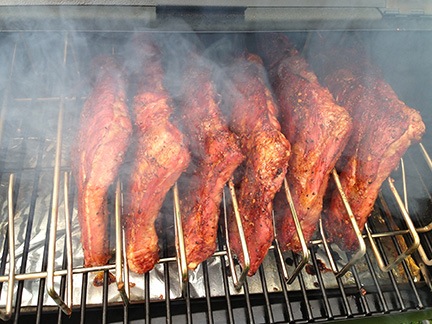
Smoking Ribs
I really do love my new Traeger. If you could only smell them…

I’m not complaining — not at all. Hanging around Quincy and, later, Wenatchee Heights, is not something a reasonable person can complain about. After all, I’ve got all the comforts of home — more, actually, because it isn’t 110°F outside — in my Mobile Mansion. And even now, as I type this, I’ve got 3 racks of St. Louis ribs on my new Traeger grill, smoking away.

With luck, we’ll get a chance to enjoy them fresh and hot before the rain comes.

My Helicopter is NOT a Birdhouse

Or is it?

Like I did the past four summers, this May I parked my helicopter outdoors at an ag strip — a simple runway used by crop-dusters — near the RV park where I begin my summer work season in Quincy, WA. (My first season here, in 2008, I managed to get a hangar at Quincy Airport.) My “helipad” is a concrete tie-down pad, created long ago when the ag strip was busier and was home to more airplanes.

These days, the strip is home to just one crop-duster, a yellow turbine biplane that barely fits inside a big hangar on the strip. That airplane’s predecessor was parked, partially disassembled, on the concrete pad in front of mine, tied down with frayed ropes. Its big radial engine had bled out its oil reserve years ago, leaving a grimy patch on the pavement that had absorbed dust and dirt and small pebbles throughout the years. Last year, part of its tail section was taken away. What remained was broken and forlorn, a sad reminder of what might have been a glorious past, its bright yellow paint faded and dirty from a long spell in purgatory outdoors.

Parking at the Ag Strip

Over time, birds had built nests inside its wings. They’d done this long before I arrived in 2009; I saw them come and go right from the first day I was there. Bits and pieces of straw stuck out of odd places. A bird would perch on a strut or cowling, then disappear into the airframe. I watched them while I was warming up my aircraft for a flight, or when cooling down at the conclusion of one.

The plane was still there when I arrived this May. But a few days later, I saw a flatbed trailer working near it. And then, one day, it was gone.

I hoped it was going to a new home, someplace where it would be rebuilt and would return to the sky.

Birds in the Fan Scroll

I was in Phoenix later that month, dealing with personal business, when my phone rang. It was the owner of the ag strip, Randy, who also flew the turbine crop-duster in the hangar. He’d never called me before. I didn’t even know he had my number.

“What’s up?” I asked him after we exchanged greetings.

“I’ll let Dalton explain,” he said.

I think my blood pressure must have jumped up a few points. Dalton was Randy’s ground guy. He spent a lot of time tearing around the strip on an ATV, running between the hangar and the refueling area and chemical loading area. I imagined him having some kind of mishap that involved the helicopter.

“I saw some birds flying in and out of the back of your helicopter,” Dalton told me. “When I looked in there, it looked like they were building a nest. I covered it up so they couldn’t get back in,” he finished.

Okay. A bird nest. Not something I wanted to deal with, but at least it wasn’t some sort of accident that involved the helicopter’s airframe. I thanked him for keeping an eye on things for me and for covering it up. I told him I’d be back in a few days and we hung up.

It made sense, when I thought about it. With the big biplane gone, a lot of birds were homeless. They moved to the closest replacement — my helicopter.

Nest in the Fan ScrollWhen I returned, I found the fan scroll cowl covered with cloth that turned out to be two old coveralls. I pulled them off to find a mess in the back end of the helicopter. Birds had flown between the fins on the fan scroll cowl (consult photo above) and had brought all kinds of hay and twigs. They’d left nesting materials inside the cowl and inside the fan itself. And there was a ton of bird poop.

What a mess!

I returned to my RV to fetch my battery powered screw driver, some hot water, and some rags. Then I got to work. First I removed the two screws holding in one of the fan cowl fins and attempted to remove all the material by reaching in. It soon became obvious that that simply wouldn’t work. So I removed the entire cowl — which involved removing about 20 screws — and began scooping out the junk I found. It took quite a while; there was an amazing quantity of the stuff. I wiped up as best as I could with the water and rags.

By then, Randy and Dalton had come by to chat. They told me to use the hose in the hangar. So I carried the filthy cowl into the hangar and cleaned it as well as I could with the hose and a brush.

Plastic over Fan CowlWhen I was satisfied all the nesting material was out and the cowl was as clean as I’d get it, I put it all back together. Then I used plastic bags to cover up the fins so birds couldn’t fly back in there. That would have to protect it until I flew again.

I should mention here that I opened all the inspection doors and looked carefully throughout the interior of the cowling to make sure that was the only nest they’d built. I admit that I was surprised that they hadn’t built anything in the main inspection area, near the upper sheave, beneath the hydraulic reservoir, or under the main rotor gearbox. I tapped on the mast cowling and tailcone in an attempt to scare out any birds that might be in there. Nothing. Not any other trace of birds anywhere.

What a relief.

Flying an Aging Aircraft

I started doing a lot of flying a few days later — charter flights, mostly. I removed the plastic bags, preflighted thoroughly, and saw no other sign of birds. When I flew, everything seemed fine.

Well, I did notice that the engine seemed to run a little warmer than usual.

The cylinder head temperature gauge has a little tick mark about 2/3 from the top. In the 8 years and 1600 hours I’ve flown the helicopter, temperature in flight is usually right around this line. It might be slightly to the left (cooler) on a cool day and slightly to the right (warmer) on a hot Arizona day. I’d never seen it to the right of the line in Washington state — it simply didn’t get hot enough. Yet that spring the temperature consistently reached and edged slightly past that line.

The engine was running warm.

At the same time, I noticed that the engine was warming up a bit quicker than usual. I figure it was because outside temperatures were pretty warm. That would also explain why it took a bit longer to cool down.

I also noticed a slight decrease in performance — I simply couldn’t maintain the 110 knots cruise speed I’d usually gotten when flying light. That could have something to do with the accumulation of dust and bird poop on the top of the main rotor blades. I cleared it off as best as I could as often as I could. I also figured that the performance issues might have something to do with engine compression; I’d learn more at its next 100 hour inspection.

Hell, my helicopter was getting old. Little changes like this were bound to happen.

Overall, however, the helicopter ran smoothly without any problems. I did numerous charter flights and numerous cherry drying flights without any problems whatsoever.

I did also notice some fresh bird poop on the fan scroll cowling, but regular examination of the area failed to show any trace of bird habitation. I figured that the birds just liked perching and pooping there with their old biplane home gone.

I should have known better.

The 50-Hour Inspection

I dried 73 acres of cherry trees yesterday morning. Afterwards, I landed at Wenatchee Airport, waiting for more expected weather to move in. I had just 2 hours left on my Hobbs meter before I’d need a 50-hour inspection. A 50-hour consists of an oil change with a filter change plus the removal of the spark plugs for inspection and cleaning.

When it became obvious that weather wasn’t moving in anytime soon, I figured I’d get the 50-hour inspection taken care of while I was there; more rain was expected the next day and I didn’t want to overrun the inspection time. I ran up the engine and repositioned the helicopter in front of Alpine Aviation’s hangar. While I was driving down into Wenatchee to fetch a case of oil, the excellent mechanics there would drain the helicopter’s oil and start working on the plugs.

Bird NesI was gone about 45 minutes. (I admit I also stopped at Dairy Queen for a chocolate shake.) When I returned with the oil, I saw a bird nest, complete with pale blue eggs, on the floor in the hangar.
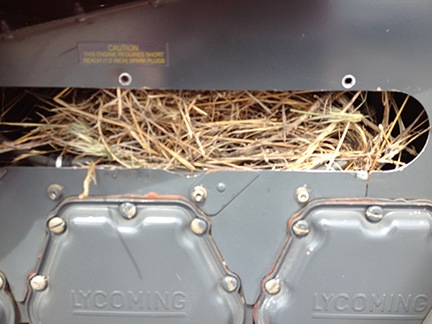
I put the case of oil down and looked up at the ceiling. “Did this blow off the roof or something?” I asked Mike, who was working nearby.

“No,” he replied. “Cass pulled that out of your helicopter.”

I stared at him. “You’re kidding.”

But Mike wasn’t kidding. “He’s got quite a mess to clean up.”

I went outside to take a look. The left side panel was off and the panel that normally hid the top half of the engine was also off. Cass was pulling bits and pieces of straw off the engine’s cooling fins.

Nest on my Engine“I got a picture of it,” he told me. On his phone, he showed me a photo of the engine with hay stuffed into the area on top of it.
“Both sides?” I asked.

“Mostly this side,” he assured me. “But it’s in the oil cooler, too.”

He spent an extra half hour with a shop vac and compressed air, cleaning the nest out of the engine compartment. Mike waited until he’d gotten most of it out before pulling the plugs on that side.

As you might imagine, I was troubled by this. A preflight inspection should find problems like this. But mine hadn’t. The nest had obviously been in there for some time — perhaps a month or more. It was probably causing the warm operating temperatures I’d noticed. (With luck) it could be causing the dip in performance, too.

Fortunately, it hadn’t caused a fire.

I talked to Cass about it. He assured me that there was no way I would have spotted it on a preflight. He had to remove two panels — both of which were secured with screwdrivers — to see the nest. This is not something that’s done on any kind of standard preflight inspection. And since the temperature and performance issues I’d noticed were not substantial, there was no reason to go beyond a standard preflight inspection.

Lessons Learned

A few lessons can be learned from this experience:

  • If an aircraft is left outdoors, in an area known for bird nesting activity, a preflight inspection should include a search for any bird activity at all. Poop is a good indication of bird activity.
  • If an aircraft you’ve been flying for years suddenly shows any change in gauge readings or performance, it could indicate an issue that needs to be found. Look beyond a preflight inspection; think about what could have changed since you noticed the different readings.
  • A preflight inspection cannot uncover all problems with an aircraft. It’s limited by what you have access to when you make the inspection.

Knowing all this, would I do anything different? Yes. The next time I see a change in the helicopter’s gauges or performance, I’ll follow up with a mechanic. I may have been lucky this time; I might not be so lucky next time.

Aerial Views from Yesterday’s Flight

A few screen grabs from GoPro video.

I did a 3-hour charter flight yesterday, taking a good client to visit cherry orchards between Wenatchee and the Tri-Cities area of Washington. Along the way, we overflew the Columbia River and vast deserts and orchards. I had two GoPro Hero cameras hooked up: one on the helicopter’s nose and one on the right skid.

Here are a few screen grabs from my flights.

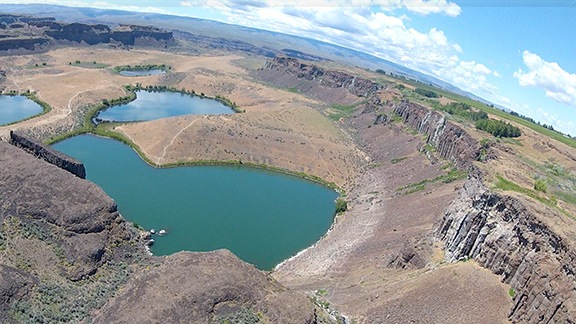
Ancient Lakes
These are the Ancient Lakes at Quincy Lakes, shot by my nosecam as I descended into the area from the Quincy Basin. If you’ve ever heard of the Ancient Lakes AVA for wine, these are the lakes that name refers to.

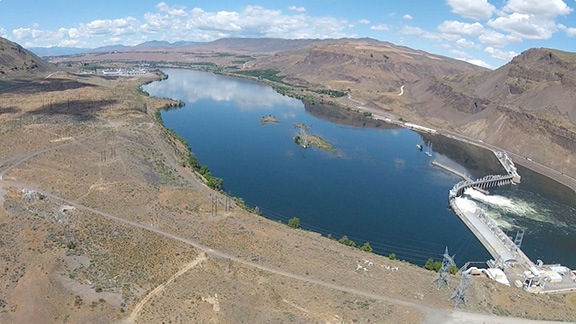
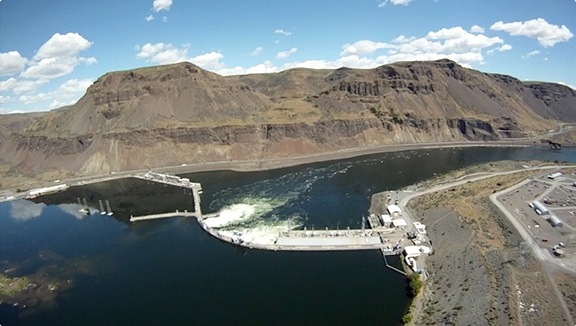
Rock Island Dam
I like this nosecam image of the Rock Island Dam, mostly because of the cloud reflections.

Rock Island Dam
A view of the Rock Island Dam from my skidcam.

Bridges
The bridges across the Columbia River between Wenatchee and East Wenatchee, shot from my nosecam.

East Wenatchee
A bird’s eye view from my skidcam as we flew over the bridge to East Wenatchee.

Columbia River at Richland
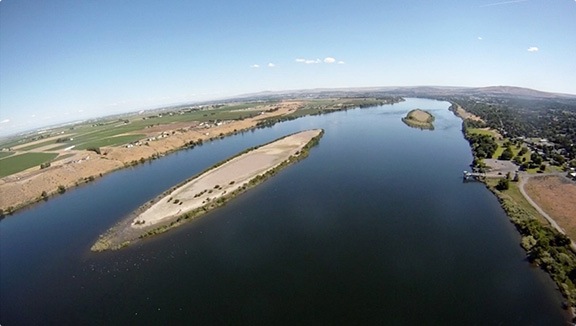
Crossing the Columbia River from west to east near Richland, WA. This time last year those islands were almost completely submerged with snowmelt floods. This is a skidcam image.

Richland Airport
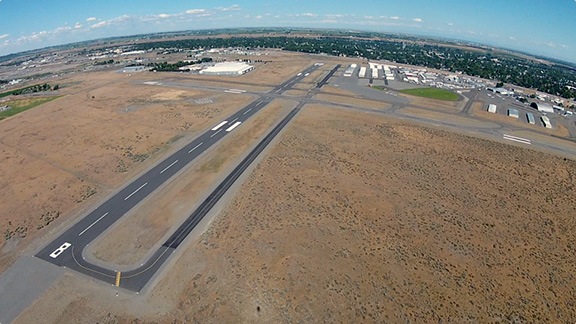
A nosecam view of Richland Airport in the Tri-Cities area.

Desert
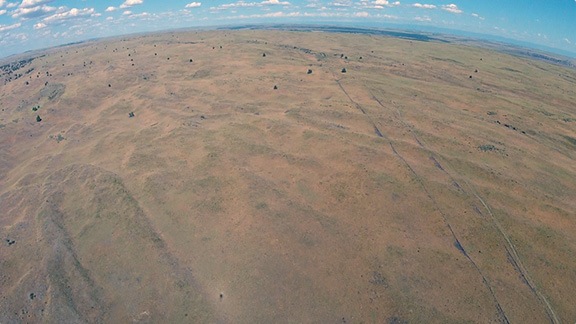
It might be hard to believe, but this area of Washington is desert. This nosecam image, shot east of Pasco, proves it.

Orchards
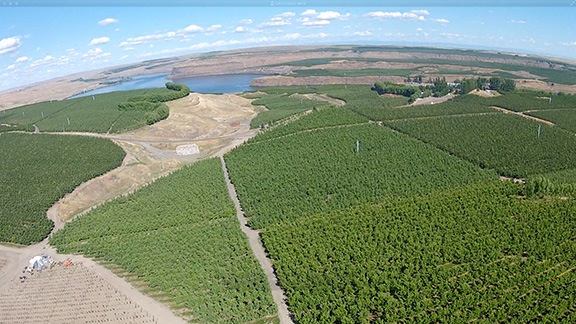
In this nosecam image, you can see the Snake River just upstream from the Ice Harbor Dam. My third landing zone was at a shop in the clump of trees on the upper right. You’re looking at thousands of cherry and apple trees here.

Even More Trees

Did I say thousands of fruit trees? There are millions in this skidcam image shot near Saddle Mountain.

Rock Island
This early evening skidcam shot of Rock Island and Malaga offers a good look at the terrain of my future home. I’ll be living at the base of those cliffs across the river by Christmas.

Unanticipated Yaw

Some comments about one of Robinson Helicopter’s latest Safety Notices.

In May 2013, Robinson Helicopter issued Safety Notice SN-42, Unanticipated Yaw. It said, in part:

A pilot’s failure to apply proper pedal inputs in response to strong or gusty winds during hover or low-speed flight may result in an unanticipated yaw. Some pilots mistakenly attribute this yaw to loss of tail rotor effectiveness (LTE), implying that the tail rotor stalled or was unable to provide adequate thrust. Tail rotors on Robinson helicopters are designed to have more authority than many other helicopters and are unlikely to experience LTE.

I discuss LTE a bit in my 2009 blog post, “How Much Wind is Too Much Wind?” You can also learn about it on Wikipedia and in the FAA-published Helicopter Flying Handbook.

Bell 206 Tail Rotor
Bell 206 helicopters have dinky tail rotor blades. (Photo Credit: Dakota Air Parts.)

Robinson points out that its helicopters are designed to have more authority than many other helicopters. This is partly because Frank Robinson worked for Bell, which has notoriously poor tail rotor authority, where he became known as a “tail rotor expert.”

I experienced the difference between tail rotor authority in a Robinson vs. another helicopter firsthand in 2004, when I flew Bell 206 Long Rangers at the Grand Canyon. After years and at least 1200 hours experience flying Robinsons, I was in a quartering tailwind at the Papillon helipads one day and got into LTE. I pressed the pedal enough to stop the rotation in a Robinson, but the yaw didn’t stop — I wasn’t flying a Robinson. Fortunately, I had the presence of mind to press harder on the pedal and get the situation under control before the rotation had reached a full 90°. It taught me a very valuable lesson about unanticipated yaw.

Robinson’s Safety Notices are normally issued in response to specific accidents. I went fishing on the NTSB website and discovered this April 2012 accident. Probable cause was issued on May 23, 2013 and that would be the right timing for a Safety Notice to appear. (Of course, I can’t be certain whether this is the accident that sparked the new Safety Notice. It’s just a guess on my part.)

From the report summary:

The helicopter slowed as it approached the landing zone on a modified right-base turn to the north. Gusting wind from the south had prevailed for most of the day and was present at the time of the accident. As the pilot turned to “enter the landing area,” he felt a “bump” in the tail rotor control pedals. The pilot added that he applied left pedal to compensate for a right yaw, and the helicopter immediately “started to rotate” at an increasing yaw rate with full left pedal applied. The pilot stated that the rotation stopped when he pushed the collective control “full down” and applied aft cyclic. The helicopter then descended through the trees and collided with terrain. Examination of the wreckage revealed no evidence of pre-impact mechanical anomaly.

The accident report goes on to provide general information about LTE. The Full Narrative refers to FAA Advisory Circular (AC) 90-95 “Unanticipated Right Yaw in Helicopters.” It also refers to Robinson Safety Notice SN-34, Photo Flights – Very High Risk as it pertains to settling with power, reduced RPM, and the loss of tail rotor thrust in low RPM situations. All of this is good reading to learn more about LTE and tail rotor operation.

It’s in low-speed situations that tail rotor effectiveness can be lost. At higher speeds, the helicopter points into the wind via normal “weathervaning.” The vertical stabilizer on the end of the tail helps make this happen. But at lower speeds, especially when turning into a tailwind, the force of the wind can easily cause the helicopter to yaw. The pilot must react quickly and firmly to stop and correct the yaw.

Experience teaches us. Years ago, I was doing a long cross-country flight with a 300-hour pilot who had just gotten his CFI. He was landing at San Luis Obispo (SBP), sitting in the left seat while I sat in the right. There was some yaw and I think he tried to correct it with the pedals. But then he panicked and said that something was wrong, that the pedals weren’t working.

I don’t recall the yaw being very bad. We were still moving along at a good clip, barely over the runway and likely doing at least 50-60 knots. I told him to push the pedal and he claimed he was and that it wasn’t working. He was visibly upset. I offered to take the controls and he agreed. I pushed the appropriate pedal and the helicopter immediately straightened. I landed without incident.

When I read this Safety Notice, I immediately thought of that low time pilot’s approach to landing and my own experience, years before, at the Grand Canyon. In both cases, we’d initially failed to use enough pedal to correct the yaw. The difference is, while I’d added more pedal when necessary, the low-time pilot had assumed there was a problem with the aircraft without trying harder to correct the yaw.

I have to wonder whether the accident pilot was in the same situation. After all, probable cause put the blame firmly on him:

The pilot’s inadequate compensation for wind during a high-power, low-speed downwind turn, which resulted in a loss of control due to loss of tail rotor effectiveness and settling with power. Contributing to the accident was the pilot’s decision to land downwind.

I guess the takeaway from all this can be summed up as follows: We always need to be aware of potential control issues, especially when operating at low speeds in crosswind or downwind situations. Yaw should never be “unanticipated.” It’s the pilot’s responsibility to keep control of the aircraft at all times by avoiding situations that could result in control issues and to use aircraft controls properly.

Helicopter Pilot Reality Check

Another message from a reader; he gets it, too.

I just wanted to share another message from a reader, along with some comments. Here’s the message; I did get permission from its author to share it here:

Hello, Ms. Langer. My name is XXX, I’m from Los Angeles, CA, and I’m 27. I just got out of the Army back in January after eight years of service, and I’m kind of lost. Don’t worry, I’m not here for guidance, or advice. I just wanted to thank you for your “So you want to be a helicopter pilot” articles. Though short and concise, they are a substantial truth in the sea of opinions and “knowledge” that is the internet. I have been considering using my GI Bill on flight training, thinking it would be a great way to make 80 thousand a year right out the gate. I knew in my heart of hearts that there had to be more to it, though, and I was right. Thank you for the reality check, the information, and for putting things in perspective. I’m still strongly considering it, but can now make a better informed decision. I believe nothing worthwhile is accomplished without paying your dues or overcoming challenges to get there. Your articles took the “too easy to be true” out of my mindset. Thank you.

(Emphasis added; more on that later.)

Messages like this one are part of the reason why I blog about my thoughts, feelings, and experiences as a pilot. I want to share what I know (or think I know) with other pilots and folks who want to be pilots.

He’s referring to my series of blog posts titled “So You Want to Be a Helicopter Pilot.” Originally written about two years ago, I’m preparing to update, revise, and expand the series and turn it into an ebook. It’s my attempt to inject a dose of reality into the whole helicopter pilot career discussion — a discussion that has been fraught with fallacies.

False Advertising

News Travels Fast

I still remember how I heard of Silver State’s demise. I’d been using their maintenance services for my helicopter. Early — before 8 AM — on a Monday morning, my FAA POI (Primary Operations Inspector) called me. “Do you have possession of your helicopter?” he asked.

“Yes,” I replied. “It’s in my hangar.” I remember feeling a moment of panic. Was it in my hangar? Or somewhere else? Why was the FAA calling me? “Or it should be,” I added quickly. “Why?”

He replied, “Silver State went out of business yesterday. They locked up all their facilities. I just wanted to make sure your helicopter wasn’t locked inside their hangar.”

To this day, I wonder what kind of ordeal I would have been put through to get my helicopter out of their hangar if it had been in there that weekend.

I blame Silver State Helicopters, the now-defunct pilot mill, an organization with a pyramid scheme as its business plan. Some readers might remember this company, which locked it doors on Super Bowl Sunday in February 2008, just days after conning another two (from what I heard) students into signing up.

Silver State was well known for conducting helicopter pilot career seminars at auditoriums all over the country. They’d run radio ads to advertise the events, luring people in with promises of $80K salaries as helicopter pilots. I never attended an event, but I was told that it wasn’t uncommon for them to put several helicopters with flight-suited pilots on stage in front of their audience. They’d paint a picture of a glamour job with a big paycheck. All you had to do was agree to pay $70K to $80K (prices varied) to go through their program. They had financing — I believe they used Key Bank — available at the event and even promised to hire all students as flight instructors to get them started on their career path.

Hundreds of people fell for their sales pitch and signed up. (Let’s face it: Who wouldn’t want to be a helicopter pilot making $80K/year? Cool job, great paycheck. Double win, no?) This enabled the company to keep expanding, adding more locations and more helicopters. They also started churning out more and more pilots. They used tomorrow’s revenue to pay for yesterday’s growth, relying on a constant, ever-growing stream of new students to stay solvent. They built their own bubble which was doomed to burst when financing became expensive and pilot jobs became scarce.

Meanwhile, the pilots in the program soon realized that the $80K jobs they thought would be available when they got their pilot ratings weren’t within reach. They needed experience. And while Silver State did hire them as flight instructors, when a flight school has as many instructors as students, it’s tough for any of those instructors to actually get any flight time. So not only did the company flood the market with pilots, but it created its own bottleneck for pilots who needed to build time. And although some folks reading this might disagree, many employers questioned the quality of a Silver State education and simply would not hire the school’s graduates, even if they did have enough flight time to qualify for a pilot position.

Unfortunately, even after Silver State folded, other flight training operations persisted in using their formula to attract students with promises of high paying jobs while glossing over the fact that thousands of hours of flight experience is required to get those jobs. That’s the “80 thousand” referred to in the email quoted above.

Reality Check

And that’s why I wrote my “So You Want to Be a Helicopter Pilot” series. I wanted people to get an idea of what it was really like to train to be a helicopter pilot. Each part of the series explores another aspect of what’s important to build a career as a pilot.

The part people seem to have the most trouble with is the part about getting experience before you can step into a good job. I cover that in Part 9: Pay Your Dues. People just don’t get it. Or they don’t want to get it.

Just last week, I saw the following post on a Women Helicopter Pilot group on Facebook:

Seems like the only realistic way for us ladies who recently finished flight school at commercial level is to slave by being an instructor first to ever build over 1000 hours to be employed by any company. I understand you learn a lot but I have no patience to teach, hence I didn’t sign up to be a helicopter instructor. What’s left to do?

I took great offense at this comment. The author seemed to insinuate that it was just women who needed to build 1,000 hours of flight time to get a decent pilot job. She used the word “slave” to imply that it would be a great ordeal to build those 1,000 hours as a flight instructor. She made it clear that she didn’t do her homework or ignored the reality presented to her: that it’s very common for all pilots — men or women, fixed wing or helicopter — to work as flight instructors to build the almost universally required minimum of 1,000 hours PIC time to secure an entry level pilot job.

And just the other day I got an email message from a blog reader that said:

my name is XXX, and i have currently got 100 hours on the R22, and am looking for some sort of way to build my hours up or for much cheaper. very passionate about flying. I’m a single man, 23 years of age and willing to go where ever is needed. please may you assist me by just directing me in the right path?

He’s kidding, right? He’s a 100-hour pilot and he’s looking for cheap flying time? Does he realize he’s standing in line behind several thousand people with the same passion and goal, most of whom at least bothered to finish commercial training to move forward?

Hell, even I’m looking for cheap flying time — it’s gotten to the point where I can’t afford to fly my own helicopter without someone paying for the flight time.

But the comment that sticks to me after many years is the one posted on my 2009 blog post, “How to Start Your Own Helicopter Charter Business.” I wrote the post after getting too many messages from wannabe pilots who saw owning and operating their own business as a shortcut to building a career as a helicopter pilot. These guys didn’t want to pay their dues. I made it pretty clear what they would pay instead in that post.

The comment said:

I have read all of your blogs and wannabe pilots and their dreams and aspirations. I will tell you of my plans, and I am sure you will shoot them down like a kamikazee pilot barreling down at your aircraft carrier. I saw and understand your step by step approach to the biz. It sounds as if you discourage the thought of anyone even pursuing the dream. like its a complete waste of time. My best friend and I are recently both divorced, and have no pilots license..period, starting from scratch with our good credit and 401k in tact, we wanted to go to panama…the country and start this Helicopter tour business…very little to no competition. We wanted to start an exciting business and this seemed the one. We are willing to hire a pilot for us initially and front the startup, then get our license along the way…what do you think? Hold on….let me get my boxing head gear on, and my bullet proof vest, and my sport cup…hold on…there, got my hockey mask on now too…ok Maria…give it to me…dont hold back! Tell me what I dont want to hear, but need to hear…you got any positive advice as well? thanks

It sounds as if I’m discouraging people? By introducing a dose of reality? By pointing out that things aren’t as rosy as you might believe? By explaining that it’s costly to get started? By reminding readers that they have to work hard and pay their dues to succeed?

This comment got under my skin. It made me realize that no matter how much I try to help people by sharing my advice and observations and experience, if what I have to say doesn’t match their preconceived notions, I’m just “shooting them down” and “killing their dreams.” (This comment was especially ridiculous because the author didn’t seem to have any insight into the helicopter tour business he was hoping to start with a partner in another country. WTF?)

Do you think a person with an attitude like that will get far in any field?

Whatever.

Back to the Message that Prompted this Post

Anyway, the message I got the other day (refer to the quoted text at the beginning of this post) made me feel good. Someone was listening, someone was trying to use the information I shared to help make an educated career decision.

Like the person who wrote to me last month, this guy gets it. He understands that you have to work to achieve a goal. He understands that any goal worth achieving has challenges.

This guy has the right attitude. He’ll succeed in anything he sets out to do — even becoming a helicopter pilot, if that’s what he wants.

I’m not going to say that it’s impossible to make $80K as a helicopter pilot. I know pilots who make that much and more. But they worked hard to get ahead in their chosen field. They built hours and skills. They had the right attitude; they made their employers want to invest in their training. They proved themselves worthy of the positions they were put into, year after year.

But what I really want to make people understand is this: The only reason you should pursue any career is because you’re passionate about that work. Do not let earning potential — either real or imagined — make your career choice for you.

I made that mistake when I was starting out in college and beyond. I made great money but I was unhappy for the first 8 years of my working life. Life’s too short to be unhappy.

Wouldn’t you rather make a living wage doing the thing you’re passionate about doing?

So my advice to anyone who’s gotten this far in yet another long-winded blog post is this: pursue a helicopter pilot career only if you’re passionate about flying helicopters. If you put your heart and soul into it and you prove yourself worthy of the job, the money will come.

In the meantime, you’ll be doing what you want to do and every day will be its own reward.