I meet with the FAA and am pleasantly surprised by how helpful they really are.
It’s an old joke among pilots. You’ve just landed at the airport and parked your aircraft and a man walks up to you. “I’m with the FAA and I’m here to help,” he says. That’s the joke. When the FAA approaches you on an airport ramp, they’re probably there to do a ramp check. It’s like getting pulled over by a cop who wants to check your paperwork and the condition of your car. How helpful is that?
Well, this isn’t what happened to me, but it was on my mind when I went to the FAA’s office in Scottsdale for a meeting yesterday morning. But before I continue that story, let me take a few steps back.
I’ve been running a Part 91 helicopter tour business since October 2001. “Part 91” refers to the part of the Federal Aviation Regulations (FARs) that covers the type of commercial operation I did. It’s highly restrictive, but not highly regulated. Basically, anyone with a commercial pilot certificate and an aircraft — even a rented one! — can become a Part 91 tour operator without so much as filing a form with the FAA.
Part 91 is highly restrictive. For example, I can take passengers on “sightseeing” tours within 25 statute miles of my starting point. Draw a circle with a 25 mile radius around Wickenburg and you can see my general operating area. On the east, it stops just short of Lake Pleasant. On the North, it’s around Peeples Valley. West, it doesn’t quite make Aguila. And south, puts me somewhere beyond that mountain range south of Vulture Peak. So I’ve had to routinely turn down requests for flights over Lake Pleasant, Bagdad mine, and various locations in the Bradshaw Mountains.
Part 91 does not allow me to land and discharge passengers. So although I could show people Gold Bar Mine from the air, I couldn’t land on that nice piece of road on the ridge and let them out to explore. I also could not pick up the odd miner (read that any way you like) who wanted to be picked up in Wickenburg and dropped off on a mountaintop twelve miles away. This hurt business, especially when I had Tristan’s 4-seat helicopter last season. The most painful was a local resident who wanted me to be his air taxi service and take him to places like Meteor Crater and Sedona. Those flights would have been extremely lucrative for me and a lot of fun. Having to turn them down was probably the prodding I needed to take the next steps in my tour business.
Those steps were to buy an R44 helicopter (a 4-seater) and to apply for a Part 135 Air Carrier Certificate.
Buying the helicopter was a tough first step. The first hurdle was getting a good deal on a ship that would meet my needs. Justin at Hillsboro Aviation helped me out there. He cut me a great deal on a brand new ship. The next hurdle was coming up with $25,000 in cash as a deposit. It took me a few weeks of scraping, aided by a nice royalty check, to get the money together. I placed the order on my birthday, June 30, and asked for the custom N-number N630ML.
Thus began the 6-month waiting period to get the helicopter. Robinson sells more helicopters than all other helicopter manufacturers combined, and their factory in Torrance, CA was in the process of being expanded. But I could wait 6 months. It would take me that long to scrape up the rest of the down payment and arrange for a loan. Besides, who wants to fly a helicopter in Wickenburg in the summer? Air conditioning was not an option.
To make the helicopter pay for itself — at least in part — I’d have to expand the tour business beyond the 25-mile, no stopping limitations set by Part 91. So in October, I applied for a Single Pilot Part 135 certificate.
Part 135 has three types of certificates. The basic certificate is for a large operation, like Papillon, for example, which has multiple helicopters and multiple pilots. I was a Part 135 pilot for Papillon’s Part 135 operation. Then there’s a single pilot-in-command certificate, which is for operations that have multiple aircraft and pilots but only one pilot who will act as pilot-in-command (PIC). This is primarily for operations with multi-pilot aircraft so there’s a handful of second-in-command (SIC) pilots to fly with the PIC. Finally, there’s a single-pilot Part 135 certificate. That’s for organizations like mine. One pilot will be doing all the flying in at least one aircraft that’s owned or leased.
Although I could apply for a basic Part 135 certificate, there’s no reason to. It’s a lot more paperwork and it takes a lot longer for the FAA to process. And there’s absolutely no benefit for me, since I’m the only pilot.
The application process is a bit lengthy. First, you go to the local Flight Standards District Office (FSDO, pronounced fizdoe) and watch a video that outlines the certification process. I did that last year, in the summer, when I was toying with the idea of applying. (That was an expensive trip to Scottsdale. I wound up buying a new car while I was down there.) I was hoping to lease Tristan’s helicopter for the season and when he didn’t come through right away, I abandoned the idea of applying. But the FSDO sent me a package of materials to get started anyway and I kept it. So when I decided to get off my butt and apply, I had everything I needed. I filled out the Pre-application Statement of Intent (PASI) form and sent it in along with a cover letter. That was on October 18. And then I waited.
One thing I know about government agencies is that they sometimes need to be gently reminded that you’re waiting for something. (I worked for the New York City Comptroller’s Office for five years, so I know exactly how bad civil servants can be.) So on November 3, I called the FSDO to see how far my form had progressed. After a bit of research, I was told that my case had been turned over to Charlie for processing. But Charlie wasn’t in. I should call back tomorrow.
I called back. Charlie didn’t know anything about it and didn’t seem too happy to hear about it. He asked me if I knew that the process usually takes three to four months, possibly five. I told him, choosing my words carefully, that I’d heard that it could take that long. He told me I’d need a Statement of Compliance and that usually took a very long time to prepare. And a HazMat training program. I asked him what the next step was. He said a pre-application meeting. And then he did something that surprised me: he offered to meet with me the following Monday morning at 9 AM. I jumped on the suggestion and agreed.
Over the weekend, I did my homework. I spent all of Saturday working on a Statement of Compliance so it would apply to Flying M Air. It took most of the day and required me to read every paragraph of FAR Parts 119 and 135, understand them (the tricky part), and determine whether they applied to my operation and, if so, how. I learned a lot about the FARs that day. When I was finished, the document was 47 pages long. I included a title page and table of contents, along with headers and footers, so it would look professional and be easy to read. I also went through all the documents I could find in my package and online — the Atlanta FSDO’s Web site was extremely helpful — to learn what I could about the process. I wrote down questions. I wrote down assumptions. I got together additional documents, including my resume, a formal application letter, a copy of my purchase agreement for the helicopter, and a summary of my logged helicopter hours.
On Monday morning, after printing the Statement of Compliance and other documents at my office (no printer at home), I hopped in the car and began the long drive to Scottsdale. It had rained overnight and was still raining in parts of Scottsdale. Arizona drivers are completely clueless about driving in the rain. Fortunately, they tend to be more cautious than less. Unfortunately, that means they drive a lot slower. So it took me a full 90 minutes to get to North Perimeter Road, off Princess Blvd. I got a parking space right out front and went in.
After I signed in, Charlie was summoned. He didn’t look happy. He said, “I’m not the person you’ll be working with. But I’ll take you to that person.”
I was already being shuffled around. I remembered my audit days at the City of New York, when the civil service shuffle was a part of my daily life. But I could deal with it and would.
He took me through a maze of cubicles and stopped in front of one, where a man was working at a computer. He looked up. “This is Maria,” Charlie said. “I told you about her this morning.” He turned to me. “This is Bill.” And then he left.
Bill looked flustered. He admitted that the first time he’d heard about me was that morning and that he didn’t realize I was coming in that day. Mentally, I prepared to be dismissed. But he grabbed a white binder and led me to a conference room — the same room I’d seen the video in over a year before. There was a big white board on the wall that listed all the Part 135 certificates in progress. Flying M Air was the second from the bottom, with a date of 10/20/04. That was a good sign. I was on the board.
The binder he’d brought with him was not mine. He left me in the room while he searched for mine. He came back empty-handed twice, but vowed to find it. After about 15 minutes, he returned with the binder and another man, Rhuno. Rhuno, it turned out, was his boss. At first, I thought he was only going to stay in the meeting for a while, but he wound up staying for the whole meeting.
Bill went over a extremely large, scary-looking flowchart that described the Part 135 process. And I started pulling documents out of my briefcase. The Statement of Compliance. The formal application letter. My resume. My flight hours. The helicopter purchase documents. They were surprised. I don’t think many applicants bring so many documents with them on the first meeting. But I was driving down from Wickenburg and didn’t want to make the drive more often than necessary. I also wanted to do my part to keep the ball in their court, minimizing delays.
Bill looked at the flowchart. In that one meeting, we’d made our way through about 1/3 of it. He and Rhuno got other documents for me. The HazMat training program. (Even though I won’t carry hazardous materials, I have to have a program that identifies them so I won’t inadvertently take them on board. HazMat now falls under the Transportation Security Administration (TSA), so my program will have to be approved by them.) A sample Operations Specifications. A minimum equipment list (MEL) for R44 helicopters. I don’t think they could have been any more helpful. I left with twice as much paper as I came with, even after dropping off my 47-page Statement of Compliance.
Along the way, I asked Rhuno how long he thought the process would take. He said that since I’d obviously done my homework and a Single-Pilot certification was usually a lot faster and easier than a basic Part 135.
“What do you think?” I asked meekly. “Is it possible to have it done by January?”
“Sure,” he said, meaning it. Later in the meeting, they led me to believe that they might be able to have everything done except the aircraft inspection before my helicopter arrived. And that’s only a month from now!
We had a great talk at the end of the meeting. They were surprised that I was the only tour operator in Wickenburg. I told them a little about Wickenburg’s economy and the difficulty in selling tours to people who were either conservative about their entertainment or on a low budget. I told him I planned to supplement my Part 135 work with Part 91 rides at special events.
In discussing Wickenburg’s growth, I mentioned Prop 421 and how glad I was that it had failed. Rhuno said it was a good thing it had failed. He said that zoning was vital in growing communities. He compared Carefree to Cave Creek, two communities, side by side. From the beginning, Carefree had always had strict zoning while Cave Creek did not. I’m familiar with the two towns. Carefree is a much nice community with higher property values and a more pleasant atmosphere. I’d much rather see Wickenburg get like Carefree than its neighbor.
Rhuno had heard about my work at Wickenburg airport, back when I had the fuel manager’s contract. He’d heard a lot of good things about the terminal’s renovations and new services there. I told him I’d given it up because of employee problems and an overload of frustrations. I also told him my honest opinion, which is that the town doesn’t care much about the airport. I told him about the jets that come and go all winter long and the big money that comes to town with them. More money arrives in Wickenburg by jet than by car. (My favorite story is the family that arrived last December in three Lear jets for their annual family reunion/vacation at Rancho de los Caballeros. The Dad handed over a check for $30,000 and told the los Cab guy to tell him when that ran out. And I’m not making this up. I was there.) You think the town would make the point of entry for these people a little more pleasing? You think they’d provide some additional services — like a fuel truck — to help service the jets that bring them? You think they’d try to get a restaurant built at the airport to attract more fly-in visitors? The unfortunate answer is No. And that’s why Wickenburg loses so much Jet traffic to Glendale, Deer Valley, and Scottsdale. The pilots would rather stay in these metro areas — and fill up while they’re there — than what they see as neglected outpost of civilization. Remember, they’re basing their opinion of Wickenburg on what they see at the airport and it just doesn’t stack up to what they see elsewhere.
Don’t let me get started.
Anyway, when I left my meeting with Bill and Rhuno, I was extremely impressed and happy. I’d started my certification process late, but it looked as if I’d get it all done by the time the season got up to full swing. The FAA wasn’t trying to hold me back — as I’d thought it might. It was trying to help. And I drove away from the Scottsdale FSDO with new respect for the folks who control aviation in this country.
 About an hour later, we passed through Chiriaco Summit, which is the highest point between Blythe, CA and Palm Springs, CA. Five minutes later, we turned on the exit for Joshua Tree National Park. This would be my third visit to Joshua Tree and, like all the other visits, it would be a visit where I just have a few hours to drive through. But one of these days, I need to come to Joshua Tree and spend some real time. It’s a great park, with mountains, valleys, two different deserts (Colorado and Mojave), and lots of vegetation. On Monday, it also had snow — quite a bit of snow, in fact, especially on the northern side of the park. We drove through the park, making a few stops here and there. Norb, my brother, and Missy, his wife, did a little hike to a dam. My sister, Laura, and I would have gone with them, but we were wearing the wrong shoes for a trip through the snow. So we hung out in the car and listened to the XM radio.
 We checked out, stowed our luggage in the car, and walked down to the Aquarium of the Pacific, which was just opening for the day at 9 AM. I’m rather fond of fish — I have a 55-gallon fish tank in my living room — and I think aquariums are very interesting. But this one went beyond that. The highlights: the jellyfish displays, the shark-petting tanks, and the lorikeet feeding aviary. We spent two hours there and enjoyed every minute of it.
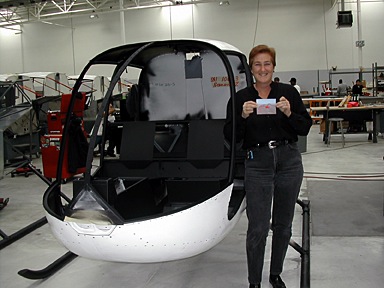 I ask you: what are the chances of visiting a factory the very day that the item you’ve purchased goes onto the assembly line?
 Marketing is an important part of any business. And the most effective marketing includes visuals. Take, for example, my slides at the movie theater. There are a few aerial shots of the town and some cattle tanks, giving people an idea of what they can see from the air. But there’s also an excellent air-to-air photo of my old helicopter, Three-Niner-Lima. In the photo, I’m flying past Vulture Peak, just like I do on my Grand Tour of Wickenburg. It’s a real photo that Mike took from the passenger seat of a Piper Cub years ago, when we were flying in formation just to take the photos. I have several of these shots. One — the one you can clearly see me in the cockpit, looking at the camera — is on my business card. These photos look so good that I’ve been accused of cooking them up in Photoshop. But I didn’t. They’re real.
 Meanwhile, I had a number of air-to-air photos of my friend Tristan’s R44 taken here in Wickenburg. I leased Tristan’s ship last year for the season and did relatively well with it. That’s what convinced me that I could build the business much better with a 4-seat helicopter. We’d taken the pictures for last year’s ad campaign: “Share the view with a friend or two!” Trouble is, Tristan’s ship is metallic gray with a dark blue stripe. My ship will be Ferrari red with no stripe.
 So I sent Bert an e-mail with a thumbnail image of the photo I wanted him to convert and brief instructions. He said he’d do it, that I should just send him a bigger image. I sent the image with more complete instructions. I asked him to remove Tristan’s N-Number. I told him that if he wanted to get really fancy, he could add mine. The next day, the fruits of his labor arrived in my e-mail inbox. It was a photo of Tristan flying a helicopter that hadn’t been built yet.

