Air-to-Air

An air-to-air photo shoot gives mixed results.

I needed a photo of my helicopter in flight for marketing materials. Jim needed a photo of his helicopter in flight for the cover of Trade-A-Plane. It seemed natural that we should go out together and take care of both photo shoots.
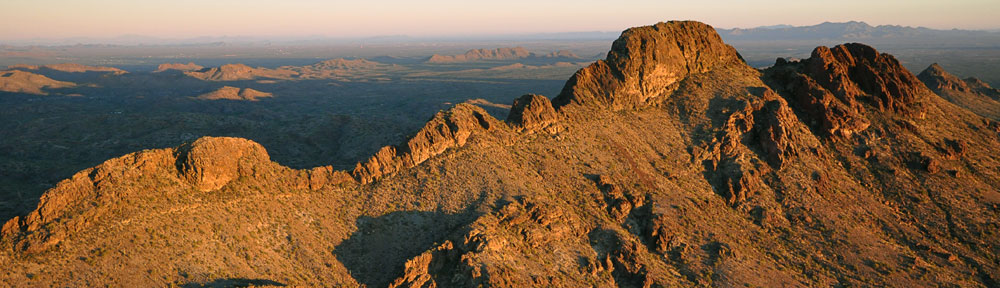
Three-Niner-LimaI’ve done this before. Years ago, when I needed photos of my R22 for marketing material, a friend took Mike and a camera up in a Piper Cub. We flew in formation around Vulture Peak. Mike snapped off 50 or so digital photos. I loaded them into my computer, discarded the really bad ones, and cropped the good ones to get what I needed.

Tristan's R44Two years ago, we did the same thing with Tristan’s R44. This time, I flew Mike in my R22. We flew in formation around Vulture Peak until Mike had about 30 pictures. For some reason, the focus wasn’t good on all of them — I think the camera’s autofocus feature was just starting to die at that point — but we had enough good photos for what we needed.

Sunday’s flight with Jim was a little different. Jim was more concerned with background than anything else. So we had to fly out to an area north of Lake Pleasant to get the interesting rock formations he wanted. He took Mike to photograph me first, then landed in a wash near what looked like a marijuana farm and let Mike out. Jim took off and I landed to pick up Mike. Then we shot Jim from my helicopter.

I didn’t enjoy the experience. Jim sits on the opposite side of the helicopter from me, so he couldn’t see me when he was next to me. He got very close twice and it really freaked me out. Mike couldn’t communicate with Jim because Jim has a push-to-talk intercom in his helicopter and Mike couldn’t push it while he was shooting pictures out of a tiny window. And the radio was a mess because every time we picked a frequency, it turned out to be a frequency already in use. We had to keep switching. Even when we got on the helicopter air-to-air frequency, some idiot kept trying to tell us to get off.

Now I know it sounds as if we dove into this without any planning. We didn’t. Jim and I discussed formation flying before we took off. We came up with a plan for getting the pictures. But somewhere along the line, the plan got thrown out the window. (It wasn’t my window; my windows don’t open.) The resulting flight was full of unpleasant surprises.

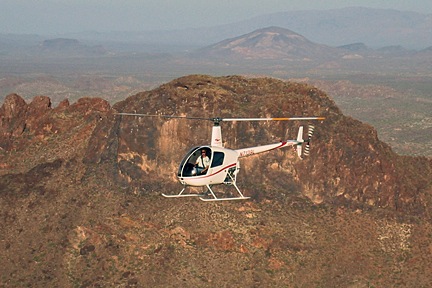
Zero Mike Lima in FlightBut Mike did get a few decent photos of my helicopter. One of them was almost perfect. A few of them were pretty funny; Mike managed to cut off various parts of the helicopter in others. Two of the photos didn’t show the helicopter at all. (That might have been when I spotted Jim over my left shoulder and veered away from him.) None of the photos, however, were as good as that first Vulture Peak shoot. In those photos, I’d been looking right at the camera. (That’s because I’d been following the lead, looking at the lead like I was supposed to. On this shoot, I’d been the lead but Jim had lost sight of me and passed me. Seeing him beside me, just after this photo was taken, scared the shit out of me.)

Jim's Hughes 500The photos of Jim’s helicopter weren’t very good at all. Jim had this idea of background firmly entrenched in his mind. So rather than form up with us and let Mike shoot photos with him relatively close, he followed the contours of a cliff face. He must have been a few hundred feet away from the cliff for the entire run. I couldn’t see him because I was ahead of him so I didn’t know how far away he was. He should have been watching me, forming up on me, adjusting his distance accordingly. I don’t know what kind of camera lens he thought we had. Mike claimed that Jim’s helicopter filled “one third to two thirds of the frame,” but Mike was seriously mistaken. In most shots, Jim’s ship is a red, white, and blue speck against the desert. I cropped the hell out of this shot here; it would not be suitable for printing.

Two Helicopters in WickenburgI was a nervous wreck when we finished up and very glad to be done. (My hands were shaking for some time afterward.) We landed and parked side by side on the ramp. Then we wandered over to the terminal to the shade to look at the photos in the camera’s tiny screen. We were both disappointed. I knew I had a few usable shots, but Jim’s were just too small to be of any use.

I do want to say that I appreciate Jim taking the time to do the shoot with us. I know his ship is expensive to fly and that he’s very busy working on a new product to show at Heli Expo early next month. I wish we’d gotten some better shots of his ship. Maybe we’ll try again sometime soon, when Jim isn’t so pressed for time.

Support Our Troops

Some rants regarding yellow ribbons.

They started appearing about a year ago on cars, vans, and trucks all over the U.S., just about the same time the flags finally disappeared. Those “yellow ribbon” stickers or, in some cases, magnets. You know the kind. They look like a looped yellow ribbon and most of them say “Support Our Troops.” Some variations include the red, white, and blue models, some of which include stars and stripes. They’re all over the place and frankly, it bugs me.

Why does it bug me? Well, let’s take a moment to think about yellow ribbons and what they represent. The first historical reference to yellow ribbons that I can think of was in the pop song from the 70s, “Tie a Yellow Ribbon” by Tony Orlando and Dawn. The song was the tale of an inmate who was soon to be released. He was writing to his girlfriend, wanting to know if she still loved him. He instructed her to:

“Tie a yellow ribbon

’round the old oak tree

It’s been three long years,

do you still want me?”

(You can get all the lyrics here.)

In this instance, the yellow ribbon was used as a signal to tell him whether he was still wanted at home, whether he should bother getting off the bus. The song has a happy ending. Not only is there one yellow ribbon there, but there’s a hundred yellow ribbons. She evidently really wanted him back.

Move forward a few years. In November 1979, Iranian militants storm the U.S. Embassy in Terhan and take about 70 Americans hostage. The “Iranian Hostage Crisis,” as it came to be known, lasts 444 days. During that time, Penelope Laingen, the wife of one of the hostages, tied a yellow ribbon around a tree at her home. Like ribbon in the song, Mrs. Laingen’s ribbon expressed her desire to have her husband come home. Soon there were yellow ribbons on trees all over the country. The ribbons stayed up until the hostages were released.

Now here’s my beef. In both of these instances, the yellow ribbon signifies a desire to bring someone who is away back home where he/she is loved and wanted. Support our troops was not the message.

I get angry when I see those ribbons. To me, they’re just another sign of the American public’s “follow the leader” mentality. Some marketing genius decided that yellow ribbon stickers that say “Support Our Troops” could sell. Some people bought them. Other people said, “Hey, I want to support the troops, too. I’ll buy a yellow ribbon and put it on my minivan.” Thus, a movement based on some money-making scheme is born. And the American public is too ignorant to realize that the symbol of the yellow ribbon has nothing to do with supporting troops.

The Chinese manufacturers of these ribbons are laughing all the way to the bank.

I’m not the only one who feels this way. In researching this entry, I stumbled across this article with comments. Could it be that I’m actually part of a group of people who think the same way? Wow.

What does a yellow ribbon mean to me? Bring our troops home. Those people are risking (and losing) their lives to fight an illegitimate war, one that we have no business fighting. Bring them home. If I had a yellow ribbon on my car, that’s what it would say. Unfortunately, you can’t buy a ribbon with that message. It isn’t a popular message and it just won’t sell.

The president’s efforts to impose a democratic government on the people of Iraq isn’t any more right than the old Soviet Union forcing communism among neighboring countries. Yes, we Americans believe in democracy and it seems to work for us, but is it right for all countries? Is it right for us to force it on a country that might not be ready for it? And while we’re discussing what’s right and wrong, is it right for us to promote women’s rights in a country where women have a traditional role that is often reinforced by religion?

Why are we trying to turn Iraqis into Americans? This absolutely reeks of what the “missionaries” did in Africa and South America, converting indigenous people into Christians when they were perfectly happy with their own religious beliefs. But rather than religion, we’re pushing politics. Oddly enough, the biggest supporters of this war are the conservative “Christians” that backed George W. Bush in last year’s election. Is there another agenda? One that goes beyond politics? What will be we pushing next?

I’m American and I’m patriotic. If an invading force came into this country and tried to make us change, I’d be one of the people with a stockpile of weapons, fighting to drive out or kill the invaders. But I can’t support a war that I feel was waged as a poorly planned publicity stunt. And I won’t be putting a “Support Our Troops” yellow ribbon on any of my cars.

But do you want to know what bothers me most about the yellow ribbons? It’s that some of them are magnetic. That means they can be easily removed when this war is over, stored in a safe place, and reapplied when the next war starts. Now that’s thinking ahead.

September 27, 2011 Update: Unfortunately, this blog post — which is SIX YEARS OLD, for Pete’s sake! — was linked to on a conspiracy theory Web site. Inappropriate comments have begun to be submitted. Rather than waste my day moderating this kind of silliness, I’ve shut down comments. Move along folks, there’s nothing new to see here.

It Goes!

I get a new set of wheels.

It’s a 1979 Marketeer. And it goes.

What?

I bought a golf cart today. No, I don’t play golf. But I needed a vehicle to leave in the hangar to tow the helicopter around the airport. I was using my Jeep, but I don’t always have the Jeep with me at the airport.

We found this golf course classic in the Arizona Republic classified ads. It was the cheapest golf cart listed, at a whopping $800 OBO. Mike called the seller and got a very talkative woman on the phone. A woman who talked so much she made me seem like a mute. After a lot of listening, Mike got to ask the right questions. When he hung up, he had directions to her trailer park off Union Hills in Phoenix. We hooked up the flat bed trailer and went to take a look.

We made two wrong turns on our way to the owner’s trailer. Trailer parks in Arizona are maze-like in design, with short blocks and few straight streets. But we finally found it and parked out front. Her son Brian was waiting for us. Beside him was a hopped-up golf cart with ATV tires and a dark green paint job. Beyond them was what would soon become my very own Marketeer.

The first thing I noticed was that one of the front wheels was not positioned vertically to the ground. It was as if the steering wheel was turned all the way to the right. That wouldn’t have been so bad if the other front wheel was parallel to it. But it wasn’t.

It was a plain off-white golf cart. The kind you think about if you live in an area with few golf carts and think about golf carts. (Although why you’d think about golf carts if you didn’t have, need, or regularly see one is beyond me.) It was almost identical, in fact, to the one that my mechanic Ed, at Wickenburg Airport, has. No frills.

There were some signs of rust — I think that’s to be expected in any vehicle that’s nearly thirty years old. But the six batteries and their cables were in decent condition and, when we hopped in and went for a ride on those maze-like streets, it ran pretty smoothly. Despite the gimpy wheel.

We drove it back to Brian. Mike voiced his approval without sounding like he was in love with it. He wasn’t, of course. It was a pretty basic and somewhat awful golf cart, with just enough right about it to make it meet our needs.

“Your mom said she’d consider other offers,” Mike said. “Would you consider $500?”

Brian smiled. “No,” he said simply.

“How about $600?” Mike asked. (This is what we’d hoped to pay.)

“I’d feel better about $650,” Brian replied.

“We’ll, we’d feel more comfortable with $600,” Mike told him. “We have cash and can take it right now.”

“Cash is king,” I chimed in.

“Cash is king,” Brian repeated thoughtfully. “Okay.”

I pulled the six $100 bills I’d put in my left rear pocket out and counted them as if I wasn’t sure how much was there. I counted again to act surprised that it was just the right amount. Then I handed them over. Brian handed me the title, which had already been “signed over.” (There’s more to that, but it isn’t worth talking about here.)

Mike drove it up the ramp onto the trailer and Brian helped us tie it down with some straps we’d brought along. The whole time, he talked to us about hunting and doing other weird things with his hopped up golf cart. About the only thing he didn’t use it for was golf course transportation. It was street legal, which isn’t so unusual in Arizona, and had a stereo. On the way to our meeting, I’d asked Mike how a golf cart could be worth $4K or more used. Brian’s golf cart showed me the answer.

We drove home, making a few stops along the way. We went right to the airport where we unfastened the cart and drove it down the ramp. Rob, from Ed’s place, was there working on a plane. He pulled Ed’s cart out and parked it next to ours. They were virtually identical, although Ed’s had fringe along the roof and a bunch of welded-on pieces to hold various airplane tow bars.

Mike hopped into our Marketeer and he and Rob took off, racing down the ramp between the hangars. Mike was quicker off the line, but Rob quickly caught up and passed him. They disappeared around a corner. A minute or so later, Rob was back. Mike followed a bit later. Okay, so it wasn’t fast. Maybe it just needed a charge. Or maybe the gimpy wheel was holding it back.

But it is a classic. And it goes.

Eat Cheese

My cheese is delivered and I have a cheese tasting dinner with friends.

The cheese (referred to in a previous blog entry) arrived on Thursday. It came in a box fitted around a Styrofoam cooler that contained the cheese and a reusable ice pack. The cheese was still cool, despite its long trip from PA via FedEx but the box was stinky, like you’d expect a box of moldy cheese to smell.

Moldy is a strong word. Blue-veined is the word the cheese descriptions use. It appears that I’ve hit that magical age where a person starts liking blue-veined cheese. Oddly enough, Mike has, too.

John and Lorna came for our cheese dinner. I put out an assortment of crackers and some sliced french bread. And the cheeses. Not only the four I’d bought online from iGourmet.com, but two others I’d bought locally.

Here’s my cheese review.

Amarello is a sheep’s milk cheese from Portugal. I bought it because I’d never had sheep’s milk cheese. It has a semi-firm texture and a rather sharp (to my palette), salty flavor. It reminded me of a cross between Provolone and Romano. I give it a thumbs down.

Brie is a soft cheese found in many places. I bought this particular brie at the local Safeway supermarket. They have several brands there and I know from experience that I like the store-brand “Primo Talgio” the best. I put it on the serving plate beside Coulommiers, a French cheese described in the catalog as the “ancestor of all bries.” When tasted side by side with the brie, it had a much more complex flavor and an interesting finish. I give both a thumbs up, but the Coulommiers gets a bigger thumbs up.

Saga is a blue-veined, brie-like cheese. I bought it at Safeway. It’s one of my favorites. It has an interesting flavor and should not be eaten with brie as it makes the brie taste bland by comparison. Thumbs up.

Morbier is the cheese that started me on this cheese quest. It’s a French cow’s milk cheese that has a unique appearance — a blue line running horizontally across its center. This cheese was the big hit of the evening. Everyone liked it. Even John, who has extremely conservative tastes in food. This cheese not only gets a thumbs up, but it will likely be on every future order.

Gorgonzola Dolce is a very soft Italian cheese that has a strong flavor and even stronger aroma. I think this was the cheese that, despite its double-wrapping, stunk up the box. I like this cheese, but I don’t think it’s because I like the flavor. It think I like the difference of the flavor. I’m always interested in eating something different and this definitely is different. I give it a thumbs up for that reason, but a thumbs down because the piece they sent is so enormous that I’ll be eating it for longer than I probably want to. I’ll probably try different gorgonzolas in the future. Smaller ones.

My cheese experiment cost about $60, including the locally bought cheeses and crackers. I have enough cheese left to do it again, several times, Mike and I will probably work through them over the next week or so.

I’ll probably do this once a month or so, just to build up my knowledge of cheeses and enjoy their flavors.

Got any recommendations? Use the comments link or form for this post.

Getting Closer

I have my first official FAA inspection as part of the Part 135 Certification Process.

An FAA inspector from the Scottsdale FSDO came up to visit me in my hangar yesterday. His name is Jim and he’d been up once before, just to introduce himself, when he was passing through on his way to Scottsdale from another airport.

Jim formally inspected my helicopter for compliance with the equipment requirements of Part 135. He came into the hangar, looked over the helicopter from the outside, and poked his head into the cockpit, for a good whiff of that new helicopter smell and a look at the instruments. He spent a considerable amount of time reading the fine print on the fire extinguisher, so he knew exactly what kind it was.

Next, he looked at the Hobbs Book I keep in the helicopter. The book has several sections.

One section lists aircraft time flown, by date. I use the same pages to record revenue, expenses, and fuel and oil added for each flight. I’m trying hard to keep a good record of my direct costs and revenues for this helicopter in an effort to improve my business.

Another section lists upcoming maintenance items by hours due and/or date due. Jim suspected that I may have left out some ADs, but when I checked with Ed later on, the page was correct and complete. I also learned that the annual inspection date is based on the Airworthiness Certificate date for a new aircraft. That means I don’t need an annual until next January (rather than December). AN extra month to keep that money in my pocket. But Jim suggested that I have every 100 hour inspection signed off as an Annual so I don’t get stuck doing an annual only 20 or 50 hours after the previous 100 hour inspection. Makes sense to me.

Another section of the Hobbs book provides a form for listing squawks. A “squawk” is a potential problem with an aircraft that must be resolved before the aircraft can be flown. For example, suppose I find a leak in my gearbox when doing my preflight. I’d write it up and make sure Ed looked at it and took care of it and signed off on it before I flew. Jim liked the form I’d come up with, which was based on a form I found on the Atlanta FSDO’s Web site.

Another section of the Hobbs book is my pilot duty log, a document I’m required to keep for the FAA. My “duty time” is limited by law and the record clearly indicates how many hours I’ve flown to ensure that I don’t fly too much. Not likely in Wickenburg.

The last section of the book has financial stuff: a folder for receipts, calculations of prices with tax (for easier billing), etc.

Next, Jim checked out the documents I store in my new cabinet, including the Maintenance Manual and Log Books. He went through all log book pages — there wasn’t much there in such a new helicopter — and pointed out a recurring item he though I’d omitted from the upcoming maintenance page. (I hadn’t; it was there.) I think he was pleased to see a copy of the 2005 FARs on the shelf, too.

Finished with the official stuff, we chatted about aviation-related things in general. I showed him my new sign and told him I was waiting for certification to hang it up because it includes the word “Charter.” He told me a funny story about a new Stinson pilot he knew years ago who made a Mayday call to the tower at an airport while she was still on the ground. (I tried telling the story to Chris later on (he owns a Stinson) and I mangled it. Some jokes I can tell, others I can’t. This one I obviously couldn’t tell.) Then we shook hands and he left for the long drive back to Scottsdale.

According to Bill, who is in charge of the certification process for me, we’re getting much closer. There are a few things I need to fix in my compliance statement and my MEL needs a lot of work. He has to come up and do a base inspection. I think that means he’ll be coming up to the hangar to make sure I have all my pilot records in order. (Too bad Jim couldn’t do that. But it wasn’t his department.) I also need a check ride with Bill, who was just signed off for R44s. (It’s scary that I’ll have more time in an R44 than my check pilot.) Then the paperwork can be wrapped up. The only thing I still need to do is my drug/alcohol program, and that’s in the works.

If things keep moving along, there’s a good chance I’ll have the certification done by month-end, or at least the end of the first week in February. And then I can hang that new sign.