I top off my water tanks without making a call — or a drive.
I’d just finished a snack of blueberries, bananas, and vanilla yogurt when I thought I heard the sound of a truck’s engine out on the road. Jack the Dog confirmed that something was out there by letting out a half-hearted bark.
I grabbed my shirt, put on my shoes, and left the screened-in room. A water truck was backing up to the only house within view of our place at Howard Mesa, a rather ugly doublewide across the road. The house has been for sale for years and lately, since the association finally made the road drivable for ordinary cars (as opposed to high-clearance, 4WD vehicles), Realtors have been popping in once in a while, trying to sell it. Last week, there was a car and a truck there for several hours and I figured it was sold. But the sign remained and no one has been back — at least not while I was here. But now water was being delivered. What did that mean? Had it been sold? Would it be occupied again soon? Although I cared about all that, it wasn’t what interested me today. What interested me was the water. Would there be any leftover in the truck, and, if so, could I get it?We have two tanks on our property. The first one we bought was a 550 gallon tank, which we originally had filled for $60. Back in those days, we’d come up on weekends in the summer and camp in our pop-up camper. It was very rugged, but quite pleasant. Not having any plumbing, we didn’t use much water. In fact, the horses drank more than Mike and I used for showering, washing dishes, cooking, etc. The next time it needed to be filled, we had trouble finding someone who would come up to fill it for us. It seemed that no one wanted to drive “all the way up” here unless they were going to pump in at least 2000 gallons. We offered to pay for 2000 gallons, but they wouldn’t hear of it. So we went out and bought another tank, a 1550 gallon tank. With 2100 total gallons of storage, we could get water delivered.

This photo shows the big tank, with Jack the Dog posing in front of it. You can see the little tank and the shed in the background.
When your water is in a tank (or tanks, in my case) rather than connected to a city utility or well, you keep close track of how much water you use and have on hand. I checked the water levels just yesterday and figured I had about 800 gallons. My water usage (including the horses) is about 40 gallons a day. That gave me a 20-day supply. I figured I’d make a call for water when the big tank was empty; the small tank had about 300 gallons in it. By the time someone came up, I’d be able to take close to 2000 gallons.
The last time we had both tanks filled — last year; I wrote about it in a blog entry because the unusual circumstances surrounding the refill — it cost us $150 for 2000 gallons. That’s 7.5¢ per gallon. My friend Matt, who lives year-round on the other side of the mesa with his wife, says he can fill his 425-gallon pickup tank in Valle for $9 or in Belmont for an unbelievable $1.50. That’s just over 2¢ or well under 1¢ per gallon respectively. Their water usage is much higher than mine and he winds up making a water run at least once a week. A water run means driving to Valle (9 miles away) or Belmont (about 40 miles away) with the pickup and its tank, filling up, then returning with a load weighing approximately 3,400 lbs. He must then attach a pump to the pickup’s tank and start a generator to pump the water from the pickup tank to his storage tank. I figure a water run to Valle probably takes him an hour and a half total.
I’ve been thinking about hauling my own water to save money but the investment in that pickup tank and pump would be at least $300, so I wouldn’t start actually saving money until I’d been able to haul at least 5000 gallons. (You need to count the cost of the water and the cost of the fuel used to haul it. I’d like to count my time, but my time is pretty cheap these days, so I’ll skip it.) Mike doesn’t think that $150 to fill the tanks is all that much and I know darn well that he has no desire to haul it himself.
Back to the water delivery across the road.
With 800 gallons on hand, water was on my mind, but not as a pressing issue. But when I saw that truck, I saw an opportunity to get the tanks topped off. So I put on my shirt (it’s hot here and I tend to lounge in my sport bra) and made the 1/4 mile walk to my neighbor’s front yard.
The driver came right out of the truck, where he was enjoying the air conditioning. He was a kind of grizzly looking older guy wearing the dirtiest national park cap I’d ever seen. He was smoking a hand-rolled cigarette — and yes, it was tobacco.
I asked him if he’d have any water left over when he was finished filling the tank. He said he didn’t know. My neighbor’s tank is underground and neither of us knew how big it was or how empty it was. I told him that I’d take anything left over, provided the price was right.
“Isn’t it better to go back with an empty truck and a few extra bucks in your pocket?”
He agreed that it was.
We spent some time chatting about the area and about the kind of people who live five miles off pavement, off the grid. We shared some gossip about my neighbor and other people he delivered water to. He said most people don’t last long out here. They come in thinking that it’s going to be great to be so secluded and then they start disliking the inconveniences of hauling water and depending on solar panels and generators for electricity. Then we marveled at the house’s big roof and lack of gutters. Around here, it’s common to collect water off your roof with gutters and leaders into your water storage tank and run it through a filter before using it. My neighbor’s house didn’t have gutters. With the size of that roof, they could easily keep their tank filled if they’d set it up properly. Maybe the new owners would wake up and take care of it.
We both heard the water reach the top before it started gushing over the fill port. The water man flipped off the pump quickly. He consulted a sight tube on the side of the truck and told me he had about 900-1000 gallons left. I asked him how much he wanted for it.
“I don’t know,” he said. “How about $25?”
“Sold.”
I climbed into his truck and he started down my neighbor’s driveway. Jack the Dog, who had followed me over, led the way on foot. The man drove very slowly — so slowly that I figured it probably took him the better part of an hour to get from the pavement to my neighbor’s house — a distance of just under five miles. I opened our gate, he drove through, I closed it, and I climbed back on board.
He asked me if my helicopter was a Hiller. I told him that it was a Robinson. He asked me what I did with it. I told him. He asked if I flew it. “Sure,” I said. He told me he’d been a helicopter pilot in “the war” — probably Vietnam. He had that kind of look about him. Not the pilot look. The Vietnam vet look.
He rigged up the piping and was pumping water into the big tank within minutes. We chatted some more. I could feel the water level rise in the tank. Soon, his tank was empty and mine was filled. The big tank had swallowed it all.
I fetched $25 from the trailer and gave it to him. Then I showed him the work I’d done in the shed. He told me he was going to build a house out of block on some land he had in the area. I told him about the house we planned to build in the future.
I rode with him down to the gate. He told me he had most of an old gunship that he’d picked up at some kind of sale. Said he needed a swashplate and some other stuff to get it flying again. His eyes sparkled mischievously. I hope he gets those parts and gets the thing flying again. Valle needs a bit more excitement and a Vietnam-era helicopter gunship would be just the ticket.
I let him through the gate and watched him drive off. With a lighter load, it shouldn’t take him more than 30 minutes to get off the mesa.
And me, I figure I got 900 gallons of water delivered for 2.8¢ per gallon. Not bad!

 One of the many things I don’t have on Howard Mesa is an Internet connection. Sure, I have my PowerBook and sure, the solar panel on the trailer roof provides enough power for me to keep it charged. So I can compose e-mail messages, write blog entries, play with my GPS’s connectivity features, and work on my novel. But I can’t surf the Web, send and receive e-mail messages, or publish those blog entries. Enter Java Cycle. This funky little coffee shop, which used to be a bicycle shop, offers a full range of coffee beverages and free wireless Internet connection. Conveniently located on the eastbound side of Route 66, west of Grand Canyon Boulevard, I can usually find a parking space right out front. So I can take my PowerBook down to Williams, order a latte, and sit at a comfortable table while taking care of my Internet needs.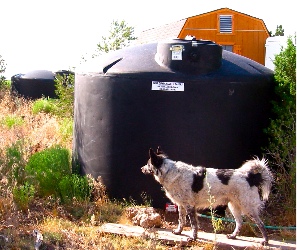
 I check out a few points of interest from the air.
 I headed northeast, right into the sun. Not good. I’d forgotten to put my hat on and the sun was shining right in my face, flickering through the blades. (I hate when that happens.) So I moved my headset down around my neck, put my hat on, and then put my headset back over my ears. Doesn’t sound like a big deal, does it? Well, you try to do it with one hand — your left hand. It was worth the struggle, though. The hat shaded my eyes nicely. I hit route 180 and followed it east, toward Flagstaff. I wanted an aerial view of Red Mountain, which I wrote about in another blog entry a few weeks ago. I had my camera and managed to snap two photos. Here’s one of them. Neither really shows the mountain well, but it’s hard to take pictures left-handed while flying a helicopter right toward a mountainside.
 This was my second trip along the Little Colorado River. It isn’t a very exciting flight, but it is mildly interesting. There are a few remains of Navajo homesteads and something that looked like an old mine. The highlight, of course, is usually the Grand Falls of the Little Colorado. But without any water falling over the big cliff, it was extremely disappointing. From that point, I headed pretty much straight toward Winslow cutting across the high desert, 300 feet above the ground at 100 knots.
 I headed west along I-40 for a short while, then spotted the “mountain” formed around Meteor Crater and headed straight toward it. I’d tried to get a summer gig at the Crater and they wanted me, but they also wanted $15 million in insurance, which I cannot get. (I don’t know anyone who can, either.) I like to fly over the crater when I’m in the area. I think it’s the best view; about 400 feet above the rim. I circled it once (D) and took a few pictures, then headed back toward I-40 again. I followed I-40 for a while, then decided to follow the traces of old Route 66. I did that past Twin Arrows, Winona, Flagstaff, Belmont, and Parks. It’s interesting the way the road fades in and out of existence along the way.
 When I got close to Williams, I caught sight of the black smoke spit out by the Grand Canyon Railroad’s steam engine. I caught up with it just short of Howard Mesa and managed to take a halfway decent photo of it from the air. (Remember, I’m doing this left-handed, and, in this case, through the passenger side window, while flying a helicopter. So cut me some slack.) Back at Howard Mesa, I followed the state road up to my property. I flew low and slow, trying to check out the road work they’d been doing. They were still working on it. I probably gave the road grader guy a mini heart attack when I passed him 50 feet off the deck about 100 feet to his left at 60 knots. (He’ll have something to tell his wife tonight.) I set down on my pad and shut down. I’d logged 2.1 Hobbs hours and had gotten a good fix.
 The hotel wasn’t very impressive from the outside. But step inside and WOW. The restoration work was incredible. Although I didn’t much care for the weird paintings that adorned the walls — paintings that probably have architect and designer Mary Jane Colter spinning in her grave — the place was beautiful.
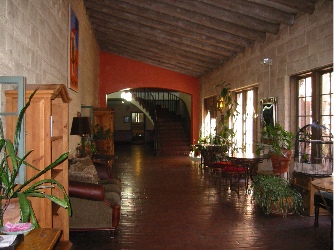 Afterwards, I explored the place, checking out the various public rooms on the main floor. I had my camera with me and snapped about a dozen photos so I could show Mike what the place was like. Beautifully decorated, beautifully restored. There was a garden in a courtyard out front and a lawn with covered patio in back facing the tracks. It was easy to imagine what staying at this place had been like years ago. I grabbed a brochure, noted the moderate room rates, and decided to talk Mike into making the trip for a weekend stay sometime in the future.