Helicopter Power Line Work

A video from the Flying M Air YouTube channel.

The title and narration pretty much says it all. We were driving across the desert and spotted some helicopter activity near some power lines. We found a road that took us right to the action. (BTW, This is the kind of thing you can see when you shut off the TV/video game/Internet and get out a little.)

I found this work fascinating and I think that if I were alone I would have captured hours of footage. But I think this taste from two angles is more than enough.

Anyone know what those line guys make? I sure hope it’s a lot!

I do know the name of the company performing this work, but have decided not to release it. Why? Well although I’m sure they were following all safety precautions and their pilots were properly trained for the work — you don’t get a job like this by being a fly-by-night operator — there’s always ONE viewer who finds something to complain about and I’m not going to help them cause trouble for these folks. Can’t you just sit back, watch, and be amazed at the things we can do?

Comments? Leave them below. I hope you enjoyed this; I’ll try to release other new content soon.

Snowbirding 2021: A Visit to Slab City

I finally get to see a place I’ve heard about numerous times and always wondered about.

I can’t remember exactly when I heard about Slab City, CA. I suspect it was about five years ago when I started visiting the Holtville Hot Springs and listening to the other RVers talk there about free places to camp.

Slab City on Wikipedia

Per Wikipedia, Slab City,

also called The Slabs, is an unincorporated, off-the-grid squatter community consisting largely of snowbirds in the Salton Trough area of the Sonoran Desert, in Imperial County, California. It took its name from concrete slabs that remained after the World War II Marine Corps Camp Dunlap training camp was torn down. Slab city is known for lifestyle that contradicts ordinary civilized lifestyle.

The rest of the Wikipedia entry is extremely informative (and I encourage you to read it), but appears to have been written mostly around 1990 and then edited to add information in 2020. (The editor in me would love to go into that entry and clean it up, but I’ll let experts tackle it.) There are photos, but I suspected that none would do it justice and I wound up being right.

The Trip

I’ve been wanting to check it out for myself for a few years. I decided to make it one of my goals for this year. But I wasn’t interested in dragging all my RVing gear out there, possibly to find a place where I wouldn’t want to camp. I wanted to make it a day trip from my campsite on the Arizona side of the Colorado River. It would be a roughly 2-1/2 hour drive each way.

Sometimes the only thing that prevents me from doing something I genuinely do want to do is motivation. I lacked motivation until this week. That’s when I happened to mention it to a new friend of mine, Bill, who is a full-time RVer. He very unexpectedly said he was interested in checking it out, too. And since he was camped out nearly halfway between my site and Slab City, it made sense for me to pick him up along the way if we did it before he moved on.

I set the date for Wednesday, which was the day after we spoke about it. There was a big holiday weekend coming up and I wanted to stick around near camp. A lot of crazies come out here with their off-road vehicles and I just felt the need to stay where I could keep an eye on things. I’m not a big fan of going out on weekends anyway, mostly because of the greater potential for crowds at my destination. One of the great things about my lifestyle is that I can go places midweek, when there are fewer people around.

That’s why I was in my truck at 8 AM on Wednesday morning with my pups, headed away from camp. I wanted to fill my truck with fuel before going into California — diesel (and other fuel, I guess) is about $1 cheaper per gallon in Arizona than California and with a 30 gallon tank that was about half full, that difference quickly turned into lunch money. I drove up to my favorite cheap gas station on my side of the river, topped off the tank, bought a pack of Oreos with a pint of milk, and set off westbound on I-10.

I was meeting Bill at Desert Center, a little over an hour west of the Colorado River. There was very little traffic, and I could cruise at or around the speed limit of 70 MPH. The stretch of I-10 between Blythe, CA on the Colorado River and Desert Center is pretty dull. A lot of empty desert, some of which has been recently filled in with huge solar energy farms. I listened to an audio book along the way and the time passed quickly. I got off the exit and rolled into the armpit of California that is the town of Desert Center.

Desert Center
Shot from a trash-strewn vacant lot near the I-10 freeway exit, this view of Desert Center, CA is what greets folks who go there.

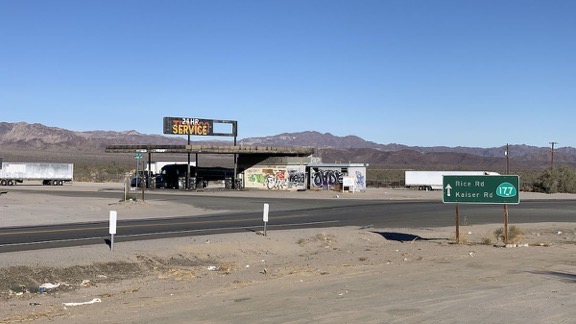
I cannot begin to describe how trashy the place is. It’s mostly empty lots and deserted, vandalized, graffiti-painted buildings. There’s trash and broken glass everywhere. A few semis with trailers were parked in various places, engines running; I guess this is an overnight stop for some truckers. I didn’t see any sign of current habitation, which is probably a good thing. I couldn’t imagine anyone actually living there.

I arrived early, of course, and had to wait for Bill, which I didn’t mind. I let the pups out to walk around the sandy lot I’d parked in and had to follow them around to make sure they didn’t step in or try to eat anything disgusting. We wound up waiting in the truck, windows open on the warm morning. But the more I looked around, I the less I liked the idea of Bill parking his custom Mercedes Sprinter van anywhere in the area for the day.

I told him that when he arrived. He looked around and agreed. He told me it had been broken into before and it was very upsetting.

I suggested Chiriaco Summit, a busier exit on the freeway that actually had businesses in operation. It was 19 miles farther in the direction we had to go anyway. He agreed and followed me.

I knew Chiriaco Summit from flying into its tiny airport, visiting the Patton Tank Museum there, and stopping for a bite to eat at Foster’s Freeze. As I pulled in, I realized that the little “town” had grown. There were additional restaurants and a handful of other businesses. Foster’s was now inside the big gas station. There was plenty of parking that would be out of the way yet close enough to activity to not draw attention. The town was all business and neat — a huge difference from Desert Center.

He parked, we went inside the gas station to use the restroom, and Bill bought a cup of coffee for the road. Then we were on our way.

I missed the exit for Box Canyon Road mostly because I was looking north. I was distracted by the Cottonwood Springs Road entrance into Joshua Tree National Park, with lots of RVs camping out in the desert, likely just outside of park boundaries. I never realized there was a road that went south there until I’d passed the exit. Duh. The next exit was six miles west and I made my U-turn there, thus adding 12 miles to the drive.

Box Canyon Road is a great drive on a decently paved road down a wide canyon that I would not want to be stuck in during heavy rain. There were a few folks camped out in there and a few others driving the same direction we were. After a while coasting downhill on the gently curving road, we got a glimpse of the Salton Sea stretched out before us in the distance. Then the winding canyon road leveled out and opened into blocks of farmland.

We saw some very neglected grape vines, lemon trees, pepper plants ready to be harvested, and a bunch of other veggies we couldn’t easily identify. GoogleMaps directed us to make a few turns before dumping us on Route 111, Grapefruit Boulevard. It should have been called Palm Highway there because it was mostly lined with date palms for a while. Then those ended abruptly and we were in the mostly barren desert on the east shore of Salton Sea.

This is not an attractive area of desert. There isn’t much vegetation and anything that was planted and neglected — think mostly palm trees — are dead or dying. Yes, the Salton Sea sparkles just off to the west and there are snow-capped mountains beyond Palm Springs even farther west than that. But the terrain is mostly a light tan color with the occasional tiny settlement, park, or abandoned, vandalized, and grafittied building hinting at past when the area had something to brag about.

Bombay Beach

Slab City turned out to be a lot farther south than I thought. Along the way we passed the Salton Sea State Park and its campgrounds, which turned out to be closed for COVID, and a settlement boasting hot springs off to the east.

Bombay Beach Art
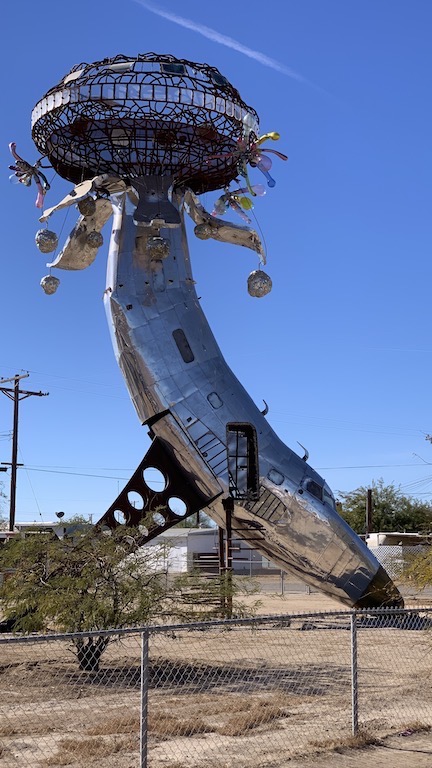
Is this the “Cessna Art” I was supposed to find at Bombay Beach? Is this a Cessna?

We eventually reached Bombay Beach, 223 feet below sea level, with a population 415. I’d been there before and hadn’t been impressed, but a Twitter friend urged me to revisit it, telling me there was some sort of Cessna artwork I needed to see. We drove through, spending a brief time on the sea side of the dike wall before completing a circle of the town. This sentence from Wikipedia sums it up perfectly:

A visitor in 2019 wrote that there were many “discarded homes and trailers long-since abandoned” and that many of the buildings were “windowless husks blanketed in graffiti, surrounded by broken furniture and rubble.”

Basically, the place looks like the ruins of a very poor community, long since vandalized, with a handful of occupied homes and a mildly interesting collection of very large artwork made mostly from junk. It’s a depressing place and I honestly can’t imagine what it must be like to live there.

We got back on the road and continued south.

Slab City

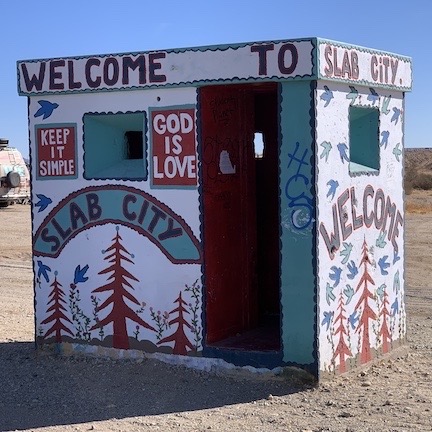
Welcome to Slab City
The obligatory photo of the Slab City Welcome sign.

The turn for Slab City was the Main Street for Niland, CA. Although I’d expected it to be a sort of remote place up in the foothills of the mountains beyond, it was actually spread out just a few miles from town. The absolute junkiness of the place hit me immediately. There were all kinds of broken and abandoned RVs and other vehicles, as well as broken and occupied RVs and other vehicles. The more we drove the more trash and decrepitude we saw.

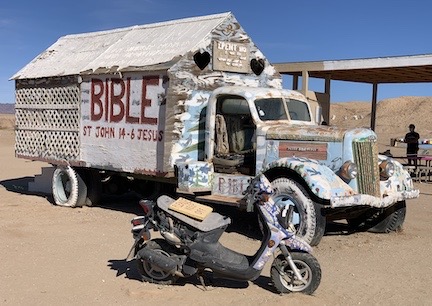
Truck at Salvation Mountain
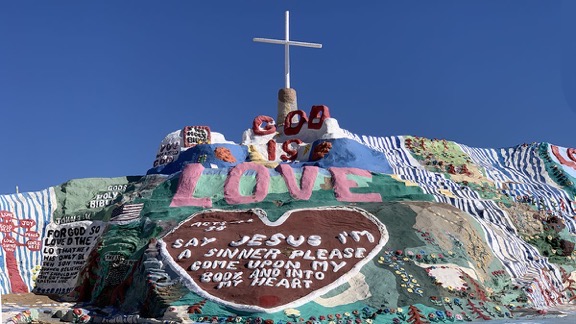
Part of the art (or “art”) installation at Salvation Mountain.

Salvation Mountain, a man-made hill painted with latex paint which had been the life’s work of a deceased resident, was the first of the art installations. Other art was more like “art.” I drove slowly through the area on what seemed like a main road while we stared at the mess around us. Yes, people lived there. There were RVs and mobile homes and shacks and even a few decent buildings. There were street signs and house numbers. There were campgrounds, one of which was hosting one of those mega-motorhomes that sell for about $750K. There was a library that was closed. There was a business at East Jesus that was closed. There was a property that used the burned out shells of RVs as a sort of fence line. The farther we got from the main area of the community, the more trash there was scattered out in the desert.

Salvation Mountain
Salvation Mountain is the primary point of interest in Slab City. Read about it on Wikipedia.

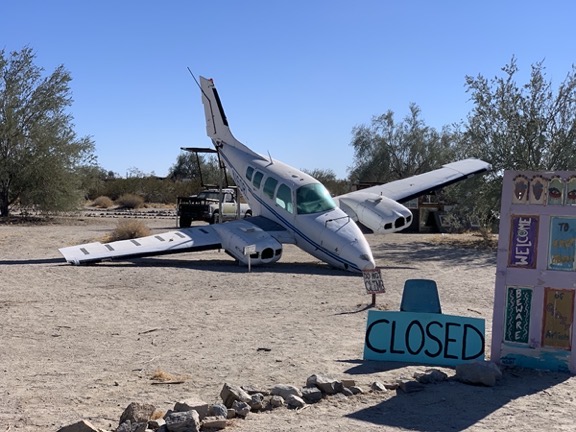
East Jesus Plane Art
A business at the end of the road to East Jesus was closed due to COVID.

I said I’d take pictures, but I took very few. The above shots are about it. Honestly, there wasn’t much I wanted a picture of.

We followed a sign for Slab LOW, not knowing what it was, and eventually arrived there. It looked like a camping area with a few buildings. Signs said they welcomed members of WIN, LOW, and Escapees — three RVer clubs. (I belong to WIN, Bill belongs to Escapees.) I stopped the truck and we got out to stretch our legs and let the pups run around. There was a single motorhome parked there and while we gave the dogs water — Rosie had puked in the truck; she still gets carsick once in a while — a man came out. Soon we were chatting with him. He lived there full time. He said the place we were at was closing and relocating elsewhere. He told us where but we never found it. Did it matter? No.

There were actually quite a few people living in the area — even if just temporarily. It looked to me as if you could camp for any length of time just about anywhere. But the vibe was about the same — at least to me — as it was at Bombay Beach. It was the ruins of something and no amount of art or “art” could hide it. Squatting on land that no one cared about was a cheap and easy way to live, but I know I could never live like that. Honestly, I’d have trouble even spending a day or two there. Too much trash. A cleanup crew could spend a year filling 30-gallon trash bags and no one would know the difference.

We didn’t stay long. And I have to admit that although Slab City sort of met my expectations, I was disappointed. I was hoping it was something better. Something more interesting. Something I’d like to stay and explore. It wasn’t. It was just a squatter community out in the desert, surrounded by decades of trash.

Lunch, the Fountain of Youth, and a Walk on the Beach

We stopped for lunch in Niland. I’d wanted very badly to go to the Oasis Date Ranch for one of their excellent hamburgers with dates on it but their cafe was closed due to COVID. The Buckshot Cafe in Niland served Mexican and American food. The restaurant itself was closed, but they were taking to-go orders through one of the front windows. We each ordered a chicken torta and wound up eating it in the back of my truck, feeding the dogs nacho chips and french fries.

Back on the road, we turned in at the sign for the Fountain of Youth RV Resort and Spa. The WIN RV group I belong to had camped there for a week in early November, before I headed south. I wanted to see what it was like. It was a typical middle-of-the-desert RV park, filled with mobile homes, park models, and regular RVs. There was a pool, a hot spring fed spa, shuffleboard, a restaurant, and more. Everyone we saw was older than we were except the kid at the gate. The campsites were close together and there were a lot of vacancies. No Canadians this year.

We checked out another RV resort with spa nearby. It was a lot smaller, more casual, and cheaper. Bill was disappointed that although they offered day use options for the spa facilities, clothing was required.

Our last stop in the valley was at a campground along the shore of Salton Sea. I’d stayed there about four years before. I wanted to show Bill the beach, which had been covered with giant barnacles and dead fish back then. The campground was closed, but we parked across the road and walked over. We climbed down an embankment and walked right up to the short. The barnacles were smaller and there were no dead fish.

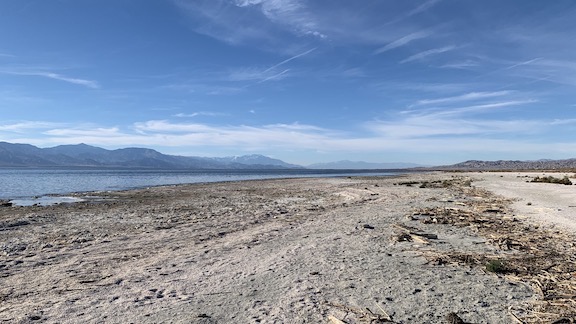
Salton Sea Beach
The beach at Salton Sea. Palm Springs lies at the base of the snow-capped mountain dead center in this shot.

The Drive Back to Camp

Bill used a map app on his phone to guide me back to Box Canyon Road and we climbed up the wide canyon to the I-10 freeway. From there, it was a short drive to Chiriaco Summit. I took my pups for a quick walk with Bill. Then we said our goodbyes and he left to go to camp while I went into Foster’s Freeze for a hot fudge sundae.

I passed Bill on the road right before reaching Desert Center. He’d told me his campsite south of there was dead quiet and pitch black dark. Sounded good to me. My site would not be quiet with all the yahoos in from Phoenix with their ATVs for the long weekend, but I had a good, private camp and wasn’t ready to move. Yet.

I finished listening to the recorded book I’d been listening to along the way. I got back to camp just as the sun set over California.

If I had a bucket list, I could cross off Slab City.

Adding Power to My Utility Trailer

I splurge on batteries and an inverter for my utility trailer/mobile jewelry shop.

For the past five winters, I’ve been traveling south in my truck with a slide in truck camper on the back. It started with “the Turtleback” in 2016/17. That was a very large and rather deluxe Lance model with all the bells and whistles, including an onboard generator and a slide-out to expand living space when parked. Then I downgraded to a smaller, newer rig, “T2,” which was roughly the same length, not quite as deluxe, and lacked both the slide and generator. What I gained in the swap was a 400-pound weight loss and a lot more inside storage space.

Why a Utility Trailer?

Over time, however, I started bringing more additional items south than I could fit inside the camper or truck. Normally, I’d have my portable Honda generator in the truck, along with my bicycle and wrangle my plastic kayak onto the roof of the camper. In 2017, I brought my little jet boat south with me and loaded it up with extras, including that kayak, for the trip south. It was nice to be able to store extra stuff in a trailer.

In 2018, on my way to my first camp, I stopped in Lake Havasu and bought an inflatable Hobie pedal/paddle kayak. Sure, the 11-foot boat deflated and fit into a bag with wheels, but that bag was both bulky and heavy. I shoved it into the entranceway of my camper for the rest of the drive to camp, but quickly realized that dealing with it in transit was going to be a royal pain in the ass.

My Rig
Here’s my truck, camper, and original utility trailer not long after I bought it. Note the dent in the upper corner.

So I got on Craig’s list and bought a 12-foot cargo trailer. It was a bit “rough,” as I blogged not long after acquiring it. I hooked that up to the back of my rig and stowed all the extras I’d crammed into my truck and camper. It had two axles, but I had trouble getting the tow ball height just right to distribute weight evenly on both of them. It was also a bit rickety and had me worried about long distance driving with it. But it made it back to Washington intact. I wasted no time selling it to a friend who was looking for a tool trailer that could be parked on job sites.

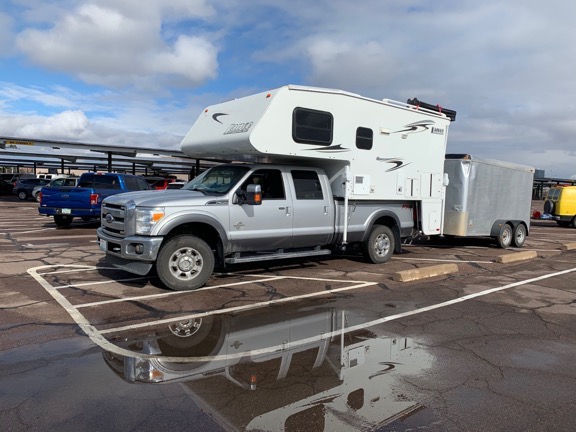
Truck and Trailer
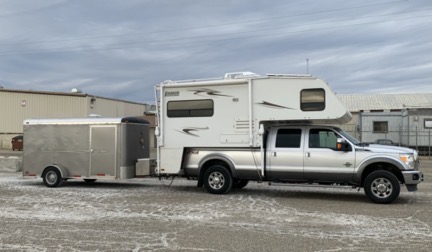
Here’s my current rig. The newer trailer is in much better condition than the original one and includes a toolbox on the tow hitch.

I went hunting for a new one. Literally new. My search brought me down to Yakima, where I stopped in at the Lance dealer for a part I needed for my camper. I mentioned that I was going to look at some utility trailers at a dealer down the road. Mike, the co-owner, mentioned offhand that he and his partner brother had a utility trailer that they never used and would consider selling. I took a look. It was almost exactly what I wanted. I looked at the new ones, then called Mike back and started negotiating for his. About a month later, at the tail end of a trip to Tacoma, I picked it up.

I started customizing the interior almost immediately, adding E-track to the walls so I could secure various items to it. The goal was to turn it into a sort of mobile jewelry shop that could also haul the things I needed to do jewelry shows and camp. I loaded it up and secured everything, but wasn’t very happy about its setup as a shop — I had to take out too many things and set up a workstation on folding tables and then be sure to stow everything before moving. Boxes were big and piled up and difficult to access. The IKEA drawer units I’d put in had limited storage space for the weight they added to the rig. It was uncomfortable and inconvenient and it just didn’t work out the way I’d imagined it would.

So this year I built the tables and shelves I needed to make a real shop area in the front of the trailer, leaving the back wide open for show equipment and camping stuff.


Here’s a brief video I shot the other day that shows off my mobile studio space while I’m parked. It also includes a glimpse of my new inverter. And did you know that I maintain a YouTube channel for ML Jewelry Designs? Find it here.

My Power Needs

Before I discuss my needs, I need to make it clear that I camp off-the-grid. I’m usually not in a campground, but if I am, that campground usually does not have any utilities running to the site. That means I need to be self-sufficient with power (as well as water and sewer). I rely primarily on solar power but also travel with a 2kw Honda generator, just in case I have cloudy weather or unusually high power needs in my camper.

What I’m discussing here is my jewelry-making power needs.

My primary jewelry-making tool is a flex-shaft. The popular brand name is Foredom and that has become a bit of a generic term for that kind of tool, but mine is a Eurotool brand. It’s basically a hanging drill motor attached with a flexible shaft to a hand piece that can accept Dremel sized tools. You turn it on and off with a foot pedal that controls the speed of the motor. Because this tool requires AC power and the only way I can get continuous AC power while camping off the grid is to run my generator (which I don’t like running because of the noise), I didn’t bring it. Instead, I brought my battery operated Dremel, with its spare battery and charger.

I also use a small rotary tumbler quite a bit, as I discuss in this blog post. That also requires AC power, but it only needs 36 watts. Unfortunately, sometimes I need to run it for hours at a time. I was able to run it with a portable 150 watt inverter attached to the power port in my truck or in a battery pack I’d bought primarily to run my telescope. I quickly ran down the battery pack and had trouble getting it charged back up. And the idea of draining my truck batteries to run a tumbler was not very pleasing.

I also found myself with lots of other little batteries that needed charging. My camper does not have an inverter; due to limited space, it only has two 12v batteries. (Higher capacity 6v batteries will not fit in the storage cabinet — I’ve already looked into it.) On short winter days with a low sun angle, the 200 watts of solar flat-mounted on the roof can basically keep those batteries charged and let me use DC power ports to charge my phone, watch, and iPad but not much more.

The Solution

Last year, I’d looked into getting a solar charged battery power system installed into the cargo trailer. The trailer has a metal toolbox on the hitch bars and I figured it would make a good place to put the batteries. I already had a Zamp portable solar panel that I could attach to my camper. Why not use that to power a 2kw system on the utility trailer? But the estimate I’d gotten — more than $3,000! — gave me pause. A whole year’s worth of pause

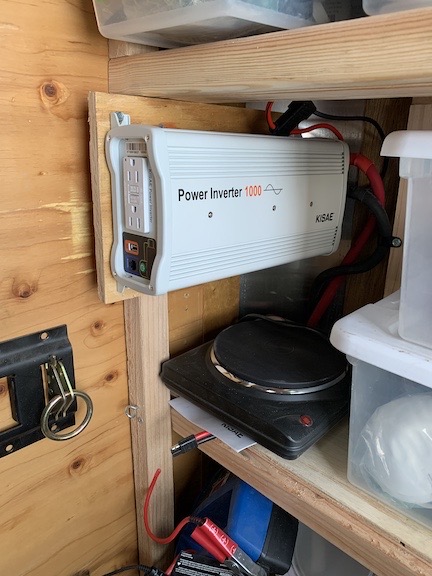
This year I went forward with a less ambitious setup that included just two 6v batteries and a 1kw inverter. I had it installed in Quartzsite, AZ, where there are numerous solar power dealers who work on RVs. (I went to Solar Bill’s, but Discount Solar is another dealer there.) It still wound up costing about $1200. But if I kept the batteries charged, I would have all the power I needed to run my tumbler and charge just about any device that needed charging.

Solar Panels PM
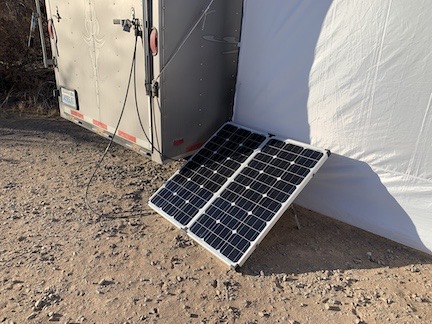
Here are my solar panels in my current setup location. The original location had the panels in full sun from around 9 AM to 5 PM; in this new spot, they get sun at 8 AM but start falling into shade around 3:30 PM. The cable for the panels is only 12 feet long and the plug for it is at the front of the trailer. Poor parking planning on my part, but it’s all good.

Plug and Outlet for Solar Panels
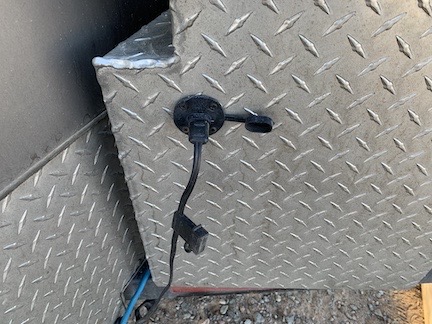
Here’s where the panels plug into the side of the toolbox where the batteries are.

Batteries for Solar Setup
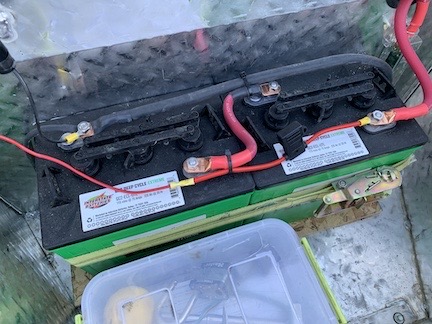
Here are the batteries inside the toolbox. There’s a vent hole behind them. I lost about half the box capacity to store things; I can’t put anything on top of them.

1000 Watt Inverter
Here’s the inverter, mounted in the front corner of my trailer just under one of the shelves. I’ll likely use the area around it as a charging station for various batteries in the future.

I brought it all back to camp, set up the solar panel in a good spot, and let the system do its thing. It was a bit iffy at first. Although the batteries were charged when I got them, I don’t think they were at 100%. My immediate use brought their power levels down a lot more than I expected. But after a few days with bright sun on those panels — including days when I didn’t use the power in the trailer at all — I soon had the batteries fully charged and able to share that power with any device I plugged in without a considerable power droop. I even managed to charge that big battery pack overnight without draining the system batteries.

I’ve since set up a little portable table near the inverter where I’ve parked various battery chargers — for my Dremel, my Ryobi tools/lights, my drone, and even my laptop. It has become the go-to place for charging things and it does a remarkable job. In the future, I’ll probably just use the shelf beside the inverter to set up a charging station.

Since moving my cargo trailer closer to my camper, I’ve also moved those portable panels closer. That means that if the utility trailer batteries are charged up and I don’t need them, I can attach another 160 watts of solar to my camper to bring those batteries up to full.

And yes, I did look into putting 200 watts of solar on the utility trailer’s roof. It would have cost me an extra $1400 for the panels, controller (which is built-into my portable panels), wiring, and labor. Not worth it — at least not yet.

Long Term Benefits

I know I won’t be traveling like this every winter forever. In fact, I’m starting to think the this might be my last year at Arizona’s Colorado River backwaters, where I’ve been coming since 2014. I’m starting to feel as if I’m stuck in a rut and and after living too many years in someone else’s rut, there’s nothing I hate more than that.

I’ve been thinking of making some major changes in my life that includes shifting focus on how I spend my free time. There will come a point when I don’t need that utility trailer at all. It seems a shame when I’ve spent so much time and money customizing it.

But the way I see it, the improvements I’ve made to the trailer make it even more flexible for me or a future owner. I can see converting it into a small living space for rugged camping — there are quite a few people camping in converted utility trailers out here in the desert. My jewelry workbench illustrates how easy it is to build removable structures onto the E-Track I’ve installed. Where I’ve put in a workbench, someone else could easily make a platform for a cot or other sleeping space. The storage shelves in the nose of the camper aren’t pretty, but they do make it possible to store lots of things in a way that can be easily secured in transit. And the power makes it even more attractive for off-the-grid use. All it takes is a need and a little imagination.

Until then, I’m enjoying the upgrade.

Snowbirding 2021: Drone Footage of Our Backwaters Camp

A look at our camp from the air.

I took out my Mavic Pro a few days ago and shot some footage of our winter camp.

I actually shot this on two different days. The first day, I took it up to get a few shots of my friend Janet, who was fishing from her boat down the backwater channel we’re camped on. I then shot a video overflight ending at our camp.

Watch My Helicopter Videos on YouTube

Time once again for a shameless plug…

Flying M Air Logo

If you like helicopters, you’ll love the FlyingMAir YouTube Channel. Check it out for everything from time-lapse annual inspections to cockpit POV autorotation practice to a flight home from a taco dinner at a friend’s house — and more.

I shot the second half the next day. I wanted to circle the camp from the air, but I wanted it set up as we usually have it. The first day, my truck was parked inside the living area because we’d offload groceries and water jugs. In the second half of the video, my truck is parked where it belongs, on the other side of the boat ramp.

The light was definitely better the first day I shot. I should have just moved the damn truck and kept shooting. My bad.

Anyway, here’s the video; I posted it on the FlyingMAir YouTube channel. Read the video description to learn more about my music choice.

Drone Footage from Winter Camp

A video from the Flying M Air YouTube channel.

An aerial view of where I’m camped right now: off the grid in southwest Arizona and relying on solar panels for Power, a 2 year old MacBook Pro for video editing, and my Verizon “4G” (LOL) connection for Internet access.

I’m camped here for a while with my friend Janet and our dogs. Camp includes our art workspaces: she paints and I make jewelry. I’m living in the truck camper with the awning out and she’s living in the shorter travel trailer. We have inflatable boats in the water. I described life in camp in this blog post, if you’re interested: https://aneclecticmind.com/2020/12/19/snowbirding-2021-life-at-the-backwaters-camp/

The footage was shot with an original DJI Mavic Pro. This drone works great for me and I haven’t needed an upgrade. (Thank heaven; these damn things cost a fortune.) I piloted the first half and used the POI feature for the second half, which I also sped up by 150%.

The music is from YouTube’s free music for Creators, “Auld Lang Syne (Instrumental)” by Jingle Punks. I liked this piece because it’s traditional holiday fare for the end of the year. This version seems (to me) as if it hits a few bad notes along the way, which is perfect for the end of a really crappy year for so many of us.

I’m uploading this as I type on a connection that’s less than 1 Mbps and it’s taking forever. This also explains why I haven’t uploaded anything better for a while. My current computer setup is a MacBook Pro that can’t run DaVinci Resolve (my preferred video editing app) so I’m stuck with Screenflow, which has limited capabilities. I am able to create 1080 video, however, so that’s what I made. 50 MB for just over 2 minutes of video takes a very long time to upload at these dismal access speeds. (Total was about 30 minutes, actually, which wasn’t CRAZY bad. I just kept wondering if I’d lose the connection in the middle somewhere. I didn’t.)

I hope everyone has a great holiday. Wear a mask, stay healthy, get vaccinated as soon as you can. Be nice to others. Don’t hate. 2021 is going to be a GREAT year — if we make it that way!