Or why I changed my flight school.
Yesterday, I dropped out of one flight school and signed up with another one.
For those of you who don’t know me from this blog or elsewhere, I’m a commercial helicopter pilot with close to 2,000 hours of flight time. The vast majority of that time is in Robinson R22 and R44 helicopters — in fact, I have more time in Robinson helicopters than most flight instructors doing training in them. I owned a 1999 Robinson R22 Beta II from 2000 through 2004 and have owned a 2005 Robinson R44 Raven II since January 2005. My other helicopter time is in Bell 206L LongRangers at the Grand Canyon during a summer job.
On Robinson Helicopters
I like Robinson helicopters. I think Frank Robinson has done a fine job designing, building, and selling helicopters that are comfortable, have good performance, and are easy to own and operate. They also give you the most “bang for the buck.” The Robinson is probably the least expensive helicopter to operate when calculated on a per seat basis.
 Although my passengers have occasionally commented on the small size of my R44, they’ve never been disappointed with its comfort or the smoothness of the ride. In fact, I’ve had plenty of comments from people who say that the ride was a lot smoother than they expected. (I’d like to think that at least some of that comes from pilot skill.)
No doubt about it: the R22 is a squirrelly little aircraft. It’s a challenge to learn to fly. Other than the electronic governor, there’s no mechanical assistance to make flying easier. The controls are sensitive and unforgiving. Some people think that’s bad. Other people point out that if you can fly an R22, you can fly any helicopter. I can confirm that I had no trouble transitioning from an R22 (max gross weight 1470 lbs, if I recall) to a turbine-powered, hydraulically controlled LongRanger (max gross weight 4200 lbs). In fact, I used to transition from one to the other on a daily basis.
I’m not willing to say that Robinsons are the best helicopters out there for two main reasons: (1) I’ve only had time in one other make/model so how can I know? (2) No helicopter is “best” at all missions. I’m also not willing to say my Robinsons have been perfect for me in every way — no aircraft (or car or fill-in-the-blank mode of transportation) is perfect. But I am certainly proud to say that I’m extremely pleased with my R44 and confident that I made the right purchase decision.
Why am I telling you this? Well, it’s important in the story that follows.
Finding a Flight School
I decided in the spring that I wanted to get an instrument rating.
If you’re not a pilot, let me explain. An instrument rating is a pilot certificate that authorizes you to fly by instrument flight rules (IFR) in instrument meteorological conditions (IMC). It requires you to learn how to fly the aircraft — in my case, a helicopter — without visual references outside the cockpit. Training covers attitude flying (so you don’t get disoriented and crash) and navigation using a variety of radio and satellite based navigation tools: VOR, DME, GPS.
An instrument rating makes a pilot more valuable, especially if they plan to fly in an area where weather could be an issue. I want to get a summer job in Alaska. I’ve been there and I saw that weather is indeed an issue. So I want the rating to make myself more valuable to potential employers and to help prepare me in the event that I do inadvertently lose visibility and need to rely on instruments for part of a flight.
My aircraft is only partially set up for IFR operations. That’s unfortunate because it means that I can’t use it for training. So I have to find a flight instructor who is a CFII (certified flight instructor for instruments) who has access to an IFR trainer aircraft. That means a flight school.
The trouble with helicopter flight schools these days is that they all want to take students through “the program.” This is a soup to nuts approach to learning to fly and it assumes that you want to learn to fly as part of a career.
When I learned, career flying wasn’t on the horizon for me; it was going to be a hobby. Things change. While I do fly for hire now, flying isn’t my full-time career. (I’d starve.) I got my training — private and then commercial ratings — piecemeal or “a la carte” when it was still widely available that way.
It’s tougher now to find flight school that will take a pilot for just one phase of training. Still, I located four candidates: three in Arizona and one in Florida. After deciding that I didn’t want to be away from home for an intensive two weeks of training in Florida, I was left with three choices in Arizona. Let’s call them A, B, and C.
A was really expensive. Although I talked to a flight instructor about the program, I never got the call back I was promised. A fellow pilot had some mildly negative things to say about A, so I decided not to pursue them.
B, which specializes in “the program” was willing to make an exception for me, primarily because of other business we do together. I’d been in a dialog with B for at least six months and we’d come up with a price structure for my lessons. They were very affordable, since they had a simulator I could use for up to 20 hours of my “flight” time, thus saving a whopping $340/hour over their aircraft flight time. I was sold.
Unfortunately, just when I was ready to start, there was an ownership change that caused a reorganization. Things went into flux. I was called down to the flight school to “get on the schedule” and, once there, told that we’d have to have a meeting the next day with the General Manager to review everything. They’d call to let me know when.
I was deeply POed. The flight school is an hour drive — each way — from where I live. They’d lured me down there on false pretenses — doing paperwork, getting on the schedule — and, instead, had wasted my time with a 5-minute meeting that accomplished nothing. And now it wasn’t even certain that I could get my training there.
If there’s one thing I value, it’s time. Wasting my time is a good way to get on my shit list. The new chief flight instructor at B was at the top of that list.
To make matters worse, I never got a call for the meeting he said we needed. Three weeks passed without getting that call.
In the meantime, I found C. C was at the same location as B. They were a much smaller organization that did a lot of charter work with LongRanger helicopters. They also fly Enstroms — two or three place piston helicopters. That’s what they used for their modest training operation.
I’d never flown an Enstrom, but I’m always interested in getting experience in different aircraft. Although they didn’t have a simulator, the Enstrom IFR trainer would be much cheaper per hour than the R44 IFR trainer at B. So I wouldn’t be paying that much more and would get all 30+ hours of flight time that I needed in a real aircraft.
Still angry at B and uncertain of the future due to the reorganization there, I signed up with C.
At the Flight School
I went for my first lesson at C last Friday. The company is based in a big hangar that houses all of its aircraft — turbine helicopters and airplanes — and provides space for its flight training operations. The layout for flight training wasn’t very practical, but I think there was only one other student there while I was there. I have no problem with small flight schools — I think they offer better personalized instruction. So that was not a problem.
My flight instructor was a great guy. Very nice, very understanding. Best of all, he had more flight time than I did, and had even spent a season at the Grand Canyon flying LongRangers. We’ll call him Joe.
Joe and I took care of paperwork and I handed over a check for my first 11 hours of flight time: $2,300 (which didn’t include the instructor time). We covered a plan of action for my self study — I was hoping to save money on ground school by learning as much as I could with home study aids — then discussed what we’d do in our flights together. He patiently explained how a VOR works — which is something I was supposed to learn as a private pilot but never did (and never needed to, as each of my aircraft was equipped with a GPS). Then we went outside, where the Enstrom was waiting, to fly.
Joe and I went through the startup checklist together and he made me start the helicopter. Starting was similar to the R44 Raven II because the Enstrom had fuel injection. I got it started on the second try. But there were significant differences in the rest of the procedure. Clutch activation is done with a weird handle that requires more strength than I have in my right arm — I had to use two hands to pull the darn thing up. And all the time we were on the ground, the whole helicopter was shaking and rattling and Joe was adjusting the mixture to lean it out properly. The whole idea of leaning was stressing me out, since Robinsons generally aren’t leaned at all. (If you lean an aircraft too much in flight, the engine may quit. Helicopters are damn near impossible to restart in flight.) The aircraft’s cyclic also needed to be trimmed using a little “hat” button on top.
Joe and I picked it up into a hover. He tried to trim it out but was not successful; the trim button wasn’t working. It was also running hotter than it should have been. He decided he wanted a mechanic to look at it. I hovered us back into our parking spot — we’d drifted forward — and set it down as gently as I could. It thumped and rattled and I immediately thought of ground resonance, which is something a helicopter with a fully articulated rotor system like the Enstrom is more likely to get than anything I’d ever flown. But we were okay. We cooled down the engine and shut down.
By now, I was having second thoughts about my decision to go with the Enstrom. It was so different from what I’d flown in the past that I was worried the differences would distract me. Perhaps I’d need more than 30 hours of dual to get the instrument skills I needed.
But 30 hours was a long time. Surely I’d get used to the Enstrom quickly — probably within my first 5 hours. And getting stick time in something so different would be good for my development as a pilot.
So before I could talk myself out of it, I’d talked myself back into it.
Things Take a Wrong Turn
Joe talked to the mechanic on the way in. We went to the schedule book and set up two dates for training the following week — the first week in January. Joe promised the helicopter would be ready. We chatted for a short while. I really liked Joe and looked forward to working with him.
On the way out, he introduced me to C’s new operations guy. Turned out, I already knew him from another company in the Phoenix area. He’d moved to C but wouldn’t get specific on why he’d left his former employer. We’ll call him John.
As Joe left us, John began an animated, one-sided discussion about his big plans for C. And that’s when he said two things that really got under my skin.
The first thing he said, numerous times, was that Robinson helicopters were “a joke.” Apparently, that wasn’t just his opinion. He said the owner of C felt the same way.
Now I’ve already reported my feelings about Robinson helicopters. I don’t think they’re a joke. I do think that his criticism of Robinsons — when he knew damn well that I own one — was incredibly rude, insensitive, and just plain stupid.
I didn’t counter with what I was thinking about Enstroms: that they’re rattletraps and that I’d be embarrassed to put paying passengers into one.
The second thing he said was that he planned to “take over” the Phoenix area tour business by offering flights in C’s Enstroms. “We put people into them and fly low and fast over the trees and they love it!” he exclaimed.
Apparently, FAA safety regulations don’t come into the equation. I know that my minimum altitude for Part 135 flights is 300 feet and I know that there aren’t any 250-trees anywhere in the Phoenix area. I also know what the height-velocity diagram looks like for most helicopters. But heck, who cares about safety when there’s money to be made, right?
That was his attitude. And it was also insensitive since he knows damn well that I’ve been working hard to build a helicopter tour business in the Phoenix area. I don’t have a big operation with multiple helicopters and pilots and an unlimited marketing budget. I don’t treat my passengers like cargo, either. But he could easily attract far more business than I could by simply undercutting my prices. It’s cheaper to fly a 3-place Enstrom than a 4-place Robinson, and that’s all people care about. And that’s what he was bragging to me about.
I started to get seriously POed. I started wondering why I’d just handed over a check for $2,300 to an organization which obviously thought so little of me and my aircraft and my business. I started wondering why I was helping to fund this guy’s efforts to put me out of business.
I held my temper. I managed to escape out into the sunshine without trying to wring his neck.
What Happened Next
On the long drive to my next destination across Phoenix, I managed to talk myself into ignoring John. He was a jackass, an idiot. I wouldn’t be dealing with him. I’d be working with Joe. Joe was a good guy. I was lucky to have such an experienced and knowledgeable flight instructor.
But when Wednesday morning came along, Joe called. The helicopter still wasn’t fixed. We’d have to postpone our lesson until the next day.
And he called to say the same thing on Thursday.
And I started thinking that maybe the stars and planets were moving together to give me a second chance, a way out of my arrangement with C.
You see, I was still deeply offended by John’s comments and couldn’t get them off my mind.
I called my main contact at B. After a bit of telephone tag, we had things settled. The pricing we’d discussed was fine. He didn’t care how I paid or when I started. He was extremely supportive. And he got the Chief CFI at his location to call me back. I could get training at B after all. I’d start on Monday.
I called Joe. “Did you folks cash that check yet?”
“No,” he told me.
“I have to ask you not to,” I said. I told him I’d changed my mind about training there. I assured him, in no uncertain terms, that it had nothing to do with him. I told him it was a combination of two things. First, I thought flying a ship as different as the Enstrom might distract me from my instrument training. Second, that I’d been seriously annoyed by comments made by John during our discussion. I got specific. I told him how these comments made me feel and how it was difficult for me to support an organization that thought so little of me, my aircraft, and my business.
Joe understood. He told me that his boss, the chief flight instructor there, might give me a call. I told him that was fine. I also told him that I had no trouble paying for the time we’d spent together the previous Friday. Just send me a bill. But please don’t cash that check.
A New Beginning
So that’s where I stand today. After a false start, I’m ready to begin training at the flight school I’d originally chosen.
But I feel better about this flight school than the one I’d tried. Why? Because my main contact understands good customer relations. Even if hr doesn’t really give a damn about me or need my business, at least he’s pretending that he does.
And when I get ready to hand over close to $10K of my hard-earned money, I want to feel good about who I hand it to.

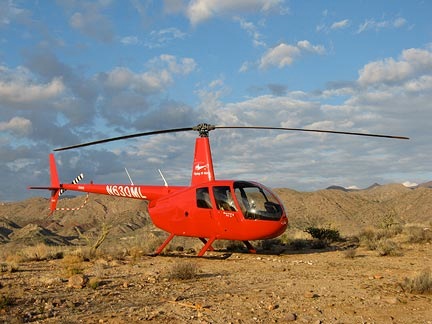 Although my passengers have occasionally commented on the small size of my R44, they’ve never been disappointed with its comfort or the smoothness of the ride. In fact, I’ve had plenty of comments from people who say that the ride was a lot smoother than they expected. (I’d like to think that at least some of that comes from pilot skill.)


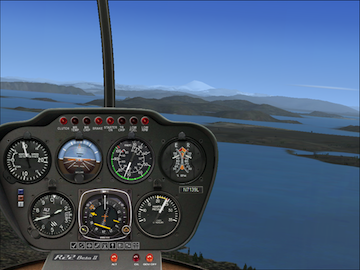 The details inside the cockpit, on the other hand, are amazingly accurate, from the vertical card compass (not shown here) on the split cockpit bubble to the instrument panel — although this particular configuration is not one you’re likely to find on a real R22. (The instrument in the bottom center is normally found on Instrument trainers, which have a larger panel with more instruments.) The realism of the scenery, airports, etc. is also pretty good. This screenshot has everything set to low quality graphics — I’m trying to realistic performance — but when you crank it up a few notches it looks pretty darn good. (Of course, there aren’t any houses near the runway at Phoenix Sky Harbor.)