Cherry Drying on Google Earth

Putting the tracks on a satellite image.

I had my handheld GPS (a Garmin GPSmap 60c) running while I was drying cherries and the GPS tracked my movements. Today, on a whim, I saved the tracklogs and downloaded them to my Mac. Then I brought them into Google Earth and looked at a few of the orchards.

The tracks are not very accurate. They show a zig-zag motion that appears to cross diagonally across the rows. In reality, when I reached the end of each row, I moved to the side and turned to go down another row. So rather than pointed endings and diagonal tracks, an accurate rendering would show squared off endings and parallel tracks.

But I still think it’s interesting to see how I moved over the land. Take a look and see for yourself. These are the tracks from my flights on July 4.

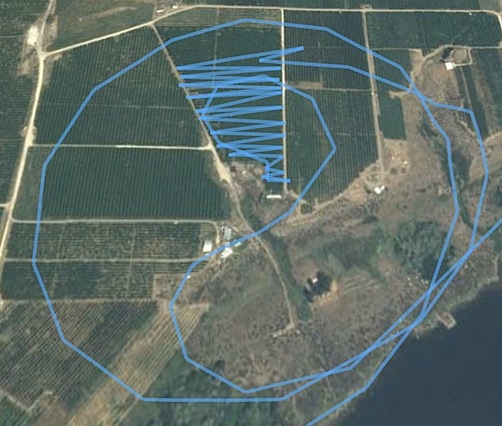
In this first example, I’d flown past the orchard on the south side from west to east, then circled back. I made a wide clockwise circle of the orchard to get my bearings, then came in on the south end, near a white single-wide mobile home. There was a woman there, waving happily when I arrived. She’d left the door of her house open and I blew a bunch of leaves into it. (Oops.) My track took me back and forth up the triangular orchard. Although the track makes it look as if I had a short row near the top, it’s just another inaccuracy in the track. I departed the area with a clockwise circle to the west.

Cherry Drying Tracks

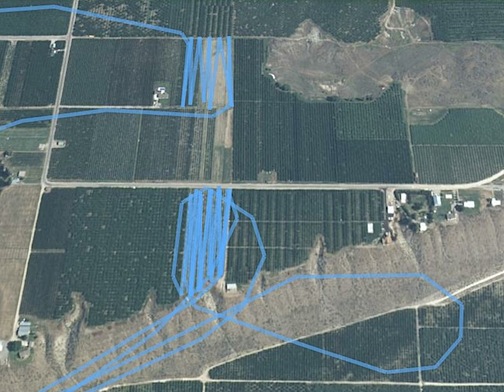
Here are two others representing three dries. I went to the lower one first, passing it by on the south from west to east. I circled back, then came in on the southwest corner. I went back and forth from west to east, then broke off. It started to rain so I repositioned to the airport, which was less than a mile away. I read for a while, then got a call with a new list of orchards. I started back up and took off, returning to re-dry the lower orchard in this image again (hence the double set of track lines) after doing others a bit farther to the west. I did the upper orchard about an hour later, coming in from the northwest and departing from the southeast side back to the west.

Cherry Drying Tracks

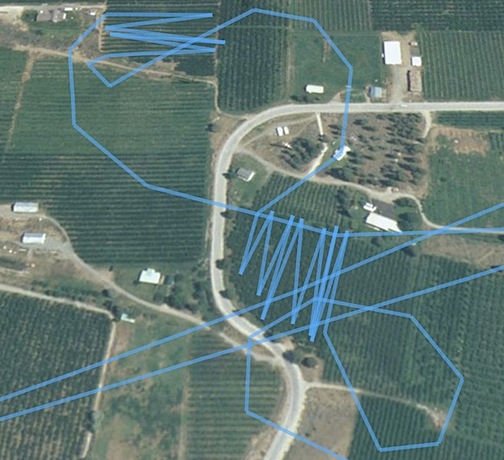
Here’s a sloppy looking one that really wasn’t this sloppy. I did the lower orchard first, coming in from the southeast and departing out the northwest. I then went directly to the upper orchard, beginning the dry at the southwest and exiting at the northwest. The pair of diagonal lines going across the bottom of this screenshot represent overflights of the orchard on my way to or from the ones in the previous screenshot.

Cherry Drying Tracks

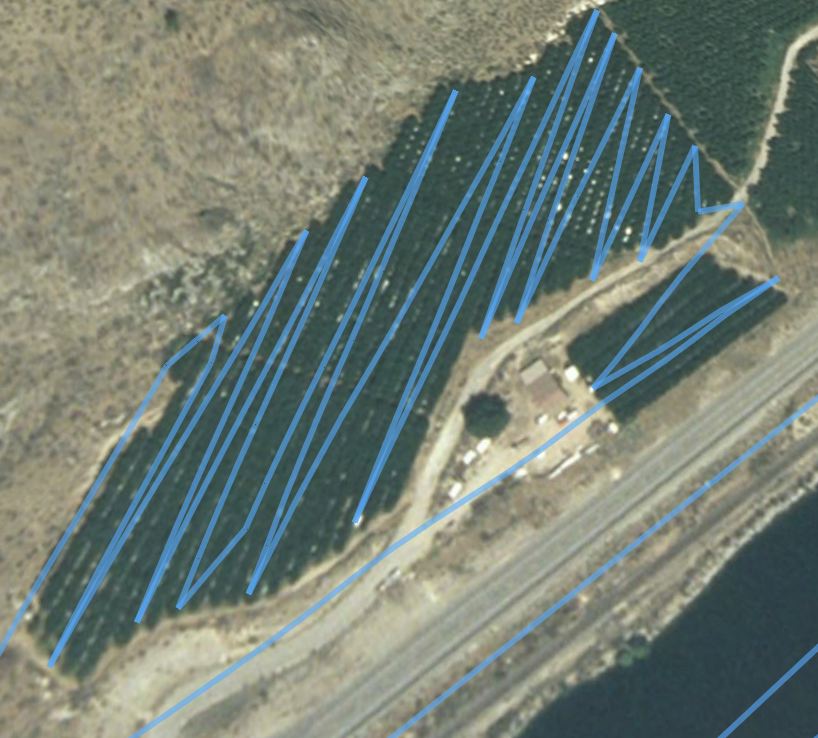
This is the first orchard I described in some detail in my “I Dry Cherries” post. Again, I really didn’t fly a zig-zag pattern in the main orchard. and I’m certain I flew at least two more rows (one in each direction) in the smaller orchard. But the GPS doesn’t seem to pick up all the points when it makes its tracks. The two other straight lines near the bottom right of the image are overflights to/from other orchards. That’s the Columbia River/Lake Pateros in the bottom right corner of the shot.

Cherry Drying 4.jpg

These are just a few of the orchards. You get the idea. Next time I fly, I’ll use my new geotagger. It can save up to 600,000 waypoints (I think) so I have a feeling the pictures it draws will be a lot more accurate. If they are, I’ll show them off here again.

We all know what a geek I can be.

When It’s Just Not Worth It to Fly

Turning down flying jobs.

I really don’t like cheap clients.

Anyone who operates an aviation business knows exactly what I mean. They’re the folks that expect you to fly for what they see as just above your cost. The way they see it, even though that rate is far below what you normally ask, you’re still making money, so you should be happy.

[What’s even worse than cheap clients who are trying to get flight time for less than cost is the wanna be clients who want you to fly them around for free. I wrote about one of those in my post, “You want WHAT for free?“]

Unfortunately, their idea of your “cost” is the price of fuel times the number of gallons per hour that you burn. As I detailed in my posts, “How do you make a million dollars in aviation?” and “How Much, How Long?,” fuel is just one part of the cost of operating an aircraft. And it doesn’t even account for 1/3 the cost.

I’ve had a number of these clients in the past and I always came up with some kind of compromise, just to get their business. The compromise was normally more than they wanted to pay but less than I usually charge. In many cases, I wound up giving away so much — usually in ferry time — that the job was operated on a break-even basis. I told myself that it was worth it to get a client that would give me business in the future. But in most instances, any future business involved the same kind of compromises. Even though I was getting compensated for the cost of the flight, I wasn’t getting compensated for my time.

And I’ve come to realize that my time is the most valuable thing I have to offer anyone.

So this week, after going back and forth with a past client, trying to come up with a deal that would satisfy both of us, we hit a wall where neither of us would budge. The job was in Nevada, which is a 3 hour flight from my home base in Wickenburg, AZ or my end-of-summer base in Page, AZ. That’s 3 hours each way. I offered to eat half the ferry time — that’s 3 hours — if he paid the other half at a reduced rate ($495/hour) and guaranteed at least 4 hours of photo flight time at my regular photo flight rate (currently $595/hour). The cost to him for 10 hours of flight time (including the 6 hours of ferry time) would have been a measly $3,865, saving him about $1,500. When I ran the numbers after I’d sent him the rates (very dumb), my first thought was, what was I thinking?

I was lucky that he refused to guarantee the 4 hours. I would have spent 6 hours flying through hot desert — the job was in August — just to get there and back. I would have done the job in hot desert, flying heavy because fuel options were limited, beating the hell out of my aircraft and myself to get the videographer in the right places to make his high-action shots. I would have to eat the cost of hotel accommodations for at least one night. And I’d have my aircraft offline for other work for about two days.

All for a net over known costs that was less than what I was saving him with my compromise offer.

I talked to a pilot friend about this yesterday. His business is remarkably like mine, although he does more photo work and I do more tour work. We swapped stories about cheap clients and cheap client wannabes.

Then he told me his take on price compromises. If there wasn’t much money in a job, he considered what he could be doing with his time if he weren’t doing the job. Hanging out with friends — maybe flying with them. Relaxing with his family. Doing things he wanted to do.

And I realized that I’d definitely done the right thing when I stood my ground. The job simply wasn’t worth flying. Maybe I’d have other paying work and maybe I wouldn’t. But I’d be spending my time in a way that I wanted to, rather than giving away my services for next to nothing.

Life’s short. Business is business.

Fighting Twitter Spammers

Fighting a new kind of spammer.

Twitter logoI’m an avid Twitter user with 5,000+ tweets to my name since I joined up over a year ago. I tweet from my computer, usually using Twitterrific, and from my Treo smartphone, usually using text messaging. I don’t follow tweets via text message, but while I’m out and about, I occasionally will use the Treo’s Web browser to see if I’m missing anything interesting among the people I follow in the Twitterverse.

If you know Twitter, you know that you can select whether you should be notified by e-mail when you get a new follower. I have this option turned on. Each time someone follows me, I get an e-mail message with a link to his/her page. In the past, this has enabled me to identify new, interesting people to follow.

Twitter, like all online services, has abusers. In the old days, this was limited to people who tweeted more promotional material and links than real “What are you doing?” content. These people used bots to follow everyone they could. And there were just enough idiots out there to follow them, making them look somewhat legit.

For new followers, I’ve always applied the 10% rule. I wrote about this rule in my post, “Twitter Sluts.” This rule states that if the Twitter member is following more than 10 times the number of people who follow him, he’s following indiscriminately and is probably abusing the system. In reality, he’s not “following” anyone at all. He’s just trying to get suckers to follow him.

Now there’s a new breed of spammers. They set up a Twitter account and post a single tweet with something like “This make money fast plan really works: http://www.somebogusplan.com/.” Then they use bots to follow every person who tweets.

People like me, who want to find new, interesting people to follow, get the notification in e-mail and click the link to check out the user’s Twitter page. What I see is the promotional link and stats that include thousands of people being followed and only a few idiots following in return.

Obvious spammer.

This wouldn’t be so bothersome if it were just one or two of these abusers a week. But I’m getting 2 to 5 of them a day. Following up on these people is becoming annoying.

While I could turn off notifications, I’d also miss out on the real Twitter users who are legitimately following me, people who I might want to follow. So that’s not an option.

Now the folks at Twitter have a technique in place to report spammers. It requires me to go to a feedback page, fill in a form with a number of fields that don’t apply, and put in the spammer’s account name. The entire process takes about 3 minutes to complete — when my currently funky Internet connection cooperates. With 5 spammers a day, that’s 15 minutes of my day pissed away on report spammers.

I don’t know about you, but my time is more valuable than that.

While I could simply ignore them, I’ve taken to using the Block button at the bottom of the user’s Twitter page to block them. This feature is designed to prevent the person from bothering me again or from seeing my tweets. But I think that if enough people do this and if the folks at Twitter occasionally glance at who’s being blocked by more than 5 or 10 people, it could be a quick and effective way to identify spammers. Just two clicks — Block, then a confirmation I want to block — the job’s done.

Of course, if the folks at Twitter installed a “This is a Spammer” link on the user’s page, it would make it clear what we’re all trying to say. I’ve put that in as a suggestion, but am still waiting.

The folks at Twitter have enough on their hands right now, just trying to keep Twitter up and running smoothly 24/7. I hope that when they’re done with that daunting task, they’ll tackle this one.

But they should keep in mind that once they put controls in place to prevent spamming, they’ll have a lot less activity on the site to worry about.

Three Unexpected/Annoying Places for Advertisements

It’s really out of control.

Yesterday, I drove into Wenatchee to take care of some errands. I had to do laundry, fill my truck’s transfer tank with 100LL fuel for my helicopter, buy a new set of sheets to replace the flannel sheets for the summer, and treat myself to a good Thai lunch. These days, I’ve been spending just about all of my time in my camper on the golf course, listening to NPR while I work on a book revision. It’s a sheltered life that doesn’t include many glimpses of the outside world.

One of the first things I noticed on my day out was an advertisement on the handle of a window-washing squeegee at a gas station. Throughout the day, advertisements would jump out at me at the most unexpected or annoying places. Here are three of them.

  • Gas station squeegee. You know the device. It sits in a container of water at a gas station. You use it to get the bugs off the windscreen while pouring a portion of your life savings into your vehicle’s gas tank. This particular squeegee had a normal round handle, but that was attached to a three sided shaft that connected to the squeegee and its sponge. Each side of the shaft had a graphic on it with or without text. When you rotate the handle to read the three sides, it was an advertisement to go inside the gas station’s convenience store to buy stale weak coffee. Well, it didn’t say stale or weak, but we all know what kind of coffee is in service station’s mini mart. This advertisement was in an unexpected place.
  • Office Depot receipt. I went to Office Depot to send a fax. When I paid the $3.51 fee with cash, I got two slips of paper as receipts. It wasn’t until I was going through my pockets this morning that I realized that the second cash-register generated paper was an advertisement for something called LifeLock Identify Protection Service. This advertisement was also in an unexpected place.
  • TV screens throughout Wal-Mart. I went to Wal-Mart to buy sheets for my camper bed. (Disclaimer: I hate what Wal-Mart is doing to this country, but it is quickly becoming the cheap and easy choice for buying items. I knew where Wal-Mart was; I didn’t know where any other store that sold bedding was. So I went to Wal-Mart.) The Wal-Mart I went to has television screens hanging from the ceiling throughout the store. Every single one is playing commercials for items you can buy at Wal-Mart. They all have the sound turned on — I guess that eliminates the need to pay licensing fees for something more pleasant, like music. Even at the cash register, while still waiting on line, a flat screen TV pointed at the line played a different stream of commercials, conflicting with the nearby ceiling television. The cashier was painfully slow and the overall experience was extremely unpleasant. I guess I get what I deserve for shopping there. These advertisements were in annoying places. (I did get a measure of revenge, however. While walking past the electronics department, I used my TV-B-Gone to turn off half a bank of televisions on display. It was unfortunate that my TV-B-Gone wouldn’t shut off any of the ceiling TVs.)

These are just three examples or unexpected or annoying places from just one day in my life. I’m sure I’ll come up with more as time goes on. What about you? Have you seen advertisements in an especially unexpected or annoying place? Use the comments link or form for this post to share them.

Another Comment Policy

And you thought mine was strict.

Reader comments are often what can make a blog far more interesting than it would be without comments. In fact, the commenting feature of blog software can create a community at a blog when regular readers and commenters add their two cents to blog posts.

Unfortunately, not everyone has something of value to add to a conversation. And that doesn’t stop them from adding it.

Comments Here

I review every single comment posted to this blog, so I know the full range of comment quality. Tossing aside the hundreds of daily automated spam comments caught by my spam protection software and the obvious attempts of human readers to redirect my blog’s readers to their sites, the “real” comments can be informative, helpful, interesting, funny, or thoughtful. But they can also be sarcastic, nasty, rude, or offensive.

June 30, 2014 Update
I’ve finally gotten around to writing up the site comment policy on a regular page (rather than post) on this site. You can find it here: Comment Policy.

I state my comment policy in various places throughout this site, including here. Although I occasionally do have to delete a comment that’s overly offensive or one that’s sure to generate a nasty argument, in general, this site has a great group of regular readers and commenters that don’t need to be watched over as if they’re poorly behaved children.

As an example of how much commenting can contribute to a blog, check out one of my posts, “The Helicopter Job Market,” which has accumulated almost 50 comments in just over a year. Many of these comments offer helpful insight to helicopter pilots and wannabes. They’ve created a conversation that just keeps growing — indeed, five comments have been added to that post in just the past week.

Anyway, I welcome comments and won’t prevent one from appearing unless it’s either offensive or totally self-promotional. Get a conversation going. I really enjoy it. And reader comments are often what trigger me to write new blog posts.

A Comment Policy From Down Under

Today, while in search of both images from the Iran missile photo controversy, I stumbled upon an article on the Herald Sun Web site. It showed both photos and provided some commentary about the situation. It mentioned that Iran was firing more test missiles today. The thought that if they kept firing missiles for tests they might run out came to my mind. Since the article had a comment field, I decided to voice that unlikely but amusing thought, mostly to lighten things up.

I posted the comment and submitted it. On the confirmation page, the following comment policy appeared:

Please note that we are not able to publish all the comments that we receive, and that we may edit some comments to ensure their suitability for publishing.

Feedback will be rejected if it does not add to a debate, or is a purely personal attack, or is offensive, repetitious, illegal or meaningless, or contains clear errors of fact.

Although we try to run feedback just as it is received, we reserve the right to edit or delete any and all material.

What I like about this comment policy is how clear it is. It’s warning commenters, almost up front, that what they submit may not appear at all or as it was submitted. I like the second sentence/paragraph. (Oddly enough, the commenter before me said “I Still dont Belive USA went to the Moon” and I’m wondering how that got through the moderation process, being that it’s pretty much meaningless, contains clear errors of fact, and does not add to the debate, but I guess that’s just my opinion.) I find the third sentence/paragraph bothersome, mostly because I don’t believe in editing someone’s comment. If it needs editing, it probably shouldn’t appear at all.

Up for Commenting

Anyway, I’m just tossing this out there, mostly to see what visitors here think about it.

Commenting is one of the good and bad things about blogging. On this site, I really enjoy most of the non-spam comments we receive. As long as you keep commenting, I’ll keep writing.