Real Scud-Running

Scud-running, defined.

In a recent post titled “Almost Scud-Running,” I recounted a flight through Snowqualmie Pass in Washington with low clouds and limited visibility. I said that was “almost” scud-running. But what we did on departure from Seattle’s Boeing Field (BFI) on Saturday was definitely scud-running.

So I guess a definition is in order here. This is my definition — other pilots might define it differently.

To me, scud-running is flying in weather that is so questionable that you’re required to alter your course to get around it. I’m not talking about an alteration planned before takeoff — we did that, too. I’m talking about multiple in-flight course changes to find your way around weather you can’t fly through. And that’s what we did on Saturday morning.

The original flight plan had us going through the pass again and, from Ellensburg on the other side, to Walla Walla and down into Oregon. But there were low clouds over Seattle that morning and a check with Duats and the Seattle FSS confirmed that Stampede Pass had just 1/4 mile visibility. Stampede Pass is one pass over from Snowqualmie and roughly the same altitude, so if it were fogged in, Snowqualmie probably was, too. (Stampede has an ASOS; Snowqualmie does not.) We could wait for the weather to lift – which might not happen that day at all — or take another route. Since I was suffering from severe back pain due to a possibly herniated disk, I wasn’t interested in waiting around. I wanted the flight over with. So we planned to go due south and find a path around the west side of Mt. Rainier and Mt. St. Helens.

Louis was flying and would do 95% of the flying for the entire ferry flight from Seattle to Page, AZ (Lake Powell). He’s familiar with BFI and handled the radio communications with the tower there before guiding us through the narrow corridor between Renton and Seatle airspace. Then we were heading south with the clouds just above us. We had perfect visibility ahead of us, but the mountains were obscured to the east.

How I Run the Scud

I have a technique I use for scud-running in mountainous terrain. This is a technique that’s easy in a helicopter — which has the ability to slow down, stop, descend almost vertically, and make very tight turns. I do not recommend using this technique in an airplane. Actually, I don’t recommend doing any kind of scud-running in an airplane.

In my technique, I fly as close to the desired course as possible as long as I can see the next upcoming ridge or mountain top. When I get near that ridge, I peek over the top of it. If I can see the top of the next ridge, I cross over and continue. If I can’t see the top of the next ridge, I fly parallel to the ridge in the direction of clearer skies, which is normally opposite the direction I really want to go. As soon as I can see the next ridge, I hop over the one beside me and head to it.

Of course, if the skies aren’t clearer in any direction, I just look for a landing zone, preferably an airport where there’s a lounge, restrooms, and vending machines or a restaurant. I do not want to get boxed in by the clouds with no options except down in mountainous terrain. And I’m not stupid enough to fly my helicopter in clouds, even if I wanted to punch out through the top.

I’ve used this technique safely in an attempt to get across the pass at Tehatchapi at the southern end of California’s Central Valley. That attempt was not successful — the pass was completely fogged in — but it did allow me to get close enough to make an informed decision without putting myself in any danger. I subsequently crossed out of the valley at Grapevine after landing at an airport and talking to the local FSS.

On Saturday

That Saturday, I guided Louis on a scud run using the technique discussed above. I had a sectional chart with me and always knew exactly where we were. There were lots of valleys that looked promising, but in quite a few cases, the chart clearly showed that these valleys would simply climb up toward either Mt. Rainier or Mt. St. Helens, both of which were hidden in the clouds. Sucker valleys. It was a good thing that there were two of us up front. If I’d been alone and unable to really study the charts as I flew, I would have tried more than a few of them and wasted a lot of time.

Scud RunningMike took this photo from the back seat when we were nearly out of it. It was pretty bright at this point and easy to see that the cloud tops weren’t far above us. It was tempting to punch out through a hole to the top. But I don’t like flying when I can’t see the ground. If the engine quits I want to see my spot right after entering an autorotation — not seconds before we hit the ground.

The result of all of this was that we wound up going nearly due south to avoid the weather. Here’s the track from my SPOT Messenger; ignore the numbers and just follow the track from Seattle south and then east:

Scud Running in Washington

Bonneville DamAll this groping around added an hour to our flight for the day and shifted our flight path to the south. The weather was still iffy with low clouds in the Columbia River Gorge between the Cascade Locks and Hood River. You can get an idea of the situation in this photo of the Bonneville Dam that Mike took when we flew by.

But by the time we got to The Dalles, it was clear and sunny — another beautiful day on the east side of the Cascade Mountains. We left the Columbia River behind and headed toward our first fuel stop at Pendleton, OR.

Wheat Fields, Mountains, Valleys, and a Very Long Drive

What I’ve been up to — and why I’ve been too busy to blog.

I haven’t been blogging regularly for the past week or so. That’s because I’ve been on the move.

Monday, July 28

Combine in ActionI spent the morning cleaning out my hangar at Quincy for departure the next day. Then I flew up to Chelan and met my friend Jim. He flew us in his helicopter to Spokane, ID for lunch and then on to Coeur D’Alene, ID where he’s based. He demonstrated a confined space landing by setting down in the parking area of his business property in downtown Coeur D’Alene to offload a bunch of stuff. Then we went to the local airport, fueled up, and picked up his wife for the return flight to Chelan. I got some great photos of combines in action on the dry wheat fields. We landed at Chelan with just enough time to chat with another helicopter pilot before it was time for me to fly back to Quincy.

Tuesday, July 29

I spent much of Tuesday morning preparing to leave Quincy. I had to disassemble my helicopter tow bar and stow its pieces in the back of my truck, then clear out everything else still in the hangar I’d been renting. I also had to drop off my last month’s rent. I bought some cherries and other fresh fruit, too.

I had just enough time for a quick shower before visitors started coming. Louis, who would fly with me later in the day to Seattle, arrived first. Then Teresa, Jim’s wife, arrived with Jim’s pickup. He bought the remaining fuel in my transfer tank — about 50 gallons of 100LL — for $4/gallon. A great deal for both of us, since I wanted the fuel out to lighten up my truck. We pumped the fuel from my transfer tank to Jim’s and Teresa departed.

Then Louis dropped me off at Quincy Airport and drove my truck to Wenatchee. I took my helicopter to Wenatchee to meet him and we flew from there to Seattle’s Boeing Field, on a marginal weather flight I reported in some detail here. After a chat with my mechanic there, Louis and his mom dropped me off at SeaTac. I had a pretty good halibut dinner at Anthony’s before I caught a flight back to Wenatchee. I was back in my camper by 9:30 PM, exhausted.

Wednesday, July 30

Wednesday was the big day. I packed up the camper, stowed Alex the Bird on board the truck in his travel box, hooked up the camper to the truck, and pulled out. I’d been in my campsite for just a few days short of two months.

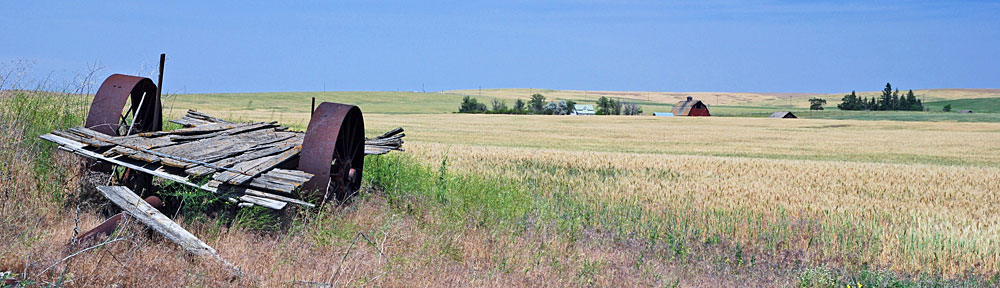
Palouse FallsMy destination was Walla Walla, WA, about 150-200 miles away. I chose a route that kept me on back roads. I don’t think I ever saw so much wheat in my life. My chosen route took me past Palouse Falls, so I stopped in and got some photos. It was an interesting place and well worth the stop.

From there, I continued on to Walla Walla, with a stop at a drugstore soda fountain in Dayton for an ice cream sundae. I checked into the Four Seasons RV Park around 5 PM, set up the camper for a two-night stay, and went out to grab some dinner. I wound up at a restaurant called Luscious, where I had an excellent polenta dish and a glass of wine.

This is also the first day I gave my new SPOT Messenger a workout. You can track my progress for this entire trip on my Share page, http://www.tinyurl.com/FindMaria. You’ll have to page back using controls under the Waypoints list to see the track for that day.

Thursday, July 31

There was something about dinner that didn’t agree with me, no matter how tasty it was, because I was up at 3 AM, leaning over the camper’s toilet and choking it all back up. I hate to puke but what they say is true: you do feel better when you’re done. But I wasn’t operating at 100% the next day, which I’d set aside to explore opportunities in Walla Walla.

It’s no secret that I pretty much hate where I live right now. Wickenburg is a dead town, full of ultra conservative retirees who live there only half the year and don’t spend much of their money in town when they’re around. They don’t have an emotional investment in the town and don’t seem to care what happens to it. As a result, new businesses — other than those that cater to the budget-conscious — don’t last more than a year or so. There are few decent restaurants and very few shopping opportunities. If it weren’t for the newly built and then remodeled Safeway Supermarket and a handful of longtime other businesses, I don’t know how I could live there at all. To make matters worse, the Mayor and Council seem more interested in growing the town’s population base for the financial benefit of their families and cronies than building an economic base that includes good-paying jobs that’ll attract young, vibrant people. The Chamber of Commerce pushed for an in-town “bypass” that’s destroying downtown parks and other facilities and adding a “roundabout” that’s sure to cause daily accidents. I love my home and its immediate surroundings and it’s painful to see how they’re destroying whatever was good about the town. There’s nothing else here for us anymore. All of our friends in our age group have already left town. We’re the only ones left.

So I’m exploring possibilities and Walla Walla was high on my list. I spent some time checking out the very pleasant historic downtown area, where it was nice to not be the youngest person on the street. Then I went over to the airport to meet with the airport manager about moving my flying business there. She was extremely helpful and enthusiastic and said a lot of things that made me believe I’d be welcome there. (What a refreshing change that was.) There would certainly be a lot more opportunities in that town than where I’m based now. I also checked out a few wineries — there are dozens in the area! — although I couldn’t do any tasting with my stomach so iffy all day.

By 4 PM, I was exhausted. I went back to the camper to relax and wound up staying in for the rest of the night.

Friday, August 1

On Friday, I needed to get an early start. I was expected in Salt Lake City at 6 PM. I’d be spending the night at the home of my friend and editor, Megg, and her family. Utah (MDST) is 1 hour ahead of Washington (PDST) so I’d already lost an hour. Trouble was, I needed to visit the post office to see if a General Delivery letter (containing a large check) had arrived. So I got as much prepared as possible before 9 AM and drove into town again. The check was there. I stopped at an excellent bakery that had been highly recommended by a Twitter friend and bought a fruit tart to bring to my friend’s place. Then I gassed up the truck.

Back at the camper, I was all ready to hook up the trailer when I realized that I was missing a leverage bar I needed for the hitch. I wasted an hour searching for it, then gave up and went to Home Depot to buy a replacement. That little fiasco cost me another hour. I didn’t get on the road until 10:30 AM.

That meant I had to take highways. I drove down to Pendleton and hopped on I-84 eastbound. And thus started a very long, very grueling day of driving. The trouble is, my 1994 Ford F150 8-cylinder pickup truck, when towing, is no match for hills and mountains. On flat areas (or downhill, of course), I could get it up to 65 MPH. But as soon as I started to climb, my speed deteriorated. Down to 35 MPH. Trucks were passing me.

And the roads through eastern Oregon and southern Idaho are very hilly.

I plowed on, stopping only for fuel and some fast food that I ate while driving. The hours slipped away. I was just entering the Salt Lake basin area when the sun set. It was about 8 PM. After making two wrong turns, I pulled up in front of Megg’s house just after 9 PM. I’d been on the road for more than 10 hours and was exhausted.

Megg fed me and helped me bring Alex the Bird’s cage into her dining room. By 11 PM, I was asleep in her guest room.

Saturday, August 2

We got up early and hit the farmer’s market in downtown Salt Lake City. This was, by far, the best farmer’s market I’d ever been to. Plenty of fresh produce, baked goods, and other items you’d expect to find at such a place, as well as other non-food items that generally dominate most other farmer’s markets in this country these days. Megg had her 5-year-old son, Cooper, along and we joined Megg’s friend and her 5-year-old son for coffee and scones at a shady table in the park. I felt as if I could have spent the whole day there — it was so pleasant.

AlbionBut we headed out to the Snowbird ski resort area, where we took a hike in Albion Basin. The area had been recommended by photographer and Twitter friend Ann Torrence, who linked to a photo of the place that made it irresistible. The three of us hiked about 2 miles round trip to Cecret Lake (also spelled Secret Lake). I took a lot of photos; this is one of them. The place was amazingly beautiful. Again, I think I could have spent the whole day there. But we didn’t have a whole day. In fact, I was hoping to be back on the road by 1 PM.

The departure time slipped as we went to the Snowbird Ski Resort and took the tram to the top of Hidden Peak. I’m so out of shape I was huffing and puffing at 11,000 feet. We headed back to Salt Lake City where I scrambled to get everything together. It was 3:30 when I said goodbye and hit the road again with Alex.

My goal had been to reach Page, AZ before nightfall. That simply was not going to happen — especially with the way my truck was climbing hills. I wound up in Beaver, UT, where I had dinner at a truck stop before pulling into an RV park for the night. I didn’t unhook the trailer or pop out any of the beds. Instead, I just plugged in the power cord, opened the sofa, and snuggled up in a comforter with a pillow.

Sunday, August 3

Reflecting PoolI pulled out of the RV park at 6 AM sharp and continued south on I-15 to SR 20 to US 89. It wasn’t until I got to Mt. Carmel Junction that I stopped for breakfast and fuel. I was back in familiar territory — the turn at this junction leads to Zion National Park. After breakfast, I continued down through Kanab, stopping to take a photo of a reflecting pool alongside the road along the way. Then I continued east and was very pleased to see the silhouette of Navajo Mountain off in the distance.

I arrived at the Glen Canyon Dam visitor’s center at 10:30 AM. Mike was already there with his truck and Jack the Dog. We had another breakfast in Page, then went to the airport to chat with the folks I’ll be flying for there, and finally to the campground, where we were told we were “lucky” to get a spot. (There’s more to this story, but I don’t feel like going into it now.) We spent the rest of the day picking up a few things for the camper and then just taking it easy. We had dinner in town, then came back to the trailer and watched a movie on my laptop before falling asleep.

Monday, August 4

We did a lot of chores that morning. We had to button up the camper to move it to another site (which we were “lucky” to get) that was suitable for monthly use. It turns out, the only thing that made it suitable was an electric meter, so if I sucked too much electricity, they could charge me for it. The new site is right near the road, which I’m not happy at all about. But I’m hoping it’ll be close enough to the office to connect to the WiFi network there.

We left Mike’s truck with the trailer and climbed back into my truck with the stuff I wouldn’t need anymore — including Alex’s cage. Then the four of us headed home. We’d gotten about 15 miles south of Page when Mike realized he’d forgotten his cell phone. We went back to fetch it, then bought milk shakes that were way too big (and way too expensive) for the ride. At 2 PM, we were in Flagstaff, where we stopped for a Thai food lunch. We were still full from the damn milk shakes, so we wound up taking most of the food home with us.

We were in Wickenburg by 5:30 PM. I fetched one of my cars from my hangar and came home.

Busy enough for you?

So that’s a whole week and then some, all accounted for here. You can see why I didn’t blog regularly. Hopefully, this long post will make up for it — if you could last through it all.

We hit the road again on Friday morning, when we fly to Seattle to fetch the helicopter and bring it down to Page. I hope to be able to share more stories and photos with readers then.

Until then, remember that you can track my progress for most of my trips these days on my SPOT Share page, http://www.tinyurl.com/FindMaria. Use controls under the waypoints list to scroll back through previous days.

And be sure to check out my photo gallery for larger images of what I’ve shared here: http://www.FlyingMPhotos.com/.
SPOT Messenger: A First Look

Initial thoughts about my new flight following solution.

My friend, Jim, is an Idaho-based R44 pilot with a company very similar to mine. He’s a single pilot Part 135 tour and charter operator who sometimes operates over very remote terrain.

Of Flight Plans and Flight Following

One of the challenges we face as charter operators is last-minute route changes requested by paying passengers. For example, suppose the passenger books a flight from Scottsdale to Sedona. I’m required by the FAA to file a flight plan that indicates my route so that if we don’t turn up in Sedona, they’ll know which way we went and can [hopefully] find us. But at times — sometimes after the flight is already under way — the passenger might say something like, “Can you follow the course of the Verde River to Camp Verde?” This is not the most direct route and it’s not likely to be the one I planned. But what do I do? Say no?

[The right answer is yes, say no. That’s the answer the FAA wants to hear. But the FAA is not paying by the hour to conduct the flight. The FAA is not going to refer its friends to a friendly, accommodating pilot.]

The problem is, if I deviate from a route and something goes wrong, the search teams may not be looking for us anywhere near where we are. So they might not find us. And sure, I have an ELT (emergency locator transmitter) in my aircraft — even though it is not required by the FAA. But how well do those really work? It certainly didn’t help them find a pilot and his co-worker when they literally disappeared on a flight between Deer Valley in North Phoenix and Sedona nearly two years ago. They’re still missing.

And then there’s Steve Fossett. Or maybe I should have said, where’s Steve Fossett. They must have spent millions by now to find him and he’s still among the missing.

Airplane pilots and pilots flying in the flatlands of the midwest can request something called flight following from the flight service station (FSS). Flight following keeps you on radar so they pretty much always know where you are. The problem with helicopters is that we fly so darn low. Even if I flew up in nose bleed territory at, say, 1500 feet above ground level (AGL), the terrain in the area I fly is too mountainous to keep me on radar. I’d have to fly much higher to stay on radar. And if I’m going to be that high, I may as well fly a plane. So flight following is not a practical solution.

The True Geek’s Solution

Jim also flies in remote and often mountainous areas. And, like me, he’s a true gadget lover — someone who likes to fiddle with electronic toys. (I think he’s lusting for a POV.1 after seeing mine.) He was based in Chelan for cherry drying season and happened to see the SPOT Messenger displayed at the local Radio Shack. He went in and checked it out. Then he did more homework. Then he bought one and told me about it.

SPOT MessengerThe SPOT Satellite Messenger is a personal location device. It’s about the size of my Palm Treo and, as you can see here, bright orange so it’s easy to…well, spot.

My understanding of the unit is that it combines GPS receiver technology with satellite transmitter technology. So you turn it on and it acquires its position via GPS. You can then use one of four different features, depending on the subscription plan you choose:

  • The SPOT standard service plan, which costs $99/year, includes the following three features:
    • OK sends a text message or e-mail message to the phone numbers or e-mail addresses you specify. The message, which is customizable, tells the people on the list that you’re checking in OK and provides the GPS coordinates for your position. Those coordinates include a link that, when clicked, displays your position on Google Maps.
    • Help, is similar, but it sends a customizable help message to the people you specify. The idea here is that you need help and have no other way to contact someone who can help you.
    • 911 sends your GPS coordinates to the folks at the GEOS International Emergency Response Center, who, in turn, notify the appropriate emergency authorities. This is for real, life-threatening emergencies. The Response Center folks also contact, by phone, the two people you specify to notify them of the signal.
  • The tracking upgrade option, which costs another $49/year, includes live tracking, which, when activated, sends you GPS position every 10 minutes or so to the SPOT folks. This information is visible to anyone who has been given access to a Share page you configure with or without a password.

Jim went with both plans. When I bought mine on Monday, I did the same.

First Thoughts

I’ve been playing with SPOT on and off since Tuesday morning. In general, I like it and I think it’ll do the job I intend to use it for — flight following on those long cross-country flights.

After configuring message recipients, I started out by sending a few OK messages. Although the marketing material makes it seem as if those messages are instantaneous, they’re not. After pushing the OK button, the unit will try for up to 20 minutes to send your OK location via satellite uplink. It’ll send the message 3 times, but only one message is forwarded to the people on your list. For experimental purposes, I made myself one of those people. I had to wait longer than 20 minutes to receive one or two of the messages. To be fair, part of the reason for that could be my location at the time — flying between Wenatchee and Seattle in mountainous terrain. (I don’t think my cell phone was receiving very well.) The delay is satisfactory, once you realize that it’s not an instant communication.

For obvious reasons, I have not used Help or 911 yet. Let’s hope I never have to.

I did set up tracking. It took several tries to turn it on properly. The unit does not have a screen, so you have to rely on understanding the blinking lights to know what it’s doing — if anything. Twice I thought I was enabling tracking, but discovered that all I did was send OK messages. Once, tracking was on and in trying to turn it on, I really turned it off. In all cases, it was operator error. Evidently, you cannot turn on tracking during the 20-minute period in which an OK message is being sent. Since both features use the same button, it’s pretty easy to do one thing instead of the other if you don’t pay attention to how long you hold down the darn button.

My husband complained that the messages he received did not include the date and time. We later realized that it was because he was not viewing the message on his phone; he was viewing its summary. (My husband is text message challenged.)

Snowqualmie PassPad 6The e-mail version of the OK message is handy because of the link it includes. Click it and go right to Google Maps with the position clearly marked. Here are two examples. In the first one, we’re flying just to the east of Snowqualmie Pass over I-90. In the second one, we’re sitting on Pad 6 at Boeing Field in Seattle. These images are at two different magnifications. All GoogleMaps features work — it’s just the location put into GoogleMaps. My personal Messages page on the FindMeSpot.com Web site displays all points with the option of displaying any combination of them on Google Maps. It also enables me to download these points to a GPX or KML format file for use with a GPS receiver or GoogleEarth.
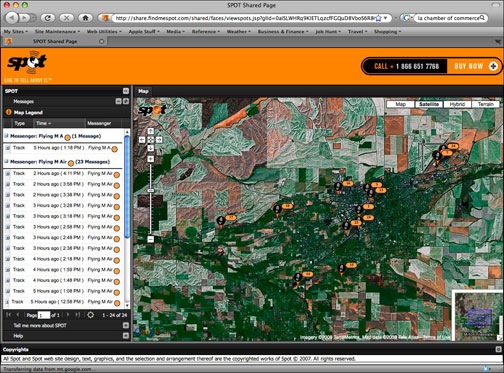
The Share page feature, which is still in beta, was not working when I first tried it. But it’s working now — and quite well! I set up a page that does not require a password so anyone could check in and see where I was when I was traveling with SPOT tracking turned on. Apparently, it only shows the past 24 hours of activity, so it you’re checking it now and there’s nothing going on, it’s because I’m not traveling with SPOT. But here’s what it looks like right now; as you can see, I spent a lot of time exploring Walla Walla, WA today:

SPOT Shared Page

A few things about this feature:

  • The lines between the points (which, for some reason, are not showing up in the screenshot) do not represent tracks. I was in a truck today and did stay on roads.
  • If the unit did not have a clear shot of the sky, the point that should have been recorded wasn’t. This wasn’t a problem today, since I had the unit sitting on the dashboard in the broiling sun — partially to see if heat would affect it. (It didn’t.)
  • Clicking a point in the list on the left side “flashes” that point in the display. You can also click other controls to get more information.
  • If you leave this page open, it will automatically update. So you can watch new points appear if you’re tracking someone. Way cool.

The URL for this feature is long and impossible to remember, so I created a custom URL using TinyURL: http://www.tinyurl.com/FindMaria. I invite you to try it for yourself.

Overall

My overall opinion is very positive. It will certainly give me peace of mind while flying in some of the remote desert locations I fly in. I think it’s worth the $150 unit cost plus annual subscriptions.

Even if something goes terribly wrong out there, I want to be found.

My next challenge: getting it to send OK messages to my Twitter account. Anyone have any ideas?

Almost Scud-Running

Flying through a mountain pass in marginal conditions.

Louis and I flew from Wenatchee (EAT) to Seattle’s Boeing Field (BFI) yesterday afternoon. The flight required us to cross the Cascade Mountains. There are two passes to choose from: Snoqualmie, which I-90 goes through and Stevens, which State Route 2 goes through. I’d wanted to take Stevens — I’d already traveled Snoqualmie once and wanted a change — but the decision would not be mine.

It was a weather issue, of course. After weeks of picture-perfect weather here on the east side of the Cascades, a cold front had moved in. Rain clouds were coming over the Cascades. It even drizzled in Quincy.

As I flew out of Quincy Airport for the last time this season, I took a good look at the ridge between Ellensburg and the Columbia River, where all those windmills are lined up. The sky was dark out that way, with thick gray clouds. Although the windmills were clearly visible, I could also see the vertical streaks of falling rain. It looked as if a flight up I-90 was out of the question.

But the picture was worse when I reached the Wenatchee area and could see out toward Stevens pass. The sharp, rocky mountains are closer there and the clouds clung to them like cotton balls rubbed across coarse sandpaper: lots of wisps in an 8 to 10 knot breeze. The clouds were definitely lower; the pass was definitely higher.

It looked as if scud-running would be in my near future.

If you’re not a pilot, or you’re a very new pilot, you might not know the term scud-running as it pertains to aviation (or anything else, for that matter). I define scud-running as flying in variable visibility conditions, when you have steer around low clouds or fog enroute to get to your destination. Scud-running is never a good idea. In fact, it’s usually a bad idea. More than a few pilot have met their end hitting a “granite cloud” while attempting to run the scud.

Helicopters, however, are uniquely suited for scud-running. We normally fly low, so the clouds have to be really low to affect our flight. We can travel at a wide range of speeds, from 0 to (in my case) 115 knots, so we can take our time and really look at what’s around us before committing to a path. And if that path turns bad, we can make a 180° turn to get out of it in a very narrow space. Best of all, if things get really out of hand, we can always land in a field or parking lot and wait out the problem.

Don’t get me wrong: I’m not recommending scud running to any pilot. It’s dangerous. I’m just saying that if you’re flying a helicopter and the clouds start to close in, you’re more likely to live to tell about it — if you handle it right — than someone flying a plane.

In Wenatchee, I checked the weather. I used Duats to get conditions in Stampede Pass, which is just south of Snowqualmie pass, and every other place along the way on both routes. There was no information handy for Stevens Pass, but my eyes had told me enough. Stampede pass had ceilings of 6000 feet. That was more than enough for me. Then I checked the radar in motion to see which way the rain I’d spotted near the windmills was going. It was driving northeast. We were north of the rain; it would pass to the south of us if we flew direct to Ellensburg or Cle Elum. It was cloudy and raining on the other side of the cascades, with 4,000 foot ceilings. Wind was light everywhere, so turbulence wouldn’t be an issue.

I decided to take Snowqualmie Pass.

We started up and I took off on a steep, 1,000 foot per minute climb from Wenatchee Airport. We had to cross the river and then cross the high ridge on the other side. To our left, the rainclouds were moving east. To our right, the low clouds were stuck on mountain peaks. The ridge was clear; the clouds were at least 1,000 feet above it. I aimed slightly to the south of the GPS’s direct-to Ellensburg, pointing the helicopter at the friendliest piece of sky.

I gave Louis the controls when we reached the ridge. He continued the climb, but adjusted our route to intercept with Ellensburg. We climbed closer to the clouds. I thought for a while about how I use a GPS for en route navigation — as a sort of general guide. Louis was putting us on the GPS track. Whatever.

We topped the ridge and the land dropped down toward Ellensburg on the other side. We stayed pretty high. Didn’t seem any reason to descend to a 500-foot cruise altitude when we’d just have to climb again. I set Cle Elum as the next go to waypoint in the GPS. Louis adjusted course to head west.

Ahead of us, the mountains closed in. I-90 threaded its way through them in one narrow valley after another. Although we still had at least 2,000 feet of cloudless sky right above us, the clouds dropped up ahead. The entrance to the mountainous area looked shrouded in a white haze. It didn’t look good.

I dialed in the Stampede Pass ASOS. It assured us that the ceilings were 1700 feet. Plenty of space for us. But we weren’t going through Stampede Pass. We were going through Snowqualmie Pass. They were very close, but would they have the same conditions?

We continued on. I paid close attention to the high-tension power lines that ran along the side of the road. If we had to descend and turn, I wanted to make sure I knew exactly where those wires were.

The road climbed into the mountains. We stayed at pretty much the same altitude until we were about 500 feet above the road. Then we climbed with it. We slipped into the white haze, which turned out to be a light mist. Tiny raindrops covered the helicopter’s cockpit bubble. Visibility was still okay, but there wasn’t enough moisture to bead up and run off the window, so we had to look through all those little droplets. Still, so far, so good.

We passed the two little airports at Cle Elum and I punched the next airport into the GPS: Easton State. If I have to make a precautionary landing, I like to do it at an airport, so I like to keep an airport dialed into the GPS. Sure, we could land in a big parking lot or field, but that’s a good way to get unwanted attention in these little towns.

Meanwhile, the clouds continued to come down. My internal alarm systems came to life when we started flying between low-hanging wisps of clouds. The last time I’d done that, I’d flown into one I hadn’t seen. That produced about 2 seconds of terror before I made a descending 180° turn to get out. I didn’t want to be there again. I told Louis, who was still flying, about my experience.

We passed Easton State. The next airport was Bandera, on the other side of the pass. I punched it in. We were now flying in a deep canyon, about 400 feet over a lake and I-90. The wires were not an issue anymore. At the west end of the lake, the highway made a sharp turn to the left into what looked like a cloud bank.

Crossing the Mountains

I listened to the Stampede Pass ASOS again. Now the ceilings were 1400 feet — still not bad. We weren’t far from there. We continued to the end of the lake, where we could see into the next canyon. Visibility was still okay, so we went in. This was the narrowest part of the canyon with very little room to maneuver. The clouds stayed high enough. The misty rainfall continued. We were okay, but I knew it could turn bad at any time.

Then we were through the pass and the road started to descend. The clouds went down with it. So did we. We’d made it through the pass but I still wasn’t sure whether we’d have a clear enough shot out of the mountains. We could never see more than a few miles ahead of us because of the mist and the twisty turns of the canyon.

But by the time we passed Bandera, it was obvious that we wouldn’t have to turn back or land. As the road continued to descend, the clouds stayed put. I tuned in the ATIS for Boeing Field and heard 10 miles visibility with 4000 foot ceilings. We landed there about 20 minutes later.

Here’s our entire route, laid out on a sectional chart;

EAT to BFI via Snowqualmie Pass

I wouldn’t call this experience scud running, but it was about as close as you could get. I don’t think too many airplanes would have made this flight successfully without getting into the clouds — granite or otherwise. Although something small and slow like a Piper Cub could have handled the altitude and airspeed, the uncertainty of what lay ahead, coupled with the extremely narrow spaces that would make it impossible for an airplane to turn around, would make this a very dangerous flight for any plane.

I’ve been in worse weather situations than this one, but I don’t think I entered into this one lightly. The entire time we were in the mountains with low clouds, I kept thinking about escape routes, landing zones, obstacles to turning, and what could happen if we let it. In Arizona, I don’t get much practice flying weather. While I think that what we experienced yesterday was marginal VFR at best, other pilots more accustomed to weather flying might think I was taking the whole thing too seriously.

But it’s when you let your guard down that Mother Nature sometimes steps forward to slap you in the face.