
Things don’t always go as planned.
I did an ash scattering the other day. Normally, that wouldn’t be a big deal. I’ve done ash scatterings before. (Read about two of them here and here.) But this one didn’t go exactly as planned.
By ash scattering, I mean the aerial scattering of cremains. Cremains is short for cremated remains. That’s what the next of kin get in a baggie and a box when someone is cremated. An ash scattering normally refers to scattering those remains over a large tract of empty land.
My Technique
I should start out by saying that I have ash scattering from a helicopter down to a science. After several trials, I’ve got a technique that works like a charm — for most scatterings, anyway. I get some tissue paper — the kind of paper you might put inside a gift box around a shirt or other item of clothing. I spread it out. The family (or friend) pours the cremains onto the paper. They gather up the corners and sides and twist them at the top to make a kind of paper package of the departed’s remains. This is all done inside, where there’s no chance the wind will foul things up.
Then we climb into the helicopter with the person responsible for scattering the cremains sitting behind me. All doors are on. I start up and fly to the location where the remains will be scattered. I climb to at least 1,000 feet over the target area. Then I bring the helicopter into a high hover — or at least a very slow flight speed.
We close all vents except the one in the ash scatterer’s door. The whole time we’ve been flying, he’s been holding the cremains in its paper package on his lap with the top still twisted closed. He untwists the top and grasps the package by its top. He slips it out through the vent and tosses it gently away from the helicopter.
The package is closed at first, but as it begins its tumbling descent, the wind whips it open. The ashes explode from the paper in a poof and drift away with the wind. The paper also falls to the ground, but since it’s thin, uncoated tissue paper, it’s likely broken down by the elements within a few months or a year.
I like this technique for several reasons:
- It scatters the ashes with a certain amount of dignity. (One of my clients even bought their own tissue paper. It was printed with a pattern of shoes because the woman who was being scattered had liked shoes.)
- It prevents the ashes from blowing back into the helicopter when dumped out.
- It prevents the ashes or their packaging from creating a danger to the helicopter’s tail rotor or other parts.
- It does an amazing job at scattering the ashes over a wide, open area.
Unfortunately, I didn’t use this technique on Saturday.
Saturday’s Scattering
Saturday’s ash scattering mission was tough for two reasons:
- The next of kin were the adult children of the two cremated people they wanted to scatter. They were not small people. The lightest one weighed in at 216 pounds. Add me and you have four fatties on board.
- The ashes were to be scattered over the family orchards, which covered a mere 30 or 40 acres and were surrounded by other farmland and orchards.
Clearly, I’d have to fly lower and use a different technique to scatter the ashes over such a small area. And because we were so heavy, I’d have to drain all but about 15 gallons of fuel out of the helicopter so I had the power I needed to fly low and slow without getting into trouble with the power curve.
We kept it simple. The ash scatterer would sit behind me and dump the two bags of ashes out through his vent. He’d do everything possible to make sure the bag opened on the outside of the helicopter. I made sure he clearly understood what would happen if he let go of the bag and it got into the tail rotor.
I examined both bags of cremains before the flight. The technology has come a long way. The mom’s ashes, created five years ago, were of a sand-like consistency, with very few grains larger than a tiny pebble. The dad’s ashes, created only recently, were powder-like.
We were all in good spirits when we did the flight. I took them out over the target area and made a high reconnoissance as they pointed out the orchard blocks. Apples, pears, and cherries. (Wash your fruit, readers!) The wind was coming from the west at about 7 miles per hour and would really help me deal with the weight I was carrying. I could point into the wind and fly on a diagonal while the scattering was being done behind me. But also to the west was a set of high tension power lines. If I got into a settling with power incident — which I’d have to identify before it became a problem — I’d have to avoid the wires on any kind of escape route. The best thing to do would be to keep moving at a speed above ETL. I’d come in from the northeast for my pass.
With that plan made, the ash scatterer prepared the first bag. I came in over the northeast corner of the first orchard block about 200-300 feet up. On my word, he began dumping ashes out of the helicopter. I could see through the corner of my eye how they streamed behind us. I pointed the helicopter into the wind and flew almost sideways to keep the ashes away from the aircraft as well as I could. I was probably doing about 20 knots ground speed.
The second bag had a small hole in it, which was discovered when the ash scatterer’s sister handed him the bag. (And yes, I still have bits of Mrs. B all over the back seat of the helicopter.) Those remains followed the first. I only had one moment when there was a power issue and I resolved it quickly by picking up speed.
Then we were done.
We made a pass over the family home before returning to the airstrip where I’m based for the summer. I set down on the concrete pad, cooled the engine, and shut down.
The white dust you see is the cremated remains of Mr. & Mrs. B.
But it wasn’t until we got out of the helicopter that I noticed a fine dusting of Mr. and Mrs. B on the right side of my helicopter.
The family wasn’t the least bit upset about their parents hitching a ride on the side of the helicopter. Or even about bits of mom in the back seat. They were more concerned about cleaning it up for me. But I told them I’d take care of it, after making sure vacuum use wouldn’t bother them.
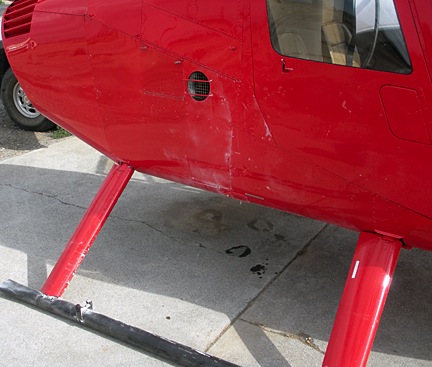
Then I did a complete walk around of the helicopter, opening up panels to make sure there were no traces of cremains inside any of the compartments. I also looked in the fan scroll area behind the engine. It looked clean, too. The only thing that looked as if it could be a problem was the air inlet behind the right passenger door. As shown in the photo below, it apparently got a heavy dose of dust.
The Extent of the Dusting
I flew the helicopter at least two more hours that day. I gave some rides to a grower’s kids and three hired hands. I flew to Cave B to join the ash scatterers for a celebratory lunch. I flew up the Columbia River as far as Chelan, where I spent the day with a friend, and flew back at high speed along the Waterville Plateau, landing at dusk in 95° heat.
The helicopter flew fine. Cylinder head temperature was up a bit more than average on the last flight of the day, but I figured that was due to my high speed and the hot temperatures. I’d seen it that high before when flying during Arizona summers. It wasn’t anywhere near red line — it was just a bit higher than the tickmark on the gauge where it normally sits.
I’d hoped that Mr. & Mrs. B would get blown off the aircraft, but they didn’t.

Cremains sucked into the air intake on the side of the helicopter. The filter will be replaced today.
The air filter had me worried. It would likely need to be replaced. I called my Seattle mechanic on Sunday morning. He proceeded to tell me about all the damage that could be caused by the cremains. Best case scenario: none of it got into the engine. Worst case; it did and was already grinding away at moving engine parts. I was told that symptoms of a problem would include increased oil use and overheating. He promised to overnight the filter for Tuesday delivery.
I went out to the helicopter with a sponge and bucket of clean water and sponged Mr. & Mrs. B off the side of the helicopter. Today, when I go out to change the filter, I’ll bring along a vacuum and inverter so I can vacuum Mrs. B out of the back seat.
And I’ll monitor the helicopter’s operations closely in flight, keeping an eye out for overheating and other indications of a problem.
You can bet that the next time I scatter cremains, I’ll do it with tissue paper and a high altitude drop.