Don’t believe what they tell you.
Looking for more up-to-date information?Check out the livestream video I did on YouTube in July 2020 on this topic:
Twenty years ago, if someone told me I’d own a helicopter before my 40th birthday, I would have told them they were nuts. Yet on October 3, 2000, I took delivery of my first helicopter, a 1999 Robinson R22 Beta II. Four years later, on January 8, 2005, I’d traded it in for a brand-spanking-new, designed to my specifications, 2005 Robinson R44 Raven II.

My first helicopter, a Robinson R22.
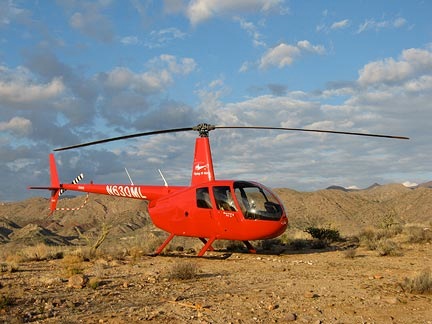
 My R44, parked out in the desert at a rides event.
I was making a lot of money as a writer back then. A handful of bestselling computer how-to books — yes, they do exist — and a few good real estate investments left me with an excess of cash. I live rather modestly in a home I can afford and although I own more than my fair share of motor vehicles, none of them are new, flashy, or expensive. In other words, I don’t live beyond my means. Although my income fluctuates wildly — especially these days — I could foresee the ability to own and operate an R44 into the future, especially with added income from a small Part 135 on-demand charter operation.
Fueling my opinion on this matter was a document published by Robinson Helicopter Company on its Web site. Titled “R44 Raven II Estimated Operating Costs,” it painted a rosy picture of an “affordable” helicopter (if there is such a thing). The conclusion at the end of the “Operating Cost-Per-Road Mile” section stated that the calculated 98¢ per road mile “…compares favorably with some expensive automobiles, and will usually be lower when the value of time saved is considered.”
The Underestimated Costs
I knew from the start that the document was overly optimistic for my situation. Some of the numbers just didn’t seem right.
- Back then, Robinson was calculating labor at $55/hour. At the same time, I had one mechanic charging me $95/hour and another charging me $105/hour. Later, I had a mechanic who charged me $75/hour. The local airplane fix-it guy, who I sent to the Robinson maintenance course, was the least expensive, charging me $45/hour at first but then bumping it up to $55/hour. He didn’t have the experience or specialized tools for the helicopter-specific inspections and maintenance I sometimes needed. So Robinson’s labor estimate was understated by 30-40%. (Nowadays, Robinson estimates $70/hour, which is still very low.)
- Robinson’s estimated fuel and oil costs were consistently lower than what I was paying. That baffled me. Robinson is based in California, which has some of the highest taxes on fuel around. Just crossing the border from Arizona to California, you can expect to spend 50¢ more per gallon on auto fuel. Yet even today, they’re estimating $4.50/gallon for fuel. Tell that to the folks at Grand Canyon, who hit me up for $6/gallon early this month. And 14 gallons per hour? Realistically, its more like 15-17 gallons per hour. And oil: Robinson estimates 50¢/hour. Where did that come from? The W100+ oil I use costs about $6/quart and I seem to be adding a quart every 5 hours or so. Do the math.
- Robinson’s insurance costs are based on Pathfinder rates. Pathfinder has a special relationship with Robinson that keeps its rates low. The annual premium in the current estimated operating costs — around $11,000 — aren’t too far off from what I paid when I insured with them for my commercial operation. Unfortunately, however, Robinson prorates this fixed annual amount over 500 hours of flight time per year. How many private owners — the same guys buying the expensive cars Robinson is comparing its helicopters to — fly 500 hours per year? I run a business with my helicopter and still don’t fly more than 200 hours a year on average. (Most private pilots fly less than 100 hours a year.) Take that $11,000 and divide it by 200 and the hourly cost for insurance alone is $55 — not the $22 figure Robinson uses.
Still, when I made my purchase/ownership decision, I plugged in whatever known numbers I had and relied on Robinson’s numbers for the unknown — especially the cost of periodic inspections and unscheduled maintenance. The result was within my budget, so I became an owner.
The Hidden Costs
I started getting slammed with unexpected costs not long after purchase. The first major component to need replacement was the starter and ring gear. My personal opinion on the matter is that the starter was defective and did not fully engage with the ring gear on every start. It began breaking teeth off the ring gear. The situation got so bad that it all needed replacement.
The clutch down limit switch, an $8 part, cracked. Of course, to replace it, you have to pull the tail cone, then put it back on and rebalance the fan scroll. That’s about an 8-hour job.
The auxiliary fuel pump went after about 500 hours. And then again another 500 hours later. And then again about 100 hours after that. The pump costs $1,600 new and $800 overhauled. I know because I’ve bought them both ways. Fortunately, a good mechanic can replace it in less than an hour.
I suppose the magneto overhaul is included in Robinson’s calculations. After all, they are required to be rebuilt every 500 hours. At a cost of $1,600 each time.
The upper bearing began leaking brown fluid at about 850 hours. The overhaul was $3,000 plus installation (which requires removal of the tail cone). The following year, it was still leaking and now overheating. I was lucky that the factory applied the overhaul cost to the price of a new one: $9,000.
I’ve also replaced the battery twice (at $400 a pop) and my oil pressure gauge once. I’ve had repairs done to my primary radio and GPS. The muffler cost another $2,200 this year.
These are just the things I’m remembering off the top of my head. If I pulled out my Engine and Aircraft log books, I’m sure I could list a lot more of the same: items that are supposed to last the life of the aircraft (okay, well maybe not the battery) simply not lasting.
But Wait! There’s More!
And then there are the Airworthiness Directives, Service Bulletins, and Service Letters. Because I operate under Part 135, these are not optional. So yes, I changed the orientation of the fuel control because some idiot who likely left his helicopter out in the rain all the time was getting water in his fuel — even though my helicopter was based in the desert, where it rarely rained, and was kept in a hangar. And I replaced the seat belt attachment points and changed the throttle link and swapped out the frame tube clamp and fiddled with the throttle linkage and changed the fuel hose supports and replaced the hard fuel lines and replaced the gascolator assembly and did something to the clutch actuator fuse holder wiring. Each one of these required maintenance items cost money — sometimes thousands of dollars. And none of them were included in Robinson’s estimate of costs.
A service bulletin that became an airworthiness directive required inspection and then repainting (or replacement) of the main rotor blades. To stay in compliance in my extremely corrosive (think dust) operating environment, I’ve had the blades removed and repainted twice in six years. It costs about $1,500 each time.
But the real kicker — the service bulletin that prompted this blog post — is the bladder tank retrofit for my fuel tanks. The kit for the retrofit will cost about $6,000 and there’s 40 hours of labor on top of that plus the cost to repaint the fuel tanks. By my calculations, this should cost me between $12,000 and $14,000. This is not one of the estimated costs on Robinson’s fairy tale cost estimate marketing document.
Limiting Robinson’s Liability
And why? I’ve discussed this at some length with two other owners and here’s what we think.
An operator — or possibly multiple operators — experience a problem. Water in the fuel tank, seat belt buckle attachment points cracking, stuck throttle link, cracked fuel lines, chaffed wiring. They whined and complained to Robinson and may have even threatened legal action. Or maybe they sued. Robinson is privately owned and self-insured. They examine the problem area and come up with a new design to fix it in the future. Then, to prevent other owners from giving them grief about it, they put out a service bulletin to address it. If you don’t comply with the service bulletin, you can’t come crying to Robinson with your problems.
The fuel line and fuel tank bladder situation is taking things to the extreme. There have been instances of post-crash fires on Robinson helicopters. (News flash: Most serious aircraft accidents involve post-crash fires.) To prevent legal action against the company, Robinson started issuing documents. First, in July 2006, came Safety Notice 40, which states:
There have been a number of cases where helicopter or light plane occupants have survived an accident only to be severely burned by fire following the accident. To reduce the risk of injury in a postcrash fire, it is strongly recommended that a fire-retardant Nomex flight suit, gloves, and hood or helmet be worn by all occupants.
Are they kidding us? Do they honestly expect me to put all my passengers in flight suits with helmets for tours around Phoenix? Or day trips to Sedona? And how do you think my passengers would feel if their pilot showed up wearing a pickle suit and helmet for their tour or charter flight?
But when that wasn’t enough to counter liability, Robinson followed up with three service bulletins: SB-67 (R44 II Fuel Hose Supports), SB-68 (Rigid Fuel Line Replacement), and now SB-78 (Fuel Tank Bladder Retrofit). They’re attempting to minimize the possibility of a post crash fire by making modifications to the fuel system to help prevent line and tank ruptures. So I’m basically required to modify my aircraft to reduce Robinson’s liability in the event that I crash and my helicopter catches fire?
That’s like requiring older car owners to add airbags and ABS brakes just to reduce the liability of the automakers.

Good thing I complied with SB-55. I knew that 5 years later, I might park out in the rain.
Now if I were a private owner and not required by the FAA to comply with all these service bulletins, there’s no way I’d waste money complying with the ones that didn’t benefit me. For example why change the fuel control to avoid that water in the fuel problem? I live in the desert and my helicopter is hangared. There’s no rain falling on it. And even in the rare instance that it does get rained on, sumping the fuel tanks — which I should be doing before every flight anyway — would drain the water out. If I started finding water in the fuel tank, I’d reconsider my position and possibly get it done.
Similarly, this fuel system retrofit is beyond reason. It doesn’t make my flight any safer. It just makes crashing safer — as if that makes any sense. To get any benefit from it, I’d have to crash with enough impact and fuel on board to cause a fire. And guess what? There’s no proof that this retrofit would prevent a fire anyway.
But I don’t have the luxury of choice in these matters. When you operate commercially, you answer to a higher authority than common sense. But that doesn’t mean I won’t try to get an exemption. After all, they’ve given us until December 31, 2014 to comply. If it can wait four years, why can’t it wait indefinitely?
The Bottom Line
When you look at the cost of acquisition, the fixed cost of ownership, and operating costs, a helicopter like mine costs a heck of a lot more than the $185.10 per hour Robinson estimates. I can tell you exactly how much I spent on insurance, fuel, oil, maintenance, and repairs over the past 6 years: $208,000. Divide that by the 1100 hours I flew during that period and you get $200 per hour. Now add in the reserve for the overhaul that is required at 2,200 hours — roughly $100 per hour. So, after 6 years of operations, I’m seeing an average hourly cost of $300 per hour — not Robinson’s rosy $185.
Of course, that calculation doesn’t include my other costs to operate a business: advertising, supplies, travel, hangar rent, automobiles, taxes, fees, etc., etc. It doesn’t include depreciation, either. It also doesn’t include the $2,100 per month I pay on my aircraft loan or my initial $160,000 cash downpayment. Ouch.
Yet the Robinson document is never seriously questioned by anyone.
Here’s an example. Last spring, I flew from Salt Lake City to Seattle with another pilot who was building time, waiting for a CFI job to open up at his flight school. He told me about his plans to lease an R44 helicopter to start a business in a small Wyoming city. He had some specific ideas (which I won’t share here) that might or might not generate revenue. He’d run the numbers using Robinson’s estimates of operating costs plus the cost of the dry lease. The numbers he came up with — including his estimated dry lease payment — were about equal to my actual costs per hour. That told me his estimates were low. There’s no way someone leasing an aircraft could operate as cheaply as an owner; if there was, we’d all lease instead of buy.
Watch My Helicopter Videos on YouTubeTime for a shameless plug…
If you like helicopters, you’ll love the FlyingMAir YouTube Channel. Check it out for everything from time-lapse annual inspections to cockpit POV autorotation practice to a flight home from a taco dinner at a friend’s house — and more.
Like Robinson, he based his proration of fixed costs such as insurance on a 500-hour flight year. That’s an average of about 10 hours a week flight time in a place that has a very definite and rather short flying season. And he didn’t consider the cost of service bulletins and airworthiness directives and unscheduled maintenance beyond what Robinson estimates. And I don’t think he considered getting a hangar and an office and all the things that go with running a business. So his numbers were very low and I knew it. I tried to tell him, but I don’t think he believed me. Maybe he thought I was trying to discourage him, to minimize my competition. That’s not the case. I was trying to help him avoid disappointment and possibly bankruptcy.
But hey, why believe me? Do my ten years of experience as a helicopter owner give me any more insight than a marketing document cooked up by the company manufacturing and selling the helicopters?
My pockets are not as deep as they once were. As print publishing continues its death spiral, it takes my books along with it. My six-figure income years are gone. I can’t afford to fly for fun anymore. I have to fly for hire. I have to earn money on every flight I conduct.
After all, I have to support my mechanics and the Robinson Helicopter Company.

 When I bought the Moitek Video Camera Mount for my helicopter from the estate of the late Erik Goldbeck (rest in peace, Erik) back in August, it came with a Marshall V-R70DP 7-inch video monitor. This is a pro video monitor described in the marketing material as follows:
 I soon realized that a lighter and easier solution would be to simply buy a portable TV with a built-in battery. To that end, I found this ridiculously cheap thing on Amazon.com: Haier HLT71 7-inch handheld LCD TV. Seriously: $50 — how could I not try it?
 My R44, parked out in the desert at a rides event.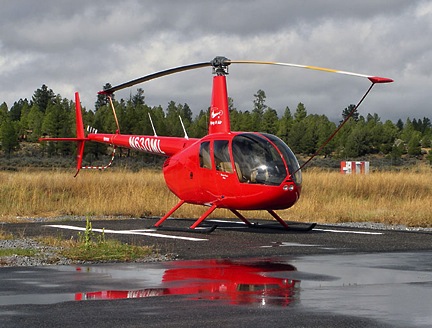

 Here are a few additional notes:
 A few years ago, my husband bought us a pair of Spin Master battery-operated radio-controlled helicopters. They’re tiny little things, maybe 8 inches long made of styrofoam, suitable for indoor flying only. We played with them that Christmas but soon lost interest with frustration. They’ve been lying around the house since then and I just charged them both up and started playing with mine again.
 This isn’t my first RC helicopter. Back in the early 2000s — maybe 2002? — I bought a kit and constructed a gas-powered one. Mine was a
  This year, however, RC helicopters are big. I’ve seen them in mall kiosks all over the place. They’re big electric models with fuselages designed to match real helicopters, both military and civilian. They seem to be a big hit.
 On my little helicopter, forward movement is determined by simple weight and balance; a few push pins in the nose (see photo; sunglasses give you a sense of scale) gives me just the right amount of weight for slow forward flight. One control lever increases or decreases power, like a collective/throttle combination. Another lever points left or right like a limited action cyclic. Tail rotor trim can be avoided if set right. It’s pretty challenging and, fortunately, pretty sturdy. I crash-land almost every time I fly it, but I am getting better.