My Little Storage Solution

I obtain a shed.

As some folks know, I’m renting a hangar at Wenatchee Airport for winter storage of my helicopter, cargo trailer, car, and the furniture and other possessions I took away from my old life in Arizona. The hangar is huge — I’m only using half of its floorspace and even the half I’m using has plenty of room for other things. In fact, my original plan was to store my RV in there for the winter while I migrated to a warmer climate for a few months. I could get everything I own under that one roof and still have room to spare.

For various reasons, however, I decided to stick around in Wenatchee. I got a lot of encouragement from my friends to spend the winter here and join them in outdoor sports such as cross-country skiing, snowshoeing, and snowmobiling. I also have some personal business in state that requires me to be available for meetings. And I’ve even managed to keep flying, with two regular clients keeping me busy once or twice a week. Winters here are about the same as winters back in the New York metro area where I grew up. It had been a long time since I’d experienced a real winter.

Of course, to stick around meant to winterize my RV — a topic I hope to cover in another blog post. Part of winterizing my RV meant clearing items out of the “basement” storage space so I could put a heater in there. I’d also accumulated quite a few tools for property maintenance — weed whacker, rake, shovel, tarps, etc. All of these things had to be stored — most likely in that cavernous hangar 30-40 minutes away by car.

While a storage shed would be nice — and I’d actually been looking at my options on and off for the past few months — the idea of building one this time of year did not appeal to me. And the cost of buying a small one was simply not justifiable considering I’d have a big storage building of my own onsite within 6 months. So I’d pretty much resigned myself to storing in the hangar and simply not having the stored things around.

The Little Shed

That was the idea until I saw a fully-built 6 x 8 foot shed with metal door and window sitting on a trailer on the side of the road with a For Sale sign on it.

I drove by but immediately stopped and made a U-turn. I parked beside it and read the sign. $600.

That couldn’t be right. It looked brand new.

I called the phone number. The man who answered confirmed that it was still available and priced at $600.

“Would you deliver it?” I asked. I went on quickly: “I live on Cathedral Rock Road. It’s about 15 minutes from where the shed is parked now.”

“I’d have to charge extra for delivery.”

“How much?”

“A couple of hundred dollars, I guess. I’ll need a crew to help me.”

I could see this little shed slipping away. I had to acquire the shed at a price that made it not just a good deal but a great deal. “I can’t see paying a couple of hundred dollars to deliver a $600 shed,” I told him, slipping into New Yorker make-a-deal mode. “I’ll give you $700 total, including tax and delivery. Cash.”

“Let me think about it,” he said.

I was back home when he called an hour later. “I’ll take that offer,” he said. “Can I bring it by on Monday?”

Later, I looked up similar sheds on the website for the local company that had likely built it. They didn’t list sheds that small; the smallest listed on the site was 8 x 8. That was priced at $2,970.

Taking Delivery

We made arrangements for him to come sometime on Monday. On Monday he called with a two hour window in the middle of the day. He showed up right near the end of that window. Didn’t matter to me; I was working around the yard all day anyway, finishing up work on my new water line.

Shed Arrival
My new shed arrived on a flatbed trailer.

He arrived with the shed on a trailer and drove it right down my driveway. His companion and I guided him while he backed up into my preferred off-loading area. This was right beside my temporary power pole, not far from my water line. I didn’t want the darn thing blocking my view.

While we waited for the rest of his crew to come with a forklift, I asked him about the shed. What was the story? It looked like I was getting a good deal.

“You’re getting a great deal,” he told me. Apparently, the shed had been bought by a local school for some sort of project. It sat on the school grounds for a while. Then the school called him and asked him to take it away. His business, after all, was delivery. Although he didn’t say, I suspected that the school had given him the shed for free in exchange for the removal service. The only cost he likely had in it was the labor of moving it. That would explain why it was so cheap.

Then he told me that he owned a vacation house at Lake Chelan and was going to put the shed there if he didn’t sell it. I told him that it was just what I needed for the winter and that it fell within my very limited budget for a shed. I told him that although I don’t usually believe that things happen for a reason, finding this shed at this price was changing my beliefs.

Forklift with Shed
They used a forklift to move the shed off the trailer. They estimated that it weighs about 3,000 pounds.

As we talked, a long flatbed came down the road, pulled by a tractor truck. They rolled past my place and turned around farther down the road where it gets wider. A while later, the 3-wheeled forklift that had been on the trailer came chugging down my driveway with one man behind the wheel and another standing on a fork. Soon they were using the tie-downs they’d brought along to fasten the shed to the forklift and lift it off the trailer. Then it was on the ground.

They positioned it on an angle I didn’t like. I asked the forklift driver if he could straighten it somehow. The team put a wooden chock beside the skid on the front and the forklift operator used one of the forks to shift the front end over a foot and a half. It was lined up perfectly.

I put a level on the little porch. It was even relatively level.

I paid the boss with money from my rainy day cash fund and he handed over the keys to the locks. Then they all left.

Enough Space…and a Bonus
My Little Shed
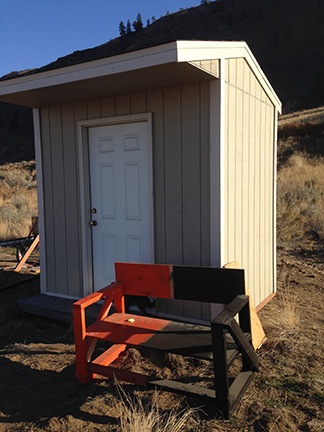
Inside the shed was a silly little bench.

Inside, I found an odd homemade bench that was likely painted in the school colors. I dragged it out. Although it needs a little work to be usable, I think it would be perfect for what I’ve begun calling “lookout point” — a part of my land that sits in the northwest corner, with completely unobstructed views of the Wenatchee Valley and Columbia River before my land drops off steeply to the valley below. I’ll move it over there the next time a friend drops in and paint it the next time the weather forecast includes several consecutive clear days. Or, more likely, I’ll just leave it where it is with a tarp over it and wait until spring to fix it up and put it in place, probably with a nice cushion. (I’m pretty sure I took the cushions that were on the teak recliners back in Wickenburg. Side-by-side, they’d be perfect.)

I spent the rest of the afternoon stowing my yard tools and basement items neatly inside the shed. It’s a shame the door was mounted opening in; that really cuts down on usable space. But I have some shelves from Ikea (also taken from my Wickenburg home) that I can assemble in there to increase the amount of storage space. And a few hooks on the walls would likely make it even more usable. The man I bought it from suggested a loft — the ceiling is 10 feet at the peak — but I don’t think it’s worth the effort. We’ll see.

Overall, it was exactly what I needed for convenient, cost-effective storage of pesky basement and yard items. It’s great to get all of that stuff out of the elements without having to take them to my hangar.
Bees: Moving Them to Their New Home

I bring my bees to my Malaga home.

I started my beekeeping hobby in June 2013 and have been blogging about it periodically. If you’re interested in reading the other posts in this series, follow the Adventures in Beekeeping tag. Keep in mind that the most recent posts always appear first on this blog.

Although I started keeping bees back in June 2013, I didn’t have my own place to keep them until much later that summer. Some beekeeping friends of mine generously offered to let me keep them on their very large lot in North Wenatchee. Jim set up an area for me that included a raised platform and even went with me when I bought the bees, in a nuc, and brought them back to their new home. I blogged about that here.

Later, I caught a swarm, which gave me a second hive. Because that happened right around the time I was moving to a friend’s property in Wenatchee Heights, I set that hive up there. Still later, when I decided to split my original hive to prevent them from swarming, I set up that third hive at my temporary home in Wenatchee Heights. Later in the summer, the lack of food there made it more practical to keep all my hives together in North Wenatchee where there was ample clover as a food source. So I moved the two hives there to be with the original hive.

In the beginning of October, I finally moved my RV to my 10-acre lot in Malaga. It was time to move my bees to their permanent home.

The Bee Shelter

Knowing that my bees would be facing a cold winter in a place that might get a lot of wind, I prepped a site for them prior to retrieving the hives from my friend’s house.

I chose a location close enough to my RV to make it convenient to visit them but not directly in my view of the valley. Because there’s a tall cliff to the south of my land, sunlight during the winter months is limited; I chose a location on the northern edge of my building area — a place that would get sun as early as possible in the day.

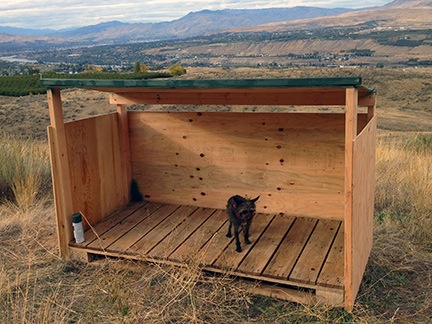
Once the site was chosen, I built a shelter on it. I had a very nice oversized palette for the floor. I set it out on the site at a slight slant that would ensure the hives would drain if they ever got rained in. I bought some lumber at Home Depot, cut to my specifications. I also bought some high quality wood decking screws; I wanted to be able to disassemble and reassemble the shelter without stripping screw heads.

My Bee Shelter
My completed bee shelter (with tiny dog for scale).

I’d bought a good battery operated drill earlier in the year and I took it and its spare battery out to the bee shelter site. I used it to drill pilot holes for the screws and to screw the shelter’s pieces together. Within an hour or so, I had a very basic shelter built: a frame with three walls and a slanted roof.

I’d bought some indoor/outdoor spray paint with the idea of using it to paint the shelter; I wound up using it to paint the 2×4 frame. Much later, after the bees had been moved in, I painted the plywood panels with outdoor paint and a roller.

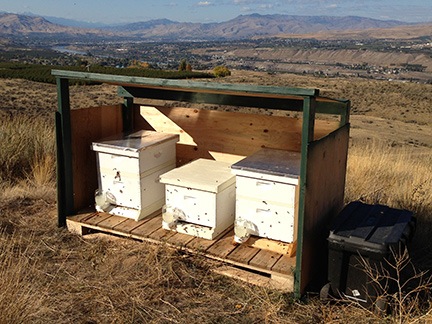
The shelter faced south so when the sun reached it, the front of the beehives would be bathed in sunlight. That would help keep the bees warm and encourage them to go out.

Moving the Bees

Late one afternoon when the shelter was finished, I drove to my friend’s house where my bees were living. By then, most of the bees had gone in for the day. I stuffed rags into the hive entrances to secure them inside. I’d move them in the morning.

The next day, I returned with my pickup truck and a new package of ratchet tie-downs. I used the tie downs to secure the hive components together. One of the hives, which had just one deep hive body, was relatively easy to move; I lifted it onto the bed of my truck without much trouble. I figure it weighted somewhere between 60 and 80 pounds. The other hives were heavier. Each consisting of two hive bodies — one deep and one medium — filled with frames, they probably weighed in at over 100 pounds each. Although my friend was keeping me company while I worked, she was unable to help me due to a back problem. So I called a friend who showed up within 30 minutes. Together, we lifted the hives onto the back of my truck. (Thanks again, Bob!)

I drove to Malaga, making a quick stop at the supermarket along the way. That’s when I realized that some of the bees had escaped from one of the hives. There were about 500 of them clinging to the side of the hive box. Another hive had shifted off its base and bees were escaping. I drove the rest of the way to Malaga watching the other drivers’ reactions every time I stopped at a light. I hoped no one had a car window open — bees were flying all around the back of my truck!

At my place in Malaga, I backed my truck right up to the bee shelter. By then, hundreds of bees were flying all around the back of the truck. They were not happy. But I didn’t rush. I took my time pulling my bee suit, veil, and gloves on. I filled the smoker and lighted it. And then then I got to work.

I didn’t need to lift the hives out in one piece. I could take them apart and reassemble them on the floor of the shelter. I actually wanted to do this — I’d purchased two screen bottoms for the two hives that had standard bottoms. The only way to put the new bottoms on those hives was to reassemble the hives on top of the new bottoms.

I did the hives one at a time, ignoring the angry bees swarming around me. Penny kept her distance. (Smart dog.) It probably took about an hour. I did a mini hive inspection while I was at it, trying to gauge the health of each hive and the amount of stored honey the bees would have for the winter. I also treated each hive with Apiguard to kill any mites. That required the addition of a spacer on each hive.

My Bees in their New Shelter
By early the next day, the bees were all settled in.

When I was finished, I went back to the RV, leaving the truck where it was. Once I was sure I hadn’t been followed by bees, I stripped out of my bee suit and had lunch. Later, I went back to the truck, gathered loose items together, and moved it away from the bees. Still later, when they’d calmed down a bit, I filled their feeders and put them at the hive entrances.

The next morning, after the sun hit the hives, I went out to take a look at them. The bees were flying around like normal. But what made me very happy is that they’d found the sagebrush flowers on the plants that grew along my driveway and seemed to be feeding on them.

The move had been a success.

One Solution for End of Life

Choosing your time to die.

I went out to eat with a group of friends yesterday. These are like-minded folks I met on Meetup.com, Freethinkers. We meet monthly for dinner. During the summer months, we have potluck BBQs in a park along the Columbia River. Now that the weather has cooled down and days are shorter, we’ve taken our meetings indoors. We ate at Thongbai, a great Thai place in downtown Wenatchee, yesterday.

It was a great night out. I think there were at least 20 of us all seated around an L-shaped table in the back room. Lots of good conversation. But there was a pall hanging over some members of the group and it wasn’t until after we’d ordered our food that I discovered why: two of our members, an elderly couple, had killed themselves in late September.

Charles was 81; his wife Ruth was 97. Ruth had health and mobility problems and could not live without assistance. Charles may have had health problems, too. They’d moved out of their house and into a Wenatchee condo in 2011. In late September, Charles arranged his affairs and got into his car with Ruth in the condo’s garage. He used a semi-automatic handgun to kill Ruth before shooting himself.

After dinner, we discussed their deaths and our thoughts about the situation in some detail. One by one, we each offered up our own opinions. They were remarkably similar: we all believed that a person should have the right to end his/her own life when the quality of life deteriorates. What made us all sad was the violent method Charles had used. We wished they could have gone out together more peacefully, hand-in-hand while they drifted off to that last sleep.

Their situation really struck a chord with me. In October, my godfather was approaching the end of his life. His quality of life had faded to the point where he probably wouldn’t have considered it worth living. I went to visit him one last time, dreading the thought of seeing him a shadow of his former self but wanting to offer him some kind of comfort in his final days. But I didn’t get there fast enough; he died the day before I left Washington. As I wrote last week, I felt good that his suffering was limited and his death was relatively quick. He didn’t need to take action as Charles and Ruth had; I doubt he would have anyway. I was just glad that he didn’t have to suffer longer than necessary.

My friend sitting beside me at dinner last night had another suicide story. Today, she’s heading over the mountains to the Seattle area to attend the funeral of a 23-year-old girl who had taken her own life. No one knew why. She was young and pretty and had a lot going for her.

In my mind, I think about the differences in these people. Charles and Ruth, together their entire lives, facing the decline of body and mind that comes with old age. Making the decision to end their lives together before they’re too far gone to make that decision (and take action) for themselves. And this 23-year-old girl, with her whole life ahead of her, bowing out without trying to live. I can understand Charles and Ruth’s decision, but can’t understand the girl’s.

I’ve written about suicide more than once in this blog. It seems to be a topic I can’t avoid — I’ve been exposed to it more than what’s natural. The Conrail engineer’s stories about people who’d purposely stand or lie or park on the railroad tracks, knowing the train couldn’t stop. The suicide I witnessed back in 2004. The artist who hung himself in one of my rental apartments. The new tenant who killed herself before even moving in. The friend who dove into the five-story atrium at work. The cousin’s girlfriend who dove off the roof of her apartment building.

Every situation is different, every situation is tragic in its own way. Every situation makes me think hard about what was going on in their heads when they committed their final act.

But as for Charles and Ruth — although I’m sad about their demise, I understand their decision. They chose to die when they were ready.

Buying Native Plants

My order is in for spring!

I get a lot of mail here — a lot more mail than I got in Arizona. I’m still trying to figure that out.

Among the mail I got this week was a four-page newsletter from the Cascadia Conservation District. I’m not a member — at least I don’t think so. I think it just went out to everyone.

Quaking Aspen
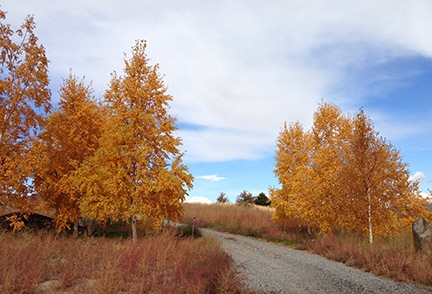
I shot this photo of quaking aspen trees at my neighbor’s home last month. I ordered 20 bare root stock aspen trees and hope to have my own grove growing next year.

This particular issue had an order form for the 2014 Native Plant Sale. I was thrilled to find bare root stock of native trees at very affordable prices. For example, a bundle of ten 12-inch Quaking Aspen trees was only $15. The same price applied to other trees that interested me: Blue Elderberry (which has edible berries), Red Osier Dogwood (which has red bark in winter), and Woods Rose. And if I wanted Ponderosa Pines — which I do, but not right away — I could get a bundle of 25 trees for $20 or 200 for $120.

There were more options on the order form, but I just chose the ones listed above (except the pines). I chose them primarily because they’re fast growers and they flower at various times of the spring or summer. (My bees will like that.) As for the aspens — well, I just love aspen trees. I mean, who doesn’t? You can download an illustrated brochure of all the plants here.

What’s best about all this, though, is that these are native trees — not something from out of the area brought in to Home Depot or nurseries just because people like them. I think it’s important to landscape with native plants. Not only are they more likely to do better locally, but in this area, they’re likely to need less irrigation or soil supplementation.

The order form requires me to submit my order with at least 50% payment by February 14, 2014. But because I know I’ll forget if I put it aside, I filled it out today and will mail it in when I drive down to town later. Plant pickup will be on April 5, 2014. In the meantime, they’re also offering a “Native Planting 101” Workshop in February, which I’ve already signed up for.

So yes, in April I’ll be digging a lot of little holes. But I’m excited about moving forward with landscaping on my property. This looks like a great way to start.

My New Old Toaster

Real retro.

As I’ve blogged elsewhere, I was in the New York area late last month. I tried to see my godfather one last time before he passed away and missed him by two days. I went anyway and spent some time with family members. I also helped my mom and cousin sort through my godfather’s belongings in preparation for auctions, estate sales, and the eventual sale of his house. I blogged the details of my trip here.

One thing I learned about my godfather, Jackie, is that although he often received gifts that he didn’t want or need, he never returned them. We found many brand new items still in their original boxes or with tags still on them. He had, for example, at least 5 blenders, three of which were still boxed. (One, which he apparently used, looked like an original Vitamix.)

My New Old Toaster
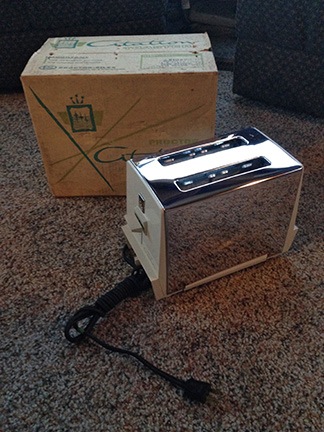
Who needs a fake retro toaster when you can have a real one?

Among the things we found was a Proctor Silex toaster in a never-opened box. I mean, the box still had those big staples across the top holding it closed. The price $9.99 had been penciled in on one side. I opened the box and pulled out a shiny circa 1966 chrome two-slice toaster. I was in awe. The damn thing was nearly as old as I am and it was in absolute mint condition. (Obviously, I can’t say the same thing about me.)

I didn’t own a toaster. I haven’t ever owned a toaster. I always had toaster ovens. Toaster ovens are nice appliances to have, but they generally do a crappy job making toast.

I think I must have shocked my mother and cousin when I asked if I could have it.

I packed the toaster in its box into my luggage when it it was time to go home. I wondered whether it would raise any red flags with the TSA when it went through their X-ray machines. I hoped that if they opened it, they wouldn’t get fingerprints all over that nice chrome.

At home, I put it on my countertop.

I didn’t use it until today. Two reasons. First, I don’t eat much toast. The reason for that is that I didn’t have a toaster and wasn’t in the habit of eating toast. Also, I try to avoid unnecessary carbs. Second, I was kind of afraid to try it. Afraid that a 47-year-old toaster would spontaneously combust when I pushed the lever down. Or afraid to somehow “ruin” it by using it. After all, it wouldn’t be mint once it had some burned crumbs in the bottom.

My New Toaster in Action
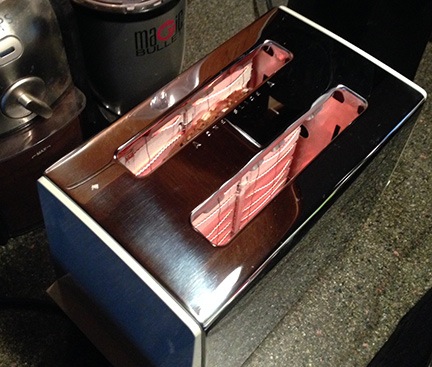
My new old toaster in action.

But today I took the plunge. I pulled a slice of 12-grain bread out of a bag in the freezer and popped it in. I pushed the lever down. I watched the metal filaments glow red. I stood ready to pull the plug and grab the fire extinguisher if need be.

In the end, all I had to do was push the lever back up when I realized that my toast was getting overdone. I guess I need to play with the darkness adjustment next time.

I spread cashew butter on the toast. It was delicious.