It’s mostly disappointment and frustration.
I rant about Facebook a lot. I used to confine my rants to this blog and to Twitter. But recently, I’ve begun ranting on Facebook.
Well, in this particular instance, I didn’t really consider it a “rant.” I mean, I know how to rant and a two or three sentence comment on Facebook falls far short of what I’m capable of. However, it was labeled a “rant” by someone whose opinion I usually trust and respect, so I’ll let it wear that label.
The Backstory
What was it about? Well, it was related to my big rant here, “Stop Asking Me to Echo Canned Sentiments in My Facebook Status,” in which I criticize the popular practice of “sharing,” via copy and paste, something written by someone else and asking your Facebook friends to post it as their status. There are people on Facebook who lean heavily on this practice to fill their own statuses with content. Indeed, some people’s status streams consist primarily of this kind of content. I can only assume it’s because they can’t think of anything original worth posting.
It wouldn’t be so bad if these things were interesting or enlightening in some way. But they usually aren’t. They’re usually gushy sentiments about moms or cancer recoveries or happiness or kids. Like a never-ending stream of Hallmark greetings that don’t even rhyme.
I solved the problem of being bombarded by these things by simply turning off the status updates for the people who did it 90% of the time. That really improved Facebook for me.

This is an example of what I mean. Yes, it’s a thoughtful quote by John Lennon. My problems with it: (1) seeing it about 10 times from 10 different people over the course of a week and (2) the absolute lack of discussion of what Lennon may have meant by this and what we could learn from it. No commentary; just a bunch of “likes.” (Note the typo in this version.)
But then came the offshoot: a pithy slogan or saying rendered as text on an image, sometimes with a graphic element or photo. People would put these “pictures” on their wall. Although friends weren’t usually asked to share them, apparently lots of people thought they were worth sharing and did so. So the same handful of images kept appearing in Facebook updates posted by my “friends,” over and over.
What I find odd about this is that this practice was picked up by people who hadn’t participated as much in the copy-and-paste status craze. This was being done by a few people who normally share things far more interesting. I couldn’t understand why they had slipped to this level. Since occasionally they’d still post something of interest to me, I couldn’t simply turn off their updates.
So I posted my own update, asking people to stop this practice. Although I got an “Amen!” or two from folks who obviously felt the same way as I did, I was also accused of ranting.
Oh, well.
What Social Networking Means to Me
I think the root of the problem is the way I look at social networking.
I have a primarily solo existence. I work from a home-based office and, other than my dog and parrot, am alone all day. I now live in three different places throughout the year, so I don’t have many solid personal relationships with friends. Sure, there are folks I could call to go out to lunch or dinner or join me for a helicopter ride. But my relationships with these people aren’t so strong that I see them daily or would call one to cry on his or her shoulder.
This might sound like a lonely existence, but it’s not. I’m the kind of person who keeps busy all the time. I’m juggling two careers and often have work to do for either one. And if I’m not working or doing what needs to be done to line up the next job(s), I’m blogging or reading or editing video or exploring my surroundings with my Jeep or helicopter and camera. Or doing countless other things to fill my time and my mind.
The point is this: People who work in offices or with other people get social networking at the workplace. I don’t. People who live in one place and have a network of friends and family members nearby get social networking during their off-work hours. I don’t. Although I can’t classify myself as “lonely,” I also can’t deny that I miss social interaction with other people.
Social networking by computer fills this gap. It enables me to get a dose of personal interaction with other people whenever I need one. Twitter is my office water cooler — and it has been for the past 4-1/2 years.
Twitter vs. Facebook
I was drawn to Twitter right from the start. Facebook….well, not so much.
On Twitter, I follow people from all over the world. The vast majority of them are complete strangers — people who I have never met and likely never will. (I have, however, over the past 4-1/2 years, met quite a few of them.) And I only follow about 130 people because that’s the maximum number of tweeters I can keep up with.
On Twitter, I can be picky and choosy about following people. As a result, I follow people who I feel are interesting. They either tweet interesting or funny or enlightening things or they share links and photos that are interesting or funny or enlightening. I can also keep the signal to noise ratio very high by simply following or unfollowing people.
I learn about current events from what scrolls by in my Twitter timeline when I sit at my desk: the ditching of a plane in the Hudson River, Michael Jackson’s death, the east coast earthquake — the list goes on and on. It’s almost like having a news radio station turned on low in the background while I work. Getting more information about a news story I read is as easy as clicking a link in a tweet or doing a quick Google search.
I interact with the people I follow on Twitter. I do this by replying to them. Often we get conversations going. Sometimes other people join in. It’s a nice break from my work day.
I know a lot about some of the people I follow on Twitter. When I see content on the Web I think would interest them, I tweet it, sometimes with an @mention so I’m sure they’ll see it. Some of them do the same for me. I get links to tons of interesting content via my Twitter friends. It really helps expand my horizons and give me new things to think about.
[It’s interesting to note here that my attention span is longer than two to four sentences. So although so many people on Facebook echo the short, pithy sentiments of others, many of the people I follow on Twitter link to full-blown articles that have been researched and carefully crafted by writers who know how to make a point. It’s substance, not fluff.]
Although there is a tiny handful of people I follow on Twitter that don’t always tweet interesting content, 140 characters seems a lot easier to ignore than longer, in-your-face passages of text or images.
Facebook, however, is different. Until recently, the only way you could “follow” someone on Facebook was if that person agreed to be your “friend.” The relationship was always two-way. (On my account, it still is; I currently don’t allow “subscribers,” although I’ll likely change that soon.) So if a person asks to be your friend and you say no, that person gets insulted. This is particularly awkward if the person who wants to be your friend is a real friend or family member that you prefer to keep at a distance. (This happened to me with my stepsister’s teenage son, who I have not seen since he was an infant and have no desire to be Facebook “friends” with.)
Of course, Facebook recently added all kinds of privacy controls so you can group your friends in a variety of ways and pick and choose which groups see which content you post. This adds a level of complexity that I simply don’t want to deal with. I don’t want to “manage” my friends.
And it’s pretty obvious that the people I’m friends with on Facebook don’t give a damn who sees what they post. One young family member who will soon be entering the job market is posting unflattering photos of herself at parties, along with the kind of inane commentary that may get her resume shuffled to the bottom of any pile it ends up in. And, of course, there’s that constant stream of second- or third-hand quotes and images that apparently everyone has to see.
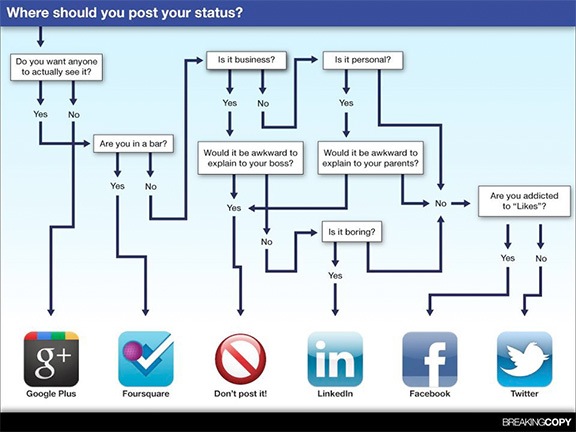
And that brings up the excellent flowchart shown below. One of my friends posted it on Facebook and its one of the few Facebook images I felt good about sharing. Funny, yet informative and oh-so-true. The one thing my Facebook friend didn’t share was the source; here it is. (Tip: Linking to the source is an excellent way to reward content creators for sharing good, original content. Just saying.)

Are Facebook Users Addicted to Likes?
Note the two bottom-right icons in this flowchart: Facebook and Twitter. What’s the difference between them? Whether you’re “addicted to likes.”
You see, on Twitter, there is no “like” button. If people like what you’ve tweeted, they can respond in one of two ways:
- Retweet it. Depending on how they retweet it (via Retweet button or use of the old RT notation), you may never know your content has been been retweeted.
- Reply to it. If you’re paying attention and actually reading incoming tweets, you can enjoy the pleasure of entering into a conversation with a fellow Twitter user — who might not even be someone you follow. (This, by the way, is how I find people to follow in Twitter; they interact with me.)
I suspect Facebook users are addicted to the Like button. They seem to click it an awful lot. And so much of what they post is what I call “Like bait” — content found elsewhere that other people liked.
So instead of sharing fresh new content and ideas with their friends, too many Facebook users take the lazy way out by simply posting short content created by others.
(Many Twitter users do this, too, of course. I just don’t see it as much because I simply don’t follow the people who do.)
Enter Google+
You may scoff at Google+ — as the above flowchart also does — but when it first started, it definitely had something interesting going for it: people were using it to communicate thought-provoking ideas. Indeed, it was almost blog-like at times, with relatively lengthy posts that had real substance and originality.
As you can imagine, I was really drawn to that.
Unfortunately, when Google+ went public, it attracted some of the same folks who are already on Twitter and Facebook. And guess what? Those folks are posting the same stuff they put on Twitter and Facebook. So the signal to noise ratio has considerably dropped over the past few months.
The good thing about Google+ is that there’s no “friend/friend” relationship. It works more like Twitter, so I don’t have to worry about insulting people. I “circle” the people I find interesting and drop the others. Or use filtering (now also available on Facebook) to narrow down whose posts appear in my stream. (And yes, I realize this is a form of friend management and no, I’m not happy about it; I’ll likely just drop the people I don’t find interesting and skip the filtering.)
Will Google+ replace Facebook in my social networking source list? Too soon to tell, but probably not.
You see, I’m not convinced I need either one of them.
Sucking Time with Little or No Benefit
The reality is, Facebook (and Google+ and LinkedIn and whatever else is out there) is a frustrating time suck. (Twitter is, too, but not nearly as much — at least not the way I use it.)
To me, Facebook is more frustrating than rewarding. I’m learning things about friends that I never wanted to know. I’m discovering that some of the people I thought were intelligent and thoughtful are really kind of dumb and shallow. I’m discovering that some of the people I respected don’t act as if they respect themselves.
I’m frustrated because in Facebook, I see a microcosm of America as a whole: a mostly politically apathetic people who value celebrities, fashion, and luxury goods over meaningful personal relationships and intellectual development, an attitude of caring for their fellow man, and an understanding that there’s only one shot at life and they need to make the most of it.
The time suck problem goes almost without saying. If you participate in social networks, have you ever tracked how much time you spend on them? According to this New York Times post:
Social media account for 22.5 percent of the time that Americans spend online, according to the report, compared with 9.8 percent for online games and 7.6 percent for e-mail.
And this Mashable piece breaks it down for Facebook:
The average U.S. user spent a whopping seven hours and 46 minutes on Facebook in August [2011]. That’s a full 15.5 minutes the average American spends on Facebook every single day.
Nearly eight hours in a month? That’s nearly four full days a year. Do you really want to spend that much time looking at content that really isn’t going to make a difference in your life?
I don’t.
So I’m off Facebook again, at least for a while.
Sure, my blog posts — including this one — will automatically be listed as a Facebook status; that’s done automatically by some Web-based app I set up years ago. And I will stop by to check on Flying M Air and Beaumont Cellars. And you might even read updates about my new books and appearances there as they are released. And I’ll try to come by weekly to follow up on any comments posted to my updates. But I probably won’t hang around long enough to click any Like buttons or challenge the meaning of John Lennon’s wise words. I’ll avoid a lot of frustration by staying away.
And my friends won’t be bothered by my “rants.”

 It’s pretty big news, every once in a while, that the U.S. Postal Service (USPS) — which is not funded by tax dollars — is on the verge of going broke. Then they raise rates by a few pennies and the hubbub dies down.