Moments to Remember

A drive through the desert on a starlit night.

Ever have one of those moments you wish you could remember for the rest of your life? I’m not talking about simple recall here. I’m talking about remembering with the detail you need to relive the experience in your mind.

I had one of those moments [again] on my way home from Phoenix last night. I’d driven down in the afternoon to pick up my husband, Mike, who had driven his Honda down that morning to pass it on it its new owners. I took my Honda S2000, which is a convertible, and because the weather was so perfect yesterday, I had the top down. After dealing with traffic on the afternoon drive through Phoenix, I finally connected with Mike on Chandler Avenue (or it is Boulevard?) in Ahwatukee. From there, we headed back into Phoenix, to one of our favorite restaurants: Tarbell’s on 32nd Street (I think) and Camelback. After a wonderful meal full of interesting flavors and textures, presented with perfect service, we climbed back into the Honda and headed northwest for home.

Tarbell’s is probably about 60 miles from Wickenburg. We took Camelback west to the 51, followed that north to the 101, and took that west to the 17. Then north to Carefree Highway and west to Grand Avenue and northwest to Wickenburg. I had my iPod plugged in, playing just below distortion volume on my Honda’s very disappointing stereo system. (The 2003 model year did not include speakers behind the headrests; what were they thinking?) I’m used to the less than satisfactory sound quality competing with road and wind noise, so I enjoyed the classic rock — mostly 70s and 80s — that I made Mike listen to. (The rule is, the driver chooses the music.)

The drive north on the 51 at night is always interesting. On most nights, you can see the landing lights of the jets on their way in from the north to Sky Harbor Airport just southeast of Phoenix’s downtown area. Last time I took this route home, I’d spotted at least eight aircraft, lined up into the distance. But last night, there were never more than four.

We stopped for gas at Carefree Highway — last gas for about 30 miles. My Honda gets between 25 and 30 miles per gallon, depending on how I drive. Because I don’t drive it very often, I tend to drive in a way that gets me lower mileage. (Hey, girls just wanna have fun, right?) But on a long highway drive, if I keep my speed down near the speed limit, I can go far more than 300 miles on a 13-gallon tank of gas.

Then came the part of the trip I’d like to store in my brain for periodic detailed recall: the drive west on Carefree Highway. It was about 7:30 PM, and even though it was a Friday night and Carefree Highway is a favored route for the Phoenix to Las Vegas crowd, there weren’t many people on the road. Once I passed the new Game and Fish Building (with its deplorable new traffic light) and rounded the bend at Lake Pleasant Road, I brought the car up to speed, set the cruise control, and drove while classic rock blared out into the night.

It was dark out there — it usually is at night — and a slim crescent moon hung in the sky, bright side down. I say “bright side” because the sky was so dark, you could clearly see the entire moon, even though most of it wasn’t illuminated. The crescent hung there in front of us, surrounded by stars, sinking ever lower into the sky. Above us, the sky was black as — well, black as night, to use an appropriate cliche. There were more stars than a city dweller could imagine; so many, in fact, that it was difficult to pick out the standard patterns of the Big Dipper, Orion’s Belt, and the Pleiades among them. And being that the sky was perfectly cloudless, those stars stretched in every direction.

What I should have done was pull over to a safe spot off the road, killed the headlights, and spent some time just looking up. Because frankly, when you’re driving 65+ miles per hour on a two-lane road in the middle of the desert at night, you really can’t steal too many glances at what’s directly above you. What’s in front of you is far more important to monitor.

Yes, it was cold — probably in the low 50s. Although the top was down, Mike had his window up and the heat was on. And yes, I hate the cold. But the cold was part of the entire experience: dark night, fun car, open roof, loud music, crescent moon, countless stars, cold wind.

The moon dipped behind a hill as we got onto Grand Avenue and drove the last ten miles to Wickenburg. In town, the carnival at the Community Center offered a bright contrast to the otherwise dark night. Town was surprisingly empty at 8 PM on Wickenburg’s big Friday night of the year.

I drove home, coming down from the kind of high you can only get from having real fun.
Go RVing?

Two photos from our first real campground experience.

I’ve been camping since I was a kid. My family camped with an elaborate setup of tents and equipments on family vacations until I was about 11 years old. That’s when my dad caught a nasty cold and decided on comfort. My parents bought a 22-foot Prowler pull trailer that could sleep seven [little] people. That gave us all the comforts of home.

My family always camped in campgrounds that had at least partial hookups, even when we tent-camped. Mike and I, however, have always favored “dry camping” on public land and parks. We’re not the kind of people who like to be compartmentalized in a parking spot surrounded by other campers. Once, when we were camping at a park in Hawaii, everyone else set up their tents in a big field. We passed all that up and set up our tent on a cliff overlooking the ocean. At night, we could see the lights of the big island in the distance, we listened to the sound of the restless sea’s waves on the rocky shore below us — not our fellow campers.

Anyway, about a year and half ago, in preparation for a summer-long helicopter gig that didn’t happen [yet], I bought a 21-foot pull trailer. We’ve used it a number of times for helicopter gigs: at the Mohave County Fair, Big Sandy Shoot, COPPERSTATE Fly In, etc.

The camper is rigged for dry camping. It has a solar panel on the roof that keeps its batteries charged, so we have plenty of power for the lights and stereo and water pump. It holds 40 gallons of fresh water and has gray water and black water tanks to hold what goes down the drain or down the toilet. The fridge and water heater run on gas. Water is our big limiter; if we take very short showers every other day and use paper plates for all meals, we could probably last a week. But if we’re out for longer than three days, we bring extra water in up to four 7-gallon containers.

Most recently, we used the camper for a weekend-long stay in the Parker area, where I’d been hired to do an aerial photography gig of the Parker 425 Off-road race. Since we’d planned to bring Jack the Dog and Alex the Bird with us and since our camper isn’t very easy to keep warm on cold desert nights, I decided to reserve a spot in a campground. We wound up in Buckskin Mountain State Park (highly recommended if you don’t mind camping in a pleasant parking lot), right on the Colorado River. And for the first time ever, we had a full hookup: water, electricity, and sewer.

The main benefit of this is that we could use a very quiet electric heater to keep the camper warm at night. The gas heater that’s part of the camper has a very loud fan and goes on and off all night long. With the electric heater — which our batteries could not run — we got a very comfortable good night’s sleep.

Which is kind of important when you plan to spend the next day chasing off-road racers with a helicopter.

Anyway, after the race gig, Mike and I came back to the campground. We took Jack the Dog for a walk up to an overlook right above the campground. And that’s where I shot this photo. It reminds me of all those Go RVing commercials they have on television. It also shows what Arizona is like in the winter time, when the snowbirds come around in their $300,000 motorhomes and set up in transient RV neighborhoods like this campground.

 
In case you’re wondering, our camper is the small one just to the right of the big spread of green indoor/outdoor carpeting. That’s where our next door neighbors had set up an enclosure for their tiny dog, which spent all of its time on the dashboard of their motorhome, yapping at whoever went by.

And because you know I can never leave an interesting scene without trying that fisheye lens, here’s another shot from the same spot. That’s the Colorado River bending around the campground. The 10.5mm lens exaggerates the bend a bit, but it really does bend quite sharply here, making an interesting spot along the river.

 
And, for the record, neither of these shots have been cropped.

Chasing Desert Racers

At the Best in the Desert/BlueWater Parker 425.

I spent this past Saturday doing one of the things I really love to do: chasing racecars with a helicopter.

The venue was the Best in the Desert Racing Association’s BlueWater Resort & Casino Parker 425, which featured highly modified trucks, cars, and buggies racing on a 140+ mile dirt track through the desert. My client was a television producer who videos these events from multiple cameras and turns them in TV shows. For this event, they had a total of 15 cameras, includibut thingsng one in my helicopter and several in the trucks out on the course.

I flew the helicopter with the cameraman and my husband, Mike, working as a spotter, on board. The cameraman sat behind me with his door off. Mike sat beside me.

We started before dawn at the Parker Airport. I started up at 7 sharp and was warmed up and ready to fly by 7:15. The police escort was leading the 300+ participant vehicles to the starting line on Route 95 in downtown Parker when we began circling about 500 feet overhead. The cameraman had a list of 15 targets he needed to video. The first one was the 15th truck in line at the start. Racers were released 30 seconds apart. When our first target was released, the fun began.

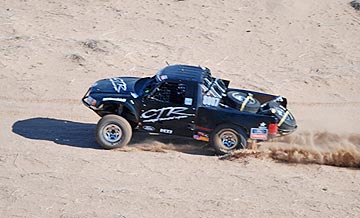
Desert Racing TruckI chased the car down the paved road and onto the dirt track, descending as I left the downtown area. Soon, we were racing beside it just 70 feet up on the long straightaway that heads due east. Mike kept an eye out for wires, calling them out as he saw them. My attention was split between the truck, the wires, and the track in front of me. I worked the cyclic and collective hard, climbing, descending, slowing, speeding up. Both arms and legs worked automatically to make the helicopter do what I needed it to do. Spectators below me went by in a blur. The track made a 90 degree turn to the left and I paused at the inside of the curve just long enough to pivot so the cameraman could keep the camera on the target. Then down the short straightaway to the edge of a steep drop with high wires on one side. The truck descended the hill while I climbed over the wires. I met the truck on the other side and we raced together through a tree-filled dry wash.

“Okay, peel off,” the cameraman instructed.

I turned away from the target and followed the road back. Now we had to find the next target. All we had were numbers — we didn’t know much about how the vehicle looked, other than what class it was in. I had to fly low enough to see them. The first one of us to see a number, called it out. We got the next target halfway back to town. I lowered the collective to slow down and made a sharp 180 degree turn. Then I was on that truck, following it to the wires and into the wash.

We repeated this process about seven or eight times, each time picking up our target a little farther away on the track and ending a little farther down the track. I got to know exactly where all the wires were. Sometimes, I’d look down in time to see a spectator wave up at us or snap a photo. I think there were more photos taken of us that day than of any one racer.

This went on for over an hour.

Then, suddenly we could no longer find any of the targets we needed to video. That started a search up and down the track, flying low enough to read the numbers. Every once in a while, the cameraman would pick out a “trophy truck” or a vehicle driven by someone well-known, and ask me to follow it. I’d follow as closely as I dared, putting the cameraman close to the action. Inside the helicopter, through our noise-reduced headsets, we could sometimes hear the engines of the racers below us or the sirens of the vehicles preparing to pass. We watched one driver slip off the track and race along beside it, scattering spectators who had been standing too close. We shot some video of a modified Hummer flying through the air after a particularly bad bump.

I suppose I should mention here that I wasn’t the only helicopter at the event. There were at least five others: 2 R44s, an Astar, a Eurocopter, and a Bell Jet Ranger. In most cases, they’d been hired to follow a specific race vehicle or team. Once they left the area, they didn’t come back for a while. So keeping an eye out for aircraft wasn’t a serious issue.

After two hours, we headed back to the airport. I shut down and placed a fuel order. Then we drove over to the BlueWater Casino for breakfast. The cameraman the cameraman met with some of the folks he works with to see how many vehicles on his list were still in the race. Each vehicle had a transponder and satellite communications device so it could be tracked from headquarters at the Casino. According to the cameraman, fewer than 50% of the vehicles finish the race. Most of them break. And if you saw the track, you’d understand why.

With an updated list, we headed out again just before noon. We were expecting one of the target vehicles in the pit area, so we stayed nearby. There was a “serpentine” area just east of the airport, with winding, bumpy tracks in a big field surrounded by spectators. I think there was about 5 miles of road there, and it was so twisty that even from the air, I had trouble figuring out the route. We spent about 15 minutes there, filming the action of vehicles skidding around the sandy curves, throwing dust high up into the air. At some point, I realized that I was probably putting on a better show for the spectators than the cars and trucks were.

We spotted a target vehicle as he was leaving the pits and took off after him. More chasing at low level, avoiding wires, slowing when the truck slowed, speeding up when it speeded up. We peeled off and continued down the track, looking for more targets. That’s when we started seeing the breakdowns. Trucks and cars and buggies on the side of the road with parts peeled off of them and drivers bent over their innards. One team was changing a tire. Another was taking the hood off the car. We saw a fender alongside the track. Later, we saw a prone driver with his companion performing CPR. (The rumor I heard was the driver suffered a heart attack or stroke while driving and died on the race course. I have not been able to confirm this yet.)

Desperate to find one last vehicle on the cameraman’s list and looking for exciting footage, we followed the entire 140-mile course. It stretched from Parker through the empty desert as far east as Cunningham Pass (north of Wenden) and around Planet Peak (near the Bill Williams River) to the northwest. This much-reduced map gives you an idea of the distance — I’ve highlighted the track in light red so it’s easier to see.

Parker 425 Map

Much of the course was pretty boring from my point of view — lots of long, straight stretches. In one area, the road ran alongside a set of high tension power lines, making it tough to get low enough to see car numbers. But things got interesting on the last 4 or so miles, when the track headed into the mountains south of the Bill Williams River. The cameraman got some excellent footage of a car winding its way down a narrow canyon. I had to stay high — there wasn’t enough room for me to fly alongside it. But when the canyon opened, I dropped down so he could get some close-up shots.

After trying a few more times to find the missing buggy — we were in touch by radio with the satellite tracking people — we headed back to the airport and I shut down.

We’d flown a total of 5.0 hours. The sky had clouded up and lighting wasn’t as good as it had been earlier in the day. Although we’d planned a third flight for the finishers, the cameraman. The cameraman decided to skip it.

It had been a great day. Not only did I do a lot of flying, but it was the kind of flying I really love to do — challenging, exciting, and with a goal other than going from point A to point B.

Why can’t all my gigs be like this one?

Note: If you were at the 2008 Parker 425 in February and have photos or video footage of a plain red helicopter (no stripe) flying with the cars, please let me know. I’d love to show them off with this post or elsewhere on this site.

February 7, 2008 Update: I added a photo Mike took during the flight to give a better idea of what was going on at Parker.

How I Burned My Fingers

Simple: I did a dumb thing.

About a week ago Thurdsay, while making dinner, I burned the first three fingers on my left hand. Since then, the burns have gone through a series of nasty, ugly, painful stages. They’re healing now, though, because I finally started taking care of them.

How I burned them is an example of how relatively smart people can do seriously dumb things. In this case, I’d put about a half cup of water in a 1-cup Pyrex measuring cup and stuck the thing in the microwave to boil. I always boil water in a microwave (if one is available). I wasn’t thinking very well — there was a lot on my mind (as usual) — and hit the Minute Plus button twice. So when I removed the cup of boiling water 2 minutes later, it wasn’t just boiling — it was superheated. As I was moving it from the microwave to the counter top, I added about 1 teaspoon of beef bullion powder. The superheated water immediate boiled over the top of the cup and onto my fingers. I put the cup on the counter, shook the hot water off my hands, and proceeded to clean up the mess I’d made on the countertop, cabinets, and floor.

I didn’t realize how badly I’d been burned until much later. It hurt, of course, but I was busy doing other things and tried hard not to pay attention. Later, I bought some Bactine and kept spraying it down. The skin was red, but I didn’t think much about it.

The next day, my forefinger was blistered and puffy. My middle finger also looked pretty bad. More Bactine. I was volunteering at an equine endurance ride and I was busy. The blisters burst and reformed multiple times. (Hope I’m not grossing you out too much.) It wasn’t until the weekend was over and I really had a chance to clean up and look at my fingers that I realized how badly I’d been burned. My first two fingers probably had second degree burns.

I won’t go into more gross details about the skin on my fingers and the stages it went through. I will say that I finally started putting Neosporin (a triple-antibacterial salve, for those of you who aren’t familiar with it) on my first two fingers and wrapping them in special knuckle bandages. If I’d done that a week ago, I’d be all healed up. But I didn’t, so I’m not.

I’ll probably be almost as good as new within a few days. I suspect, however, that my forefinger will be scarred because of my stupidity. No hand modeling in my future.

Lessons learned: put containers of boiling water on the countertop before adding ingredients.

The Super Bowl is Coming!

Developments around the University of Phoenix Stadium in Glendale.

I’ve been doing flight training down at Glendale Airport for the past few weeks, working on my Instrument Rating at Silver State Helicopters. Two or three times a week, I drive or fly down there in the afternoon, spend a few hours sitting in a simulator trailer with a flight instructor, and fly or drive home.

The drive is long and boring. I found the best route though, thanks to my friends Ray and Robbie: Grand Avenue to Litchfield Road to Glendale Avenue to the airport. I can do it in just over an hour sometimes. It’s about 50 miles each way.

University of Phoenix StadiumGlendale Airport is just 3 miles or so from the University of Phoenix Stadium, where Super Bowl XLII will be held this Sunday. The other day, while waiting for the Glendale Tower controller to clear me across the runway, I overflew the stadium area. The grass was outside, looking rich and green. The top of the stadium was closed. A ferris wheel was under construction in the parking lot on the west side of the stadium and there were lots of party tents and other things going up.

The Super Bowl is apparently Glendale‘s chance at the “big time” and they’re doing everything they can to make it a big party.

At the airport, things are also changing. Glendale Aviation, which had been the FBO there for years, expanded its building and added a corporate hangar large enough to accommodate three small jets. (At least that’s how it looks to me.) It’s now called LuxAir — I guess you need a foo-foo name to attract football fans arriving by jet. Of course, since it’s the only real FBO there, there’s no competition at the airport. It’ll probably make enough money this weekend to cover the cost of the building addition and more. But it couldn’t have been timed any better; crews are probably putting on the finishing touches inside as I type this.

Last week, the ramp was completely full of small airplanes, like Cessnas and Pipers. Apparently, the guy who owns the hangars and shades evicted everyone while doing some upgrades, then raised the rents beyond what local pilots were willing to pay. Few planes went back. I guess their owners would rather roast their wings in the hot Arizona sun. But yesterday, the ramp was almost empty. They’d moved all the little planes under the shades or to the more remote parts of the ramp, leaving plenty of room for incoming jets. Even the DC3 that had been sitting there for months (if not years) had been towed to the far reaches of the airport ramp, tucked into a spot between the hangars and perimeter fence like a broken down truck in someone’s yard.

Inside the terminal, the lobby area’s furniture — a mixture of chairs and tables normally used by one of the flight schools for training and briefing — have been removed. In their place are leather chairs and tables, arranged in little chat groups. I can’t tell you how comfortable they are because I don’t know. They’ve roped the whole thing off with yellow caution tape so no one sits on them until the big money starts arriving. I’m willing to bet that next week, when I return, all that nice furniture is gone.

It’s almost as if Glendale Airport is putting on airs, like Scottsdale Airport.

Glendale Airport’s restaurant, which had been closed for months, reopened last week. It’s the same old place, but with new owners. I haven’t eaten there, so I can’t rate it. I’m sure they expect to do a good business over the weekend. Rumor has it that they’re going to do a buffet. Rumor also leads me to believe that they’re doing a buffet because they can’t deal with table service and they’re taking the easy way out.

Yesterday was my last afternoon at Glendale Airport until after the big event. I canceled Friday’s lesson so I could get an early start out to my weekend gig in Parker, AZ, chasing race vehicles around a desert racetrack with a film crew on board. Wickenburg is one of two area airports outside the 30-mile TFR (Temporary Flight Restriction) that’ll kick in around Glendale on Sunday afternoon, before the game, so even if I get back late on Sunday afternoon, I don’t have to worry about landing at my home base.

But I doubt whether Wickenburg will see the big jets. There’s plenty of room at Glendale and, thanks to the inability of Wickenburg’s Airport Consultants and Manager to plan for the future, only two jet parking spaces at Wickenburg Airport.

The above image of University of Phoenix Stadium is from Wikipedia and is licensed under Creative Commons Attribution ShareAlike 2.0 License (cc-by-sa-2.0). In short: you are free to share and make derivative works of the file under the conditions that you appropriately attribute it, and that you distribute it under this or a similar cc-by-sa license.