
Why I Think U.S. Health Care Needs Fixing

Three true stories.

Health care problems are in the news lately and I can’t help but think about the situation from my own very fortunate point of view. Fortunate because I have health insurance and the financial means to pay for care up to my $3,000 deductible. Too many people simply cannot afford either coverage or the deductibles, even when subsidized by an employer. I consider myself lucky.

I want to share three real life stories from my past to illustrate what I think is wrong with our health care system. Maybe you have similar examples. While I don’t know what the solution is, I know that something has to be done. Remember, I’m fortunate. People who don’t have my resources are basically screwed.

Knee Pain

Years ago, when I was still in my 20s, I fell while ice skating in Rockefeller Center. I vaguely remember the fall — I landed hard on my left knee. But I was young and I got up and kept skating.

A year or two went by. I began having problems with my left knee. A lot of pain when I sat with my legs crossed “indian style,” which I usually do, even while at my desk. I had a “real job” back then and insurance. I decided to see an orthopedic surgeon to see what was wrong with my knee. I had no idea whether it was connected to my ice skating mishap and still don’t. But it’s the only “injury” I can connect with it.

This began a multi-step process that completely tapped out my $1,000 deductible (at the time) and cost my insurance company many thousands of dollars. Here are the steps:

  • Initial consultation. Tell the doctor what hurts and when it hurts.
  • X-rays. Inconclusive — except to show that I was already showing signs of arthritis that was not likely causing this problem.
  • MRI. This is the test that fulfilled my deductible. It was also inconclusive.
  • Physical therapy. Twice a week, I drove to a physical therapy place about 15 miles from my home. I rode a bike, bounced on a ball, and fiddled around with some kind of resistance machine. I did this for two months. My insurance company paid $90 for each visit.

When my insurance “ran out” for the physical therapy, I went back to the doctor and asked if there was anything else he could do. He seemed not to believe I was in pain. He finally said that they could open it up orthoscopically and take a look. I’m not someone who wants surgery, but if that was the last resort, I was ready. I was tired of wasting time and money. If there was something wrong — and there certainly seemed to be — I wanted it fixed.

More steps:

  • Hospital pre-admission. They basically sent me to the hospital to learn how to use crutches. What f*cking waste of time and money that was! Fortunately, I didn’t need to buy a pair; I could borrow them.
  • Outpatient surgery. My doctor put two small holes in my knee area while I slept on a table in the O.R. He poked around in there and found I had a torn meniscus. It was torn in the shape of a triangle with a pointy tip that was evidently jabbing me when I crossed my legs. He cut off the torn part, and closed me. up. I don’t think it took him more than an hour to do everything.

I went home the same day. My knee was swollen. I think they gave me painkillers; I don’t remember much pain. I used the crutches the next day, one crutch the day after that, and a cane the day after that. Then I was pretty much back to normal. I don’t even have scars.

This was my first experience with the health care system’s ability to diagnose and fix a relatively minor but annoying health problem. I realized that a cure wasn’t possible until as many part of the health care system could get a piece of the pie as possible:

  • Doctor – Several consultations and surgery.
  • Physical therapy – don’t even get me started on that.
  • Hospital – X-ray, MRI, crutch lessons (that still pisses me off), and outpatient surgery services.
  • Support staff for surgery – nurses, anesthesiologist, etc.

But I was “cured.” I was happy.

Back Pain

Fast forward to the summer of 2008. I picked up something heavy while seated at my desk. This “threw out” my back. The pain didn’t begin immediately, but it began in earnest a day or two later. It became unbearable on a flight from Phoenix to Seattle with my husband. So bad that I found clinic in the Seattle area and was able to get in to see a doctor within 30 minutes of arrival.

The doctor started out skeptical. I think a lot of people must go to clinics to get drugs. Although I wanted something to stop the pain, I had to fly my helicopter to Arizona over the next two days. I couldn’t take painkillers. I wanted to know what was wrong and what I could do to fix it.

The doctor was good. After hitting my knees with a hammer and surprising me with the results, she had me perform several movements while seated and while standing. She told me I probably had a herniated disc and that I should ask my doctor for an MRI when I got home. She gave me some muscle relaxers and told me not to take them while I was flying.

I was impressed. Unfortunately, I wasn’t going home. I was going to Page, AZ. I figured I’d find a doctor there and follow her advice.

The flight to Arizona was painful, but not unbearable. It wasn’t until I was settled into my camper in a Page campground that the pain became more than I could bear. If I sat at my table for more than 10 minutes, when I got up I could barely walk. I was miserable.

I’d got the number of a local doctor from my health insurance company. But when I called, I was told that the earliest appointment was more than two weeks away. I set up the appointment, not seeing that I had any other choice. The pain got worse by the day. The only relief was when I lay flat on my back, and even that wasn’t making things better. I had to work. I couldn’t just lie around, waiting for a doctor’s appointment that might or might not resolve my problem.

One day, I simply couldn’t take the pain any longer. I found a clinic in Page and went. I signed in. Although the clinic was on my insurance, they wouldn’t accept my insurance. They wanted me to pay up front. There were at least a dozen people waiting in front of me to see a doctor. The wait would be at least two hours. The only seating was aggravating my condition. I was in so much pain that I was crying on and off. No one seemed to care. The other people waiting tried to avoid eye contact.

Finally, I got up and went across the street to the hospital emergency room.

Write this down: Page Banner Hospital. Now, under no circumstances, allow yourself to be taken to this place or any facility associated with it in Page, AZ.

There was no one waiting ahead of me, but I still had to wait 20 minutes to get help. I followed someone down a long hallway, struggling to keep up, since I could barely walk. A doctor came and asked what the problem was. I told him. He did a cursory examination — nothing at all like the doctor in the Seattle clinic had done — and found nothing. He thought I was there for drugs. I told him I wasn’t. I asked him to do a test — something that might shed light on what was wrong. I told him what the doctor in Seattle had said. He wasn’t interested. He sent me with a radiologist for an x-ray.

I was waiting back in the examining room, sitting on a metal chair instead of the examining table, trying not to cry, when I heard the doctor and another emergency room employee at the nurse’s station, chatting and laughing. The doctor told his companion how he liked to use some kind of drug to knock out unruly kids brought to the emergency room. They had a good laugh over that. It was as if I didn’t exist or I couldn’t hear them. They obviously didn’t care about me.

When I’d sat there long enough, the doctor came back in. He said he’d looked at the x-rays and there was nothing on them. He told me to go home and take aspirin.

This “service” cost me over $500. If I didn’t have insurance to negotiate the rates, it would have cost two or thee times that.

A few days later, I tried the clinic again. Ironically, I got to see the doctor I had an appointment for the following week. I gave her my story. She didn’t examine me thoroughly either. Instead, she signed me up for physical therapy.

I made two visits. The first one featured a piss-poor massage. I could have done better for about half the money at a good spa. On the second visit, they had me lie on my stomach and hooked me up to some kind of machine that put electric pulses through my body. Then they just left me alone in a room. After about 10 minutes, I started feeling sick. Five minutes later, I called for help. No one came. A bell rang and the machine shut off a few minutes after that. A few minutes later, someone came in to unhook me from the machine. I told her I didn’t feel well. She said it was because I’d been lying down. Then she left me to leave on my own. I got as far as the appointment desk before I had to sit down. If my back still hurt, I didn’t know it. It was all in my head — dizzy, lightheadedness — I can’t describe it. I asked someone to take my blood pressure. You think I’d asked them to give up their first born! They made me walk to an examining room where they hooked me up to a machine. I was at 180/110. So wonder I felt so bad! But did anyone there seem to care? No. The person who took my blood pressure simply said, “You should get that checked.”

I didn’t show up for the next visit. When they called, I told them they were making me worse. I nearly dropped dead the following month when I saw the bill for the two visits: over $500.

I started dosing up on ibuprofen. Three and four at a time. It kept me functional. I switched from megadoses of ibuprofen to tylenol and back. At night, if I knew I didn’t have to fly the next day, I’d take the muscle relaxants I’d gotten from the doctor in Seattle. The only time I didn’t have painkillers in my system was when I had to fly. But as soon as I was done, I’d dose up again.

This went on for about three weeks. Then, one day, the pain was a lot less than usual. And within a few days, the pain was gone.

Did I have a herniated disc? Had I somehow “fixed” it myself through normal movement? I don’t know. I’ll never know.

All I know is that I spent a lot of money for absolutely no assistance from about a half dozen medical professionals. I spent about a month in serious pain, frustrated that I was unable to get help.

In my honest opinion, the number one reason people should avoid moving to Page, AZ is the absolutely dismal health care available there. If the medical professionals there know what they’re doing — which I doubt — they definitely don’t care.

Maybe I should have given up and gone home to get help. Even if I couldn’t have gotten help in Wickenburg, I could have gone to Phoenix. But I wonder — how many doctors and hospitals and physical therapists would I have to have seen to have the problem diagnosed? How long would I have been in pain — and how much money would I have had to spend?

Chest Pain

Late last year, I began having mild chest pains. The pain would manifest itself in the middle of my chest, at the bottom of my sternum, when or right after I lifted something heavy. At night, I’d sometimes suffer from heartburn or acid reflux, which would wake me with nausea.

I’m in my 40s now and am starting to think seriously about my health. A minor health problem that I would have ignored 20 years ago is now something I should look into. So I started seeking help.

I began with a digestive specialist down in Phoenix. She asked for my symptoms and I told her. She told me to take an over-the-counter remedy for heartburn. Then she listened to my heart with her stethoscope, made some notes on a fancy tablet computer, and left me. I wrote a check for $119.80 against my now $3,000 deductible.

I don’t believe in treating symptoms. I believe in finding causes and treating them. I believe in curing a health problem, not hiding it with medicine.

So I began seeing a local family practitioner, figuring I could start with a basic doctor and work my way up to specialists if I needed to. I told her my symptoms and what I thought it might be: a hiatal hernia. But she zeroed in on the phrase “chest pain” and, after changing my blood pressure medicine, began ordering a bunch of tests:

  • Blood tests (3 of them)
  • Chest x-ray
  • Electrocardiogram
  • Sonogram
  • Echocardiogram

One of these tests showed a tiny abnormality. That sent me to a cardiologist who set me up for a stress test. I passed the stress test with flying colors. There’s nothing wrong with my heart.

I never thought there was.

I still have the same problem I started investigating in January of this year. It’s now June. I’m in Washington now, away from my doctor. I avoid the problem by simply not lifting anything heavy. When the acid reflux flares up, I take Tums.

I’m not done with this. When I get home, I’ll keep pushing. Maybe some medical professional will take a real interest in my real problem and help me find out what’s causing it. I don’t think I’ve found that person yet. Maybe I’ll get the test I need to determine whether I have a hiatal hernia. I don’t care if the answer is yes or no: I just want to know the answer so I can move forward.

I should mention here that the tests I’ve taken for this “chest pain” problem have completely wiped out my $3,000 deductible. That’s three grand out of my pocket — and the problem is not resolved. All I know is that I have a healthy heart. I guess that’s worth something.

But what of the people without health insurance or an extra $3K in a medical savings plan? How would they have shouldered this burden? Would they be convinced they were on the verge of a heart attack?

This is Wrong

Health care shouldn’t be like this. Doctors should listen to symptoms and do what they can during initial consultations to find out what the problem could be. Of all the details I listed here, there’s only one doctor who seemed to have a clue — the clinic doctor in Seattle. No one else was interested in listening to my symptoms or finding the cause of my pain.

Too many doctors assumed I was just seeing them to get drugs. The truth of the matter is that I have enough old bottles of Percocet and Vicodin at home to last a month. I don’t want or need painkillers. I just want to be heathy and feel that way.

One of the current complaints about the health care system is that doctors order too many tests. I can concur with that. Not only are they ordering too many tests, but they’re apparently not ordering the right tests. Tests that can provide conclusive results. An x-ray is not going to show a herniated disc. An EKG is not going to show a hiatal hernia.

Do doctors come into a conversation with a patient with preconceived notions about what a problem could be and then test for that? If a patient has five of the seven symptoms for a problem, do they not test for the problem because two symptoms are missing? Do they choose tests based on how easy they are to get, how much they cost, or what they can reveal?

The health care system in this country is definitely broken. I’d like to see it fixed in my lifetime.

Beaten with a Stupid Stick

A quick report from the trenches.

Okay, here’s a true story about a “senior” couple who committed three acts of stupidity right in front of me in the span of ten minutes.

Background: The couple were living in a motorhome in the parking space next to mine. They’ve been there four days. They also have an SUV that, when they’re on the move, is towed behind the motorhome. This is commonly known as a “towed” or “toad.”

Stupid Trick #1

I went out to locate a cherry orchard. When I returned, I saw the motorhome driving through the parking lot in front of the campground parking spaces. It made a U-turn, then drove back toward where it had been parked. The SUV was also on the move with the wife behind the wheel. The motorhome stopped right in front of my camper, right in the space I’d been parking in every single day and night since they arrived. I pulled in behind it, hoping my presence would give the idiot at the wheel the hint that he should move up. He didn’t take the hint. He parked and shut down the engine.

The whole f*cking parking lot is available, but they have to park in my space as I’m returning.

Stupid Trick #2

I parked elsewhere and walked around the front of my camper. Their water connection is in my “yard.” They’d disconnected their hose but had left the water dribbling out of the faucet. Loudly. You know how some outdoor faucets get when you don’t turn them off all the way? A loud, whistle-gurgle? It was enough noise that it would have kept me up at night.

I figured it was broken, but I stepped up to it anyway and attempted to twist it off. No problem. I shut it off and it stopped dripping.

Apparently, shutting off a faucet is too difficult for the brain-dead.

Stupid Trick #3

It had been windy for the past few days and I’d stowed my awning. Now the sun was out and the wind was calm. While they were right in front of my camper, in my parking spot, hooking up their toad, I began extending my awning. Then I arranged my lounge chair and table under it.

The husband came around the front of my spot. He’d finished hooking up the SUV to the motorhome. “We’ll just be about three minutes,” he said. “Then we’ll be out of your way.”

“No problem,” I said, just wishing he was gone already. “I parked somewhere else.”

“Oh,” he said, looking puzzled. “I thought you were getting ready to leave.”

Tell me, how stupid does a person have to be to think that extending an awning and arranging lawn furniture can be confused with leaving? Any moron could tell that I was settling back in. Can’t drive a camper with a f*cking awning hanging out, can I? Can’t stow a lounge chair if I’ve just extended it on the lawn, can I?

They’re on the Road Now

People like this are driving large motorhomes on our roads and freeways. Right now.

Be afraid. Be very afraid.

Life’s Short, Live While You Can

Remembrance of a friend lost.

I first met Erik by phone back in 2006. I’d placed an ad on a helicopter forum, looking for summer work with my helicopter. Erik saw it. He called and introduced himself, then asked if I’d ever heard of cherry drying. It was the beginning of a long-distance friendship.

Erik was a helicopter operator based in Seattle who was building a cherry drying business in Central Washington. He’d just broken into the business and was looking for another experienced and reliable pilot to share the work he expected to get.

That first summer, he was unable to get enough work for two of us. But we stayed in touch by phone. We’d talk every few months, sometimes staying on the phone for an hour or more. He was interested in getting a Part 135 certificate for his business and I offered to help with the mountain of paperwork that the FAA requires.

The second year, 2007, he gave me a lead on a cherry contract in Wenatchee. I followed up on it with a bid. I didn’t get the job. He tried to convince me to fly up anyway. He assured me there would be work. I declined; I couldn’t afford to gamble with such a long ferry flight (10 hours each way). He called me at the end of his first day of drying. He was exhausted. He’d flown 10 hours that day and would fly a lot more that season.

Last year, 2008, Erik lined up enough work for both of us. I made the commitment to come up at the end of May. I’d get my helicopter’s annual inspection at his mechanic in Seattle, then get to work with him in early June.

That was the plan, anyway. Two things happened to change it.

In April, there was a late frost that destroyed about 30% of the Central Washington cherry crop, including half the orchards we’d contracted for. Suddenly, there was only half as much work to do.

Around the same time, one night, Erik woke up, got out of bed, and collapsed on the floor. He was paralyzed from the waist down. One of his vertebrae had crushed.

And that’s when they discovered the cancer.

I didn’t ask many questions. It was hard for me. I listened to what he told me when he called, groggy from medication. I didn’t understand most of it, but I didn’t want to ask questions — especially the big one.

When I flew my helicopter up to Seattle, I rented a car and drove to the hospital where Erik was recovering from back surgery. It was the first time we met in person. Although he’d lost an inch or more in height from his back injury, he was still very tall — maybe 6’5″! — and not at all what I expected. But we greeted each other like old friends.

Erik was learning to walk again. I followed him and a physical therapist and a hospital orderly around the hospital floor as Erik took baby steps. He had to stop twice for rest, sinking into the wheelchair the orderly steered along for him. He was upbeat; this was just a setback. He’d be fine. He expected to be flying again soon. Perhaps he’d even come see me in Central Washington, where I’d be handling all the cherry drying work.

He didn’t come by that summer. I spoke to him a few times. He usually sounded tired and weak. But optimistic. Always optimistic.

Erik’s situation had a profound impact on me. I’d always been a kind of carpe diem person, but now things became urgent for me. Erik was 56 years old. Older than me, but still not very old. His life had taken a sudden change for the worse with paralysis, pain, cancer, chemotherapy, and a never-ending stream of health problems. He couldn’t fly, he could barely walk. His life had been taken from him. The same thing could happen to me. Or anyone else. Erik’s situation reminded me that life was short and you had to make the most of it while you could. Don’t put off until tomorrow what you can do now; there might not be a tomorrow.

Things for Erik took a turn for the worse in autumn. I tried to plan a trip to Seattle to see him again. With book deadlines, the holidays, and house guests, I couldn’t get it together. Maybe I didn’t try hard enough. Maybe I couldn’t bear to see the new reality of the man I’d associated with that upbeat, friendly voice on the phone. Maybe I just wanted to remember the voice and the person I’d imagined with it.

Then I heard he was in remission. I tried calling him several times. I had three phone numbers for him and tried all of them. Every number had a recording of his voice, asking me to leave a message, promising a call back. His work phone number even suggested that he might be out flying. I knew how unlikely that was.

When I dropped off my helicopter in Seattle again this May, I tried to set up another visit. More calls, more e-mail. No response. I didn’t know what to think.

And then today’s phone call from a mutual friend. Erik had passed away. There would be a memorial service for him in Seattle on Saturday. Because of contractual obligations, neither of us could go. I called a florist and arranged to have flowers delivered. I signed it: “Our Thoughts and Prayers are with You; Jim, Maria, and the Cherry Drying Pilots.”

Erik’s gone, but my memory of him and those phone calls remains. He expanded my horizons by bringing me to Washington State, by introducing me to a new kind of flying, a new way to squeeze a few bucks out of my helicopter investment.

And he reminded me that life is short. Live it while you can.

The Life of a Cherry Drying Pilot

What it’s really like.

Help Wanted!

I wrote this blog post way back in 2009. Since then, I’ve built a medium sized cherry drying business and have moved to the Wenatchee area to be close to my work. Each summer, I contract with five or more pilots to fly with me and help me cover my contracts. If you have an R44 helicopter and want a “paid vacation” in central Washington State next summer, I want to hear from you. Read this and then get in touch.

I’ve been writing a lot about my summer gig as a cherry drying pilot. Most folks focus on the flying or the money or the simple fact that I can perform what looks like an easy task, make money, and build flight time. Few people seem interested in what it’s really like.

The truth is, it’s neither fun nor glamorous. In fact, when you look at the big picture and understand the responsibility and potential danger involved, it’s rather tedious.

So I thought I’d take the time to fully describe what being a cherry drying pilot is all about.

An Introduction to Cherry Drying

Let me begin by describing what this is all about.

Cherries grow on trees in orchard blocks in the U.S. northwest (and elsewhere). Like other fruit trees, cherry trees flower in the spring and are pollinated by birds and bees and possibly by other methods I’m not familiar with. The fruits begin to grow.

Split CherryAbout three weeks before the cherries are ready to be picked, they are particularly vulnerable to threats that can damage them. One of those threats is water. When it rains, the water sticks to the cherries and can cause them to rot, split, or both. This makes the cherries far less valuable to buyers.
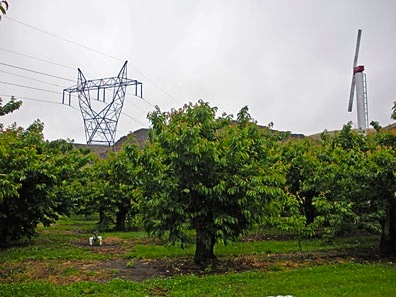
Cherry growers have long tried to find ways to dry the cherries and prevent the rot/split problems. They put fans on tall poles in their orchards and run blowers up and down the rows. But this isn’t usually effective. Enough rain in those last few weeks can destroy the entire crop.

Sometime in the past — maybe 10 or 15 years ago? — someone had the idea of using the downwash of helicopters hovering over the cherry trees to blow the branches around and shake the water off the cherries. This was extremely effective and apparently well worth the cost.

“Cherry drying” by helicopter was born.

How I Got Here

Learn more about helicopter cherry drying

I first heard about cherry drying a little over four years ago. I was looking for summer work with my helicopter and another helicopter pilot, who was based in Seattle, got in touch with me. He was trying to build a cherry-drying operation and wanted to get together a bunch of pilots he could call on each year.

Two years in a row, I almost got work doing this. But there wasn’t enough guaranteed work for me to make the 10-hour (each way) ferry flight from Arizona. Last year, there was. I flew up, stopped in Portland, OR to get some training with another pilot, and set up base in Quincy, WA. I was working for my pilot friend as a subcontractor for several growers and for another cherry drying provider.

Last year wasn’t very good for pilots — but it was great for growers. Why? It didn’t rain. I was on a variety of contracts for a total of seven weeks and only flew 5.2 hours. And because my assigned orchard blocks were so small, most of that time was spent flying from one to another.

This year, everything was a mess. My friend had let his business go because of a serious health problem so he wasn’t digging up work for me. The other cherry drying provider had promised me some work but, at the last possible minute, went out of business. Pilots like me were frantic, trying to find contracts for work. Growers were frantic, trying to find pilots. And out of this mess, with the help of some contacts I had from last year, I managed to get four contracts stretching out over a period of six weeks.

How It Works

The cherry drying work I do is on contract. This year, I contracted directly with growers (or orchard managers) for a 2 or 3 week period. During the contract period, the grower pays me a daily standby fee. Payment of this fee ensures that I will be available to come dry the orchard block within a reasonable period of time — usually within 20 minutes of the call to come.

When it rains, the grower calls. He usually calls at least twice:

  • The first call is what I call the “heads up” call. At this point, it’s either raining or very likely to rain on the orchard. The grower wants to make sure I’m aware that I’ll probably be called out to dry soon.
  • The second call is the call to action. The grower expects me to arrive as quickly as possible and get right to work.

When I’m finished drying and return to my base, I note the time flown as indicated on my Hobbs meter. At the end of the week, I bill the grower for the flight time at a pre-agreed hourly rate.

The Expenses

Because I can never depend on it to rain, I have to set my standby rate high enough to cover all of my fixed expenses. These expenses include:

  • Cost of transporting the helicopter between Arizona (where I live) and Washington (where I dry cherries).
  • Cost of getting my truck up to Washington and back.
  • Lodging expenses for the entire time; I save money by living in my small RV, which I tow up with my truck.
  • Meals and other living expenses.
  • Insurance. Last year I had to supplement my regular insurance with a second policy; this year I got a policy that covers all of my operations.

There are also a bunch of startup costs that have to be considered:

  • Helicopter. Medium sized helicopters with two-bladed systems are best. Think Robinson R44, Bell JetRanger, and Hiller. R22s and Schweitzer 300s generally don’t push enough air, although they can get into tighter spots.
  • Truck. It’s needed to provide ground transportation and haul around fuel.
  • 100-gallon fuel tank, pump, filter, and grounding strap so I can carry and pump aircraft fuel.
  • Helicopter helmet.
  • Nomex flight Suit.

As you can imagine, this can be a major investment. My fuel setup alone cost $2K. And have you priced up helicopter helmets lately?

Finally, the expense many people don’t consider: taking a normally revenue-generating helicopter offline.

You see, when you contract for cherry drying, you have to keep your helicopter near the orchards. That means you can’t hold it out for hire on other jobs. While my helicopter is here in Washington, I can’t be doing charter work down in Arizona. I have no customer base here. And even if I did, I couldn’t fly customers unless I was absolutely certain it wasn’t going to rain.

So suppose I’d fly 5 hours a week in Phoenix but can’t fly those 5 hours in Washington. That’s 5 hours of revenue lost each week. My standby rate has to compensate me for this potential loss of revenue.

What It’s Like

Cherry drying is a waiting game, one that turns you into a local weather expert.

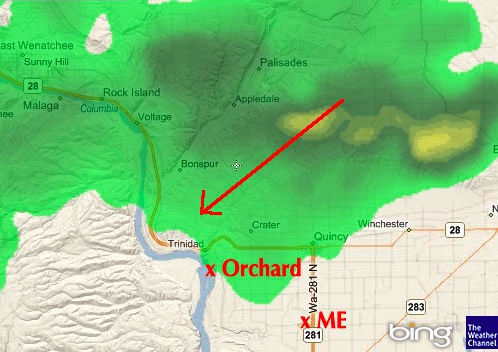
Radar

Here’s the kind of analysis I make all day long when there’s weather moving in. The arrow indicates the direction of the weather movement.

Each day starts with a look out the window and at the current day’s weather. I have an Internet connection here, so I can check the weather from a variety of sources throughout the day. I also have a scanner with weather frequencies that broadcast official local weather 24 hours a day. If there’s no rain in the forecast and no clouds in the sky — like most days last season — you’re free to do what you like, as long as you keep monitoring the weather and can be back at base at the slightest hint of rain. But if there’s any rain in the forecast or any clouds in the sky, you need to stick around base, just in case those clouds turn rain-bearing and they drop moisture on your assigned orchard blocks.

Or maybe the day starts with a phone call. Like today.

The point is, when you’re on contract and being paid standby money, you’re responsible for making sure you’re available quickly when called. That means you can’t screw around and do whatever you want wherever you want. If it looks like rain, you need to be ready to fly. Even if it doesn’t rain and you don’t get the call.

For me, that means spending a lot of time hanging around my RV at the golf course. (It’s almost unfortunate that I don’t golf.) It means having access to weather information and having something to do to keep busy so you don’t die of boredom. It means keeping your cell phone fully charged and in a place where it gets a good signal.

It doesn’t mean disappearing to Seattle for a few days without telling anyone. That’s a horror story I heard from a guy who hires pilots as subcontractors. He’d hired one irresponsible pilot who didn’t take the job seriously. When he called the guy to fly, the guy admitted that he was in Seattle and couldn’t get back for hours. That’s too late. The crop would be destroyed by then.

For the amount of money we’re being paid to hang around, the least we could do is hang around.

Oh, and did I mention how long the days are here up in North Central Washington in June and July? Sunrise is at around 5 AM. Sunset is around 9 PM. I have to be available for all daylight hours. That means I have a 17-hour work day.

The Work

Of course, sooner or later those calls will come.

On the first call, I prepare the helicopter and myself for flight. For the helicopter, that means taking off the cockpit cover (if it’s on). I’ll also remove the blade tie-downs, but only if a storm isn’t approaching my position. The helicopter is already pre-flighted. Then I’ll go back to the camper — it’s literally right down the block — and prep myself by pulling on my flight suit. I wear a tank top with it, so I can keep the top half of the flight suit off with the sleeves tied around my waist. It’s hot and humid here and I don’t want to sweat my brains out in a long-sleeved Nomex suit. I make sure all my documents and my sunglasses and the helicopter keys are in my pockets. I put on socks and comfortable shoes. If Alex the bird is outside, I bring him in. I also zip the bed windows closed so rain doesn’t get into the camper. I put a bottle of regular water and a bottle of “vitamin water” in my little six-pack cooler to bring along on the flight.

And then I wait.

The other day, I waited three hours. The second call never came. The first call had been premature and it never rained on the orchard. I had to call the grower to see if he thought he’d need me to fly. He didn’t. I was all dressed up with no place to go.

When the second call comes, I’m ready to go. I pull up the top half of my flight suit and zip up. I lock up the camper and drive back over to the helicopter. I take off the tie-downs (if they’re not already off), do a walk-around, and climb on board. I start the engine and get it warming up. Then I put on my helmet, set up my cell phone to receive calls in flight, and when the helicopter is warmed up, I take off.

The Orchard Block from Hell

I thank my lucky stars that I never had to dry this nightmarish block.

I use my GPS to fly direct to the orchard block. I’ve already scouted all the blocks on foot and by air, so I know how to approach. I come in low over one corner and settle down to 5 to 10 feet over the tree tops. Then I fly slowly down the row. At the end, I turn, move over a row or two — depending on the density of the trees — and fly back to the side I started on. I go back and forth like this at 5 to 10 knots groundspeed, being careful to avoid obstructions like wires, fans, poles, tall bordering trees, hillside rock outcroppings, and buildings. Some orchard blocks are easy to dry. Others are damn near impossible. Most fall somewhere in between — not too difficult to do, but not so easy that you can do it without paying attention.

Complacency can kill you — or at least destroy your helicopter and a bunch of trees.

You can read about my first time drying here.

Cherry Drying Isn’t for Everyone

I can’t tell you how many people have contacted me, asking me to help them get into cherry drying. Do these people understand the expenses involved? The skill level required? The dedication to waiting around for a phone call that may never come? I don’t think so.

I also don’t think they understand the competitive nature of this work. Right now, there are too many pilots for the available work. We’re all competing against each other for contracts. This year, a bunch of JetRanger pilots were so desperate for work that they undercut the rates of most other pilots — they were actually billing themselves out for less than R44s! How can we compete against that?

When the company I flew for part of the season last year fell apart this year, I had to scramble to get the contracts I have. While I got enough work for myself, I could handle more. It’s just tough to break into this work and build a reputation for yourself — especially if you don’t get a chance to fly and prove you can meet growers’ needs. I wasn’t able to prove myself last year and feel lucky to have the opportunity again this year.

And then there’s the skill level required to do this kind of flying. It’s not as easy as it seems — especially if conditions are less than perfect. Sure, any decent pilot should be able to hover slowly over tree tops. But for hours on end? And what if the wind kicks up and you’re dealing with a quartering tailwind as you travel in one direction? Or the block is full of obstructions, like power lines and fan poles? Or bordered by trees? Or there are storms in the area that you need to fly through to reach your orchard blocks?

Why do you think I wear a helmet and a Nomex flight suit when I fly?

No Flying Today

I worked on this blog post on and off all day. I watched the storm clouds build and move in the sky and on Doppler radar. I saw the scary yellow blobs of convective activity flare up and fade out on my computer screen.

It’s still cloudy, but if the radar can be believed, it’s not threatening rain over my orchard.

But it’s only 5 PM. There are still more than 4 hours left in my work day.

Greed is Stupid

Just one example.

I’m in Quincy, WA, right now, living in my camper while I work four cherry drying contracts. I live in my camper because it’s cheaper than living in a motel. A lot cheaper. And since I can cook my own meals, I save a ton of money over the cost of a motel.

One of my contracts is for an orchard down by the Columbia River. There’s a campground literally across the street from it. The campground is also right on the river. I thought it might be nice to stay there for the duration.

I called. They wanted $42 per night for a hookup that included water and power, but no sewer. They weren’t interested in giving a discount for long-term stays. In fact, they didn’t seem to want long-term guests. I figured it was because they were so busy they didn’t need the business.

I knew I could camp at the Colockum Golf Course (formerly the Quincy Golf Course) for $300/month. The site included electricity, water, and sewer. High-speed, reliable WiFi was also available for an additional $35/month. There’s even a restaurant on the premises.

I couldn’t justify the additional $30+ per night for a campsite with fewer amenities. I parked at Quincy, where I’ll likely spend the next seven weeks.

Yesterday evening, I drove down to the orchard to refresh my memory about the setup. I needed to know where the powerlines were and whether there was a fan in the block. While I was down there, I drove through the $42/night campground.

Every single spot was empty.

So explain this to me: wouldn’t it be more beneficial to get someone in there for $20/night ($600/month) rather than no one in there for $42/night?

A perfect example of how greed can be stupid.