My Morning Cup of Joe

It has to be just right.

I start each morning with a cup of coffee. That’s not unusual in the United States. Coffee is a pretty standard breakfast beverage. It’s why we drink coffee and the kind of coffee we drink that varies from person to person.

And my morning cup is special.

First of all, I don’t drink coffee because I rely on that jolt of caffeine to jump start my day. If all I wanted was caffeine, I’d get it from a double espresso at the local Starbucks or allow myself to become addicted to one of those idiotic “energy drinks” that young guys like to get hopped up on.

Instead, I drink coffee because I actually like coffee. I like the flavor. I like the aroma. I like the way it feels going down my throat when it’s just the right temperature: good and hot.

The trouble is, I don’t like just any old coffee. I like a certain kind of coffee the way I like it made.

And that’s the rub.

The Ingredients

Coffee ingredients are very basic, right? Well, to many folks, they are. But to someone as picky as me about coffee, they’re special.

  • Coffee. This is the main ingredient in a cup of coffee and, for me, it needs to meet several requirements:
    • Freshness. I buy coffee beans so I can grind them myself at home. The beans never come out of a hopper in a supermarket, where they may have been sitting for who knows how long. They always come in a vacuum-sealed package.
    • Bean type. This is where I differ from many self-proclaimed coffee connoisseurs. I don’t like Columbian coffee. To be fair, it may be the way it’s normally roasted: dark. I prefer Arabica beans with a light to medium roast. I also like Kona from Hawaii. These are smooth, mellow beans, roasted in a way where the roasting process doesn’t impart a bitter or burnt taste.
    • Roast. As mentioned, light to medium roast is my preference. Dark roast coffee tastes bitter or burnt to me. This is my big gripe against Starbucks and other “high end” coffee shops.
    • Eight O'Clock CoffeeBrand. The brand of coffee isn’t nearly as important to me as the other criteria. These days, my coffee of choice is Eight O’Clock coffee. I tend to buy it in bulk — 4 to 6 12-oz bags at a time — when it’s on sale at the local Supermarket. I store the unopened (very important) bags in the freezer. (They say that freezing coffee doesn’t do anything to maintain its freshness, but I do it anyway, just in case.) I’ll also buy any brand of light to medium roast pure Kona (not a “blend” — whatever the hell that means) and, in a pinch, Starbucks Breakfast Blend. I should mention here that a recent “coffee snob” house guest turned her nose up at my coffee choice and would make a special trip to Starbucks every morning for her cup. I guess if you’re not spending at least $1/ounce for coffee, you just can’t make some people happy.
    • Caffeine content. I drink caffeinated coffee. While I’m not in it just to get the caffeine, I don’t see any reason to drink coffee that has been tampered with in a lab to remove a naturally occurring ingredient. The resulting buzz I get if I drink two cups of coffee is what keeps me from drinking a third.
  • Water. I’m fortunate enough to live in a home with excellent and tasty well water. When I’m at our Phoenix place, however, I will use the tap water, which tastes like chlorine to me. The way I brew my coffee, the taste of the water is usually not a factor.
  • Milk. Yes, I put a small amount — about 1-1/2 tablespoons, if you were to measure — of milk in my coffee. Not cream, not half and half, and certainly not some powered crap with ingredients I can’t pronounce. I prefer 2% milk but can use 1% or whole milk. Skim milk is pushing things a bit.
  • Sugar. I also put about 1/2 teaspoon of sugar in my coffee. I like plain granulated sugar or evaporated cane juice sugar (often touted as “organic”). I don’t like Sugar in the Raw, a popular product that has a distinct molasses flavor. Ick. I also won’t use artificial sweeteners. There are 16 calories in a teaspoon of sugar and I’m using only half of that. Surely I can put another 8 calories into my body each day?

The Daily Grind

Before I got a decent grinder, I’d buy one or two bags of coffee at a time and grind them using the supermarket’s grinder. It was important to shake out any trace of the hopper coffee that the previous user might have left in the machine. I once ruined a package of coffee by letting it mingle with what some flavored crap.
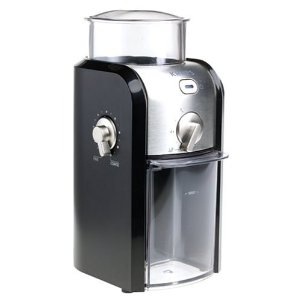
Krups Burr GrinderBut now I have a nice Krups Burr grinder which I like. It got mixed reviews on Amazon.com and I do agree with some of the points brought up by negative reviewers — for example, it can be a bit messy — but, in general it’s perfectly suited to my needs.

Almost perfectly. The least coffee it’ll grind is for two cups — even though the setting says it’s for one cup. But that’s okay. I usually do drink two cups of coffee a day. If I don’t drink the second cup, I don’t mind using coffee ground the day before. I’m not that picky.

I grind my coffee more finely than what’s recommended for drip coffee makers. Not quite an espresso grind, but certainly more fine than a basket or cone drip. That could be why the darn grinder gets messy.

The Coffee Preparation Device

A year or three ago, the big chatter on Twitter was about an $11,000 coffee maker. It brewed one cup at a time. At least they got that part right.

Brew and GoMy coffee maker of choice is a Black & Decker Brew ‘N Go. Designed for people who want to grab their cup of coffee as they head out the door on their morning commute, it comes with an insulated thermal plastic travel mug. I don’t use the mug unless I’m heading out to the car, too. I use a large ceramic coffee mug. It probably holds about 14 ounces.

I don’t use the reusable “gold” filter that came with the coffee pot. Because I prefer my coffee ground finely, the coffee grinds make their way though those gold filters and get in my cup. So I use #2 cone filters in the filter basket of the machine. I’m not picky about brand or paper bleaching. (Sheesh.) Because I go through so many of these things, I like to buy them cheap. I’ve actually found them very cheap in the coffee maker area of WalMart. So on the rare occasion that I’m in there, I stock up. And yes, when I’m at home, I compost the filters and coffee after brewing.

The Brewing Process

To brew a cup of coffee, I go through this routine.

  1. Fill a coffee cup with cold water and pour it into the coffee maker’s well.
  2. Refill the coffee cup with hot water to prewarm the cup. If I can’t get hot water from the tap right away, 2 minutes in the microwave warms whatever water I can get.
  3. Put a clean coffee filter in the filter holder.
  4. If necessary, grind enough coffee for a cup.
  5. Using a measuring spoon, measure out enough coffee for that size cup.
  6. Tamp the coffee down into the filter paper and close the lid.
  7. Dump the hot water out of the cup and put it on the coffee machine’s cup shelf.
  8. Push the button.

What comes out about 2 minutes later is a steaming hot, fresh cup of very strong coffee. This is what I like.

The Coffee I Don’t Like

I don’t like bad coffee and won’t drink it. What’s bad coffee? This:

  • Weak coffee. If I can see my spoon while I’m stirring, it’s too weak for me.
  • Coffee brewed from inferior ingredients. Yeah, I know the 3-pound plastic tub of Savarin was on sale at Costco last month. But don’t think I’m going to drink it.
  • Coffee that has sat in a pot on a warmer for more than 10 minutes. Yes, just 10 minutes. I have experimented with this at home using our bigger coffee maker. I’ll use that to make enough coffee for a group of people and the first cup is usually fine for me. But the second cup from the same pot ten minutes later? Keep it.
  • Columbian or dark roasted (or both) coffee. If it’s brewed right and fresh, I can drink it. But it’s normally not brewed strong enough or not fresh enough for me.
  • Most restaurant coffee. It usually falls into one or more of the above categories. Occasionally, you’ll get a good cup of coffee at a good restaurant, but I won’t even consider ordering coffee at a diner or cheap restaurant.
  • Flavored coffee. Are you serious?
  • Instant coffee. I stopped drinking instant coffee about 20 years ago and have seen no real reason to go back. And no, the new Starbucks instant coffee does not impress me. At all.

I prefer to drink no coffee than any of the above. In fact, I have. If I’m traveling and need a hot beverage and can’t track down a place to get a latte — freshly brewed, with enough milk to cut the bitterness of the dark roast — I’ll order tea. Or iced tea. Or juice.

Picky, yes. Snobbish? I don’t think so. If I were snobbish about my coffee, I’d buy expensive coffee, brew it in some fancy gadget, and turn my nose up at everything else. Instead, I buy relatively cheap coffee and brew it in a cheap machine the way I like it: hot, strong, and fresh.

What’s in your cup?

Tax Time = Torture Time

How did we let it get like this?

Yesterday, I did my own taxes for the first time in four years.

Understand this: I have a BBA degree in accounting. Having that degree always convinced me that I should do my own taxes. After all, if an accountant can’t do her own taxes, who can?

But back in 2005, my taxes were extremely complex. I sold a rental property and bought a helicopter. There were capital gains and losses and all kinds of weird things. Even though I’d been using TurboTax (and MacInTax) to do my taxes for the previous eight or so years — and doing it manually before that — I didn’t feel up to the task. So I handed it off to my husband’s tax preparer and let him deal with it. I’ve been doing that ever since.

TurboTaxBut after last year’s debacle with a new tax preparer who charged me more than $500, I decided to take matters into my own hands again. I bought TurboTax Home & Business. Yesterday, I sat down in front of my computer to do my taxes and my husband’s.

My husband’s taxes were the warm-up exercise. His taxes should be relatively simple, right? After all, he has an employer and gets a W-2 form. He didn’t buy or sell stocks, he doesn’t operate a business. He didn’t purchase or sell any property during the year. Yet even with the software, it took me two hours to prepare his Federal and State return. And when it was done, he didn’t like the answer and said he’d probably take it to a tax preparer anyway.

As we muddled through the process, however, I realized that my husband knows nothing about tax preparation. He didn’t know what any of the forms were and whether he’d filed them in the past. I’m not talking about those weird forms that only tax geeks know about. I’m talking about common schedules like A and C. He was clueless. For his whole life — and he’s in his 50s now, folks — he’d put his trust in a tax preparer, from his dad to local accountants to Hewett-Jackson. Whatever they told him was golden. He write a check or get a refund and be satisfied. After all, he didn’t have to deal with the bullshit of putting together a tax return.

After “completing” Mike’s return, I sat down to do mine. It took 4-1/2 hours. With a computer and software. And it isn’t as if I had to wade through a pile of papers to get the numbers to input. I use Quicken for my personal and business accounting. It does all the math for me. (It can also export to TurboTax, but I admit that I don’t trust them together for that.)

When I was finished, I saw the final numbers. I have to pay — I nearly always do because I’m too stupid to pay estimated taxes like I should — but the numbers weren’t quite as bad as I expected. (Of course, I had no clue what I’d made last year until I actually sat down to do my tax return.) But what’s mind-boggling to me is the forms TurboTax spit out. Here’s this year’s list:

  • Form 1040-ES Payment Voucher. There are four of these for my estimated payments, which I’m really going to try to send in this year.
  • Form 1040-V Payment Voucher. That’s the one I’m supposed to send in with my big check.
  • Form 1040Form 1040 US Individual Income Tax Return. Yes, it’s the long form. I can’t remember the last time I filed a short form. I may have been a teenager.
  • Schedule A Itemized Deductions. I’ve also been filing this one for years, although I’ve never been able to deduct medical expenses. I suppose I should be glad.
  • Schedule B Interest and Ordinary Dividends. I have a variety of investments that are not tax deferred.
  • Schedule C Profit or Loss from Business. I file two of these: one for my writing and publishing business and one for my helicopter charter business.
  • Schedule D Capital Gains and Losses. I sold some stock at a loss.
  • Schedule E Supplemental Income and Loss. This is for a rental property I own and my royalties on copyrights.
  • Form 8889 Health Savings Accounts. This is one way to deduct medical expenses. Save for them in a special kind of account and deduct your savings, then pay your medical bills with that account.
  • Form 8829 Expenses for Business Use of Your Home. I have an entire room in my home that’s dedicated to the mess I call my office.
  • Form 4562 Depreciation and Amortization. This is for my helicopter and other assets used by Flying M Air.
  • Form 8582 Passive Activity Loss Limitations. Apparently, I can’t deduct the tiny loss on my rental property because I don’t dedicate my life to keeping it occupied. Whatever.
  • Arizona Form 140 Resident Personal Income Tax Return. Arizona needs a piece of my pie, too.
  • Arizona Schedule A Itemized Deduction Adjustments. At least I can deduct my medical expenses in Arizona.

I should be clear here: it didn’t take me 4-1/2 hours to fill in these forms. It took me 4-1/2 hours to enter the raw data that TurboTax needed to fill in the forms. TurboTax did the job in seconds, completing just the forms it thinks I need and spitting them out of my printer as if they’d been typed by hand.

Frankly, I don’t think it’s humanly possible to prepare a tax return like mine by hand anymore.

And that’s my point. There are rules upon rules upon rules to the U.S. tax law. I remember studying taxes back in the early 1980s — it was a nightmare then. It’s even worse now. How frustrating is it to enter line after line of financial details on a worksheet or form just to discover that it won’t impact your taxes because it didn’t total more than 2% of line 38? Or perform a convoluted calculation just to see what percentage is taxable or deductible? Or answer questions regarding child care, home expenses, foreign transactions — the list goes on and on. Four and a half hours worth of questions and answers.

In this stack of paper I’m sending the IRS this week, there must be over 500 different numbers. What do they all mean? Do they really matter?

There’s an entire industry built on the annual torture of U.S. Citizens required to complete tax returns. I bought tax software to make filing my own return possible. It cost me $80 (discounted). Other people pay $50 or more to tax preparers to do the job for them. Hell, I paid $550 to get my taxes prepared last year! (That’s more than some people pay in taxes!)

And why? Because the tax laws are so complex and confusing that people with basic math skills simply can’t do it on their own.

Hello? IRS? Are you listening? Whatever happened to the Paperwork Reduction Act?

Jack the [Desert] Dog

Not exactly a “dog park” dog.

Wickenburg just put in a dog park. If you’re not familiar with the concept, it’s basically a fenced-in area where people can let their dogs run around. It’s especially nice for folks who live in apartments or trailers or don’t have fenced-in yards. Wickenburg’s dog park isn’t anything special — at least not yet. I hope they plant some trees and do some cross-fencing to spruce it up a bit. Right now, it’s just a big area adjacent to the airport that’s surrounded by chain link fence. There are two leaf-less trees, two cheap park benches, and a bunch of molded plastic patio chairs.

But it’s better than nothing and I’m glad whoever put it in did so.

Throughout the day, folks gather there with their dogs, letting them run around together. The dogs bark, the owners shout. The dogs play, the owners socialize. It’s a relatively pleasant scene. Since the dog park is right on the other side of the fence from my Wickenburg hangar, I see its dynamics each time I’m at the airport.

My dog, however, will never set foot inside the dog park. You see, Jack’s a desert dog. He — like my neighbors’ dogs — roams freely on our property on the outskirts of town. On a nice day, we open the back door and let him out. He chases rabbits and squirrels and, when it gets a bit warmer, lizards. We have 2-1/2 acres of property, but he occasionally wanders off to visit with my neighbors, too. Their dog comes to see us once in a while, so it all evens out.

Jack goes lots of places with us. When I head out to the airport or store in town, he rides in the back of my Jeep or pickup truck. He likes to bark when he’s in the back of the truck, as if to yell out “Look at me!” It’s actually pretty annoying and I have to break him of the habit again soon. (Stopping the truck suddenly and throwing a cup of water on him usually does the trick.) When he rides in the Jeep, he likes to sit in my seat while I’m in the store. I don’t have the back windows on the Jeep and he’s fallen out twice. Once was when I was parked at the supermarket. An announcement over the loud speaker said, “Will the owner of a black and white dog please come to the courtesy counter.” I went out to the parking lot to find him circling the Jeep excitedly. He was very glad to see me. A woman standing nearby said, “Is this your dog and Jeep? He’s been trying to get into it. I was going to let him in, but I wasn’t sure if it was his.” I opened the door and he jumped in. We all had a good laugh. He hasn’t fallen out since.

Jack the DogJack also goes hiking with us out in the desert. He’s well behaved on the trail and never bothers other hikers. He’s a bit of a nuisance when we go out to take photos, as we did the other day. He always seems to get into the shot. But now that he’s older — he turned nine this year — he’s starting to slow down and spends a lot more time just relaxing in the scant shade of a tree while we bend over wildflowers and lie prone to shoot up at cacti. It could also be his thick winter coat — which I’ll soon be vacuuming up off my floors and carpets — that keeps him too hot in the springtime to run around.

In answer to a commonly asked question, yes, Jack has flown in the helicopter. He’s been flying with me three times now. I think he considers the helicopter just another vehicle. The last time we flew together, he was very well behaved alone in the back seat.

Jack’s a good dog — the best I’ve had so far. Although he tends to get excited easily and seems to live to be petted, he’s smart and listens — unless, of course, he’s chasing a rabbit. We may spoil him by making him a part of our lives, but we don’t pamper him and don’t allow him to misbehave, especially when there are other people around. In other words, we don’t allow him to give people a reason to complain about him. If more people disciplined and trained their dogs properly, we wouldn’t need so many “No Dogs” signs and leash laws.

And we probably wouldn’t need dog parks, either.

Off-the-Grid Camping in the New RV

Working out the kinks.

One of the improvements I made on my old RV was to add a solar panel to the roof. It was connected to a battery charger which, in turn, was connected to the camper’s batteries. When the sun was out — which is during most daylight hours here in Arizona — the batteries were charged. This made the camper extremely useful for off-the-grid camping. My husband and I did a lot of that last year on our way back from Washington to Arizona. We never ran low on power, which was a good thing because we didn’t have a generator.

There are a few things that won’t work in an RV without a connection to A/C power:

  • A/C power outlets. This means you can’t plug in and use any device with a standard plug.
  • Certain light fixtures. Some lights are A/C while some are D/C. A/C fixtures won’t work without an A/C connection.
  • Microwave. Even if it’s standard equipment on an RV, it’s plugged into an A/C outlet.
  • Air Conditioning. It’s A/C and it sucks a ton of power when it is plugged in and running. That means that even if you have a generator, you need a pretty powerful one to run the A/C when you’re not hooked up to campground or city power.

There are a few things that will run on propane or battery (D/C) power if you’re camping off-the-grid:

  • Refrigerator. Setting the refrigerator on “Auto” tells it to look for A/C power first; if that’s not available, it uses propane from the onboard tanks (assuming the valves have been opened).
  • Stove/Oven. Obviously, they’re propane. It would be dumb to put an electric stove in an RV.
  • Water pump. If you’re not connected to a pressurized water line, a D/C pump activates when you run the water to pump the water from the onboard fresh water tanks.
  • D/C devices. Some RVs include D/C outlets — think of power ports or cigarette lighters on a car. My old RV had one and I added a second; my new RV had three and I added a fourth. These are handy for charging cell phones or plugging in low wattage inverters to plug in low wattage A/C devices like laptops.

Other appliances use D/C power all the time, but if you’re plugged in, your battery is being charged all the time, so it’s no big deal. The heater, stereo, and certain light fixtures are good examples.

As you can see, RVs are pretty much designed to be self-sufficient when you’re off-the-grid. There’s a limit, of course, to how long you can live in an RV without a hookup, though. The solar power (or a generator) helps take care of electrical needs. Eventually, however, you’ll run out of water or fill up your black water sewer tank. There are ways to get around these issues — for example, minimize toilet use by using public toilets whenever possible, carry extra water in external tanks, etc. — so two people can easily live in a well-equipped RV off-the-grid for several weeks if they need to.

Oddly, however, most RV owners do not live in the RV off-the-grid. Instead, many of them tend to pull their RVs from one parking lot-like RV park to the next, cram them into narrow spaces between other RVs, hook up power, water, and sewer lines, and retreat inside their luxury boxes to watch television.

I’m not like most RV owners.

Before trading in the old camper, I pulled the 135-watt solar panel off the roof. This past week, I had it installed, with a new battery charger and controller, on the roof of my new RV.

This weekend, my husband and I are out in the desert about 25 miles west of our Wickenburg home, testing the trailer’s off-the-grid setup. I’m out in Aguila, at a private “resort” where my clients are testing some wireless networking equipment. The test requires me to fly their equipment around in the helicopter to see how well it works with ground-based mobile and stationary equipment. There’s more to it than that, but for the sake of my client’s privacy, that’s really all I’m willing to say.

At Robson'sThe job has a lot of down time — time when I’m just waiting around for them to be ready to fly. It made sense to bring the RV out here for the weekend. It gives Mike and I a chance to get away and relax away from home and we can bring along Jack the Dog and Alex the Bird. And, of course, we can test the off-the-grid setup of the RV close enough to home so that if there’s a serious problem, we’re not suffering. So the RV is currently parked about 100 yards from the helicopter’s landing zone out in the desert.

We’ve discovered a few things:

  • When the refrigerator works off propane, it makes a noise that sounds like a fan running inside it. We’re not sure if it should be doing that. It seems to work fine and the fan noise does stop when the refrigerator reaches the correct temperature. But my last two RVs had silent refrigerators, so we’re a bit concerned.
  • The fresh water in the tanks smells like shit. I do mean that literally. We’re not drinking it, but we are washing with it. It’s making the RV stink a bit on the inside, so we have a lot of windows open to keep the air cleared out. This is our fault. We should have flushed out the system before using it. We’ll do that after this trip and likely run at least one tankful of clean water through it, too.
  • The new solar setup works great. It had the batteries fully charged before 10 AM. While it was doing that, we were using the lights, stereo, cell phone chargers (all D/C) and a 300-watt A/C inverter to charge my MacBook Pro and some aviation radios.
  • The 2000-watt Honda generator I bought so I could run A/C devices if I wanted to works great. It’s easy to start and can be very quiet. We gave it a good test on Saturday night when we ran it to see if we could watch a DVD (Up) on the 32-inch (or thereabouts) flat screen TV the RV came with. It ran hard when we first started it — likely to recharge the batteries we’d run down a bit after sunset while giving us A/C power — then settled down to a lower, quieter power setting. I don’t think I’d run it in the future just to watch TV, though.

Everything else works exactly as expected.

At this point, I consider this second test a success. It proves to me that the new RV can be at least as comfortable — more so, of course — than the old one when camping off-the-grid. Even though I didn’t get the solar power system I wanted, I think my less expensive solution — one solar panel to charge the batteries and a portable generator for more power when needed — will work fine.

One thing’s for sure: having a portable house along on these weekend long gigs is very nice indeed — even if I’m not plugged in.

Glass Replacement FAIL in Wickenburg

How does anyone get anything done in this town?

The old guy Mike called to give us an estimate for replacing two windows refused to take driving directions to our house. Instead, I had to drop everything and go out to meet him.

He wasn’t at the corner where he was supposed to be. Instead, he’d driven his unmarked truck past me and was waiting two blocks from our home. He used his cell phone to call me. I tracked him down and he followed me to my house.

Upstairs Windows

The window on the right is the one that needs replacing.

The windows are upstairs. He followed me up the stairs. I pointed out the 4 foot by 8 foot double-pane glass panel that needed replacement. The seal between the two panes had failed and moisture had slipped in. Each day, the window would fog up in a way that couldn’t be wiped clean. Since the window is one of two that offer the best view in the house, we wanted it fixed quickly.

He walked up to the window and looked at the garage roof outside. “How do I get out there?” he asked.

“On a ladder,” I replied.

“We can’t do that. The glass is big and heavy.”

“You did it twelve years ago when we first bought the house,” I told him. I pointed at the identical panel of glass beside it. “You replaced that one right after we moved in.”

“How did we get up there?” he asked.

“On a ladder.”

Bathroom Window

The bathroom window is broken.

I took him into the upstairs bathroom to see the other window that needed replacing. This was a small two-part window of white-smoked glass. One panel slid back and forth to open or close the window. The other panel remained stationery. The stationery panel had always had a bad seal that let moisture in, but we never bothered to replace it since you couldn’t see through it anyway. But during a recent storm, that panel’s outside pane had broken. We wanted it replaced.

He pulled off the panel that slid back and forth and set it down beside the toilet. He reached around, pushing the screen out a bit and mumbling about how he hoped nothing fell.

“How do you get up to this window?” he asked.

“On a ladder,” I replied yet again.

“What size ladder?”

“My husband uses an extension ladder. We have one you can use.”

He put the other panel back in place. “I don’t know why anyone would build a house like this,” he muttered as he led the way out of the bathroom.

My patience was stretching thin. “People don’t usually design houses just to make it convenient to replace windows,” I told him.

He went downstairs, outside, and around the side of the house. I followed. He looked up at the bathroom window, which had to be at least 20 feet off the ground. Then he looked at the comparatively short climb to the garage roof.

“Once you get up there,” I told him, you can walk on the garage roof pretty easily.

He looked at the situation for another moment, then suddenly said, “I can’t help you, lady.”

I don’t know if he was expecting me to argue or beg with him, but if he was, he was disappointed.

“Okay, thanks for your time,” I said quickly. “You can find your way out? Be careful backing up.”

And then I went into the house, leaving him find his way back to wherever it is he’d come from.

Of course, since the old guy is the only glass replacement option in Wickenburg — or at least the only one my husband could find — we’ll have to get someone up from Phoenix to do the job. But that’s typical here. No matter how much you try to spend money locally, you just can’t get what you need.