Me and My Traeger

I enjoy my first rack of ribs, smoked to perfection on my new grill.

Grilling has been a part of my life for the past 30 or so years. I had a grill in Queens (New York), New Jersey, and Arizona. Even when I lived just three months in Yarnell, AZ back in 1995, I bought a little hibachi and used it almost every evening to grill up some meat and vegetables over charcoals for dinner. My old RV had a built-in gas grill and when I got my new RV, the “mobile mansion” back in 2010, I bought a small gas grill to satisfy my craving for grilled food.

I grill year-round, several times a week.

About 10 years ago, I attended a cookout at Prescott’s Love Field airport. My host was cooking on a Traeger Grill. The benefit of the grill was clear: it was fed wood pellets — not gas or charcoal — and it automatically maintained any temperature you set it at. The fact that it was also capable of smoking meat made it something I wanted. Badly.

Time passed. I wasn’t in charge of procuring grills for my home. Someone else was. And he liked gas.

Whatever.

I did have a smoker for a while. I got it from a friend about eight to ten years ago, right before she moved to Colorado. I traded an old bird perch — she has a parrot, too — for it. It was a good-sized traditional smoker with an external firebox and smokestack. It worked well — on the few instances I took the time to use it. Smoking, you see, was all about time — time preparing the wood, time starting the fire, time getting it up to temperature, time checking the temperature, time adding the wood, time checking the temperature, time adding the wood, time checking the temperature — well, you get the idea. When I smoked something, I had to hang around and tend to the smoker. Getting a remote thermometer helped — at least I could monitor the temperature without going outside. But it was still a pain in the butt.

I gave away the smoker. I traded it for a new heating element installed on my hot tub. (Ironically, I gave away the hot tub, too. I traded it for some help moving furniture out of my house last month.)

I’m living in my RV again this summer, prepping to build a custom home on 10 acres of view property in Malaga, WA. That home is going to need a new grill. And this time, I’m in charge.

My Traeger GrillSo I bought the grill I’ve been wanting for the past 10 years. A Traeger.

I bought the “Junior.” It’s the second smallest model and it now comes with the same digital LED thermostat previously available only on the larger, more costly models. Not that the grill was cheap — it wasn’t. But the $50 rebate did help convince me to buy now.

After all, why the hell not?

I bought it at Stan’s Merry Mart in Wenatchee. (I love that store. It’s so funky-weird. Hell, just look at its sign.) Just the day before, a young sales guy had almost talked me into it. I left, thought about it some more, and came back to buy it. They loaded it into the back of my truck with a big bag of mesquite pellets and I drove it back to the Mobile Mansion.

The next day, I assembled it. (If you watch the time-lapse video here, see if you can see the mistake I made and fixed.) But I couldn’t use it that day — I was going to Wenatchee to meet someone new and watch him play softball. Over dinner, I told my new friend about my new grill. I invited him over for the christening celebration: two racks of ribs, smoked. We’d go for a helicopter ride while we waited for the ribs to finish cooking.

And that’s what we did.

Before he came, I prepped the meat by covering it with a mesquite rub. I prepped the Traeger by doing its initial start and seasoning the porcelain grill. Then I turned the thermostat to 250, which brought the cooking chamber up to around 225 — the recommended temperature. I put the ribs on the grill, closed the lid, and went about my business without having to check the temperature or add fuel even once.

Amazing RibsWhen we got back from our flight, the ribs were nearly done. They looked amazing. I made us some salad and corn on the cob, then brushed the smaller of the two racks with BBQ sauce and threw it on my old grill, set to high, to caramelize the sauce onto them.

The finished product was perfect.

What’s next? I’ve been thinking about salmon…

Land of Wildflowers

Something new is blooming every time I visit my future home.

As I blogged earlier in the week, I spent some time on the Cathedral Rock Road lot I plan to build my home in Malaga, WA. I wanted to measure out the footprint for my building and put in marked stakes at each corner. It would help me visualize where the building would go and how much space it would take up.

The 48 x 50 building looked tiny on the 10-acre lot. So I decided to make it bigger: 60 x 50. That’ll give me room for a good sized shop bench and storage beside the RV and helicopter.

I’d been texting earlier in the day with my friend Tom, who keeps bees in Vermont. That conversation continued, even when I was walking around, pounding stakes with red ribbons into the ground. I mentioned that I wished I was able to set my bees up on the lot now because there were plenty of flowers around. He wondered how many hives the area would support. I hadn’t given it any thought. But it also got me wondering about how many different kinds of flowers there were right there.

Not having anything pressing to do, I took out my camera and started shooting quick photos of the different kinds of flowers I saw. I thought I’d share them here, mostly to document them. I might do the same thing in a month and then again in two months. It’ll be interesting to build a history of flowers, especially since my bees will soon be depending on them for nutrition while they make me honey and wax.

So here are the photos.

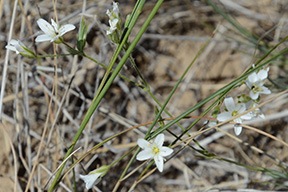
Tiny Yellow FlowersTiny White Flowers
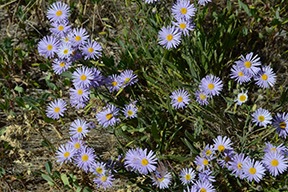
Purple FlowersBig Purple Flowers
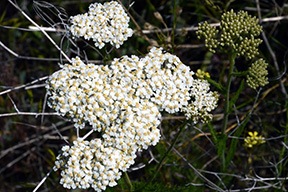
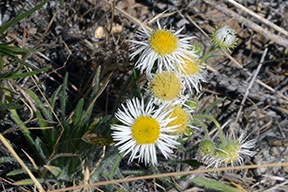
White FlowersWhite & Yellow Flowers
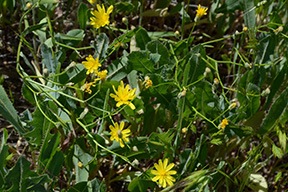
Yellow FlowersLupine

This is just what I saw that day, while walking around. There were different flowers earlier in the season and I suppose there will be different flowers later in the season.

If so, I’ll show them off here.

What Life is All About

An amazing, ordinary day.

I had one of those amazing days today. The kind of ordinary day that reminds you just how good life can be.

I slept until 6 AM — late for me — and read in bed until the sun shined right through the window into my eyes. You see, I’d forgotten to lower the shade. But that didn’t matter because no one was going to look in my bedroom window. No one other than the sun.

I had my coffee and tidied around my little home. I prepped for my day in Wenatchee. I had a long list of things I wanted to accomplish and I’d even made notes the night before. I wanted to make sure I had everything I needed when I headed into town.

I loaded up the Jeep and sat Penny on the seat beside mine. We headed out. I got about a mile down the road when I realized I’d forgotten something. I turned around and went back to fetch it. Then we headed out again. I got about 10 miles when I realized I’d forgotten something more important. I turned around and went back to fetch it.

I didn’t mind driving the extra 22 miles because of my bad memory. I wasn’t in a rush. I was doing my own things at my own pace. That was nice.

I drove up to the lot I’m going to buy soon in Malaga. Along the way, I stopped at the lot next door. (The one my husband has photos of that I don’t own and never will.) There were three men working there with a big backhoe. The foundation for my future neighbor’s home was in. They’d chosen a nice building site with nearly the same great view I’d soon have on the lot next to theirs. I chatted with the builder and got his number and the name and number of his girlfriend, who had designed the custom home under construction. I chatted a while with the earth moving guy and talk to him about septic systems and perk tests. I got his card and the number for the septic system designer. It was nice to meet new people, to learn about folks who might help me build my home one day.

On my future lot, I gathered together some of the stakes the owner had used to mark the footprint of the house he’d never build. I took my 100′ tape measure and marked out the footprint for the home I’d build: 48 x 50 feet, right beside the end of the driveway. I marveled at how small that footprint looked on the vast expanse of land I’d soon own.

New FlowerI walked around with Penny, through tall weeds and wildflowers that reached my waist, thinking about where I’d put my beehives and my RV and my septic system. I saw yet another type of flower I’d never seen there before. I admired the view for a while and felt the wind in my hair on a day with perfect weather. I looked back at those stakes and imagined my new home rising above the wildflowers. I imagined sitting on the deck with a glass of wine, taking in the view.

I went down to Wenatchee and had lunch with a friend in a Japanese restaurant where they make a seafood salad just the way I ask. My friend put away an amazing quantity of food. We talked about business and life and what great a gig we had as cherry drying pilots. My friend bought me lunch; I left the tip.

Fresh Honey in the CombI drove over to a friend’s house to tend to my bees, which were living in his backyard. I was inspecting my new hive for the first time. I took my time prepping and suiting up. My friend kept me company and explained what I was seeing while my GoPro camera, set on a tripod, created a 1080p HD video of the entire inspection with our running commentary. Afterwards, I sucked the honey out of the wax comb I’d trimmed from the top of the hive box. No honey tastes as good as the honey you eat fresh, right from your own beehive.

I went to Lowes to look at appliances and cabinets and bathroom fixtures for my new home. I thought about washers and dryers and glass-topped stoves. I looked at refrigerators with drawers and dishwashers that could hold all of my dishes. I talked to a kitchen design consultant and set up an appointment to design my kitchen. I thought about how nice it would be to finally have the kitchen of my dreams — and how nice it was going to be to skip the decision-making ordeal with someone incapable of making a decision.

I ran into a friend of mine and her daughter. We chatted for a while about nothing important.

I stopped at Stans Merry Mart to look at Traeger smokers. The sales guy, who couldn’t have been much older than 18, gave me a thorough rundown on how they worked, what I could make, and how easy they were to clean. I thought about smoking racks of ribs and other yummy food. I came very, very close to buying one, but remembered that my deck wasn’t built yet.

I swung by the spa place to look at hot tubs, but it was late and they’d already closed. Another day. There was no rush.

I went to the supermarket to buy olive oil and flowers and salad fixings.

Drive In FoodAs I headed out of town, I saw the sign for Larry’s Boneless Chicken and decided to give it a try. It was an old-style drive-in restaurant, with girls that came out and took your order and then hung a tray with your food on your car window. The waitress was friendly and happy and smart; the food was good. Penny and I listened to the radio and munched chicken and onion rings.

I drove home in the summer evening light, when the sun was turning that golden color that makes everything look good. I looked at the green hills and the dark brown cliff faces and the blue river and marveled at how beautiful and full of life everything was.

At home, I put away my groceries and watched the video of my hive inspection on a 32-inch HD TV, reliving the highlight of my day, chatting with Facebook friends as I sipped a glass of wine. Outside, the sun was setting. The family of skunks living in the bushes nearby walked past my back window: a mom and six babies. Penny, who was waiting for them, barked.

Penny in BedA while later, I climbed into bed with my laptop to write this blog post. Penny, in her bed with her favorite toy, watched me through sleepy eyes. I thought about how nice it was to spend the day with her and how much she’d love running loose among the wildflowers at our future home.

Just another day in my life. Another great day.

People who go through life angry and hating and trying to take things that aren’t theirs from others who have done them no wrong are missing the point of life. In fact, they’ve missing life itself.

It’s not about what you have and how little you did to get it. It’s not about hating strangers enough to try to make their lives miserable. It’s not about how good you are at screwing over others. It’s not about getting away with lies or abandoning your moral standards to win something that really isn’t yours. It’s not about how much better you are than everyone else. It’s not about your last European vacation or your fancy car or the $150 you dropped on dinner for two the night before.

Life’s about the simple things. The things that make you happy. The things that make you feel whole. The things that are good and right.

Life’s about having a great day, a calm day, a day where you do what matters to you and you enjoy every minute of it.

Adventures in Beekeeping: Tracking Down Swarms

I accompany friends while they track down three swarms of bees.

James
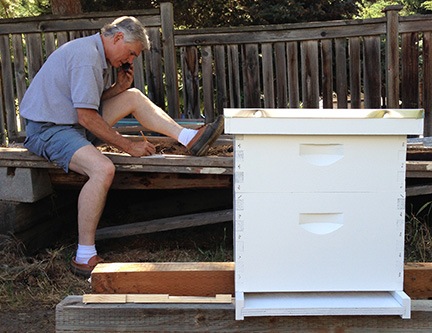
While I was admiring my new beehive, my friend James was on the phone, taking down information about two swarms he might be able to capture.

On the day I set up my hive in a friend’s yard, he got a call from a fellow beekeeper with two leads on swarms that needed capturing. Within 15 minutes, the two of us were heading north on highway 97 to chase them down.

About Bee Swarms

First, you need to understand that a bee swarm is not a dangerous thing. In fact, bees are least likely to bother people when they’re swarming because they don’t have a hive to protect. They’re on the go, looking for a new home. They’re protecting the queen. When they’re hanging out somewhere, they’re resting and waiting for scout bees to return with news about possible hive sites.

Beekeepers love swarms. Why? Well, because they’re free bees.

All a beekeeper needs to do is go to the swarm with a box and some protective gear, sweep the bees and their queen into the box, cover it up, and go. Back at the apiary, dump the bees into a hive body with frames and voila! A new colony, all set to grow and produce honey.

Or, if the beekeeper doesn’t need another colony, he can let the swarm develop into a colony in a nuc box and sell it to someone who needs bees.

Either way, it’s a win.

The Weeping Cherry Swarm

The first swarm sounded like the good one. It had landed in a weeping cherry tree at a home right off the main road. The tree was reportedly only 7 feet tall. That made it a potentially easy capture.

The only problem is, the call had come in earlier in the day. Much earlier.

We arrived at a nice home at the end of a dirt road. The Columbia River drifted past in the form of the Entiat Reservoir. There were lots of trees but no people. My friend, James, went to find the homeowners while I looked for a buzzing weeping cherry tree, not really knowing what such a tree looked like.

He called out to me a while later. He’d found the homeowner. The swarm had moved on a while before. We’d missed it.

The Chimney Swarm

Bees on a Chimney
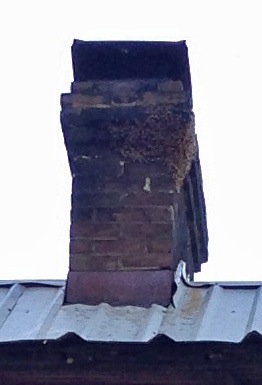
I know this is a pretty crappy photo, but take my word for it: there’s a partial swarm of bees on this chimney.

The second swarm was reported up by 25-mile creek on Lake Chelan. A quick check of my map app told me it would take 40 minutes to get there. I called the homeowner while James drove.

The swarm had been inside their chimney. When they discovered the bees, the homeowners had lit a fire in the fireplace to get them out. They’d come out of the chimney and were now on the outside of it in a big mass.

It was a two-story log home.

We arrived after a nice drive through the mountains at a home high above Lake Chelan with magnificent views of the lake and the mountains beyond. We met the homeowners and they pointed out the bees. Sure enough, they were gathered on the side of the chimney, high above us.

Throwing a Rope
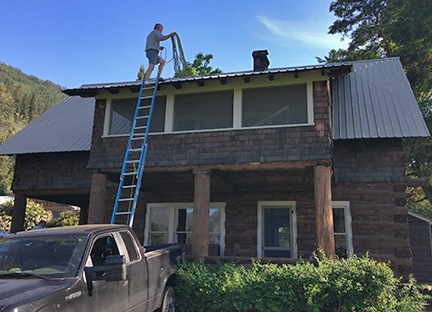
Here’s James at the edge of the roof at the front of the house, trying to throw a rope over the peak.

The roof was steep and metal. James and the homeowner put an extension ladder in the back of the truck. James climbed up. He tried to throw a rope over the peak of the house so it could be held or tied on the opposite side to prevent him from falling off the roof when he climbed. There was no way he could climb to the bees without such protection.

Multiple tries from both sides of the house proved unsuccessful. By this time, James had gotten a good look at the bees and was quite certain that it was only part of the swarm and was likely queenless. Not very valuable and not likely to survive much longer.

James tried walking on the slick metal roof. He couldn’t get any traction. He told the homeowners that he was giving up. I thought it was a good idea. Climbing up that steep roof without a rope to support him would be a great way to get himself hurt or killed.

We left empty-handed again.

The Pump House Swarm

Fast-forward two days. The beekeeping group James and I belong to was meeting for their monthly “bee chat” in Leavenworth. One of the members, Steve, lived in Plain, about 16 miles away. He put out an open invitation for members to visit his apiary. James and I went — he on his motorcycle and me in my Jeep.

Steve’s got six hives and is having some trouble with them — mostly, a queen that has stopped laying. He paints his hive bodies in pretty pastel covers and they look nice in his yard, protected from deer and bears by an electric fence. We visited and he showed us some of his feeders and his solution for winter protection. I learned a lot.

He told us he was going to try to pick up a swarm on his way to Leavenworth and invited us to come along. We did. I was even ready to help if needed — I had my bee equipment in my Jeep after tending to my bees at James’s house earlier in the day.

Inside the Pump House
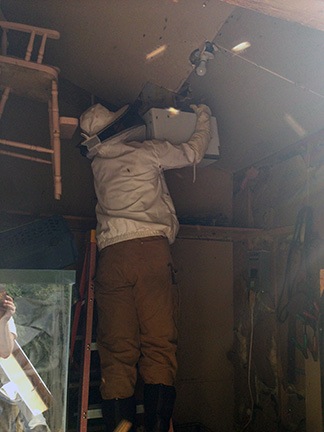
Steve had to scoop bees out of a hole in the building’s ceiling.

The swarm was almost all the way back to Leavenworth. The homeowner met us as we pulled up in our three separate vehicles. The bees, he said, had been hanging around on the outside of the pump house. He pointed to a building near a creek on his property that had bees coming out of the eaves. They’d since moved inside.

Steve went in for a look. James and I peeked, too. There were bees all over the place, but mostly around a big hole in the building’s ceiling.

Steve suited up, grabbed a nuc box with a few frames in it, and went into the building with a ladder. A few minutes later, he was scooping bees out of the ceiling and into the box, hoping to get the queen among the handfuls of bees he moved.

We stayed outside the building. It seemed like the prudent thing to do.

When he was finished, he came outside for a break. He reported that there was something dead in the ceiling. The homeowner said it could be the squirrels who had lived in there and done all the damage.

Outside the Pump House
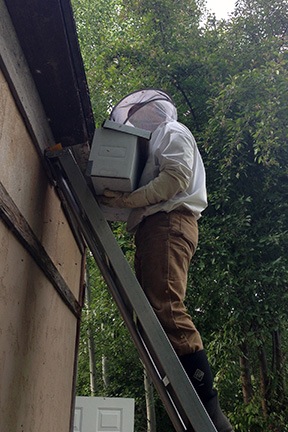
It was easier to gather bees on the outside of the building.

James got a picking ladder and leaned it on the side of the building. Steve climbed up and started scooping bees from the outside of the building into the box. His goal was to get as many bees as he could.

He also examined the bees in the box to see if they were “fanning.” He explained that when the queen was captured, the other bees would use their wings to spread her scent out where the other bees could smell her. The idea was for everyone to come together where the queen was. He saw some evidence of fanning in thx box and none on the side of the building. That was a good thing.

After a while, he’d done just about all he could. He closed up the box, taped the lid down, and put it in the trunk of his car. As he stripped off his bee suit, he told the homeowner to call him if the bees were still there the next day. He’d come back and try to get the rest of them.

One for Three

The score for the three attempts I’d witnessed this past week was one for three. I don’t think it had anything to do with skill, though. I think it was luck. James had bad luck, Steve had slightly better luck.

In watching two successful swarm captures (including the one last year), I’m pretty confident that I could catch a swarm if it was easily accessible — maybe on a 7-foot weeping cherry tree. I hope to get the opportunity to try soon. Wish me luck!

Bees: Filling My Hive

I get some bees and begin caring for them.

I started my beekeeping hobby in June 2013 and have been blogging about it periodically. If you’re interested in reading the other posts in this series, follow the Adventures in Beekeeping tag. Keep in mind that the most recent posts always appear first on this blog.

Hives don’t usually come with bees in them and my hive was no exception. It arrived in a series of big cardboard boxes. Each box contained a hive body and ten frames with foundation. Another box included the base, an inner cover, and an outer cover. All I had to do was stack these in the right order and put bees inside the resulting box and I was in business.

As I discussed in a previous post, I got a line on some bees locally from someone who answered a Craig’s List ad I’d placed. I knew very little about bees and felt weird going to pick them up by myself. Fortunately, my friend James, who kindly lent me some real estate to put my hive at his North Wenatchee home, agreed to come along.

Assembling the Hive

But first I had to assemble my hive.

Although I’d bought a traditional hive with two deep hive bodies and two medium hive bodies, I didn’t need the whole thing. When you establish a colony of bees, you give them enough space for the queen to lay eggs and the workers to tend to the brood and start storing honey and pollen. Then, when they’re almost out of room, you add another hive body with more frames.

It’s like waiting until you’ve almost run out of space in your bookshelf to buy and install another bookshelf.

My Hive
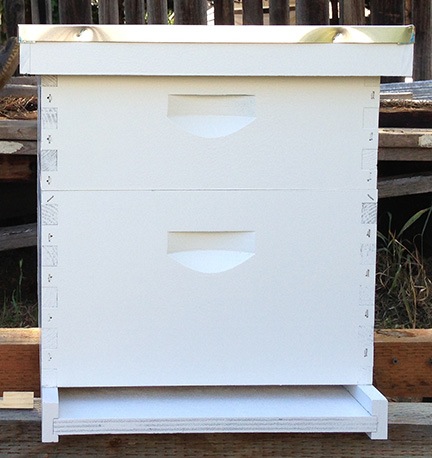
My initial hive setup.

I figured I’d set up a deep hive body for brood and a medium for honey. So that’s what I did. It looked very nice on the hive stand James had thoughtfully provided for me. (I guess he didn’t want me using the palette I’d found and rescued in his backyard. I can’t really blame him.)

I should mention here that I had been regretting my purchase of the two deep hive bodies for some time — since reading the book that came with my beekeeping kit, in fact. I read the book on the flight from Seattle to Phoenix and then from Phoenix to Seattle a few days later. I nearly finished it. In it, the author so strongly recommends that beekeepers buy only 8-frame medium hive bodies that she assumes every reader has done so. And although I have yet to meet a beekeeper who is using 8-frame hive bodies, I know quite a few who are using only medium depth hive bodies. I had decided that I ordered the wrong equipment even before I began using it. And I kept wondering how I was going to make the switch in the future.

That’s what I was thinking about as I assembled my hive and prepared to pick up my bees.

Then James got a phone call about two swarms. I went with him to track them down and (hopefully) capture them. More about that in another post.

Picking Up the Nuc

I was buying a nuc or nucleus colony. As I discussed in a previous post, a nuc is a box of bees with a queen already installed, mated, and laying eggs. It’s basically a very small hive. My Vermont beekeeping friend, Tom, says that this is the best way to get bees because all the bees already know the queen and there’s already brood and honey and pollen stored up.

The nuc was in Dreyden, which is about 15 miles from where my bees would live. After James and I finished chasing down swarms, we headed right to Dreyden. I called the seller, Randy, along the way. He’d meet us at the Shell station, which James knew. I told him what we were driving and he told me what he was driving. It was a typical Craig’s List meet.

We got there first and he pulled up next to us a few minutes later. He was a big guy — think horizontal — in blue denim overalls. He told us to follow him. We crossed the main road and got on a narrow drive. A minute or two later, we were pulling into a yard with lots of grass, a garden, a double-wide mobile home, and lots of parked cars and trucks, some of which looked as if they hadn’t moved in a long while.

A Nuc
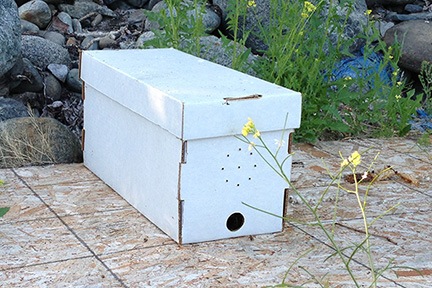
This is actually the nuc I didn’t take. We’d already loaded the other one into James’s truck when I realized I should have gotten a picture.

The nucs — he had two of them — were sitting on a board on the edge of the property. They were wax-coated cardboard, with a round hole in the front for the bees to come and go. Bees were flying in and out of each of them. Not too many, though — it was getting late.

And this is when I was suddenly glad I’d bought deep hive boxes. You see, the nucs use deep frames. If I only had medium frames in my hive, I wouldn’t be able to use the frames in the nuc. That was James’s situation. He wanted to buy the other nuc because he’d lost a queen in one of his hives but he couldn’t because the frames wouldn’t fit in any of his hive bodies.

Randy and James chatted quite a bit. It seemed they’d met before. James used to work for the cable company and had been to Randy’s house up by Blewett Pass. Randy was a nice guy. Very friendly.

Finally, it was time to do business. Randy asked me which one I wanted. I asked him which one was better. He and James agreed that whichever one was heavier probably had more bees. Randy checked them both. He put the round cap in one of them to close off the entrance and lifted it up. He handed it to James and James handed it to me.

I was holding a 15-20 pound cardboard box containing 5,000 to 10,000 live bees.

Cool.

We tucked the box in the back of James’s truck. I gave Randy a $100 bill. We shook hands. He told me to call him if I had any problems at all. Then we drove back down to Wenatchee.

Putting the Bees in the Hive

Back at James’s house, his neighbor’s son, Seth, came out to greet us. When he realized we had new bees, he asked if he could help.

“Suit up,” James told him.

Seems that Seth, who was maybe 10 or 12 years old, was really into bees. Even though his mom wouldn’t let him get any, she did let him get a bee suit and James let him help out. That was fine with me.

I unwrapped my brand new bee suit and pulled it on over my jeans and tee shirt. I put on the pith helmet and arranged the veil over it. Then I tried to zip the veil to the suit. I couldn’t do it. Neither could James. Neither could Seth — although he told me he had a lot of trouble with his, too. So I just let the veil hang over the neck of my suit and hope that the bees couldn’t find their way in. I put on the long gloves, grabbed my hive tool, and, feeling pretty silly, looked at James and our helper and asked, “Do we need smoke?”

Smoke calms the bees. I had a smoker, but I hadn’t used that either. James told me I wouldn’t need smoke. That was okay with me.

I carried the nuc box into the yard where my empty hive was waiting. James told me to take off the top box because I wouldn’t need it. Just the bottom box to get started. I pulled it off and set it aside. Then I pulled five empty frames out of the middle of the bottom box and set them aside. The five frames in the nuc would go into their places.

The moment of truth had arrived. I took the lid off the nuc box.

There were a lot of bees in there. They didn’t seem too interested in me. The tops of the frames were dirty and they were filled with thick comb. And dark brown goo.

James used my hive tool to scrape off a piece of burr comb on top that was filled with honey. “Your first harvest,” he said, handing me the comb.

I set it aside. I’d suck the honey out later.

Using my hive tool, I tried to pry one of the frames loose from the box. Bees create something called propolis — a dark brown goo — which is like a glue they use to seal up cracks. It’s the main reason a hive tool is necessary. I began prying up one side of a frame and tried to get the other.

The bees didn’t like that. A bunch of them came out and started swarming around my veiled head.

I tried again, but the bees were stressing me.

“Do you want some smoke?” James asked.

“If you think it would help,” I replied.

He and Seth left to get a smoker going. While they were gone, I just stood around, holding my hive tool in one hand, while bees swarmed all around me. I didn’t move my head much; I was afraid they’d find the gap between the veil and my suit and get inside. I was very happy to see them coming back about 5 minutes later. They puffed smoke into the nuc. It seemed to have some affect on the bees. Or maybe on me. I calmed down and got back to work.

One by one I removed the frames from the nuc. I didn’t really look at them, although I suppose I should have. I just wanted to get the job done. It was late and the light was fading.

I got all the frames from the nuc into the space in the hive body, making sure to put them in the same orientation and order so as not to confuse the queen.

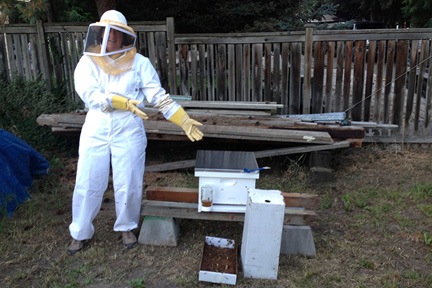
Me and my Beehive
Here I am with my beehive. The nuc box and its cover are nearby so the bees remaining in/on them can find their way into the hive. The sugar water looks brown because I use unbleached sugar.

There were lots of bees still in the otherwise empty nuc box and clinging to the box cover. James said to leave them; the bees would find their way into the hive overnight. That was fine with me. Finished, I put the inner and outer covers on my now occupied hive.

One thing left to do: fill the feeder. I’d prepared a 1:1 sugar:water mixture in advance in a jar. I fit the lid of the feeder on the jar, inverted it, and slipped it into one side of the entrance.

I was done.

I posed for a picture, then went back to the truck. I stripped out of my bee suit and my companions did the same. After a bunch of goodbyes, I left. It was just getting dark.

The tiny bit of honey in that burr comb was good.

Two More Visits

I visited the bees — mostly to feed them — on each of the following days.

On Wednesday, I arrived after my meeting with surveyors, lunch, and a lot of divorce bullshit that I wrote about in another blog post. My main reason to visit was to give the bees more sugar water. I got my veil zipped onto my bee suit. I also got my smoker going — although I really didn’t need it. I didn’t need to open the hive. All I needed to do was take the lid off the feeder jar, refill it, and then put it back in place. Bees were coming in and out of the entrance. All looked good.

The bees were mostly out of the nuc box. I shook the last few out and used my hive tool to scrape away the propolis and wax on it. Back at my RV, I’d put the five frames I’d removed into the nuc box for safekeeping. I now had a good place to put a swarm if I had the opportunity to catch one.

On Thursday, I arrived after spending too much time at Hooked On Toys, getting a fishing rod set up for salmon fishing. (Too bad salmon season doesn’t start until July 1!) I’d brought enough sugar water to keep them for two days. This time, I wore the suit — call me a coward — but skipped the smoke.

I didn’t visit them at all on Friday. North Wenatchee is 40 miles from where I’m living right now. Those bees are going to have to learn to fend for themselves. I can’t visit them every day.

I’ll likely visit again this weekend, though, to give them more sugar water. I’ll also use that opportunity to inspect the hive and hopefully add another deep hive body and frames. Later, I’ll add a queen excluder and honey super. I don’t expect to harvest any honey this year — the bees will need it all to get through the winter — but I’m eager to give them what they need to keep the colony growing.

More in another post. Stay tuned!