Chickens Again, Part I

Getting started with a new batch of chickens.
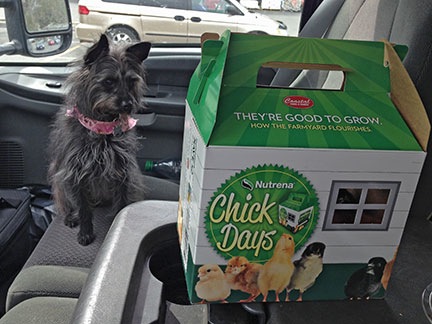
Penny with Chicks
Penny suspected trouble when I got into the truck with this little box.

A few weeks ago — just a few days after returning from my 2-month California trip, in fact — I bought 8 chicks. I set them up in my shed, in the stock tank I’d bought last year for my poor man’s hot tub.
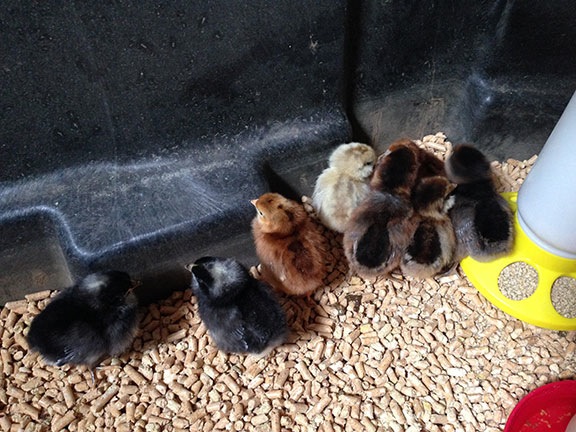
Chicks in my Shed
My little chickies, huddled together in their nursery.

I’d had chickens before, in Arizona. They’re a lot of fun and you really can’t beat fresh eggs. Because I knew I’d have chickens again, when I moved to Washington, I took along most of my chicken-rearing equipment: feeders, waterers, and heat lamp. That saved me a bunch of money when it came time to get these started. And the stock tank in the shed really beats the cardboard boxes I used to use in my garage to get the chicks started.

The Chicken Yard

Of course, they couldn’t stay in the shed. Eventually, they’d need a chicken coop and a fenced-in yard. Like Wickenburg, this area has coyotes and I’d have to protect the chickens from them. It also has large hawks, eagles — including Bald Eagles — and owls, so a net across the top would be vital. I wanted the chicken yard to be large enough to accommodate all the chickens and, with the real possibility of free-range egg sales, even more chickens in the future. And although I only wanted to build it once, I didn’t want it to be permanent. (I’ve come to realize that I don’t want anything in my life to be permanent because nothing really is. But that’s a philosophical discussion best saved for another blog post.)

I explored many options. “Hog panels” looked good, but the only ones available in the area were very large and very costly. Someone suggested a dog kennel and even sent me to Costco in search of one that seemed like a good deal. But they were out of stock and I was running out of time. I needed the chickens out of the shed before I headed south for a few days on personal business.
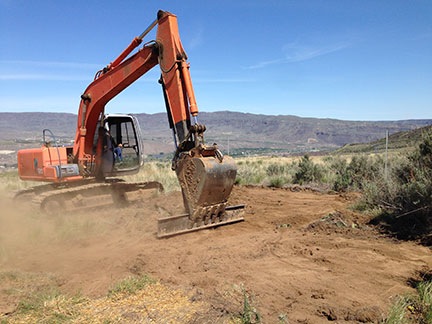
Gardening with a Backhoe
Jeff cleared a space for my shed and garden and left a pile of bunchgrass and weeds in the area just north of the garden patch.
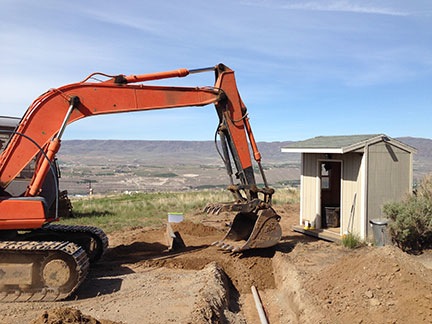
Covering Conduit
After he moved my shed and dug a trench, I ran conduit for my temporary electric and water lines to keep them off the driveway and he covered it back up.

Meanwhile, Jeff, the earth-moving guy, was preparing the pad for my future home. He had a honking huge backhoe and an i-beam that he used to scrape the ground. I wanted a garden and I wanted my shed moved to the other side of the driveway. (Originally, I figured I’d sell the shed when my building was done, but I realized it would make a great place to store garden tools so I decided to keep it.) I realized that Jeff could give me a good head start on my garden prep with that i-beam and I set him to work on a small area near where I wanted the shed. He dug out the few sagebrush there and scraped the ground clear of bunchgrass, leaving it piled up in an area north of the garden. He even dragged my shed to its new position — it was built on skids — and got it level for me. And dug a trench so I could run power and water for my RV and shed under the driveway so the cords and hose would not be run over by construction vehicles this summer.

When he left, I looked at my future garden location and the spread-out, uprooted bunchgrass beside it. The chickens wouldn’t mind all that grass. And it would be nice to have them next to the garden so I could let them in to eat bugs. Without even intending to, Jeff had chosen the spot for my chicken yard.

I wound up buying 150 feet of 5-foot tall “horse fence” at the nearby Coastal Farm and Ranch store. I wanted 6-foot fencing so I’d have plenty of room to walk around under the net, but this was on sale for a good price and it’s not as if I’ll be hanging out in there with the chickens. I also bought a few 6-foot T-posts. I already had a T-post driver and a bunch more T-posts that a friend had given me.

But I began realizing that I’d have a problem when I got the roll of fence home. It was too heavy for me to lift. I couldn’t even push it out of the truck bed. Clearly, I’d need help.

Assembling the Fence

Help came in the form of my friend, Mike. He’d come up from California with his helicopter towed behind his motorhome. After dropping off the helicopter at the airport, he rolled down my driveway and greeted me with a big hug.
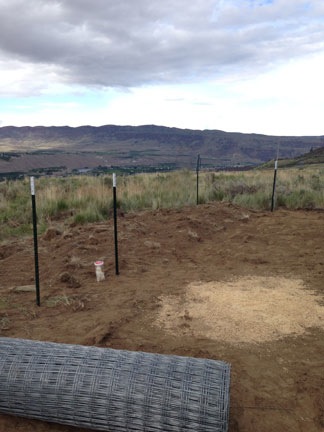
Fence Under Construction
Some of the T-posts in the ground around the future chicken yard; the roll of fencing was very heavy.

After getting a tour of the place — building pad, “lookout point,” apiary, chicks in shed — we talked about the things I needed to do. I mentioned the chicken yard and the fence, never even thinking about asking him for help. That’s when he offered to help me.

I’m not an idiot. When someone offers to help me with a difficult task, I say yes! We got to work right then and there.

The work went surprisingly well. Within about 2 hours, we had completely fenced in a 9 x 25 foot area beside my future garden, leaving only a 4-foot wide doorway for a gate. Although it wasn’t perfect, it was a lot better than I expected it to look.
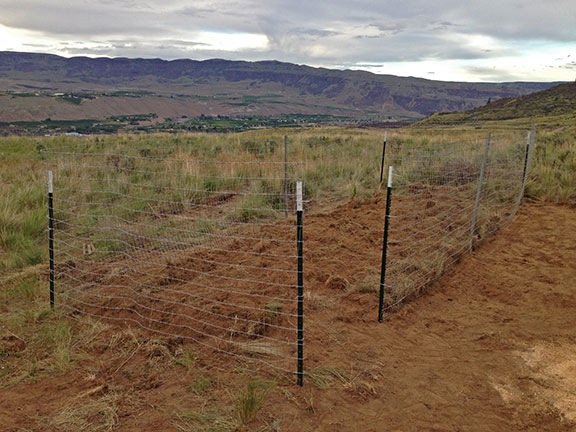
Chicken Yard
The nearly finished chicken yard.

Finishing Up. Almost.

The next day, I bought some bird netting at Coastal. Although it was supposedly 14 x 45 feet in size, the 14 foot width could not span the 9 foot width of the chicken yard. (What was that all about?) But with a little creative cutting and attaching, I was able to fit three pieces across to protect the chickens from aerial predators.

The next morning was warm and sunny with hardly any wind. I decided to try out the chickens in their new yard — I really needed to get them settled in before I went on my trip. I dragged the stock tank out of the shed and into the chicken yard. I closed the makeshift gate I’d made behind me. And then I tilted the stock tank so it was laying on its side, thus freeing the chicks.

They were not happy. And Penny, of course, went nuts. She couldn’t get into the chicken yard and she wanted a piece of those chickens. The chickens ran around and Penny ran around the yard. And that’s when the chickens started squeezing through the fence.

What followed was a comedy routine that involved me and Penny chasing 3-week old chicks. Penny was good at catching them and, for some reason, she didn’t kill them. I managed to get them all back in the stock tank. After putting food and water in there, I went back into the RV, hot, sweaty, and dusty.

The chicks would not be much bigger before I headed out on my trip. That meant that if I wanted them in the yard, I’d have to put something around the bottom edge of the fence to prevent them from squeezing through. What? I had some chicken wire, but I’d bought 4-foot width and that was overkill. It looked as if I’d have to head back to Coastal for some more chicken wire.

Reuse, Recycle

I was back out in the yard, contemplating the situation, when my eyes fell upon the 22 bales of straw I had in two piles in my yard. I’d bought the straw the previous autumn to stack around the base of the RV to winterize it. When I moved the RV out for my California trip in February, I’d stacked the straw neatly to get it out of the way.

If I laid the straw around the base of the chicken yard, right up against the fence, would that prevent the chickens from getting out? It certainly seemed as if it would.
8 WD
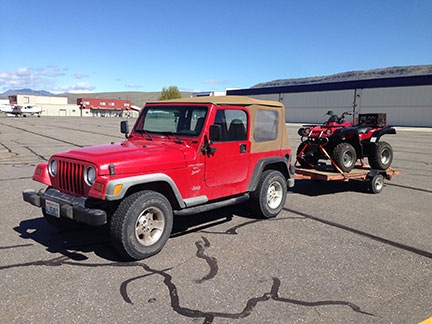
Although I bought this little flatbed trailer — a Craig’s List deal — primarily to move my bees around in the future, its size and low bed make it perfect for moving my ATV and straw bales.

So I got to work. I’d brought my ATV home, along with the little cargo trailer I’d bought years ago for yard work up at our vacation property in northern Arizona. The cargo trailer’s tires had been replaced and it was all ready for use. But last week I’d also bought a very small flatbed trailer that was larger than the ATV’s yard trailer. With a ball on the front of my ATV for towing the helicopter, I could tow the little flatbed trailer. It would be perfect for moving all that straw.

A formerly wise man used to say that any job is easy if you have the right tools. How true. I had the straw moved and positioned in less than an hour.

I was thrilled. My solution solved more than just the chicken escape problem. It also temporarily solved the problem of what I was going to do with all that straw.

A while later, I tried again to let the chickens out into the yard. This time, they didn’t escape.
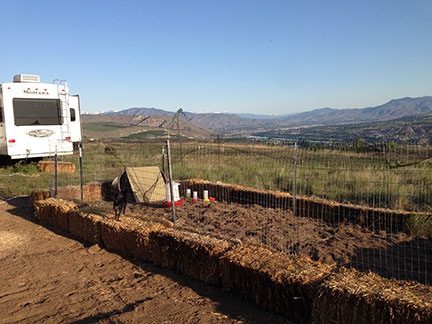
Chicken Yard
The chicken yard this morning. I haven’t done a headcount, but I’m pretty sure all eight of my little girls are in there.
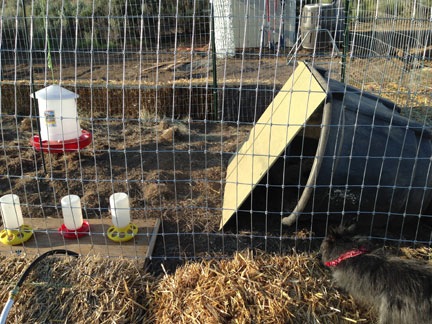
Temporary Coop
The temporary chicken coop is nothing more than a stock tank on its side with a piece of scrap plywood as a lean-to wall.

I set up an automatic waterer that I think might be a bit too big for them. Then I set up their chick feeders and waterer. I left the stock tank on its side against the side of the fence as a makeshift shelter for them; later, I leaned a piece of scrap plywood against it to enclose most of it. My list of things to do includes building a chicken coop, but I’m not sure I’ll get to that before my trip. The chicks are still small and should be okay in the stock tank, at least for a few more weeks.

The sun has just risen as I’m tying this. Seeing movement out the window, I took a closer look. The chicks are out in their little yard, scratching around in the early morning light. They’re exploring their big automatic waterer and, with luck, will soon be using their hanging feeder, too.

It looks like I’m on the road to chicken success. More later, after I’ve built their coop.
Airport Life: Today’s Drop-In Surprise

You never know what you’ll see out your back window.

Just a quick post to share a photo of the view out my RV’s back window this morning. The mobile mansion is parked at an airport in the Sacramento area. I’ll be living here for the next 7-8 weeks on a frost contract for almond orchards in the area. I’ll tell you more about that in another blog post when I get time to write it.

This Morning's Drop In Visitor
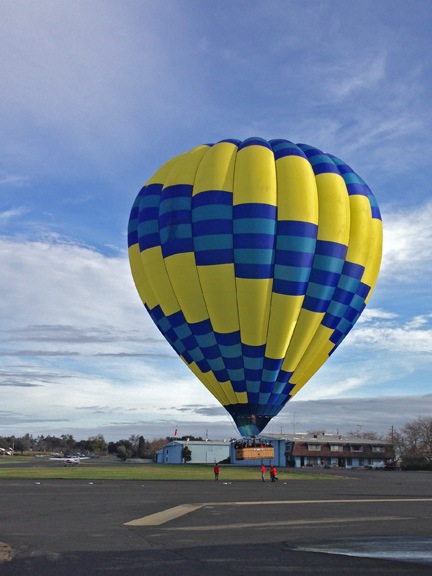
Look what landed in my “backyard” this morning.

The airport I’m living at isn’t very busy at all — despite the fine weather. But this morning I was very surprised to see a big hot air balloon just miss the hangar behind the mobile mansion on a descent to a field near the airport office. The crew was already onsite when the balloon landed with only a bit of ground run. I got some pictures as it came in.

Once it was stabilized and the balloon deflation begun, at least 20 people climbed out of the huge wicker basket. Penny and I went to greet the passengers and chat with the pilot while the crew worked to stretch out the balloon on the dewy grass. My chat with the pilot was fruitful. Looks like I’ll be swapping a balloon ride for a helicopter ride one day soon.

Other balloons were on their way in, but approached too high and ran out of room before being able to land on the airport property. They climbed up and drifted off to the north, one after another. I suspect I’ll see them again soon.

Shoveling Snow Time-Lapse

I shovel snow for the first time in 16 years.

It snowed last night. Finally.

Yeah, we did have some minor snowfall way back at the end of November or beginning of December, but it wasn’t much. I bought a snow shovel at the local Habitat for Humanity shop for $5 but was better off just sweeping that snow away.

But last night we had the real thing. About four inches of the stuff, slightly wet but otherwise powdery. I saw it in the dark when I woke up and let Penny out. She ran to the edge of the porch, saw the white stuff on the walk and in the yard, and turned tail, running back into the house, obviously afraid. It was 30 minutes later, after she’d finished most of her breakfast and really had to go that she stepped out into it. That’s when I got an idea of how deep it was — she sank in up to her little body and wound up doing her business under the porch.

I walked out, still in my slippers, and stuck a forefinger in the fresh snow on the walkway. My finger was buried before I touched the ground.

At least four inches. Whoa!

I waited eagerly for the sun to rise. I was actually looking forward to using that new shovel.

Those of you in winter wonderlands who have had snow dumped on you all season probably think I’m nuts. I’m not. I grew up in the New York Metro area where the weather was a bit colder in winter than where I am now — and a lot colder than where I lived in Arizona for 15+ years. I didn’t realize how much I missed the snow until I got here, prepped for winter sports, and then waited for the snow to fall.

It didn’t.

Until last night.

Anyway, at about 8 AM, I donned my winter pants and jacket and boots and fashioned my Buff into a balaclava. Then I pulled on my ski gloves and went out to do a chore most people hate: shoveling snow. Of course, I created a time-lapse:

I don’t have to shovel the driveway, which is quite long. The man who owns the house I’m living in right now has arranged for snow plow service if the snow gets too deep. Right now, I don’t think it’s too deep at all — my Jeep has big, gnarly tires that won’t even notice the snow. Besides, temperatures later this week are expected to rise above freezing — heck, it’s already 31°F outside right now — so I don’t expect the snow to linger.

Maybe that’s why I was in such a hurry to get out there and shovel? I didn’t want to miss my opportunity.

Besides, once it starts melting, I suspect it’ll be a lot heavier and harder to move.

Scavenging in a Landing Zone

Sunflower seeds, right from the source.

The other day, I had a helicopter charter from Wenatchee to Ephrata. My landing zone was a harvested sunflower field.

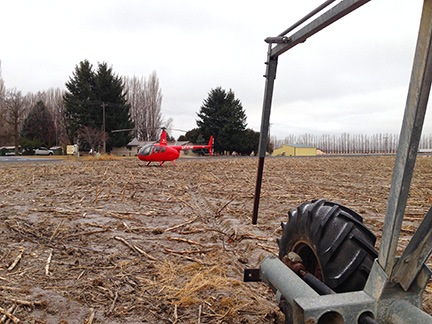
Parked at the Sunflower LZ
I parked not far from the end of the irrigation pivot for the field.

The ground was rough but frozen hard. I landed with my skids perpendicular to the furrows where the plants had been lined up during the growing season. Thick dried stalks littered the field and, as I came in for my landing, I wondered how many would become airborne and whether they’d cause me any problems. Some did stir while other pieces of the harvested plants got airborne in my downwash as I neared the ground. But there was no danger. I settled down so softly, my passengers even commented on it.

“Smooth,” one of them said as he unbuckled his seatbelt.

My two passengers climbed out as I began the cool down procedure. They walked around the front of the helicopter, well beneath the spinning blades, and met the men they’d come to see alongside the road. I watched them cross the street and disappear down a driveway.

It didn’t take long to cool down the engine. It was 1°C outside. I brought the blades to a stop and climbed out to survey my surroundings and take another look at the ground near my skids. It’s a habit I have on off-airport landings — checking the skids to make sure they’re free of objects or terrain that could cause a dangerous pivot point later when it was time to leave. And, of course, I took a few pictures; I always photograph my landing zones.

That’s when I found out what I’d landed on. From the air, I’d assumed it had been corn. But there were quite a few big, round structures in the field and it didn’t take long to figure out what they were: the seed heads of sunflowers.

The Seed Heads

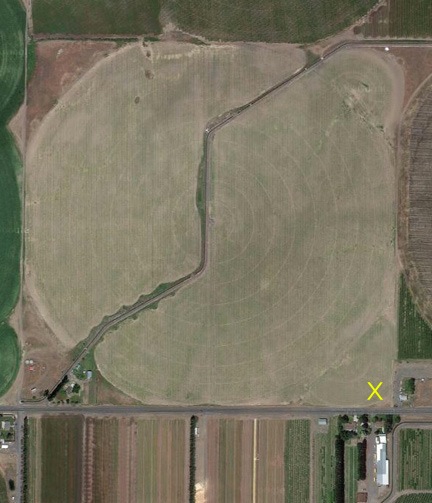
The Sunflower LZ
This Google satellite view tells the story of a big round field with a draw running through it and a smaller field in the corner where I’d parked.

This part of Washington is farm country. While they mostly grow tree fruit and grapes in the Wenatchee area where I live, out toward Quincy and Ephrata and Moses Lake they grow a lot of row crops. The corner of this huge field had its own little irrigation pivot. I don’t know what they grew in the rest of the field, but this corner had been sunflowers, and lots of them. I could only imagine how beautiful they must have looked in bloom.

Now there were just scattered seed heads lying around. Like any machine-harvested field, some crops are left behind.

I got to thinking about those sunflowers and all the seeds that were embedded in them. Hundreds in each seed head. They obviously didn’t want them. If I grabbed a bunch, pulled the seeds off, and scattered the seeds around my 10 acre lot in Malaga, there’s a good chance I’d get a few sunflowers for very little effort. My bees would be very pleased indeed for the late season pollen and nectar source.

I started gathering seed heads. They were dry but dirty. The stalks on some were quite long. I pulled out my pocket knife and sawed them off.

I’d gathered four of them and had stowed them under one of the back seats when I got a text message from my client.

“You can come in if you want,” it said.

Usually, I sit out at the helicopter and read while I wait for my passengers. But usually, it isn’t 1°C outside. I realized I was cold. I closed up the back seat, put my knife away, grabbed my iPad, and traced their steps across the street and into the lobby of the nursery/packing house they were visiting. After explaining who I was, I settled down on one of the chairs there, took off my coat, and read.

The Seeds

I brought the seed heads home from the airport after our flight and stowed them in a big shoebox in the garage. (Now I know why I saved that box.) I wasn’t sure how wet they were and I didn’t want bugs in the house or mice among the seed heads.

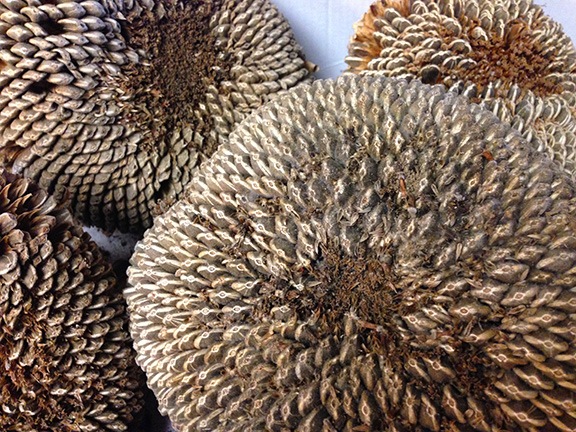
Today, I took them out for a better look. They were quite beautiful in an old, post-harvest kind of way. They were brown — not black, as we’re so accustomed to seeing in snack packaging. I’m not sure if they were brown because of the dirt or because of the type of sunflower.

Sunflower Seed Heads
Seed heads in a shoebox.

Sunflower Seeds
Harvested sunflower seeds beside the largest of the four seed heads I brought home.

I picked one up and, holding it over the box, rubbed it roughly with my thumb. The seeds began to dislodge and fall off into the box. About ten minutes of rubbing cleared them off the three smaller seed heads. I figured I had about 2,000 sunflower seeds. The final seed head would likely add another 1,000 or so.

The plan is to let them dry indoors in the box. When I’m sure they’re good and dry — and I honestly think they already are — I’ll put them in a bag. In February, before I leave for my frost gig, I’ll scatter them all over my property, keeping about 100 or so to manually plant alongside my vegetable garden.

But before I do any of that, I’ll likely soak a few of these to make sure they sprout. After all, there is a chance that they’re hybrids grown for some specific purpose — oil, seeds, etc. — and that the seeds themselves aren’t fertile. I’ll know soon enough.

3,000 free sunflower seeds. Not bad for a bit of scavenging.

Snowshoeing. Finally.

More like iceshoeing, if you ask me.

When I decided to spend the winter at my new home in Malaga, WA, I decided to embrace the winter. After all, it was the first real winter I would experience since leaving New Jersey for Arizona in 1997. And, from what I could see, the winter was likely to be about the same as the winters I’d experienced back east — perhaps a little milder but with a little more snow. Perfect for winter sports.

Embracing Winter Sports

Back in my New York and New Jersey days, I did some cross-country skiing — although not enough to ever get good at it. I discovered just how rusty and inexperienced I was when I went cross-country skiing up in the Methow Valley for Christmas. I had a great time, but also learned that I certainly need more practice.

Back in my east coast days, I also did some sledding, tobogganing, and ice skating — but very little of all three in my adult years. (I do vividly remember dislocating my shoulder on a Girl Scout skate outing — the troop leaders were convinced I’d broken my collarbone and the X-rays showed nothing because my shoulder had popped itself back into place before they could get me to the hospital.)

But snowshoeing? That was something that people back east just never did. In fact, whenever I conjured up an image of snowshoes, I saw wooden frames similar to the business end of a tennis racket strapped onto someone’s feet. Was that from cartoons or old movies?

When I moved out here, however, everyone was talking about snowshoeing and I soon realized that it was the winter version of hiking. I love to hike — it’s great exercise and a wonderful way to spend time outdoors with friends and my dog. Surely I’d love to go snowshoeing. I put snowshoes on my Christmas wish list and my brother sent them to me — thanks, Norb! I’d already outfitted myself with all the warm winter clothes I’d need to stay cozy while out in the snow.

But what snow? That was the problem.

Where’s the Snow?

This is my first winter in north central Washington state. I was here for a week last January, just to see what it was like. There was about 4-8 inches of snow on the ground, depending on where I was. No fresh snow fell during that time, but it stayed cold enough to keep the snow from melting.

Everyone told me that it usually starts snowing in December here and that it snows periodically through January and into February. They even said that April snowstorms aren’t unusual. Surely snow must be common — after all, there’s a ski resort right outside of town!

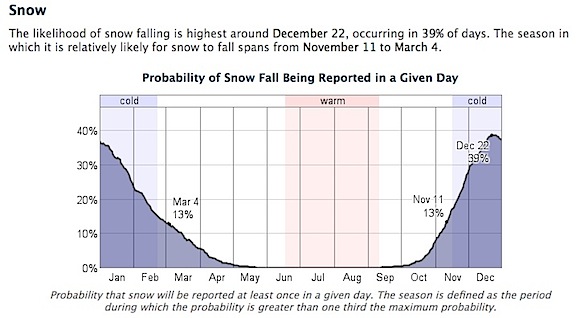
Weatherspark Snow
Here’s what Weatherspark has to say about snowfall averages in Wenatchee.

And things did start off promising. It snowed right around the time I moved into the house I’m caring for this winter — December 1 or thereabouts. There was about 2-3 inches on the ground — not quite enough to get the driveway plowed, but enough to see my truck’s tracks in the snow. I even bought a snow shovel, which I used to push the snow off the pathway so I wouldn’t track it in the house.

But that was it. It got warm enough over time to melt all that snow away. Then very cold and warm and cold and not so cold. It was always cold enough for it to snow out — daytime temperatures hovered around 30°F — there simply wasn’t any moisture in the air.

Or, actually, there was. But it came in the form of Wenatchee’s famous winter fog.

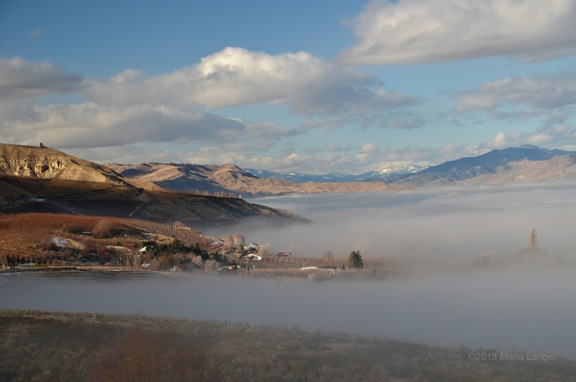
Understand that although I do live in Washington, I don’t live anywhere near Seattle or the ocean. This fog is a completely different from what you might expect in a coastal region. It apparently forms when there’s stagnant air — indeed, we’ve been under an air stagnation advisory for nearly two weeks now. That means no wind. None at all. Air quality isn’t affected — the air is crisp and clean. But a layer of clouds forms over the valley and sometimes dips quite low. More than once, the house I’m living in now (elevation 1200 feet) was in those clouds. Another time, it was above them.

Above the Clouds
The view out my window about a month ago. Have I already shared this? I really love this shot!

For some reason, this year we’re getting lots of that fog but none of the usual snow. And it’s not just Wenatchee, which sits at about 600 feet elevation. It’s also Leavenworth, which is the closest cross-country ski and snowshoeing area. There just isn’t any snow.

Showshoeing at the Fish Hatchery

I set up a snowshoeing outing for my favorite local Meetup group, the Wenatchee Social & Outdoor Adventure Group. It was a free outing at the Leavenworth Fish Hatchery, sponsored by Friends of Northwest Hatcheries. It included a 2-hour walk along hatchery trails, guided by naturalists. Snowshoes would be provided.

Of course, I brought my own. I went with my friend Tim — who seems to know everyone everywhere we go. We got there early and Tim wasted no time chatting with one of the guides while I went to check out the salmon fry in huge tanks in their indoor facility. (I could go into a lot of detail about what they do at this hatchery, but I’ll save it for another blog post — probably one after a springtime visit to the trails.) After a while, another four people joined us. Then a second guide arrived and we were ready to go.

Although there was no snow, our guides insisted that we bring and later put on snowshoes. The trouble was the ice — everywhere the snow had melted into pools had turned into patches of ice. Some of them were quite large. All of them were pretty slippery. One of the guides, Janet, said she didn’t want to be calling any ambulances today. Apparently she’d been calling them periodically over the past few weeks.

The three of the four later arrivals — all of whom traveled from Oregon for the weekend, I might add — came without snowshoes. We stopped at a shed along the way and Janet handed them out. Then we got on the trail along Icicle Creek. When the ice began covering too much of the trail to stay off it, we put on our snowshoes and continued on our way.

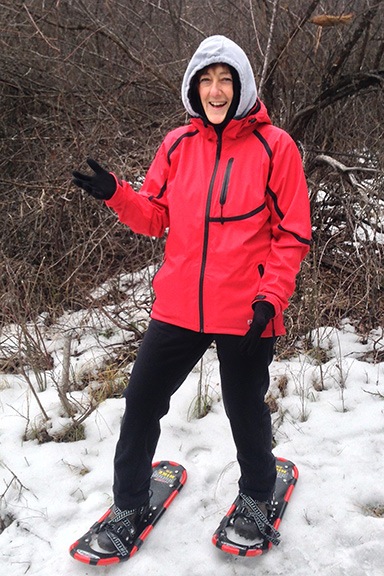
Maria on Snowshoes
Tim took this picture of me in the snowiest spot we could find.

This was my first time wearing snowshoes. I didn’t have much trouble putting them on over my big Sorrel snow boots once I figured out how the straps worked. Soon I was crunch-crunch-crunching over the ice with my companions. The sound was deafening as the metal spikes at the bottom of the shoes stabbed through the ice, pushed down mercilessly by the weight of person above them. Whenever the guides wanted to tell us about something along the trail, we all had to stop and stand still just to hear them.

But what I liked most about them was that with them on my feet, I wasn’t going to slip one single inch.

We walked for about two hours stopping here and there along the trail. We learned about the various types of fir and other evergreen trees, including the incorrectly named Douglas Fir, which isn’t a fir at all. We saw tiny birds flittering about the trees over head, bear scratches on tree bark, beaver dams, and water-carved ice floes. We learned about various unusual local plants (like horsetail) and how they were originally used by the native people who once inhabited this area. I soon realized that we were on a very large and complex trail system that would be great to explore on foot in the spring, summer, or fall.

I would have taken pictures along the way, but I managed to leave my phone behind in the Jeep. That just gives me an excuse to come back with my Nikon, long lens, and monopod. Apparently the area is a prime site for bird watching, with plenty of viewing blinds along Icicle Creek. A springtime hike with Penny and my camera should be lots of fun, with plenty of photos to share.

We were back at the Visitor Center by 3 PM and heading back to Wenatchee a while later. I was glad to have had the chance to finally give my snowshoes a try. Tim tells me they’re a lot more fun when there’s a nice deep base of snow. Somehow, however, I suspect I’ll have to wait until next year to experience that.