Lights at Night

Beautiful, but at a cost.

As the days are getting shorter, I’m finally rising and going to bed when it’s dark out again. This morning, I took a few moments to contemplate the predawn lights of Wenatchee from my home. And it really is beautiful.

Lights at Night
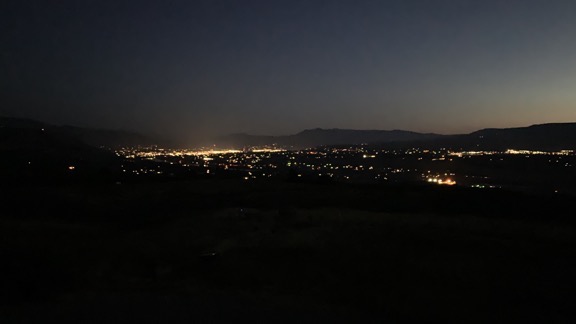
The view from my deck looking out towards Wenatchee at 4:51 AM this morning.

When I was a kid, my family would occasionally take a drive up to the east side of the town we lived in, Cresskill, NJ. Back in the 1960s and into the 1970s and beyond, developers had begun building luxury homes on a hillside that climbed away from the town toward the Palisades. We used to call it “the rich people’s hill” because the homes were huge and it was obvious that only rich people lived there. I remember one of those drives being in the evening, after the sun had set and the lights of Cresskill had come on. I remember seeing all those lights, like diamonds in the darkness.

That’s what my nighttime view here reminds me of sometimes.

I cannot begin to describe how wonderful it is to live in a place so removed from, yet within reach of, a small city like Wenatchee. I have all the conveniences that the little city offers — shopping, dining, theaters, nightlife, services, and even an airport with airline service to a real city (Seattle) and beyond. Yet I’m not down in it, crawling around in — or listening to — traffic. Even as I sit here now, typing out my thoughts as the sky brightens out my windows, the only sound is my wine fridge humming and my rooster crowing. Even when they’re spraying down in the orchards far below me, the sound seems more earthy, more natural, than the sounds of the city.

But the lights. Sigh.

I’ve begun to notice bright ones getting closer. When I returned from my winter travels in spring 2018, I noticed four new bright spotlights over some sort of maintenance yard down by the river. You can see them on the right side of this photo: three in one color and one in another. And last spring I noticed a new bright light across the river, likely shining down into someone’s yard. Why?

Here at my home, I have subdued lighting at night. There are solar accent lights along my driveway and the path to my tent and the posts tops on the uncovered side of my deck. There are motion-sensor lights that go on when someone — or something — walks near them. None of these lights shine up. And that’s it. I see no reason to pollute the sky with light at night.

And that’s what it is: light pollution. The only complaint I have about my home is the fact that it never gets truly dark here. (Well, it actually does, but only at night when it’s foggy.) And because I don’t have (or need) curtains on my windows, it never gets dark inside my home.

It was with a bit of sadness that I sold my old telescope last year. It was parked near the door to the deck for years and only used, with disappointing results, once or twice. Although I’m likely to pick up a more compact one with tracking that I can take on my winter travels — plenty of dark sky out in the desert! — I just have no use for one here.

It’s blue hour right now, light enough to see the empty sage land between my home and the orchards and lights beyond it. The city lights are starting to fade. It’ll be a hot sunny day today.

But at night, I’ll see those lights again, enjoying the view while lamenting my loss of dark night sky.

A(nother) Short Story about the State of US Healthcare

Who wants a “pre-existing condition” these days?

I thought I’d take a moment to share a few recent thoughts related to the healthcare situation in the United States.

I’m in my late 50s now and have, for the first time, begun spending a lot of time doing close work with my hands. Making jewelry with fine wire and small tools doesn’t put a lot of strain on my hands, but it apparently does work the muscles and joints more than I’m accustomed to.

Arthritis runs in my family. I clearly remember my grandmother on my mother’s side, who lived to be about 90, complaining about it once in a while. She had typical “old lady hands,” that included thick knuckles and crooked joints under wrinkled skin. She’d spent nearly a lifetime doing close work with her hands in a garment factory, starting work when she was as young as 13 and working until many years later when my grandfather had a stroke and she had to stay home to care for him.

I’ve had knee problems on and off throughout my life. They always got worse when I was heavier and disappeared when I lost a lot of weight back in 2012. But before they disappeared — back when I had a lot of disposable income and a decent health care plan — I went to a doctor about it. Arthritis, he said, pointing at the x-rays.

Handxray
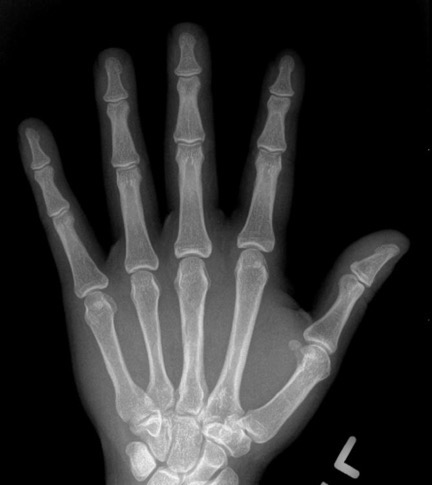
X-ray of a hand from Wikipedia. I’ve got my own x-rays around here somewhere.

More recently, a fall off the back of my truck that sprained an ankle apparently fractured some bones in my left wrist, which I’d landed on. While trying to diagnose the occasional swelling and severe pain (caused by “floating bodies,” we later discovered during arthroscopic surgery that removed most of them), the doctor took x-rays. He pointed out the early signs of arthritis in my wrists and hands.

So yeah. I have arthritis.

It’s gotten to the point that it’s starting to bother me enough to seek medical solutions that don’t necessarily include painkillers. (I can take Vitamin I (ibuprofen) without a doctor telling me to, and I’m not interested in anything stronger.) Would exercises help? CBD creams (as everyone keeps telling me)? Heat or ice therapy? Vitamin supplements? I’m not interested in querying Dr. Google because we all know that there’s enough bad advice there to drown out the good advice. I want to visit a doctor, have her take new x-rays, and tell me what I can do to slow the progression of this very common problem.

And here’s the rub.

If I go to an arthritis specialist — provided I can get an appointment with one — I’m making a very public (on my medical records) statement that I have a medical problem bad enough to seek medical help. In other words, I’m admitting I have a condition that, once admitted, becomes a “pre-existing” condition for future health care coverage.

Now, under the Affordable Care Act (ACA, AKA “Obamacare”), as it was passed by the government and enacted into law, pre-existing conditions didn’t matter. But things are different now.

Let me tell you another story about pre-existing conditions prior to the ACA.

Years ago, when I was very heavy, I was having digestive issues that included GERD, heartburn, acid reflux, and vomiting. To this day, I think it was a hiatal hernia but at the time I was unable to find a doctor to offer any advice beyond “take Pepcid AC.” Back in those days, I made the fatal error of mentioning “chest pain” as a symptom. As you might imagine, that triggered a flurry of heart tests, all of which came back negative. I did not have a heart problem, I had a digestive problem. I blogged about this in detail way back in 2010.

This profit-driven nonsense established me in medical records with a “pre-existing heart condition” that didn’t exist. All of the tests came back negative! So when my idiot wasband lost his job (again), made a late COBRA payment, and got our health insurance canceled, the insurance company refused to cover me when they started the insurance back up. I had a “pre-existing heart condition,” they said.

For six of the scariest months of my life, I had no health insurance because a couple of greedy doctors put me through a battery of unnecessary heart tests and an idiot couldn’t manage his money properly. It wasn’t scary because of my health. It was scary because if, during the time I was uninsured, I got some kind of real negative health diagnosis (think cancer) or had an accident at home (think falling down the stairs) that put me into the hospital or long term treatment, I could lose everything I owned. Medical bankruptcy is a real thing here in the United States and I was set up to become a victim.

I got limited insurance coverage back and later got my own damn insurance again so I didn’t have to worry about an idiot screwing things up for me. The ACA really helped things; it was as if those old medical issues simply didn’t exist. And, so far, I haven’t had insurance denied because of these things — although the rate has gone up dramatically since Trump took office. Next year, who knows?

So here I am in 2019. I have arthritis in my hands and want help to prevent it from getting worse quickly. But I’m afraid to make an appointment with a specialist because I’m afraid to get the condition on my medical records. So instead, I’ll keep waiting, letting the condition likely get worse. All because I don’t want to be denied insurance coverage in the future.

Is it right? Does it makes sense? No and no. But there isn’t a damn thing I can do about it other than emigrate to a country with decent health care for all. And believe me, I’ve been thinking about it.

So that’s my situation as I type this.

At least the CBD cream smells nice.

The Broody Hen

I help a broody hen hatch 12 eggs.

Right around the time I returned from my vacation in early May, one of my hens got broody. A broody hen, in case you’re not familiar with the term, is one who wants to sit on eggs so they hatch and she can have chicks.

Although I’ve had chickens on and off for at least fifteen years, I’d never had a broody hen. The trouble with a broody hen is that she doesn’t lay eggs. She just sits on them. Worse yet, some of the other hens will lay eggs where she’s sitting so you don’t get eggs from those hens either. If you have chickens for eggs — which is why I have them — you don’t want a broody hen.

But I figured I’d let her sit until she got bored. She was sitting in the upper nest closest to the coop door and was in there every day that I peeked in to gather eggs.

And then one day, she was sitting on the nest farthest away from the coop door, leaving all her eggs — about ten of them — exposed and cold.

For some reason, I decided to take the eggs and stick them in my incubator. I set it up in the garage, added water to keep the humidity sensor happy, put a box of cat food cans on top to secure the lid, and forgot about it.

Until about four days later when she switched back to the first nest.

I gathered up the neglected eggs and added them to the incubator. At that point, I had 18 eggs in there.

Becoming a Chicken Mama

Life went on. She kept sitting on eggs in that first nest. I kept trying to pull the eggs out from under her, trying to discourage her from sitting.

And then one evening about 18 days after starting the incubator (according to the incubator’s clock), I went down to check the incubator and heard a chick. I saw the broken egg but didn’t see the chick right away. Turns out it had fallen off the platform where the eggs were in their turner and fell into a tiny crevice that normally would be full of water. Fortunately, I’d put water on one side only.

I had to take the incubator apart to get it out. Then I had to set up a warm place for it to brood. I had a chicken heater and a clear plastic bin and some pelleted litter material. Within minutes, I had a place set up on my dining table for the squawking little bird. Then I went back to the garage, put the incubator back together and put the eggs back.

Chick and Eggs
Here’s the first chick that hatched, along with two pipping eggs. Can you see the cracks? The black thing is a heater that won’t burn the birds (or anything else).

That’s when I noticed that three more eggs were pipping. That means they had tiny cracks caused by the chick trying to get out. I brought them upstairs and set them in the warm bin with the other chick, which had quieted down now that it was warm.

And then I thought about the work I’d made for myself: brooding another batch of chicks in my chicken coop. I had a brooding area in there that could comfortably hold 8 chicks for about a month. They had to be manually fed and given water daily. And then I had to shift them to a separate area in my chicken coop and yard so the larger birds wouldn’t kill them. I had just gone through this process with chicks I bought in March and those six birds were still separated. I was looking forward to having just one flock. These four (or more) chicks would make that tough.

But what about that broody hen? She seemed to want chicks. How about if I let her hatch one?

Worth a try, I figured. I grabbed one of the pipping eggs, took it out to the coop, and stuck it under the broody hen.

I went to bed. Around 1 AM, I was woken by squawking chicks. I got out of bed for a look. There were two more chicks with the first one. I went back to bed.

In the morning, there were three more hatched chicks in the incubator. I brought them upstairs and stuck them in the bin.

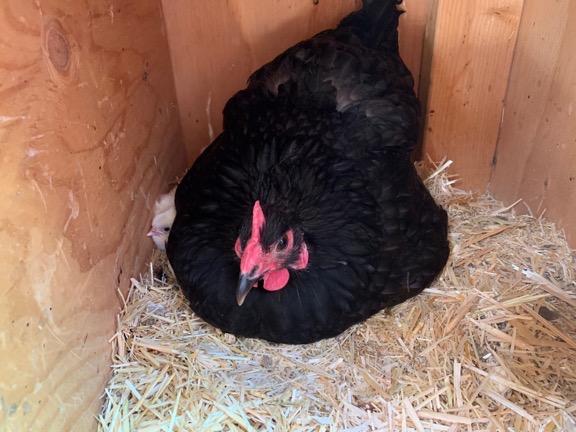
Outside in the coop, there was a fluffy yellow chick poking out from under the broody hen.

Hen with Chick
Here’s a happy mama with her first baby.

I called my friend Janet, who has experience with broody hens. I wanted to know if she thought I could stick the other chicks in with the first one. We decided on a plan of adding them one by one and keeping an eye on things. If the hen rejected the chicks, she’d kill them.

So, for the rest of the day, I worked in the garden near the chicken coop. Ever hour or so, I’d go upstairs, grab a chick, and bring it outside. I’d open the coop door, talk to the hen, pet her with my left hand, and drop the chick behind her with my right hand. I also prepped the adolescent chicken area, which was still occupied by six pullets, with a tighter screen that the tiny chicks would not get through. I even made a nest for the area and added chick food and a water bottle.

I tried getting the pullets in with the adult hens and roosters. That didn’t work out right so I herded them back into their area. I figured the mom would protect her chicks against them.

By around 3 PM, I went up for the last two chicks. More petting and dropping. The broody hen didn’t seem to mind. She’d bonded with all the chicks and they had bonded with her. They stayed together and when they got cold they snuggled up under her. It was painfully cute.

But they were in an upper nest and I wanted them in the other area. So I opened up that area and started grabbing chicks. The hen immediately started squawking, but I worked fast. In the end, I grabbed her and stuck her in there with the single egg she’d been sitting on. I closed up the area. As her chicks gathered around her and she made a spot in the makeshift nest to sit on the egg, they all calmed down.

Hen with Chicks
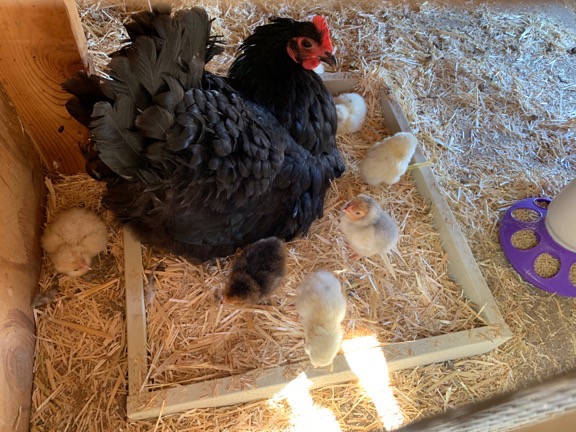
The hen and her chicks settled into the young chicken area of my coop.

Success!

I kept an eye on the situation, visiting regularly over the next few days. I was very surprised when they went outside just two days later. The young chickens didn’t bother them — but they also stayed far away. I think the broody hen read them the riot act while I wasn’t looking.

When I saw the chicks slip through the fence from the young chicken yard to the adult chicken yard, I nearly panicked. But the adult chickens didn’t bother them at all and they slipped right back to mama quickly.

More Chicks

Of course, my chicken hatching experience wasn’t over. There had been 18 eggs from at least two batches. There were 11 left.

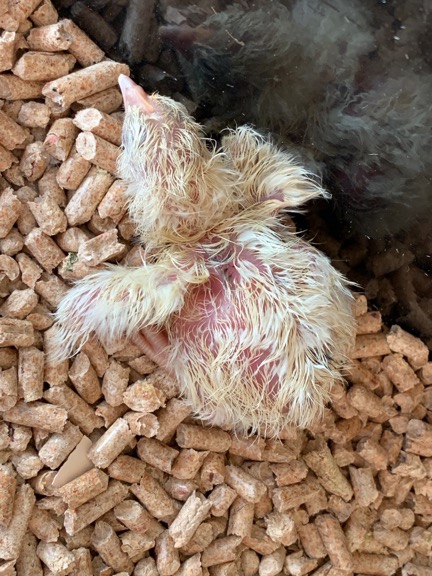
Baby Chick
This was the first of the second batch of chicks to start hatching.

I checked the incubator after a day out running errands and was horrified to discover that one of the eggs had hatched and the chick had fallen into one of the water reservoirs. It was chirping away with just its head above water. In a panic, I gently lifted it out by its head and wrapped it in my shirt, then hustled upstairs to the bin, turned the heater back on, and put it inside.

Then I carried the incubator upstairs and put it on the table so I could keep an eye on it.

Later in the day, I tried introducing the new chick to the mama hen. She took one look at it and pecked it on the head. I snatched it out. Damn.

I had a little get together with friends that evening and they all commented on how cute the chick was. I explained my dilemma, which was worse than it had originally been: it looked as if I had to raise a single chick by itself.

Fortunately, my friend Alyse agreed to take it. She’d just ordered some chicks and already had some older ones. She felt confident that she could introduce it to her flock. I was thrilled. I put the chick in a yogurt container with a pierced lid and she took it home with her. The next day, she sent a photo of her significant other with the tiny chick and an older chicken sitting on his chest and belly.

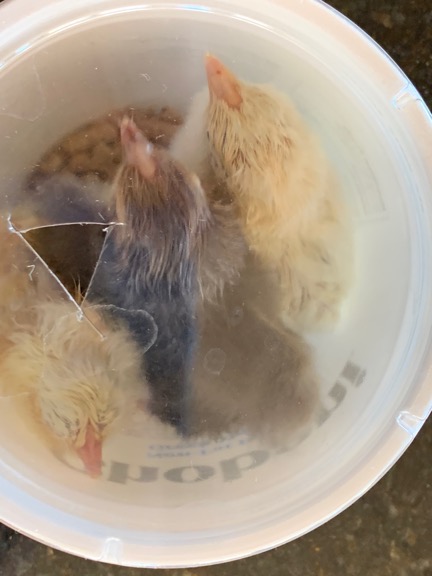
Chicks
Three chicks fit comfortably in a one-quart yogurt container.

Unfortunately, three more chicks hatched the next day. Again, she agreed to take them. We met up in town and I handed off another yogurt container full of chicks.

I wasn’t done yet. The next day, another chicken hatched. (If you’re keeping count, this is number 12.) This time, I set up my camera atop the bin and videoed the last few minutes as the chick finally pushed out of the egg.


Watch that last chick hatch.

Later in the day, I met up with Alyse and handed over yet another yogurt container.

And that was it. No more pipping or hatching for the next two days. I disposed of the six remaining eggs.

Meanwhile, in the Chicken Yard

Meanwhile, I took away the divider between the chickens so all of them have access to the whole coop and both chicken yards. The mama and her babies mostly stay in that first yard where I have chick feed in the feeder. They camp out at night in a tucked away spot in the young chicken area. When the hen inexplicably got out with her chicks and Penny went after them, she charged Penny several times, successfully driving her back before I got them all back in the yard.

Chickens
The mother chicken and her babies. Note the young chickens to the left. They are mortally afraid of the big hen.

So I’ve got seven more chickens — for a total of 18 — and just have to hope the little ones turn out to be girls. One rooster is enough.

Prepping and Planning for my Winter Migration

In waiting — and planning — mode.

Autumn is just about over. The leave are mostly gone and nighttime temperatures are dipping into the 30s. There’s been frost on the ground every morning. As the sun rises and fills the valley north of my home with light, odd little patches of evaporation fog form over the Columbia River 800 feet below the shelf where my home perches. I often stop my morning activity to watch, wishing I had one of my good GoPros around to create a time-lapse of the slow cloud formation and dissipation.

Of course, by the time that happens, I’ve already been up for a few hours. I’ve had my coffee and usually my breakfast. I’ve probably finished my daily journal entry and maybe even a blog post. I wake very early no matter what the season is, usually between 4 and 6 AM, although sometimes earlier. I’m a morning person and I have been for at least the past 20 years. It’s hard for me to believe that I had trouble attending 8 AM classes when I was in college. These days, by 8 AM, I’m usually ready for my mid-morning snack.

Sunlight and the Shadow Time

Living this far north — latitude 47.34° — the days start getting very short around the middle of October. By mid November, there’s only 9 hours and 15 minutes of daylight each day and we’re losing about 2 minutes of it every day. By the Winter Solstice, the sun is up for only about 8 and a half hours a day. That means the sun isn’t up for 15 and a half hours a day.

But worse than that is what I call the Shadow Time — the six weeks each year that the sun fails to clear the cliffs south of my home. For that brief period, sunlight does not shine at all on my house, although it does still reach out and fill the Wenatchee Valley. For the days leading up to the start of Shadow Time — December 1, I think — there’s less and less light on my house. Yesterday, there was about an hour of it starting around 1 PM. I love the way it shines into the high windows on the south side of my home, sending warm light at weird angles into my living space. But it’s weird looking out the north windows and seeing a big shadow in the foreground with the brightness of the valley behind it.

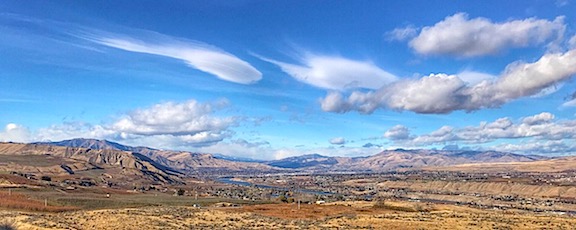
November View
I shot this photo yesterday afternoon from my deck. The clouds were great and the river was so blue. It’s a panorama for a reason — I cropped out the shadow in the foreground.

And I don’t have it bad at all. Some of my neighbors on the south side of the road have been in it for weeks already. Their Shadow Time lasts months. I can’t imagine living that long in the shadows, without the rejuvenating properties of warm, direct sunlight coming through the windows. Honestly, I don’t know why some of them built their homes where they did, especially when I see the occasional boulder coming down off the cliffs dangerously close to one neighbor’s backyard. It seems like it’s only a matter of time before one of those basalt columns lets go and ends up in their living room.

The Shadow Time is one of the reasons I go away for the winter. I’m a sunlight person — I need to be in the sun. That’s one reason why I like living on the east side of the Cascade Mountains. People think it rains a lot in Washington, but that’s not true. It rains a lot in Seattle. It doesn’t rain much here. And those short days turn into gloriously long ones in the summer time; it’s actually light out when I wake up and sometimes when I go to bed.

My goal is always to be gone during the Shadow Time and I’ve been pretty good about that for the past few years. But this time, I’m can’t get out quite as early as I hoped to.

Killing Time

So as November winds down, I find myself waiting for my departure date.

I’m spending much of my time at home goofing off and doing odd jobs around the house, with a few occasional forays down into town to catch a movie, have dinner or cocktails with friends, or run errands. My home and its menagerie — currently 13 chickens (including a rooster just learning to crow properly) and two garage cats (for rodent control) — are pretty much prepared for winter. There’s always something to do around here, but none of it is pressing and some of it has to wait until spring.

I’m also working on glass projects again — something I haven’t done for years. The goal is to create some recycled glass wind chimes for sale in Quartzsite, AZ in January. I’ve been working with my new kiln for a few days now but have had disappointing results. Apparently, I’ll be spending a few more days troubleshooting before I can start churning out new pieces.

And, of course, garage reorganization is something I’m always working on. I’ve still got boxes to unpack. I’m also prepping for a garage sale in the spring. I have a lot of stuff I don’t want/need anymore — some of it from my old home/life in Arizona. While Craig’s List has been instrumental in offloading the larger items, there’s a ton of little stuff I can sell cheap.

My helicopter business is slow this time of year — and only gets slower as winter creeps in. I do have a nice charter later this month; I’ll be working with two other helicopters to take a group of nine men on a flight to various points of interest (to them) around the state. I’m hoping our flight path takes us past my house; my next door neighbor’s kids love it when I fly by with other helicopters — they say it’s like an air show.

Then, of course, is the primary thing keeping me in the area: my December 3 flight bringing Santa to Pybus Public Market. This is a community service I do every year. (Last year was the first time I missed a flight but that’s because the helicopter was in Arizona for overhaul.) The last time I did it, about 300 kids and parents were waiting on the ground when we landed at Pybus in my bright red helicopter. There were photos in the newspaper. I usually shut down and stick around for a while so folks can come up to the helicopter and get their photo taken with it. I’ll do that this year if the weather cooperates.

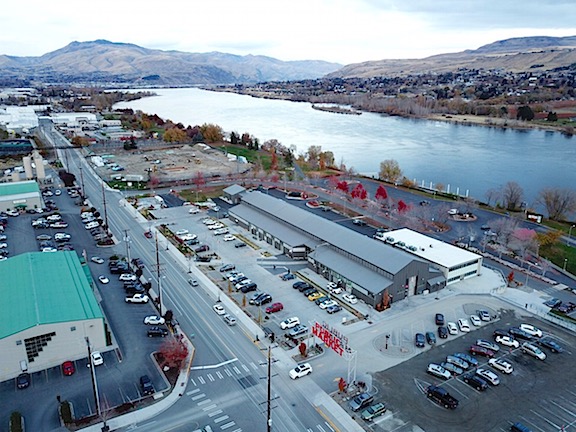
Pybus Market
An aerial view of Pybus Public Market, shot with my Mavic Pro the other day. I land the helicopter in the corner of the parking lot in the lower right part of the photo, not far from the white building. One year, we rolled the helicopter into the main (gray) building where I left it on display for a week.

Of course, that doesn’t mean those are the only days I’ll fly the helicopter. There’s a pretty good chance I’ll take it out today. I have two wine club shipments waiting for me at Cave B Estate Winery down in Quincy. That’s an hour drive but only 20 minutes by helicopter. I figured I’d take a few friends down there for lunch — I fly for food — and pick up my wine while I’m there.

And the helicopter will go to California for its sixth season of frost control work, likely in mid February.

Going South

Once I’m done with the few things I need to do in the area, I’ll hop on a flight to Phoenix with Penny the Tiny Dog. My truck, camper, and boat are already down there waiting for me. With luck, a month from today I’ll be camped out on one of the Salt River Lakes, soaking up the sun while I explore the lake in my silly little boat.

I’ll spend Christmas along the Colorado River with some friends, camped out in the desert. The site I hope we get — we got it last year — has a boat ramp and easy access to a stretch of river that runs 76 miles from the Palo Verde Dam north of Ehrenberg, AZ to the Imperial Dam north of Yuma. I brought along my new tent and some tent camping gear so I can do overnight boat camping trips along the river. My friends are seriously into fishing and I know we’ll do some of that, too. Last year, we had fish tacos a few times. We have a campfire nearly every night; it gets cold but not too cold to enjoy the outdoors.

Sunrise at the River
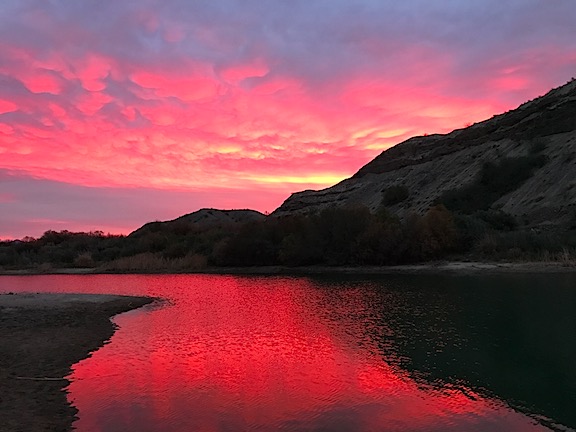
We were treated to a few amazing sunrises during our stay along the Colorado River last year.

Then in January, we move to Quartzsite where my friend sells her artwork at a 10-day show at Tyson Wells. This year, I got a booth, too. I’ll be selling drone aerial photography services for folks camped out in the desert, as well as my recycled glass wind chimes (if I can get the problems with the new kiln worked out). It’ll be weird and it might not make any money, but I’m really in it for the experience more than anything else. Besides, my booth at Tyson includes a full hookup and it’ll be nice to get a bit of “civilization” after more than a month camped out in the desert.

After that, I’ll likely start heading north along the Colorado River with my truck, camper, and boat. I’m hoping to do some camping and boating at each stretch of the river between dams, all the way up to Hoover. I’ll definitely revisit Arizona Hot Springs — this time in my own boat — and tent camp for a day or two in the mouth of the canyon there.

In mid-February, I’ll come home (via commercial flight), fetch the helicopter, and take it down to the Sacramento area for its frost contract. From that point on, I’m “on call.” This is different from cherry season, when I need to stick around with the helicopter to be called out on a moment’s notice. Instead, I get my callout at least 12 hours before they might need me. That’s enough time to hop on a flight from wherever I am to Sacramento.

I’ll be in the Vegas area for a week or so in late February to explore Lake Mead, visit some friends, and see HAI’s big helicopter show. When that’s over, I’ll continue north and west, eventually ending up in the Sacramento area. I’ll stick around there, boating on Lake Berryessa and Clear Lake, wine tasting in Napa Valley, and hiking in the foothills of the Sierra Nevada Mountains until March. If I’m lucky, I’ll get a few callouts while I’m already there; this can really be lucrative when I don’t have to hop a commericial flight, rent a car, and get a hotel room. Then, depending on weather in California and back home, I’ll make my way back north. I did a coastal route last year, but I might try a more inland route this time. It’s all about going new places and seeing new things.

It’s the typical migratory route I’ve been doing with minor variations since 2013 but I’m going to make it count this year. It might be the last season I go to Arizona for the winter; I’m hoping to begin researching retirement destinations in Mexico, Costa Rica, Belize, and possibly New Zealand in future winter seasons. We’ll see.

Of course, I will be working every day. I’m writing a book about my flying experiences and am determined to finish it before I get home. So I expect to spend at least 4 hours at the keyboard daily — likely early in the morning — to knock out a manuscript. I’ll handle publication next spring.

While I’m gone my house will be in good hands. I have a house-sitter who will live there for the entire time I’m gone. We did a trial in October when I took a 2-week vacation south to visit friends, re-explore a few national parks in Utah, and reposition my portable winter home in Arizona. While I’m gone, he’ll make sure the chickens and cats have food and water and collect eggs. Maybe he’ll even put up my Christmas decorations, which I haven’t bothered to do in years.

Waiting

So I’m in a sort of limbo right now, waiting for my departure date to roll along.

I feel as if I spend most of my life waiting. In the old days, I was waiting for my wasband to get his head out of his butt and start enjoying life. It was frustrating, to say the least. The older I get, the less time I have left. Waiting for someone else was like idly watching my life slip by without being able to do anything to enjoy it.

Now, with him out of the picture, I do a lot less waiting and a lot more doing. I spend a lot of time traveling when I’m not busy with flying work. When I’m home, I spend my time building and learning new things. My life is much more full and interesting; my time is much more flexible.

But I still have responsibilities that tie me to my home, even if I’m not kept here by work. So I’m waiting for calendar pages to flip by again so I can do the few things I need to do.

And then I’m outta here.