
Getting a lot done by myself.
 As I blogged last week, I finally purchased that 10-acre view lot in Malaga, WA that I’ve been wanting for over a year. And I wasted no time getting started on turning that piece of land into my next home.
Utilities
One of the great things about this lot is that it already has important utilities on it. It’s just a matter of getting them set up and turned on.
- Water
Water was the easiest of the utilities. I have “city water” meaning that the water is provided by Malaga Water District. No well or pump to share or maintain. A water pipe comes out of the ground and has a spigot handle on top. According to the water guy, the pipe is designed for cold weather use; the pipe drains when the water is turned off so winterization isn’t necessary. When my building is constructed, the plumber will tap into this pipe below ground and run the water line in a trench to the building. Until then, I can simply fasten a hose to the pipe.
Getting the water turned on was easy. I made one call to tell them I wanted it turned on. They sent me a contract that I received the same day — such is the benefit of living in a small town where the utility guy drops off a stamped envelope at the post office and the postmaster puts it right in your post office box. I filled out the contract, put a deposit check in the envelope, and mailed it back. Two days later, they called to tell me the water was turned on. - Electricity
Electricity is a bit more involved. Because there’s no building on the property, I need temporary service set up by an electrician. He then submits an application to the Chelan Public Utility District (PUD) and when they approve it, they turn on power. Later, when my building is constructed and wired, I’ll go through another process to get electricity turned on there.
Fortunately, there’s already a transformer on my lot so it won’t cost a thing — at least not payable to the PUD — to turn on temporary power. It will, however, cost about $500 to have a temporary power post with plugs and circuit breakers installed and left on my lot for a year. The post is a rental; I could buy one if I needed it for a longer period of time. I’ll have it set up with 2 110v outlets, a 30 amp outlet, and a 50 amp outlet. That’ll make it easy to plug in just about anything, including power tools and my RV.
So far, I’ve had one bid on the temporary power pole. I should get another bid on Sunday. Once I choose an electrician, the power should be turned on within a week. - Fiber

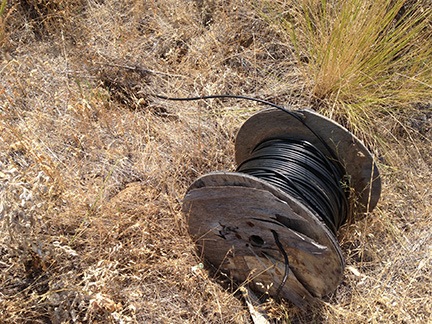
I have enough phone cable to wire the entire neighborhood.Fiber is the tough one. Although I thought the cable coming out of the ground near my electric transformer box was fiber optic cable, it’s really telephone cable. Who wants that?
Fortunately, fiber optic cable already runs down my road past my lot. And a conduit for fiber optic cable has already been put in place between the source on the road and a spot near my transformer. So all I need is for the Chelan PUD to run the cable down into the conduit and the local internet service provider, LocalTel, to set up service.
The PUD guy who checked my transformer box told me that dropping the cable is an easy job. Unfortunately, there’s backlog and it could take several months for the drop to be done. I did what I could: I got myself on the list so I’d eventually get service.
And the service is definitely worth waiting for! 100Mbps download and upload speeds. That’s 100 times the speed I had in Wickenburg and 20 times the speed I had in Phoenix.
LocalTel also offers television service, which I may get. It depends on what kind of DVR they’ll make available. I don’t watch much television and I certainly won’t watch live television. Life’s too short to sit through commercials.
Septic System
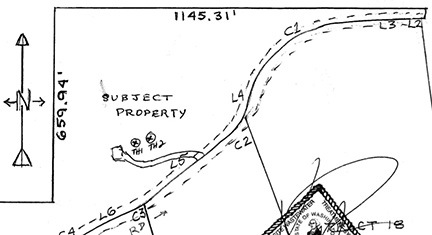
A good portion of the septic system design preparation work was already done.
The property’s previous owner had been preparing to build on the lot. That’s one of the reasons it has utilities as discussed above. They’d even gone so far as to begin work on a septic system. In fact, they’d already done a percolation test (or perk test) to test the suitability of the land for a septic system. That was good news for me. It meant that if I put my septic system in the same place the designer had tested for, I didn’t need to get another perk test. That would save me about $300 and at least a week.
Of course, I didn’t really want the septic system where the original owner wanted it. But I did want to save money on a perk test and I definitely wanted a gravity system. So I had the septic system designer over and we discussed it. In the end, I chose a location near where the original owner planned to put his septic system. No additional perk test would be needed. The designer could draw up plans and prepare the application for me in less than a week. Once I had the plans in hand, I could get bids. By the time the plans were approved by the county, I’d have the crew on site to dig. There was a distinct possibility the septic system would be installed by month-end.
The “Necessary” Building
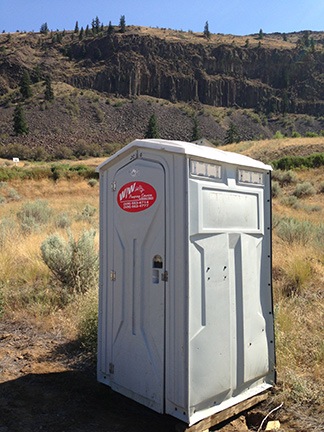
My stepdad would call this the “necessary building.”
During the week, I also arranged for a portable toilet to be delivered to the lot. That took just a single phone call; a man with a gray plastic building showed up two hours later.
The toilet building was really a necessity. First of all, some builders require one to be onsite. And even if they didn’t, I don’t want workers pissing all over my property.
(A side note here. There’s a house under construction down the road from where I’m currently living. As I drove down into town one day, I witnessed a worker urinating on the house near the front door. Seriously? How can anyone have so little respect for someone else’s property?)
I needed the toilet there, too. Even though my visits to the property are usually only a few hours long, it’s nice to be able to take a leak if I need to. And if I move my RV to the lot before the septic system is done, I’ll need the building to reduce the load on my RV’s tank until it can be dumped.
Those building, by the way, aren’t gross if they have limited use and are kept clean by someone who actually cares. That’ll be me. The hose is nearby; I don’t expect that building to get or stay very dirty very long.
And in case you’re wondering, it will be serviced — i.e., pumped out — once a week. So it shouldn’t get very gross at all.
Name and Address Sign
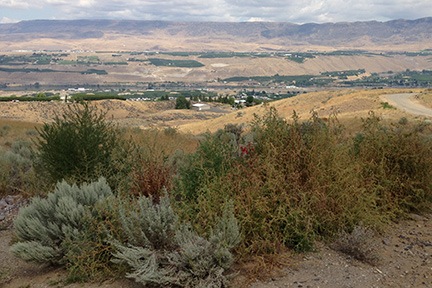
You can barely see the previous owner’s name sign behind all these weeds.
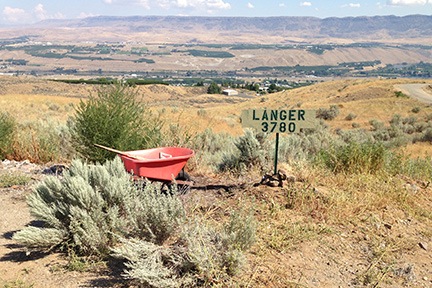
Here’s my sign after pulling most (but not all) of the weeds. The sage bushes in the foreground went, too.
This week I also took care of putting a name and address number sign on the lot near the end of my driveway. The old sign, hand painted with the name “Young,” just wasn’t going to cut it. I wanted a nicer sign so I got a piece of scrap wood from the pile where I’m living, painted it with my landlord’s exterior house paint — a nice shade of sage green — and used spray paint with a stencil to add my last name and street number. The resulting sign looked pretty decent for something I cooked up myself.
I bought a t-post and a t-post driver and some screws with nuts and washers. I drilled holes in the wood (with my new drill), pounded the post into the ground, and ran the screws through the post to hang the sign.
Seeing the sign there made me very happy. It made my ownership of the lot more real to me. (It’ll also make it a lot easier for my wasband’s “investigator” to find the correct lot if he feels a need to “investigate” or take photos of my progress over the coming weeks and months.)
My War on Weeds
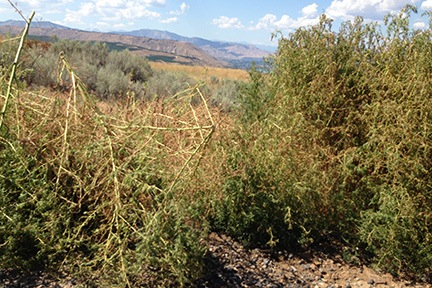
I attacked the kochi a with a weed whacker, a pruning saw, and a hedge trimmer. The wilted plants here show the effect of the weed killer.
The final bit of work I did this week was to begin my war on weeds.
An invasive weed was growing in a few places along my driveway and en masse along my road frontage. The weed, which is called Kochia (Kochia scoria), reminded me a lot of tumbleweed (Russian Thistle), which had pretty much taken over our Howard Mesa property’s prime building area when we failed to get it under control. With shallow roots, the bushy plant grew as tall as me in some places. Each plant would yield thousands of seeds which, fortunately, would only remain viable for a year. If the plant could be removed before it went to seed for a year or two, it would be gone.
 I was able to pull the smaller plants out by the root. The slightly larger ones could be cut back with my weed whacker. But the larger ones were a real pain. The best way to get rid of them was with a pruning saw. It was hot, back-breaking work. I spent about 2 hours a day for three days in a row working at it. On the fourth day, I attacked them with a hedge trimmer I’d rented from Home Depot.
And I was winning.
I managed to clear them completely out of my driveway and make a dent in the ones along the roadside. I should mention here that the road association — my property is on a private road — sprayed the weeds along the road. By that fourth day, I could see that the spraying was taking effect. The weeds were beginning to die. Maybe, if I was lucky, they’d be killed by the weed poison and I wouldn’t have to deal with them.
Then, that afternoon, I sprained my foot. Doing more weed control was out of the question, at least for a few weeks. And I have to admit that that’s the only good thing about having a sprained foot — it gives me an excuse not to deal with those damn weeds.
But I know I’ll face them again in the future. And I’ll win.
Up Next
More of the same…and then some. Stay tuned.
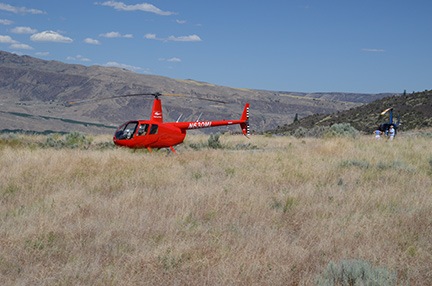

 At 9:45 AM, I was on the ramp at the airport, waiting with my helicopter for my passengers. It was the first day of my new life as a free woman.
 I bought a book — as I usually do when I want to learn something. I chose
  I also rented
  If that wasn’t enough, I bought and sat through (in two sessions again)
  Because I liked the Storey Guide series book about raising chickens, I figured I’d try
  By this point, I’d pretty much decided that I wanted to move forward and give beekeeping a try. So I bought one more book, this one to use for general reference:
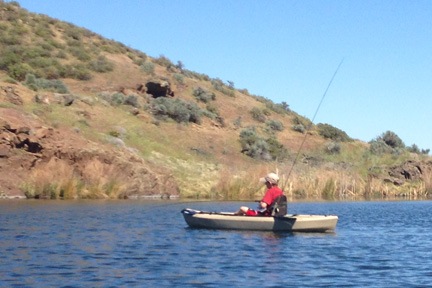
 Penny the Kayaking Dog.