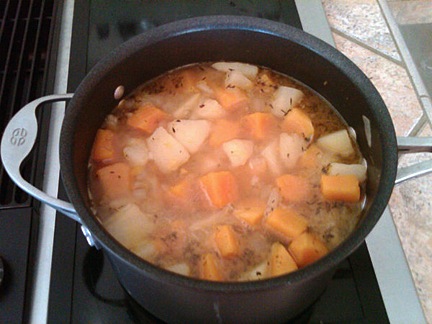
Easy, To Die For Butternut Squash Soup

I can’t get enough of this stuff.

One of my favorite things to eat is butternut squash soup. Trouble is, when I have a flavor in your mind and I find myself eating something that just isn’t quite as good, I get seriously disappointed. You know what they say: If you want something done right, yadda yadda yadda.

Here’s the recipe I like. It’s remarkably easy to make, but in case you have a serious case of lazy bones, I’ve included a few shortcuts to make it even easier.

Ingredients

  • 1 medium onion, chopped. I use sweet onions. Lazy? You can buy them pre-chopped in most supermarket produce departments or the freezer section.
  • 2 tablespoons margarine or butter.
  • 2 cups chicken broth. I use canned. Although one can is 15 ounces (I think), that’s close enough.
  • 1 pound butternut squash, pared, seeded and cut into 1-inch cubes. This is probably the most labor-intensive part of the process. Those squash are a real pain to pare. And where have you ever found one less than 2 pounds in size? I usually do it the hard way, but today I stopped off at Trader Joe’s and picked up a 2-pound bag of butternut squash already prepared. (So, of course, I made a double-batch of soup.) You might be able to use frozen squash if it is unseasoned; I’ll leave that up to the seriously lazy cooks to experiment with.
  • 2 pears, pared and sliced. I use fresh pears whenever possible, but I suspect that you could get away with canned pears, as long as you rinse off the sugary syrup they insist on canning them with.
  • 1 teaspoon fresh thyme leaves. Yeah, like I’ll find fresh thyme in Wickenburg. I use dried but only half as much.
  • 1/4 teaspoon of salt. I usually omit this, especially if the broth does not have reduced salt. You can always add salt later; you can never take it away.
  • 1/4 teaspoon white pepper. I use regular pepper, which I grind as I need it.
  • 1/4 teaspoon ground coriander.
  • 1 cup whipping cream. This is killer stuff and makes the soup very rich. I suspect you could use half and half to make it a little less deadly.

Cooking Instructions

  1. Cook and stir onion in margarine in a medium pot until tender.
  2. Butternut Squash SoupStir in broth, squash, pears, thyme, salt, pepper, and coriander.
  3. Heat to boiling; reduce heat heat and cover.
  4. Simmer until squash is tender, 10 to 15 minutes.
  5. Puree soup in a food processor or blender. You may have to do this in batches. You might also want to wait until the soup has cooled a bit; I cracked my food processor bowl by processing hot soup. I now use my glass blender.
  6. Return pureed soup to pot.
  7. Stir in whipping cream and heat until hot.
  8. Garnish with pear slices and toasted pecans if desired.

Yields 6 1-cup servings.

This is a great soup for Thanksgiving. The squash and pears are in season right now so it’s the perfect time of year to make this. Treat yourself. You won’t be disappointed.

The Best Smoothie I Ever Made

Here’s the recipe.

I hate dieting, but I love an excuse to make smoothies. If done properly, they’re very healthful and low in calories. They’re also very filling, making a good meal substitute.

I have a basic smoothie recipe I’ve been following, using whatever appropriate fruit is handy. But today’s was the best.

Ingredients
1/2 cup plain, fat-free yogurt
1/2 cup orange juice (I use Tropicana Premium because it’s not from concentrate)
1/2 cup fresh strawberries, halved
1/2 cup frozen mango (I buy frozen because I’m too lazy to peel and cut them)
1 whole banana, broken into pieces

Instructions
Combine all ingredients in a blender and blend until smooth.

Any combination of berries or stone fruit usually works, but today’s was the best I’ve tasted. There’s no added sugar, but it’s plenty sweet. The frozen mango chills down the mixture, making it almost frosty. I’ve used frozen berries in the past, but I really think it’s the fresh strawberries that made the smoothie so good today.

Total calorie count comes in just under 300; you can read the rest of the nutritional information here. If you give it a try — or make your own version — let me know what you think.

And if you like smoothies, don’t fall for those mixes you’ll find in the supermarket. They usually full of added sugar and other crap. You’ll get a healthier treat if you make it yourself using simple ingredients.

Cherry Chutney

A twist on my Mango Chutney recipe.

I love chutney as a condiment with grilled pork and roast turkey (instead of cranberries). There’s always a batch of mango chutney in my fridge at home. Unfortunately, when I left with my RV for the summer, I forgot to bring some along. But since I’m currently surrounded by cherry trees with ripe fruit, I figured I’d try making cherry chutney for a change.

Cherry ChutneyI found a recipe for cherry chutney online and made a batch of it. It had some major differences from my mango chutney recipe — for example the inclusion of onion, spices, and mustard seed — and I had mixed feelings about the result.

Yesterday, I decided to try again by simply substituting cherries for mango in my mango chutney recipe. The result was quite tasty. Here’s the recipe as I made it.

Ingredients:

  • 1-1/2 pounds cherries, pitted and cut in half or quarters. I’d picked the cherries the night before, choosing small fruit from the tree since I knew my client wouldn’t pick and sell it. (Shame to see it go to waste.) The small fruit fit well in my cherry pitter and most cherries didn’t need to be quartered; halved was enough. If cherries aren’t in season, you could probably use frozen. Do not use cherry pie filling.
  • 1 cup golden raisins. You can use the regular kind if you can’t find golden.
  • 1 cup packed brown sugar. This is an excellent recipe for using up brown sugar that has solidified in an improperly closed bag. But fresh brown sugar won’t hurt it.
  • 1/2 to 3/4 cup vinegar. I usually use white vinegar, but the only vinegar I had available was apple cider vinegar (from the other recipe). Didn’t hurt this recipe at all.
  • 1 jar (2-7/8 ounces) crystallized ginger, finely chopped. I don’t know what kind of jarred ginger my source recipe is talking about. This time, I found crystalized ginger in a 6-oz bag and used half of it.
  • 1 clove garlic, chopped. I cheated this time and used about a teaspoon of jarred chopped garlic.
  • 1 teaspoon salt. This time around, I skipped the salt.

Instructions:

Place all ingredients in a sauce pan and heat to boiling. Reduce heat and simmer uncovered for about an hour or until slightly thickened. Remove from heat, cool. Place in a sealed container — a canning jar works well for this; I avoid plastic for anything I want to keep long term — and store in refrigerator. It will stay fresh and edible for quite some time. Serve with pork or roast turkey (as discussed above) or Indian curry dishes.

Yield: Approximately 4-5 cups.

Warning: It does not smell good while cooking.

Easy Cherry Cobbler for One

When you have a limitless supply of cherries, you get creative.

Fresh-picked CherriesA few days ago, I asked my client if I could go into his orchard and pick some cherries. I’d finished off the 15+ pounds of Rainiers I’d picked in Quincy two weeks before and was fresh out of fruit. Across the street from my RV were 86 acres of ripening cherries. My client gave me the green light and I’ve had fresh-picked cherries in my fridge ever since.

If you have some kind of comment about the affect of cherries on my digestive system, save them. I seem to be immune to the usual effects. Indeed, I easily put away a pound of cherries a day with no significant side effects.

But I am bored with simply popping fresh cherries from a plastic container. Back in June, I began experimenting with cobbler. The results were so-so. I wanted an easier recipe so I turned to Bisquick.

Bisquick, in case you’re not familiar with it, is a Betty Crocker/General Mills product known primarily as a pancake batter mix. But what a lot of folks don’t realize is that it’s a good quickbread batter mix that you can also use to make biscuits and “shortcake.” (Shortcake is in quotes because it doesn’t make real shortcake.)

The trick is to mix Bisquick with milk and a small amount of sugar to make a batter. Then bake it for a little sweet breadlike cake. Add fruit to the batter and you have an easy cobbler.

Here’s my current recipe. It makes just one (because I’m by myself here) but I don’t see why you couldn’t multiply the recipe to make more. You might try making individual ones in large muffin tins.

Ingredients:

  • 1/4 cup Bisquick
  • 2 tablespoons milk
  • 1 teaspoon sugar
  • 7 cherries, pitted and split in half

Instructions:

  1. Preheat oven to 350°F.
  2. Grease an ovensafe custard cup or other suitable baking vessel.
  3. In a small bowl, mix the first three ingredients until blended.
  4. Fold in the cherries.
  5. Place batter in custard cup.
  6. Bake 20 minutes or until batter is done.

This would probably be excellent with fresh whipped cream or vanilla ice cream. I have neither so I do without. It isn’t bad.

If you give this a try — with or without your own modifications — please do use the comments for this post to let us know what you think.

My Morning Cup of Joe

It has to be just right.

I start each morning with a cup of coffee. That’s not unusual in the United States. Coffee is a pretty standard breakfast beverage. It’s why we drink coffee and the kind of coffee we drink that varies from person to person.

And my morning cup is special.

First of all, I don’t drink coffee because I rely on that jolt of caffeine to jump start my day. If all I wanted was caffeine, I’d get it from a double espresso at the local Starbucks or allow myself to become addicted to one of those idiotic “energy drinks” that young guys like to get hopped up on.

Instead, I drink coffee because I actually like coffee. I like the flavor. I like the aroma. I like the way it feels going down my throat when it’s just the right temperature: good and hot.

The trouble is, I don’t like just any old coffee. I like a certain kind of coffee the way I like it made.

And that’s the rub.

The Ingredients

Coffee ingredients are very basic, right? Well, to many folks, they are. But to someone as picky as me about coffee, they’re special.

  • Coffee. This is the main ingredient in a cup of coffee and, for me, it needs to meet several requirements:
    • Freshness. I buy coffee beans so I can grind them myself at home. The beans never come out of a hopper in a supermarket, where they may have been sitting for who knows how long. They always come in a vacuum-sealed package.
    • Bean type. This is where I differ from many self-proclaimed coffee connoisseurs. I don’t like Columbian coffee. To be fair, it may be the way it’s normally roasted: dark. I prefer Arabica beans with a light to medium roast. I also like Kona from Hawaii. These are smooth, mellow beans, roasted in a way where the roasting process doesn’t impart a bitter or burnt taste.
    • Roast. As mentioned, light to medium roast is my preference. Dark roast coffee tastes bitter or burnt to me. This is my big gripe against Starbucks and other “high end” coffee shops.
    • Eight O'Clock CoffeeBrand. The brand of coffee isn’t nearly as important to me as the other criteria. These days, my coffee of choice is Eight O’Clock coffee. I tend to buy it in bulk — 4 to 6 12-oz bags at a time — when it’s on sale at the local Supermarket. I store the unopened (very important) bags in the freezer. (They say that freezing coffee doesn’t do anything to maintain its freshness, but I do it anyway, just in case.) I’ll also buy any brand of light to medium roast pure Kona (not a “blend” — whatever the hell that means) and, in a pinch, Starbucks Breakfast Blend. I should mention here that a recent “coffee snob” house guest turned her nose up at my coffee choice and would make a special trip to Starbucks every morning for her cup. I guess if you’re not spending at least $1/ounce for coffee, you just can’t make some people happy.
    • Caffeine content. I drink caffeinated coffee. While I’m not in it just to get the caffeine, I don’t see any reason to drink coffee that has been tampered with in a lab to remove a naturally occurring ingredient. The resulting buzz I get if I drink two cups of coffee is what keeps me from drinking a third.
  • Water. I’m fortunate enough to live in a home with excellent and tasty well water. When I’m at our Phoenix place, however, I will use the tap water, which tastes like chlorine to me. The way I brew my coffee, the taste of the water is usually not a factor.
  • Milk. Yes, I put a small amount — about 1-1/2 tablespoons, if you were to measure — of milk in my coffee. Not cream, not half and half, and certainly not some powered crap with ingredients I can’t pronounce. I prefer 2% milk but can use 1% or whole milk. Skim milk is pushing things a bit.
  • Sugar. I also put about 1/2 teaspoon of sugar in my coffee. I like plain granulated sugar or evaporated cane juice sugar (often touted as “organic”). I don’t like Sugar in the Raw, a popular product that has a distinct molasses flavor. Ick. I also won’t use artificial sweeteners. There are 16 calories in a teaspoon of sugar and I’m using only half of that. Surely I can put another 8 calories into my body each day?

The Daily Grind

Before I got a decent grinder, I’d buy one or two bags of coffee at a time and grind them using the supermarket’s grinder. It was important to shake out any trace of the hopper coffee that the previous user might have left in the machine. I once ruined a package of coffee by letting it mingle with what some flavored crap.

Krups Burr GrinderBut now I have a nice Krups Burr grinder which I like. It got mixed reviews on Amazon.com and I do agree with some of the points brought up by negative reviewers — for example, it can be a bit messy — but, in general it’s perfectly suited to my needs.

Almost perfectly. The least coffee it’ll grind is for two cups — even though the setting says it’s for one cup. But that’s okay. I usually do drink two cups of coffee a day. If I don’t drink the second cup, I don’t mind using coffee ground the day before. I’m not that picky.

I grind my coffee more finely than what’s recommended for drip coffee makers. Not quite an espresso grind, but certainly more fine than a basket or cone drip. That could be why the darn grinder gets messy.

The Coffee Preparation Device

A year or three ago, the big chatter on Twitter was about an $11,000 coffee maker. It brewed one cup at a time. At least they got that part right.

Brew and GoMy coffee maker of choice is a Black & Decker Brew ‘N Go. Designed for people who want to grab their cup of coffee as they head out the door on their morning commute, it comes with an insulated thermal plastic travel mug. I don’t use the mug unless I’m heading out to the car, too. I use a large ceramic coffee mug. It probably holds about 14 ounces.

I don’t use the reusable “gold” filter that came with the coffee pot. Because I prefer my coffee ground finely, the coffee grinds make their way though those gold filters and get in my cup. So I use #2 cone filters in the filter basket of the machine. I’m not picky about brand or paper bleaching. (Sheesh.) Because I go through so many of these things, I like to buy them cheap. I’ve actually found them very cheap in the coffee maker area of WalMart. So on the rare occasion that I’m in there, I stock up. And yes, when I’m at home, I compost the filters and coffee after brewing.

The Brewing Process

To brew a cup of coffee, I go through this routine.

  1. Fill a coffee cup with cold water and pour it into the coffee maker’s well.
  2. Refill the coffee cup with hot water to prewarm the cup. If I can’t get hot water from the tap right away, 2 minutes in the microwave warms whatever water I can get.
  3. Put a clean coffee filter in the filter holder.
  4. If necessary, grind enough coffee for a cup.
  5. Using a measuring spoon, measure out enough coffee for that size cup.
  6. Tamp the coffee down into the filter paper and close the lid.
  7. Dump the hot water out of the cup and put it on the coffee machine’s cup shelf.
  8. Push the button.

What comes out about 2 minutes later is a steaming hot, fresh cup of very strong coffee. This is what I like.

The Coffee I Don’t Like

I don’t like bad coffee and won’t drink it. What’s bad coffee? This:

  • Weak coffee. If I can see my spoon while I’m stirring, it’s too weak for me.
  • Coffee brewed from inferior ingredients. Yeah, I know the 3-pound plastic tub of Savarin was on sale at Costco last month. But don’t think I’m going to drink it.
  • Coffee that has sat in a pot on a warmer for more than 10 minutes. Yes, just 10 minutes. I have experimented with this at home using our bigger coffee maker. I’ll use that to make enough coffee for a group of people and the first cup is usually fine for me. But the second cup from the same pot ten minutes later? Keep it.
  • Columbian or dark roasted (or both) coffee. If it’s brewed right and fresh, I can drink it. But it’s normally not brewed strong enough or not fresh enough for me.
  • Most restaurant coffee. It usually falls into one or more of the above categories. Occasionally, you’ll get a good cup of coffee at a good restaurant, but I won’t even consider ordering coffee at a diner or cheap restaurant.
  • Flavored coffee. Are you serious?
  • Instant coffee. I stopped drinking instant coffee about 20 years ago and have seen no real reason to go back. And no, the new Starbucks instant coffee does not impress me. At all.

I prefer to drink no coffee than any of the above. In fact, I have. If I’m traveling and need a hot beverage and can’t track down a place to get a latte — freshly brewed, with enough milk to cut the bitterness of the dark roast — I’ll order tea. Or iced tea. Or juice.

Picky, yes. Snobbish? I don’t think so. If I were snobbish about my coffee, I’d buy expensive coffee, brew it in some fancy gadget, and turn my nose up at everything else. Instead, I buy relatively cheap coffee and brew it in a cheap machine the way I like it: hot, strong, and fresh.

What’s in your cup?